A bearded Oscar Isaac as Colin Clive….we know that much. And the unseen Jacob Elordi as Victor Frankenstein’s monster.

A bearded Oscar Isaac as Colin Clive….we know that much. And the unseen Jacob Elordi as Victor Frankenstein’s monster.
…are, in this order, Peter Weir‘s Witness, John Huston‘s Prizzi’s Honor, Albert Brooks’ Lost in America, Woody Allen‘s The Purple Rose of Cairo and Robert Zemeckis‘s Back to the Future.
These five share 1985’s top honors…then, now and forever. Over the last 40 years they’ve not only held on but deepened or added.
I could possibly make room for a sixth — John Boorman‘s The Emerald Forest. (I’m actually thinking right now about re-watching it.) And a seventh, I suppose — Lawrence Kasdan‘s Silverado. And an eighth — Hector Babenco‘s Kiss of the Spider Woman. And a ninth, come to think — Stuart Gordon‘s Re-Animator. And actually a tenth — William Friedkin‘s To Live and Die in L.A..
So that’s five great ones and five very goods. Plus seven honorable mentions for a total of 17….not a bad tally.
Sydney Pollack‘s Out of Africa, which won ’85’s Best Picture Oscar, is handsomely shot, nicely paced and very well acted (by Meryl Streep in particular), but I haven’t rewatched it once this century. That means something.
I never much cared for Clint Eastwood‘s Pale Rider…haven’t rewatched it, will probably ignore it for the rest of my time on this planet.
I hate Steven Spielberg‘s The Color Purple, Terry Gilliam‘s Brazil, Richard Attenborough‘s A Chorus Line, James Bridges‘ Perfect, Wolfgang Petersen‘s Enemy Mine, Richard Marquand‘s Jagged Edge, Richard Donner‘s Ladyhawke, Carolco’s Rambo: First Blood, Part II, Michael Ritchie‘s Fletch, Joel Schumacher‘s St. Elmo’s Fire….if you want to be cynical about it, you could say ’85 delivered way too many shallow or otherwise disposable films.
Honorable Mention: Fred Schepisi‘s Plenty, Martin Scorsese‘s After Hours, Andrei Konchalovsky‘s Runaway Train, Roger Donaldson‘s Marie, Alan Rudolph‘s Trouble in Mind; Akira Kurosawa‘s Ran, Peter Masterson and Horton Foote‘s The Trip to Bountiful. (7)
The problem with Clint Eastwood‘s Juror No. 2, which I re-watched today after catching it last November, is that Nicholas Hoult‘s story can’t resolve itself in a way that feels fair or just.
It plays with you and keeps you guessing while boxing you in, but it’s deliberately meant to end “badly”, which is to say in a way that leaves you thinking “this isn’t right….I don’t like this…why did Hoult’s character, a decent guy, have to suffer so for an accident?”
If you ask me the Rotten Tomatoes critics overpraised it. They respected the story tension (as I did), but sidestepped the fact that the film is written in such a way that it can’t possibly resolve itself in a generally satisfying fashion.
Posted on 11.5.24: Clint Eastwood‘s Juror No. 2 is a smart, somber, adult-angled jury deliberation drama that holds you start to finish. Alas, it leaves you with an unsatisfied feeling at the very end.
It’s about a reasonable, sensible 30something dude (Nicholas Hoult‘s Justin Kemp, a married, ex-alcoholic magazine writer) trying to wriggle his way out of a tough moral-pressure-cooker situation.
There’s no good way out of what Kemp is facing, and yet we, the audience, would like to see this obviously decent protagonist find a solution regardless.
Serving as a juror on a murder trial, Kemp is devastated early on by a two-fold realization — i.e., the guy accused of killing his girlfriend (Gabriel Basso‘s James Michael Sythe) is not guilty, and that Kemp, of all the forehead-slapping coincidences, is accidentally guilty of having hit this woman with his car on a dark rainy night.
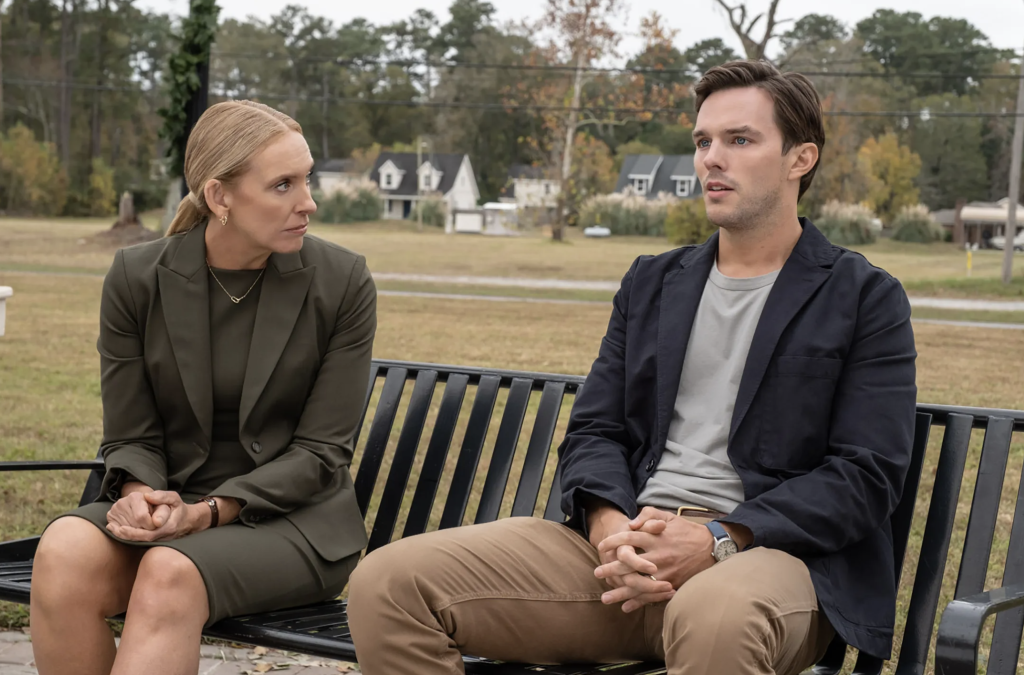
Kemp initially thinks he might have hit a deer, but he’s also not sure. He’s actually suppressing a terrible inkling. His car was damaged by the impact but he had the dent fixed and then he lied to his pregnant wife about where the collision happened.
So the film is basically held together by Kemp’s moral discomfort as well as our own.
How to solve this horrific situation? Kemp tries the Henry Fonda-in-12 Angry Men solution by trying to talk his fellow jurors out of finding a guilty verdict due to reasonable doubt. A hung jury won’t suffice as the case will just be retried.
Juror No. 2 lacks the tension and intrigue of 12 Angry Men, but it never bores and it certainly ends boldly. That’s all I’m going to say.
Our natural inclination is to want to see justice done, which in this case means Kemp has to come clean and face the music. But an attorney friend (Kiefer Sutherland) tells Kemp that because of his prior alcoholism no one will believe he was sober at the time of the accident, and that he’ll wind up doing serious time. Excerpt hie wife (Zoey Deutch) is about to give birth so there’s nothing but pain either way.
Without getting into specifics there’s a major plot hole that involves auto-body repair receipts. That’s all I’m going to say but this issue becomes more and more bothersome.
I haven’t seen Laura Piani‘s Jane Austen Wrecked My Life, but leaving aside this Sony Pictures Classics release, we’re obviously looking at a dreary weekend.
The only respectable diversion, for some, is Wes Anderson‘s The Phoenician Scheme, which I saw a couple of weekends ago in Cannes. And yet it only has a 77% RT rating, which by high-school grading standards is equivalent to a C-minus. Has anyone seen it?
I felt immediately mystified hy the casting of Mia Threapleton, the 25 year-old daughter of the once-married Kate Winslet and painter-filmmaker Jim Threapleton, in the lead female role. She delivers the same kind of standard deadpan performance that Wes always gets from his actors. The odd thing is Threapleton’s appearance. She’s not only short and chubbyish, but her face is wider than it is tall, and I’m sorry but she simply doesn’t stir the pot. I just couldn’t understand why she was cast.
Otherwise The Phoenician Scheme is another Wes comfort zone movie. Too much so.
Posted on 5.19.25: It’s not important or even noteworthy, trust me, to explain the plotline of Wes Anderson‘s exactingly composed The Pheonician Scheme. Because it’s just (stop me if you’ve heard this before) another serving of immaculate style mixed with ironic, bone-dry humor — another signature tableau exercise in WesWorld stuff — wit, whimsy, staccato dialogue, a darkly humorous attitude, faintly detectable emotional peek-outs. Plus the usual symmetrical framings, immaculate and super-specific production design and the Anderson troupe reciting their lines just so.
I’ve written repeatedly over the last couple of decades that Wes needs to recover or re-charge that old Bottle Rocket / Rushmore spirit and somehow climb out of that fastidiously maintained Andersonville aesthetic and, you know, open himself up to more of the good old rough and tumble. Maybe there’s no remedy. Maybe we’re all just stuck in our grooves and that’s that. What’s that Jean Anouilh line from Becket? “I’m afraid we can only do, absurdly, what it has been given to us to do. Right to the end.”