“Ballerina” Is Not Jizz Whizz — The Second Half Is Actually Pretty Good Porno-Violent Performance Art, Sick and Soul-less As It Is

9:15 pm update: I was surprised to discover this evening that a good portion of Len Wiseman’s Ballerina is actually kickasserino…enjoyably engaging, I mean, during the snowy second half. (The first half is mostly a generic origin story.)

I take it back about Wiseman being an “animalas Ballerina is much better directed than expected, effectively shot and often witty (the action choreography rivals the wit of Buster Keaton here and there) and at times is actually funny — two or three times I yaw-hawed out loud and once I slapped my thigh with enthusiasm.

Ana de Armas is playing Eve Macarro, a major badass, of course, but not a superwomanshe’s believably vulnerable throughout and gets slugged and slammed around quite a bit.

John Wick: “You killed my dog!” Eve Maccaro: “You killed my daddy!”

There’s an especially funny bit when Eve shoves a hand grenade into a bad guy’s mouth and then traps him behind a door and then BLAM-SPLATTER-GLOPPITY!!! Blood and brain matter all over the place….hair on the walls!!

And the duelling flamethrower finale is magnificent! Roast those ayeholes! They’re all disposable meat hunks….nothing but flamebroiled chickensgaaaahhh!!

As with all previous John Wick films, Ballerina‘s theme and tone are completely divorced from any sort of humanitarian mindfulnesswhat am I even talking about? This is a movie that saysembrace your inner sociopath.”

And while Anjelica Huston‘s Prizzi’s Honor voice is recognizable (“So, Charlieya wanna do it?”), she’s been surgically transformed in such a way that I couldn’t quite get a handle on the situation. As theDirector“, AH is in league with Gabriel Byrne ‘s “Chancellor“. My initial reaction waswell, Gabe has obviously aged but at least he semiresembles the Usual Suspects or In Treatment guy.”

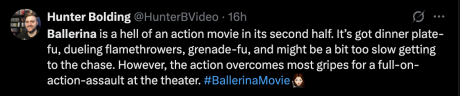
I can’t believe I’m saying this but I had a fairly rousing time during Ballerina‘s second hour. It’s like a sadistic video game with a wicked sense of humor, made by a team of truly sick fucks with a darkeyed, no-longer-a-spring-chicken human being (de Armas is 37) at the center of the action.

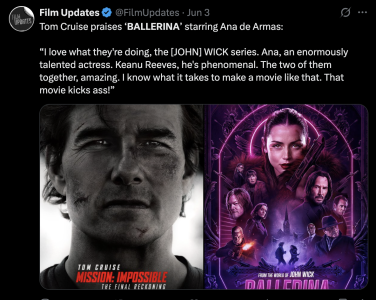
Earlier today: Tom Cruise is not doing Len Wiseman‘s Ballerina (Lionsgate, 6.6) any favors by (heh-heh) praising it.

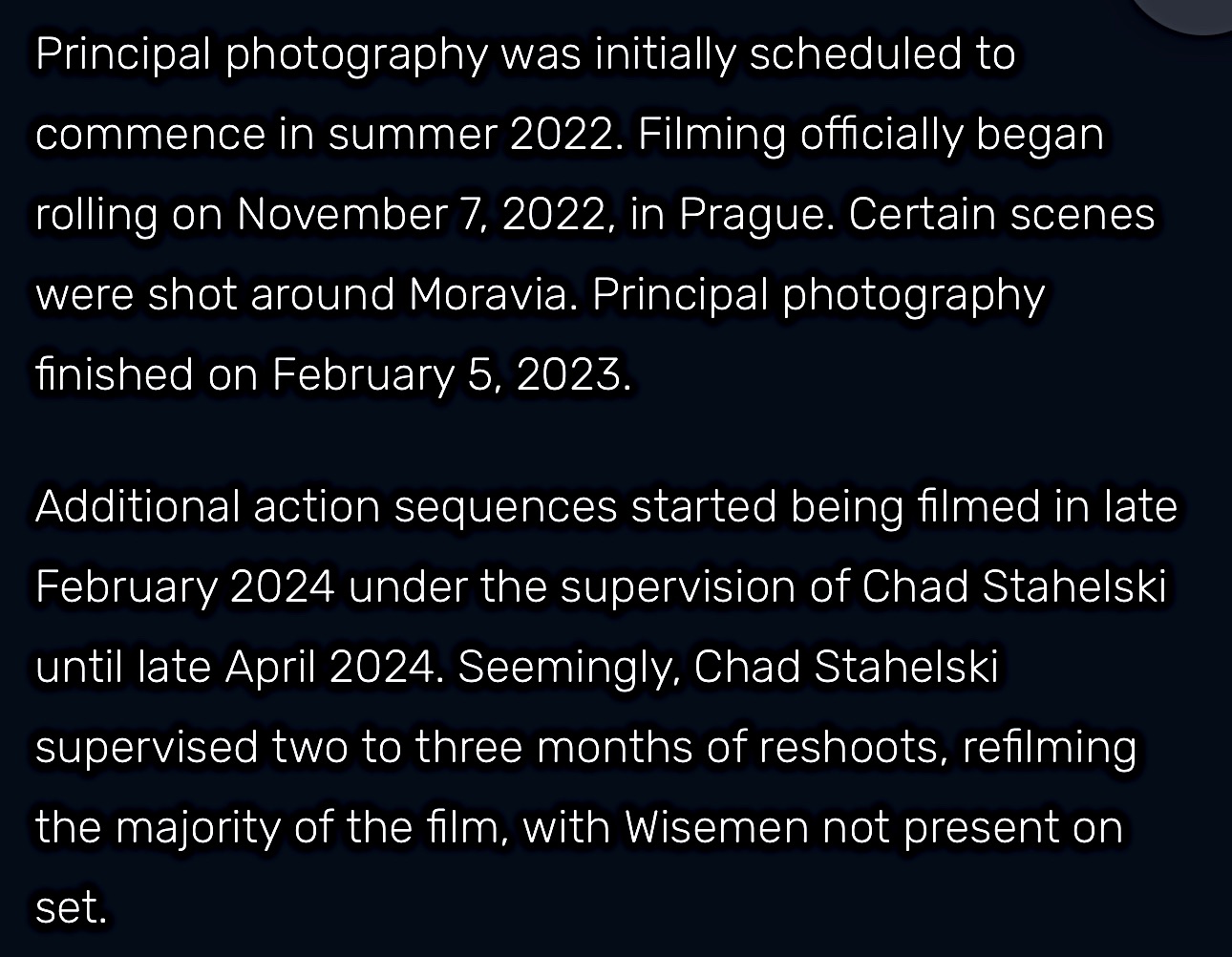
We know Cruise has chosen his own films very carefully over the last 45 years, and that a John Wick-ian action film by an obvious animal like Weisman…we know that Cruise would never star in a film of this calibre for fear of damaging his brand. [6.3 update: Wiseman is not an animal.]

We also know that his praise is generally insincere or at least partial because he’s been (heh-heh) “doing” Ana de Armas over the last few months so c’mon…why say anything about this obviously coarse, low-rent film?

Before yesterday’s Ballerina premiere de Armas called Cruise’s recent public support for the film “unbelievable“….that’s right, it IS unbelievable!

“But you know what, he supports every movie,” de Armas went on. “He really wants the industry and cinema to do well and [get] people going to the theaters. We’re working together, so he got to see Ballerina and he actually really liked it…he loved the John Wicks.”

Bullshit! Wick-y flicks like Ballerina (which I’m actually going to see in a couple of hours) are slick garbage…cancer pills…soul destroyers. C’mon, we know this going in.
From John Wick fandom:

From Owen Gleiberman’s Variety review:

1993 Was Actually A Better-Than-Decent Year

…although it wasn’t a major, historical year for movies…certainly not like 1939, 1962, 1971, 1999 and 2007 were.

In my humble opinion, the most loathsome film of 1993 was, is and always will be Chris Columbus‘s Mrs. Doubtfire. Piss on this stupid film forever…soak it in horse urine.

And the finest five films of 1993 were and still are, in this order of enjoyment or admiration, (1) Harold Ramis and Bill Murray‘s Groundhog Day, (2) Jonathan Demme‘s Philadelphia, (3) John McNaughton and Richard Price‘s Mad Dog and Glory (a pair of Bill Murray films among the top three!), (4) Fred Schepisi and John Guare‘s Six Degrees of Separation, and (5) Steven Spielberg‘s Schindler’s List.

#6 through #10: Sydney Pollack‘s The Firm (I’ve watched it at least 10 or 12 times, largely because I love Gene Hackman‘s fundamentally humane performance as Avery Tolar, mitigated by his chuckling, shoulder-shrugging cynicism), Spielberg’s Jurassic Park (two or three viewings), Tony Scott‘s True Romance (minus the ridiculous ending but containing the first great Brad Pitt performance), Martin Scorsese‘s The Age of Innocence (very moving finale), Wolfgang Petersen‘s In The Line of Fire, and Joel Schumacher‘s Falling Down.

Honorable Mentions (in order of preference): Tim Burton‘s The Nightmare Before Xmas, Neil Jordan‘s The Crying Game, Robert DeNiro and Chaz Palminteri‘s A Bronx Tale, Jim Sheridan‘s In The Name of the Father, Robert Altman‘s Short Cuts (Julianne Moore‘s red public hair), Adrian Lyne‘s Indecent Proposal, Brian DePalma‘s Carlito’s Way, Rob Reiner‘s Sleepless in Seattle, Alan J. Pakula‘s The Pelican Brief, Jon Amiel‘s Sommersby, George Sluizer‘s remake of The Vanishing (which wimpishly changed the ending of Sluizer’s 19888 original), Clint Eastwood‘s A Perfect World, Bruce Joel Rubin‘s My Life (Michael Keaton with cancer), Ivan Reitman‘s Dave, James Ivory‘s The Remains of the Day (15).

Not So Hot: Renny Harlin‘s Cliffhanger, John McTiernan‘s Last Action Hero.

The Sounds of Silence

When I consider the finest feature films made without a musical score, I always think first of Call Northside 777 (’48), Henry Hathaway‘s Chicago-based, docu-styled procedural about a tough reporter (James Stewart) gradually managing to prove that an alleged cop killer (Richard Conte) is innocent.

But of course, Call Northside 777 has a musical score, composed and conducted by Alfred Newman. But only at the very beginning (opening credits…crashing, bombastic) and at the tail end (final 10 seconds, if that). Otherwise this 111-minute film (the first 9 minutes are annoying to sit through) is completely without musical enhancement, and all the better for it. Get rid of Newman’s intrusion and those first nine minutes and it’s perfect.

Among the better known music-free features: Sidney Lumet‘s Dog Day Afternoon, Alfred Hitchcock‘s The Birds (not even opening- or closing-credit music), Joel and Ethan Coen‘s No Country For Old Men, Ingmar Bergman‘s The Silence, Hitchcock’s Rope. Lumet’s Network has no “score” but aside from the characters and dialogue the first element you always think of is that brassy Howard Beale Show fanfare.

Others?

When A Pet Passes On

No, I’m not suggesting that when your dog or cat succumbs to the inevitable (and I’ve been through the deaths of one Siamese cat from pancreatic cancer and two from related illnesses so don’t tell me)…I’m not suggesting that you go right out and get a puppy or a kitten. That would be heartless. Pet owners need to commune with the spirit of the dear and departed and settle into a reasonable period of mourning (a month or two) before bringing home a newbie. I get the idea of respectful meditation.

But I do think it’s necessary to affirm the continuum and embrace the natural life process by embracing youth and vitality and the prospect of a new beginning…a full dog life of 12 to 15 years, or a cat life of 15 to 20. You can’t let yourself sink into mourning and never climb out of that hole. I’ve known people who’ve done this (they feel that their deceased pet, residing in pet heaven, will feel terribly hurt and rejected if he/she is replaced…they feel that keeping the flame burning for the dear and departed is all), and it’s really not right. After 30 or 60 days you have to stand up, brush yourself off and move on….start all over again.

Sleep From Which There’s No Waking

There have been several…okay, a few good films about death, and the best of them (like that closing statement at the ass-end of Barry Lyndon) impart a sense of absolute cosmic indifference about what happens or doesn’t happen when the lights go out. But that is almost unheard of.

Most of the good ones impart a sense of tranquility or acceptance about what’s to come**, which is what most of us go to films about death to receive.

They usually do this by selling the idea of structure and continuity. They persuade that despite the universe being run on cold chance and mathematical indifference, each life has a particular task or fulfillment that needs to happen, and that by satisfying this requirement some connection to a grand scheme is revealed.

You can call this a delusional wish-fulfillment scenario (and I won’t argue about that), but certain films have sold this idea in a way that simultaneously gives you the chills but also settles you down and makes you feel okay.

Here’s a list containing some top achievers in this realm. I’m not going to explain why they’re successful in conveying the above except to underline that it’s not just me talking here — these movies definitely impart a sense of benevolent order and a belief that the end of a life on the planet earth is but a passage into something else. I’ve listed them in order of preference, or by the standard of emotional persuasion.

1. Martin Scorsese‘s The Last Temptation of Christ (final scene on the cross).

2. Stephen FrearsThe Hit (“Death be not proud”).

3. Brian Desmond Hurst‘s A Christmas Carol.

4. Warren Beatty and Buck Henry‘s Heaven Can Wait (“You’re the quarterback”).

5. Henry King‘s Carousel (based on Ferenc Molnar‘s Lilliom).

6. Tim Burton‘s Beetlejuice (“That’s death for the dead!”).

6. Michael Powell‘s A Matter Of Life And Death, a.k.a. Stairway To Heaven.

7. Albert BrooksDefending Your Life.

I’m also giving a pat on the back to that old Twilight Zone episode called “Nothing in the Dark,” in which Robert Redford played a kind of angel of death in the guise of a wounded policeman.

For me the four worst films about death — the shallowest and most phony-manipulative and least reassuring — are (a) Ghost, (b) Flatliners, (c) What Dreams May Come and (d) Death Becomes Her. These are movies that pull down their pants and play cheap little games for the enjoyment of those in the audience who are scared shitless of death and need to fantasize or joke about it in order to allay their fears.

And the single most terrifying film about death as envisioned by fundamentalist Christian wackos is Michael Tolkin‘s The Rapture. One look at that film and you’ll be able to at least consider the idea that hardcore Christians have taken something naturally serene and peaceful and created a terrifying new-age mythology that would give Satan pause.

Update: I don’t know why I forgot to mention Wim Wenders Wings of Desire. Because it’s doesn’t fit the mold, I suppose. Because it’s not about passage from life to death as much as passage from death to life, being about an angel (Bruno Ganz) who falls in love with a circus girl (Solveig Dommartin) and wants to be mortal so he can experience love and pain and all the rest of it.

Read more