

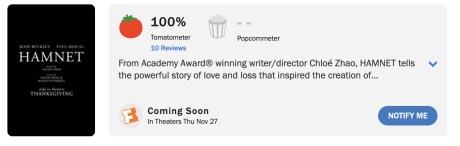
Obviously Chloe Zhao‘s Hamnet has been getting gangbuster reviews after debuting at the Telluride Film Festival. Critics are doing cartwheels and backflips, but can they be trusted? What about those research screening tipsters who had problems with it? Either way Hamnet is an apparent lock for a Best Picture and Best Director nom. I noted a few days ago that Jessie Buckley is overwhelmingly assured of a Best Actress nomination.
Earlier today I arose at 6 am to catch an 8:30 am screening of Olivier Assayas‘s eloquently written, intriguingly acted The Wizard of the Kremlin, a sprawling historical film which I was wholly taken with despite its 156-minute length. Paul Dano stars as influential Kremlin counsel and Vladimir Putin spin doctor Vadim Baranov, a semi-fictional character who’s largely based upon the still living Vladislav Surkov.
I was especially impressed by Jude Law‘s supporting performance as Putin. A critic friend sneered that it’s basically a TV movie — a view I sharply disagree with. My review will run this evening or early tomorrow…whichever.
Tonight I’ll be catching Mona Fastvold‘s The Testament of Ann Lee, a historical musical about the founding leader of the Shakers religious sect with songbird Amanda Seyfried in the lead role. It screens at at 7:15 pm. I might as well be honest and admit I’m scared to death of submitting to this 130-minute film, mainly because HE nemesis Brady Corbet co-wrote the script with Fastvold, his wife.
The final film of the day will be Alexandre O. Philipe‘s Kim Novak’s Vertigo, which press-screens at 10 pm.
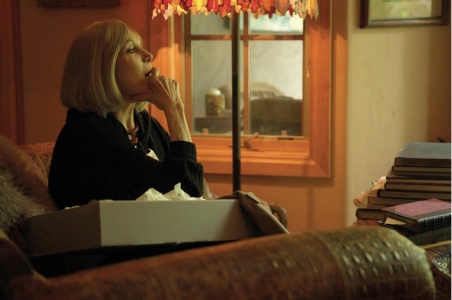
Incidentally: A restored version of Joseph L. Mankiewicz‘s House of Strangers will screen at the Venice Film Festival on 9.2 and 9.3 (Tuesday and Wednesday). Until reading about this on the festival site, I’d honestly never even heard of this 1949 release. All due respect for the great Joseph L., but I’m presuming it’s a stiff.
How many Frankenstein features have been released over the last 90-plus years? Several dozen. And how long have I been on a “no more Frankenstein flicks” diet? At least three decades, or since the release of Kenneth Branagh‘s Mary Shelley’s Frankenstein in 1994. I’ve never seen it, and I never will.
No offense to the great Guillermo del Toro, but there was never the slightest chance in hell of my not ducking his version, which screened yesterday (Saturday, 8.30) at the Venice Film Festival.
The diet was inspired by the 1973 double whammy of Paul Morrisey‘s Flesh for Frankenstein and Frankenstein:The True Story, a British made-for-TV flick with poor Michael Sarrazin (5.22.40 – 4.17.11) as the creature. Actually the Morrisey, a black comedy, isn’t that difficult to watch.
I’d been told not to expect too much from Kent Jones’ Late Fame, that it was on the minor side. This turned out to be hooey.
Based on a 1914 Arthur Schnitzler novella with the same title, Jones’ film is a fine, true-to-itself, cut-to-the-chase rendering that has a fine short-story economy.
Willem Dafoe‘s performance as the late-60ish Ed Saxberger, a onetime celebrated poet who peaked 45 years ago (sometime between ‘79 and the very early ‘80s) only to abandon poetry for a humdrum job at the post office, is one of his all-time greatest.
And Greta Lee is wonderful as Gloria, an arresting, electrically flirtatious, life-of-the-party type who sings and acts in small clubs and regional productions. Soon after Saxberger is embraced and celebrated by a small group of rich-kid fans who want him to start writing again, Gloria and Ed take to each other immediately, and the prime current and intrigue of Late Fame is whether or not this attraction will lead to something or just be a passing, flash-in-the-pan fancy…this is what holds you.
It’s clear early on that the latter scenario is the most likely, and so the viewer is seized with concern about whether or not Saxberger will make a fool of himself. Don’t go there, bruh! Step back and hold yourself in check.
Sharply sculpted by screenwriter Samy Burch, Late Fame wins you over early on with well-honed dialogue and a tone of no-bullshit clarity, and within 96 minutes it hits the melancholy mark with admirable bull’s-eye precision.
It’s easily one of HE’s best films of the year (and surely of the festival) because it holds a tight and true focus from start to finish. Congrats to Jones, Dafoe, Lee and also costar Edmond Donovan as one of Saxberger’s rich-kid admirers, and a tip of the hat to everyone else on the relatively small production team. Excellent, character-driven filmmaking of this sort is all too rare.
At 11 am this morning I caught Potsy Ponciroli‘s Motor City, an animal-level exploitation bruiser (set in 1977 Detroit!) that’s noteworthy for experimenting with crafting a grotesquely violent cheeseball revenge-splatter film with almost zero dialogue.
Last night (Friday) I saw Jane Pollard and Iain Forsyth‘s Broken English (the Marianne Faithful tribute doc, running 96 minutes) and Kent Jones‘ Late Fame (also 96 minutes!), and I can’t really write about either with a 10:15 pm screening of Jim Jarmusch‘s Father Mother Sister Brother breathing down my neck.
It’s a shitty feeling, being this far behind. Sometimes I’m able to just bang stuff out
willy-nilly, and other times it’s a struggle.
Even if I was flush, I wouldn’t pay $500 per night for any Venice hotel room. (I would, however, pay $500 for a perfect pair of Italian-made suede lace-ups, if money was no object. Or the right kind of sweater or suit.) And yet you can’t say that these videos, forwarded by festival-attending friends, don’t convey a certain lusciousness. Worth $500 per night? You tell me.
It’s important to watch these videos with good, strong sound.
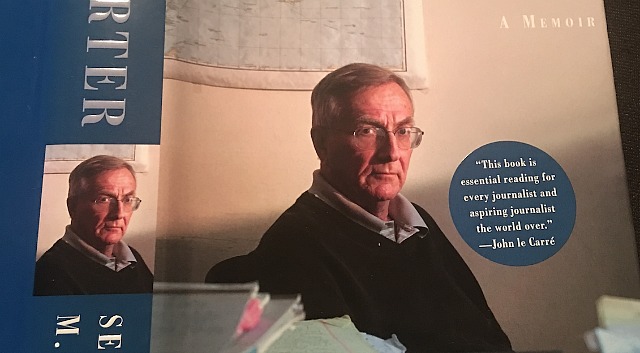
I don’t have instant comprehensive recall of each and chapter of Seymour Hersh‘s reporting career, but I know a lot about it.
Seven years ago I read a few chapters from Hersh’s “Reporter“, and it was almost entirely riveting.
So I wasn’t exactly blown away by Laura Poitras and Mark Obenhaus‘s Cover-Up, as I knew many of the stories and details and whatnot. It was nonetheless immensely soothing to watch.
Anyone with the slightest interest in Hersh’s work or who understands that the calibre of journalism that Hersh delivered in the ’60s, ’70s, ’80s and ’90s is pretty much absent today, please see it for affirmation’s sake. Even those who know nothing of Hersh’s work, seeing Cover-Up is pretty close to essential. The thought is that others might try to follow Hersh’s example, and that it can only do good to spread the gospel.
From Hersh’s “Looking for Calley“, published in a 2018 issue of Harpers
Hersh: By early 1969, most of the members of Charlie Company had completed their tours and returned home. I was then a thirty-two-year-old freelance reporter in Washington, D.C. Determined to understand how young men — boys, really — could have done this, I spent weeks pursuing them. In many cases, they talked openly and, for the most part, honestly with me, describing what they did at My Lai and how they planned to live with the memory of it.
In testimony before an Army inquiry, some of the soldiers acknowledged being at the ditch but claimed that they had disobeyed Calley, who was ordering them to kill. They said that one of the main shooters, along with Calley himself, had been Private First Class Paul Meadlo. The truth remains elusive, but one G.I. described to me a moment that most of his fellow-soldiers, I later learned, remembered vividly. At Calley’s order, Meadlo and others had fired round after round into the ditch and tossed in a few grenades.
“Nightmare From half A Century Ago“, an HE post that appeared on 6.17.18:
It’s hard to set aside time to read a book when you’re already putting in several hours a day on a column plus the usual chores, reveries and occasional screenings. Last night I nonetheless read five or six chapters of Seymour Hersh‘s “Reporter“, which hit stores less than two weeks ago.
I read the ones about Hersh serving as an Associated Press Pentagon reporter and as press secretary for the presidential campaign of Eugene McCarthy in late ’67 and ’68, and two chapters about his breaking the My Lai massacre story — “Finding Calley” and “A National Disgrace.”
Of course and indisputably, “Reporter” is a page-turner. First-rate writing and reporting — pruned to the bone, no wasted words. I was completely hooked and immersed, and then appalled all over again when I got to the Calley chapter. After I finished I found “Finding Calley” in a recent Harper’s post.
I don’t care if Gavin Newsom has personal flaws…who doesn’t? I don’t care if he’s fucked up here and there. I don’t care if he was complicit in allowing San Francisco to become the leading American poop-on-the-sidewalks city….a city in which unchallenged shoplifting and breaking into parked cars became an accepted thing. And I don’t care if he seems hollow, or even if he is hollow to a certain extent.
I certainly don’t approve of Newsom’s views on gender-affirming care, which he needs to evolve out of. But being a tap-dancer, he probably will.
What I do care about is that Newsom is more or less sane, and that he’s standing up against Trump in various showboating, muscle-car ways…I care that a big-state governor is flat-out calling Trump a bad guy and defying his ass and telling him to go eff himself. Because Newsom believes in and stands for, at the very least, a pre-Trumpian sense of decency and constitutional normality and proportionality…he supports a pretty good semblance of representative democracy, and that really matters. He leans left but is primarily a skillful tap-dancer…he’s mainly fluid and adaptable…he blows with the wind, and that’s all you can expect of a clever politician these days.
I would much rather see him move into the Oval Office on 1.20.29 than J.D. Vance…c’mon.
…or you’re fucked. Saturday tourist groups ruin everything. They’ve always been a kind of plague, and have certainly ruined my day thus far.
Update: I barely managed to attend my 11 am screening of Vladlena Sandu‘s Memory, a personal recollection doc about the horrid Chechnyan war trauma of the ’90s. I entered the darkened Sala Serla with seconds to spare.
How moved or devastated did I feel while watching Sandu’s “hypnotic prose poem” (per Deadline‘s Damon Wise)? It’s quietly impactful and sobering, but it’s fair to respectfully note that the idea of war in any form being a hellish, brutalizing experience for combatants and civilians alike…I had contemplated this bruising reality countless times before this morning’s screening. That said, Sandu’s film us quite jolting, harrowing. Full respect.
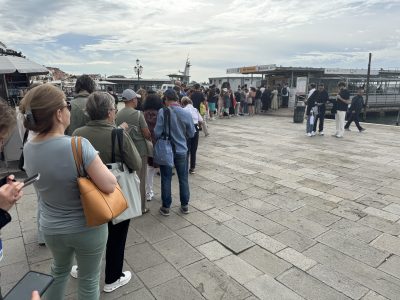
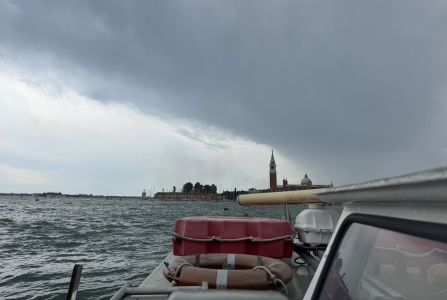
The enclosed Lido village that the Venice Film Festival folks maintain is so damn fraternal and comforting. It’s all green and grand and flush and pine-scenty, and the cappuccinos at the indoor and outdooor cafes (at least three or four) are transporting.
Everyone is cool and approved, wearing lanyard press badges or the purchased kind, and there are no loud vulgarians or drunken gigglers. It’s all cool and settled down, everyone floating on the same vibe. It’s like being a member of some kind of flush, elegant country club on the Adriatic.
Many of us know what hardcore film festivals are like —- 18 hour days, fighting exhaustion at every turn — and it’s no vacation, but at the same time we’re all channeling a certain communal spirit. And the early-morning and late-night vaporetto rides are calming and altogether wonderful.
It rained heavily late last night, and again this afternoon. You just roll with it.
I’m back in Castello now, sitting solitary at a plastic cafe table. A half-hour ago the midnight church bell rang, echoing all over the city. Like the bells of Notre Dame.
Tonight’s screenings were Broken English and Late Fame. Both are about intimate portraiture, modest and soft-spoken and internal, and I don’t mind saying I found them touching and actually delightful.
I immediately fell in love with the opening frames of Luca Guadagnino‘s After The Hunt, or more precisely the amplified sound of a slowly ticking clock — an aural statement that says “ominous stuff is brewing, you bet.”
Though I was fully familiar with the basic story bones, having read an early draft of Nora Garrett‘s original screenplay, a #MeToo rape accusation drama mostly set on the Yale campus, I was pulled in all over again.
Largely because After The Hunt is not a simple point-and-shoot capturing of Garrett’s script, but a Guadagnino re-think…a stirring, a modification, an enhancement. Assured, unforced and deliberate, Luca’s version fascinates by not pushing too hard…by advancing the campus mystery in a gradual, step-by-step way.
I was actually kind of startled — pleasantly — by his decision to keep things on the subdued side. No sharply raised voices or glaring expressions or slamming doors or anyone throwing things around.
Except, that is, for a tantrum thrown by Andrew Garfield’s Hank Gibson, a professor who’s up for tenure — a reaction to his having been accused of sexually assaulting Ayo Edibiri‘s Maggie Price, an allegedly mediocre philosophy student, the daughter of super-wealthy parents, and a lesbian.
Maggie is a key story figure, not just because of this alleged assault but also because of her protege relationship with Julia Roberts‘ Alma Imhoff, a whipsmart, well-liked, seriously admired Yale professor who’s also in line for tenure. (It’s an either-or choice between Alma and Hank.) But as things develop and social pressure increases, Alma and Maggie’s relationship becomes less and less trusting, and then tips over into hostility.
I was mostly taken by a tone of ambiguity that manifests in the third act. A haunting ambiguity mixed with stabs of suspicion. And, not incidentally, by a somewhat instructive score by Trent Reznor and Atticus Ross.
Did a drunken Hank in fact assault Maggie after a boozy, low-key party at the home of Alma and Fredrik, her bearded, laser-focused psychiatrist husband (Michael Stuhlbarg)? Who’s lying or fudging the truth?
I for one didn’t want to believe Maggie’s accusation, as she is an all-too-typical, hyper-sensitive, woked-up Zoomer…a product of #MeToo theology who seemingly lives to take offense or at least sneer at white-male privilege, and seems almost eager to unsheath the deer rifle and plug Garfield.
Hank doesn’t respect Maggie, by the way, because he strongly suspects that she’s plagiarized a social-analysis essay she’s been working on for quite some time.
Through an array of voices, Guadagnino’s rewrite doesn’t shrink from sharing disdainful, eye-rolling views of the recent #MeToo terror climate and the general “all white guys are bad” belief system, and so I, gripped by ny own persuasions, was hoping Maggie would get some kind of comeuppance.
Alas, things are not that simple.
The only thing that threw me was the appearance of Maggie’s girlfriend, Alex, who is played by Lio Mehiel, a gay female who uses “they” pronouns and, to my surprise, has absolutely no breasts at all, and I mean not even the tell-tale surgical scars that some lesbians have after boob-removing surgery.
Last February I wrote that Garrett’s screenplay “feels like a splicing of Todd Field‘s TAR, David Mamet‘s Oleanna and Ruben Ostlund‘s The Square.”
This is pretty much how the film feels, although Ostlund’s satirical jabbing was far more pronounced. Hunt leaves you to grapple with your own persuasions and suspicions. It is my take (feel free to disagree) that the film offers no final, clear-cut resolution that delivers an unmistakable unmasking of the more or less guilty party (or parties). It doesn’t fully exonerate anyone while keeping at least a couple of doors ajar.
This, I feel, is what makes After The Hunt such a fascinating adult drama. It basically says “what a hard-to-figure shit show these poor academics are caught up in.” Hell, all of us.
I also loved that Guadagnino’s voice — his actual, literal voice — chimes in at the very end, although I won’t say how.
I also wrote that Garrett’s screenplay planted “expectations of Roberts’ performance possibly stirring convos about a Best Actress trophy”, as she’s “playing one of those well-sculpted, sturm und drang roles that older actresses have always pined for.”
This still seems likely but what do I know? Alma is definitely a hider with a major buried secret that doesn’t surface until things have reached a breaking point. She’s certainly no fighter for any kind of ultimate truth, and she’s suffered a social beating that will reverberate big-time.