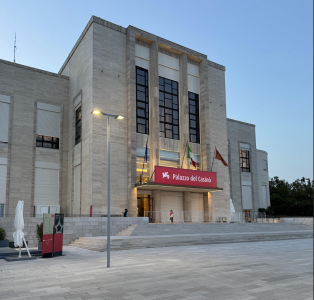
Post-War Hungarian Family Horror Film…Black As Night, Black As Coal

There are boilerplate audience-unfriendly films, and then there is Laszlo NemesOrphan, arguably the most audience-unfriendly film of all time or certainly of the 21st Century…a bitter, taste-of-ashes, morally appalling, end-of-decency film that will make your hair follicles stand at attention.

And yet — here’s the rub — Orphan is an Olympian achievement —- a paralyzing tale about hard-knocks survival —- a devastating, coming-of-age arthouse saga — an undeniably staggering drama of a very high order.

Nemes (Son of Saul) is a masterful, pulverizing filmmaker

Set in 1957 Budapest in the wake of the Hungarian revolt against Soviet domination, it’s an utterly first-rate, grimmer-than-grim tale about a young lad gripped by nihilistic rage and, goaded by an oppressively evil situation concerning his terrified, traumatized mother and an evil, grotesquely fat butcher, a growing inclination for self-destruction.

And yet it ends on a note of mixed (make that extremely mixed) note of roundabout hope, if you want to call it that.

HE reply to friendo who asked for my reaction five minutes after it ended, just after 9 pm: “Excellent but horrifying, but at least the boy didn’t self-destruct at the end. He grows up by deciding to survive. Ghastly story. Excruciating.”

Tapping this out at 12:30 am and looking at 6 am wake-up, I’m not going to spill any more beans.

Orphan to Come and See: “Hold my beer.”

Wiki excerpts:
“Mother” Is Complex, Interesting But..

Teona Strugar Mitevska’s Mother, which I saw just after La Grazia, is an impressionistic, occasionally hallucinatory origin story about a 38-year-old Mother Teresa (Noomi Rapace) tending to Calcutta’s dirt-poor. She did so, the film says, not just with standard-issue compassion but also a strict and demanding edge.

Pic delivers intimations of a platonic lesbian vibe between Teresa and a hot Sister Agnieszka (Sylvia Hoeks). It also goes with a metal-rock score. Rapace has described the tone of the film as “punk rock”

I honestly don’t feel like reviewing it now, partly because it’s an “almost”. Plus I’ve been up since 3 am and need a break before catching a 7 pm screening of Laszlo NemesOrphan. I need to walk outside and smell the Adriatic.

But Mother is a respectable, better-than-decent portrayal of an iconic figure. It certainly doesn’t portray her in rapt devotional terms. This is basically young Mother Teresa as an unsettled personality and a tough taskmaster.

I somehow never picked up on the fact that Calcutta is now spelled Kolkata.

Variety copy: Pic follows Teresa, Mother Superior of the convent of the Sisters of Loreto, as she anxiously awaits permission to leave her monastery and create a new religious order. The drama, shot in English, focuses on seven pivotal days in the life of the future saint when she faced a dilemma that challenged both her ambitions and faith.

“Mitevska, who previously explored Mother Teresa’s life in her unreleased documentary Teresa and I, draws from extensive research including interviews with the last living sisters who witnessed the saint’s character.

“The director positions her protagonist not as a traditional saint, but as ‘almost a CEO of a multinational company, relentless and ambitious.'”

“The filmmaker acknowledges the controversial aspects of her subject, particularly Teresa’s stance on abortion, while choosing to examine the woman before she became a globally recognized saint.

“The screenplay, penned by Goce Smilevski, Mitevska, and Elma Tataragić, presents what the director calls ‘a female story’ that avoids traditional martyrdom narratives.”

My Soul Freezeth Over

The common perception is that that Paolo Sorrentino makes lulling eye-bath films that intrigue on a certain level but don’t quite add up to much more than that. But he’s a respected cinema stylist and this, take it or leave, is his signature…immaculate visual compositions, a strictly applied tone of dry irony, understated performances that nonetheless invite curiosity and, if you’re so inclined, a certain scrutiny.

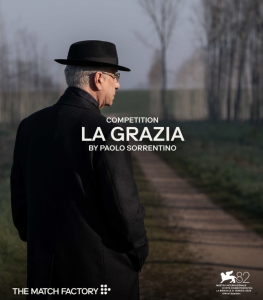
La Grazia, which screened this morning at 8:30am inside the over-refrigerated Sala Darsena, is a stately, decidedly opaque portrait of an aging, white-haired Italian president named Mariano De Santis (longtime Sorrentino collaborator Toni Servillo), his daughter Dorotea (Anna Ferzetti), a crusty, combustible old friene (also white-haired) named Coco Valori (Milvia Marigliano) and…oh, God, I’m just dingle-dangling here. As with almost all of Sorrentino’e films I felt a mix of appreciation for hie 2.39:1 compositions as well as distanced and vaguely frustrated. Within ten minutes I knew it would be a tough haul and it was.

I could feel the press audience politely enduring it, sorta kinda working through it (is this a meditation on aging, death, white-haired wigs, obsession, cigarettes?) but waiting for something engaging to happen and getting little satisfaction, at least according to HE standards.

The only concise description I can settle on is “ironically bloodless”. As in mummified, underwhelming, lyrical, stillborn, subdued emotionalism, lemme outta here. But this is what tends to happen when Sorrentino and Servillo pool forces.

And the Sala Darsena climate was really too cold…you’d have to call it assaultive. I buttoned up my black Kooples shirt and hoped for the best, but I was freezing the whole time. The morning’s only genuine pleasure came when La Grazia (i.e., Grace) finally ended and I escaped from the ice-truck atmosphere by walking into the warm Italian sun….”thank you, God…aaaahhh!”

Veteran festival friendo who was at the same screening: “Ahaha yeah they love to crank up the AC in that cinema! Everyone I know brings a jacket to stay warm. It’s nice when you first enter if it’s really hot outside! But since it’s pretty normal warm now it was freezing inside there today.”