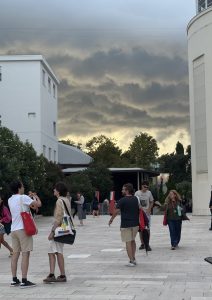
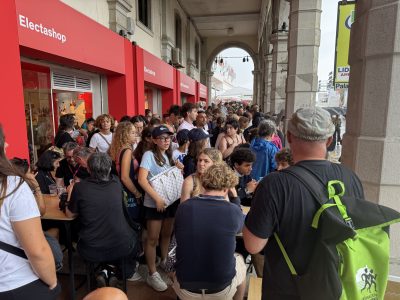
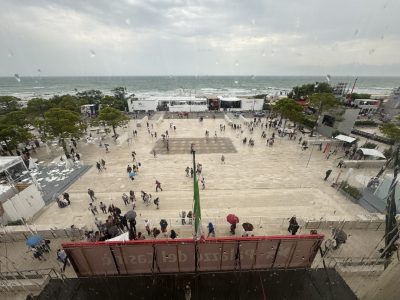
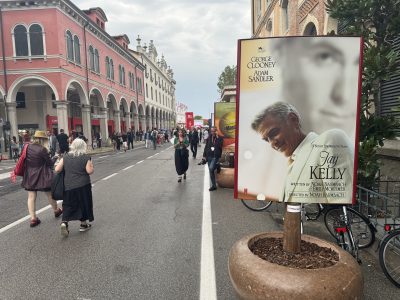
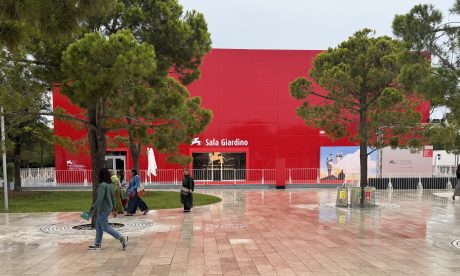
The enclosed Lido village that the Venice Film Festival folks maintain is so damn fraternal and comforting. It’s all green and grand and flush and pine-scenty, and the cappuccinos at the indoor and outdooor cafes (at least three or four) are transporting.
Everyone is cool and approved, wearing lanyard press badges or the purchased kind, and there are no loud vulgarians or drunken gigglers. It’s all cool and settled down, everyone floating on the same vibe. It’s like being a member of some kind of flush, elegant country club on the Adriatic.
Many of us know what hardcore film festivals are like —- 18 hour days, fighting exhaustion at every turn — and it’s no vacation, but at the same time we’re all channeling a certain communal spirit. And the early-morning and late-night vaporetto rides are calming and altogether wonderful.
It rained heavily late last night, and again this afternoon. You just roll with it.
I’m back in Castello now, sitting solitary at a plastic cafe table. A half-hour ago the midnight church bell rang, echoing all over the city. Like the bells of Notre Dame.
Tonight’s screenings were Broken English and Late Fame. Both are about intimate portraiture, modest and soft-spoken and internal, and I don’t mind saying I found them touching and actually delightful.
I immediately fell in love with the opening frames of Luca Guadagnino‘s After The Hunt, or more precisely the amplified sound of a slowly ticking clock — an aural statement that says “ominous stuff is brewing, you bet.”
Though I was fully familiar with the basic story bones, having read an early draft of Nora Garrett‘s original screenplay, a #MeToo rape accusation drama mostly set on the Yale campus, I was pulled in all over again.
Largely because After The Hunt is not a simple point-and-shoot capturing of Garrett’s script, but a Guadagnino re-think…a stirring, a modification, an enhancement. Assured, unforced and deliberate, Luca’s version fascinates by not pushing too hard…by advancing the campus mystery in a gradual, step-by-step way.
I was actually kind of startled — pleasantly — by his decision to keep things on the subdued side. No sharply raised voices or glaring expressions or slamming doors or anyone throwing things around.
Except, that is, for a tantrum thrown by Andrew Garfield’s Hank Gibson, a professor who’s up for tenure — a reaction to his having been accused of sexually assaulting Ayo Edibiri‘s Maggie Price, an allegedly mediocre philosophy student, the daughter of super-wealthy parents, and a lesbian.
Maggie is a key story figure, not just because of this alleged assault but also because of her protege relationship with Julia Roberts‘ Alma Imhoff, a whipsmart, well-liked, seriously admired Yale professor who’s also in line for tenure. (It’s an either-or choice between Alma and Hank.) But as things develop and social pressure increases, Alma and Maggie’s relationship becomes less and less trusting, and then tipsoverintohostility.
I was mostly taken by a tone of ambiguity that manifests in the third act. A haunting ambiguity mixed with stabs of suspicion. And, not incidentally, by a somewhat instructive score by Trent Reznor and Atticus Ross.
Did a drunken Hank in fact assault Maggie after a boozy, low-key party at the home of Alma and Fredrik, her bearded, laser-focused psychiatrist husband (Michael Stuhlbarg)? Who’s lying or fudging the truth?
I for one didn’t want to believe Maggie’s accusation, as she is an all-too-typical, hyper-sensitive, woked-up Zoomer…a product of #MeToo theology who seemingly lives to take offense or at least sneer at white-male privilege, and seems almost eager to unsheath the deer rifle and plug Garfield.
Hank doesn’t respect Maggie, by the way, because he strongly suspects that she’s plagiarized a social-analysis essay she’s been working on for quite some time.
Through an array of voices, Guadagnino’s rewrite doesn’t shrink from sharing disdainful, eye-rolling views of the recent #MeToo terror climate and the general “all white guys are bad” belief system, and so I, gripped by ny own persuasions, was hoping Maggie would get some kind of comeuppance.
Alas, things are not that simple.
The only thing that threw me was the appearance of Maggie’s girlfriend, Alex, who is played by Lio Mehiel, a gay female who uses “they” pronouns and, to my surprise, has absolutely no breasts at all, and I mean not even the tell-tale surgical scars that some lesbians have after boob-removing surgery.
Last February I wrote that Garrett’s screenplay “feels like a splicing of ToddField‘s TAR, DavidMamet‘s Oleanna and Ruben Ostlund‘sTheSquare.”
This is pretty much how the film feels, although Ostlund’s satirical jabbing was far more pronounced. Hunt leaves you to grapple with your own persuasions and suspicions. It is my take (feel free to disagree) that the film offers no final, clear-cut resolution that delivers an unmistakable unmasking of the more or less guilty party (or parties). It doesn’t fully exonerate anyone while keeping at least a couple of doors ajar.
This, I feel, is what makes After The Hunt such a fascinating adult drama. It basically says “what a hard-to-figure shit show these poor academics are caught up in.” Hell, all of us.
I also loved that Guadagnino’s voice — his actual, literal voice — chimes in at the very end, although I won’t say how.
I also wrote that Garrett’s screenplay planted “expectations of Roberts’ performance possibly stirring convos about a Best Actress trophy”, as she’s “playing one of those well-sculpted, sturmunddrang roles that older actresses have always pined for.”
This still seems likely but what do I know? Alma is definitely a hider with a major buried secret that doesn’t surface until things have reached a breaking point. She’s certainly no fighter for any kind of ultimate truth, and she’s suffered a social beating that will reverberate big-time.
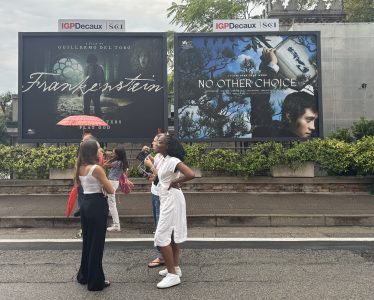
I firmly decided last night to duck this morning’s 8:30 am screenng of ParkChan–Wook‘s No Other Choice, and I don’t care about the hosannas that the whore contingent is sharing now.
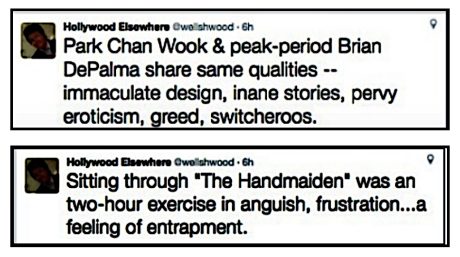
Every time I see a Park Chan-Wook film, I have the same damn reaction — full respect for the visual chops (he’s quite the purveyor of cinematic swoon…a major stylistic maestro) with plot and character internals that feel thin and infuriating.
I’m not saying I won’t see it down the road, or that PCW isn’t a respected filmmaker. But after stumbling into the apartment last night at 1 am after an 18-hour day, soaked and whipped, I definitely didn’t feel that No Other Choice was worth the pain of rising at 6 am.
Dogged rush-line persistence got me into last night’s 7:30 pm press screening of Luca Guadagnino‘s After The Hunt…eureka! (HE’s approving review posts this evening, roughly 12 hours from now.) And then I went straight into Cover-Up, the life-of-Seymour Hersh documentary by Laura Poitras and Mark Obenhaus….also posting this evening, but it was pure journalistic pleasure.
Three films on today’s agenda, although this could get whittled down to two — Giulio Bertelli‘s The Pornographer (an LBGTQ entry), Iain Forsyth and Jane Pollard‘s Broken English, some kind of doc hybrid (“a genre-defying act of resilience and rebellion”) about the late Marianne Faithfull(7:45 pm), and Kent Jones‘ Late Fame (9:30 pm).
It was raining fairly heavily when the MC vaporetto dropped me at the San Zacarria-San Marco stop around 12:30 am. No umbrella — I just trudged on through, arriving at the Calle de la Vida apartment pretty much soaked to the bone.
24 hours previously, or around midnight on Wednesday, 8.27 and near the same San Zaccaria location, I came upon a team of EMTs (emergency medical technicians) working on a seriously overweight woman who had collapsed and was lying on her back. She was breathing, at least, but clearly in trouble — they were using what looked to me like an electric jolt device, presumably to get her heart going.