The great and legendary Giorgio Armani has passed at age 91.
Either you understood and embraced the Armani men’s clothing aesthetic of the late ’70s, ’80s and early ’90s, or you didn’t. And if you didn’t you were pretty much out of it.
In the mid ’90s I interviewed Armani (or a rep who claimed to be him) for my weekly L.A. Times Syndicate Hollywood column, the topic being Oscar fashion. I had faxed an interview request to his Milan office, and and to my surprise somebody said “sure.”
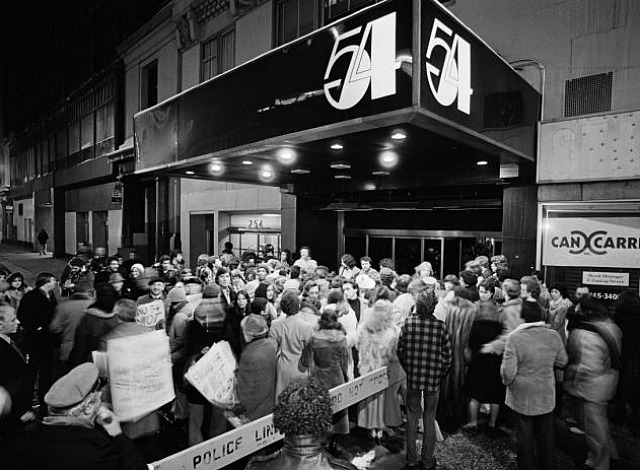
The ironclad rule about gaining entrance to the original Studio 54 (i.e., Schrager-Rubell, April ’77 to the ’80 shutdown over tax evasion) was that you had to not only look good but dress well. That meant Giorgio Armani small-collared shirts if possible and certainly not being a bridge-and-tunnel guinea with polyester garb and Tony Manero hair stylings.
As I watched Matt Tyrnauer‘s Studio 54 I was waiting for someone to just say it, to just say that Saturday Night Fever borough types weren’t even considered because they just didn’t get it, mainly because of their dress sense but also because their plebian attitudes and mindsets were just as hopeless.
It finally happens at the half-hour mark. One of the door guys (possibly Marc Benecke) says “no, the bridge-and-tunnel people never got in“…never.” I can’t tell you how comforting it was to hear that again after so many years.
Another thing: Bob Calacello or somebody mentions how Studio 54 happened in a glorious period in American culture that was post-birth control and pre-AIDS. The film explains how liberal sexual attitudes were particularly celebrated by urban gay culture, which was just starting to sample freedoms that today are more or less taken for granted. Guys couldn’t hold hands on the street but they certainly could once they got inside Studio 54.
But one thing you can’t say in today’s climate (and which Tyrnauer’s film doesn’t even mention in passing) is that the ’70s were also agloriousnookieeraforheterosexualguys. It was probably the most impulsive, heavily sensual, Caligula-like period (especially with the liberal use of quaaludes) to happen in straight-person circles since…you tell me. The days of Imperial Rome?
This kind of thing is now a verboten topic, of course, with the 2018 narrative mainly being about how guys need to forget “impulsive” and turn it down and be extra super careful in approaching women in any context. But things were quite different back in the JimmyCarterera. I’m not expressing any particular nostalgia for those days, but the new Calvinism of 2018 couldn’t be farther away from what the social-sexual norms were 40 years ago. Just saying.
I didn’t hate Julian Schnabel‘s In The Hand of Dante, which I caught a night or two ago, or at least I didn’t hate it altogether. But it did make me groan here and there, and it instilled anguished feelings…spasms of revulsion and disgust and disorientation. I literally said out loud “oh, God…oh, no…oh, Jesus” during a ridiculous mass-murder scene.
And I felt heartbroken that poor Oscar Isaac had committed to playing the dual lead role (a fictional wise-guy version of Tosches as well as the real, actual Dante Alighieri), and I felt so sickened by Gerard Butler‘s coarse, poseur-level performance as Louie, the hit man, that — BIG-ASS SPOILER WARNING! — I was overjoyed when Louie finally got plugged. “Good!” I said to myself, “and please burn in hell.”
Something is very wrong when a film by a director you’ve respected and admired for the better part of 30 years (Basquiat, Before Night Falls, The Diving Bell and the Butterfly and At Eternity’s Gate are Schnabel’s best)…something is very, very wrong when his latest initially excites and delights and fills you with hope and even wonder, and then, in the space of less than 20 or 25 minutes, makes you feel like you’ve dropped some really bad acid.
No, I haven’t read Nick Tosches’ same-titled source novel, but I know Tosche’s hipster prose style pretty well (I’m a huge fan of “Hellfire” and “Dino: Living High In the Dirty Business of Dreams“) and…how to put this?…as I watched Schnabel’s film I was saying to myself “This is wrong, man…the crude, porno-violent pistol murders are way over the top…this isn’t the Tosches I know or want to know.”
Tosches’ 2002 novel was co-adapted by Schnabel and wife Louise Kugelberg, and this fact alone is somber testimony, you bet…proof, even, that fortifying a marriage by working on a movie script together is not, in and of itself, a good idea, for the lurching between delirious madman poetry and black-and-white bullets slamming into craniums and chest cavities is my idea of godawful.
I guess I’m now obliged to finally read Tosches’ 2002 book, a trippy, semi-fictional dream saga with the same title, but how could Tosches have written such a thing? There’s no question that Schnabel and Kugelberg have desecrated Tosches’ legacy here.
I can only tell you that walkouts began early on in the Sala Darsena, and that I was cringing and flinching and almost writhing in agony.
Butler is now 55 and way overweight, and the ridiculous “Louie” smokes like a mentally-deranged chimney. Butler reminded me a bit of Orson Welles‘ Hank Quinlan in Touch of Evil (’58), not in terms of Welles’ obesity (Butler is merely bloated by way of a pig diet) but in terms of his character’s perversity…theatrical, random-ass, sub-mental, dumb-fuck cruelty.
Born and raised in Scotland, Butler’s natural accent is soft and gentle and charming, but of course he’s been speaking with a fake, tough-guy patois all these years…what a shame.
HE to friendo a couple of hours after Dante ended: “Tosches’ semi-fictional book of the same title can’t be as vulgarly, bruisingly violent as the film is, not to mention gven to such wildly florid trip=outs and generally lost in its own psychedelic fantasy scenario. It starts well but within the first half-hour there’s a noticable absence of taste and discretion. It’s occasionally just plain awful. Okay, Martin Scorsese’s bushy-bearded cameo is a hoot, and Al Pacino has a good scene with a very young Tosches early on. But the shootings are so plentiful and thoughtless and grotesque…beyond repulsive.”
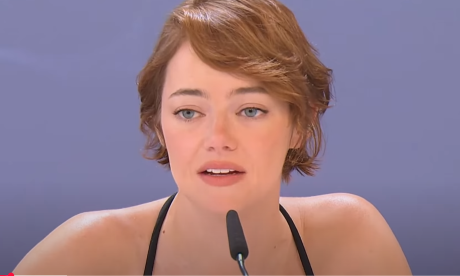
Bugonia isn’t top-grade Lanthimos…not for me, it isn’t. But Emma Stone has magnificent eyes and her reddish hair has grown back in, and all was certainly well during the Bugonia press conference.
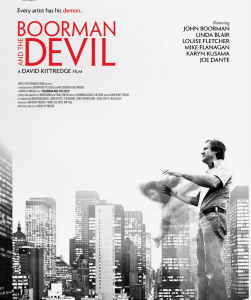
Tomorrow’s most highly anticipated viewing is David Kittredge‘s Boorman and the Devil, which screens at the Sala Corrinto at 9 am. The reputation of John Boorman‘s The Exorcist II: The Heretic was so bad in ’77 that I not only ducked it theatrically, but have avoided even the various video versions. I haven’t even streamed it in recent years.
Basically because I’m so invested in the excellence of William Friedkin’s original Exorcist that I don’t want the aura tainted in any way, shape or form. But now I’m into it, and will be at tomorrow morning’s screening with bells on.
David Kittredge statement: “When I first saw The Exorcist as a teenager, it bewitched me — both as fan of 1970s films as well as a horror fan. Next to it on the shelf of my video store was its 1977 sequel, Exorcist II: the Heretic. I knew it had a bad reputation — but I saw it was directed by John Boorman, who I knew had made a number of critically acclaimed movies (which I hadn’t seen yet) so I quickly rented it.
“Exorcist II: The Heretic was mesmerizing to me. It didn’t play like a conventional horror movie; nothing felt conventional about it at all. It was a sequel that was nothing like the original — it was visually stunning, colourful, kinetic, overflowing with ideas and images. It felt like it came from another world.
“Over subsequent years I became obsessed with this film. And when I got the opportunity to connect with director John Boorman about it, I embarked on a seven year journey to tell the story of how he made one of the most audacious, big-budget creative swings in Hollywood history, and then endured a critical and commercial cataclysm. It’s a story about how Hollywood once took huge bets on auteur filmmakers, and how that era ended. And it’s the story of one of the most hypnotic, subversive and misunderstood studio films in Hollywood history.”