
Just over 14 years ago I posted a relatively short riff called “Respectful Sirk Takedown” (2.22.10). Through the ’70s, ’80s, ’90s and aughts I had been constantly berated and belittled by elite film mavens. telling me it was my fault, not Sirk’s, that his films had never come together in my head as wondrous servings of lush “ironic” cinema.
So in my head I finally said “enough!” and posted my critique, and boy, did I get shat and spat upon by the dweebs. I was called a lowlife troglodyte, a vomiting dog, a man without a soul.
So it feels very gratifying that Paul Schrader has just posted along the same lines, saying in effect “is it time for a reassessment of this overpraised mofo?” For years I’ve stood alone against the fiercest of winds. Now, at long last, I have good company.
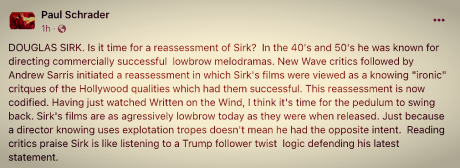
HE’s original piece: The German-born Douglas Sirk has long been considered a world-class, pantheon-level filmmaker. That’s because the film dweebs have been telling us for years that the dreadfully banal soap-opera acting, grandiose emotionalism and conservative suburban milieus in his films are all of an operatic pitch-perfect piece and are meant as ironic social criticism. (Or something like that.)
The dweebs are playing an old snob game. They’re basically saying that you have to be a serious cineaste to recognize Sirk’s genius, and that if you don’t recognize it then you need to think things through because you’re just not as perceptive as you need to be.
There’s no winning against this mindset, which is somewhere between a schoolyard bully move and an intellectual con. The dweebs (and I’m talking about a very small and cloistered group of big-city critics) have put one over on us. And I’m suggesting, due respect, that the time has come to push back on Sirk and to consider him once again as the Guiding Light-level director that some (myself included) believe that he always was.
Sirk was mostly dismissed by critics of the ’50s and early ’60s for making films that were no more and no less than what they seemed to be — i.e., emotionally dreary, visually lush melodramas about repressed women suffering greatly through crises of the heart as they struggled to maintain tidy, ultra-proper appearances.
In his praise of Written on the Wind, Roger Ebert wrote that “to appreciate [this film] probably takes more sophistication than to understand one of Ingmar Bergman‘s masterpieces, because Bergman’s themes are visible and underlined, while with Sirk the style conceals the message.”
Aaaah, the old concealment game! For this is the essence of the Sirk con. John Ford used to “conceal” also, but you can watch Ford’s films, or at least savor what’s good about them (despite the Irish sentimentality). If Ebert’s comment isn’t Orwellian film-dweeb speak, I don’t know what would be.