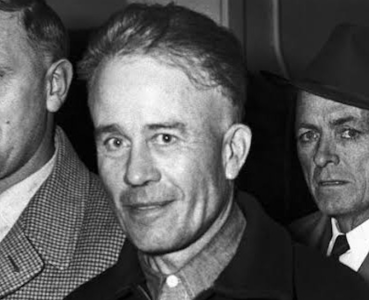
Last night I watched two episodes of Ryan Murphy‘s recently-popped Ed Gein miniseries…Monster: The Ed Gein Story (Netflix, 10.3). I flipped and zipped around here and there but mostly I stayed with #3 and #4.
It’s primarily a wildly imagined, “we’ll show anything we feel like showing and we don’t care” impressionist fantasia, and I felt honest respect for the loose-shoe scheme of it. It streams like a dream through Ed Gein’s twisted psychology and grotesque imagnings, and we’re shown very little (next to nothing) in the way of hard documented facts or realism.
Okay, it contains a few nods to reported fact and a few reenactments of certain incidents, but mostly the series is about Ian Brennan, the series’ showrunner and screenwriter, and director Max Winkler using the Gein history as a launchpad for a dive into Bunuelian impressionism by way of bland, middle-American, mid 20th Century horror.
And guess what? Gein’s portrayer Charlie Hunnam, 45, is nearly a dead ringer for the Real McCoy. Except he performs every line with the same wimpy, fluttery, high-pitched voice.
The Gein miniseries (eight episodes) is a psychological dreamscape thing that ignores, flagrantly lies about or luridly exaggerates what is generally known about Gein — an older, plain-faced, mother-loathing Wisconsin farmer who never had sex in his life — and the gruesomely chilling horror films (Psycho, The Texas Chainsaw Massacre, The Silence of the Lambs) that he and his gruesome acts inspired.
The Psycho portions are basically one flagrant lie after another. The enactment of the Psycho shower murder scene (much bloodier and more bruisingly violent than Hitch’s original, and in COLOR yet!) and the audience reactions (throwing up, fainting, etc.) is all florid poppycock, but it’s imaginatively surreal at the same time. And I love the look of smug satisfaction on Hitch’s face when he sees how upset the theatre patrons have become.
I watched episodes #3 and #4 (“Babysitter” and “Green”), the former featuring the Psycho demimonde (Alfred Hitchcock, Robert Bloch, Alma Reville, Anthony Perkins, Tab Hunter) and the latter featuring Lesley Manville as Bernice Worden, a hardware store owner who was Gein’s final victim.
I wanted to watch the Manville chapter because I was told that this elderly British actress has shrieking doggy-style sex with Hunnam, except her cries and moans struck me as insincere and superficially performative, which I’m presuming was intentional.
For me the most horrifying element in the whole series are those frozen, snow-covered, eternally flat Wisconsin landscapes. (Gein and his horrible mother lived on a small farm in Plainfield, Wisconsin.)
Hunnam, Manville and Laurie Metcalf‘s mom aside, the performance standouts include Tom Hollander‘s Hitchcock, Ethan Sandler‘s Robert Bloch, Suzanna Son, Vicky Krieps, Olivia Williams (Alma Reville), Joey Pollari (Anthony Perkins), Jackie Kay (Tab Hunter), Addison Rae (pretty blonde who mysteriously disappeared) and Elliott Gould‘s Weegee.
Incidentally: Gein is a German name, of course. “EIN” is used in hundreds of German or German-Jewish names — Rheingold, Feinberg, Heinrich, Heinz (ketchup) — and it’s always pronounced like the words “eye”, “fly” or “rye” with an “n” attached. Obviously Gein should be pronounced the same as “Heinz” or the first syllables in “Rheingold”, “Feinberg” or “Heinrich.” And yet many nonsensically insist that Gein should be pronounced “GEEN” — wrong!