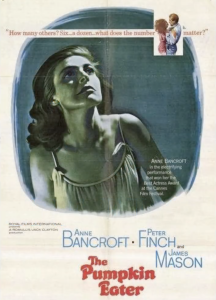
Until last night I had ducked Jack Clayton and Harold Pinter‘s The Pumpkin Eater (’64) for decades. I never even thought about giving it a whirl, mainly out of fear that it might smother me in dreary wifey nihilism and perhaps make me feel morose. (It’s based on a novel by Penelope Mortimer.)
But I finally gave in last night, and it’s actually quite exceptional — a sophisticated, finely wrought, moderate-mannered parlor drama about a gradually deteriorating London marriage.
Vaguely similar to David Jones Betrayal‘ (’83), which Pinter also wrote, of course, based on his 1980 play, The Pumpkin Eater has a wry, half-fleeting, matter-of-fact quality. But it also conveys genuine compassion for a woman who’s slowly perishing within.
It’s basically about Peter Finch‘s chilly screenwriter husband — an aloof, constantly disloyal hound who in his heart of hearts needs to be constantly worshipped and massaged and, I’m guessing, blown for good measure — quietly and relentlessly cheating on the poor, wounded, downhearted Anne Bancroft, who allows their many children to basically run their marriage.
This is going to sound shallow but I felt deflated by the fact that Bancroft’s hair is rather gray throughout — only in the very beginning are her locks dark and ravishing in the style of Mrs. Robinson, whom she would play two or three years later. It makes her look drained and faded. Bancroft was only 32 or 33 when the film was shot, and yet Clayton tries to make her look at least 47 or 48, if not older. But her performance is staggering, and it resulted in her second Best Actress Oscar nomination.
Costarring James Mason, Maggie Smith, Cedric Hardwicke, Alan Webb, Richard Johnson and Yootha Joyce. Oswald Morris‘s black-and-white cinematography is generally delicious; ditto Georges Delerue‘s score.
Pauline Kael: “Bancroft’s performance as the (compulsive childbearing) Englishwoman whose nerves are giving out has an unusual tentative, exploratory quality. (It ranks with her more straightforward acting in The Miracle Worker.)
“The Pumpkin Eater is a stunning, high-style film — fragmented yet flowing. The murky sexual tensions have a fascination, and there are memorable moments: Bancroft’s crackup in Harrods; glimpses of Mason being prurient and vindictive, and Maggie Smith being a troublemaking ‘other woman.'”