
…and then it opened and the audience said “eff the social critique or condemnation aspect…we think the main protagonist is actually kinda cool or at least, you know, engagingly colorful.”
This hqppened to a certain extent with Todd Phillips‘ Joker (’19) — what could have been a D.C. villain’s origin story was artified in a bigger, operatic, more emotionally intense thing, almost certainly in a manner unanticipated by Warner Bros. It became something else.
I knew it had happened with The Wolf of Wall Street (’13) when I saw it with a live whooping dudebro audience at the Zeigfeld, and especially when LexG wrote that he liked Martin Scorsese’s 2013 film “for the wrong reasons.”
It certainly happened with Oliver Stone‘s Wall Street (’87) — intended as a cautionary moral tale, Michael Douglas‘s Gordon Gekko (a character based on Stone’s father) inspired a whole generation of asshole stockbrokers (including Jordan Belfort!) who saw Gekko into a aspirational role model.
I’ve written about Martin Ritt‘s Hud (’63) before in this context, but it remains the ultimate social-criticism flick that was hijacked by audiences and celebrated for its rogue charms.
And it was Pauline Kael who first spptted what had happened, and laid it all out in a 1964 Film Quarterly piece called “Hud, Deep In the Heart of Divided Hollywood.”
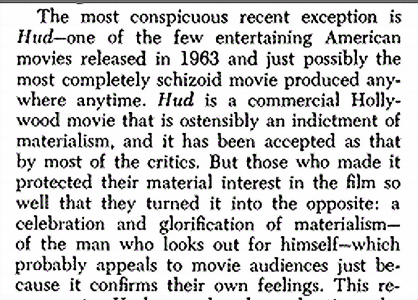
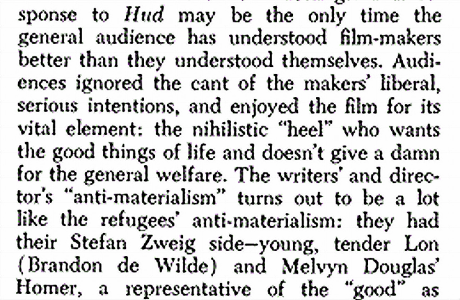
From HE’s “Hud Template,” posted on 1.3.20:
