…and it’s been staring us right in the face since Paul Thomas Anderson’s anti-rural-white-America epic opened four weeks ago on 9.26.
And here it is:
Even the ugliest, most deranged, most demonically boozy or druggy dad would have serious qualms about killing his own daughter, especially if the bad dad is a hardcore rightie, given traditional conservative beliefs (Charlie Kirk, etc.) in the sanctified rituals of parenting and fatherhood.
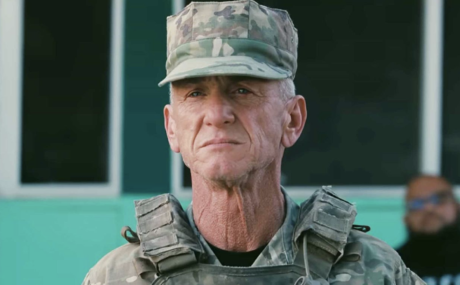
And yet Sean Penn’s Colonel Lockjaw is such an impossibly racist fucktard that he somehow determines that his mixed-race daughter, Chase Infiniti’s Willa, has to be iced so as to eliminate biological proof that he once had sex with Willa’s African-American mother (Teyana Taylor’s Perfidia Beverly Hills)…a paternity situation that would totally kill his chances of being accepted into a secret rightwing racist fraternity called the Christmas Adventurers Club.
This is what’s fundamentally and humanly wrong with One Battle After Another. There’s just no believing that this kind of psychopathic ugliness could prevail within the heart of even a fanatical rightwing hard-ass like Lockjaw….even the sickest, most racially diseased dad in the world wouldn’t clip his own daughter over a social-political motive.
Even if Lockjaw was so insanely devoted to racist ideology that he tried to nullify his own heart and shut off his own soul spigot in order to commit filicide, even the sickest bad dad would be so inwardly torn about the prospect of murdering his own that he probably couldn’t go there. Because deep down, even the worst dads are human.
And yet PTA has dramatically invested in this kind of venality. He believes that Lockjaw, being a racist pig and all, could be a daughter-killer. He bases the bulk of the film, in fact, upon this premise. (Not the 40-minute prologue set in 2008 or thereabouts, but the present-tense part.)
The problem isn’t just that silent Godly guidance and the better angels of human nature forbid such a diseased mindset at the end of the day, but that we, the ticket-buying, popcorn-inhaling, non-lefty extremists in the audience…we can’t and won’t believe this shit. It simply doesn’t add up in human terms. Filicide is simply a bridge too far in this context, and it just doesn’t wash.
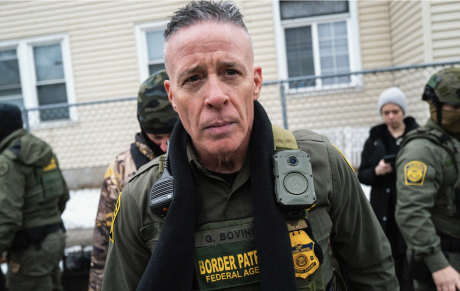
Left progressives (who of course include many film-industry types and many if not most film critics) are buying it, of course, because they see hardcore, immigrant-arresting, ICE-resembling righties in starched military fatigues as inherently evil…to them a belief in Lockjaw’s inhuman scheme is a no-brainer and a no-sweater.
Even I, a sensible centrist, had half-accepted Lockjaw’s sick decision to slay his own daughter. I sat there in my movie-theatre seat and went along with PTA’s dramatic suggestion until, yesterday around noon, a friend flipped a moral switch by mentioning what I’ve written here. A lightbulb went on and I went “wow…yeah, of course…that’s a good one.”
Will someone explain what’s so friggin’ Oscar-y about Geeta Gandbhir‘s The Perfect Neighbor (Netflix), which premiered 9 or 10 months ago at wokey-woke Sundance?
It’s a very compelling, skillfully edited police-bodycam-footage doc of a boilerplate racial-animus-in-a-neighborhood killing. Hate-driven, agitated-by-noisy-kids Karen (who probably drinks) pulls a gun, loses control, plugs her POC neighbor in the chest…par for the course in Ocala, a boondocky burgh in northern central Florida …a downmarket tabloid American town.
An unfortunately commonplace occurence these days, but on the other hand (a) what’s the big deal?, (b) what else is new? and (c) so what?
What about a Netflix doc about Iryna Zarutska, the innocent young Ukranian blonde who was recently stabbed to death by that mentally unstable black dude, Decarlos Brown, in the Charlotte area?
Or about that 2023 NY subway episode in which Daniel Penny restrained the mentally unstable Jordan Neely and inadvertently choked him to death?
No way, Jose. One, no documentarian operating within the iiberal Hollywood filmmaking bubble would dare make a doc about either incident. And two, neither Sundance nor Netflix would ever screen either one, mainly because of content that would inevitably reflect negatively on DOCs (dudes of color).
I’m obviously not defending that seemingly scabrous Ocala woman who shot her neighbor point blank. But docs about real-life killings have to cast frowning judgment upon paleface aggressors.
I’m sorry but herewith is a bellowing HE ixnay in response to an outrageous, forehead-slapping assertion from Variety‘s Owen Gleiberman, to wit:

No, no, no, no, no…no way.
First, Owen says that the “OBAA is hardcore leftwing girlboss agitprop” accusation is primarily coming from “commentators on the right, the far right, and the extreme alt-right, from Ben Shapiro to film critic Armond White.”
But wait…he acknowledges that Brett Easton Ellis is saying this also.
And hey…what about little old me, bruh?…a sensible centrist who voted for Kamala Harris, Barack Obama and John Kerry, who wears Italian-crafted lace-ups and has undergone three Prague touch-ups, continues to swear by David Bowie, Lou Reed and Warren Zevon on the headphones while telling Big Star cultists to go fuck themselves, dropped acid at least 10 or 12 times in the old days, and so on? I’m no rightie! I’m an odd blend of Honore de Balzac, Georges Danton and Robert Ryan‘s Deke Thornton in The Wild Bunch, for Chrissake.

And what about John Nolte‘s recent, thought-through assertion that One Battle After Another is a grand inverse of D.W. Griffith’s The Birth of a Nation?
HE to Gleiberman: “I’m very, very sorry but OBAA definitely celebrates or at least emotionally supports or sympathizes with vigorous hard-left agitation and sweaty-ass-cheek insurrectionism…
“On top of which it’s totally fucking finished as a prospective Best Picture Oscar winner. Nominations, sure, but no Best Picture cigar. The four finalists with an actual chance of winning the top prize are Hamnet, the totally masterful and elevational Sentimental Value, possibly Marty Supreme but not really, and Ryan Coogler’s bullshit mediocre schlocksploitation vampire flick.
“The nationwide vibe shift has changed everything. Charlie Kirk (whose views I mostly found appalling, no matter how civil his debating manner was) was shot in the neck by a young, ferocious-minded gay lefty…a dude who thought and acted and burned within like Perfidia Beverly Hills. Stick a fork into One Battle After Another. Stick it in and break it off.”

Eureka! Late last night I watched the first three episodes of Rebecca Miller’s Mr. Scorsese, and I felt so roused and super-engaged I didn’t even notice that episode #3 (which ends with the rightwing hate that greeted The Last Temptation of Christ in ‘88) ended just after 2 am.
We’re all fully familiar with the frenzied, 60-year, up-and-down-but-mostly-up saga of the career of Martin Scorsese, of course, but there’s something primal and alive and almost cleansing in the fissures and textures of Miller’s five-hour doc.
Why did it hold me so? Because it didn’t just feel like Scorsese’s story but my own. At every juncture I was “there” in real time, communing with each and every film — emotionally, instinctually, aesthetically — and I mean going all the way back to Boxcar Bertha, which wasn’t much (after seeing it John Cassavetes gave Scorsese a fatherly hug and said “you’ve just spent a year of your life making a piece of shit”) but at least had one good sex scene.
In a phrase Mr. Scorsese is really great stuff. First-rate, up close and searingly personal. It reminds you that Scorsese led a very anxious and shadowed and haunted life for at least his first half-century on the planet. No bowl of cherries, no walk in the park.
I’m thinking now of an on–camera Paul Schrader quote about how Travis Bickle, the proverbial Underground Man, was speaking to “no one” in the early ‘70s…the isolation was all but total back then. Now almost the same kind of guy is online, and he is legion…the solo Underground Man thing has become an online community…the “Internet Man”.
Please re-read Pauline Kael’s 2.9.76 New Yorker review of Taxi Driver.

Friendo: “The persistent sneers of dismissal that now frequently greet Pauline’s name are one more sign that 2025 film culture has lost its marbles.”
Being a highly skilled thesp, Robert DeNiro has always been able to play mellow or solemn or soft-spoken. He’s performed in this vein more often than not.
But except for five low-key, major-value performances — his Vito Corleone in The Godfather, Part II, Jack Walsh in Midnight Run (full of inner conflict, regret about past mistakes), the inwardly chilly, mostly pragmatic Neil MacAuley in Heat, timid Chicago cop Wayne Dobie in Mad Dog and Glory, and that super-moderate, restrained, gentle-feeling performance that he gave in Nancy Meyers’ The Intern — DeNiro has generally failed to make truly vivid impressions unless he’s played characters with some kind of manic vibe or a violent impulse thing or, you know, a loose screw aspect.
The more “normal”, sensible and schlubby his characters were, the less effective DeNiro has been. The more “ruled by inner demons” they were, the better he was.
Those five perfs aside, DeNiro was born to play edgelords.
Think about it — Johnny Boy in Mean Streets (hyper nutter), Jake LaMotta in Raging Bull (animal), Travis Bickle in Taxi Driver (psycho with a messiah complex), Rupert Pupkin in The King of Comedy (delusional would-be comedian), Satan in Angel Heart, Al Capone in The Untouchables (fiendish, baseball-bat-wielding, Prohibition-era monster), Jimmy Conway in Goodfellas (Brooklyn mob sociopath), Max Cady in Cape Fear (evil psychopathic pervert), Louis Gara in Jackie Brown (stupid lowlife criminal), Jack Byrnes in Meet The Parents (obsessive psycho-dad), Pat Solitano in Silver Linings Playbook (obsessive Philadelphia Eagles gambling junkie), Frank Sheeran in The Irishman (contract killer).
These twelve performances are where the DeNiro gold is…twelve edgelords…twelve sociopaths or obsessives…twelve lit fuses.
Luca Guadagnino‘s exceedingly thin thatch looks naturally pleasing and fine all around, but Bing
Crosby‘s mostly hairless crown always looked like a bad idea. Surely Crosby knew that and yet he rarely wore a rug. Why was that?


With all due respect, I really, really don’t want to watch a film about George Clooney withering away from the plague condition known in certain circles as “Al Z. Heimer”.
Ditto Annette Bening, playing Clooney’s wife who arranges, at Clooney’s earnest request, to send him off to the next world.
First, a Clooney-type guy would never be married to a woman who’s more or less his age. (He and Bening are both in their mid 60s.) A Clooney-type guy would have tied the knot with…I don’t know, some kind of slender, 20-years-younger, dark-haired, uptown fox.
Second, I might accept or find some way to tolerate Clooney arranging for Bening to buy the farm, but not the other way around…please! Bening has played several morose, beaten-up characters over the last couple of decades, but Clooney is too slender and vital…too much the bon vivant smoothie. He’s Jay Kelly!
Third and finally, this Paul Weitz project is obviously (dare I say nakedly ambitious?) awards bait.
I don’t want Clooney or Bening to die. I want them to…I don’t know, fall into an adventure of some kind. Drive down to Central America and then Venezuela out of boredom and maybe get involved in the drug trade for extra cash. Okay, I’ll accept an accidental death (eaten by a shark?) but no Keverkorian action.
Even the matinee-handsome JFK, arguably the most attractive Oval Office resident in U.S. history…even JFK was impressionistically presented as some kind of hulking Quasimodo figure for a 1962 Time magazine cover. The painter was Pietro Annigoni.
Anyone can look diminished or even grotesque if captured by the wrong painter or snapped from the wrong angle.
I’m certainly no Trumpalo admirer or defender but he’s obviously been torpedoed by Time’s photo editors. They wanted him to look like a balding, Porky Piggy, saggy-faced animal and they certainly achieved that result.
With all his dough Trump could have easily taken care of his neck wattle problem. My Esthe Plastika Prague guy could have fixed him right up.


A few days ago I agreeably chatted with a nice, friendly, 50ish Connecticut woman about…well, not much but briefly about films.
She and her husband are hardly movie hounds, she confessed. They watch a lot of sports. “So no films at all?” I gently inquired. She said they’ve enjoyed streaming Tulsa King, the Sylvester Stallone / Paramount + series. (My interest in continuing our conversation dropped precipitously after she said this.)
I asked if she’s seen Anora, 2024’s Best Picture Oscar winner. She not only hasn’t seen Sean Baker’s edgy Russia-Brooklyn comedy, she told me, but before I pitched my question she’d never even heard of it. So much for the influence of the Academy Awards.
Repeating for posterity: Before her encounter with the living, breathing embodiment of Hollywood Elsewhere, this gracious, soft-spoken woman had never once HEARD of Anora.
She and her husband have, however, not only heard of but watched Edward Berger’s masterful Conclave, which is HE’s second most admired 2024 film (right after Anora). Alas, they zoned out and turned it off after an hour or so.
Whoa. I said “okay” to indicate that there’s nothing wrong or worrisome about not liking this or that film. But the silence that followed this admission — the silence between us, I mean — was deafening.
I was going to suggest that she and her husband might enjoy seeing Sentimental Value when it opens in November, but after considering their lack of rapport with Conclave I thought better of it.