“Killers” in Westport

Late yesterday afternoon I sat through my second viewing of Martin Scorsese’s Killers of the Flower Moon. (My first exposure was on 5.20.23 at the Salle Debussy, or five months ago.) It happened at Westport’s AMC Royale 6, Theatre #3 at 4 pm.

The screen illumination was decidedly dim (in Cannes the brightness levels seemed well above the SMPTE standard of 14 or 15 foot lamberts) and so the whole thing felt needlessly shrouded and vaguely downish…dark rainclouds overhead.

Plus there were only four of us in the theatre — Jody and myself plus a 60ish couple in the rear.

I knew I would be experiencing a kind of waiting, stuck-in-the-Oklahoma-mud gaslighting hell for the first two hours. For it’s not just Lily Gladstone being monotonously lied to by Robert DeNiro’s incessantly drawling “King” Hale and his dumbfuck nephew, Leonardo DiCaprio’s Ernest Burkhart — it was me also…me, Jeffrey Wells, sprawled in my handicapped seat for extra legroom…I had to sit through all that gaslighting bullshit…lying, lying, “ahh feel fer yew in your tahhm of grief”…will you shut the fuck up already, Bobby?

I flinched with every DeNiro sighting. Jesus, here it comes again…”we wull leave no stone unturned in order to fahhnd these killers…”

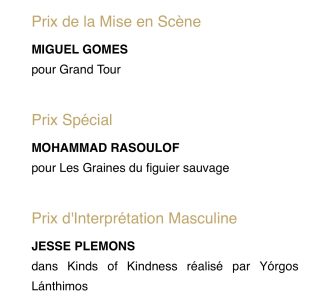
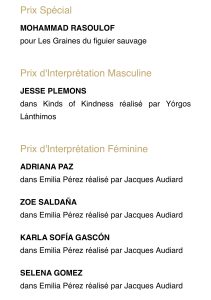
And then finally Jesse Plemons (as FBI investigator Tom White) shows up at the two-hour mark, and things start to pick up. But even then…

For one thing there’s no real Lily / Mollie catharsis at the end. No admonishments, no barking, no “how dare you?”

Even during her final scene with Leo / Ernest, after White has doubtless told her the full sordid truth about Leo’s conspiratorial complicity in the Osage murder spree as well as her own poisoning, Lily / Mollie can’t bring herself to slap or even scold that hayseed.

Instead she embraces Leo / Ernest and then her right palm gently touches the side of his face. Lily’s pained expression says, “I feel mostly pity in my heart for you, my poor dumb beef-bod yokel. You’re the lamb who went astray and saw to the deaths of my family and friends…poor little stupid baby.”

Not very dramatically satisfying, Lily, Leo and Marty!

Respect for Burt Young

Prior to yesterday’s announcement about the passing of Burt Young, I was honestly under a vague impression that he had passed 10 or 15 years ago.

I’m not saying this disrespectfully — I had just come to believe that Young, 83, had breathed his last during the Obama administration, or even before that. Somehow that driving-and-coughing death scene in that Sopranos episode (he played Bobby Baccalieri‘s cancer-ridden dad) had lodged in my memory as the real thing, or an omen of same.

Oh, and Young’s Chinatown character (“Curly”) wasn’t a “rotten client” of Jack Nicholson “Jake Gittes”, as THR’s Mike Barnes described him yesterday. Curly was actually a decent schlubby guy from Long Beach who helped Jake out in a pinch.

Young’s second most vivid performance was as “Bed Bug Eddie” in The Pope of Greenwich Village (‘84).

I know he played “Paulie” in all those Rocky movies, of course, but those were mostly paycheck gigs. Okay, the first one (in the 1976 John Avildsen-directed original) wasn’t — Young actually derived a Best Supporting Actor Oscar nomination out of that effort.

Young passed on 10.8, or a week and a half ago.

Billionaire’s Row

If you’re living in one of these soulless, pencil-thin glass towers on Central Park South, you are definitely suffering from a serious aesthetic deficiency — a condition some would call the wealthy Shallow Hal syndrome.

Rossen’s Dream Dashed

In other words, during filming of The Hustler director Robert Rossen developed the hots for female lead Piper Laurie, unaware that she’d been “seeing” critic Joe Morgenstern (aka “JoMo”). Just before filming ended Rossen offered Laurie a significant role (presumably the sensuous, mentally disturbed temptress that Jean Seberg eventually played) in Lilith, but the blood drained from Rossen’s face when Laurie said she was about to marry Morgenstern…gaahhh!

Stop Cillian Murphy

There is something truly skewed and bent out of shape about Best Actor contender Cillian “I walked with a zombie” Murphy having more predictive support from your damp-finger-to-the-wind Oscar spitballers (largely due to the fact that Oppenheimer surprised everyone by becoming a huge financial success) than The HoldoversPaul Giamatti, who gives a wonderfully snippy, peculiar, emotionally vulnerable, multi-faceted performance that blows the bloody door off…c’mon!

Plus Giamatti was robbed 19 years ago when his exquisite, time-honored Sideways performance as melancholy “drink and dial” Miles failed to land even a Best Actor nomination. How many times has Sideways been re-watched compared to Taylor Hackford’s Ray, in which Jamie Foxx played Ray Charles and was not only nominated but won the Best Actor trophy? Ray is a good film and Foxx (also nominated the same year for his taxi-driver performance in Collateral **) is excellent in it, but in the intervening years I haven’t given Ray a single solitary re-watch. How many times have I re-watched Sideways since the fall of ‘04? Oh, at least 10 or 12 and probably closer to 15.

** Since late ‘04 I’ve rewatched Collateral at least ten times.

Fincher Heroin

I loved David Fincher’s The Killer (Netflix 10.27)…a great escape film if I’ve ever seen and felt one. It took me out of myself and dropped me into a higher realm, or at least my idea of one. It redefines the meaning of the word “chill” in a way that will either knock you out or, if you’re an ideologue or a shoulder-shrugger or a constipated, closed-off type, leave you with shards.

It’s first and foremost about the supreme comfort of living in a super-clean, perfectly crafted Fincher film, and about the joy of being a ghost and travelling alone like a nowhere man, and about the blissful solitude and curious joy of disassociative technique…about the existential solace and solitude of having a wonderfully endless supply of fake IDs, fake passports and fake license plates, and maneuvering through flush and fragrant realms and the zen of nothingness…about the almost religious high of not giving a single, solitary fuck.

Despite sitting in a too-small Paris theatre seat (I could barely move my legs) and despite Fincher’s film starting almost a half-hour late, I was in heaven start to finish. It’s all about eluding fate and slipping the grasp, about playing a fleet phantom game and, much to my surprise and delight, about chasing down several unlucky functionaries and nefarious upper-caste types and sending them to God.

It’s about a side of me (and of Fincher, of course) that loves being on the move and managing to slip-slide away like Paul Simon but in a GOOD way or at least an extremely cool one…about being blissfully free of conventional entanglements and concerned only with slick stealth and ducking out of sight and, despite suffering a bruise or two, gaining the upper hand.

The Killer is about the joys of living a cold and barren life…it mainlines the hollow but feels like a kind of new-age opiate…it turned me on like Joni Mitchell’s radio, and I’m still feeling the buzz and humming the melody the morning after. I can’t wait to see it another two or three times, bare minimum.

Thank you, Mr. Fincher, for slipping me a great nickle bag of smack and what felt last night like the best meaningless-but-at-the-sane-time meaningful movie high I’ve had in a dog’s age.

“Ferrari” Is Authentic, Bruising, Searing Stuff

Michael Mann’s Ferrari (Neon, 12.25) has turned out to be much better than I expected.

A portrait of aging Italian car magnate Enzo Ferrari struggling to keep his business and family afloat at a highly critical juncture, Ferrari is “better” in terms of recreating the past and a very particular cultural milieu (mid to late ‘50s, northern Italy) and generally radiating a certain textural, visual and emotional verisimilitude that is rather wonderful in its own studious, deep-dish way.

I’ve been reading since last summer that Ferrari is a period racecar drama that doesn’t follow the expected plot contours and certainly not in the fashion of James Mangold’s 2019 Ford vs. Ferrari, another racecar saga which involved the same real-life character (played by Remo Girone) while set in the mid ‘60s, or roughly eight years after Mann’s story.

Ferrari is basically a torrid Italian family drama (Mann meets Luchino Visconti with a splash or two of Douglas Sirk salad dressing) about emotional and financial turmoil afflicting the embattled Ferrari, played by a nattily-dressed, white-haired, slightly paunchy Adam Driver.

Let’s not forget, of course, that two years ago a younger-looking Driver played another head of an elite, world-renowned, family-owned Italian company in Ridley Scott’s House of Gucci.

Let’s be honest — Joe and Jane Popcorn are going to say “this again?”

Given the Ferrari-Driver-Gucci overlap, I’m not sure how commercially vigorous Ferrari will turn out to be when it opens in late December. All I know is that despite the vaguely odd-duck, here-we-go-again factor, Ferrari works on its own compelling terms.

Ferrari is about an old man (Ferrari was born in 1898) entwined in a make-or-break struggle to keep his teetering car company afloat while preparing for a climactic, fate-defining cross-country race and while finessing a volatile family situation involving infidelity and conflicted loyalties.

It’s a great time-machine trip, intimate and low-key for the first three quarters but with a serious knockout finale. It’s culturally authentic (you really feel like you’re there) with a sturdy script and several nicely flavored performances…an ensemble piece that pretty much fires on all cylinders.

Ferrari really pays off over the last 35 to 40 minutes, which is almost all racing.

Penelope Cruz’s blistering, tough-as-nails, scorned-wife performance is a guaranteed Best Supporting Actress nomination lock.

Eric Messerschmidt’s cinematography is wonderful — it reminded me of Gordon Willis’s lensing of the first two Godfather films and Part Two in particular.

It’s basically 90 minutes of fractured family drama and a knockout crescendo showing the 1957 Mille Miglia, a decisive, hair-raising event in the fortunes of Ferrari’s precariously financed car company.

The domestic side is basically about Ferrari’s hands being full with Cruz’s angry wife Laura, Ferrari’s mistress Lina Lardi (Shailene Woodley), and loads of financial pressure and numerous wolves at the door.

Mario Andretti: “[Ferrari] just demanded results. But he was a guy who also understood when the cars had shortcomings. He was one that could always appreciate the effort that a driver made, when you were just busting your butt, flat out, flinging the car and all that. He knew and saw that. He was all-in. He had no other interest in life outside of motor racing and all of the intricacies of it. Somewhat misunderstood in many ways because he was so demanding, so tough on everyone, but at the end of the day he was correct. Always correct. And that’s why you had the respect that you had for him.”

I can’t think of a kicker ending so what I’ve written will have to do.

Read more

Bucks Up

Ferrari is generally in the high-middlebrow mode of The Insider or Ali more than the genre mode of Miami Vice or Blackhat. It’s largely a domestic drama with racing and auto manufacturing as the milieu. Yeah, it’s got racing scenes and an absolutely harrowing, mercilessly constructed racing accident climax. But if social media imbecile and Oppenheimer complainer Logan Paul sees the movie, he’ll likely bitch that it’s just Ferrari and his wife and mistress and drivers talking all the time.” — Glenn Kenny’s 8.31 Venice Film Festival review.

Knockout Vapid

Last night I saw about 65 minutes’ worth of Taylor Swift’s The Eras Tour, which runs 169 minutes. You can’t say I didn’t man up, buy the popcorn and give it the old college try. I didn’t hate it but it didn’t hook my heart or elevate my soul, and the more Swift sang and waved and strummed and strutted around and gave it up for her adoring, beaming and even tearful fans, the flatter I felt within.

As concert films go The Eras Tour is quite the visual power-punch (first-rate photography, editing, choreography, lighting design plus considerable personal charm and audience rapport) but aside from the fan-rapture aspect (95% younger white women) Swift’s act just doesn’t levitate. Or at least it didn’t in my situation.

I swear to God I sat down with an attitude of “okay, I’m here…let’s do it!” But it just didn’t connect.

Swift doesn’t have the greatest singing voice (it’s okay) and her country music origins put a damper on things. Her songs are rather flat and popfizzy and lacking in catchy, inventive hooks…they all kinda sound the same…no rivers of soul (not even streams of it)…confessional lyrics (ruptured romances, shitty boyfriends) but rendered without much in the way of edge or unusual style or anything “extra”…imbued with an unmistakably bland, girlygirl current, and a general lack of sophistication or complexity.

Swift is no Joni Mitchell-in-her-prime. Her songs seem to lack depth and intrigue.

I was engaged and studying the spectacle (which is fascinating in some respects) for the first half-hour but starting around the 45-minute mark I began to feel narcotized and then drained.

I nonetheless respect Swift’s energy and verve and swagger, and the Beatles-like following that she’s acquired over the last 16 or 17 years.

I was collecting my reactions in the AMC Westport lobby when a Manhattan-based journalist who’d also escaped at the one-hour mark (he’d been sitting two seats to my left) came over and said howdy. He’d been unable to snag a ticket to any Thursday night Manhattan showing and decided that a show in Connecticut was his best option.

We chewed things over for a half-hour or so. He felt roughly as I did about the film. “What’s the essence of Swift’s appeal?,” he asked. “Power,” I said. “The Swifties relate to who she is and where she’s been, and are really getting off on the bold persona and image…she’s a heroic figure in their eyes. It ties in, I think, with the Barbie explosion on some level.”

He had taken a Metro North train and then Uber-ed to the theatre, but didn’t want to see any more of the film. So I gave him a lift to the East Norwalk train station. Nice guy.

A respectful hat tip lo Eras Tour director Sam Wrench, director of photography Brett Turnbull and editor Don Whitworth.

Shot last August at Inglewood’s SoFi Stadium over a period of three nights, The Eras Tour is indisputably a huge cultural and commercial phenomenon. Swift-produced, Swift-starring, Swift-distributed (straight to AMC and Cinemark) and sure to pull down God knows how many hundreds of millions.

Everyone did a great job. It just wasn’t for me.

Friendo: “You’ve offered a reality-based corrective. The media is offering her a rubber-stamp rave. I think she’s got a number of very good songs like ‘Mean’, ‘I Knew You Were Trouble’ and ‘Shake It Off’ and — possibly her greatest — ‘Lover’.

“But you have to watch what you say if you have young daughters. You can’t come down on Taylor too hard, but I think her war against men is deplorable. And fundamental to her appeal. But I can’t say that in mixed company.”

HE: “I give her football player boyfriend (Travis Kelce) another couple of months. Okay, five or six months total.”

Friendo: “These men are just momentary accessories to her. Her message is basically ‘fuck men — they suck and we don’t need them’. In that sense, she’s doing her own bit to bring Trump back. All woke behaviors help the other side. Because the majority of people don’t want to vote for psychosis.”

Strange Submission

Friendo: “I’m confused.”

HE: “I’m catching it this evening at 6 pm. If Paul Schrader can find it in his heart, maybe I can too.”

Friendo: “Why on earth would you bother?”

HE: “It’s a cultural event. Like Barbie. I can’t ignore it. I can’t live in a cocoon. I have to open myself up to it.”

Friendo: “Do U like Taylor Swift? Ur gonna be crazy bored watching a concert movie in a theater.”