As far as I can recall there are only two films with a strong, recognizable musical theme or theme song…Elia Kazan‘s East of Eden (’55) and Robert Altman‘s The Long Goodbye (’73)…these two may be the only films in which the musical theme is sung or hummed by characters within the film itself.
Which means, obviously, that the theme was composed and performed before principal photography on these films began.
In Eden, Julie Harris hums Leonard Rosenman‘s main theme (which begins at the :40 mark in the below video), and in The Long Goodbye, a lounge singer croaks or croons John Williams and Johnny Mercer‘s “Long Goodbye” tune in the Hollywood bar in which Marlowe retrieves his messages.
There are probably other films that have operated this way, theme-song-wise — I just can’t remember them.
On a certain level I feel nearly ashamed for having this far failed to see Paul Greengrass‘s The Lost Bus, which began streaming yestetrday (10.3) on Apple TV Plus.
Back in the day not catching a new Greengrass film as early as possible would have been unthinkable. When I say “back in the day” I mean 2002 to 2007, or the time of Bloody Sunday, The Bourne Supremacy (the birth of shakycam), United 93 (a truly masterful 9/11 nightmare flick) and The Bourne Ultimatum.
For me the Greengrass brand weakened slightly with the arrival of Green Zone (2010), Captain Phillips (2013) and Jason Bourne(2016). It weakened a bit more when 2018’s 22 July came out, and then was damn near broken by 2020’s News of the World.
I was in Venice when The Lost Bus premiered at the 2025 Toronto Film Festival on 9.5.25. It was released in select NYC theaters on 9.19.23 (15 days ago). Decent reviews, favorable reactions, not even a slight burn. But Greengrass needs to deliver another United 93. He could have easily directed A House of Dynamite if Kathryn Bigelow hadn’t grabbed it first.
I’ll see Lost Bus tonight or early tomorrow. Reactions?
Progressives began to flee into the forest when Kamala Harris lost last November, and for now they need to stay there. Live in tents, wear animal hides for warmth, bathe in rivers, eat raw game and wild berries
Ezra Klein to Ta-Nehisi Coates: “In losing as badly as we have, we have imperiled trans people terribly…we’ve just begun to lose that argument terribly…and that has put people in real danger”
“‘[Because] a huge amount of the country, a majority of the country, believes things about trans people, about what policy should be toward trans people, about what language is acceptable to trans people, that we would see as fundamentally and morally wrong.’
Sullivan: “Bingo. Behind the rhetoric, the woke mindset still reigns.
“And let’s look at what Americans actually believe ‘about what policy should be toward trans people’: there are big majorities for allowing trans adults to transition to the sex they want, and for banning discrimination against them, which is now the law of the land, thanks to a Trump nominee. How is that ‘fundamentally and morally wrong’?
“According to Klein, it’s because even bigger majorities (a) oppose sex changes for children, (b) don’t want biological men competing against women in sports, and (c) believe that being male or female is a function of biology, not something entirely in your head.
“Disagree if you want, but why is this ‘fundamentally and morally wrong’? It just isn’t. Nor is it ‘fundamentally and morally wrong’ to undo the unprecedentedly reckless immigration policies of Biden and Boris.
“We’re not stupid. No amount of fake rhetorical moves to the center will work. When very basic things that most human beings take for granted — that foreigners are not citizens and citizens come first, that men are not women, that children are not adults — are deemed fundamentally immoral in one political party, that party deserves to lose.
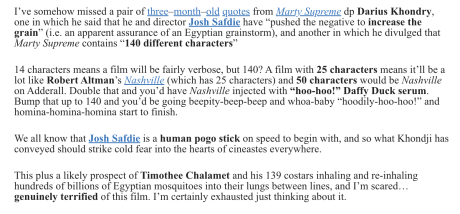
Josh Safdie‘s Marty Supreme (A24, 12.25) will have its big fat whammo debut via the New York Film festival on Monday, 10.6 at 8:30p pm…just shy of three months before it opens commercially.
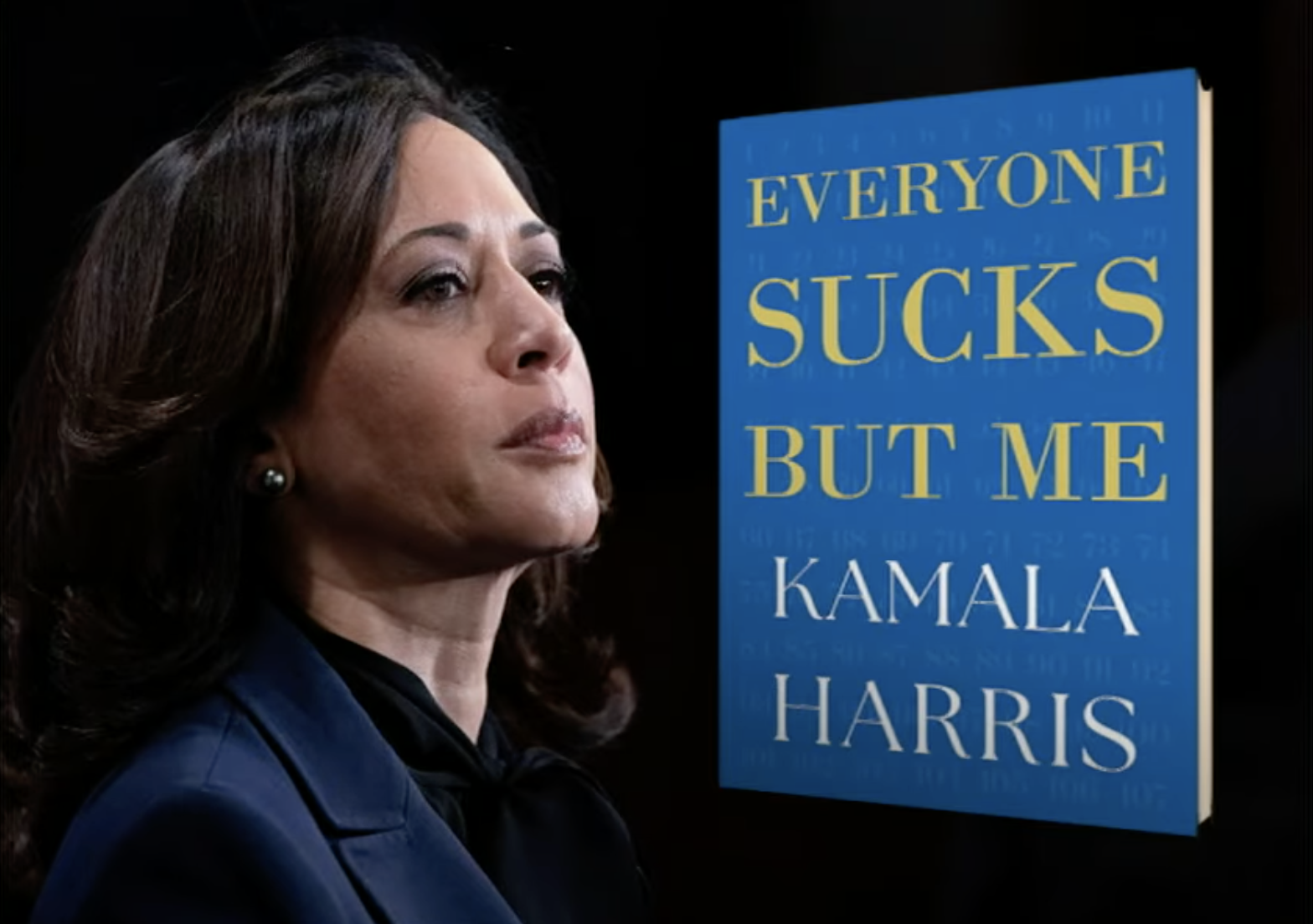
“Yeah, and a billion and a half dollars. And a built-in army of about 75 million people who’d vote for any human-adjacent life form that wasn’t Trump. But in ‘107 Days,’ nothing is ever Kamala’s fault.”
Didn’t particularly care for these Soderbergh trifles: King of the Hill, Solaris, Logan Lucky, Black Bag, Kafka, Let Them All Talk, The Girlfriend Experience, Bubble, Presence, No Sudden Move, Full Frontal, Bubble, The Good German, Side Effects, Unsane, The Laundromat, Let Them All Talk, Kimi. (17)
The absolute worst show, movie or presentation that Soderbergh has ever directed (or ever will direct for the rest of his life) was the 2021 Woke Oscars from Union Station.
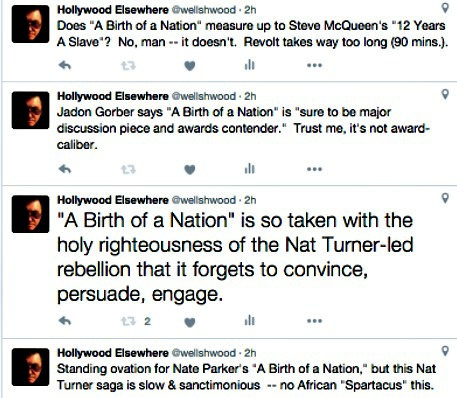
My Sundance pan of Nate Parker‘s The Birth of a Nation was posted nine and three-quarter years ago — 1.25.16.
Within an hour or so many confidantes wrote me or pulled me aside and said “why are you opening yourself up to charges or racism? Nate Parker is an industry hero and you post this? Do you have a death wish? Don’t you want advertising income from Fox Searchlight?”
I basically said that Parker’s film is decent here and there and definitely impassioned, etc., but it’s finally a mediocre effort that strives to “sell” and “act” misery rather than simply being or exuding it. It’s basically an ambitious Starz movie.
1.25.16: One of the biggest self-congratulatory circle jerks and politically correct wank-offs in the history of the Sundance Film Festival happened late this afternoon when Nate Parker‘s heartfelt but sentimental and oppressively sanctimonious The Birth of a Nation ended and the entire audience rose to its feet and began cheering wildly, even ecstatically.
This is a sentimental, briefly stirring, Braveheart-like attempt to deify a brave African-American hero — Nat Turner, the leader of a Virginia slave rebellion in August 1831. But a black Braveheart or Spartacus this is not. Nor is it, by my sights, an award-quality thing.
The Birth of a Nation delivers a myth that many out there will want to see and cheer, but don’t kid yourself about how good and satisfying this film is. It’s mostly a mediocre exercise in deification and sanctimony. I loved the rebellion as much as the next guy but it takes way too long to arrive — 90 minutes.
Parker, the director, writer and star, sank seven years of his life into this film, and invested as much heart, love and spiritual light into the narrative as he could. But the bottom line is that he’s more into making sure that the audience reveres the halo around Turner’s head and less into crafting a movie that really grabs and gets you, or at least pulls you in with the harsh realism, riveting performances and narrative, atmospheric discipline that made Steve McQueen‘s 12 Years A Slave an undisputed masterpiece.
As noted, Parker doesn’t seem to even respect the fact that he needs to deliver the historic rebellion (i.e., horribly oppressed African-Americans hatcheting white slave-owners to our considerable satisfaction) within a reasonable time frame, which would be 45 minutes to an hour, tops. Kirk Douglas and his fellows broke out of Peter Ustinov‘s gladiator training school around the 45-minute mark.
I realize that the Turner-led slave rebellion was suppressed within two days, but in Parker’s movie it’s over before you know it. I’ve been waiting 90 minutes for the rancid whiteys to get their comeuppance, and Turner’s small army is surrounded and defeated within 15 minutes? That’s not satisfying, dude. No way would Douglas and Stanley Kubrick have kept their gladiators in Capua for 90 minutes and then had Laurence Olivier‘s Crassus defeat them within a quarter of an hour.
You can call me a whitey for referencing Spartacus but The Birth of a Nation has been cut from the same basic cloth.
In HE’s version Turner doesn’t wear a halo and is given qualities that make him less of a saint and more of a tough, flesh-and-blood, hard-knocks guy. The land owner injustices and atrocities simmer for about an hour, and then the rebellion kicks in with Turner and his army getting their bloody revenge and doing their best to fight the law and the white militias for the second hour, and then the capture, execution and wrap-up for the last 10 or 15 minutes. And no religious ceremonies, no angels, no choir music and no apparitions….just stark realism.
If you ask me the Sundance hipster smooch brigade went to The Birth of a Nation determined to celebrate it as much as possible. The idea, trust me, was to demonstrate to the world and particularly to the slow-to-get-it crowd in Los Angeles how much hipper, cooler and sensitive they are regarding the 21st Century African-American experience and particularly how much wiser they are than the unfortunate Academy attitudes that resulted in OscarsSoWhite.
Full disclosure: I’ve never sat down and actually watched D.W Griffith‘s The Birth of a Nation (1915).
I’ve watched clips, of course, and I’ve been reading all my life, of course, that aside from its landmark status as the first epic-sized movie ever produced, Birth is almost certainly the most reprehensibly racist film ever made, first and foremost from its ugly depictions of African Americans plus the glorifying of The Ku Klux Klan as a heroic force that “protects white women and maintains white supremacy”.
Truly rancid stuff, complete acceptance, no question.
I’m therefore not in a position to authoritatively agree with or dispute John Nolte‘s Breitbart.com review of One Battle After Another, in which he calls it a grand inverse of Griffith’s film with PTA’s Antifa-like resistance depicted in the same semi-glorious, semi-heroic terms used by Griffith to portray the KKK.
Note has trudged his way through Griffith’s film so he’s ahead of me in this respect.
Is this a fair comparison? Or a less-than-fair one? Either way it’s certainly worth kicking around.
“One Battle After Another is basically an inverted remake of D.W. Griffith’s racist 1915 masterpiece, The Birth of a Nation.
[HE interjection] Militant reps of one race of people (in Battle’s case, the white race) are (back to Nolte) “portrayed as inferior — stupid or pure evil. Militant reps of another race — i.e., black female reps who command the French 76 — are portrayed as moral, brave, capable, and on a righteous mission to save America from that inferior race.
“Battle’s central plot is even the same as Birth of a Nation’s: saving an innocent girl from possible harm by ugly reps of the inferior race.
“The comparisons do not end there.
“Both movies are too long. Both have great moments. Both are brought to us by master filmmakers of their era. Both exalt and legitimize terrorism. Both are indefensible and amoral.
“Nevertheless, One Battle After Another is something of a comeback for writer-director Paul Thomas Anderson, his first decent movie since 2007’s There Will Be Blood.
“After the incredible winning streak of Hard Eight (1996), Boogie Nights (1997), Magnolia (1999), Punch-Drunk Love (2002), and There Will Be Blood (2007), Anderson dropped four self-indulgent hard-sits in a row: The Master (2012), Inherent Vice (2014), Phantom Thread (2017), and Licorice Pizza (2021). Those first five, I can watch again and again (and have). One watch was more than enough with the final four.
“For all of its moral and storytelling flaws, One Battle After Another moves and entertains, at least in certain stretches.
“Battle is definitely a woke movie: full of black girlbosses and white guys who are either hapless sitcom dads or virulent racists. The legions of villains (all white) are obvious stand-ins for [HE-redacted] the ICE brigade. The good guys are violent, leftist Antifa-style revolutionaries.
“Battle opens 16 years ago, when the French 75 (i.e. Antifa) were on a bombing rampage. “Ghetto” Pat Calhoun, aka Bob Ferguson (Leonardo DiCaprio), is a jumpy, over-excited, immature explosives expert who takes orders from the brave, competent, and stoic black women who really run things. This includes Bob’s lover, Perfidia Beverly Hills (Teyana Taylor).
“A French 75 raid to liberate a California ICE facility introduces Perfida to Col. Steven J. Lockjaw (Sean Penn). He’s a racist, but her sexuality immediately warps him. She also finds herself attracted to him. They end up having something like an affair. One of the movie’s flaws is that you feel no connection between Perfidia and Lockjaw or Perfidia and Bob.
“Sixteen years later, Perfidia has disappeared, and Bob is a useless stoner hiding out in California with his 16-year-old mixed-race daughter, the smart, mature, and capable Willa (Chase Infiniti). Meanwhile, the insecure Lockjaw is desperate to feel special, appreciated, and respected by something called the Christmas Adventurers Club — a secret group of super-wealthy, influential, and dangerous white supremacists.
“At this point, about an hour in, the plot finally came to life. To become a Christmas Adventurer, Lockjaw must cover up his interracial affair with Perfidia, so he begins to hunt down Bob and Willa.
“With the hunt on, there’s action and humor, and the characters begin to form into something more than social, racial, and political symbols. And so, by the time the lights come up, you end up sympathizing with the characters, especially (and surprisingly) Penn’s Lockjaw.
“Battle’s MVP is unquestionably Benicio del Toro’s Sergio St. Carlos, a martial arts instructor who smuggles illegals into America (the movie never explains why anyone who cares about Mexicans would smuggle Mexicans into a country run by fascists and racists). Del Toro’s quiet and subdued (but still hilarious) Ying to DiCaprio’s neurotic and incompetent Yang lifts Battle into something special. Ocean waves. Ocean waves.
“Although it dragged at times, for the last two hours, the story was mostly engaging. What I hated was the plunking piano score and an ending that celebrated the terrorism of Antifa. Until then, the story had been on the road to redemption as a family story, so buttoning things up on this amoral note left a sour, Birth of a Nation-ish taste.
“One Battle After Another desperately wants to earn comparisons to the 1966 leftist masterpiece The Battle of Algiers, director Gillo Pontecorvo’s stunner about a real-life revolution against the French government. Anderson is so self-consciously desperate for this comparison, we watch DiCaprio get high and watch the movie.
“[But] if Anderson were honest, he would’ve had DiCaprio’s character get high watching Birth of a Nation. That’s a legitimate comparison. Battle’s plot, racial politics, and exalting of terrorism are as grotesque as Birth’s.
“From a pure storytelling point of view, OBAA is a failure. Because once you crack Battle’s racial code, there are no surprises.
“Nevertheless, both Battle and Birth have their moments, and it would be dishonest not to say so.
Post–script (Nolte to HE) — “When I say in the review that once you crack the racial code it becomes predictable, one example is that I knew, because he wasn’t white, that the older, heavy-set Native American guy with the wise, patient expression [name?] would try to save Willa.
“Plus that ending with Leo handling an iPhone like a retarded ape while strong, confident, brave Willa leaves for Oakland to fight alongside Antifa as the film closes with Tom Petty‘s ‘American Girl’ as accompaniment. Man alive!…”
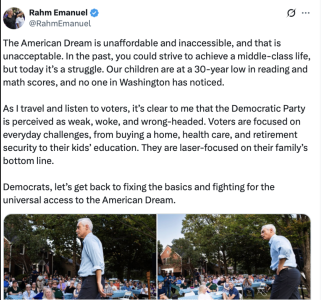
Democrats haven’t even begun to acknowledge that average voters not only hate their woke attitudes and sensibilities, but want to punish them for years to come for trying to impose this lunatic theology upon the U.S.A.
Only a sensible left-center male (i.e., Newsom or Emanuel) has a chance of landing the 2028 Democratic nomination and defeating J.D. Vance, and that’s an optimistic belief.
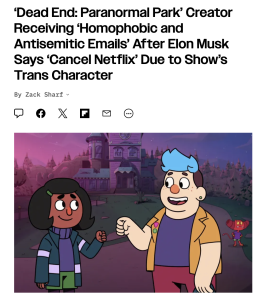
Dead End: Paranormal Park was a 2022 Netflix animated trans-propaganda series for kids. It concerned a 17-year-old gay and transgender Jewish American boy who runs away to the theme park because of a “complicated” relationship with his family.
It ran for two seasons, launching on 6.16.22 and ending on 10.13.22. The show was canceled by Netflix in January 2023. Creator Hamish Steele confirmed the news on social media after the second season aired in October 2022.