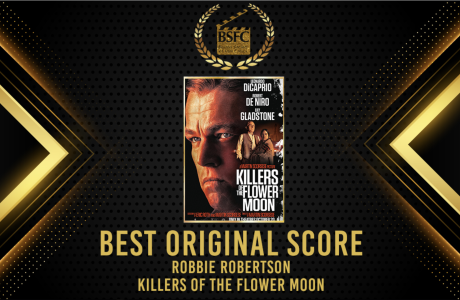
Did you know that the late Robbie Robertson, who composed the metronomically rythmic tom-tom score for Killers of the Flower Moon, waas born with Native Anerican blood? His mother, Rosemarie Dolly Chrysler, was a blend of Cayuga and Mohawk, and was raised on the Six Nations of the Grand River reserve southwest of Toronto.
And did you know that Robertson’s score stands completely on its own, and that his ethnicity means very little if anything in terms of the final impact? His music understands what Killers is about more than this torn and confused film knows itself. The Best Score Oscar is Robertson’s to lose. The work, not the blood.
Carey Mulligan and Michael Fassbender are obviously fine, gifted, thoughtful and certainly insightful artists….two youngish people in theh absolute fullness of their lives. But these Variety encounters are nonetheles vapid. Because they’ve been instructed (and have gone along with the instruction) to keep it fleet and zippy and mutually flattering and whatnot, and if you miss one of these conversations you’re fine. If you’ve seen their respective award-season films (Maestro and The Killer), you’ve got what you need. They’re both perfect.
A dissolve is when a shot fades and surrenders visual presence in order to transition to a subsequent shot that takes over. This clip from Shane is not that. This a shot of a gunslinger (Jack Palance‘s “Wilson”) quickly fading into a ghost — literally nothing — and then physically re-appearing three or four seconds later. He disappears in order to make a point (yo soy Senor Creepy), decides that the point is made, and then rematerializes into flesh, blood, bone, boots, hat and gunbelt.
A 12.6.23 N.Y. Times piece about the dissolve, a classic but all but abandoned cinematic transition device, was posted a couple of days ago by M.D. Rodrigues. The article mainly focuses on Alexander Payne‘s elegant and artful dissolves in The Holdovers.
“Each dissolve is a dawdling ellipsis,” Rodrigues explains. “Over its course, feelings develop or disperse; life happens or doesn’t. With its slow, valedictory air, a long enough dissolve evokes the momentum of real experience.”
“One thing is going away, another thing is coming in,” Payne has observed. “I can’t explain it, but there’s something poetic and melancholy about it.”
But near the start of Hal Ashby‘s The Last Detail, however, a dissolve is used for comic effect. I chuckle each time I watch it.
Otis Young‘s “Mule”, an in-transit sailor, is ordered to report to the master-at-arms (i.e., top sergeant). “Tell the M.A.A. you couldn’t find me,” Mule tells the lower-ranked messenger. “”He knows where you are,” the seaman replies. “Oh yeah?….when you’re in the Navy, shirtbird, and in transit, nobody knows where the fuck you are so go tell that F.A.A. to go fuck himself, I ain’t goin’ on no shit detail.”
What’s funny is how Ashby starts the slow dissolve before Mule has fully delivered his rant. It begins as Mule says “so tell that F.A.A. to go fuck himself,” as if Ashby is saying to the audience “this isn’t worth your time…he’s just blowing off the usual steam…just another pissed-off sailor…blah blah.”
I remain semi-mystified why the fix has been in on Justine Triet‘s Anatony of a Fall. It won the Palme d’Or in Cannes last May, the momentum kept building after the early fall fall festivals, and now it’s swept the European Film Awards in Berlin, taking Best European Film, Director, Screenplay and actress for Sandra Hüller.
It’s an approvable film within its own realm, but it’s not earth-shattering. It’s been overpraised from the get-go. Sometimes you can just tell that critics and industry voices decided to give a certain film is getting a pass because it exudes the right kind of social bonafides, and that’s that. A strong feminist imprimatur.
Anatomy of a Fall is a thorough, exacting and meticulous (read: exhausting) “what really happened?” exercise by way of a courtoom procedural, and is certainly smart and interesting as far as it goes but let’s not get carried away…please.
Sandra Huller is excellent as a bisexual writer accused of murdering her angry, pain-in-the-ass French husband (Samuel Theis), but the film goes on for 152 minutes, and the cloying kid playing Huhler’s half-blind son (Milo Machado-Graner) lays it on too thick, and the loud and relentless playing of an instrumental cover of 50 Cent’s “P.I.M.P.” drove me fucking nuts. The more I heard it, the more angry I felt…”Why is Triet making me listen to this over-loud track over and over?”
Another highly dubious declaration from Richards: “What makes Anatomy of a Fall so compelling is that Triet and Arthur Harari’s script has you constantly battle with yourself over whether or not you believe in Sandra’s innocence.” Not so! No battle! I was never even faintly persuaded that Huller might be a murderer…not for a minute.
Ryan O’Neal has died at age 82, presumably from cancer. It feels unsettling to acknowledge (or remind ourselves of the fact) that death doesn’t fool around, and because…well, a half-century ago O’Neal was quite the hotshot with golden-amber hair and a Prince of Malibu title and all the rest of it.
On 8.4.19 I wrote that I preferred to think of O’Neal as the guy he was in the early to mid ’70s, when things were as good for him as they would ever get.
I had two minor encounters with O’Neal in the ’80s.
The first was after an evening screening of the re-issued Rear Window** at West L.A.’s Picwood theatre (corner of Pico and Westwood) in late ’83. As the crowd spilled onto Pico O’Neal and his date (probably Farrah Fawcett) were walking right behind me, and I heard O’Neal say “that was sooo good!” Being a huge Alfred Hitchcock fan, this sparked a feeling of kinship.
Four years later I was a Cannon publicity guy and charged with writing the press kit for Norman Mailer‘s Tough Guys Don’t Dance, which didn’t turn out so well. I for one, however, liked Mailer’s perverse sense of humor.
I did an hour-long phoner with O’Neal, and my opening remark was that he was becoming a really interesting actor now that he was in his mid 40s with creased features. He was too good looking when younger, I meant, and so his being 46 added character and gravitas. O’Neal was skeptical of my assessment but went along — what the hell.
In fact O’Neal’s career had been declining for a good five or six years at that point. He knew it, I knew it — we were doing a press-kit-interview dance because there was nothing else to say or do.
O’Neal’s last hit film had been Howard Zeiff and Gail Parent‘s The Main Event (’79), which critics panned but was popular with audiences. He had starred in four mezzo-mezzos before that — Peter Bogdanovich‘s Nickelodeon (’76), Richard Attenbrough‘s A Bridge Too Far (’77), Walter Hill‘s The Driver (’78) and John Korty‘s Oliver’s Story.
O’Neal’s career peak lasted for five years (’70 to ’75) and was fortified by a mere four films — Arthur Hiller‘s Love Story (’70), Bogdanovich’s What’s Up Doc? (’72) and Paper Moon (’73), and Stanley Kubrick‘s BarryLyndon (’75). (The Wild Rovers and The Thief Who Came to Dinner, which O’Neal also made in the early ’70s, were regarded as mostly negligible and therefore didn’t count.)
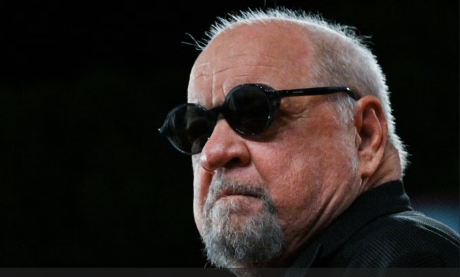
Geoffrey Mcnab’s 12.8 Independent interview with Paul Schrader is a good read, but it’s paywalled. I’m not a subscriber but have managed to read it anyway. I don’t think I should share the link…sorry.
Last night I watched the first two episodes of Jeff Pope‘s Archie, a four-part Britbox miniseries about the inner turmoils and insecurities of Cary Grant. I’d read some weak reviews and didn’t expect much, and during the sit I was trying to imagine such a series looking or feeling more inauthentic.
You can really feel a certain communion —- vibes, textures, atmospheres — with ‘50s Italy in MichaelMann‘s Ferrari, for example. Archie rarely ventures beyond the banal and mundane and superficial.
Laura Aikman‘s Dyan Cannon aside, nobody even vaguely resembles the characters they’re playing. It’s almost all third-string. Pope makes no attempt to make the mid-20th Century dialogue sound like it was spoken back then — his script is riddled with 2023 slang expressions and attitudes, which is awful.
But it’s not altogether awful.
Pope’s view (shared by biographers) is basically that once Grant finally got going as a movie actor in the early 1930s, he faked it left and right and gradually came uo with the wryly debonair “Cary Grant” — an alternate personality that was mostly divorced from the anxious, insecure guy he actually was.
I like the fact that Archie adventurously time-jumps all over the place — British childhood, snowy-haired finale, 20something years, late middle age…here, there, everywhere.
The first-rate Jason Isaacs doesn’t begin to resemble Grant, but he does a half-decent job of inhabiting or recreating certain aspects of Grant’s charming but shifty nature. Most of the time you’re thinking “this is too low-budget, too sloppy and slipshod” but now and then it’s interesting.
Received this morning from Bill McCuddy: “Finally caught up with Todd Haynes‘ May December last night…this after reading that Owen Gleiberman and Peter Debruge have it on their Top Ten lists, and then I saw that Vanity Fair‘s Richard Lawson has it at number one.
“I’d heard it was actually bad. It’s not, but where some critics are seeing subtlety- — except for the goofy soap opera music jolts — I saw missed opportunities.
“There are definitely spoilers here so HE readers be warned.
“1. I’d have made Natalie Portman‘s character more obsessed with Julianne Moore‘s character. Parrot her more than she does. Have her dress like Moore earlier in the film.
“2. I’d have had Portman say she’s also a producer on the film and continually reassure the couple (Moore and the much-younger Bruce Melton) that they will be portrayed truthfully and sympathetically, only to have Moore find a copy of the script and realize it’s not that, and in fact borders on a sleazy takedown.
‘3. Late in the second act I would reveal that the movie Portman is supposedly making has actually been put in turnaround or cancelled altogether and Portman went to Savannah anyway. Way creepier.
“4. Instead of sleeping with Portman’s character, I would have had Melton rebuff her, fueling her anger and disillusionment.
“5. I’d have ended the film not with a scene from the real (not in my version) movie but instead from a faux-documentary about what happened when Portman’s character came down there.
“The basic idea that anyone in that Savannah-region hamlet might still gave a shit about something that happened 25 years ago (i.e., a May Kay Letourneau trauma) is a ludicrous premise. In Hayne’s version the whole family is still living with the affair. So is the whole town. They’re still buying her cakes out of sympathy 25 YEARS LATER?! Bullshit.
“The real tension in the movie should be that all the horrific attention they got 25 years ago is gonna come back. It’s long gone and over with in my version.
“Finally, and this is a small nit, but where in the hell did they get the money for that waterfront resort island house? Reading X-rays and baking Gingerbread men? Uh, no. I saw that house in the first few frames of the movie and thought ‘well, at least they sued someone like Fox News and got a lot of money’ but nope.”
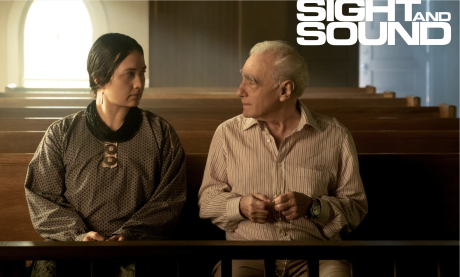
They know that Martin Scorsese‘s Killers of the Flower Moon is not one of his top-tier films. They know it’s basically a woke movie, a guilt-trip thing. They know that it has no character viewpoint other that “century-old Oklahoma white guys bad.” They know that Scorsese and Eric Roth decided to more or less abandon FBI agent Tom White, the central figure in David Grann’s 2017 book, in favor of Leonardo DiCaprio‘s dumbshit Ernest Burkhart, who isn’t worth the effort.
They know all that and voted Killers as the year’s top film regardless. Because they wanted to proclaim their belief and investment in the redemption narrative. It’s their way of saying “we get it Marty…you did your best under the circumstances and understandably felt that you couldn’t go with White as the champion…we get it and we support you and are on your side despite the fact that if we were voting on merit alone we wouldn’t have chosen Killers….you get that and so do we…plus we absolutely believe in the metaphor of Lily Gladstone‘s identity campaign for Best Actress…all hail our recognition of past sins and our attempt at absolution or at least forgiveness.”