Hollywood Elsewhere flies to Copenhagen around dinner hour on Saturday, 8.23 (48 hours hence). Two days later my Milan train arrives at Venice’s Santa Lucia station at 4:40 pm Monday (8.25). I’ll be in the pad by 6:30 pm or so, after which I’ll quickly hop on a vaporetto to the Lido Casino to pick up my press and vaporetto pass, probably by 8 pm or thereabouts.
Like everyone else, this morning I reserved my press and industry tickets for the first three days of the festival (8.27 thru 8.29). I got tickets to everything I wanted to see except for Luca Guadagnino‘s After the Hunt, which I didn’t pounce on quickly enough.
And now I’m blocked from attending the two big press screenings on Thursday (8.28) evening…the one Venice film I was most looking forward to and I can’t get a ticket…terrific!
I’ve asked a couple of well-connected pallies for some help in this regard….here’s hoping.
HE to Venice press office: “Are there any plans to schedule a spill-over screening of After The Hunt for slowboat douchebags like myself? Anything you could do would be greatly appreciated. Thanks!”
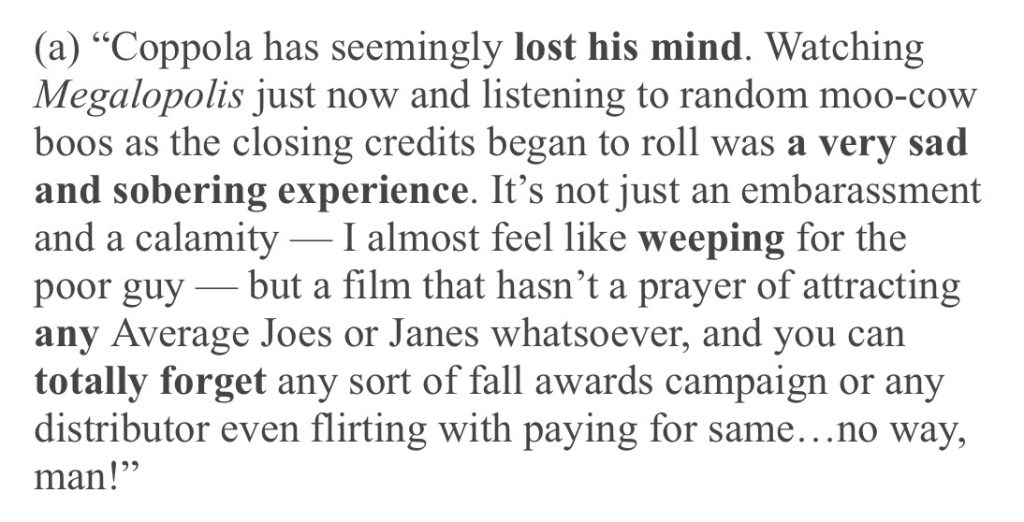
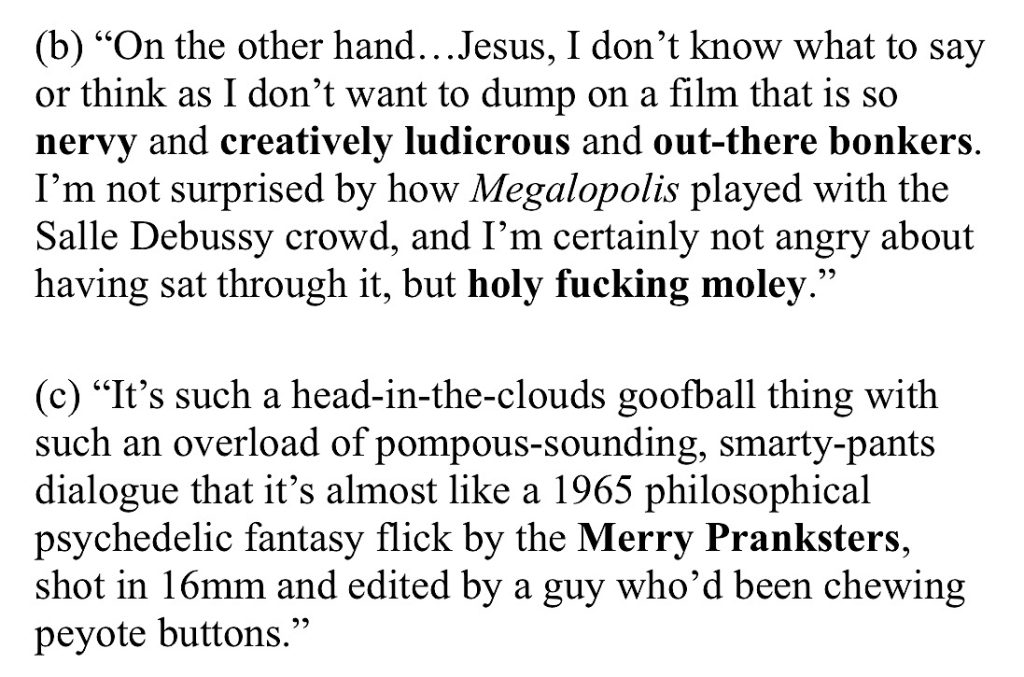
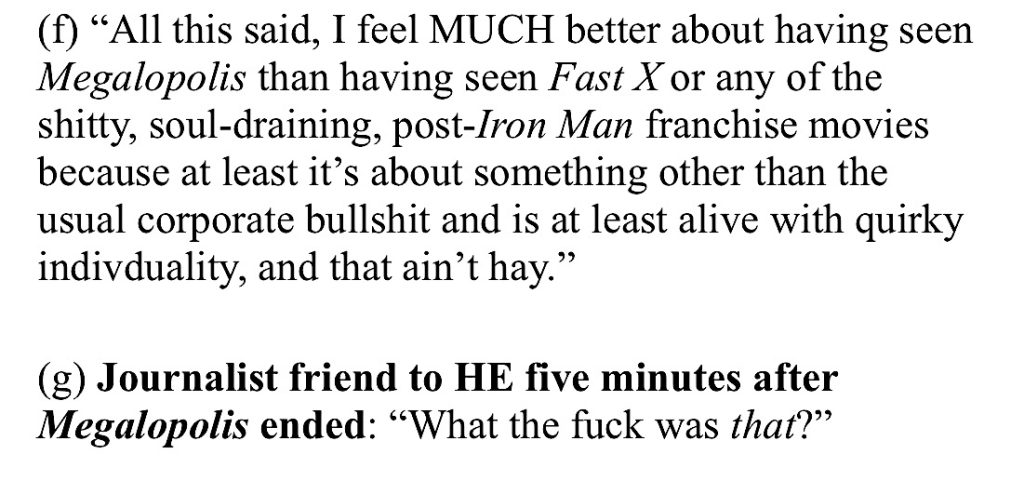
…want to sit through this thing? Francis Coppola has been doing his Megalopolis Foghorn Leghorn routine since the early spring of ’24, and I can’t imagine how Mike Figgis‘ Megadoc wouldn’t be more of the same.
Megadoc is debuting at the Venice Film Festival (which launches on Wednesday, 8.27). I for one will be taking a respectful pass.
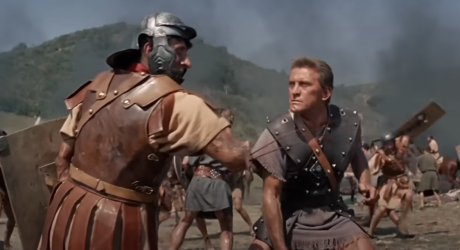
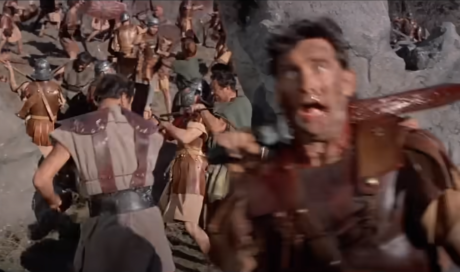
The climactic battle scene in Stanley Kubrick‘s Spartacus (’60) ends with a poignant, Viva Zapata metaphor…a lone thoroughbred galloping away from the carnage [8:26]. The horse makes this sequence….he brings it home.
…you know the movie is going to be a bit of a chore to sit through, unless it’s been directed by Alice Rohrwacher. You also know he’ll be playing a guy who wears the same pair of smelly socks two or thee days in a row. One look at O’Connor and a certain Paul McCartney lyric comes to mind…”man, I can smell your feet a mile away.”
Because The Mastermind, which I sat through several hours ago, is basically about a married, middle-class, not-smart-enough jerkoff — Josh O’Connor‘s James Blaine Mooney, or “JB” — being so inept at organizing a theft of some Arthur Dove paintings from a museum in Framingham that he’s unmistakably in the running for the sloppiest felon in motion picture history, and I mean right up there with Al Pacino‘s Sonny Wortzik in Dog Day Afernoon.
We know going in, of course, that Reichardt doesn’t do genre stuff and that The Mastermind, which is being praised, of course…we know her film will be exploring something else. It certainly isn’t Rififi, for sure. But what is it?
Reichardt is primarily interested in JB’s life being blown to smithereens when the half-assed robbery goes wrong. But why? Is it about JB’s subconscious attempt to punish himself for marrying Alana Haim‘s Terri and having two boys with her and…I don’t know, feeling trapped by this? Is he looking to thumb his nose at his straightlaced parents (played by Bill Camp and Hope Davis)?
It certainly seems to be about a form of convoluted self-destruction.
JB winds up on the run, penniless, scrounging around, snatching an old lady’s cash-filled handbag and finally being arrested during an anti-war demonstration. But to what end?
The Mastermind asks “how would a born-to-lose guy go about escaping from his life?” Suicide would be the simplest way, of course, but JB seems to lack the necessary character and conviction to put a pistol in his mouth. If he wants to join up with some hippies and run away to Hawaii or Mexico or Central America, why doesn’t he just do that? Why go to the trouble of hiring a pair of young fuck-ups to steal the paintings, knowing that in all likelihood one or both will eventually screw up and get popped and rat him out?
All I know is that The Mastermind has a little story tension going on during the first 75 minutes or so, but once the jig is up and JB goes on the lam, it has nowhere to go. The last shot of JB in a police paddy wagon conveys a little something, but the film basically peters out.
I don’t want to say any more. The film isn’t dull or uninteresting — O’Connor is always good in a grubby, glint-of-madness sort of way — but it’s basically a wash. For me, at least, but then I’m not a cultist.
I wasn’t exactly afraid of any chowing-down scenes, but I knew I’d be a wee bit antsy about anything too graphic. I mainly wanted The History of Sound to be as good as Luca Guadagnino‘s Queer, but I knew this would be a tall order.
I emerged from a Debussy press screening of The History of Sound about an hour ago, and my initial reaction, much to my surprise, was “where’s the vitality…the primal passion?”
I’m not saying I wanted to see Mescal lick up more cum droplets (as he did in All Of Us Strangers), but there hasn’t been a more earnestly delicate, suppressive, bordering-on-bloodless film about erotic entanglement since David Lean‘s A Passage to India (’84) and before that Alfred Hitchcock‘s Marnie(’64).
Come to think of it, Marnie at least has that one scene when Sean Connery rips off Tippi Hedren‘s bathrobe, leaving her buck naked.
A History of Sound delivers a welcomely non-graphic sex scene early on, but that’s all she wrote.
The History of Sound is a gay romance made for older straight guys like me, I suppose, but even I was thinking “Jesus, I never thought I’d complain about this thing being too tasteful and hemmed in.”
Variety‘s Owen Gleiberman has called it “listless and spiritually inexpressive…Brokeback Mountain on sedatives.”
The heart of the film is when lovers Lionel (Mescal) and David (O’Connor) go hiking around rural Maine in boots and backpacks and carrying a wax cylinder sound-recording device, the idea being to record rural types singing folk tunes.
Except this happens in the winter months, and if you’ve ever been to Maine between December and late April…well, c’mon! Not to mention the lack of bathtubs or showers on such a trek, which means smelly feet and gunky crotch aromas after a few days. Who the hell would do such a thing? During the summer maybe…
O’Connor’s role is smaller than Mescal’s but the former exerts more feeling somehow…more command. Mescal’s Lionel is supposed to be a native Kentuckian, but he doesn’t sound or look country-ish. (Imagine if he’d played Lionel in the manner of Gary Cooper‘s Alvin York, who hailed from Tennessee around the same time.)
Mescal is basically playing a master of emotional constipation who doesn’t behave in a manner that suggests “1920s gay guy”…he’s very, very committed to keeping it all buttoned inside…the relationship with O’Connor’s David is highly charged and drilled, and yet they part company and Lionel moves to Italy and then England to teach music.
And then, while in England, Lionel flirts with the idea of being in love with with Emma Canning‘s Clarissa, a to-the-manor-born British lass who seems to love him unconditionally, only to blow their relationship off in order to return to Maine and possibly hook up with David again.
Which is totally nuts, of course. There was no percentage in living an openly gay life in the 1920s, so the smart move for Lionel would have been to marry wealthy Clarissa and, in the manner of Heath Ledger‘s camping trips with Jake Gyllenhaal in Brokeback Mountain, visit O’Connor for annual vacations and whatnot.
If (a) you can’t pronounce the fecking title, (b) you don’t even know what it fecking means, and (c) the trailer is selling a downhead gloom vibe, the movie is fecking dead in the water.
Sorry, mate, but aside from the “reclusive Daniel Day Lewis returns to the screen” factor, Anemone (Focus Feautres, 10.3) is a fecking suicide mission.
Directed by the cherry-haired Ronan Day-Lewis…here’s hoping it’s a film of substance.
Watching the gray and grizzled DDL do his usual intense-darkman thing will, of course, be worth the price of admission for hardcore cinefiles, but Joe and Jane Popcorn will shine this thing so fast that Ronan and DDL’s heads will spin.
The jowly-faced Sean Bean (remember when he was lean-faced in Patriot Games?) appears to be the principal costar. Samantha Morton, Samuel Bottomley and Safia Oakley-Green also appear and presumably act.
You’re sitting down and interviewing (or simply speaking with) a somewhat older and certainly more famous fellow than yourself, and as the conversation is winding down he affectionately, quickly, semi-aggressively grips your knee.
That’s a gesture of courtly approval — it means that you’ve passed inspection.
I don’t know how many times this has happened to me personally, but I’d say a few. I’m thinking in particular of a 1999 Toronto Film Festival party for TheLimey, and hanging for a half-hour or so with the great TerenceStamp. As the party was ending and we were all starting to disengage, Stamp gave me a nice fatherly knee-grab — not too gentle, not too aggressive, right in the middle.
I can’t honestly say I’ve ever knee-gripped some younger guy. I tend to prefer shoulder grips or upper back pats.
I’m getting distinct Leaving Las Vegas vibes from this trailer for Edward Berger‘s Ballad of a Small Player (Netflix, 10.15). Honestly? I’m not looking forward to this.
Would I rather re-watch Josef von Sternberg and Nicholas Ray‘s Macao? Yes.
“The son of a vacuum cleaner salesman from Croydon, Lord Doyle has more reason than most to want to shed his wealth. It is loaded with the guilt of ill-gotten gains.
“As a lawyer back in England, he fleeced an elderly widow; now he has fled the country, hiding out in Macau, mainland China’s Las Vegas, across the bay from Hong Kong. The casinos he inhabits resemble fantasy versions of the European culture he has deserted, with names such as The Greek Mythology and The Mona Lisa: schmaltzy, sham palaces as tinselled as anything in Nevada.
“His game of choice is punto banco baccarat, ‘that slutty, dirty queen of casino card games’. It is the game Bond plays in Casino Royale (though in the film it was replaced with poker), the game of instant death, the guillotine. It is a game of no skill or strategy, the card-game equivalent of tossing a coin. The only hope the punter has is in the timing and pacing of his bets. But Doyle cares little for winning or losing. His life seems given over to the laws of chance, as though he were trying to gamble himself out of existence.
“The beauty of this novel is in the elegance and precision of its prose, which renders the glaring kitsch of Macau into a series of exquisite miniatures, and draws on Osborne’s reserves as a travel writer. The problem is that, apart from Doyle himself, there is no one else in the novel of much interest — the casino staff, the expat colleagues, the remembered family and friends back home: none of them comes to life with any conviction. The story itself begins to feel as though it is on a loop as the money comes and goes.
“Even when Doyle carries his winnings to his room in seven suitcases stuffed with cash, that isn’t the end of it, and one tends to lose interest in how many times Doyle goes from bankruptcy to riches and back again.”
HE is okay with Anya Taylor Joy playing the young Joni Mitchell in Cameron Crowe‘s forthcoming biopic (per Jeff Sneider’s scoop), but Amanda Seyfried would have been a much better choice. Obviously.
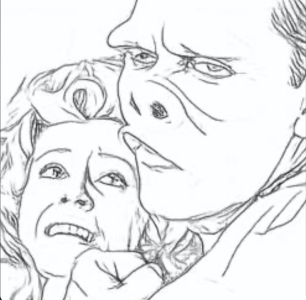
This morning I stumbled upon a free, relatively recent AI software that converts photos into line drawings. The idea is to hand prints of these drawings to Sutton for coloring. This weekend, I mean. Go ahead, lay it on me…tell me that free photo-to-line drawing conversion software has been around for years.
I’ve also just happened upon a YouTube file of Lou Reed‘s “What’s Good”, my favorite song from his 33-year-old “death album” (Magic and Loss).