Ricky Nelson‘s performance in Rio Bravo isn’t half bad. He more or less holds his own. I just have problems with that smooth, casually unbothered, almost feminine sounding voice of his.
Nelson sounds like a Hollywood kid who’s game to play the part of a semi-fabled gunslinger and cowhand (a variation upon John Ireland’s Cherry Valance), but unable to do much more than behave cool and slinky as he goes through the motions. He’s playing himself in a hall-of-mirrors situation. An 18 year-old kid with pretty eyes, a guy who’s been playing himself on a TV series since he was eight or nine (and is therefore highly experienced after a fashion) getting to play himself in old-west garb. No change or switch-off…same basic deal.
So Nelson makes it through the film unscathed and certainly doesn’t get in the way, but there’s no forgetting that he’s essentially bringing his usual Adventures of Ozzie and Harriet game with a little buckaroo sauce, and that he’s no Clift or Dean or Brando.
You know what really gets me when I watch him play “Colorado”? Nelson’s tragic death at age 45.
There’s a passage in TomWolfe’s “The Me Decade and Third Great Awakening“, which I happened to re-read a couple of days ago, that put the hook in. It says that Ingmar Bergman‘s Scenes From A Marriage (’73 — recently remade for HBO with OscarIsaac and JessicaChastain) “is one of those rare works of art, like ErnestHemingway’s The Sun Also Rises, that not only succeed in capturing a certain mental atmosphere in fictional form…but also turn around and help radiate it throughout real life.”
Hundreds of fictional films have captured a certain social atmosphere or way or looking at life, of course. It could be argued, in fact, that this is what defines a great film — the capturing of some aspect of real actual life that millions recognize as being genuine in some poetic or distilled, boiled-down way. But how many times has the public reception to this kind of film turned around and regenerated and become a current in and of itself?
My first thought when this question came to mind was William Wyler‘s The Best Years of Our Lives (’46). Or John Badham‘s Saturday Night Fever, although I’m not sure how many people really wanted to live the life of John Travolta‘s Tony Manero. Or Robert Redford‘s Ordinary People. I’m actually not sure which films meet this standard — still kicking this one around.
A key drama of our own day is Ingmar Bergman’s Scenes From a Marriage. In it we see a husband and wife who have good jobs and a well-furnished home but who are unable to “communicate”—to cite one of the signature words of the Me Decade. Then they begin to communicate, and there upon their marriage breaks up and they start divorce proceedings. For the rest of the picture they communicate endlessly, with great candor, but the “relationship” — another signature word — remains doomed. Ironically, the lesson that people seem to draw from this movie has to do with “the need to communicate.”
Scenes From a Marriage is one of those rare works of art, like The Sun Also Rises, that not only succeed in capturing a certain mental atmosphere in fictional form … but also turn around and help radiate it throughout real life. I personally know of two instances in which couples, after years of marriage, went to see Scenes From a Marriage and came home convinced of the “need to communicate.” The discussions began with one of the two saying. Let’s try to be completely candid for once. You tell me exactly what you don’t like about me, and I’ll do the same for you. At this, the starting point, the whole notion is exciting. We’re going to talk about Me! (And I can take it.) I’m going to find out what he (or she) really thinks about me! (Of course, I have my faults, but they’re minor, or else exciting.)
She says. “Go ahead. What don’t you like about me?”
They’re both under the Bergman spell. Nevertheless, a certain sixth sense tells him that they’re on dangerous ground. So he decides to pick something that doesn’t seem too terrible.
“Well,” he says, “one thing that bothers me is that when we meet people for the first time, you never know what to say. Or else you get nervous and start babbling away, and it’s all so banal, it makes me look bad.”
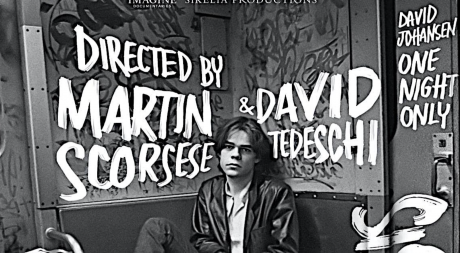
Last night I watched Martin Scorsese and David Tedeschi‘s Personality Crisis: One Night Only, and I came out of it knowing and caring a bit…okay, a lot more about David Johansen than I had before I sat down.
It’s basically standard documentary portraiture, of course, but primarily a relaxed, low-key lounge concert film, shot in the Carlyle bar in January 2020.
The doc is augmented with recent interview footage (apparently shot in Johansen’s home by his stepdaughter Leah Hennessey, daughter of wife Leah Hennessey) plus some performance footage from the good old days (New York Dolls, ’70s solo career, Buster Poindexter in the ’80s and ’90s).
And the thing that stuck in my head, frankly, is the made-plain fact that Johansen is a free-floating existentialist dancer-singer-performer who’s more or less cool with the fact that he’s not stinking rich. He and his family are living with a certain amount of style, comfort and swagger, but the difference between David Jo’s lifestyle and that of, let’s say, Mick Jagger is apparently considerable or at least noteworthy. (There’s a moment during the Carlyle show when he repeats a famous line from Ira Levin‘s Deathtrap — “Nothing recedes like success”.) I also loved it when Johansen tells his stepdaughter about never having had a grand master plan for his life, and that he’s always considered his journey (Johansen is 73) in five-year increments.
Posted on 3.16.23: Along with ex-girlfriend Sophie Black, who matured into a respected poet, I co-produced two Save The Whales benefit rock concerts in Wilton, Connecticut. Both were held on a 52-acre property owned by Sophie’s parents, David and Linda Cabot Black. The first happened over the July 4th weekend in ’76; the second (for which Sophie and I were interviewed for a 6.26.77 N.Y. Times piece) happened a year later.
Back to right now: A couple of months prior to the ’76 concert Johansen and I chatted in some downtown Manhattan bar, and I really liked his charm, aura, self-deprecating humor, etc. Plus I learned that night that Johansen loves (or loved) to play-act and pretend to be someone else. DJ made bank on play-acting when Buster Poindexter came along in the ’80s, but when I spoke to him that night he was speaking with a working-class British accent. Pretending to be, in a manner of speaking, some Jagger-like rocker from East London or something. It was well known at the time that Johansen was a lifelong New Yorker (raised in Staten Island), and so I was flat-out thrilled and fascinated that he was performing for me — an audience of one. Johansen was dishy in a Jagger-ish way back then, and the accent fit right in. I’ll never forget that moment as long as I live.
…would be significantly bumped or noticably uprezzed if I were to miraculously buy a Sony Bravia XR Z9J LED 8K UHD 85-incher, which is what I would do if money was no object. It would make me feel “better”, yes, and would make a “difference,” yes, but not in a way that would wondrously enhance the image quality of the films (21st and 20th Century (1920-2000) films that I watch on a daily basis.
The Sony OLED 4K 65-incher that I now watch is pretty damn good if I do say so myself. Big, fat, dazzling 8K TVs have been out and about for roughly four years (I saw my first one at Stockholm Arlanda airport in May 2019), and even if I didn’t give a damn about money I’m not sure I would buy one of these suckers. I’m not a sports-watcher and I hate CG-driven fantasy crap. I’m just not persuaded that David Fincher‘s Zodiac or Ingmar Bergman‘s The Silence (’63) would look significantly better on an 8K.
Obsession (Netflix, 4.13) is the second filmed adaptation of Josephine Hart‘s “Damage,” a 1991 novel about a self-destructive affair between a British politician and his son’s fiance.
The newbie is a four-parter, and, in my judgment, far less appealing than Louis Malle’s 1992 feature version for the simple reason that Jeremy Irons and Juliette Binoche, as the doomed lovers, are much more attractive and dynamic that the Netlix duo, played by Richard Armitage and Charlie Murphy.
I don’t especially want to see the latter couple get it on — it’s really that simple. They just don’t have it.
Plus Malle is and was, I gather, a much more gifted and accomplished director than Glenn Leyburn and Lisa Barros D’Sathe, the co-helmers of the Netflix series. That said, I’ll be watching the Netflix just to compare and quibble.
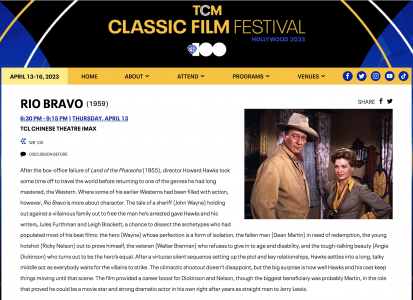
Okay, not “heartbroken” but kinda sorry. FOMO’ed. I never really thought there was anything especially irksome or substandard about the 2015 Bluray version, but I love the idea of watching a richer, more vibrant version inside the big Chinese and basking in the whole Hollywood lore of it all (Steven Spielberg, Paul Thomas Anderson, Angie Dickinson).
Rio Bravo was shot in the summer of ’58, and released in April ’59. Russell Harlan‘s lensing used the Technicolor process. A restored Rio Bravo means what…punchier colors and richer black levels? Fine.
Like most invested film buffs I’ve appreciated and respected Rio Bravo for decades, of course, but I’ve never been a panting cultist like Quentin Tarantino. Rio Bravo is one of those oddly over-praised Film Catholic westerns that many if not most of the holy rollers have lost sight of, I suspect, because it’s been a long while since they’ve actually sat down and watched it. The cultists have been chanting and “ohm”-ing for so many years that the rep has overpowered or obscured the actual film.
Plus there’s something a tiny bit deranged about losing your shit over Rio Bravo to begin with. It’s a film about community and character and dependability, but that Ricky Nelson “I’ve Got A Feelin'” vibe gets in the way…that image of a teen idol sitting around the jailhouse with those holstered six-guns and that high-pitched voice of his. I love those Howard Hawks signature bits, but the film never feels truly dependable or genuine in any kind of “this is how it really was back in the Old West” sense. It’s just a comfortable, laid-back, easy-going Hollywood hangout film…a lot of talking, a bit of understatement and not that much shooting.
Bupkis (Peacock, 5.4) feels like The King of Staten Island, Part II…no? Starring and co-written by Pete Davidson…same Staten Island deal. A “heightened, fictionalized version of Davidson’s life”…ditto. Davidson has a strained relationship with his mom (Edie Falco), as his character did with his Staten Island mom, played by Marisa Tomei. He occasionally hangs with a snappy father figure, played in Staten Island by Bill Burr and by Joe Pesci in Bupkis. Girlfriend: “You run away from people who love you,” etc.
Costarring Joe Pesci and guest-starring Bobby Cannavale, Ray Romano, Brad Garrett, Kenan Thompson, Sebastian Stan, Steve Buscemi, Method Man, Jon Stewart and Al Gore.
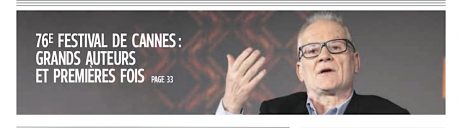
After stating that Woody Allen‘s Coup de Chance had not been officially submitted to the festival, Cannes topper Thierry Fremaux has revealed in a Le Figaro interview (page 33) that he did see it unofficially.
Fremaux also said — this is a real shocker — that even if it had been officially submitted he might have had reservations because showing it would rip the festival apart into pro- and anti-Woody camps.
Fremaux: “The Polanski, we have not seen it. The Woody Allen, it’s a bit special. I saw it without seeing it. The film was not a candidate. We also know that if his film was shown at Cannes controversy would take over the fest, both against him and against the other movies.”
Was this Fremaux conveying what he himself is actually fearful of, or was he sharing the view of the Woody camp? Either way this is flat-out cowardice. The statement essentially says “there will be too many Woody haters attending the festival, and there are serious concerns about the spectacle of the festival being convulsed by Woody hate vs. Woody defenders.”
Imagine if the Cannes Film Festival had voiced similar concerns about showing Michelangelo Antonioni‘s L’Avventura and wimped out? After screening that classic film in May 1960, it drew howls of derision. Ditto, in 1977, Marguerite Duras‘s The Truck (Le Camion) — following the Cannes showing, “Duras stood atop a flight of stairs while a crowd yelled insults at her.” Or Vincent Gallo‘s problematic but certainly brave The Brown Bunny, which screened in Cannes 20 years ago? Or, a year earlier, Gaspar Noe‘s Irreversible, which would almost certainly not be screened now due to squeamishness about the #MeToo community.
And Allen’s film, to judge from earlybird reactions posted by Showbiz 411‘s Roger Friedman and resturateur Keith McNally, is hardly an envelope pusher but a tart and crafty 90-minute noir about infidelity and murder.
Ten years ago Fremaux and the Cannes Film Festival would have been delighted to screen Coup de Chance. Now they’re letting the woke banshees control things, at least in this instqnce.
(Thanks for World of Reel‘s Jordan Ruimy for providing the Le Figaro link.)
Just to be clear: The showrunner and writer of the eight-episode Penguin series is Lauren LeFranc. The Batman director MattReeves is serving as executive producer. The first three episodes have been directed by Craig Zobel (Mare of Easttown).
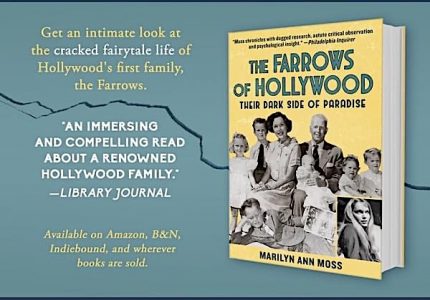
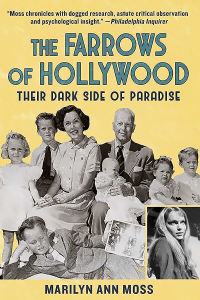
My motive is speaking to Ross was to try and persuade her to tell me a bit more about Farrow’s personal life and maybe answer a couple of other dangling questions that the doc hadn’t really gotten into. Alas, Moss was more into verbal volleying for its own sake. So we just kind of chatted and danced around. Cool.
I haven’t had a chance to read her Farrow book, but Moss seems to know nearly everyone and everything…she’s really been around. And her literary credentials are impressive — author of “Raoul Walsh: The True Adventures of Hollywood’s Legendary Director” (2011) and “Giant: George Stevens, a Life on Film (2004). In 2021 the Criterion Collection released her 2019, feature-length documentary, The True Adventures of Raoul Walsh, on Blu-ray. Moss is a former film and television critic for The Hollywood Reporter and Boxoffice Magazine.
Married for 20-odd years to Maureen O’Sullivan while constantly catting around, the Roman Catholic Farrow sired seven children, including Mia Farrow.
Co-directors Claude Gonzalez and Frans Vandenburg have delivered a respectable effort, often edifying if less than fully satisfying, for reasons I’ll try to explain.
The sage talking heads include Australian directors Phillip Noyce, Bruce Beresford and Philippe Mora, plus film critics Todd McCarthy, David Thomson, David Stratton, Margaret Pomeranz, Imogen Sara Smith and Farran Smith Nehme. Hollywood biographer Charles Higham and Farrow’s wry look-alike son, John Charles Farrow, also participate.
I’m not a serious Farrow devotee but I respect his assurance and sense of polish and control, and his extra-long takes are Scorsese– or Coppola-level.
I’m as much of a fan of The Big Clock as the next guy. Vincent Price’s performance in His Kind of Woman is one of my all-time camp favorites of the ’40s, and Five Came Back (’39), a crashed-in-the-jungle survival story with Lucille Ball, is a keeper. I’m trying to recall if I saw Farrow’s 1956 remake, Back From Eternity. And the 3-D, John Wayne-starring Hondo is pretty good.
I understand why producer Mike Todd fired Farrow off the direction of Around the World in 80 Days (i.e., Todd wanted a less headstrong director, someone he could push around) but why exactly did Farrow lose the King of Kings gig? The filmmakers couldn’t explore that? This is one of the issues I wanted Moss to explain.
Farrow losing two high-paying 1950s prestige gigs in the space of five years is odd. It alludes to an imperious, uncooperative manner.
Was Farrow’s 1963 heart attack a genetic thing? Was it due to alcohol abuse? Farrow was only 58 when he passed — a relatively early departure for a man who wasn’t overweight.
How many years ago was this doc shot? The answer seems to be “not recently.” Three, four years ago for the most part? More?
“In recent years, Rupert Murdoch has suffered a broken back, seizures, two bouts of pneumonia, atrial fibrillation, and a torn Achilles tendon, a source close to the mogul told me. Many of these episodes went unreported in the press, which was just how Murdoch liked it. Murdoch assiduously avoids any discussion of a future in which he isn’t in command of his media empire. “I’m now convinced of my own immortality,” he famously declared after beating prostate cancer in 1999 at the age of 69. But unlike the politicians Murdoch has bullied into submission with his tabloids, human biology is immovable. ‘There’s been a joke in the family for a long time that 40 may be the new 30, but 80 is 80,’ a source close to Murdoch said. On March 11, he turned 92.” — from Gabriel Sherman‘s Vanity Fair cover story, “Inside Rupert Murdoch’s Succession Drama.”