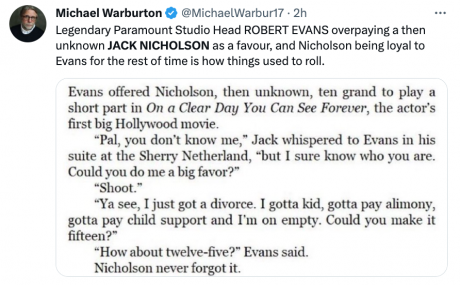
Until five minutes ago I had never watched a single frame of Vincente Minnelli‘s On A Clear Day You Can See Forever (’70). I always kinda wanted to see it because of Jack Nicholson‘s smallish part, but I never went there. The 32-year-old Nicholson plays “Tad Pringle”, the ex-brother in law of Barbara Streisand‘s “Daisy Gamble”, a chain-smoking clairvoyant. If only the film had somehow managed to let the audience savor some of Tad’s sitar-playing. Alas…
I was pleasantly surprised last night by Stephen Frears‘ The Lost King (IFC Films). Surprised because experience has taught me that a film with a combined aggregate rating of just under 70% (75% Rotten Tomatoes, 64% Metacritic) has problems.
Well, The Lost King has exactly one issue, but nothing that should give pause to any semi-reverent filmgoer. Otherwise it’s completely fine, which means that the critics who trashed it are petty and pissy.
I’m not kidding. You can quibble with this film but you can’t trash it, and if you do you’re a prick. If anyone wants to make anything out of this they know how to get in touch.
To a somewhat lesser extent, the film is also about the rescue of Richard’s reputation from the clutches of Tudor legend…from the centuries-old myth about what an allegedly conniving and murderous bastard he was…saving Richard, in a manner of speaking, from the perverse (if enjoyable) imaginings of William Shakespeare, Laurence Olivier, Ian McKellen, Richard Dreyfuss and Al Pacino, among many others.
So I went in expecting some kind of problematic sit, but within four or five minutes I knew The Lost King was a keeper. It has a smooth, confident, almost jaunty vibe, courtesy of the usual Frears touch and the just-right screenplay (SteveCoogan and JeffPope) and Sally Hawkins‘ exquisite lead performance plus the other sturdy players (Coogan, Harry Lloyd, Mark Addy, Lee Ingleby). Plus it’s wonderfully scored by Alexandre Desplat.
It’s basically about one woman pushing a rock uphill and struggling against several skeptics and naysayers, and…well, it’s comforting and reassuring to watch a flawed and vulnerable person get hold of an idea and carry it into the end zone…to stand up against dull-witted functionaries and achieve something noble and historic and resonant. Philippa goes through the usual ups and downs, fits and starts, dead-ends and false flares. She is frequently ignored, belittled and fought against, but she persists.
So what’s wrong with it? The decision to make Richard III into a friendly ghost or apparition– a phantom who initially doesn’t speak, and then finally speaks and then gets huffy and hurt when Philippa asks if he murdered anyone in order to take the throne, etc. (The dead king is played by Harry Lloyd.) I didn’t hate the device but I wasn’t that fond of it either. So I ignored it, and I didn’t find this difficult.
At times I was bothered by Hawkins overplaying the fragility — she seems barely able to hold it together in social and business situations. Constantly quaking, gasping, shivering. But I got used to it.
The Lost King is a good, personable, middle-class British film. Amusing here and there but not a comedy. I completely enjoyed its company, and let me just say one more time that the people who trashed it are really and truly rancid.
There’s a major disconnect in the trailer for Love and Death (HBO Max, 4.27), a true-crime drama written by David E. Kelley and directed by Lesli Linka Glatter. Boiled down, the disconnect is Elizabeth Olsen saying to Jesse Plemons, “Are you interested in having an affair?”
I’m not having trouble digesting the facts of the case, which happened in 1980 in the small town of Wylie, Texas. Candy Montgomery (Olsen) was a terminally bored mother and housewife whose husband, Pat Montgomery (Patrick Fugit), was an electrical engineer. Montgomery’s close friend Betty Gore (Lily Rabe) was married to Allan Gore (Plemons). Candy and Allan wound up having an affair, and Betty freaked when she found out, which led to Candy doing some freaking of her own — she savagely murdered Betty with an axe, striking her dozens of times.
All of this is fine, but biological reality is strongly arguing.
It would be one thing if the actress playing Candy was shlumpy or overweight or less than dynamically attractive. But Olsen, 34, is a double-A hottie and has been so for many years, so why in the real world would she want to have sex with a C-minus guy (at best) who looks like Jesse Plemons? Fleshy and ginger-haired, pale and puffy-faced, tiny pig eyes.
This isn’t how life works. Birds of a general feather tend to flock together, and saucy hotties don’t sleep with plump ginger dudes as a rule. I don’t care how bored they are.
Obsessive fans of Stanley Kubrick‘s The Shining have been carrying the torch for decades, and apparently will never quit. I wouldn’t necessarily include myself, although I’ve seen Stanley Kubrick’s 1980 horror film at least 11 or 12 times.
My first reaction was subdued bordering on disappointed, but the film has gradually expanded or deepened in my head over the years, which is significant considering that it’s not especially scary and is more noteworthy for its perverse sense of humor than anything else. Which makes it, of course, rewatchable as fuck. For people like me, that is.
Every time I watch the Jack-and-Wendy baseball bat scene, I chuckle or even laugh out loud at Jack Nicholson‘s twitchy unhinged wackazoid, which is total Kabuki theatre. And I adore Nicholson’s Delbert Grady interrogation in the bright red bathroom. Not to mention the chat with Lloyd the bartender, although I would have preferred it if Lloyd had said the Richard Price line from Mad Dog and Glory — “women…can’t live with ‘em, can’t kill ’em.”
All to say that if money was no object I would be tempted to buy Lee Unkrich’s new Shining book, an ultra-meticulous cataloguing of the entire effort, start to finish. Call it the ultimate obsessive Shining fan publication, made by and for wealthy people.
The Taschen publication is priced at $1500. It took Unkrich a dozen years to put it all together. He apparently talked to damn near everyone who had ever worked on it or who knew or had heard anything.
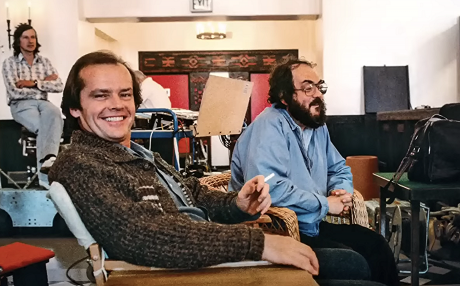
Two days ago IndieWire‘s Bill Desowitz posted an interview with Unkrich. I spoke to Desowitz yesterday. Our conversation focused on two areas of interest — (a) the fact that Unkrich has never seen the missing second-to-last scene in which Barry Nelson‘s Overlook Hotel manager, “Mr. Ullman”, visits Shelley Duvall‘s “Wendy Torrance” in a Denver hospital following the death of Jack Nicholson‘s “Jack Torrance”, and (b) the number of takes used to shoot the hotel staircase baseball bat scene.
I, Jeffrey Wells, am one of the few living souls on this planet to have seen the hospital visit scene. I saw it a few weeks before The Shining opened on 10.2.80. The print I saw was 146 minutes long, and the venue was the old Warner Bros. screening room at 75 Rockefeller Plaza.
Desowitz told me yesterday that he too saw this scene, albeit shortly after the movie opened. The 146-minute cut was shown commercially in Westwood for a week or less. Kubrick hired an editor to remove the scene from prints playing in Los Angeles and New York.
The scene is nothing special, I can tell you. Not a “bad” scene, but definitely a ho-hummer. The narrative energy drops significantly, and it basically adds very little to the whole. Roughly ten years ago Unkrich posted the dialogue. I’ve posted it after the jump.
Unkrich’s Shining book includes a couple of frame captures from the hospital scene.
How many times was the baseball bat scene shot? No more than 15, Desowitz says. The scene with the most takes is the one in which Jack, Wendy and Danny are being shown the golden ballroom by Ullman — 66 takes in all.
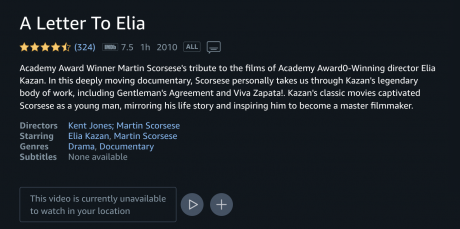
Repeating: For years I’ve been trying to buy or stream Martin Scorsese and Kent Jones‘ Letter to Elia, which I saw exactly once at the 2010 New York Film Festival. It’s basically Scorsese talking about his worship of Elia Kazan over the decades, and “a delicate and beautiful little poem,” as I wrote 13 years ago. It’s one of the most touching docs of this sort that I’ve ever seen.
But you can’t buy a stand-alone DVD or Bluray version, and you can’t stream it. It’s part of Fox Home Video’s Elia Kazan Collection, but I can’t find it anywhere. (In my home, I mean — I bought it in 2010.) Nine years ago it played on PBS‘s American Masters series, but right now there’s only a webpage.
The blockage presumably boils down to a rights issue. Several years ago I asked Jones why it’s unviewable (except for the box set), and he mumbled a non-response. I took that to mean that the absence of Letter to Elia is a conversational non-starter.
Posted on 11.24.10: “Letter to Elia is a personal tribute to a director who made four films — On The Waterfront, East of Eden, Wild River and America America — that went right into Scorsese’s young bloodstream and swirled around inside for decades after. Scorcese came to regard Kazan as a father figure, he says in the doc. And after watching you understand why.
“It’s a deeply touching film because it’s so close to the emotional bone. The sections that take you through the extra-affecting portions of Waterfront and Eden got me and held me like a great sermon. It’s like a church service, this film. It’s pure religion.
“More than a few Kazan-haters (i.e., those who couldn’t forgive the director for confirming names to HUAC in 1952) were scratching their heads when Scorsese decided to present Kazan’s special lifetime achievement Oscar in 1999. Letter to Elia full explains why, and what Scorsese has felt about the legendary Kazan for the last 55, going on 60 years.”
For me Paris is about strolling around the cool neighborhoods (like the rue Bretagne nabe in the video) with occasional, hour-long pit stops in cafes, and about revisiting old haunts from years and decades past. I’ve visited at least 11 or 12 times. If there’s one place that’s good for recharging your spiritual batteries, this is it. And I always slip into a Paris mood a few weeks before Cannes.
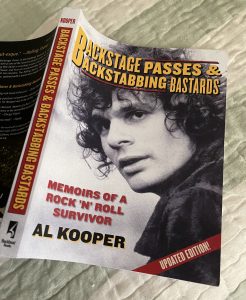
It’s taken me three or four weeks to get through Al Kooper‘s “Backstage Passes and Backstabbing Bastards.” Not because it’s a difficult or boring read, but because I tend to droop off if I read a book in the mid-to-late evening. It’s also a mild annoyance to read a dead-tree paperback. I’m pretty much a Kindle guy.
Kooper can write. His sentences are plain, unaffected, semi-humorous or sardonic. He conveys a confident, unpretentious, no-skin-off-my-ass attitude, which feels relaxing for the most part.
The first chapter I read covered the formation and break-up of Kooper’s version of Blood, Sweat&Tears (Nov. ‘67 to April ‘68). Kooper was the lead singer and designated artistic honcho, but he was soon ganged-up upon by drummer BobbyColomby and guitarist SteveKatz for not having a strong enough voice. Which, if you listen to “Child Is Father To The Man,” was a fair criticism. Kooper was Odd Man Out-ed and and vocally replaced by DavidClaytonThomas, and the second BS&T hit it big.
Kooper: “Like the monster who killed Dr. Frankenstein, they ousted me from a band I had envisioned and christened. I had lived my musical Camelot. [But] it only lasted eight months, shot down from a grassy knoll by ‘Lee Harvey’ Colomby.”
I’m sorry but “Bobby Colomby was a bad guy” is now and heretofore stuck in my mind.
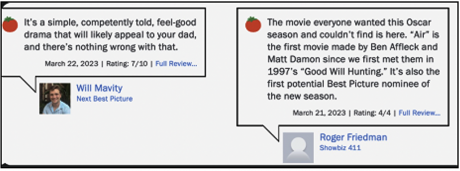
I won’t be seeing Ben Affleck‘s Air until 7:30 pm this evening, but Will Mavity’s take is infuriating. Or the excerpted quote is. I love movies that represent the sensible end of the spectrum…movies that speak rationally, work their way through a logical, non-looney tunes narrative and wind up making practical sense — an almost disappeared genre. And Mavity is calling it a fucking “dad” movie? And yet, ironically, he likes it.
“This is no edge-of-your-seat type thriller like Gone Baby Gone or The Town.” HE reaction: Good!
“This is a cast of charismatic actors rattling off intelligent dialogue for two hours as they approach an inevitable conclusion.” HE reaction: And that’s bad?
“And yet Air manages to be effortlessly irresistible. Like Ben Affleck, it’s something that challenges the viewer to refrain from rooting for it, flaws and all. Strip away the overt corporate branding, and it’s the kind of movie that used to be Hollywood’s bread and butter and now feels increasingly like a rarity in today’s cinematic landscape.
“It doesn’t have any grand social themes of importance, looking to make a change in today’s world. It’s a simple, competently told, feel-good drama that will likely appeal to your dad, and there’s nothing wrong with that.”
A friend mentioned having an original vinyl copy of the 2001:A Space Odyssey soundtrack. I asked if it contains the weird-sounding overture, a Gyorgy Ligeti composition that precedes the “Also Spracht Zarathrusta” main title.
Now I’m not sure what the overture is called on the soundtrack, or if it’s even featured. I know there are three Ligeti tracks on the soundtrack album — “Atmospheres” (Ligeti, SUDWESTFUNK SYMPHONY ORCHESTRA, ERNEST BOUR), “Lux aeterna” (Ligeti, Chor des Norddeutschen Rundfunks, Helmut Franz) and “Aventures” (Ligeti, Ensemble Intercontemporain, Pierre Boulez, Jane Manning, Mary Thomas, William Pearson).
The music heard prior to the second-to-last scene (French Chateau interior, brightly illuminated floor)…the music heard as Dave Bowman‘s pod zooms along and above the topography of the planet Jupiter (which several HE readers have derisively insisted is not the planet Jupiter…ayeholes)…this music is called “Atmospheres”. And yet a voice is telling me that this music is different from the overture track. I’m somewhere between lost and confused — can anyone straighten this out in a calm and rational way?