Overpraised “Tori and Lokita”

Jean Pierre and Luc DardennesTori and Lokita is a watchable but moderately dull heart-and-compassion film about a typical Dardnennes subject — i.e., young underdog characters who are misunderstood by or at odds with mainstream Belgian society.

It’s a tragic immigration drama set near Liege, Belgium, about a pair of young, unrelated African kids (Pablo Schils as the younger Tori, Mbundu Joely as the teenaged Lokita) who get exploited and kicked around and treated cruelly by drug-dealing wolves.

It ends sadly and shockingly. I didn’t melt down but I felt it. The Cannes snobs did cartwheels in the lobby, but it’s just moderately okay.

The Dardennes have always had this plain, unaffected directing style — just point, shoot and watch. Believable characters, realistic dialogue, no musical score. Straight-up realism, take or leave. I’ve always emerged from their films saying “yup, that was a good, honest film” but I’ve never really been knocked flat. Because their plain-and-straight signature only penetrates so far. In my case at least.

If you know the Dardennes and how their films tend to play, Tori and Lokita feels very familiar You can’t help feeling sorry for these kids, but desperate immigrants have been getting kicked around and exploited for centuries, haven’t they? Life can be heartless for have-nots.

Tori and Lokita had its big debut in Cannes ten months ago. It opened in Europe last fall, and was available on Bluray & streaming late last October. Sideshow and Janus Film will give it a limited opening stateside on 3.24.23.

Read more

HE Once Again Defends “Gone With The Wind”

Aspects of Gone With The Wind are obviously antiquated and icky, and I don’t blame those who’ve washed their hands of it over the odious racial stuff. But it’s not, as an Ankler burb recently stated, “one of Hollywood most disgraced films.” That’s putting it way too harshly. The film’s distasteful attitudes aside, it’s more noteworthy for being one of Hollywood’s most misunderstood films. By wokesters, I mean.

I’ve posted this three or four times over the last seven years, but here goes again: “I don’t believe it’s right to throw Gone With The Wind under the bus just like that. Yes, it’s an icky and offensive film at times (Vivien Leigh‘s Scarlett O’Hara slapping Butterly McQueen‘s Prissy for being irresponsible in the handling of Melanie giving birth, the depiction of Everett Brown‘s Big Sam as a gentle, loyal and eternal defender of Scarlett when the chips are down) but every time I’ve watched GWTW I’ve always put that stuff in a box in order to focus on the real order of business.

“For Gone With The Wind is not a film about slavery or the antebellum South or even, really, the Civil War. It’s a movie about (a) a struggle to survive under ghastly conditions and (b) about how those with brass and gumption often get through the rough patches better than those who embrace goodness and generosity and playing by the rules. This is a fundamental human truth, and if you ask me the reason Gone With The Wind has resonated for so long is that generation after generation has recognized it as such. Anyone who’s ever faced serious adversity understands the eloquence of that classic Scarlett O’Hara line, “I’ll never be hungry again.”

“I think GWTW particularly connected with 1939 audiences because they saw it as a parable of the deprivations that people had gone through during the Great Depression.

“On top of which the second half of part one of Gone With The Wind (the shelling of Atlanta to Scarlett shaking her first at those red skies) is undeniably great cinema. Max Steiner‘s music, the struggle, the crowd scenes, the panic, the burning of Atlanta, Ernest Haller‘s cinematography, the anguish, the soldiers groaning and moaning, Scarlett’s drooling horse collapsing from exhaustion, the moonlight breaking through as she approaches Tara…you just can’t throw all that out. Yes, the film’s unfortunate racial attitudes, which were lamentably par for the course 75 years ago, are now socially obsolete. And I wouldn’t argue with anyone who feels that portions of it are too distasteful to celebrate, but it just doesn’t seem right to lock all of that richness inside some ignoble closet and say “no more, forget about it, put it out of your minds.” Legendary filmmaking is legendary filmmaking.”

Which Oscar Nominees Are Purely Merit-Based?

In any given year many Oscar nominees are elevated by career narratives (being “due” or launching a comeback). More recently or over the last five or six years, it’s been a matter of narrative plus identity with an emphasis on the latter.

In other words the Oscars have never been solely about merit, but since ’17 and especially in the Best Picture realm** they’ve become equity-driven and identity-branded, certainly as far as the Best Picture winners have been concerned. (The exception was Peter Farrelly‘s Green Book, which won in early ’19.)

We’re all familiar with this year’s recipients of equity largesse, but some nominees have made the grade solely on merit…imagine!

The merit nominees include Cate Blanchett‘s Tar performance, obviously, in the Best Actress realm. (She won’t be winning.) ElvisAustin Butler (likely winner), BansheesColin Farrell and Living‘s Bill Nighy among lead actors. The Whale‘s Hong Chau (deserves to win) was nominated completely according to merit. Among support male performers the leading meritorious trio are BansheesBrendan Gleeson and Barry Keoghan, and The FabelmansJudd Hirsch.

And among the purely meritorious Best Picture nominees there’s no elbowing aside Top Gun: Maverick, All Quiet on the Western Front, Tar, The Banshees of Inisherin, The Fabelmans.

** Moonlight (’17 — counterweight to “Oscars so white”), The Shape of Water (’18 — mousey spinster has sex and falls in love with the grandson of The Creature From The Black Lagoon), Parasite (’20, absurdly plotted, chaotically concluded social drama from plump South Korean nerd director), Nomadland (’21, rootless nomad shitting-in-a-bucket drama, directed by female Asian who went on to shit the bed with The Eternals), CODA (’22, hearing-impaired feelgood family drama that also won because everyone realized at the last minute that they really didn’t want Jane Campion‘s The Power of the Dog to win the big trophy.) When EEAAO wins Best Picture Oscar next Sunday (3.12) the Academy will have bestowed six identity-driven Best Picture Oscars over the last seven years.

Pristine, Earthy-Looking “Seven”

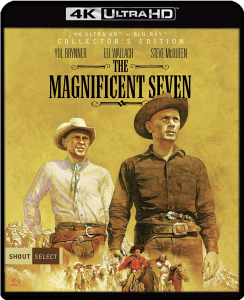
I’ve often bitched about 4K remasterings looking too dark, but I didn’t feel this way about Shout! Factory’s recently released 4K Bluray of John SturgesThe Magnificent Seven (’60).

My immediate reaction was “whoa, this looks like celluloid!” I felt as if I was watching a screening at a Seward Street post-production house of a mint-condition 35mm print made from the original negative.” Shout! informs, in fact, that it’s a 2022 restoration and color grading using an existing 4K scan of the original camera negative.

I was spellbound during last night’s viewing — it seemed absolutely perfect to me. Excellent earthy colors, never too dark, spotless, fresh from the lab.

The Hi-Def Digest comparison footage below (the fast-draw contest between James Coburn and Robert Wilke) suggests that the disc is darker than it needs to be. It didn’t look that way to me. It struck me as more organic-feeling than previous versions, but that’s an enhancement in my book. I didn’t notice any teal tinting either.

TMS was shot by Charles Lang (Some Like It Hot, The Facts of Life, One-Eyed Jacks) in 35mm Panavision anamorphic. Lensing began in Mexico on 3.1.60. The Mexican village and the U.S. border town were built from scratch. The locations included Cuernavaca, Durango and Tepoztlán. Indoor filming was done at Mexico City’s Churubusco Studios.

“Just Geek Shit”

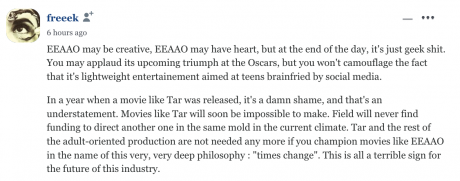
HE commenter “freeek” has misspelled entertainment and is misreading the room when he says EEAAO is “aimed at teens brainfried by social media” — the target audience is an 80-20 blend of Millennials (born between 1981 and ’96, ranging from 27 to 42 years old) and Zoomers (hatched between 1997 and ’12, spanning between 10 and 25). But when the Oscar season finally ends and most of us can all blessedly forget about the Daniels for the rest of our lives, the title of this post will live on. Hopefully, I mean.

The Pride and the Passion

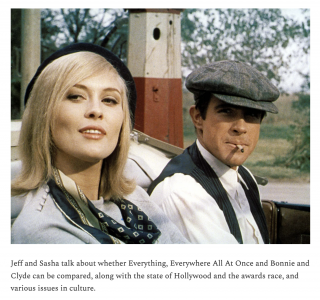
For what it’s worth today’s Oscar Poker podcast (3.4, 64 minutes) was and is my personal Jeff-and-Sasha favorite so far. I felt calm, level-headed and reasonably articulate. Feel free to listen.

Branch Davidian Spirits Can Go Eff Themselves

The deeply loathed Everything Everywhere All at Once has triumphed at the Branch Davidian Spirits, and nobody fecking cares! It won all seven of the categories in which it was nominated, including Best Feature. Seven of its eight nominees won in their categories, I meant to say. Cultists!

Read more

Vic Lizzy’s Ass Handed To Him On A Plate

In a thread about “Dude Needs To Be Cancelled” (posted at 1:37 pm eastern), the excitable Vic Lizzy posted the following with a straight face: “Who’s saying it’s not okay to be white? There’s no significant groundswell of that sentiment. Calling out racism is not the same as being anti-white.”

An hour later Bobby Peru set him straight.

Peru: “Actually, there sort of is [a significant groundswell of that sentiment].

“I work for a large global firm and at least three times this week I heard the phrase ‘white male’ used in a dismissive and derogatory way. This was with respect to suggestions of antiquated leadership, exec team makeups of the past, “traditional” behaviors that need to be eradicated, etc.

“We had a work dinner this week with our CEO, who is a white woman, and she talked on and on about our recruiting efforts, and how we would not be focusing on white males. This type of discourse is considered to be politically correct, and progressive, and she is a huge advocate for diversity.

‘At this point in time there seems to be no distinction between vaulting diversity up as an important initiative and the takedown of white male leadership. A very common refrain over and over is this notion that we need to move past the ‘white male’ leaders of yesterday. Every time this is said everyone nods in agreement, even the white male leaders.”

Best Car Chase Finale Ever?

High-speed chase scenes have been a staple of crime + action films since The French Connection, but this just-posted news-video sequence (a cop chasing a pair of teens, 14 and 15) has one of the greatest endings ever.

Has anyone ever seen a chase sequence end this way in some Gone in 60 Seconds-type film?

If William Friedkin had ended his big freeway chase sequence in To Live and Die in L.A. this way, the audience would’ve yelled “bullshit!” and thrown soft drinks at the screen.

The kids crashing through a chain-link bridge fence and then falling 20 or 25 feet to the ground is great enough, but then they get out of the car, unharmed, and run for it…amazing! They were wearing their seat belts!

The movie version would end with either (a) the kids being picked up by a friend on the road below and escaping to safety or (b) a live-free-or-die passerby stopping to see if the kids are okay, and the kids jumping into his car and telling him “hit it, man…please, just get out of here and tromp on it…we need to get outta here!…come on, man!”

Read more

Dude Needs To Be Cancelled

Foam-at-the-mouth wokesters** might shriek and howl about my having posted this, but putting aside the digital footprints of Scott Adams and MrsWalker613, I like the performer (whose name and Twitter/TikTok handle I’m still not sure about) and I respect his willingness to make a point that seems fair and logical.

** not Jeremy Fassler, who received his walking papers yesterday.