Okay, I get it: It’s a non-judgmental contemplation of Hollywood narcissism.
Laura Dern‘s character: “Don’t. Touch. People.”

 Jeff Wells
 Okay, I get it: It’s a non-judgmental contemplation of Hollywood narcissism.
Laura Dern‘s character: “Don’t. Touch. People.”
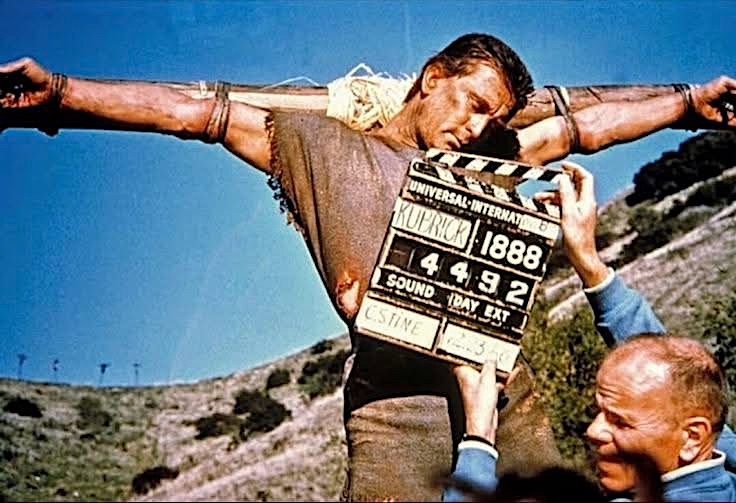
The one thing that Laurence Olivier and John Gavin don’t do in Spartacus is smile like socially outgoing, alpha-vibe executives at a company picnic.
Let’s all celebrate the AI transformation of Leonardo da Vinci’s painting of Italian noblewoman Lisa del Giocondo, dated between 1503 and 1506…let’s all cheer the degradation of this fascinating 16th Century woman into a banal shopping-mall Zoomer, posing for a selfie.
“Wicked, evil, up to no good” — Roger Thornhill, 1959.
Bringing art to life with Grok Imagine
1. Leonardo da Vinci’s Mona Lisa pic.twitter.com/0RgzKudjNU
— James Lucas (@JamesLucasIT) August 3, 2025
I caught a midnight show of The Empire Strikes Back on 5.21.80 at Loew’s Astor Plaza, and I’ll never forget that feeling of immense calm and profound satisfaction as I sat in my aisle seat and listened to John Williams‘ closing credits music.
I was especially charmed by a 15-second-long downshifting bridge (1:18 through 1:35) that departed from the traditional theme.
Even listening now (I watched it last weekend with Sutton) puts you in the mood.
The greatest of all Star Wars films doesn’t really “end” brilliantly — it just stops and winds down and settles into an “okay, all that happened so now it’s time to settle and reflect” mood, but that spunky, tarah-tarah transformation when “directed by Irvin Kershner‘ suddenly appeared…I was muttering ”thank you, God and Gary Kurtz“.
George Lucas was increasingly freaked by and fretting about Empire‘s production costs rising from $8 million to $30.5 million (“It doesn’t have to be that good!”). It wound up making $401.5 million worldwide that year. Not to mention another $138M from subsequent re-releases.
The “fans” who were “conflicted about Empire‘s darker and more mature themes” were major-league morons.
I’m really and truly sorry, but the just-popped trailer for James L. Brooks‘ Ella McCay (20th Century, 12.12) feels decidedly off in certain ways.
And I’m saying this as a serious die-hard fan of the great Brooks films of the ’80s and ’90s (Terms of Endearment, Broadcast News, As Good As It Gets)…all brilliant, incisive, emotional empathy scenarios that wrestled with real-life adult stuff, and in a way that really and truly touched the bottom of the pool.
I’m sorry but there’s just something what-the-fucky about the simultaneous mixture of the following:
(a) A neurotic, emotionally truculent family dramedy about 40-plus adults (one significant exception being the titular character) dealing with unresolved failings and repressed anger plus an anguished, darkly humored tolerance of same;
(b) The film seemingly or primarily leaning upon a trusting mother-daughter relationship…the high-strung, emotionally fraught central character — a driven, pushing-30 political careerist — played by Emma Mackey plus the stalwart, silver-haired, mid-60ish Jamie Lee Curtis;
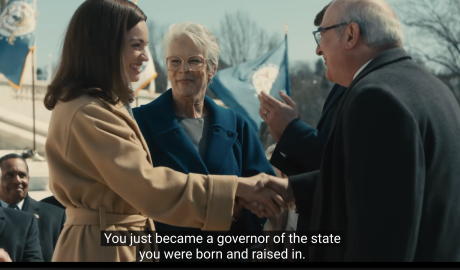
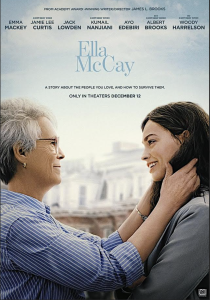
(c) The name of the titular character sharing the same kind of WASPy ethnicity, the same initials and the same number of syllables as Mackey…Ella McCay is apparently a non-elected colleague of some kind …some kind of managerial, high-level ally of “Governor Bill” (the white-haired Albert Brooks) who’s somehow taking over as governor when “Bill” has to leave office for some unspecified reason (poor health? sexual malfeasance?), plus…
(d) The principal offender being a selfish, stubbornly immature, moderately deplorable older male played by the 60ish Woody Harrelson, the father of Mackey’s McCay.
Plus the vaguely irksome Ayo Edibiri…forget it, not going there.
What the hell is this, man?
I’m good with the punchy, soul-baring family turbulence stuff but we all understand that lieutenant governors succeed governors when a resignation occurs, and not a trusted colleague or political manager or protector in the tradition of, say, who Rahm Emmanuel was while serving Barack Obama during the first couple of years of that adminstration.
Principal photography, mind, began in Rhode Island on 2.1.24, and it wrapped three months later on 5.3.24, and yet extensive additional filming began eight months later (i.e., January through March 2025), not just in Rhode Island but also in Cleveland and New Orleans. What does that tell you?
In March ’25 Julie Kavner, Becky Ann Baker and Joey Brooks (the director’s son) were revealed to be cast additions.
In the trailer the long-of-tooth Kavner, portraying a longtime assistant of McCay, self-announces as the film’s narrator, which indicates that Brooks decided that the movie needed a narrator during the early ’25 extra-filming period, which is always a sign of trouble.
A 50ish showbiz buddy thing meshed with a European road movie….sounds good!
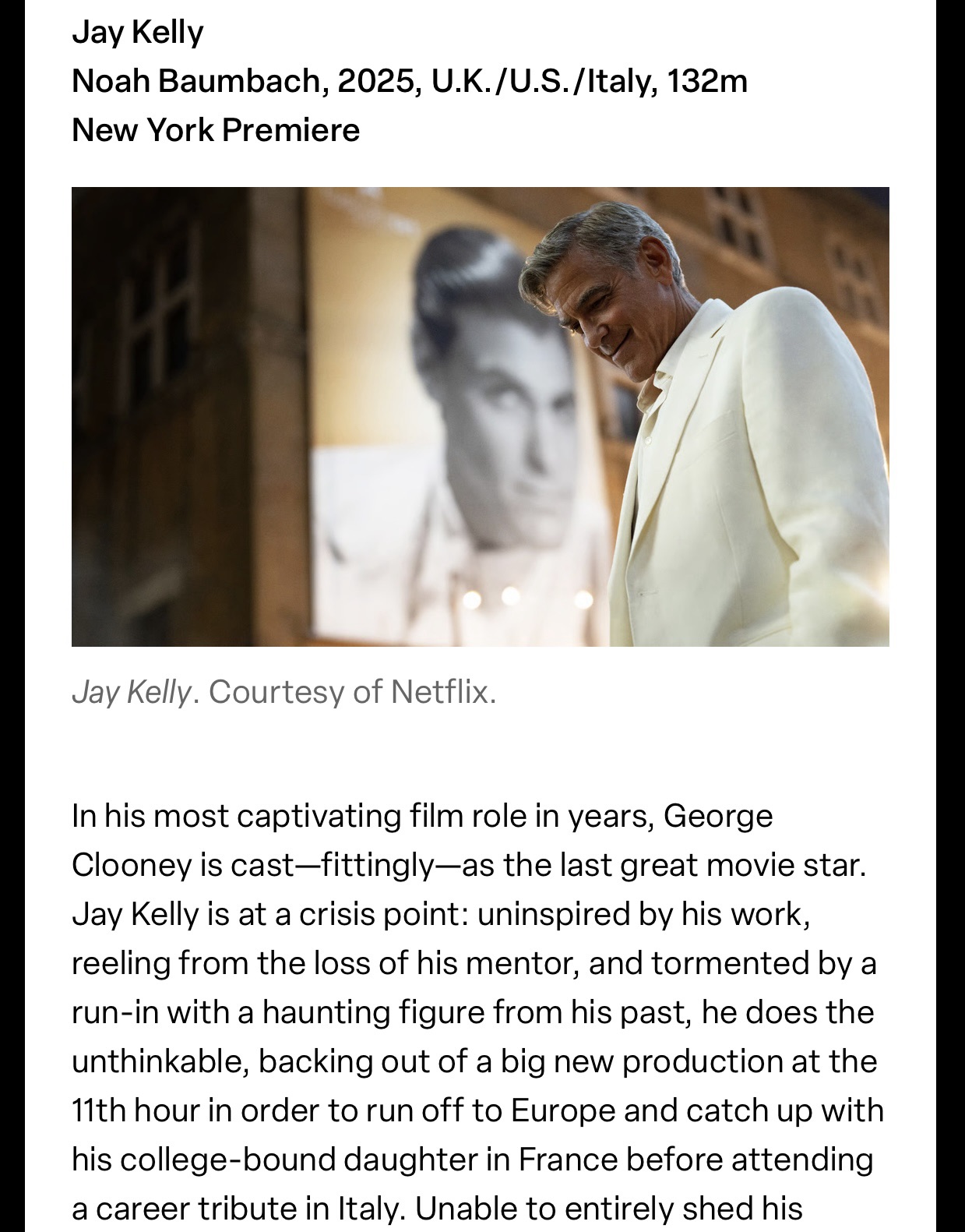
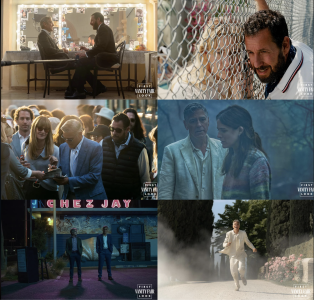
Noah Baumbach‘s Jay Kelly, a dramedy written by Baumbach and Emily Mortimer, “follows a friendship between a famous actor (George Clooney) and his manager (Adam Sandler) as they travel through Europe and reflect on their life choices, relationships, and legacies.”
Plus Laura Dern, Billy Crudup, Grace Edwards, Stacy Keach, Riley Keough, Jim Broadbent, Greta Gerwig, Patrick Wilson.
Pops at the Venice Film Festival roughly three weeks hence; enters Netflix streaming feed on 12.5.
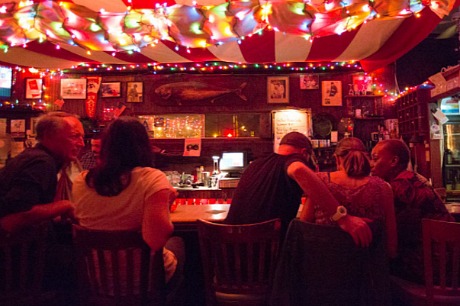
Posted on 3.12.17: Early last evening we visited Chez Jay, the legendary dive-bar eatery on Ocean Avenue. It’s still noisy as hell and the service faintly sucked, but the entrees are still delicious. The faintly grubby aura, reddish lighting, checked tablecloths, peanut shells on the floor, banners on the wall, thunky-sounding music system — walk through the front door and you’re Marty McFly in 1971.
Chez Jay has been one of those lowdown, cool-cat, special-vibe places since ’59. Very few Los Angeles establishments feel this time-machiney.
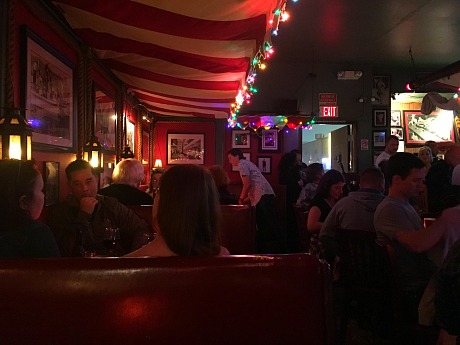
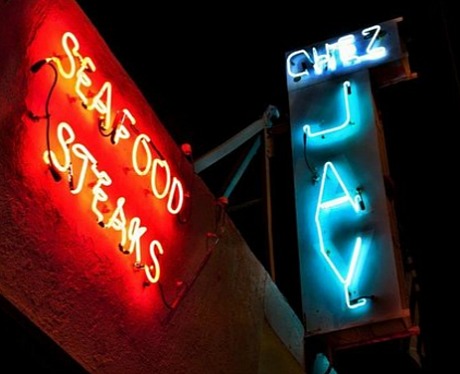
I somehow managed to afford dinner there two or three times during my Los Angeles lost-weekend period in the early to mid ’70s, or right before I drove back east to work at becoming a film writer. This was when Chez Jay was a serious celeb haunt. Jack Nicholson (sporting the tight curly hair perm that he wore for The Fortune) and Lou Adler and a couple of women had the back table one night; I spotted a flannel-shirt-wearing Jeff Bridges during another visit.
I knew Jay Fiondella, the owner-founder and sometime actor, very slightly back then. Every time I ran into him I’d mention how much I liked John Flynn‘s The Outfit (’73), in which he played a poker player who gets held up by Robert Duvall and Joe Don Baker.
Jay died in ’08 of Parkinson’s. The place is currently run by Michael Anderson, Fiondella’s longtime business partner, who co-owns it with Fiondella’s daughter and son, Anita and Chaz. Here’s a four-year-old L.A. Times piece that sums up the lore.
This Jonah Hill scene was shot and subsequently cut out of Knocked Up 18 or 19 years ago, and before today I’d honestly never seen it. Really. Semen milkshake chug-a-lug.
I hated this effing film after first glancing at the one-sheet, and now most of the world, it seems, has joined HE’s hate team. Tears of joy…weeping with gratitude.


In 1946 Hermann Goering was convicted of conspiracy, crimes against peace, war crimes, and crimes against humanity at the Nuremberg trials. He was no one’s idea of an Albert Speer-like moderate, but he was primarily a go-alonger. A Hitler ally and almost certainly an anti-Semite from way back, he played the political game in order to gain and wield power. He liked to eat (a total fatty until the final year of his life) and collect art and swagger around. He doesn’t appear (emphasis on the “a” word) to have been a rabidly racist Nazi ideologue like Heinrich Himmler. He got what he deserved at Nuremberg, but was fundamentally no more and no worse than, say, Dick Cheney during the Dubya years.
“Well, so was Ulysses S. Grant. Maybe it’ll work out like that.”
Justine Bateman, starting around 4:30 mark: Before streamers and tech companies came to regard more or less everything as content, “the goal was this excellence…you wanted to be associated with something really good…something that would last beyond this era…[back then it was almost] shameful to do something [just] for money…sometimes you had to but you didn’t feel good about it.
“But what happened 10 years ago was that [we had] this streaming situation and studio chiefs chasing after the streamers and not wanting to look like chumps, so [that] really screwed things up. The studios started looking at films and TV series just as content. There have been exceptions over the last 10 years, of course, but the focus became volume content.”
I voted for Harris because I wanted someone semi-sane and mostly sensible running things, but I understand why the battleground schmoes didn’t like her.
“A party of scolding, bullying, cancel culture…this is actually what fascism is.”
@mimzie2.0 Piers Morgan Says Democrats Should reevaluate themselves, before next election