
 Jeff Wells
Submitting to Corporate Poison
HE to friendo who’s seen James Gunn’s Superman: “How can you even stand to watch another DC Superman film? How can you let that shit into your soul? The endless reliance upon DC formula, remaking and remaking and remaking it all over again, is poison in the bloodstream.”
Friendo: “If I had a magic wand and could eliminate the blockbuster culture of the last 45 years, I would. But the poison didn’t start with comic-book movies. It started in the early ‘80s. And yet the bottom line is that some comic-book movies are good. That said, I’ve no doubt Superman will be trashed into the ground.”
Older Actors Are Expected To Look Better
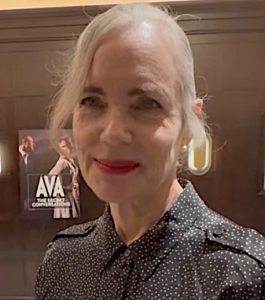
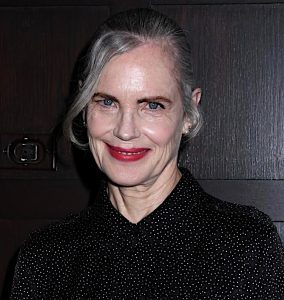
Born on 7.18.61, Elizabeth McGovern was around 18 when she played Jeanine Pratt in Robert Redford’s Ordinary People (9.10.80). A lively career followed, and 45 years have since flown by. McGovern is now about to begin a six-week run in Ava: The Secret Conversations at the New York City Center (131 W. 55th Street).
On-stage she resembles the older Ava Gardner, wearing a dark and tidy On The Beach wig. This Ava actually half-resembles the brunette Elizabeth McGovern who appeared in Cannes in 2012. But she’s gone gray in recent years and is making no effort to hold onto a semblance of her former self.
The truth is that McGovern currently looks like a blend of Jessica Tandy in The Birds and that care-worn woman who came to take Blanche Dubois to the mental hospital during the finale of A Streetcar Named Desire.
Not that there’s anything wrong with that.
McGovern is roughly Demi Moore’s age (actually a year older), but she sure as hell hasn’t been taking Substance injections. We’re simply accustomed to famous actresses looking a little bit better for wear, and it’s a wee bit jolting when, out of costume and sans makeup, they appear to be more or less their natural age. Which is not a crime — just a surprise.

Hopper + Burroughs vs. Johnson
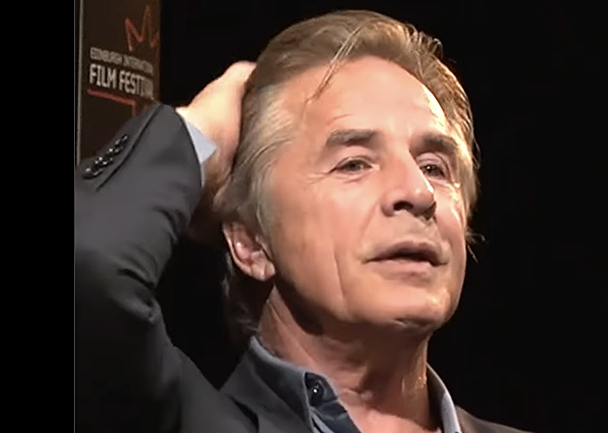
Just for clarification’s sake, Dennis Hopper directed The Hot Spot. To further clarify, I don’t think I’ve ever seen it. Okay, maybe I did see it and put it out of my mind. But if not, maybe I should? A sexually simmering, small town noir-slash-potboiler, based on “Hell Hath No Fury“, a 1953 novel by Charles Williams, who also co-wrote the screenplay.
style=”color: #c9c8cd; font-family: Arial,sans-serif; font-size: 14px; line-height: 17px; margin-bottom: 0; margin-top: 8px; overflow: hidden; padding: 8px 0 7px; text-align: center; text-overflow: ellipsis; white-space: nowrap”>A post shared by Don Johnson Actor For Life | Admin: Bibi | 55 years with DJ (@donjohnson.actor.for.life)

Somehow Missed This Three Weeks Ago
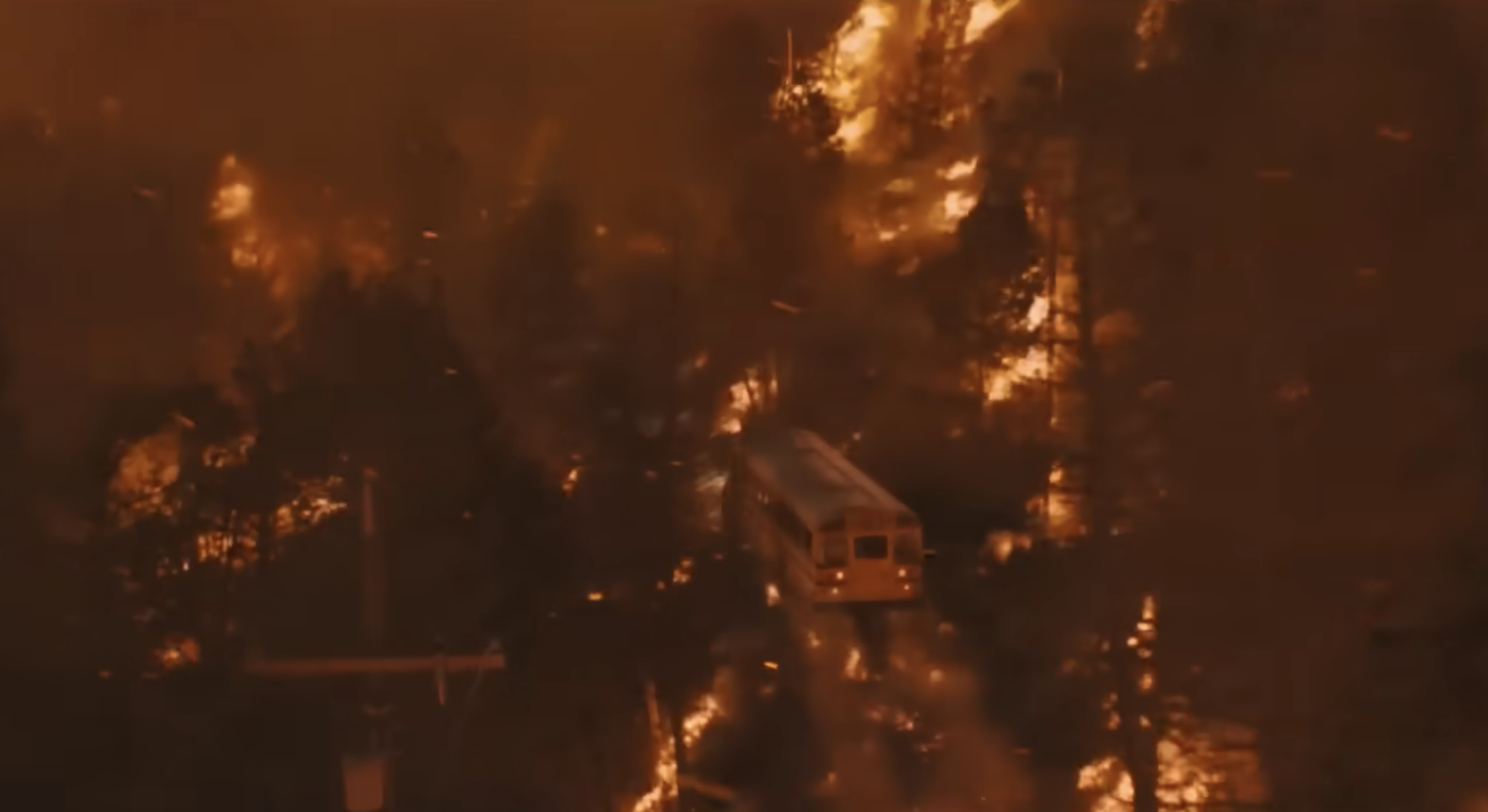
No firm release date for Apple’s The Lost Bus, but with Paul Greengrass directing you know it’ll be fairly decent, at worst. Greengrass (United 93) doesn’t fool around.
Based on Lizzie Johnson’s “Paradise: One Town’s Struggle to Survive an American Wildfire“.
A bus driver (Matthew McConaughey) has to navigate a bus carrying children and their teacher (America Ferrera) to safety through the 2018 Camp Fire, which became the deadliest fire in California history.
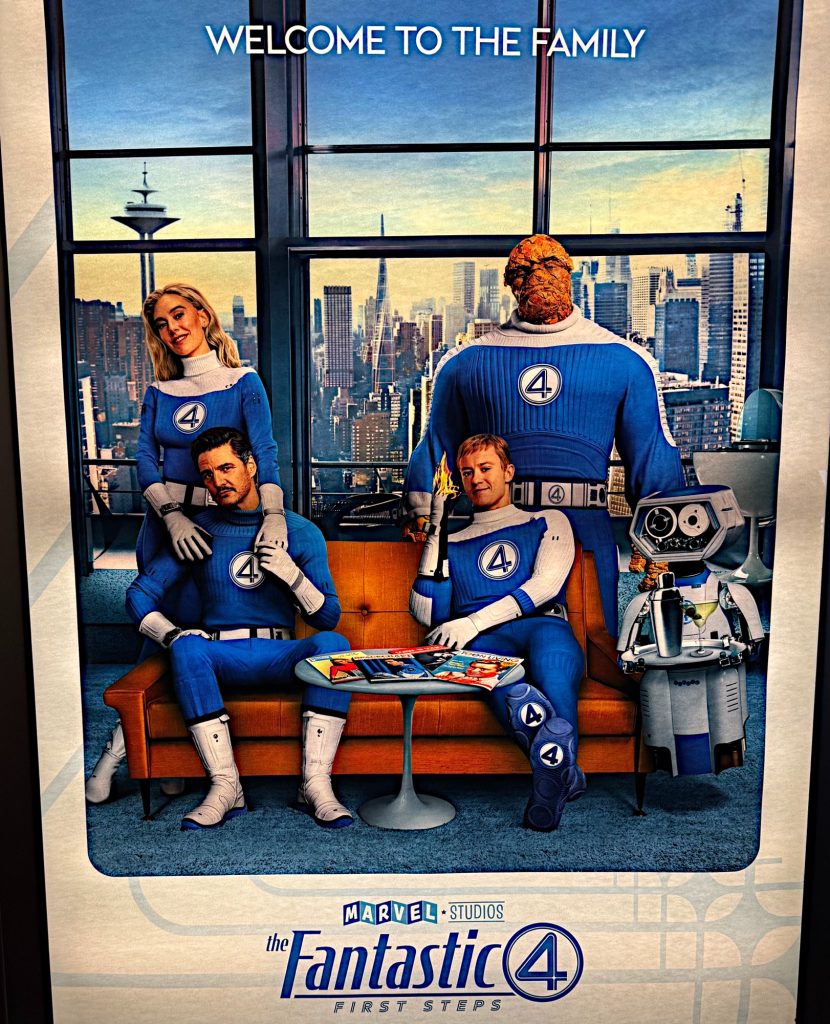
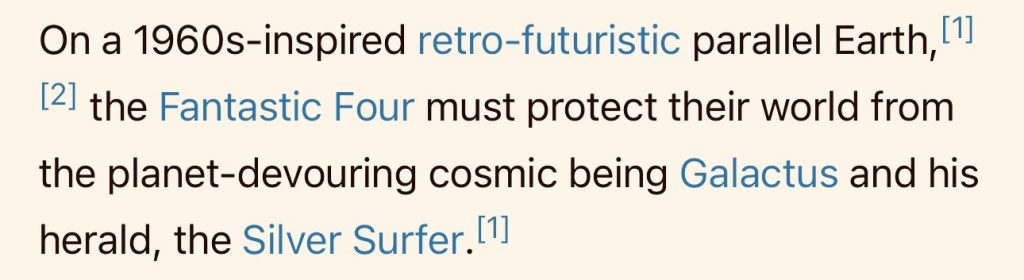
“Fantastic Four” Feels Like A Form of Cancer
I’m not going to say that I loathe and despise Marvel’s Fantastic Four: First Steps sight unseen, as that wouldn’t be fair or wise, much less patient.
And yet I do kinda feel this way. The light-blue color scheme — it’s basically The Jetsons within a Marvel universe — makes me feel nauseous. But let’s not go there until it screens.
I can at least say this: As one of the Fantastic Four is played by Joseph Quinn, who is destined to sully, vandalize and perhaps ruin the memory of George Harrison when Sam Mendes‘ quartet of Beatles biopics comes out in ’27…I can at least call myself a Fantastic Four hater because of Quinn alone.
> Posted on 6.5.25:Snapped last night inside the big Danbury AMC, prior to catching Ballerina. Obviously the people behind Fantastic Four: First Steps (Disney, 7.25) have no shame. Has Pedro Pascal ever said no to anything or anyone? And the gingered Joseph Quinn, who will play the physically dissimilar George Harrison for Sam Mendes later this year…this, ladies and germs, is whoredom personified.
Leaked Daily Beast Review Says Gunn’s “Superman” Blows The Big One
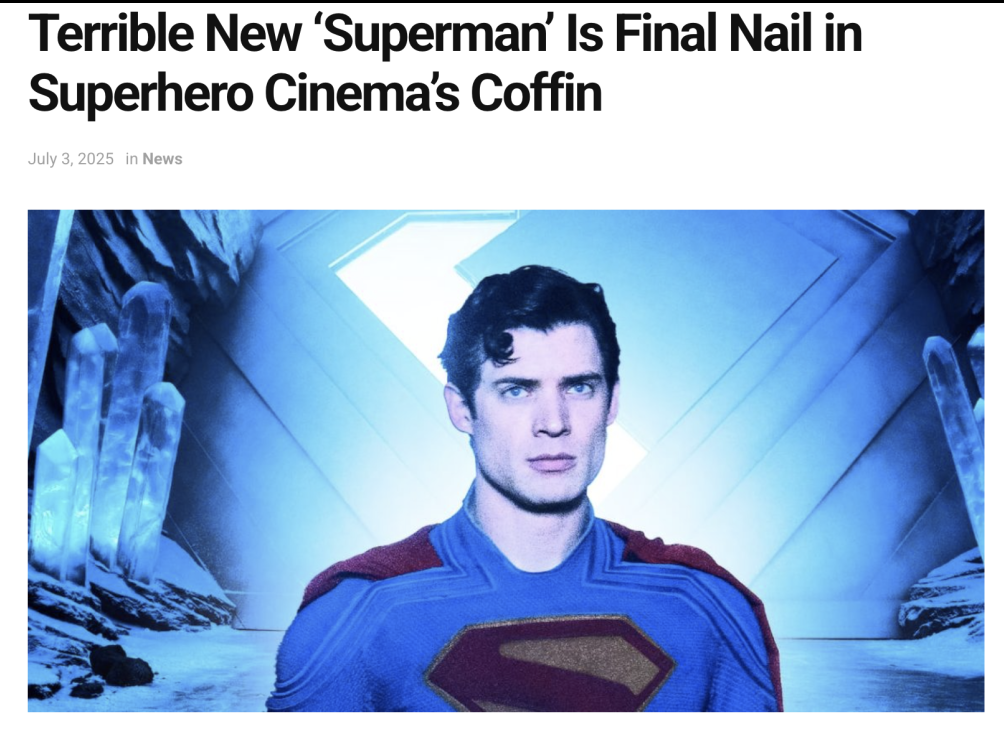
My head is spinning from the mere effort of trying to make sense of Nick Schager’s summary of the allegedly jumbled, gravity-free, Jasper Johns-like, geek-splattered plot in James Gunn‘s Superman (WB, 7.11).
Schager’s leaked Daily Beast review posted yesterday before being hastily taken down.
Imagine trying to follow or make sense of this Warner Bros. release on its own terms (and with shitty AMC multiplex sound to boot!) when it opens next week.
So now that the cat is out of the bag and the Superman review embargo is totally blown, will the trades follow suit today with their own reactions (whether positive, comme ci come ca or negative)? Will trade reviewers try to go a little easy out of sympathy, given the vitriolic tone of Schager’s review?
Here’s Schager’s review: Just as the seemingly indestructible Man of Steel is fatally weakened by kryptonite, so too is the once-unbeatable superhero genre gravely threatened by audience fatigue.
Tasked (alongside Peter Safran) with reinventing Warner Bros’ DC movie brand with an all-new “DC Universe,” director James Gunn strives to combat such lethargy with Superman, a rambunctious reboot of the Action Comics icon that, tonally and narratively, is the exact opposite of Zack Snyder’s grimdark predecessors.
It’s a big swing in a polar-opposite direction, and one that, alas, turns out be as big a whiff, resulting in a would-be franchise re-starter that resembles a Saturday morning cartoon come to overstuffed, helter-skelter life.
Superman’s hero is no brooding Snyder-ian Christ figure; rather, he’s a sweet and sincere do-gooder who uses the word “dude,” takes time out of fighting behemoths to save squirrels from harm, and believes that viewing everyone as beautiful is “punk rock.”
The same goes for Gunn’s film, which is set on an Earth overrun by metahumans, the most powerful of which is Superman (David Corenswet), who at outset crash lands in the Arctic after losing his first-ever fight to an armored adversary known as the Hammer of Boravia—a country whose attempts to start war with neighboring Jarhanpur was recently thwarted by Superman.
Dragged to the Fortress of Solitude by his caped canine companion Krypto, Superman is nursed back to health by his lair’s robot minions, all as he listens to an incomplete recording made by his parents that accompanied him on his initial journey to our planet.
Superman is soon back in the fight, although he doesn’t initially realize that his true enemy is Lex Luthor (Nicholas Hoult), whose unparalleled knowledge of the Kryptonian’s moves and instincts allows him to successfully direct the Hammer of Boravia in their clashes. Following this battle, Superman wrestles with growing political and public outrage over his rash unilateralism, and bristles at the nasty social media campaigns ruining his reputation.
He receives merely moderate support from Lois Lane (Rachel Brosnahan), his Daily Planet colleague as well as his girlfriend, whom he grants an interview only to immediately regret it. Everyone has doubts about the noble titan, including Green Lantern Guy Gardner (Nathan Fillion), who dubs him a “wuss” for wanting to study rather than kill a fire-breathing goliath, and who is partners with genius Mister Terrific (Edi Gathegi) and warrior Hawkgirl (Isabela Merced) in a trio he’s desperate to dub the “Justice Gang” (and whose headquarters is the classic Super Friends Hall of Justice).
Luthor is in league with the president of Boravia, whom he visits via portals through a “pocket universe” that he’s created, damn its potential to beget a reality-destroying black hole. He’s also determined to turn humanity against Superman by executing a scheme that raises nature-vs.-nurture questions this tale doesn’t seriously address.
Despite his enmity for metahumans and, particularly Superman, Luthor is aided in his quest by two superpowered minions, the nanotechnology-enhanced Engineer (María Gabriela de Faría) and the mute, masked Ultraman, who partake in some of Gunn’s elastic, hyper-speed skirmishes.
Superman doesn’t skimp on the high-flying action, to a fault; the film is so awash in over-the-top CGI insanity that its slam-bang mayhem loses its punch. Not helping matters, the charming Corenswet looks the part but, in the shadow of Christopher Reeve (whose son Will cameos) and Henry Cavill, he comes across as relatively slight—a situation exacerbated by the all-over-the-place nature of his saga.
Superman doesn’t establish its scenario so much as it situates viewers in media res and then asks them to hold on for dear life as it whiplashes about from one out-of-this-world locale and incident to another. While verve isn’t in short supply, substantiality is; by not first building a foundation for its fantasy, the film feels as if it’s operating in a comic-book sandbox devoid of any (literal or figurative) gravity.
That continues to be the case as Superman finds himself at the mercy of Luthor and is compelled to partner with the Justice Gang as well as Metamorpho (Anthony Carrigan), a shapeshifting creature whom he meets in an interdimensional prison that boasts an “anti-proton river,” and who asks him to rescue his giant-headed infant son from Luthor’s minions.
DC Comics die-hards may delight in Superman’s endless geekiness but everyone else is apt to feel adrift or, at least, along for a frenetic, flimsy ride that only feigns interest in actual emotion. Superman and Lois’ relationship gets about as much attention as do sequences in which the Daily Planet reporter flies a spaceship. And interjected into the middle of colorful chaos and madness, a trip back to Smallville to visit Ma (Neva Howell) and Pa Kent (Pruitt Taylor Vince) is too sketchy to generate aww-shucks pathos.
Unfortunately, the proceedings aren’t better when it comes to humor; though Gunn continues to be adept at balancing multi-character concerns, his script — unlike his superior Guardians of the Galaxy trilogy and 2021’s The Suicide Squad — delivers scant amusing one-liners or gags, save for cute Krypto’s habit of excitably wrestling and licking Superman at the least opportune moments.
With a chrome dome and a cocky sneer, Hoult makes for a faithful Luthor. However, as with Brosnahan and Skyler Gisondo as Jimmy Olsen—who has a straining-to-be-funny subplot involving Luthor’s selfie-loving girlfriend Eve (Sara Sampaio)—his performance is overwhelmed by the material’s endless sound and fury.
Zipping this way and that, Superman gets tangled up in fanciful nonsense that soon renders the entire affair superficial and silly. Similar to Snyder and Joss Whedon’s misshapen Justice League, Gunn’s spectacular overpopulates itself with heroes and villains it has neither the time nor the inclination to develop. Consequently, everyone and everything is two-dimensional, no matter that the director’s imagery is sharp and vibrant.
John Williams’ classic theme from Richard Donner’s 1979 Superman is heard (in different forms) throughout, yet it’s incapable of lending the scattershot film the magic it needs. Biting off more than it can chew, Gunn’s wannabe-blockbuster eventually resorts to setting up future franchise installments via quick-hit appearances from Maxwell Lord (Sean Gunn) and Supergirl (Milly Alcock). That’s not to mention by highlighting second-banana figures like Mister Terrific at the expense of fully establishing the altruistic heart of its protagonist, whose path toward self-actualization is mostly an afterthought.
Looking ahead rather than focusing on the here and now, this attempt at reimagining DC’s movie series ultimately proves to be more of the same old interconnected-universe bedlam that, at this point, is perilously close to going out of fashion.
WB’s Superman review embargo ends on Tuesday, July 8 at 3:00 pm eastern.
When Giddy Drunks Were Amusing
In a certain vague sense, I was “there” when this Arthur scene was shot on Fifth Avenue and 59th Street. It was the summer of ’80 and I was anxious and under-employed. I was standing across the street with several other onlookers, and I recall watching Liza Minnelli, Dudley Moore and John Gielgud performing this scene two or three times. I can still hear Minnelli yelling “get me a cop!”, over and over….the clapper, “cut”, etc.
I remember staring at Gielgud between takes, parked on a canvas chair, and wondering why he was sitting so stiffly…motionless, like a sphinx. Then I saw the film a year later, and Gielgud’s snooty putdown riffs were hilarious. He and Minnelli had the funniest lines.
Minnelli was 34, Moore was 45, Gielgud was 77.
Posted on 2.18.06, roughly six years before I embraced sobriety:
“Dudley Moore‘s drunken playboy was funny in 1981’s Arthur, but less so in 1988’s Arthur 2: On The Rocks. Arthur was a fresher film, of course, with a kind of champagne-fizz attitude. The sequel was boozier and more “real.” Moore was obviously older in ’88, his career wasn’t going quite as well, the performance felt desperate and the mood wasn’t the same.
“Drunks aren’t funny in real life unless you’re 19 and hanging with your drunken friends and as drunk as they are. You have to be fairly young and unsullied.
“True story: I was staying with some friends at a beach house on the Jersey shore when we were all 17 or thereabouts, and there was this big guy named Richard Harris who was half-sitting and half-lying on the living-room couch and about to throw up from too much vodka. I was coming down the stairs and Harris was suddenly on his feet and making for the bathroom (or at least the kitchen sink), but he wasn’t fast enough.
Bass Was Enough
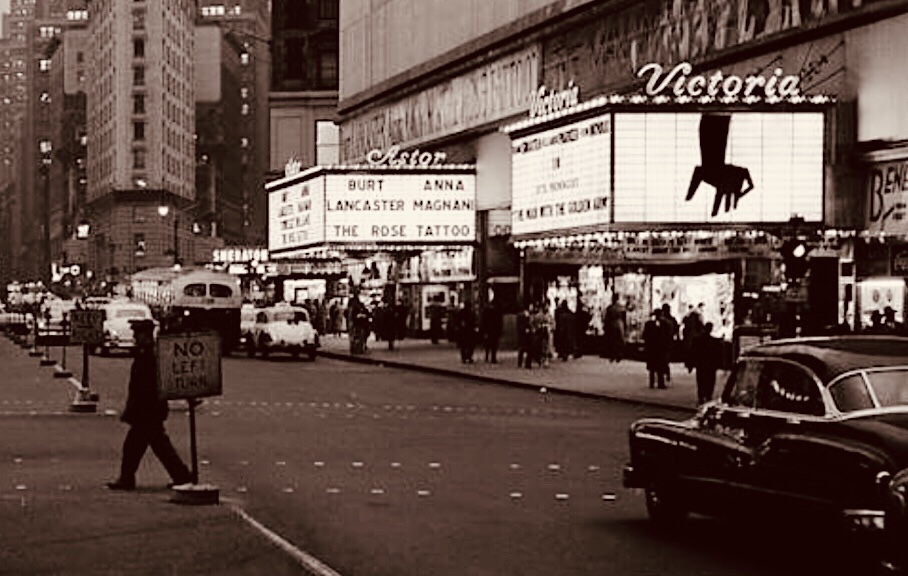
In the good old Times Square of the ‘50s and ’60s, the movie marquee sell — the visual presentation of the theme or tone of the film — made a big impression. It conveyed attitude and confidence. It meant a lot.
In the case of Otto Preminger‘s Anatomy of a Murder, it’s noteworthy that Columbia distribution execs felt that Saul Bass‘s austere, monochrome logo for this 1959 film (opened on July 2nd) was the way to go.
Frank Capra‘s A Hole in the Head, playing one block to the north at Leow’s State, opened two weeks later (July 15th).
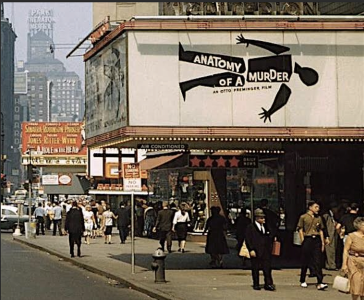
“Marquee Swagger”, posted on 12.16.19:
You also have to admire the marketing chutzpah of the distribution executive who calculated that a visually concise Saul Bass logo (is there any other kind?) would be more than sufficient to attract Times Square passers-by. You have to admire the certainty and the confidence. The applicable term is “balls.”
The point was that the distribution guys were so confident that Saul Bass’s twisted arm logo had penetrated the marketplace that they figured they didn’t need to spell out the title to sidewalk traffic. Yes, the east-facing front of the Victoria marquee spelled it out, but that side wasn’t seen as much as the north and south facers.
Fair Shake for Eastwood’s “Breezy”
In A.O. Scott‘s N.Y. Times review of Shawn Levy‘s “Clint“, he notes that Levy’s judgments “mostly follow the critical consensus, but the mini-reviews embedded in the narrative are among the most amusing and illuminating parts of the book.
“Levy can be witheringly succinct: ‘Ew. Just ew’ sums up his view of Breezy (’73), Eastwood’s little remembered third feature as a director. (It’s about a middle-aged man’s sexual awakening with a 17-year-old flower child).”
Correction #1: Scott is dead wrong. Breezy is about a middle-aged man’s (William Holden) spiritual awakening by way of a relationship with a 17-year-old hippie chick (Kay Lenz). They eventually become lovers in Act Two, yes, but Eastwood gently de-emphasizes the sexual aspects of their relationship. It’s a story about emotionally opening up.
Correction #2: Breezy isn’t even a slight “ew” — it’s modest and character-driven and entirely effective for what it is. I hate Holden’s ’70s wardrobe (orange sweaters, checked pants, elephant collars) and his real-estate hustler scowls a lot (Lenz’s hippie-chick calls him “dark cloud”) but it’s an honestly felt, medium-range thing, and a better-than-decent effort on Eastwood’s part.
The pacing is natural and unhurried, and the dialogue is nicely sculpted for the most part. It was also the first film Clint directed in which he didn’t star.
Holden’s performance as Frank Harmon, a cynical real-estate agent, radiates a solid gravity force in every one of his scenes. I’m particularly fond of a moment in which Harmon and a real-estate colleague are discussing some hippie kids who are frolicking nearby. Harmon offers a sardonic two-word assessment: “Low tide.”

“Bet You’re A Big Lee Marvin Fan…Aren’t Ya?”
Alternate: “Are you gonna bark all day, little doggie, or are you gonna bite?”
Fair Play for George Hickenlooper
With a dynamically enhanced, 4K-scanned and restored Hearts of Darkness opening at the Film Forum tomorrow, it’s an opportune time to remind the HE readership that while this 1991 doc about the making of Apocalypse Now uses the late Eleanor Coppola‘s footage and narration, the heavy lifting in most senses of the term was done by the late George Hickenlooper, whom I regarded as a friend, and Fax Bahr.
Here’s what Hickenlooper told me on 8.26.10:
“I think the more appropriate way to look at it is that Hearts of Darkness is Eleanor Coppola‘s story, but it’s not her film. Hardly. It’s her story. But that’s because I decided to make it her story.
“When I got involved with this project 20 years ago, Showtime was going to make it a one-hour TV special called Apocalypse Now Revisited. It was going to be basically an hour-long special about how they did the war pyrotechnics. It was going to be dull and stupid.
“At the time I told Steve Hewitt and my partner Fax Bahr. ‘Nobody cares about a making-of movie, especially one that is 14 years old.’ I argued that the film had to have an emotional component. At the time, no one was familiar with Eleanor’s diary ‘Notes.’ My father had purchased it for me on my 16th birthday [in 1979]. I devoured it up.
“When I got involved with Hearts of Darkness, I advocated using her diary as the narrative thread. I got incredible resistance from Showtime, and I got initial resistance from Eleanor. Not much, but some.
“Once I was able to convince everyone that the film would best be told through her narrative voice, it was then and only then it became HER STORY.
“Eleanor did shoot the footage in the Philippines back in 1976, but she only stepped twice into our cutting room on the back lot of Universal. Twice. For a total of eight hours.
“I was there for a year, 15-18 hours a day. So it’s not a film by Eleanor, but I guess it’s sexier from a marketing angle to make it look that way.”
Hickenlooper elaborated upon the Hearts of Darkness history in a 2007 interview with laist correspondent Josh Tate.
In an 8.27.10 HE followup Hickenlooper stated that “the reality is that Fax Bahr hardly had anything to do with HOD. He was writing for the show In Living Color at the time. He spent a total of about three weeks out of the entire year in the editing room. Eleanor spent two days. It was me and the two editors for an entire year.”
James Mockowski, Film Archivist and Restoration Supervisor at American Zoetrope: “For the past 30 years, Eleanor’s 16mm behind-the-scenes footage has been three to four generations removed from the original elements. For this new release and restoration of the documentary, Francis decided to scan the original sources in 4K. The extensive excerpts from the feature are now presented in their original 2.39:1 aspect ratio, rather than being letterboxed into a 4×3 frame.”