But with some experience and seasoning…
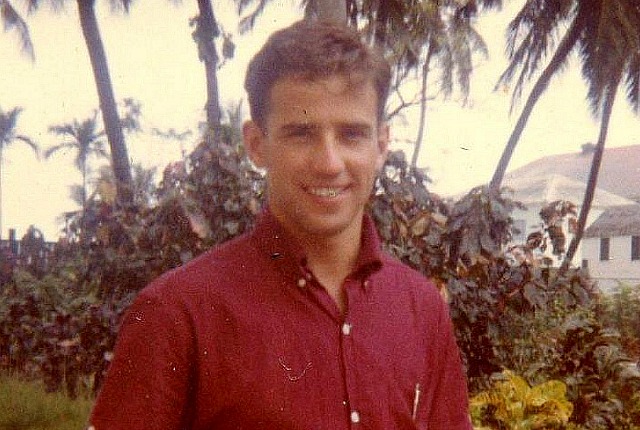


But with some experience and seasoning…
…and perhaps may even be cured.
The treatment for Hodgkin lymphoma is highly effective. The five-year survival rate for dudes with Hodgkin lymphoma is 87%. If the cancer is found in its earliest stages, the five-year survival rate is 92%. If the cancer spreads regionally, the five-year survival rate is 94%. If the cancer has spread to different parts of the body, the five-year survival rate is 78%.
Non-Hodgkin lymphoma may arise in lymph nodes anywhere in the body. Hodgkin lymphoma typically begins in the upper body, such as the neck, chest or armpits. Hodgkin lymphoma is often diagnosed at an early stage and is therefore considered one of the most treatable cancers.
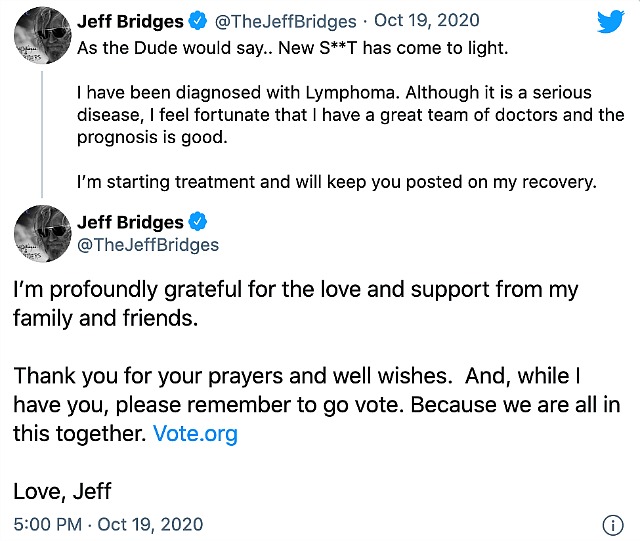
…with her pet cats. Which I’m happy to hear.
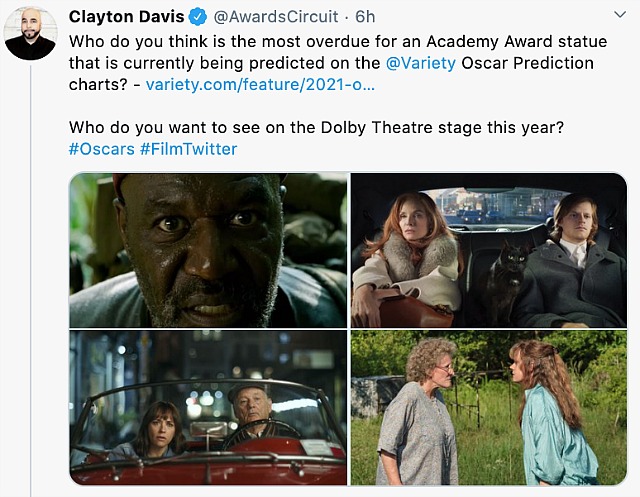
Delroy Lindo, Bill Murray, Glenn Close and Michelle Pfeiffer are all overdue for Oscar recognition. This year they’ve all hit the jackpot in Da 5 Bloods, On The Rocks, Hillbilly Elegy and French Exit, respectively. I’d rather not say who’s the most deserving in this regard. Okay, it’s Close — she’s been nominated six or seven times over the last 40 years. Lindo’s performance as a Trump-supporting Vietnam veteran is fairly locked in. Murray’s performance represents 85% to 90% of On The Rock‘s allure, but I’m not sure it’s on the level of his historic turns in Rushmore and Mad Dog and Glory. Pfeiffer’s 40 years in the business could in themselves validate her “due”-ness. Close, Murray, Lindo and Pfeiffer — that’s my lineup.
From Pauline Kael’s “The Man From Dream City,” published in The New Yorker on 7.7.75. “Nearly all of Cary Grant’s seventy-two films have a certain amount of class and are well above the Hollywood average, but most of them, when you come right down to it, are not really very good.
“Grant could glide through a picture in a way that leaves one indifferent, as in the role of a quaint guardian angel named Dudley in the bland, musty Goldwyn production The Bishop’s Wife (1947), and he could be the standard put-upon male of burbling comedy, as in Every Girl Should Be Married (1948) and the pitifully punk Room for One More (1952) — the nice-nice pictures he made with Betsy Drake, who in 1949 became his third wife.
“[And] he could be fairly persuasive in astute, reflective parts, as in the Richard Brooks thriller Crisis (1950), in which he plays a brain surgeon forced to operate on a Latin-American dictator (José Ferrer). He’s a seasoned performer here, though his energy level isn’t as high as in the true Grant roles and he’s a little cold, staring absently when he means to indicate serious thought. What’s missing is probably that his own sense of humor isn’t allowed to come through; generally when he isn’t playing a man who laughs easily he isn’t all there.
“No doubt Grant was big enough at the box-office to have kept going indefinitely, surviving fables about caterpillars, and even such mournful mistakes as hauling a cannon through the Napoleonic period of The Pride and the Passion.
“But if Alfred Hitchcock, who had worked with him earlier on Suspicion, hadn’t rescued him with Notorious, in 1946, and again, in 1955, with To Catch a Thief (a flimsy script but with a show-off role for him) and in 1959 with North by Northwest, and if Grant hadn’t appeared in the Stanley Donen film Charade in 1963, his development as an actor would have essentially been over in 1940, when he was only thirty-six.
“In all four of those romantic suspense comedies, Grant played the glamorous, worldly figure that ‘Cary Grant’ had come to mean: he was cast as Cary Grant, and he gave a performance as Cary Grant. It was his one creation, and it had become the only role for him to play — the only role, finally, he could play.
“The special charm of Notorious, of the piffle To Catch a Thief, and of North by Northwest and Charade is that they give him his due. He is, after all, an immortal — an ideal of sophistication forever. He spins high in the sky, like Fred Astaire and Ginger Rogers. He may not be able to do much, but what he can do no one else has ever done so well, and because of his civilized non-aggressiveness and his witty acceptance of his own foolishness we see ourselves idealized in him. He’s self-aware in a charming, non-egotistic way that appeals to the very people we’d want to appeal to.”
Am I allowed to say that one of the first things I noticed about Viola Davis‘s Ma Rainey is her liberal application of rouge? And that she could do with a bit less?
Boilerplate: “Tensions and temperatures rise over the course of an afternoon recording session in 1920s Chicago as a band of musicians await the trailblazing Ma Rainey — legendary ‘Mother of the Blues.’ Late to the session, the fearless, fiery Ma engages in a battle of wills with her white manager and producer over control of her music. As the band waits in the studio’s claustrophobic rehearsal room, ambitious trumpeter Levee (Chadwick Boseman) — who has an eye for Ma’s girlfriend and is determined to stake his own claim on the music industry — spurs his fellow musicians into an eruption of stories, truths, and lies that will forever change the course of their lives.”
Gertrude “Ma” Rainey (born Gertrude Pridgett, 4.26.86 – 12.22.39) “was one of the earliest African-American professional blues singers and one of the first generation of blues singers to record. Known for her powerful vocals, energetic disposition, majestic phrasing and a moaning style of singing — qualities most evident in her early recordings ‘Bo-Weevil Blues’ and ‘Moonshine Blues’.”
“Rainey recorded with Thomas Dorsey and Louis Armstrong, and she toured and recorded with the Georgia Jazz Band. She toured until 1935, when she largely retired from performing and continued as a theater impresario in her hometown of Columbus, Georgia until her death at age 53.”
Donald Trump during reported conference call with campaign staff from his namesake hotel in Las Vegas: “People are tired of Covid. I have these huge rallies. People are saying whatever. Just leave us alone. They’re tired of it. People are tired of hearing Fauci and all these idiots. Fauci is a nice guy [but] he’s been here for 500 years. Fauci is a disaster. If I’d listened to him, we would have had 500,000 deaths.”
Trump was throwing around the same “people have had enough” and “free the states” crap back in April-May-June, and this attitude is what led to much more infection and basically where we are right now. If people had hung tough last spring and early summer and behaved like the population of West Hollywood does as a rule, and if there hadn’t been so much anti-masker sentiment among the Karens and belligerent red-hats and if there hadn’t been so many super-spreader events like the recent motorcycle rally in Sturgis, South Dakota…if more people had worn masks, washed their hands and behaved like reasonable adults, the country would be in a less infected place right now.
For decades and decades there used to be this thing, this standard, this kind of widely admired, grade-A movie that was more or less regarded as extra-good on its own carefully constructed, well-ordered, just-right terms.
The charm was mostly in the craft and rigor and style of it, and rarely about what it was saying. That’s not to say that each and every significant film since the 1920s didn’t “say” something, or that the things that were said time and again (sometimes overtly, more often in the subtext) were entirely admirable. They often weren’t, but good movies were mostly about the way they played to a relatively accommodating paying crowd. They were about being smart, clever, confident and assured….about having their act figured out and thought through to the bottom, which often resulted in a more-or-less harmonious whole.
Right here and right now, this kind of approach to first-rate filmmaking — that kind of finely-tuned, craft-based methodology a la Manchester By The Sea, Call Me By Your Name, 12 Years A Slave, The Social Network, A Separation, Zero Dark Thirty, The Irishman, Lady Bird, Son of Saul, The Wolf of Wall Street, Leviathan, Joker, The Square, Moneyball, The Lighthouse, Dunkirk — that kind of filmmaking has been…well, not “forgotten” exactly but sorta kinda put aside for the time being. Right here and right now, films are mainly being made and judged according to who’s in them, who made them and whether or not the right boxes have been checked.
And guess what? If you say in so many words that the afore-mentioned seems to be happening, you’re a bad person who needs to be cancelled.
Critics are totally playing along with this, of course. Because they don’t want to be replaced.
This is the ideological garrison state within which we all currently reside. What a film is “saying” is all. Craft levels are appreciated, respected…but if they’re only so-so in this or that film, no one is going to get overly bent out of shape. Because ideology and social reflection are what matter. Say it correctly and assemble the package with the right collaborators, and you’re more than halfway home.
As much as I admired the directorial stamp of the late Richard Franklin, Psycho II (’83) was not a good film. The main problem, or so I recall, was Tom Holland‘s script. Alfred Hitchcock‘s original Psycho (’60) was based, of course, on a 1959 novel of the same name by Robert Bloch.
In ’82 Bloch published “Psycho II“, a bizarre sequel about a 20-years-older Norman Bates and his twisted psychology. Bloch’s book had nothing whatsoever to do with Franklin and Holland’s creation.
It was suggested yesterday that Bloch’s novel, which Universal suits hated, might have been worth shooting back in the day. I read the Wiki synopsis last night. It struck me as a slasher flick told by an idiot. Please read it and share whatever reactions come to mind.
Why don’t the bad guys want Bruce Willis to put a new, store-bought battery into his car? I’m not following, in part because the editing feels forced and frenetic.
Born in ’65, De’voreaux White (aka “Argyle”) was around 22 when the original Die Hard was shot — he’s now 55. Clarence Gilyard (aka “Theo”) was 32 or thereabouts during filming — do the math.
Earlier today a friend observed that the 2020/’21 Oscars are going to be a virtue-signaling “shit show.” Representational politics, woke priorities, aspirational attitudes…pretty much everything that your average popcorn-eating movie lover doesn’t necessarily look for as he/she buys a ticket or pops for a rental.
At least a few of the 2021 Best Picture contenders will be about POC characters and situations, and the odds that a woman will be nominated for and possibly win the Best Director trophy are fairly high. The presumption is still that Nomadland is the odds-on favorite to win the Best Picture Oscar, and that its director, Chloe Zhao, is likely to win for Best Director.
This morning I threw together a list of likely contenders while asking Awards Daily‘s Sasha Stone and World of Reel‘s Jordan Ruimy for their own Best Picture spitballs. We all agree that the hottest five are Nomadland, Florian Zeller‘s The Father, David Fincher‘s Mank, Aaron Sorkin‘s The Trial of the Chicago 7 and Paul Greengrass‘s News of the World. Yes, two of these are unseen but you know Fincher and Greengrass will deliver..
After that it gets a little dicey. I feel that Regina King‘s One Night in Miami is a respectable film as far as it goes, but not necessarily Best Picture material. Then again it checks the right boxes. I haven’t seen Lee Isaac Chung‘s Minari but it also has the right kind of non-Anglo pedigree. Lee Daniels‘ The United States vs. Billie Holiday also meets the requirements. Ditto Shaka King‘s Judas and the Black Messiah and George C. Wolfe‘s Ma Rainey’s Black Bottom (Netflix, 12.18).
There’s also Taika Watiti‘s Next Goal Wins, but who knows?
Here’s what Stone said earlier today about the Best Picture Oscar situation as it currently stands:
“The good news about [my] list is that it checks off the boxes of what is required of Hollywood and the Oscars at this point in time.” Politically, she means. The right kind of potential would-be nominees whose nominations would convey the right kind of values and statements for the political-cultural times in which we live.
“The slate overall is a bit slimmer than we’re used to, which will allow for less juggernaut competition and thus, films that might not have a shot otherwise will likely have a better shot to be represented,” Stone explained. “It’s probably going to be GenZ’s favorite Oscar year ever.
“I would not be surprised to see Rod Lurie’s The Outpost pop up in a few places as it’s one movie that is really not like any of the others and could stand out for that reason. But for now, I think it’s probably too risky to predict for the Academy.
Earlier this month I posted a list of films that qualify as the year’s best for cinematic reasons alone, without necessarily assessing the wokester factor. Here they are.
Blind comment #1: “The bottom line is that there aren’t that many [Oscar contending] movies this year so it’s a good time to really pay the p.c. piper.” Blind comment #2: “Critics group choices will be politically correct up and down the line. You know that.” Blind comment #3: “Here we have the full spectrum of identity politics represented [with the current list]. Not just Chicago 7 but also a Black Panther movie. Not just a woman director but women of color. You get the drift.” Blind comment #4: “The political Oscar calculus was already bad enough [before the pandemic]. This year it’s gonna be 100X worse.”
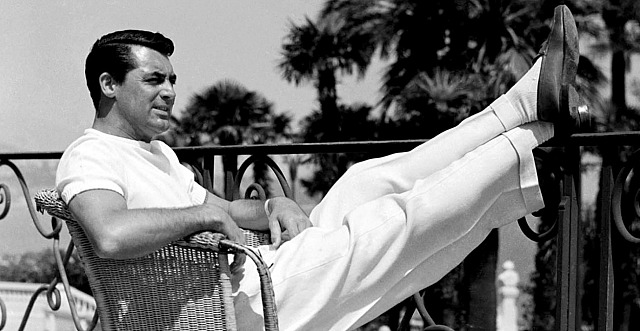
From Scott Eyman’s “Cary Grant: A Brilliant Disguise” (Simon & Schuster, 10.20), as excerpted in The Daily Beast:
“[Writer] Bill Royce and Grant even had a conversation about sex. After Royce unburdened himself about his affairs with both men and women, Grant responded by implying he had been basically gay as a young man, later bisexual, still later straight.
“[Randolph] Scott, he said, had seen their relationship as ‘locker-room playing around.’ It had nothing to do with how a man should lead his life. Besides that, at one point Darryl Zanuck had taken Randy aside and told him that enough was enough.
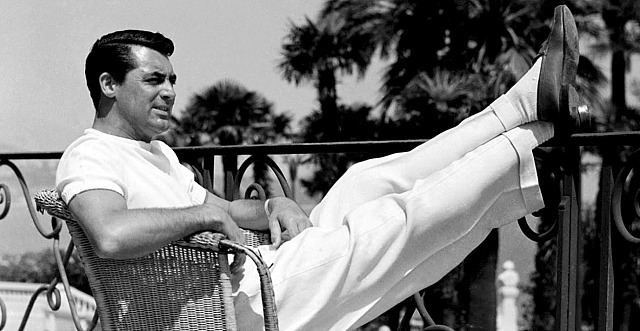
“Grant explained sexuality in terms of performance, of acting. He told Royce that to not completely explore one’s sexuality would be like an actor playing only one character for life. Everybody, he said, had more than one character inside them. He didn’t think homosexual acts were anything to be ashamed of, or, for that matter, proud of. They simply were part of the journey, not necessarily the final destination.
“I think Cary saw the searching I was doing and trusted me. He had been influenced by the Kinsey report and saw sex as a spectrum. Most people think it’s either/or. And there are men like that, but there are also men who are occasionally gay and occasionally straight. I remember one thing Cary said: ‘England is Victorian, but America is more Victorian than England.’
“My sense of it was that he found homosexual life unrewarding. As he got older, he wanted children, and he didn’t think he had any chance at a child as long as he was living that life.
“His conversation with Grant made Royce curious about Randy Scott. He was at the Beverly Hills post office one day when Scott came in to pick up some mail. He was dressed in tweeds, an ascot, had steel gray hair and sported a deep tan, just like Grant. Royce walked over and introduced himself. ‘Mr. Scott, my name is Bill Royce. I help Cary Grant with his place off Benedict and just wanted to thank you for your movies.’
“Scott smiled and said ‘Well, I haven’t seen him in a while. Tell Cary I said hello.’ Royce thought Scott was stunning; he went back to the house and told Grant about how Scott had looked. ‘Yeah, he was really something,’ Grant said, in a tone that combined esteem, fondness, and sadness.”
If you haven’t read Pauline Kael‘s “The Man From Dream City,” a 7.7.75 New Yorker essay, please take it for a spin.