
Opening Mean Streets voiceover: “You don’t make up for your sins in church. You do it in the streets. You do it at home. The rest is bullshit and you know it.” All this time, all these decades I’ve presumed that the guy saying this is Harvey Keitel‘s Charlie. No — it’s Martin Scorsese. Hat-tip to Indiewire‘s Zack Sharf — I learned something today.
Daily
What Kind Of Sick Mind Would Dream Up Another Matrix Flick?
Just for the record, the reported Matrix reboot isn’t a reboot. Or a sequel or any kind. Four days ago screenwriter Zak Penn explained on Twitter that the screenplay he’s planning will be some kind of stand-alone, alternative-universe, Logan-like thing. Okay, fine.
But why would anyone want to make another film with the word “Matrix” in it at all? It’s been nearly 14 years since the double-shot poison cocktail of The Matrix Reloaded and The Matrix Revolutions killed this franchise but good. Why would anyone want to drink from the same glass again? And yet Penn and Warner Bros. execs are willing to hold their noises and cobble something together in order to make money.
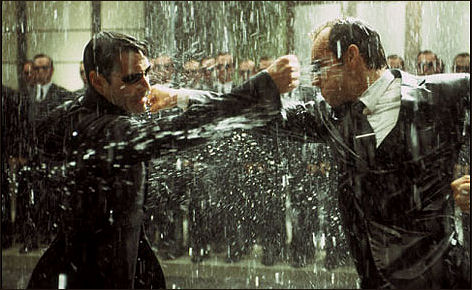
From “Shoulda Quit When They Were Ahead“, posted roughly three years ago: “I remember paying to see the original The Matrix in the old multiplex at the Beverly Connection, on the southeast corner of La Cienega and Beverly Boulevard. It was opening weekend, and I remember floating out of the theatre and listening to the chatter as the crowd trudged down the stairway exit. A visionary knockout. The first grade-A cyber adventure. Bullet time, baby! Obviously a hit.
“For the next four years I was convinced that the press-shy Wachowskis, who’d also directed the brilliant and hot-lesbo-sexy Bound, were pointing the way into 21st Century cinema and that everything they would henceforth create would dazzle as much as The Matrix, if not more so.
“And then The Matrix Reloaded came out a little more than four years later (5.15.03) and the millions who’d flipped over The Matrix were standing around with dazed expressions going “wait…what? ” And then The Matrix Revolutions opened on 11.5.03 and that was it…dead, finished, imploded. Larry and Andy who?
Worst Best Actor Acceptance Speech in Hollywood History
It’s standard form for Oscar winners to thank their colleagues, and also those to whom they owe everything — a mother, teacher, friend or wife who offered help or inspiration at exactly the right moment and in just the right way. And perhaps briefly reflect upon their their career journey or whatever combination of fate, luck or happenstance may have contributed to this. And it never hurts to apply a drop or two of emotion. Keep it real, of course, but give that shit up.
By the measure of these criteria, Humphrey Bogart blew it when he won a Best Actor Oscar for his African Queen performance in the spring of 1952.
The 52 year-old Bogart had been a star for a little more than a decade, having broken through at age 41 (at which point actors are almost never waiting for lightning to strike) as Sam Spade in The Maltese Falcon (’41), and had received his big Hollywood break only 15 years earlier when Leslie Howard insisted that reluctant producers of The Petrified Forest (’36) cast him as Duke Mantee. By any measure Bogart had just barely made it into the club, and by the skin of his teeth.
And yet when the big moment arrived Bogart, obviously unprepared and nervous and interested in exiting the stage as quickly as possible, could only thank Queen director John Huston and costar Katharine Hepburn and rather curtly at that, and mention that accepting the Oscar was more pleasant than shooting The African Queen in the “Belgian” Congo.
Megaplex Masses Have Spoken
Joe and Jane Popcorn have embraced Disney and Bill Condon‘s Beauty and the Beast to the tune of $170 million domestic and $350 million worldwide. I’m sorry but I don’t give a shit about this movie at all, and I respect Condon as a guy who’s made films I’ve enjoyed and admired (Gods and Monsters, Kinsey, Mr. Holmes) and presumably will again. I could have attended an all-media screening a few days ago but I “forgot” about it — i.e., never wanted to see it in the first place and embraced the first distraction that came along.
What am I missing? Nothing…nothing at all. I am not a lemming, and I don’t do cliffs. I won’t see it or stream it, and I won’t lose a blink of sleep.

Knowing Disney and their corporate factory-product sensibility, I strongly sensed that the view of The Verge‘s Tasha Robinson would be my own: “[This is] largely a frustrating clone of the original [animated] movie — same songs, same script, often even the exact same shot choices — but it replaces every moment of authentic or moving emotion with bombast and hyperbolic overemphasis. It slows down the flow of the familiar music by jamming in extra phrases, and builds up the energy by jamming nonstop, busy action onto the screen. It’s a garish, strident film, as well as a profoundly unnecessary one.”
Idiocy Compounded
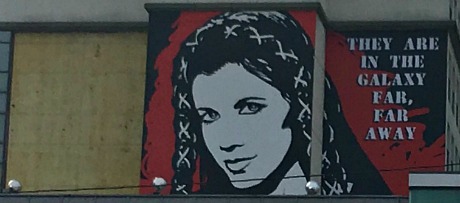
Two and a half months ago I posted a riff about what may have been the dumbest example of giant poster art ever seen in Los Angeles. Occupying an east-facing wall of the Beverly Hills Sofitel, it was an image of Ziggy Stardust-era David Bowie (rooster hair, lighting-bolt makeup) from ’72, except the artist added “1969” at the bottom. Bowie looked nothing like that at the time. A month or so later the same artist painted a same-sized image of young Carrie Fisher, who had passed on 12.27.16, along with another lulu of a caption that read “they are in the galaxy far, far away.” The artist, thinking no doubt of the Star Wars prologue “a long time ago in a galaxy far, far away,” was apparently unaware that there’s no such thing as one big, universe-encompossing “galaxy”, and that the number of galaxies in the observable universe range from 200 billion to 2 trillion. Both the artist and the Sofitel exec who hired him, obviously two or three cards short of a full deck, have made their mark and will live together in infamy. I noticed yesterday that they’ve gotten rid of the Bowie image, and yet Fisher and the galaxy copy remain.

Brick-Hard Words, Jagged-Glass Wit
Throughout my semi-adult life I’ve always admired legendary New York City columnist and novelist Jimmy Breslin. His writing, I mean. That bluntly phrased, straight-from-the-shoulder street prose that he never fancied up. A regular guy who wrote for regular guys. I was from Fairfield County, Connecticut and the son of an advertising copywriter, but I got it. The stuff Breslin wrote was always real-deal. He never tip-toed or pussied around. Well, he probably did from time to time but his legend said otherwise.
Breslin’s rep was that of a guy who could be brusque at times but was always fair and honest and respectful of the people he covered, who were usually (okay, almost always) working-class New Yorkers who never led lives of leisure, and who could never be accused of being well-educated, much less refined. And now their hinterland counterparts have given us Donald Trump. Thanks, assholes! I didn’t mean to say that — it just slipped out.
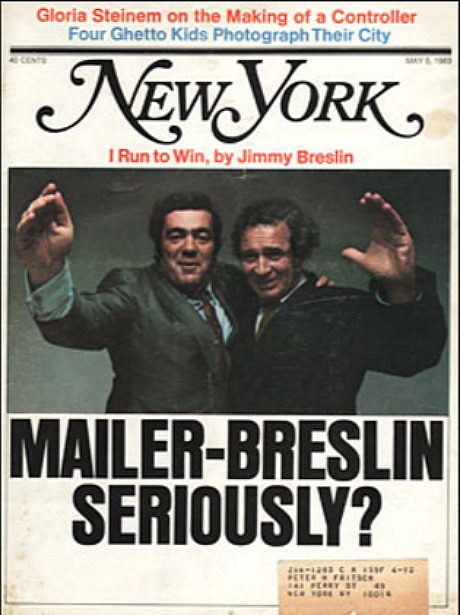

Breslin also wrote about mob guys, most famously in his 1969 book “The Gang Who Couldn’t Shoot Straight,” a roman a clef about Joey Gallo which was made into a 1971 film. In 1970 Breslin got clobbered by Jimmy Burke, the real-life model for Robert De Niro‘s Jimmy Conway in Goodfellas. Burke was pissed about something Breslin had written, some perceived slight or whatever.
Born in ’28 or thereabouts and 88 years old when he died earlier today, Breslin was best known for his N.Y. Daily News and Newsday columns. He was New York City personified in the same way that Sidney Lumet‘s New York films delivered that bad-coffee-and-shitty-pizza attitude and aroma, that thing that they make in the five boroughs and nowhere else. I first heard of Breslin in 1969 when he ran for New York City Council president along with mayoral candidate Norman Mailer (“No more bullshit”), their main platform being that New York City could and should secede from New York State and become the 51st State in the union.
Hey, Breslin…were you down with Hollywood Elsewhere’s idea of cutting the bumblefucks loose and forcing them to form their own separate country? What about green reeducation camps? You know in your heart that the country would be better off without them. Hell, you know that in your head.
Chuck Berry, Indelible Rock Legend, Duckwalkin’ In The Clouds
I haven’t time to write anything now, but hats off to the father of rock ‘n’ roll, a guy who had it all and knew it all in the mid to late ’50s — a masterful singer-songwriter who played guitar like a ringin’ a bell, a guy who held mountains in the palms of his hands and owned it until…what, ’60 or ’61 or thereabouts? Okay, “Nadine” and “No Particular Place To Go” followed, but for the most part he cruised the nostalgia circuit from around that time on. He was the great Chuck Berry, after all — all he had to was show up, grin and perform “Maybeline”, “Sweet Little Sixteen”, “Roll Over, Beethoven” and “My Ding-a-Ling.” Play on, play on. Respect & condolences.

Nazi Baddies, Humanitarian Shelter, Polish Zoo, etc.
Speaking as a fan of Niki Caro’s Whale Rider and McFarland, U.S.A., I’m wondering why there’s zero buzz on The Zookeeper’s Wife (Focus Features, 3.31). I’m hearing nothing, feeling nothing — not even after the 3.8 premiere in Warsaw or a 3.12 Cinequest Film Festival showing. I’ll be attending the 3.27 premiere at the Arclight. Shot in Prague in late ’15 and based on the book by Diane Workman, pic costars Jessica Chastain, Johan Heldenbergh, Daniel Bruhl and an assortment of exotic animals. Based on a true story about the hiding of Jews from Nazis by Warsaw zookeepers Jan and Antonina Żabinski.
Yo, Amazon — What About Screening The New Linklater in Cannes?
Richard Linklater‘s Last Flag Flying, a kind of long-throw, post-9/11 sequel to Hal Ashby‘s The Last Detail (’73), is being research-screened in Pasadena on Wednesday evening. If it’s good enough to test-screen, why not take a whirl on a Cannes Film Festival showing? This is precisely the sort of little film that could actually benefit from a successful Cote d’Azur showing. Based on Daryl Poniscsan’s 2005 novel, it focuses on a reunion between Badass Buddusky, Mulhall (a.k.a. “Mule”) and Larry Meadows, who were played in Ashby’s film by Jack Nicholson, Otis Young (who died in ’01) and Randy Quaid. Flying stars Bryan Cranston (Buddusky), Laurence Fishburne (Mule) and Steve Carell (a much shorter Meadows…maybe he shrank in the Portsmouth brig?).
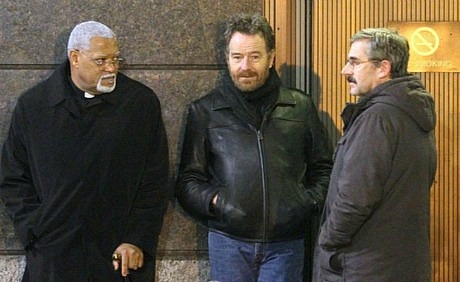
(l. to r.) Last Flag Flying‘s Laurence Fishburne, Bryan Cranston, Steve Carell.
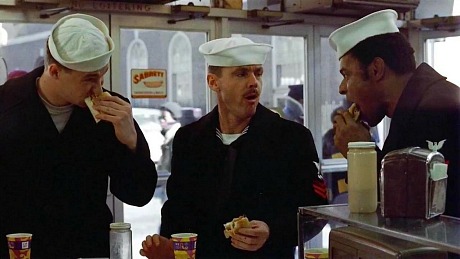
(l. to r.) Randy Quaid, Jack Nicholson, Otis Young in Hal Ashby’s The Last Detail.
When Something Happens, The Public Always Pays
A soldier shot and killed at Orly Airport? Okay, that’s it — cancel all flights! Bring the entire Orly travelling community to a screeching halt while we determine if this is part of a vast conspiracy, which of course it isn’t. Obviously. Bad guys have to be stopped, of course, but law enforcement’s highest priority when this stuff happens is to shut airports down. Update: Yes, Orly is now back in business but how many tens of thousands were affected? All because of one Muslim asshole (“I am here to die for Allah!”) who was on the terrorist watch list. Guys like this are always lone wolves.