PGA Nominations Fortify The Expected, Enhance Ex Machina, Diminish Room

Within the past week or so the Best Picture Oscar narrative has changed from “it’s probably going to be won by Spotlight, not out of unbridled passion but out of respect and a kind of default attitude” to “The Big Short is coming on strong and nipping at Spotlight‘s heels.” This morning’s Producers Guild of America motion picture nominations, generally considered an Oscar nomination bellwether, have more or less fortified the second narrative along with a little Mad Max injection.

But what everyone is mainly talking about this morning are two eyebrow-raisers — a film that wasn’t expected to be PGA-nominated and one that some handicappers were sorta kinda thinking would be…maybe. But finally wasn’t.

The PGA has nominated Alex Garland‘s Ex Machina, and in so doing has thrust this admired sci-fi drama into the Best Picture narrative, although more as a last-minute oddity than anything else. Up until this morning Ex Machina has been almost universally regarded as a critically respected also-ran that opened last spring and which launched Alicia Vikander. Now it can be honestly handicapped as “definitely in the game” to some extent.

The PGA has also declined to nominate Lenny Abrahamson‘s Room, and that, as Robert Blake used to say, is the name of that tune. Room hadn’t been seriously regarded as a Best Picture nominee by anyone in weeks, and now the situation is down to what everyone has presumed it would be all along, which is that likely Best Actress nominee Brie Larson will be the standard-bearer and not Abrahamson.

The PGA’s film nominations: The Big Short, Bridge of Spies, Brooklyn, Ex Machina, Mad Max: Fury Road, The Martian, The Revenant, Sicario, Spotlight, Straight Outta Compton.

What about Todd HaynesCarol (fully HE-supported) and Quentin Tarantino‘s The Hateful Eight? Not a good day for the Weinstein Co. Sorry, guys.

I wasn’t that surprised that Denis Villenueve‘s Sicario and F. Gary Gray‘s Straight Outta Compton being on the list. They’ve had plenty of supporters all along, and both have benefitted from well-run campaigns.

The PGA awards will be handed out on 1.23 — three days into Sundance ’16. Academy Award nominations will be announced nine days hence, or on Thursday, 1.14.
Passing of Mr. Stigwood

Rock music manager, theatrical impresario and film producer Robert Stigwood (a.k.a. “Stiggy”) has died at the age of 81. Quite the fellow in his time.  In the ’60s and early ’70s he was best known for managing Cream, the Bee Gees, Eric Clapton and Stevie Winwood, but fairly or unfairly his name eventually become closely associated (if not synonymous) with his atrocious movie musical Sgt. Pepper’s Lonely Hearts Club Band, which all but ruined his Hollywood reputation and that of the Bee Gees along with it. (The 1978 film inspired a famous Herald Examiner front-page headline: “Sgt. Pepper’s Lonely Hearts Club Bomb.”) Stigwood’s theatrical productions of Hair, Evita!, Jesus Christ Superstar and Sweeney Todd were huge. His film successes include Saturday Night Fever, Grease, Jesus Christ Superstar (as co-producer) and Tommy. He produced three legendary stinkers aside from Sgt. PepperMoment to Moment with John Travolta and Lily Tomlin, Sylvester Stallone‘s Stayin’ Alive and Times Square.

Too Many MCU Interiors = No Nommies?

Last year Birdman got an ACE Eddie Award nomination but not an Oscar editing nom because members decided that (a) it had too many interiors and (b) the editing was too invisible, which it is. Therefore the cutting didn’t stand out in a way that seemed nominatable. This year Spotlight wasn’t nominated by ACE because members said to themselves “naaah, the cutting doesn’t pop for us…Spotlight is just one MCU interior after another…cut, cut, cut, cut…a nice, smooth, first-rate film…very few exteriors…no biggie, no nomination.” But Star Wars: The Force Awakens…whoa! The cutting in that puppy was really something and therefore deserving of a nomination. The Martian, Mad Max: Fury Road, The Revenant and Sicario also landed dramatic editing noms. All five nominees used exterior footage. The comedy editing noms went to Ant-Man, The Big Short, Joy, Me and Earl and the Dying Girl and Trainwreck — all with significant exterior footage.

This Couple Obviously Has Issues

The creative minds behind this Campbell’s Soup ad are obviously expressing an opinion about (a) the sick guy’s wife/girlfriend and (b) modern relationships in general. They’re saying she’s a nice spirited bitch and that the days of being taken care of by your girlfriend/wife are over. The woman in the ad cares enough to ask the guy how he’s feeling but is too independent-minded and opposed to the idea of being an old-fashioned nurturer to make the poor guy some chicken soup. “You should call your mom” is pretty close to saying “and you think I’m going to stop what I’m doing and make you some chicken soup? Sorry, dude…I’ve got stuff to do and a life to live!” Imagine if the roles were reversed and it’s a sick wife-girlfriend mentioning the chicken-soup remedy to her husband/boyfriend and he goes, “Oh, okay…well, you should call your mom then!” and walks out the door. The universal response would be that the guy is a selfish asshole. The last shot of the guy making soup for himself conveys solitude and despondency. He’s thinking to himself, “Yeah, we get along pretty well and she’s got a lot of good qualities, but she can also be aloof at times. When I get better I might give my ex-girlfriend a call. Maybe go for a drink or something.” The woman is saying to herself, “I gotta lose this guy. All he does is mope around and wait for me to wait on him. I need a real man in my life, and by that I mean somebody’s who’s better at satisfying me sexually.” Narrator: “Campbell’s Chicken Noodle Soup — there when no one else is…made for real, real life.”

Ghost Island: From Billy Wilder to J.J. Abrams

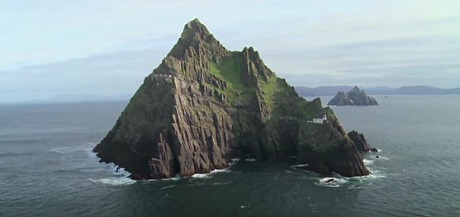
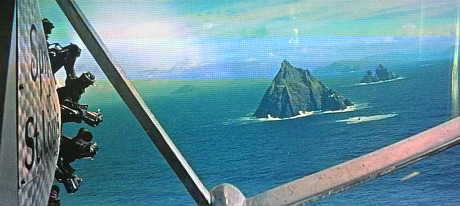
The first time I saw that stony green island where Rey (Daisy Ridley) finds Luke Skywalker (Mark Hamill) at the end of Stars Wars: The Force Awakens, I said to myself “I know that place…I’ve seen it before.” But I wasn’t sure where or when. The island is called Skellig Michael, and is located about 12 kilometers off the west coast of Ireland. Today I finally remembered. I first saw the island near the end of Billy Wilder‘s The Spirit of St. Louis (’57). It happens about 15 minutes before the finale. Jimmy Stewart‘s Charles Lindbergh, exhausted and bleary-eyed after 30-plus hours of flying, looks out and spots a pointed, rocky island that he eventually realizes is his very first glimpse of Irish soil. No question about it — it’s the same damn island.


Skellig Michael at it appears in Star Wars: The Force Awakens.

The same island as it appears in Billy Wilder’s The Spirit of St. Louis.

Read more

Feinberg’s Visions, Blind Spots

Hollywood Elsewhere is registering sharp disagreements with two of Scott Feinberg’s personal picks for 2015’s Ten Best films. Feinberg has the nerve to place Quentin Tarantino‘s The Hateful Eight, which is ruined by one of the most repulsively violent third acts in cinema history, in his #2 slot, and he’s ranked Ramin Bahrani‘s lethally dull and predictable 99 Homes seventh on his list. And I really, really didn’t like Room, which Feinberg has ranked sixth. And Mustang, for me, is a flatliner. But I’m down with the rest — Brooklyn, Spotlight, 45 Years, Far From The Madding Crowd, Straight Outta Compton and especially Feinberg’s tenth-ranked Love & Mercy. Wait…he blows off The Revenant, one of the hands-down immersive masterworks of the 21st Century?

Excerpt: “I must confess that I went into this June release with a sense of dread, thinking to myself, ‘Do we really need another biopic about a famous musician who falls upon hard times?! In retrospect, I failed to account for two things: (1) this film is not a biopic and (2) Brian Wilson is not like any other musician. Wilson, the co-founder and key creative force behind The Beach Boys, has lived many different lives, and it is a credit to writer Oren Moverman and director Bill Pohlad (best known as a producer, though he directed once before, decades ago) that they decided to construct a film focused on ‘just’ two of them.

Read more

Oh, By The Way…

Despite Revenant director Alejandro G. Inarritu having told both myself and Indiewire‘s Anne Thompson in interviews (both of which posted on 12.19) that an appeal of the Academy’s disqualification of Ryuichi Sakamoto‘s score was being pushed, the appeal was in fact rejected on 12.18. There was no hearing. Letters of appeal were written by Alejandro and Sakomoto, and the Academy responded by declaring that their decision stands.

Read more

2016 Oscar Season Passion Isn’t What It Could Be

It hit me the other day that the award-season argument factor isn’t as strong this year as it has been in the past. Everyone seems to be adopting a comme ci comme ca attitude. Nobody seems to be cranked up about anything. There’s certainly nothing this year to equal, say, the sharp aesthetic divide between The Social Network advocates and the soft saps who fell for The King’s Speech. There’s no conservative vs. liberal social values clash as exemplified by Crash vs. Brokeback Mountain for Best Picture. There’s certainly nothing to match the revulsion that some of us felt about The Artist or Chicago winning their respective Best Picture Oscars. There have been no serious take-down campaigns except for the one against Truth.

I’m not saying the season is entirely lacking in emotionalism, but that the bonfires aren’t burning as brightly as before. The 2015/16 season has been characterized by a series of small brush fires. What has stood out is the lack of real feeling about anything or anyone.

There have been, however, unexpected responses to films that many had presumed would at least score a nomination or two, or to films and performances that really had no business being nominated or awarded. Here’s how it tallies from this end:

(1) The late-inning resurgence of George Miller‘s Mad Max: Fury Road as a strong Best Picture contender, which was driven almost totally by critics group awards and not very much, it seemed, by Warner Bros. advertising and promo pushes. Emotional furnace level: 7.5.

(2) The curious but strangely passionate insistence by fans of The Martian that it deserves a Best Picture nomination. Make no mistake — this Ridley Scott effort is a highly intelligent, perfectly satisfying popcorn movie about a community of space agency types pooling resources to rescue a nice resourceful guy who’s stranded on Mars. There’s certainly nothing wrong with it. It’s totally fine. But Best Picture-nominating a film for simply being “likable” and/or selling a lot of tickets degrades the brand. Especially when its own distributor has encouraged its Golden Globes/HFPA classification as a “comedy.” Emotional furnace level: 6.

(3) The shameful dismissal of Love & Mercy as Best Picture contender by the blogaroonies for the reprehensible reason that it didn’t open during Oscar season and therefore didn’t really count. (Rationale: It doesn’t matter if their bread is sufficiently buttered with parties and ad buys — the movie HAS to open after Labor Day or it’s a no-go.) Ditto the corresponding under-support for Paul Dano, whose performance as young Brian Wilson was easily one of the year’s finest in whatever category (Best Actor or Best Supporting Actor). Philistines! Emotional furnace level: 9.

Read more

Don’t Forget Goransson’s Creed Score

From a GQ piece by Joshua Rivera, posted on 12.24: “A lot of movie soundtracks aren’t so great right now. It’s surprising how many big blockbusters will be accompanied by scores that are hard to describe as anything other than ‘forgettable’. But what’s also interesting is that once-common musical ideas like motif have fallen out of fashion — when was the last time you saw a movie with a theme you could hum? The sort of instantly recognizable, heroic melody that has accompanied and elevated films like Rocky, or, hell, Star Wars, just doesn’t happen as often anymore, and in that way, Creed‘s score is kind of a throwback. But it’s a throwback that’s full of so much that’s new. Like hip-hop.

Ludwig Goransson‘s Creed compositions frequently reference Bill Conti‘s legendary Rocky score, but in quiet ways — you first hear the Rocky theme’s familiar six-note refrain as the tender conclusion to the music that plays behind Adonis’ first casual date with Tessa Thompson‘s Bianca. It’s a technique that makes an old tune feel very different while also keeping you in subconscious suspense, wondering if you’ll ever hear those horns you know so well. And maybe you will — on some level, you know the movie has to go there — but Creed has other, more exciting things to do before that.”

11.25 HE post: “I’ve noted a few times that I prefer the kind of film score that seems to be watching the movie with you and expressing what you’re feeling as the story progresses. (Examples: Spotlight, Moneyball.) The other kind announces the emotional intention or goal on a scene-by-scene basis and more or less instructs you how to feel. Ludwig Goransson‘s Creed score is one of the latter, but it’s an arresting and often rousing example of this approach.

Read more

Sasha + Jeff Poker

Sasha Stone and I waited until the National Society of Film Critics had announced their awards before recording the latest Oscar Poker. What’s up with the NSFC’s Best Actor going to Creed‘s Michael B. Jordan? And why doesn’t Sasha subject herself to the Palm Springs Film Festival? Oh, and Sasha doesn’t agree with Scott Feinberg, by the way, about Martian helmer Ridley Scott being in a better-than-decent position to win the Best Director Oscar. Why is Spotlight, easily one of the year’s best, piddling along with a mere $27 million in box-office receipts thus far? We’re all about to be soaked in O.J. Simpson lore starting around mid-January this month and into February-March. I sound much better this week, being mostly over the life-threatening illness. Again, the mp3.

Too Much, Too Early

Speaking as a major O.J. Simpson murder trial enthusiast and one who has seen six of the ten hours of the forthcoming The People vs. O.J. Simpson (FX series debuting on February 2nd) and as one who will attend Sundance 2016, I’m very much looking forward to seeing ESPN’s OJ: Made in America, a doc that runs 7 and 1/2 hours. Unfortunately the doc is being shown in Park City during a single marathon on Friday, 1.22, complete with a lunch break and post-screening q & a. Which isn’t going to work. I can’t devote a whole day to this — I would miss too many other screenings. If ESPN were smart, they would screen O.J.: Made in America to select LA and NY press before the festival. I would love to get into this but the first Friday of Sundance is always full of the hottest films. If ESPN won’t pre-screen it, how about a second marathon showing on Thursday, 1.28 or Friday, 1.29, when things will be much quieter?

Read more