BFCA Nommie Shakedown

There are two significant omissions among the Broadcast Film Critics Association‘s nominees, which were announced this morning. One, Albert NobbsGlenn Close wasn’t nominated for Best Actress despite there being six slots. And two, Tinker Tailor Soldier Spy‘s Gary Oldman was given the go-by for Best Actor. BFCA picks have generally tended to reflect default preferences among the schmoozy guild and Academy set, so this may (I say “may”) be cause for concern among the Close and Oldman camps.

All along the unspoken Close-for-Best-Actress argument has been “even if you’re not knocked out by her Albert Nobbs performance, you can’t deny that her acting over the last 30 years warrants a career-tribute salute.” But during yesterday’s Oscar Poker podcast (which hasn’t yet posted) I asked whether that rationale or equation might be wearing thin against competitors whose performances are knocking people out, in and of themselves. The SAG nominations later this week will either follow the BFCA glide path or countermand it.

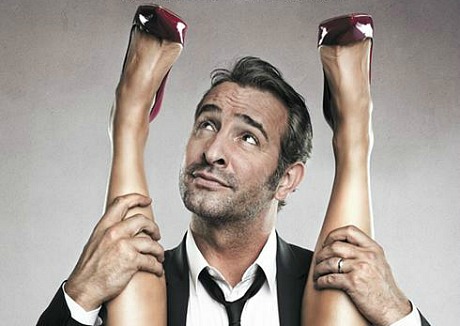
I don’t get the Oldman blow-off. There’s serious admiration and respect out there for his George Smiley performance, and he sure as hell delivers in a more subtle and layered fashion way than the nominated Jean Dujardin does in The Artist . The BFCA ballot, which I filled out last weekend, only asks for three nominees in each category, so obviously most people…okay, I submitted Brad Pitt, George Clooney and Michael Fassbender in those slots. I know, I know: I fucked up. I should have ranked Oldman after Pitt and Clooney — I loved Fasssbender’s Jane Eyre performance, but his Shame guy is too glacial and impassive — but I let my Zelig impulse carry me away. Not a proud moment.

The Artist and Hugo garnered 11 nominations each. People voting to support the latest by dear, beloved Martin Scorsese — keeper of the cineaste flame — is understandable despite 75% of Hugo being a mostly tedious sit. But support for The Artist is pure Zelig thinking — a vote for pleasantness and taking the easy schmoozy way out and sparkling, silver-toned good vibes. It’s cool that Drive landed eight nominations, and a bit curious that The Help got eight also.

The BFCA also denied The Girl With The Dragon Tattoo‘s Rooney Mara a deserved Best Actress nomination, and gave the film itself only two minor nominations — Best Score and Best Editing. My guess is that the BFCA was responding to Sony’s strict review embargo on some level. They were saying, “We get it — you guys don’t see this film as an awards contender and that’s fine.” But they were wrong, I feel, to throw out Mara with the bathwater.

Kris Tapley and I both heard from guys who caught an early peek at Extremely Loud & Incredibly Close and proclaimed that Max Von Sydow was a slamdunk lock for Best Supporting Actor. (Here‘s my post.) Except Von Sydow didn’t even get nominated by the BFCA. Those two guys have some splainin’ to do.

That said, Extremely Loud & Incredibly Close did manage nominations for Best Picture, Best Director, Best Adapted Screenplay and Best Young Actor/Actress.

Rooney Rules Over Tattoo Re-Do

Is there anyone over the age of three and under 75 who doesn’t know that David Fincher‘s The Girl With Dragon Tattoo (Sony, 12.21) is a remake of Niels Arden Oplev‘s 2009 Swedish-language film of the same title, and that both are based on the late Stieg Larsson‘s 2008 novel? Is it therefore likely that anyone will be surprised to read that Fincher’s film looks, plays and feels exactly like a remake, albeit one that’s costlier, punchier, gloomier and more vigorous?

Boiled down to basics, that’s what this film is — a highly efficient, A-grade, gripping-as-far-as-it-goes deja vu experience. It’s a bit darker and very well acted all around (especially in terms of one crucial performance), and more atmospherically noirish in an almost luxurious, Hollywood-comes-to-Sweden sort of way. But these are attributes of efficiency rather than vision or art. I mean, the territory had already been well mapped by the book and the ’09 film. What could Fincher be expected to do except give it a high-style topspin?

There’s nothing wrong with re-doing a recently made, highly successful foreign language film (which grossed over $100 million), but let’s call a spade a spade: this is primarily a cash-grab enterprise that didn’t really need to happen except for a desire on the part of the creative principals (Fincher, producer Scott Rudin, Sony Pictures) to make piles of money. Yes, that’s why 97% of all films are made, but you go to a Fincher film expecting that extra “something”, however you want to define that word, and Tattoo, for all its stimulations and satisfactions, doesn’t have that. Not as far as I could detect, at least.

Tattoo has a wonderfully haunting main-title sequence and a great score by Trent Reznor, okay, but it’s certainly no landmark Fincher film in the vein of The Social Network, Se7en, Fight Club or Zodiac. As far as I can tell it was an exercise, a job, something cool to do. And that’s okay. A home-run hitter will sometime hit a double or a sacrifice fly, and there’s no shame whatsoever in that. And Tattoo, Lord knows, is certainly a grabbier, more straight-shooting, less pretentious deal than The Curious Case of Benjamin Button.

Is Tattoo well-made and reasonably absorbing in terms of suspense, thrills, performances and high-style brushstrokes? Yeah, it is. Is it a whole lot better than the Swedish original? You could make that argument and I wouldn’t put up a fight. But as a Fincher film it very nearly belongs in the company of The Game, Panic Room and even Alien 3.

Why did I use the word “nearly”? Because The Girl With The Dragon Tattoo delivers a major standout element in Rooney Mara‘s performance as Lisbeth Salander.

This is a culturally important role, for sure — a tough-but-wounded, leather-clad Gothy biker with a laptop, a brilliant analytical mind and a brusque, back-off attitude. Salander is easily the leading fictional female empowerment figure of the 21st Century, certainly to the millions of women who’ve read Larsson’s Tattoo books. And Mara, I feel, gives Salander a sadder and more vulnerable aura and a more emotionally readable quality than what Noomi Rapace delivered in the Swedish trilogy.

You might compare the two films down the road and say, “Nope, don’t see it…six of one, half-dozen of the other” but I know what I felt from Mara’s eyes, and there’s a lot going on inside her, I swear. Tremors and feints and glances and looks that say “stay away, I don’t want you near….wait, maybe I do.”

There’s enough in this performance, I feel, for Mara to be counted among the year’s Best Actress nominees. But I don’t know if that’s going to travel given the apparent decision on Fincher, Rudin and Sony’s part to not offer Dragon Tattoo as an award-calibre December release and to just put it out there as “a people’s movie.” They’re probably right as far as the film goes — it’s not a original-enough thing to really crank up the critics — but I’m afraid that Rooney’s performance might get thrown out with the bathwater. And that wouldn’t be right or fair. She’s got an exceptional inside-rumble going on.

I’ve just came back from Brad Bird and Tom Cruise”s Mission: Impossible 4 — Ghost Protocol and it’s after midnight and I don’t have much energy left, I’m afraid, so I’ll have to run a review about how Dragon Tattoo plays on a scene-by-scene, jolt-by-jolt basis in a day or two. Here’s Justin Chang‘s Variety review, which is somewhat more enthusiastic than mine.

Neon Nightmare

Universal Citywalk is truly the Speed Racer of hell malls. I used to bring the kids here when young, but there really would have to be something wrong with you to bring a date here. And of course, none of the restaurants offer wifi. The local Starbucks is closed for renovations, but none of the waiters who recommended that I go there for wifi even knew that.

But it’s cold and rainy outside and I need the warmth so I’m sitting in a wifi-free Chinese joint, morose and resentful.

Why am I subjecting myself? Paramount’s M:I4 all-media IMAX screening.

Brooks On The Line

About three hours ago I had a nice easy chat with Albert Brooks, whose sardonic and malevolent performance as a former exploitation film producer-turned-“bad guy” resulted yesterday in three Best Supporting Actor awards from the Boston Film Critics Society, the New York Film Critics Online and the San Francisco Critics Circle. Add these to his New York Film Critics Circle win in the same category two weeks ago, and he’s surely a lock for an Academy Award nomination. Right now it’s Brooks vs. Christopher Plummer, I’d say.


Albert Brooks (photo not taken by yours truly)

Seriously — we had a really good discussion about this and that and whatever else. It goes on for about 35 minutes and is highly recommended.

Last June I wrote that Brooks “is deliciously direct in Drive — cynical, snarly, smart-mouthed. And yet good-humored at times. His Bernie Rose, a former schlock movie producer, is one of those tasty-ironic characters, mostly ‘written’, of course, but also a series of riffs and rim-shots that Brooks seems to have co-written or half-improvised as he went along.

“Bernie doesn’t like mincing words and futzing around with low-lifes but he does enjoy wordplay on a certain level and reflecting on the past, etc. He’s crafty and cunning and straight…and so corrupted he’s lost sight of whatever he might have been in the ’80s. I wish the script could have given Brooks/Bernie just a bit more humor and meditation (and less in the way of artery-slicing), but what’s there is fine, quite fine.”

The Drive guys in this testimonial video are very taken with the menacing quality of Brooks’ performance, but I think that people are voting for him because he’s simply delicious in the film, and because people have liked and admired him since the mid ’70s and all that. It’s fun to watch him play dark and bad, but he’s too embedded in our consciousness as a brilliant comic auteur to be fully accepted as the guy he’s inhabiting in Drive. Which isn’t to take anything away from the performance — it’s just that Brooks-the-comic-legend is bigger. A vote for Brooks is a vote for Brooks, and that’s a good thing.

Black As Night, Black As Coal

If anyone has PDFs of the following Blacklist scripts lying around, please send this way. I can read one or two on my Thursday, 12.15 flight to NYC. (Thanks to L.A. Times reporter Nicole Sperling for listings and descriptions.)

Evan Susser and Van Robichaux‘s “Chewie” (WME) — “A satirical, behind-the-scenes look at the making of Stars Wars through the eyes of Peter Mayhew, who played Chewbacca.”

Matthew Aldrich‘s “Father Daughter Time: A Tale of Armed Robbery and Eskimo Kisses” (CAA) — “A man goes on a three-state crime spree with an accomplice, his 11-year-old daughter.”

Mike Jones‘ “In the Event of a Moon Disaster” (CAA) — “An alternate telling of the Apollo 11 mission to the moon that examines what might have happened if the astronauts had crash-landed there.”

Michael Mitnick‘s “The Current War” (WME) — “Based on the true story of the race between Thomas Edison and George Westinghouse to develop a practical system of electricity and sell their respective inventions to the country and the world.”

Keith Bunin‘s “Ezekiel Moss” (CAA) — “A mysterious stranger who possibly has the power to channel the souls of the dead changes the lives of everyone in a small Nebraska town, especially a young widow and her 11-year-old son.”

Transformers Submerged

The funniest bit in this relatively new Battleship trailer is a moving shot of the sea followed by a title card that says “the ocean.” And the funniest line is spoken by Liam “paycheck” Neeson: “I want to have this thing thoroughly investigated.” Hasbro usually means submental.

Six Days Ago

During a Manhattan q & a last Tuesday night, Meryl Streep explained that The Iron Lady is “three days in the life of a little old lady who just happens to [have been] the longest-serving prime minister in the 20th century and the only female in the western world to rule a nuclear country. I mean, pretty interesting stuff, to look at a life in its ebbing and in its diminishment…our movie is about her history through her eyes.

“We took things from three days of a life — things that would be called up from a fire on a television, an explosion. What memory would that trigger? A son calling and saying he’s not gonna make it again up to see her. What memories would that trigger about lost sons? It’s imagining Margaret Thatcher as a human being, which is very, very hard for some people.”

The interview, which included Iron Lady director Phyllida Lloyd, was moderated by Hollywood Reporter award-season columnist Scott Feinberg. It happened almost a week ago but it took several days for the Weinstein guys to transfer it to YouTube. It happened at the DGA theatre on 57th Street, and it ran for about 40 minutes,

“I would like to think that everybody that got on a subway and saw some old lady sitting across from them…that they would imagine that a whole huge life lay behind all those wrinkles and that seemingly nondescript forgettable face,” Streep said at one point.

“I mean, there is almost nothing less interesting in our consumerist society than an old lady. Dismissed. We don’t make movies for her, we don’t give a damn, we can’t sell her anything, she doesn’t buy anything. But just the idea that everything — the whole panoply of human experience: births, deaths, struggles, joy — everything’s in there. And just to imagine that. That’s what I would hope.”

“We Are No One”

Will Smith wants to entertain. He wants to be loved, and to be rich. And right now and for the foreseeable future, I’m done with him. His being in a film is persuasion enough that I probably won’t like it, or that I’ll feel bored or distracted. Plus the moustache doesn’t work — too dark, too punctuated.

Word From San Francisco, Houston, Detroit

The awards chosen this afternoon by the 2011 San Francisco Film Critics Circle Awards are more independent-minded than those handed out by the Boston Film Critics Society and the New York Film Critics Online a few hours ago. The top SFFCC choices: Best Picture, The Tree of Life; Best Director, Terrence Malick, The Tree of Life; Best Original Screenplay, J.C. Chandor, Margin Call; Best Adapted Screenplay, Bridget O’Connor & Peter Straughan, Tinker Tailor Soldier Spy.

Best Actor, Gary Oldman, Tinker Tailor Soldier Spy; Best Actress, Tilda Swinton, We Need to Talk About Kevin; Best Supporting Actor, Albert Brooks, Drive; Best Supporting Actress, Vanessa Redgrave, Coriolanus; Best Animated Feature; Rango; Best Foreign Language Film, Certified Copy; Best Documentary, Tabloid; Best Cinematography, Emmanuel Lubezki, The Tree of Life; Special Citation for underappreciated independent cinema: The Mill and The Cross.

I can’t transcribe any more. My fingers are numb. Here’s In Contention‘s report about the Houston Film Critic awards and the Detroit Film Critic nominations.

Last Great Black-and-White Action Film

It’s been about 13 years since the last newly mastered DVD of John Frankenheimer‘s The Train was commercially released. It was re-issued two years ago but wasn’t even re-scanned for 16 x 9. MGM needs to issue a Bluray, and within the same 1.66 to 1 aspect ratio that it had on the old early ’90s laser disc and DVD.

This is one of the most brilliantly choreographed, all-natural, CG-free adventure thrillers ever made — an ace-level thing top to bottom, loaded with grease and grit and verisimilitude. And several Scorsese-level tracking shots. Shot in ’64, it was the last studio-funded outdoor thriller filmed in black-and-white. The DVD looks okay…pretty good, really — but a larger, needle-sharp Bluray would be breathtaking. Please.

Sheep Eating Artist Grass

On 11.30, or a day after the New York Film Critics Circle voted to hand The Artist its Best Picture prize, I got down on my rhetorical knees and pleaded with the nation’s critics not to “tumble for The Artist like dominoes…please, I’m begging.” But that’s exactly what’s happening, to judge by this morning’s critics award voting. The Boston Film Critics Society has given The Artist its Best Picture trophy, and so has the New York Film Critics Online.

Update: Thank God on bended knees that the Los Angeles Film Critics Association has resisted the domino effect and given its Best Picture Award to Alexander Payne’s‘s The Descendants. A critics group finally realized what was happening, stepped up to the plate and said “enough! We have to choose something else! And incidentally better!”

All I know is that I’ve never before felt such contempt for the BFCS and the NYFCO. Because despite the LAFCA Descendants win, their championing of The Artist today makes it almost certain that the Zelig impulse will manifest across the nation in critics group after critics group, and then, in all likelihood, in guild after guild and then among Academy members.

The Artist — a pleasingly thin and insubstantial entertainment, a French-made and produced That’s Entertainment! for the 21st Century — has become the soft consensus choice that will probably sweep across the land like Genghis Khan and take the Best Picture Oscar.

Unless, of course, fate intercedes and The Descendants or Extremely Loud or War Horse gains ground among SAG and Academy voters, etc. Which would be worse, War Horse or The Artist winning Best Picture? The former, I think.

I don’t hate The Artist. I rather like it. It’s a very engaging and pleasing little film (as long as you don’t see it twice, in which case it does a big fade). But I’m starting to hate all those soft-bellied, default-minded critics who’ve paved the way for its Best Picture coronation.

We’ve known all along that 2011 hasn’t been the strongest year. And so the hope, I wrote two weeks ago, was that critics would show a little bravery and spread the love around “with a little mixed award salad — a little love for Moneyball a sprinkling of Artist bits, a few Descendants olives, a little Extremely Loud and Incredibly Close vinaigrette, etc.” No such luck.

On 11.30 I wrote that “with The Artist having taken yesterday’s New York Film Critics Circle Best Picture prize, there will be a natural tendency for critics groups around the country to regard this Weinstein Co. release as a safe and likable default choice for Best Picture in their own balloting. Plus any critic voting for an entertaining black-and-white silent film is sending a message to colleagues, editors and especially readers that he/she is willing to embrace the novel or unusual, which indicates a certain integrity.

“I understand how celebrating a film that mimics how movies looked and felt in the 1920s is a way of saying that you respect classic cinema and Hollywood’s history, blah blah. And by doing so critics will get to lead at least some of their readers into the past, and seem wise and gracious in the bargain, and all the while supporting a film that’s mainly about glisten and glitter and decades-old cliches.”

LAFCA, NYFCO Tallies

The Los Angeles Film Critics Association has stopped the Artist sweep in its tracks (for the time being at least…thank Jehovah for small favors) by handing its Best Picture award to Alexander Payne‘s The Descendants. LAFCA’s Best Picture Runner-Up was Terrence Malick‘s The Tree of Life. Here are the group’s final picks:

Best Picture: The Descendants.

Best Director: Terrence Malick, The Tree of Life. (Runner-Up: Martin Scorsese, Hugo.)

Best Actor: Michael Fassbender, A Dangerous Method, Jane Eyre, Shame, X-Men: First Class. (Runner-Up: Michael Shannon, Take Shelter.)

Best Actress: Yun Jung-hee, Poetry. (Runner-Up: Kirsten Dunst, Melancholia.)

Best Supporting Actress: Jessica Chastain, Coriolanus, The Debt, The Help, Take Shelter, Texas Killing Fields, Tree of Life. Runner-Up: Janet McTeer, Albert Nobbs.

Best Supporting Actor: Christopher Plummer, Beginners. Runner-Up: Patton Oswalt, Young Adult.

Best Music/Score: The Chemical Brothers, Hanna. Runner-Up: Cliff Martinez, Drive.

Best Cinematography: Emmanuel Lubezki, The Tree of Life.

Best Production Design: Dante Ferretti, Hugo. Runner-Up: Maria Djurkovic, Tinker Tailor Soldier Spy.

________________________________________________________

Here are this morning’s New York Film Critics Online choices:

Best Picture: The Artist.

Best Director: Michel Hazanavicius, The Artist.

Best Actor: Michael Shannon, Take Shelter. (Runners-up: Michael Fassbender for Shame and Gary Oldman for Tinker, Tailor, Soldier, Spy)

Best Actress: Meryl Streep, The Iron Lady.

Best Ensemble Cast: Bridesmaids.

Best Supporting Actor: Albert Brooks, Drive.

Breakthrough Performer: Jessica ChastainThe Tree of Life, The Help, The Debt, Take Shelter, Texas Killing Fields, Coriolanus.

Best Cinematography: Emmanuel Lubezki, The Tree of Life.

Best Screenplay: Alexander Payne, Nat Faxon, Jim Rash, The Descendants.

Best Use of Music: Ludovic Bource, The Artist.

Best Debut Director: Joe Cornish, Attack the Block.