

The presumption is that these four promotional documentaries will deliver the usual corporate gloss-over zoneout. What else are they gonna do?
Imagine all the fascinating material that won’t be included…truth-for-truth’s-sake stories that don’t necessarily enhance the stock value. I’d be there for that.
“Featuring insights and first-person stories from directors, actors, executives, journalists and historians, the four specials trace Warner Bros.’ underdog origins — from its founding in the early 1920s by four brothers from an immigrant family, through decades of creative risks and impactful storytelling, to the historic mergers of the 2000s that transformed the company into a global entertainment powerhouse.
“Directed by Leslie Iwerks with narration by Morgan Freeman and clips from iconic films and hit TV series, 100 Years of Warner Bros. offers a fascinating behind-the-scenes look into the indelible stories that have spoken to audiences around the world for generations. The first two #WB100 documentaries stream May 25 on Max,” blah blah.
…is my next screening (5:30 pm), followed by a 10:45 pm showing of Jean-Stephane Sauvaire‘s Black Flies (paramedics tear-assing around Manhattan — Sean Penn, Tye Sheridan, Katherine Waterston, Michael Pitt, Mike Tyson).
This is just a taste of Killers of the Flower Moon (Apple/Paramount, 10.6) , but those luscious outdoor vistas (oil fields, burning homes at night) strike me as fairly magnificent. Too much conspicuous CG in the opening shot of the prairie natives. Leo’s hayseed accent reminds me of his Howard Hughes voice from The Aviator. Somehow the idea of a plump Leo and the mid 30ish Lily Gladstone playing a married couple…I’m not sure what to do with this. Jesse Plemons and Brendan Fraser are barely seen.
Thoughts, impressions, intuitions?
The big Cannes press screening happens almost exactly 48 hours hence (Saturday, 5.20, 4:30 pm).
Verbatim message to Cannes cohabitants with identities deleted, sent this morning: In lieu of last night’s SNORING DISASTER, which resulted in my getting roughly two and a half hours of sleep (if that) and my sleeping through roughly 40% of section #1 of Steve McQueen’s Occupied City, the important…nay, vital thing is to isolate [the snore bear] from [the other two residents] as much as possible.
This is what occasionally happens when you’re poor and are forced to share festival accommodations. You’ll sometimes lose lots of sleep because one of your flatmates is a bit of a sociopath in the sense that he regards snoring as something that can be endured or brushed away (it CAN’T be!), and the sounds that come out of this guy are nothing but agony from the first night on.
I’ve been through two or three difficult snoring situations at Sundance but I’ve never before experienced a snoring assault of this magnitude. Sawing, growling, snorting, rattling the china. Once it takes hold in your mind you can’t get rid of it. Having to endure this aural horror every night is going to absolutely RUIN my Cannes experience. It’s intolerable, and I’m really and truly furious at what [snore bear] is doing to us.
Remedy #1: [Snore bear] sleeps on the living room couch, from [the other two] sleep in the bedroom, which is separated by two doors.
Remedy #2: Everyone needs to buy a set of extra-effective ear plugs at a pharmacy.
Remedy #3: [Snore bear] needs to buy some kind of anti-snoring remedy or device at a pharmacy. This is the LEAST he can do. A wooden clothes pin that clasps upon his nose, say.
Remedy #4: Early this morning I went searching through the building for some kind of storage or basement utility room that [snore bear] could sleep in. Alas, I found nothing but little car garages.
I reluctantly sat down this morning with Steve McQueen‘s Occupied City, a doc about the Nazi occupation of Amsterdam during World War II and the various oppressions, suppressions and terrors that arose from this. “Reluctantly” because I’d read that McQueen’s film is a bit of a tough one or, in the words of Variety‘s Owen Gleiberman, “a trial to sit through.” It seemed at the very least unworthy of a four-hour-plus investment. Maybe.
I was nonetheless ready to engage, and I can at least report that I didn’t hate it. Given the historical aspect you might presume that McQueen would be using troves of digitally enhanced archival footage from the war years, but it was all shot during the pandemic of ’20 and ’21, and in vivid color inside a boxy (1.37:1) aspect ratio, and overflowing with Amsterdam capturings.
It’s based upon “Atlas of an Occupied City: Amsterdam 1940-1945,” a purportedly exacting coffee-table book by McQueen’s wife Bianca Stigter, and it’s basically one fixed-tripod tableau after another of Amsterdam, augmented or expanded upon by narration (read by Melanie Hyams) about this or that dark anecdote or tale about Jewish residents of that Dutch city who were persecuted or hid in attics or were eventually murdered in concentration camps. But it feels awfully dry and rote and static, I can tell you. It’s not boring or uninvolving but a bit flat, but within 12 or 15 minutes I was muttering to myself “this is it?”
McQueen’s basic idea (hold on, it’s a lulu) is that the bureaucratic repression of the Covid years, which we all felt pained and smothered by in more ways than one, and the deeply injurious Amsterdam restrictions, suffocations and violations of the early to mid 1940s are somehow related. Or, you know, not dissimilar.
This is what the film keeps saying over and over, that we’re all living in the now but that the past is still with us (and isn’t even “the past”, heh-heh) and lingering in our hearts and souls and all that. It’s a strange concept but I went with it, and I certainly came to know the various neighborhoods and bridges and weathered buildings and town squares of Amsterdam look like these days, much more than ever before, I mean, and I’ve been to Amsterdam, mind. Too many British pubs, too many party boys.
But I have to be honest and admit that my eyelids didn’t make it all the way through. I’m blaming this not on myself but on a certain fellow I’m sharing the apartment with, and more particularly his grizzly bear-snoring…make that his Steven Spielberg T-Rex snoring. (More on this in subsequent story.)
McQueen’s film includes an intermission, and it’s finally time to fulfill the promise of the above headline and state that the musical entr’acte interlude between parts one or two is truly, oddly moving. In a liturgical sense. I loved just sitting there and letting it sink in. It made me feel oddly happy, and also persuaded me that there might be something deeper to Occupied City…something that i wasn’t paying sufficient attention to. But I let that notion go.
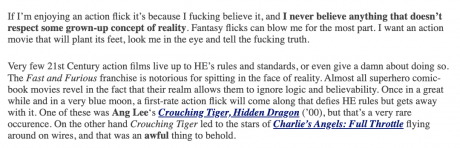
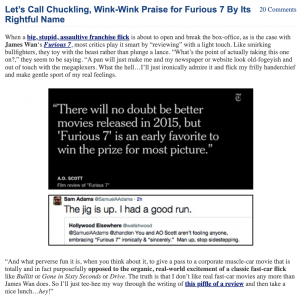
You can’t trust any major action or fantasy franchise (John Wick abominations, endless Fast flicks, any Marvel or D.C. torpedo) to depict the dying of this or that character with any finality. That’s because they don’t respect death. They mostly regard death and serious physical injury as a speed bump, a plot detour, something to fiddle or fuck with until an apparently dead character comes back to life.
I’ve been complaining about this for years, but most critics and columnists have stayed away from such criticisms. Which is why Variety‘s Peter Debruge deserves respect for the following passage in his Fast X review:
“There are explosive scenes in Brazil, Portugal, Los Angeles and Antarctica, all of which seem to be a five-minute commute from one another. While Vin Diesel’s Dom spends much of the movie trying to protect his 8-year-old son (Leo Abelo Perry), a whole bunch of beloved long-timers wind up ‘dying,’ although these movies have shown such a flexible understanding of mortality (not to mention physics and plausibility) that it doesn’t make sense to mourn them just yet.”
And this: “Every race needs a finish line. For the Fast & Furious franchise, the studio keeps shoving it farther down the road, at least according to Diesel, who suggested at the world premiere of the 10th installment — a brainless but action-packed thrill ride billed as Fast X — that Universal might split the ‘finale’ over three movies. Why not seven? Or 20 more, for that matter?
“While Hollywood’s highest-octane franchise shows no signs of slowing, it was crazy reckless to give the green light to such a clunker.”
I’m sorry but I’ve never been a fan of Hirokazu Kore-eda, the humanist, kind-hearted, Ozu-like Japanese director whom everyone (i.e., the Cannes mob) admires. I “respect” his signature focus (sad, anxious, troubled families going through difficult times), but his films (Shoplifters, Broker, Like Father, Like Son) have always bored my pants off.
Which means, of course, that I don’t like Kore-era’s humanism…right? I know I’ve always found his stories frustrating because they seem to just go on and on.
I certainly felt this way during today’s Salle Debussy screening of his latest film, Monster, which deals with school bullying, repressed rage and various family misunderstandings.
It struck me as repetitive and meandering and lacking in narrative discipline. I began to feel antsy after the first hour, and then this feeling seemed to double-down. My soul was screaming during the final half-hour of this 125-minute film, which felt more like three hours. I was silently whimpering.
I’m not condemning Monster or calling it a bad film. I’m just saying the world of Kore-era is not for me, and never will be. This doesn’t make me a bad person, or so I’m telling myself. I know that at the 95-minute mark I leaned over and muttered to a friend, “I don’t know how much more of this I can take.”
I got up early to attend this morning’s 8:10 am Directors Fortnight screening of Cedric Kahn‘s The Goldman Case (aka Le process Goldman), and yet the show didn’t begin until 8:45 am. No matter — all my irritations melted away almost immediately once it finally began. For this is a taut, lean and honed to the bone French courtroom drama — boxy-framed and based on an actual 1976 trial of admitted felon, social activist and revolutionary militant Pierre Goldman, who was charged with killing two female pharmacists during a robbery.
Goldman (Arieh Worthalter) admits to being an armed thief while vehemently insisting that he killed no one. And yet he refused to approve a typical defense, at least as far as calling character witnesses was concerned. “I’m innocent because I’m innocent,” Goldman declares while venting disgust with the usual courtroom strategies. In a pre-trial letter to his attorney Georges Kiejman (Arthur Harari), we hear a letter from Goldman in which he fires Kiejman for his allegedly soul-less mindset while calling him an “armchair Jew”. Then again Goldman recants soon after.
So the trial testimony boils down to reviewing Goldman’s life and political history while Kiejman tries to chip away at eyewitnesses whose testimony has pointed to Goldman’s possible guilt.
All I can say is that The Goldman Case eschews typical courtroom strategies and dramatics as ardently as Goldman 47 years ago. Based upon interviews with Goldman’s attorneys and news accounts and certainly shorn of almost everything that might appeal to fans of typical American courtroom dramas (i.e., everything from Witness For The Prosecution to The Verdict to A Few Good Men and Primal Fear), this is one ultra-tight, super-specific and and brilliantly focused courtroom nail-pounder. It pulls you right in and keeps you hooked, in no small part due to Worthalter’s intense but subtly moderated lead performance.
I have a Monster screening breathing down my neck so that’s all I can say for now. The Goldman Case is way too severe and hardcore for typical American audiences, who won’t know or give a fuck who Goldman was in the first place. But I was riveted, and I would expect that many others will feel the same when and if The Goldman Case begins streaming on U.S. shores. (I would be surprised if a U.S. distributor decides that it’s worth showing theatrically, but then again someone might.)

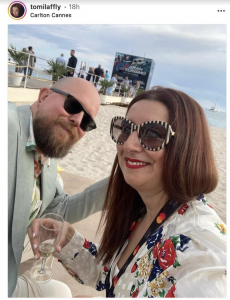
Maybe not, but they’re certainly Variety critic Guy Lodge and TheWrap film critic Tomris Laffly.
In a 5.16 riff about the recently posted young Robert DeNiro vs. young Al Pacino hottie competition, Esquire‘s Bria McNeal, who allegedly writes about “all things entertainment,” has stated that she’s “never seen The Godfather.”
Which is sorta kinda like Variety’s Clayton Davis having admitted a couple of years ago that he’s never seen Casablanca. Maybe he and McNeal could exchange thoughts?