Nothing There

Nothing There

If I wanted to just blurt it out and cut to the chase, I could say that Jarhead (Univ- ersal, 11.4) is nothing. But it’s not entirely nothing — it’s the fall’s first major what- the-hell-were-they-thinking? movie, and that ain’t hay. Trust me, it’s going to send tens of thousands of viewers out of theatres and into the street next weekend (it’s tracking…it’ll open) asking themselves this very question.
Oo-rahh…
Based on Anthony Swofford’s first-person account of his experience as a Marine during the 1991 Gulf War, Jarhead was probably pitched to Universal execs as the first GenX war movie…the Nirvana generation’s answer to Full Metal Jacket.
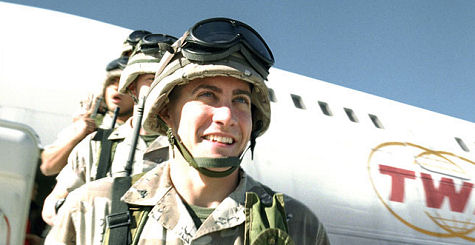

Swofford (Jake Gyllenhaal) arrives at U.S. airbase in Saudi Arabia, ready to whoop ass.

It was probably also sold it as a kind of GenX woe-is-us movie…as a Douglas Coupland-referenced metaphor about feelings of impotence and powerlessness… about Gulf War grunts feeling robbed of immediacy and ground-floor opportunity during their Big Combat Moment.
Or maybe they (Mendes or producers Lucy Fisher or Doug Wick, or all three) sim- ply told Universal they would deliver an honest definitive portrait of what a letdown the Gulf War was for the combatants and how it felt to be bored out of your ass in the desert, and Universal execs listened, looked at each other and said in unison, “Cool, that’ll sell tickets.”
< ?php include ('/home/hollyw9/public_html/wired'); ?>
Universal bought the pitch, but Jarhead isn’t a movie. It’s about waiting in your seat for the movie to begin, and then waiting and waiting and eventually saying to yourself, “Oh, shit.” It doesn’t dig in or get down or manage to be any more than what Three Kings was during its first 15 minutes.
My respect for David O. Russell, the director and writer of Three Kings, is very much renewed. Great filmmaker!
Swofford’s book was fairly absorbing (I read about half of it), but the material that would make for a moderately absorbing movie simply isn’t there.
Jarhead is a series of scenes showing Marines being trained to be killers state- side, and then flying to Saudi Arabia in ’91 and waiting to go to battle against Saddam Hussein’s Republican Guard troops, and then never quite seeing battle.
And to give things a generically haunting vibe it tells us (by way of narration by Jake Gyllenhaaal, who plays Swofford, or “Swoff”) that a grunt can never forget that rockin’ feeling of having his finger on a trigger. To which you will say…to which your friends will say…to which anyone with a mind will say…”So what?”
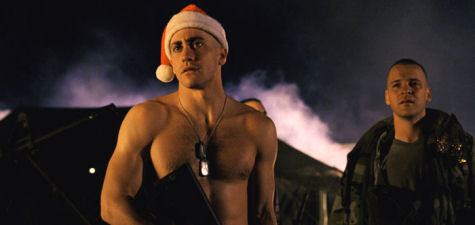

Gylennhaal, costar Peter Sarsgaard (r.) in Sam Mendes’ Jarhead

If Jarhead wasn’t a Sam Mendes movie, and wasn’t a big-studio early November release (and hence a presumed Oscar contender on some level)…if it had opened in, say, March or August without a lot of hoopla…it might have been seen for what it is — a nicely textured, maddeningly empty film about grunts coping with boredom, loneliness and disappointment — without people resenting what it isn’t.
It’s not terrible. It’s well made, well acted, convincing, etc. But $1.75 and a movie like Jarhead will get you a bus ticket.
And I’m not going to be sucked into saying what some critics are probably thinking right now, which is, “Whoa…ballsy! A hall-of-mirrors film about nothing happening that actually becomes what it’s about!”
Watch out for any critic who tries this one out on you, because that critic will be totally full of shit.
I was in my local Montrose Avenue grocery store after Monday night’s screening and the counter guy — Hispanic, early 40s, unmarried – asked me about it after spotting the program notes in my hand. “A Gulf war movie…been wanting to see this,” he said. I said, “Well, I don’t know…it’s fairly well made but no fighting.” And he said, “No fighting?”
Not even the genius of Universal marketing honcho Marc Schmuger can save this film.
It’s kind of Full Metal Jacket-y at times, but it mainly resembles that film’s floun- dering middle section. That means no character intrigue or simmering conflict (like Vincent D’Onofrio’s Pvt. Gomer Pyle being slowly tortured into animal madness by F.Lee Ermey’s drill sergeant), and no third-act battle-scene climax or a very young dying enemy soldier lying on the ground and whispering “Shoot me…shoot me!”… and no final ironic statement that comes close to Stanley Kubrick’s grunts singing the Mickey Mouse Club song with the hell-fires of Hue in the background.

It has one big scene toward the end that isn’t really a big scene…it’s kind of a final “sorry, son but this war won’t be happening for you” scene. You start to feel something when it happens but then it’s over and it’s back to the same old blah.
And there’s one really good line that Gyellenhaal says about not wanting to hear Vietnam music (i.e., a cut by The Doors) in the middle of an early `90s desert war.
So Kubrick wins and Mendes loses. (He never had a chance, really.) The British -born director, a good guy, started things off with a bang with American Beauty six years ago, and managed a stirring followup with Road to Perdition, but he didn’t have Connie Hall to punch things up this time and the material was too unfocused and insubstantial…and he failed. Jarhead is the suck.
No Oscar nominations for anyone except cinematographer Roger Deakins. No acting awards or nominations for Jake Gyllenhaal, although he’s pretty good (as far as it goes). No Best Supporting Actor nom for the great Peter Sarsgaard because the script doesn’t let him do or say anything except for a single emotional crackup scene near the end (and it’s nowhere near enough).
Universal will get its first weekend gross and then the word will get out and it’ll be down-the-toilet time.
Okay, it’s well-crafted. Yes, it has a certain high-visual distinction (occasional sur- real or dream-like flourishes) and (I keep mentioning this but there’s nothing else to mention) a streak of apparent honesty in its depiction of what boredom it can be to park your eager-beaver Marine ass in the Arabian desert for months and months, etc.
But the script never grabs hold of anything in the characters and tries to make something happen. Nothing means nothing. “Swoff” is nervous about what his girlfriend may be up to with some guy she says she’s met…who cares? Sars- gaard’s Troy is wired tight and born-to-fight…and that’s it. Jamie Foxx is a sergeant who loves the Corps and doesn’t shrink from handing out discipline…nothing. Chris Cooper gives two pep-rally speeches…showboating.
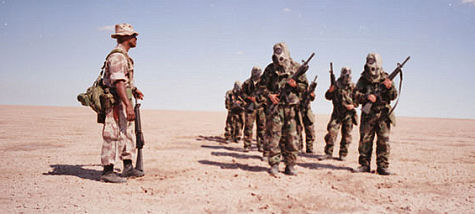

Marine Sergeant Jamie Foxx (l.) and the guys

There’s no narrative through-line to hitch your wagon to…no sense of gathering force or anything of interest approaching…nothing emotional. A lot of presumed disloyal girlfriend stuff, a little homoeroticism here and there…but it’s all Waiting for Godot-ish. The actors have zip to work with. They do moderately well with what they’ve been given, but moderately well doesn’t cut it during Oscar season.
Deakins’ photography is fine…okay, better than fine…and the CG of the burning oil wells in the third act is my favorite kind of CG, which it to say pretty much invisi- ble.
But a supposed war movie about not fighting a war — about the boring nothing bullshit stuff that happens when soldiers who’ve been trained to kill are just hanging around in the desert with their dicks in their hands…I’m really amazed. Jarhead‘s audacity would be startling if it didn’t feel so inert.

Mondo Kongo

Anyone who’s seen the Lord of the Rings trilogy (or, more to the point, has sat through the extended versions on DVD) knows Peter Jackson has never been into brevity. He couldn’t operate farther from a less-is-more aesthetic if he tried.
Eye-filling visuals, teary emotionalism, portentousness, sets and costumes that are just so, probing closeups, dialogue scenes that go on longer and are more exacting than necessary…Jackson loves to heap it on.

It should therefore come as no surprise that King Kong, his latest film which Universal will open theatrically on 12.14 (or six and a half weeks from today), is going to run three hours, according to a 10.27 story by New York Times reporter Sharon Waxman.
The obvious implication is that Jackson’s Kong is going to be a lot more about Jackson — his brushstrokes, I mean, and the absolute power and perogative he has to throw as much paint at the canvas as he deems fit — than anything else.
It also seems that Jackson’s indulgent streak has most likely overwhelmed any chance of audiences getting to savor a straight, clean re-telling of a classic tale about a dishy blonde and a big heartsick ape.
Take a look at the Kong stills and it’s obvious the film is going to look awesome. They’re clearly mouth-watering. But that aside, all bets are off.
I know how some of you are reading this. I have a case against Jackson and have hated everything he’s done since Heavenly Creatures, blah blah, so anything I say in advance about King Kong is a broken-record “here we go again” deal.
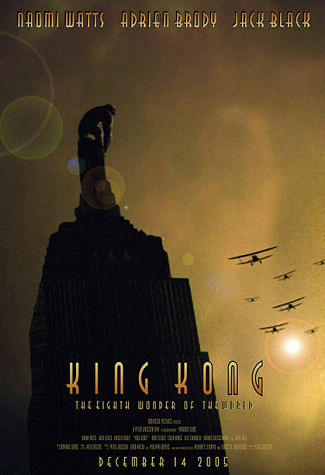

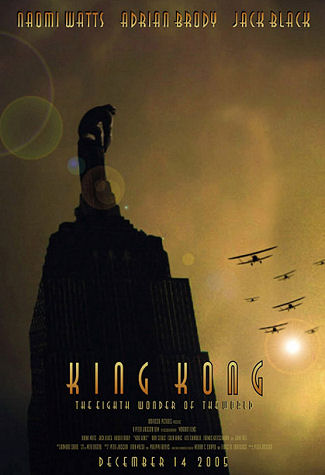
This poster is an unoffical fanboy thing, but thanks anyway to Jeremy Huggins for fixing the spelling of Adrien Brody’s name.

But ask yourselves this: has there ever been a remake of any kind — play, film, televised — that has been judged to be superior because it went on longer and used more words, sets, costumes and tubes of paint than the original leaner version?
I’m not saying this hasn’t ever happened (and I will honestly love it if Jackson outdoes the original in any way…really), but I’m having trouble thinking of an example.
The whole idea in Jackson making this film, according to his own proclamations when he began work on it a couple of years ago, was to pay some kind of tribute to Merian C. Cooper’s 1933 original film. Not in a Gus Van Sant/Psycho way, but to essentially re-do a classic movie…to re-experience and re-deliver to modern audiences what he loved about Kong when he first saw it as a kid on TV.
The project, which has swollen in cost to $207 million dollars, has apparently evolved into something more obsessive than personal.
The 1933 Kong runs 100 minutes, and Jackson is pretty much using the same story and situations, or so I’ve understood all along. So what could the extra 80 minutes be about? Only a few people know, but I’m fairly certain they’re about one thing and one thing only: Jackson’s power to make this film any way he damn well pleases, and about nobody at Universal being able to say boo.
In other words, the extra 80 minutes are about the auteurist “wheee!” factor…the same carte blanche E-ticket that has allowed all powerful directors at the apex of their careers to go for broke.

Given his huge success with the Rings trilogy, Jackson is certainly in no position, contractually or psychologically, to alter his modus operandi. And he’s in no way obliged to listen to anyone else’s opinions, be they practical brass-tacks sugges- tions or what-have-you.
“The film is substantially longer than Universal had anticipated and presents dual obstacles,” Waxman writes. “The extra length has helped increase the budget by a third…while requiring the studio, owned by General Electric, to reach for the kind of long-term audience interest that made hits out of three-hour movies like Titanic and the films in Mr. Jackson’s Rings trilogy.
“Hollywood blockbusters have increasingly relied on big releases that bring in as much as half of their ticket sales on the first weekend. But long films receive far fewer showings per day, and the most successful ones, like Lord of the Rings: The Fellowship of the Ring (2001) by Mr. Jackson, which took in $315 million at the domestic box office for New Line Cinema, have remained in theaters for well over half a year.”
Asked about the length of King Kong, Universal executives told Waxman they saw it “as an advantage in an era when jaded moviegoers are hungering for something extraordinary.
“‘This is a three-hour feast of an event,’ said Marc Shmuger, vice chairman of Universal Pictures. ‘I’ve never come close to seeing an artist working at this level.'”

Waxman notes that “few elements of the film have been seen by the larger public, and even Universal executives saw a finished version of King Kong’s face — with its expressive eyes, broadly fierce nose and mane of computer-generated hair — only in recent days.”
“Expressive eyes”? Is that Waxman talking or something she was told by some other Universal exec? No telling yet, but a Golum-ish, Andy Serkis-ized Kong will be a very tough row to hoe.
“Exhibitors have long complained that very long films make it harder to draw audiences, though in this difficult year at the box office, they have complained louder about not having enough good films to show,” Waxman writes.
No one will be happier than myself if Kong kicks ass. And yet the indications are what they are. Snaggle tooth, Jack Black doing a half-comical spin on Carl Den- ham, three-hour running time, 11th-hour firing of composer Howard Shore, etc.
Talk me out of this. Tell me how I’m reading this the wrong way…I mean, without resorting to the usual you-can’t-see-straight-when-it-comes-to-Peter-Jackson argument.

Implied

That European poster for Steven Spielberg’s Munich (Universal, 12.23) confirms what I wrote about this film last March, which is that it’s not going to be about killing the Palestinian perpetrators of the 1972 Munich Olympic Games massacre as much as the feelings of guilt and futility that are the inevitable dividend of any such act.
Munich, which will star Eric Bana and Daniel Craig, is about a revenge operation planned and executed by Mossad, or Israel’s CIA. And, I gather, the moral and ethical mucky-muck that resulted. The script is by New York playwright Tony Kushner (Angels in America).
The guy in the poster is sitting in a hotel room and holding a piece and obviously experiencing a moment of spiritual doubt of some kind. He’s not wondering what TV show to watch.
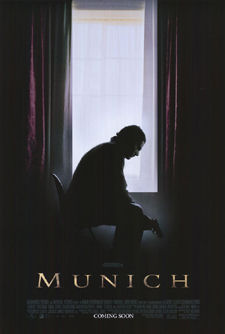

European one-sheet for Steven Spielberg’s Munich

Munich will be Spielberg’s second major-league feature having to do with lethal aggression against Jews, the first being Schindler’s List, and he knows this latest effort will be compared to his 1993 Oscar winner, so he’s got to…you know…make it complex, high-minded, morally probing.
The theme, I’m guessing, will be something along the lines of “if we all keep taking an eye for an eye, pretty soon the world will be blind.” This line comes from a 1986 TV movie called Sword of Gabriel, which was based on the same true-life story the Spielberg-Kushner film is apparently about.
Two athletes were killed during a hostage-taking and stand-off situation with German authorities at Munich’s Olympic village. Nine more were killed by a grenade blast at Munich’s Furstenfeldbruck airport when authorities tried to shoot it out with the terrorists.
I haven’t read Kushner’s script, but one of the film’s vantage points is that of “Committee X,” a high-ranking group of Israeli officials, chaired by Israeli premiere Golda Meir and Defense Minister Mosha Dayan, and the assassination campaign they ordered Mossad to carry out — to murder every strategist and supporter known to have in some way supported Black September’s Munich operation.
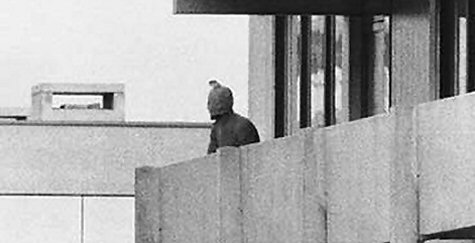

A member of Black September standing on balcony of Israeli athletes’ condo in Munich’s Olympic Village during September 1972 hostage stand-off.

The operation was known in some circles as Operation Wrath of God.
The idea behind the campaign, which was known as the kidon (Hebrew for bayonet) and run by senior Mossad agent Mike Harrari, was to strike terror in the hearts and minds of the plotters. It was primarily for the sake of revenge, I’m sure, but also to try and psychologically deter similar operations.
Mossad started with a list of 11 names, but the people they wound up killing numbered 18, by one count.
Harrari’s plan was to be absolutely precise and avoid collateral damage, and yet people who had nothing to do with the Munich killings — a Moroccan waiter, a Russian KGB agent, an Arab-looking bodyguard in Gibraltar, three Arab-looking guys who made the mistake of pulling out guns during a raid in Switzerland — died at the hands of the kidon killers. Seven in all.

Snob Aesthetics

My favorite flip-through book last summer was David Kamp and Steven Daly’s “The Rock Snob’s Dictionary” (Broadway Books), an incisive and tidy sum-up guide about the who, what and wherefores of elitist rock-music savoring.
And now I’m into “The Film Snob’s Dictionary,” which I scored an advance copy of last week. It’s less of an education than “Rock Snobs” — I’m obviously much more familiar with the turf — but I’m having just as good a time with the knowingness and wit and concise prose style.
“The Film Snob’s Dictionary” won’t be out until February ’06 (to tie in with seasonal Oscar frenzy), but I don’t think I’m blurbing it too early. You’ll be reading advance items and friendly mentions come November-December, and…I don’t know…time seems to whiz by faster and faster these days…torrents of information surging at hurricane-speed.
The authors are the Manhattan-based Kamp, a longtime Vanity Fair writer and sometime contributor to GQ, and another New York journo named Lawrence Levi, who first met Kamp when they worked together at Spy in…I think it was the late ’80s or early ’90s, when Graydon Carter was the editor.
Snobs are always hovering around any field of creative endeavor, and most of them are usually fringe wannabe types (i.e., producers, financial patrons, hangers-on) covering some insecurity.
Film Snobs are mostly fringe types also, but a certain number can be found among journalists and critics. Naturally, I exclude myself. I have this delusional idea that I’m an anti-snob, man-of-the-people type. The truth is that I know my stuff and feel no empathy for lowbrow ignorance, and I always go into fits when people refuse to support a film I know is intelligent, well-honed and suffused with honest emotion.
So maybe I’m a bit snobby, although for the sake of balance I try to ground myself in my middle-class, rubbing-shoulders-with-prole-types background. And I think Bollywood films are for the birds.
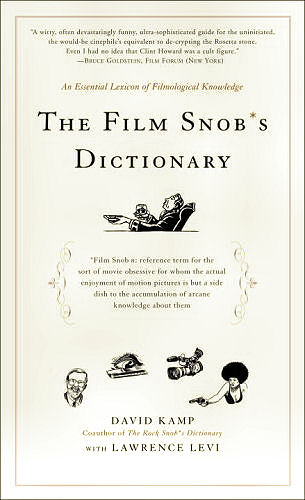
And yet I couldn’t help laughing when I read this line from the opening graph of “An Introductory Note by the Authors”:
“The Film Snob fairly revels, in fact, in the notion that The Public Is Stupid and Ineducable, which is what sets him apart from the more benevolent Film Buff — the effervescent, Scorsese-style enthusiast who delights in introducing novitiates to The Bicycle Thief and Powell-Pressburger films.”
I know film-snob attitudes quite well, or at least what it is to feel grossly insecure about not knowing enough about movies and therefore lacking the chops to qualify as a snob.
I felt this way when I first came to New York in the late ’70s to try and make it as a film journalist. I was acutely aware that I didn’t have the seasoning and the film knowledge to even stand in the same vicinity as the big New York guns of the time (Pauline Kael, Andrew Sarris, Stuart Byron, etc.), and it caused me no shortage of anguish.
This was compounded by the fact that writing articles at the time was doubly difficult because I couldn’t relax and just write what I knew and felt on my own terms.
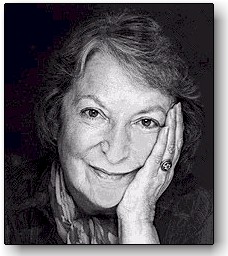

Pauline Kael

I finally got past all this, partly out of a realization that certain elite critics lived on the planet Neptune. I came to realize that although they knew what they knew and had a brilliant way of saying it, their views weren’t any better than mine…although my respect for the elites and worshipping their prose all those years (as well as boning up on venerated critics like Andre Bazin, Otis Ferguson, Manny Farber, Dwight McDonald, James Agee, et. al.) had a cumulative effect.
I wrote last summer that I especially enjoyed “The Rock Snob’s Dictionary” because “it’s so exquisitely written. Every sentence is a Hope diamond, chiseled and honed and phrased to perfection with just the right seasoning of know-it-all attitude…aimed, naturally, at the snobs who initially created it.” The same goes with the new volume. It’s an immaculate, whip-smart read.
One difference is that “The Film Snob’s Dictionary” runs 114 pages, or 36 pages shorter than “The Rock Snob’s Dictionary.” I would have preferred a few more snob obsessions being thrown in (film snobbery encompasses a vast universe and at least 85 years of film history) …but since it’s aimed at people who don’t know this world at all, I guess the idea was to avoid getting too anal-particular.
Another difference is that knowing the film world as I do, a lot of what’s in the book is back-of-the-hand familiar. But I’m sure rock aficionados felt the same way last summer.
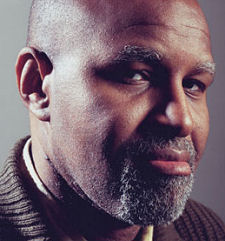

New York Press critic Armond White

The intro piece is pretty good…
“The Film Snob’s stance is one of proprietary knowingness — the pleasure he takes in movies derives not only from the sensory experience of watching them, but also from knowing more about them than you do, and from zealously guarding this knowledge from the cheesy, Julia Roberts-loving masses, who have no right whatsoever to be fluent in the works of Samuel (White Dog) Fuller and Andrei (the original Solaris) Tarkovsky.”
The graph about the public being Stupid and Ineducable follows, and then…
The Film Snob’s Dictionary seeks to redress the knowledge gap between Snobs and non-Snobs, so that normal, nonsociopathic, movie-loving people may (a) become privy to some of the good stuff that Film Snobs zealously hoard for themselves; and (b) avoid or approach cautiously the vast quantities of iffy or downright crappy material that Snobs embrace in the name of Snobbery.
“This second service is especially valuable, because the Film Snob’s taste is willfully perverse, glorifying drecky Hong Kong martial-arts flicks and such misunderstood works of genius as Mike Judge’s Office Space and Michael Mann’s Heat for no rational reason whatsoever.”
(I read the preceding graph Sunday night to L.A. City Beat film critic Andy Klein, who isn’t a snob but surely knows his stuff as well as Jim Hoberman or Armond White. Klein laughed and said, “Obviously they’re trying to get a rise out of critics,” etc. He also declared that Heat, Office Space and, one inferred, a selection of his favorite Hong Kong chop-socky flicks “are all great.”)
“The authors of this book, in compiling its entries, have sought to strike the right balance between intellectual curiosity and Snob madness, so that the reader will feel less intimidated about renting a genuinely entertaining film such as Fritz Lang’s M just because it is ‘German Expressionist,’ but liberated from the burden of ever having to watch a Peter Greenaway film.”
The intro also says that “readers knowledgable about film will notice the conspicuous absence from The Film Snob’s Dictionary, apart from passing references, of such titans of foreign cinema as Federico Fellini (8 1/2), Ingmar Bergman (The Seventh Seal), Akira Kurosawa (The Seven Samurai), and Satyajit Ray (the “Apu” trilogy).
“The Film Snob may indeed know a fair amount about these filmmakers (Fellini in particular, given that his movies’ soundtracks were often composed by Snob cause celebre Nino Rota), but he generally scoffs at them, deeming them to be mere name-drops for bourgeois losers wishing to seem cultured. Watching a Bergman film is so PBS tote-bag, so Mom-and-Dad-on-a-date-in-college, so baguettes-and- Chardonnay.
“The Snob prides himself on his populist, un-arty taste, favoring, for example, the soapy, over-emotive schlock of India’s Bombay-based `Bollywood’ film industry over the artful, nuanced films of the Calcutta-born Ray, and the Spaghetti Westerns of Sergio Leone and Corbucci over anything Fellini ever made. It’s a reverse Snobbery more powerful than the Snobbery it’s rebelling against.”
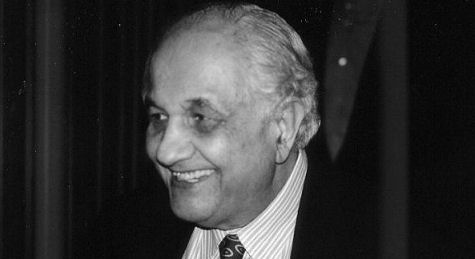

New York Observer critic Andrew Sarris

There are something like 250 capsule mentions. As noted earlier, there could probably be another 100 or so more if Kamp and Levi wanted to bulk up. Some of these have appeared in two past issues of Vanity Fair, and there’s a site that quoted a few of them in ’04, so it doesn’t seem like much of a spoiler to excerpt a few more.
The eight entries I’m running deal solely with critics and film magazines/sites. If it were my book I would have mentioned other Neptuners (B. Ruby Rich, Jim Hoberman, Ray Pride, Armond White, Robert Koehler, Emanuel Levy) — each of whom, it could be argued, are fascinating in their authority-exuding quirkiness.
There’s certainly no slight in saying these people should have been included. Film Snobbery is an excusable neurotic outgrowth of being an extra-passionate Film Buff, and every Neptuner I’ve mentioned in this graph is a fine writer and respected scholar, so let’s not have any arched backs.
Anyway…
Farber, Manny: Beloved alter kocker film critic emeritus, now working as a a painter in Southern California. Preceding his friend Pauline Kael by more than a decade as a nonconformist thinker about movies, Farber got his start writing reviews for The New Republic in the 1940s and proved as comfortable decon- structing Tex Avery cartoons and Don Siegel genre exercises as he was evaluating the French New Wave and Rainer Werner Fassbinder — in effect, inventing the prevailing critic vogue for high thought on low entertainment. A big influence of Snob-revered Jonathan Rosenbaum, Farber, more than Kael or Andrew Sarris, is the name to drop for instant Crit Snob credibility.
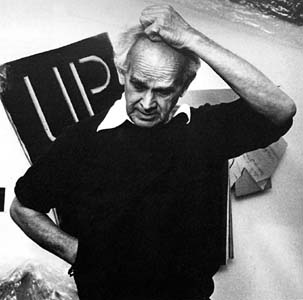

Retired film critic Manny Farber

Film Comment. Smug, aggressively elitist bimonthly magazine published by the Film Society of Lincoln Center. Where Snobs go to read (or write) dithery articles about Bollywood and despairing critiques of popular cinema.
Film Threat. Surprisingly buoyant, unsmug Web ‘zine devoed to independent film. Where Snobs go to read fulsome appreciations of Sam Raimi and interviews with such Queens of the B’s as Debbie Rochon and Tina Krause.
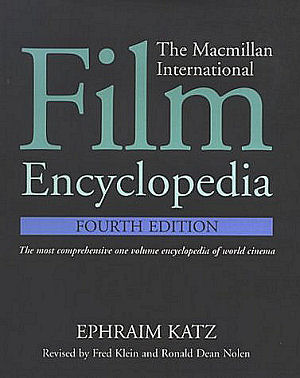
Katz, Ephraim. Industrious Israeli-born film nerd who, in the 1970s, single- handedly undertook the task of compiling an encyclopedia of film. Published in 1979, after years of work, Katz’s The Film Encyclopedia quickly established itself as the definitive film reference for both Snobs who need to know what a “friction head” is (it’s a kind of tripod head that ensures smooth camera movement) and laypersons who can’t keep Linda Darnell straight from Joan Blondell. Katz died in 1992, and successive, expanded editions of the Film Encyclopedia have been produced by his proteges, though hard-core Snobs take issue with some of the cuts that were made from Katz’s original, and keep the ’79 edition around.
Kael, Pauline. Revered film critic (1919-2001) whose work, most of which appeared in The New Yorker, stood out for its bracing, provocative prose and its author’s loony, nonsensical taste; no one was smarter and more cogent about Cary Grant’s career and Steve Spielberg’s early films, yet no one was more reckless in overpraising grim 1970s murk and unbearably blowsy female performances (e.g., Elizabeth Taylor in X, Y & Zee; Karen Black in Come Back to the 5 & Dime, Jimmy Dean, Jimmy Dean; Bette Midler in Big Business). A tiny woman, Kael nevertheless inspired fear in her legions of movie-critic acolytes (known as “Paulettes”), full-grown men and women who tremulously sought her unforthcoming approval and pilgrimaged to her home in the Berkshires in the vain hope of being anointed her heir apparent.
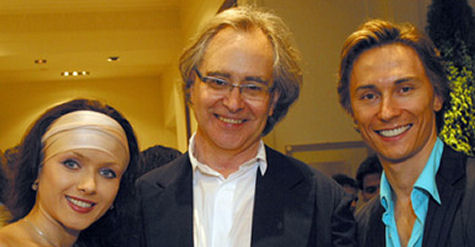

Snob-favored New York Times critic Dave Kehr, flanked by two Russians with four-syllable last names

Kehr, Dave. Third- or possibly fourth-string New York Times movie critic. Though often relegated to reviewing DVD releases, he is preferred by Snobs over A.O. Scott, Manohla Dargis and Stephen Holden.
Rosenbaum, Jonathan. Industrious but mirthless film critic for the Chicago Reader; one of the few important film writers of the post-Kael era. Given to chiding fellow Snobs about their ignorance of the Iranian New Wave.
Sarris, Andrew. Brooklyn-born film critic and theorist known for popularizing the Auteur Theory, and for arousing the ire of Pauline Kael with his totemic 1968 book The American Cinema: Directors and Directions, 1929 — 1968, in which he categorized directors by preference, prompting Kael to deride him, to his face, as a “list queen.” His gentlemanly, hypeless prose has remained consistent since 1960, when he began writing for the Village Voice. Married to the fellow film-critster Molly Haskell, Sarris now plies his trade for the New York Observer and as a trainee Snob-admired lecturer at Columbia University.
Reminder to Kamp and Levi: Montgomery Clift got drunk and slammed his car into that telephone pole in May, 1956. And the cool thing about Todd A-O in the 1950s wasn’t just the 70mm format — it was mainly the 30-frame-per-second rate of photography and projection (even though it was viewable in the big-city roadshow engagements of only two films — Oklahoma! and Around the World in 80 Days).
“The Film Snob’s Dictonary” is an essential, highly educational read for non- snobs, and snobs will have to buy a copy just to keep it on their bookshelves… something to leaf through and reflect upon as a kind of cautionary text.
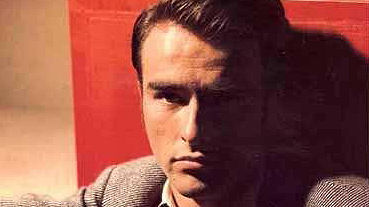

Montgomery Clift

Grabs


Lounge area on main floor of Algonquin Hotel — Monday, 10.24.05, 10:30 pm.
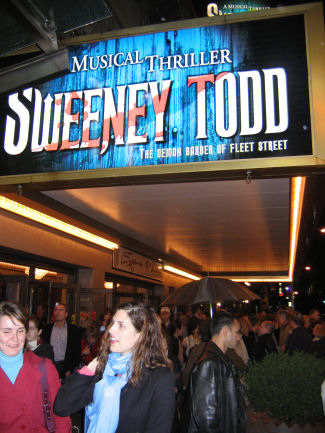
Tuesday, 10.25, 10:25 pm.
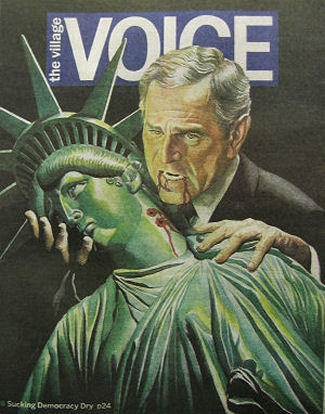
2004 Village Voice cover…never saw it before this week
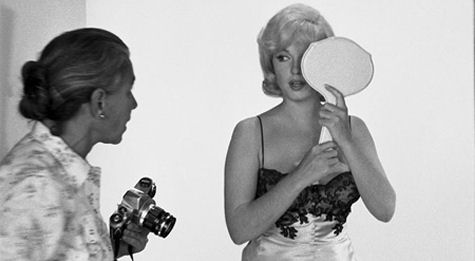
Marilyn Monroe photo shoot, sometime around ’59 or ’60. (I think.)
Mondo Kongo

Mondo Kongo

Anyone who’s seen the Lord of the Rings trilogy (or, more to the point, has sat through the extended versions on DVD) knows Peter Jackson has never been into brevity. He couldn’t operate farther from a less-is-more aesthetic if he tried.
Eye-filling visuals, teary emotionalism, portentousness, sets and costumes that are just so, probing closeups, dialogue scenes that go on longer and are more exacting than necessary…Jackson loves to heap on the syrup.

It should therefore come as no surprise that King Kong, his latest film which Universal will open theatrically on 12.14 (or six and a half weeks from today), is going to run three hours, according to a 10.27 story by New York Times reporter Sharon Waxman.
The obvious implication is that Jackson’s Kong is going to be a lot more about Jackson — his brushstrokes, I mean, and the absolute power and perogative he has to throw as much paint at the canvas as he deems fit — than anything else.
< ?php include ('/home/hollyw9/public_html/wired'); ?>
It also seems that Jackson’s indulgent streak has most likely overwhelmed any chance of audiences getting to savor a straight, clean re-telling of a classic tale about a dishy blonde and a big heartsick ape.
Take a look at the Kong stills and it’s obvious the film is going to look awesome. They’re clearly mouth-watering. But that aside, all bets are off.
I know how some of you are reading this. I have a case against Jackson and have hated everything he’s done since Heavenly Creatures, blah blah, so anything I say in advance about King Kong is a broken-record “here we go again” deal.


Note to eagle-eyed proofreaders: the misspelling of Adrien Brody’s name above is not my doing and I can’t figure how to Photoshop in a correction.

But ask yourselves this: has there ever been a remake of any kind — play, film, televised — that has been judged to be superior because it went on longer and used more words, sets, costumes and tubes of paint than the original leaner version?
I’m not saying this hasn’t ever happened (and I will honestly love it if Jackson outdoes the original in any way…really), but I’m having trouble thinking of an example.
The whole idea in Jackson making this film, according to his own proclamations when he began work on it a couple of years ago, was to pay some kind of tribute to Merian C. Cooper’s 1933 original film. Not in a Gus Van Sant/Psycho way, but to essentially re-do a classic movie…to re-experience and re-deliver to modern audiences what he loved about Kong when he first saw it as a kid on TV.
The project, which has swollen in cost to $207 million dollars, has apparently evolved into something more obsessive than personal.
The 1933 Kong runs 100 minutes, and Jackson is pretty much using the same story and situations, or so I’ve understood all along. So what could the extra 80 minutes be about? Only a few people know, but I’m fairly certain they’re about one thing and one thing only: Jackson’s power to make this film any way he damn well pleases, and about nobody at Universal being able to say boo.
In other words, the extra 80 minutes are about the auteurist “wheee!” factor…the same carte blanche E-ticket that has allowed all powerful directors at the apex of their careers to go for broke.

Given his huge success with the Rings trilogy, Jackson is certainly in no position, contractually or psychologically, to alter his modus operandi. And he’s in no way obliged to listen to anyone else’s opinions, be they practical brass-tacks sugges- tions or what-have-you.
“The film is substantially longer than Universal had anticipated and presents dual obstacles,” Waxman writes. “The extra length has helped increase the budget by a third…while requiring the studio, owned by General Electric, to reach for the kind of long-term audience interest that made hits out of three-hour movies like Titanic and the films in Mr. Jackson’s Rings trilogy.
“Hollywood blockbusters have increasingly relied on big releases that bring in as much as half of their ticket sales on the first weekend. But long films receive far fewer showings per day, and the most successful ones, like Lord of the Rings: The Fellowship of the Ring (2001) by Mr. Jackson, which took in $315 million at the domestic box office for New Line Cinema, have remained in theaters for well over half a year.”
Asked about the length of King Kong, Universal executives told Waxman they saw it “as an advantage in an era when jaded moviegoers are hungering for something extraordinary.
“‘This is a three-hour feast of an event,’ said Marc Shmuger, vice chairman of Universal Pictures. ‘I’ve never come close to seeing an artist working at this level.'”

Waxman notes that “few elements of the film have been seen by the larger public, and even Universal executives saw a finished version of King Kong’s face — with its expressive eyes, broadly fierce nose and mane of computer-generated hair — only in recent days.”
“Expressive eyes”? Is that Waxman talking or something she was told by some other Universal exec? No telling yet, but a Golum-ish, Andy Serkis-ized Kong will be a very tough row to hoe.
“Exhibitors have long complained that very long films make it harder to draw audiences, though in this difficult year at the box office, they have complained louder about not having enough good films to show,” Waxman writes.
No one will be happier than myself if Kong kicks ass. And yet the indications are what they are. Snaggle tooth, Jack Black doing a half-comical spin on Carl Den- ham, three-hour running time, 11th-hour firing of composer Howard Shore, etc.
Talk me out of this. Tell me how I’m reading this the wrong way…I mean, without resorting to the usual you-can’t-see-straight-when-it-comes-to-Peter-Jackson argument.

Implied

That European poster for Steven Spielberg’s Munich (Universal, 12.23) confirms what I wrote about this film last March, which is that it’s not going to be about killing the Palestinian perpetrators of the 1972 Munich Olympic Games massacre as much as the feelings of guilt and futility that are the inevitable dividend of any such act.
Munich, which will star Eric Bana and Daniel Craig, is about a revenge operation planned and executed by Mossad, or Israel’s CIA. And, I gather, the moral and ethical mucky-muck that resulted. The script is by New York playwright Tony Kushner (Angels in America).
The guy in the poster is sitting in a hotel room and holding a piece and obviously experiencing a moment of spiritual doubt of some kind. He’s not wondering what TV show to watch.


European one-sheet for Steven Spielberg’s Munich

Munich will be Spielberg’s second major-league feature having to do with lethal aggression against Jews, the first being Schindler’s List, and he knows this latest effort will be compared to his 1993 Oscar winner, so he’s got to…you know…make it complex, high-minded, morally probing.
The theme, I’m guessing, will be something along the lines of “if we all keep taking an eye for an eye, pretty soon the world will be blind.” This line comes from a 1986 TV movie called Sword of Gabriel, which was based on the same true-life story the Spielberg-Kushner film is apparently about.
Two athletes were killed during a hostage-taking and stand-off situation with German authorities at Munich’s Olympic village. Nine more were killed by a grenade blast at Munich’s Furstenfeldbruck airport when authorities tried to shoot it out with the terrorists.
I haven’t read Kushner’s script, but one of the film’s vantage points is that of “Committee X,” a high-ranking group of Israeli officials, chaired by Israeli premiere Golda Meir and Defense Minister Mosha Dayan, and the assassination campaign they ordered Mossad to carry out — to murder every strategist and supporter known to have in some way supported Black September’s Munich operation.


A member of Black September standing on balcony of Israeli athletes’ condo in Munich’s Olympic Village during September 1972 hostage stand-off.

The operation was known in some circles as Operation Wrath of God.
The idea behind the campaign, which was known as the kidon (Hebrew for bayonet) and run by senior Mossad agent Mike Harrari, was to strike terror in the hearts and minds of the plotters. It was primarily for the sake of revenge, I’m sure, but also to try and psychologically deter similar operations.
Mossad started with a list of 11 names, but the people they wound up killing numbered 18, by one count.
Harrari’s plan was to be absolutely precise and avoid collateral damage, and yet people who had nothing to do with the Munich killings — a Moroccan waiter, a Russian KGB agent, an Arab-looking bodyguard in Gibraltar, three Arab-looking guys who made the mistake of pulling out guns during a raid in Switzerland — died at the hands of the kidon killers. Seven in all.

Snob Aesthetics

My favorite flip-through book last summer was David Kamp and Steven Daly’s “The Rock Snob’s Dictionary” (Broadway Books), an incisive and tidy sum-up guide about the who, what and wherefores of elitist rock-music savoring.
And now I’m into “The Film Snob’s Dictionary,” which I scored an advance copy of last week. It’s less of an education than “Rock Snobs” — I’m obviously much more familiar with the turf — but I’m having just as good a time with the knowingness and wit and concise prose style.

“The Film Snob’s Dictionary” won’t be out until February ’06 (to tie in with seasonal Oscar frenzy), but I don’t think I’m blurbing it too early. You’ll be reading advance items and friendly mentions come November-December, and…I don’t know…time seems to whiz by faster and faster these days…torrents of information surging at hurricane-speed.
The authors are the Manhattan-based Kamp, a longtime Vanity Fair writer and sometime contributor to GQ, and another New York journo named Lawrence Levi, who first met Kamp when they worked together at Spy in…I think it was the late ’80s or early ’90s, when Graydon Carter was the editor.
Snobs are always hovering around any field of creative endeavor, and most of them are usually fringe wannabe types (i.e., producers, financial patrons, hangers-on) covering some insecurity.
Film Snobs are mostly fringe types also, but a certain number can be found among journalists and critics. Naturally, I exclude myself. I have this delusional idea that I’m an anti-snob, man-of-the-people type. The truth is that I know my stuff and feel no empathy for lowbrow ignorance, and I always go into fits when people refuse to support a film I know is intelligent, well-honed and suffused with honest emotion.
So maybe I’m a bit snobby, although for the sake of balance I try to ground myself in my middle-class, rubbing-shoulders-with-prole-types background. And I think Bollywood films are for the birds.

And yet I couldn’t help laughing when I read this line from the opening graph of “An Introductory Note by the Authors”:
“The Film Snob fairly revels, in fact, in the notion that The Public Is Stupid and Ineducable, which is what sets him apart from the more benevolent Film Buff — the effervescent, Scorsese-style enthusiast who delights in introducing novitiates to The Bicycle Thief and Powell-Pressburger films.”
I know film-snob attitudes quite well, or at least what it is to feel grossly insecure about not knowing enough about movies and therefore lacking the chops to qualify as a snob.
I felt this way when I first came to New York in the late ’70s to try and make it as a film journalist. I was acutely aware that I didn’t have the seasoning and the film knowledge to even stand in the same vicinity as the big New York guns of the time (Pauline Kael, Andrew Sarris, Stuart Byron, etc.), and it caused me no shortage of anguish.
This was compounded by the fact that writing articles at the time was doubly difficult because I couldn’t relax and just write what I knew and felt on my own terms.


Pauline Kael

I finally got past all this, partly out of a realization that certain elite critics lived on the planet Neptune. I came to realize that although they knew what they knew and had a brilliant way of saying it, their views weren’t any better than mine…although my respect for the elites and worshipping their prose all those years (as well as boning up on venerated critics like Andre Bazin, Otis Ferguson, Manny Farber, Dwight McDonald, James Agee, et. al.) had a cumulative effect.
I wrote last summer that I especially enjoyed “The Rock Snob’s Dictionary” because “it’s so exquisitely written. Every sentence is a Hope diamond, chiseled and honed and phrased to perfection with just the right seasoning of know-it-all attitude…aimed, naturally, at the snobs who initially created it.” The same goes with the new volume. It’s an immaculate, whip-smart read.
One difference is that “The Film Snob’s Dictionary” runs 114 pages, or 36 pages shorter than “The Rock Snob’s Dictionary.” I would have preferred a few more snob obsessions being thrown in (film snobbery encompasses a vast universe and at least 85 years of film history) …but since it’s aimed at people who don’t know this world at all, I guess the idea was to avoid getting too anal-particular.
Another difference is that knowing the film world as I do, a lot of what’s in the book is back-of-the-hand familiar. But I’m sure rock aficionados felt the same way last summer.


New York Press critic Armond White

The intro piece is pretty good…
“The Film Snob’s stance is one of proprietary knowingness — the pleasure he takes in movies derives not only from the sensory experience of watching them, but also from knowing more about them than you do, and from zealously guarding this knowledge from the cheesy, Julia Roberts-loving masses, who have no right whatsoever to be fluent in the works of Samuel (White Dog) Fuller and Andrei (the original Solaris) Tarkovsky.”
The graph about the public being Stupid and Ineducable follows, and then…
The Film Snob’s Dictionary seeks to redress the knowledge gap between Snobs and non-Snobs, so that normal, nonsociopathic, movie-loving people may (a) become privy to some of the good stuff that Film Snobs zealously hoard for themselves; and (b) avoid or approach cautiously the vast quantities of iffy or downright crappy material that Snobs embrace in the name of Snobbery.
“This second service is especially valuable, because the Film Snob’s taste is willfully perverse, glorifying drecky Hong Kong martial-arts flicks and such misunderstood works of genius as Mike Judge’s Office Space and Michael Mann’s Heat for no rational reason whatsoever.”
(I read the preceding graph Sunday night to L.A. City Beat film critic Andy Klein, who isn’t a snob but surely knows his stuff as well as Jim Hoberman or Armond White. Klein laughed and said, “Obviously they’re trying to get a rise out of critics,” etc. He also declared that Heat, Office Space and, one inferred, a selection of his favorite Hong Kong chop-socky flicks “are all great.”)

“The authors of this book, in compiling its entries, have sought to strike the right balance between intellectual curiosity and Snob madness, so that the reader will feel less intimidated about renting a genuinely entertaining film such as Fritz Lang’s M just because it is ‘German Expressionist,’ but liberated from the burden of ever having to watch a Peter Greenaway film.”
The intro also says that “readers knowledgable about film will notice the conspicuous absence from The Film Snob’s Dictionary, apart from passing references, of such titans of foreign cinema as Federico Fellini (8 1/2), Ingmar Bergman (The Seventh Seal), Akira Kurosawa (The Seven Samurai), and Satyajit Ray (the “Apu” trilogy).
“The Film Snob may indeed know a fair amount about these filmmakers (Fellini in particular, given that his movies’ soundtracks were often composed by Snob cause celebre Nino Rota), but he generally scoffs at them, deeming them to be mere name-drops for bourgeois losers wishing to seem cultured. Watching a Bergman film is so PBS tote-bag, so Mom-and-Dad-on-a-date-in-college, so baguettes-and- Chardonnay.
“The Snob prides himself on his populist, un-arty taste, favoring, for example, the soapy, over-emotive schlock of India’s Bombay-based `Bollywood’ film industry over the artful, nuanced films of the Calcutta-born Ray, and the Spaghetti Westerns of Sergio Leone and Corbucci over anything Fellini ever made. It’s a reverse Snobbery more powerful than the Snobbery it’s rebelling against.”


New York Observer critic Andrew Sarris

There are something like 250 capsule mentions. As noted earlier, there could probably be another 100 or so more if Kamp and Levi wanted to bulk up. Some of these have appeared in two past issues of Vanity Fair, and there’s a site that quoted a few of them in ’04, so it doesn’t seem like much of a spoiler to excerpt a few more.
The eight entries I’m running deal solely with critics and film magazines/sites. If it were my book I would have mentioned other Neptuners (B. Ruby Rich, Jim Hoberman, Ray Pride, Armond White, Robert Koehler, Emanuel Levy) — each of whom, it could be argued, are fascinating in their authority-exuding quirkiness.
There’s certainly no slight in saying these people should have been included. Film Snobbery is an excusable neurotic outgrowth of being an extra-passionate Film Buff, and every Neptuner I’ve mentioned in this graph is a fine writer and respected scholar, so let’s not have any arched backs.
Anyway…
Farber, Manny: Beloved alter kocker film critic emeritus, now working as a a painter in Southern California. Preceding his friend Pauline Kael by more than a decade as a nonconformist thinker about movies, Farber got his start writing reviews for The New Republic in the 1940s and proved as comfortable decon- structing Tex Avery cartoons and Don Siegel genre exercises as he was evaluating the French New Wave and Rainer Werner Fassbinder — in effect, inventing the prevailing critic vogue for high thought on low entertainment. A big influence of Snob-revered Jonathan Rosenbaum, Farber, more than Kael or Andrew Sarris, is the name to drop for instant Crit Snob credibility.


Retired film critic Manny Farber

Film Comment. Smug, aggressively elitist bimonthly magazine published by the Film Society of Lincoln Center. Where Snobs go to read (or write) dithery articles about Bollywood and despairing critiques of popular cinema.
Film Threat. Surprisingly buoyant, unsmug Web ‘zine devoed to independent film. Where Snobs go to read fulsome appreciations of Sam Raimi and interviews with such Queens of the B’s as Debbie Rochon and Tina Krause.
Katz, Ephraim. Industrious Israeli-born film nerd who, in the 1970s, single- handedly undertook the task of compiling an encyclopedia of film. Published in 1979, after years of work, Katz’s The Film Encyclopedia quickly established itself as the definitive film reference for both Snobs who need to know what a “friction head” is (it’s a kind of tripod head that ensures smooth camera movement) and laypersons who can’t keep Linda Darnell straight from Joan Blondell. Katz died in 1992, and successive, expanded editions of the Film Encyclopedia have been produced by his proteges, though hard-core Snobs take issue with some of the cuts that were made from Katz’s original, and keep the ’79 edition around.
Kael, Pauline. Revered film critic (1919-2001) whose work, most of which appeared in The New Yorker, stood out for its bracing, provocative prose and its author’s loony, nonsensical taste; no one was smarter and more cogent about Cary Grant’s career and Steve Spielberg’s early films, yet no one was more reckless in overpraising grim 1970s murk and unbearably blowsy female performances (e.g., Elizabeth Taylor in X, Y & Zee; Karen Black in Come Back to the 5 & Dime, Jimmy Dean, Jimmy Dean; Bette Midler in Big Business). A tiny woman, Kael nevertheless inspired fear in her legions of movie-critic acolytes (known as “Paulettes”), full-grown men and women who tremulously sought her unforthcoming approval and pilgrimaged to her home in the Berkshires in the vain hope of being anointed her heir apparent.

Kehr, Dave. Third- or possibly fourth-string New York Times movie critic. Though often relegated to reviewing DVD releases, he is preferred by Snobs over A.O. Scott, Manohla Dargis and Stephen Holden.
Rosenbaum, Jonathan. Industrious but mirthless film critic for the Chicago Reader; one of the few important film writers of the post-Kael era. Given to chiding fellow Snobs about their ignorance of the Iranian New Wave.
Sarris, Andrew. Brooklyn-born film critic and theorist known for popularizing the Auteur Theory, and for arousing the ire of Pauline Kael with his totemic 1968 book The American Cinema: Directors and Directions, 1929 — 1968, in which he categorized directors by preference, prompting Kael to deride him, to his face, as a “list queen.” His gentlemanly, hypeless prose has remained consistent since 1960, when he began writing for the Village Voice. Married to the fellow film-critster Molly Haskell, Sarris now plies his trade for the New York Observer and as a trainee Snob-admired lecturer at Columbia University.
Reminder to Kamp and Levi: Montgomery Clift got drunk and slammed his car into that telephone pole in May, 1956. And the cool thing about Todd A-O in the 1950s wasn’t just the 70mm format — it was mainly the 30-frame-per-second rate of photography and projection (even though it was viewable in the big-city roadshow engagements of only two films — Oklahoma! and Around the World in 80 Days).
“The Film Snob’s Dictonary” is an essential, highly educational read for non- snobs, and snobs will have to buy a copy just to keep it on their bookshelves… something to leaf through and reflect upon as a kind of cautionary text.


Montgomery Clift

Grabs


Lounge area on main floor of Algonquin Hotel — Monday, 10.24.05, 10:30 pm.

Tuesday, 10.25, 10:25 pm.

Marilyn Monroe photo shoot, sometime around ’59 or ’60. (I think.)

Snob Aesthetics

Snob Aesthetics

My favorite flip-through book last summer was David Kamp and Steven Daly’s “The Rock Snob’s Dictionary” (Broadway Books), an incisive and tidy sum-up guide about the who, what and wherefores of elitist rock-music savoring.
And now I’m into “The Film Snob’s Dictionary,” which I scored an advance copy of last week. It’s less of an education than “Rock Snobs” — I’m obviously much more familiar with the turf — but I’m having just as good a time with the knowingness and wit and concise prose style.

“The Film Snob’s Dictionary” won’t be out until February ’06 (to tie in with seasonal Oscar frenzy), but I don’t think I’m blurbing it too early. You’ll be reading advance items and friendly mentions come November-December, and…I don’t know…time seems to whiz by faster and faster these days…torrents of information surging at hurricane-speed.
The authors are the Manhattan-based Kamp, a longtime Vanity Fair writer and sometime contributor to GQ, and another New York journo named Lawrence Levi, who first met Kamp when they worked together at Spy in…I think it was the late ’80s or early ’90s, when Graydon Carter was the editor.
< ?php include ('/home/hollyw9/public_html/wired'); ?>
Snobs are always hovering around any field of creative endeavor, and most of them are usually fringe wannabe types (i.e., producers, financial patrons, hangers-on) covering some insecurity.
Film Snobs are mostly fringe types also, but a certain number can be found among journalists and critics. Naturally, I exclude myself. I have this delusional idea that I’m an anti-snob, man-of-the-people type. The truth is that I know my stuff and feel no empathy for lowbrow ignorance, and I always go into fits when people refuse to support a film I know is intelligent, well-honed and suffused with honest emotion.
So maybe I’m a bit snobby, although for the sake of balance I try to ground myself in my middle-class, rubbing-shoulders-with-prole-types background. And I think Bollywood films are for the birds.

And yet I couldn’t help laughing when I read this line from the opening graph of “An Introductory Note by the Authors”:
“The Film Snob fairly revels, in fact, in the notion that The Public Is Stupid and Ineducable, which is what sets him apart from the more benevolent Film Buff — the effervescent, Scorsese-style enthusiast who delights in introducing novitiates to The Bicycle Thief and Powell-Pressburger films.”
I know film-snob attitudes quite well, or at least what it is to feel grossly insecure about not knowing enough about movies and therefore lacking the chops to qualify as a snob.
I felt this way when I first came to New York in the late ’70s to try and make it as a film journalist. I was acutely aware that I didn’t have the seasoning and the film knowledge to even stand in the same vicinity as the big New York guns of the time (Pauline Kael, Andrew Sarris, Stuart Byron, etc.), and it caused me no shortage of anguish.
This was compounded by the fact that writing articles at the time was doubly difficult because I couldn’t relax and just write what I knew and felt on my own terms.


Pauline Kael

I finally got past all this, partly out of a realization that certain elite critics lived on the planet Neptune. I came to realize that although they knew what they knew and had a brilliant way of saying it, their views weren’t any better than mine…although my respect for the elites and worshipping their prose all those years (as well as boning up on venerated critics like Andre Bazin, Otis Ferguson, Manny Farber, Dwight McDonald, James Agee, et. al.) had a cumulative effect.
I wrote last summer that I especially enjoyed “The Rock Snob’s Dictionary” because “it’s so exquisitely written. Every sentence is a Hope diamond, chiseled and honed and phrased to perfection with just the right seasoning of know-it-all attitude…aimed, naturally, at the snobs who initially created it.” The same goes with the new volume. It’s an immaculate, whip-smart read.
One difference is that “The Film Snob’s Dictionary” runs 114 pages, or 36 pages shorter than “The Rock Snob’s Dictionary.” I would have preferred a few more snob obsessions being thrown in (film snobbery encompasses a vast universe and at least 85 years of film history) …but since it’s aimed at people who don’t know this world at all, I guess the idea was to avoid getting too anal-particular.
Another difference is that knowing the film world as I do, a lot of what’s in the book is back-of-the-hand familiar. But I’m sure rock aficionados felt the same way last summer.


New York Press critic Armond White

The intro piece is pretty good…
“The Film Snob’s stance is one of proprietary knowingness — the pleasure he takes in movies derives not only from the sensory experience of watching them, but also from knowing more about them than you do, and from zealously guarding this knowledge from the cheesy, Julia Roberts-loving masses, who have no right whatsoever to be fluent in the works of Samuel (White Dog) Fuller and Andrei (the original Solaris) Tarkovsky.”
The graph about the public being Stupid and Ineducable follows, and then…
The Film Snob’s Dictionary seeks to redress the knowledge gap between Snobs and non-Snobs, so that normal, nonsociopathic, movie-loving people may (a) become privy to some of the good stuff that Film Snobs zealously hoard for themselves; and (b) avoid or approach cautiously the vast quantities of iffy or downright crappy material that Snobs embrace in the name of Snobbery.
“This second service is especially valuable, because the Film Snob’s taste is willfully perverse, glorifying drecky Hong Kong martial-arts flicks and such misunderstood works of genius as Mike Judge’s Office Space and Michael Mann’s Heat for no rational reason whatsoever.”
(I read the preceding graph Sunday night to L.A. City Beat film critic Andy Klein, who isn’t a snob but surely knows his stuff as well as Jim Hoberman or Armond White. Klein laughed and said, “Obviously they’re trying to get a rise out of critics,” etc. He also declared that Heat, Office Space and, one inferred, a selection of his favorite Hong Kong chop-socky flicks “are all great.”)

“The authors of this book, in compiling its entries, have sought to strike the right balance between intellectual curiosity and Snob madness, so that the reader will feel less intimidated about renting a genuinely entertaining film such as Fritz Lang’s M just because it is ‘German Expressionist,’ but liberated from the burden of ever having to watch a Peter Greenaway film.”
The intro also says that “readers knowledgable about film will notice the conspicuous absence from The Film Snob’s Dictionary, apart from passing references, of such titans of foreign cinema as Federico Fellini (8 1/2), Ingmar Bergman (The Seventh Seal), Akira Kurosawa (The Seven Samurai), and Satyajit Ray (the “Apu” trilogy).
“The Film Snob may indeed know a fair amount about these filmmakers (Fellini in particular, given that his movies’ soundtracks were often composed by Snob cause celebre Nino Rota), but he generally scoffs at them, deeming them to be mere name-drops for bourgeois losers wishing to seem cultured. Watching a Bergman film is so PBS tote-bag, so Mom-and-Dad-on-a-date-in-college, so baguettes-and- Chardonnay.
“The Snob prides himself on his populist, un-arty taste, favoring, for example, the soapy, over-emotive schlock of India’s Bombay-based `Bollywood’ film industry over the artful, nuanced films of the Calcutta-born Ray, and the Spaghetti Westerns of Sergio Leone and Corbucci over anything Fellini ever made. It’s a reverse Snobbery more powerful than the Snobbery it’s rebelling against.”


New York Observer critic Andrew Sarris

There are something like 250 capsule mentions. As noted earlier, there could probably be another 100 or so more if Kamp and Levi wanted to bulk up. Some of these have appeared in two past issues of Vanity Fair, and there’s a site that quoted a few of them in ’04, so it doesn’t seem like much of a spoiler to excerpt a few more.
The eight entries I’m running deal solely with critics and film magazines/sites. If it were my book I would have mentioned other Neptuners (B. Ruby Rich, Jim Hoberman, Ray Pride, Armond White, Robert Koehler, Emanuel Levy) — each of whom, it could be argued, are fascinating in their authority-exuding quirkiness.
There’s certainly no slight in saying these people should have been included. Film Snobbery is an excusable neurotic outgrowth of being an extra-passionate Film Buff, and every Neptuner I’ve mentioned in this graph is a fine writer and respected scholar, so let’s not have any arched backs.
Anyway…
Farber, Manny: Beloved alter kocker film critic emeritus, now working as a a painter in Southern California. Preceding his friend Pauline Kael by more than a decade as a nonconformist thinker about movies, Farber got his start writing reviews for The New Republic in the 1940s and proved as comfortable decon- structing Tex Avery cartoons and Don Siegel genre exercises as he was evaluating the French New Wave and Rainer Werner Fassbinder — in effect, inventing the prevailing critic vogue for high thought on low entertainment. A big influence of Snob-revered Jonathan Rosenbaum, Farber, more than Kael or Andrew Sarris, is the name to drop for instant Crit Snob credibility.


Retired film critic Manny Farber

Film Comment. Smug, aggressively elitist bimonthly magazine published by the Film Society of Lincoln Center. Where Snobs go to read (or write) dithery articles about Bollywood and despairing critiques of popular cinema.
Film Threat. Surprisingly buoyant, unsmug Web ‘zine devoed to independent film. Where Snobs go to read fulsome appreciations of Sam Raimi and interviews with such Queens of the B’s as Debbie Rochon and Tina Krause.
Katz, Ephraim. Industrious Israeli-born film nerd who, in the 1970s, single- handedly undertook the task of compiling an encyclopedia of film. Published in 1979, after years of work, Katz’s The Film Encyclopedia quickly established itself as the definitive film reference for both Snobs who need to know what a “friction head” is (it’s a kind of tripod head that ensures smooth camera movement) and laypersons who can’t keep Linda Darnell straight from Joan Blondell. Katz died in 1992, and successive, expanded editions of the Film Encyclopedia have been produced by his proteges, though hard-core Snobs take issue with some of the cuts that were made from Katz’s original, and keep the ’79 edition around.
Kael, Pauline. Revered film critic (1919-2001) whose work, most of which appeared in The New Yorker, stood out for its bracing, provocative prose and its author’s loony, nonsensical taste; no one was smarter and more cogent about Cary Grant’s career and Steve Spielberg’s early films, yet no one was more reckless in overpraising grim 1970s murk and unbearably blowsy female performances (e.g., Elizabeth Taylor in X, Y & Zee; Karen Black in Come Back to the 5 & Dime, Jimmy Dean, Jimmy Dean; Bette Midler in Big Business). A tiny woman, Kael nevertheless inspired fear in her legions of movie-critic acolytes (known as “Paulettes”), full-grown men and women who tremulously sought her unforthcoming approval and pilgrimaged to her home in the Berkshires in the vain hope of being anointed her heir apparent.

Kehr, Dave. Third- or possibly fourth-string New York Times movie critic. Though often relegated to reviewing DVD releases, he is preferred by Snobs over A.O. Scott, Manohla Dargis and Stephen Holden.
Rosenbaum, Jonathan. Industrious but mirthless film critic for the Chicago Reader; one of the few important film writers of the post-Kael era. Given to chiding fellow Snobs about their ignorance of the Iranian New Wave.
Sarris, Andrew. Brooklyn-born film critic and theorist known for popularizing the Auteur Theory, and for arousing the ire of Pauline Kael with his totemic 1968 book The American Cinema: Directors and Directions, 1929 — 1968, in which he categorized directors by preference, prompting Kael to deride him, to his face, as a “list queen.” His gentlemanly, hypeless prose has remained consistent since 1960, when he began writing for the Village Voice. Married to the fellow film-critster Molly Haskell, Sarris now plies his trade for the New York Observer and as a trainee Snob-admired lecturer at Columbia University.
Reminder to Kamp and Levi: Montgomery Clift got drunk and slammed his car into that telephone pole in May, 1956. And the cool thing about Todd A-O in the 1950s wasn’t just the 70mm format — it was mainly the 30-frame-per-second rate of photography and projection (even though it was viewable in the big-city roadshow engagements of only two films — Oklahoma! and Around the World in 80 Days).
“The Film Snob’s Dictonary” is an essential, highly educational read for non- snobs, and snobs will have to buy a copy just to keep it on their bookshelves… something to leaf through and reflect upon as a kind of cautionary text.


Montgomery Clift

Grabs


Lounge area on main floor of Algonquin Hotel — Monday, 10.24.05, 10:30 pm.

Looking south on 7th Avenue from 57th Street — Friday, 10.21.05, 1:10 pm.

57th Street and 7th Avenue, looking east — Friday, 10.21.05, 1:07 pm.

Marilyn Monroe photo shoot, sometime around ’59 or ’60. (I think.)
Willie’s Out

Willie’s Out

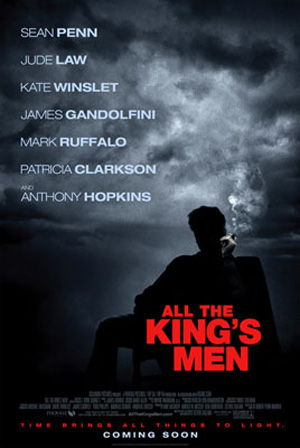
You can bid a sad Oscar farewell to Sean Penn, Willie Stark, Patty Clarkson, Mike Medavoy and director-writer Steven Zallian…at least as far as the ’05 race is concerned.
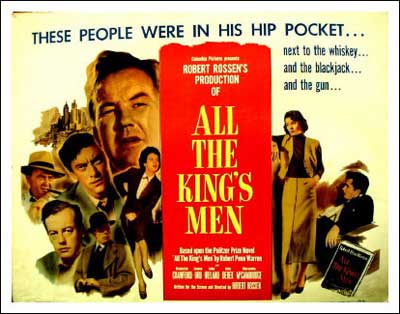
All The King’s Men, a southern political melodrama about the corruption of a home-grown politician in the mode of Louisiana Senator Huey P. Long, has been pulled from its 12.16 release date, which has been scheduled for several months now.


Sean Penn in Steven Zallian’s All The King’s Men

ATKM will probably open in late ’06, according to Medavoy, the film’s producer and head of the Sony-based Pheonix Pictures.
Medavoy told me Thursday afternoon that “we’re just not ready” to release All The King’s Men by 12.16.
“And although I’m personally not happy that we didn’t make it, I know enough about this business to say thank you to the studio for having the guts to [make this decision].”
< ?php include ('/home/hollyw9/public_html/wired'); ?>
One obvious result is that the Best Picture Oscar race is suddenly a tad less challenging for contenders like Brokeback Mountain, Capote, Munich, Walk the Line, Jarhead, Good Night, and Good Luck and The New World.
The assumption was that ATKM might be an Oscar contender on several fronts, especially since the 1949 screen adaptation of Robert Penn Warren’s novel, which was directed by Robert Rossen, won a Best Picture Oscar and two acting Oscars (for costars Broderick Crawford and Mercedes McCambridge).
The story’s about an idealistic southern politician who starts off as a sincere man-of-the-people type, but gradually becomes corrupted by the system as he becomes more and more powerful.

“The few people who’ve seen the movie are over the moon about it…there’s no question this film would have gotten several Oscar nominations,” said Medavoy. “But we have another four weeks to go with the editing, we haven’t even heard the music, we didn’t have the TV spots ready…we would have had to rush everything.”
In other words, said Medavoy, the version of the All The King’s Men that he, Zallian and Columbia would have had to put into theatres to meet the 12.16 release date might not be “the best movie that we know how to put out there, one that I’ll be proud and you’d be proud of… we’re just not ready.”
All The King’s Men finished shooting last April — five months ago — and has been editing ever since. Steven Spielberg’s Munich, another presumed Oscar contender, began filming early last July and will be in theatres by 12.25.
The average guy might compare the two and ask if Spielberg can finish a film in six months, start to finish, why can’t Zallian get his done satisfactorily in double that time, since principal photography on All The King’s Men started in early December of ’04?


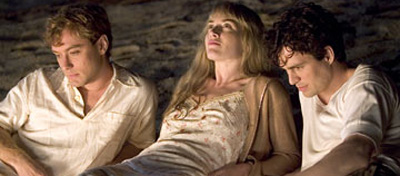
Jude Law, Kate Winslet, Mark Ruffalo

Medavoy’s answer is that Warren’s novel “is a very complicated story. You’ve read the novel, you know what I mean. And we didn’t want to send out a wet print. Spielberg can send out a wet print. We can’t afford to do that.
“The current plan is to wait until the fall,” said Medavoy. “Maybe we’ll have a Cannes plan or a New York plan…we’ll see how it all develops.”
Zallian previously directed two pretty good films — A Civil Action and Searching for Bobby Fischer, and won a best Adapatred Screenplay Oscar for his work on Schindler’s List.
All The King’s Men also stars Kate Winslet, Mark Ruffalo Anthony Hopkins, James Gandolfini and Kathy Baker.

Grab Ass


Looking south on 7th Avenue from 57th Street — Friday, 10.21.05, 1:10 pm.

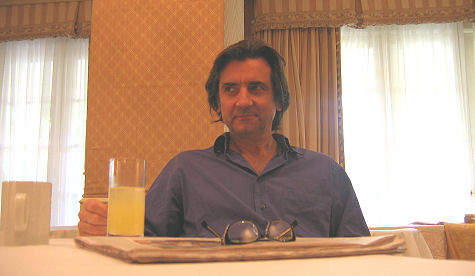
Fierce People director Griffin Dunne in Almond room of Four Seasons hotel — Friday, 10.21.05, 12:15 pm. (Note to the gang at Michelle Robertson publicity: thanks, really, for calling and politely reminding me about Thursday’s interview — very thorough and much appreciated.)

Hany Abu-Assad, director and co-writer of Warner Independent’s Paradise Now, at Thursday’s press junket at Century City’s Hyatt-whatever hotel (i.e., the terra cotta-colored one).

57th Street and 7th Avenue, looking east — Friday, 10.21.05, 1:07 pm.

Buffet for journalists at Paradise Now junket, courtesy of Hyatt and Warner Independent.

Waiting for the fabled A train at Howard Beach station, Brooklyn, not far from JFK — Friday, 10.21.05, 6:05 am.

Brief Encounter

Quality over quantity…right? Longer usually ain’t better and less is usually more. Except when it comes to performances.
The only exception I can think of was Beatrice Straight taking a Best Supporting Actress Oscar for a single deeply-felt scene in Sidney Lumet’s Network. But if Straight had given that killer performance in an anthology film, she’d have been passed over.


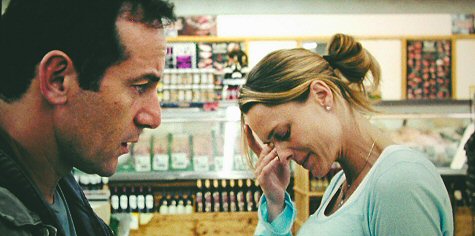
Jason Isaacs, Robin Wright Penn in Rodrigo Garcia’s Nine Lives

The rule seems to be that a performance isn’t award-worthy unless it takes the viewer on at least a 70 or 80-minute journey.
But rules are made to be broken, and Robin Wright Penn’s performance in Rodrigo Garcia’s Nine Lives (Magnolia) — nine short films about women in some kind of emotional transition or meltdown — is enough to make anyone step back and go “wait a minute.”
Penn’s performance comes in the second segment, called “Diana.” She plays the title character — a very pregnant married woman who runs into an old flame named Damian (Isaacs) in a Bel Air market…a man she deeply loved and had the major hots for, and who obviously hurt her very badly.
They spot each other and start talking, and things rekindle in a matter of minutes …or is it seconds? By the time this 11-minute sequence ends, Penn is a mess…crying, anxious…looking for her ex-lover in a darkened parking lot to no avail. And you’re right with her, feeling it.
All the sequences in Nine Lives are shot in a single unbroken take, and the camera is right on top of Penn for every second of “Diana.” And she shows a fuller, more flickery sense of pushed-down hurt and passion than anything I’ve felt from any other female performance, leading or supporting, this year.


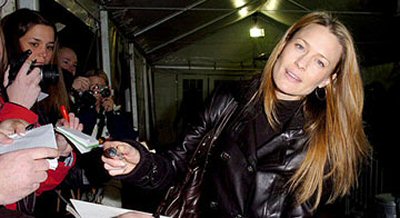
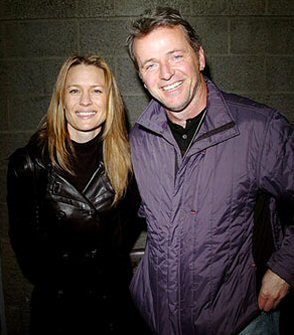
Robin Wright Penn prior to Sundance ’05 premiere for Rodrigo Garcia’s Nine Lives

The fact that she gets to the places she gets to with such delicacy and depth of feeling, and in such a short time…
As good as Isaacs is also (he supplies exactly the right portions of confidence, charm and implied unruliness), you can’t help but study Penn for every facial spasm, every crack of a half-smile, every surge of hesitant feeling.
She’s so good I went back last weekend and paid to see Nine Lives, and nobody freeloads like me when it comes to movies and DVDs.
Most of the major critics have singled out this segment and/or Penn’s performance as the best in the film.
Entertainment Weekly‘s Lisa Schwarzbaum called “Diana” “my favorite among the nonet of 10-minute scenes of women in crisis that make up [this] deeply satisfying feminine maypole dance.
“The air between [Diana and Damian] is electric with unresolved feelings, and the woman truly doesn’t know which way to turn: She tries this aisle and that to find her emotional way, while the camera follows her agitated indecision in one unbroken take.”


Nine Lives director Rodrigo Garcia

“Erotic sparks fly [in this sequence],” said N.Y. Times critic Stephen Holden, “as [Diana’ is gripped by the familiar, scary feeling of disappearing in [Damian’s] presence.”
Variety‘s Scott Foundas has called “Diana” “the pic’s most haunting sequence,” and the L.A. Daily News critic Glenn Whipp called it “the best of the lot.”
“The mundane conversation mingling with obvious chemistry, bitter confrontation and, finally, abject sadness (we get the feeling Damian has really hurt her) is so beautifully handled by Wright-Penn that even the sound of her shopping cart speeding and slowing down matches her staggered feelings,” wrote Reel.com’s Kim Morgan.
L.A. Times critic Kevin Thomas called “Diana” “an especially fine example of Garcia’s masterly control in developing a scene to its fullest,” adding that Wright Penn “beautifully reveals Diana’s increasing inner turmoil along with her determination not to lose her self-control.”
It was Damian’s “inability to commit [that] ended their relationship a decade earlier,” he observed. “Even though Damian has married, as has Diana, he instantly realizes he has never stopped loving her, and in his regret, selfishly resolves to force her to acknowledge that she feels the same way about him.


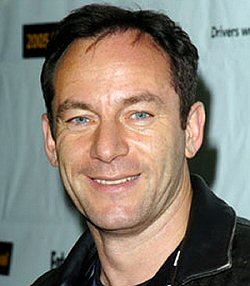
Jason Isaacs at Sundance ’05 premiere

“He starts out in a low enough key that Diana, though thrown by running into him, is finding the chance meeting pleasant enough until he starts bearing down on her,” Thomas explained. “Diana therefore finds herself in a very public place having to confront an unexpected and painful truth and then rise above it, holding on to her dignity and determination all the same.”
Wait a minute….Damian doesn’t really bear down on Diana. He comes over and says he “can’t stop thinking about her,” etc., which I guess is kind of over- bearing, but she’s obviously torn up about seeing him without any prompting (searching for him as she walks down the aisles with her basket, etc.) that he hardly seems like an invader.
Will anything happen for Penn with the critics groups or the Academy? Doesn’t matter on one level because great work is its own reward, but she’s less than a year from being 40 and we all know what that means for actresses. She could do with a pat on the back and some extra attention for being as good as she is.

Arclight Double


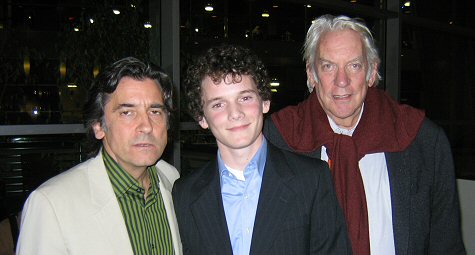
Fierce People director Griffin Dunne, costars Anton Yelchin (center) and Donald Sutherland (r.) at Arclight theatre prior to Hollywood Film Festival showing — Wednesday, 10.18, 7:55 pm. Lions Gate will release Fierce People in April ’06.

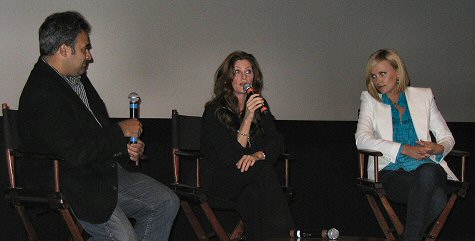
Movie City News editor David Poland chatting with North Country director Niki Caro, star Charlize Theron following screening at Arclight — Wednesday, 10.18, 10:10 pm. Nice interview, but the sound system was all screwed up. The Fierce People q & a could be heard on speakers in the North Country venue, and vice versa. And the cordless mikes kept cutting out.

Steal This Tune

“Jeff, you deserve all props from Ann Hornaday (& Poland!), but you’re wrong about Harrison’s heist of ‘She’s So Fine.’ In fact, he heisted a heist, as you’ll read in Marc Shapiro’s Harrison bio Behind Sad Eyes.
“The info’s from Delaney Bramlett, who says it all happened on the Delaney and Bonnie and Friends tour:
“‘George came over to me and said, ‘You write a lot of gospel songs. I’d like to know what inspires you to do that,” Bramlett begins. ‘I told him, ‘I get things from the Bible, from what a preacher may say, or just the feelings I felt toward God.’ He said, ‘Well, can you give me a for instance? How would you start?’


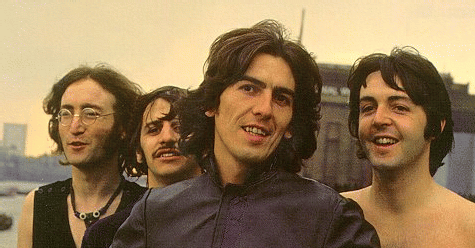
Allegedly snapped on George Harison’s birthday…which might explain why he seems to be the recipient of more-than-the-usual attention here.

“‘So I grabbed my guitar and started playing the Chiffon’s melody from ‘He’s So Fine’ and then sang the words, ‘My sweet Lord/ Oh, my Lord, Oh, my Lord/ I just wanna be with you….’ George said okay. Then I said, ‘Then you praise the Lord in your own way.’
“Rita [Coolidge] and Bonnie were there and so I told them when we got to this one part to sing, ‘Hallalujah.’ They did. George said okay.”
“[After it came out as the top hit on George’s All Things Must Pass album], ‘I called up George and told him that I didn’t mean for him to use the melody of ‘He’s So Fine.’ He said, ‘Well, it’s not exactly,’ and it really wasn’t. He did put some curves in there but he did get sued.”
“Delaney became even more upset when he went out and bought the record and discvoered that only George was credited with writing the song.
“‘When I saw I wasn’t credited, I called George and said, ‘George, I didn’t see my name on the song.’ He promised me it would be on the next printing of the record, but I was never given credit on that song…even though he did admit that the song, to a large extent, was mine, and I never saw any money from it.”


Delaney Bramlett

“Delaney was upset but refused to pursue his legitimate complaint in the courts. His feeling was that he would not give up his friendship with George for a song. Unfortunately, George did not feel the same way.”
“On the same tour, George also stole his pants. ‘One night George got really crazy drunk and tore off the green velvet pants I was wearing and I ended up running down the street naked, chasing after the tour bus.'” — Tim Appelo, esteemed film critic for Seattle Weekly
Wells to Appelo: I obviously stand corrected. Harrison may have been the most spiritually pure (or at least ardent) Beatle, but he wasn’t the most exacting guy in the world when it came to ethics.

Spoil

“Having seen Steve Martin’s The Pink Panther about six months back, I do agree that it’s a lot more fun than it has any right being, but you totally blew one of the best gags in the film by mentioning the Clive Owen thing.
“Granted it’s now lost some of its foresight now that Daniel Craig’s been cast as Bond, but it’s such an awesome nod to film fans and it really comes out of nowhere. There’s a reason IMDB made a point of not mentioning it: it’s supposed to be a surprise. You really should do your readership a solid and take the mention down. They’ll thank you come February (or whenever the film finally gets released).” — Andrew Dignan, Sherman Oaks, CA.
Wells to Dignan: It’s meaningless and at most an asterisk thing now with Craig’s casting…an anecdotal drop in the bucket. Nobody cares, it’s all swirling down the toilet, and you and I and our friends and our pets will all be dead in 70 or 80 years, if not sooner.

Again

Having just seen Mrs. Henderson Presents (Weinstein Co., 12.9) a second time, I’m still 90% convinced Dame Judi Dench will snag a Best Actress Oscar nomination.
She plays the title character, a 70ish widow who buys a London theatre in the late 1930s and, with the help of a feisty 50ish theatre manager (Bob Hoskins), eventually puts on a nude revue…and does so with her usual aplomb.
Dench may not be quite the slam-dunk that Philip Seymour Hoffman is in the Best Actor category, but she’s probably “in”…assuming there are no surprises in the wings (which an Oscar-handicapper should never do) and depending, obviously, on the breaks.


Jason Isaacs, Robin Wright Penn in Rodrigo Garcia’s Nine Lives

Her competitors are Reese Witherspoon (Walk the Line), Maria Bello (A History of Violence), Toni Collette (no full-length performance has out-shone hers in In Her Shoes, but the flat box-office revenues for this 20th Century Fox release will probably lessen the attention), Charlize Theron (North Country), Sara Jessica Parker (The Family Stone), and — if you ask me — Robin Wright Penn.
Who am I missing? Karen Fried, who’s repping that trans-gender drama Transamerica (which I haven;t seen), swears that Felicity Huffman’s performance is good enough to contend, and says “many press people” feel the same way.
It’s not just that Dench is spirited and funny-sad, but she has a pitch-perfect way of delivering zap lines with just the right tone of upper-class indifference. With a less-skilled actress at the helm this could seem offensive, depending on the direction…and yet the joke is always on Dench.
Plus she gradually starts to soften and sadden her Mrs. Henderson (a 70ish widow who buys a London theatre and eventually puts on a nude revue) at the halfway point, and generally makes her into a woman of considerable heart and soul.

Listen Up

Here’s a recording of a special introduction to the just-out “collector’s edition” DVD of Joel and Ethan Coen’s The Big Lebowski. I just popped it in last night, not expecting anything special, and I had one of those “what the fuck is this?” reactions.
It’s billed on the package as an “Exclusive Introduction featuring Mortimer Young, a practitioner of ‘non-uptight’ film preservation.”

This dry and perverse intro is hilariously delivered by an actor who’s really good at sounding like a vageuly pompous know-it-all. His name escapes me, but he’s in his late 60s or early 70s and has been in, I think, a Coen brothers film or two
The copy was obviously written by Joel and Ethan. The riff about “the catastophic period of synergy” (onwership of Universal by Vivendi, Seagrams, etc.) is hilarious.
Everybody knows producer’s rep Jeff Dowd was the quasi-inspiration for Jeff Bridges’ Jeff Lebowski character, but no one has ever said this: Jeff Dowd is nothing like Jeff Lebowski except for the girth. Dowd is quick, shrewd, on top of it. Was into White Russians in the ’70s or ’80s but not now. Not much of a bowler.

“Brown” Booty

“I imagine that the money hairs on the back of Ridley Scott’s neck may be going `Whoo, whoo, whoo’ about directing an Encyclopedia Brown movie, but I have to say ‘What the fuck?’
“Donald Sobol’s books were the shit in the `80s the same way R.L. Stine’s Goosebumps were the shit for kids in the 90s and Harry Potter is now and will soon be replaced by the next volume of books with strikes a chord with the upcoming generation of pre-pubescents with stories of kids as the main characters.
“But even back then, misguided third-grader that I was, I couldn’t imagine there being an `Encyclopedia Brown’ movie.
“Nothing about it is cinematic. Something happens — usually something that stumps little Leroy’s dad, the chief of police — and Encyclopedia snoops around a bit, and Sally follows him around and gets into fisticuffs with anyone who’ll start something. A little more investigating and lightbulb goes off. Then you go to the back of the book and see the solution to the mystery. It has less of a story than a single episode of `Scooby Doo.’

“Who wants to watch an entire movie of vignettes like that? What’s Scott going to do with that? You can create kinetic shots by adjusting the shutter speed on gladiator fights before the emperors and the bloody battles in Somalia, but a pre-teen solving a mystery? And this is from one of the little tykes who blindly made Teenage Mutant Ninja Turtles the highest-grossing movie in 1990.
“I even vaguely remember my third-grade teacher bringing in a videocassette of an episode of the show based on the books and my class didn’t even like it. I can smell `80s revivalism from the other side of the country on this one, trying to bring in the dollar of twenty-somethings with a title from their youth just to get a few quick bucks.
“Just like that Dukes of Hazzard abomination from this summer and the soon-to-be abomination that will be Michael Bay’s Transformers movie (which future existence still gives me nightmares like no scary movie could), it seems like a way to milk empty nostalgia from the unsuspecting public.
“And with things the way they are in a overly-p.c. landscape, what kind of kid’s movie will have a guy named Bugs Meaney, who wants to beat of a girl? If you ask me, Sobol should be satisfied that his books made it into one of the greatest movies of the `90s, Pulp Fiction. A deleted scene, okay, but still better than the prospect of a Ridley “Brown” picture.” — Jay from the state of Georgia.
“That Encyclopedia Brown thing, if not nauseating, is annoying as hell. Okay, maybe it’s nauseating, too. Since when has Ridley Scott given a shit about kids’ movies? And isn’t Narnia enough of an exploiation of the Harry Potter and Lord of the Rings reps?


Ridley Scott

“We must count our blessings, regardless of these developments. Remember that if even if the worst comes to pass, at least Ridley’s brother Tony will not have directed this new film. The cruel taint on Scott Free Productions is Tony’s vile hand; he who committed such crimes as Spy Game and True Romance. All right, I guess The Fan was okay.
“But I’m a jerk for saying such things. I never directed a movie, so what right do I have to blast Tony Scott? Man. (And good Christ, I am STILL so disturbingly correct somehow… funny, that.)” — Steve Clark

Grabs


Entrance to 20th Century Fox studios — Tuesday, 10.18, 4:25 pm.

Meandering around West Hollywood’s Farmer’s Market — Saturday, 10.15, 4:50 pm

Ditto

West Hollywood = the quickening of the pulse.

Chicken Little promo package filled with a handful of chicken feathers that half-spill out and half float-out the minute you open it…sent late last week by Disney publicity.

Lobby of Laemmle’s Sunset 5 — Sunday, 10.16, 7:20 pm. As a result of taking this photo, I was (a) asked to produce my ticket stub by a suspicious usher, (b) interrogated by the manager and the assistant manager about why I was taking a photo of the lobby, (c) asked to show the camera so they could make sure it wasn’t a video camera.

What does the fruit section of Whole Foods on Third and Fairfax have to do with anything…?

Rear of vehicle parked on San Vicente Blvd. outside West Hollywood post office — Tuesday, 10.17, 3:25 pm.

I know…so what?

That photo of a South Pacific island that Jamie Foxx’s cab driver in Collateral kept on his sun visor so he could take a brief vacation when he needed to? Same difference. Atop a hillside in Tuscany, taken in June 2003.

Willie’s Out

Willie’s Out

You can bid a sad Oscar farewell to Sean Penn, Willie Stark, Patty Clarkson, Mike Medavoy and director-writer Steven Zallian…at least as far as the ’05 race is concerned.
All The King’s Men, a southern political melodrama about a the corruption of a home-grown politician in the mode of Louisiana Senator Huey P. Long, has been pulled from its 12.16 release date, which has been scheduled for several months now.


Sean Penn in Steven Zallian’s All The King’s Men

ATKM will probably now open in late ’06, according to Medavoy, the film’s producer and head of the Sony-based Pheonix Pictures.
Medavoy told me Thursday afternoon that “we’re just not ready. And although I’m personally not happy that we didn’t make it, I know enough about this business to say thank you to the studio for having the guts to [make this decision].”
< ?php include ('/home/hollyw9/public_html/wired'); ?>
One obvious result is that the Best Picture Oscar race is suddenly a tad less challenging for contenders like Brokeback Mountain, Capote, Munich, Walk the Line, Jarhead, Good Night, and Good Luck and The New World.
The assumption was that ATKM might be an Oscar contender on several fronts, especially since the 1949 screen adaptation of Robert Penn Warren’s novel, which was directed by Robert Rossen, won a Best Picture Oscar and two acting Oscars (for costars Broderick Crawford and Mercedes McCambridge).
The story’s about an idealistic southern politician who breaks in as a man-of-the-people type, but he gradually becomes corrupted by the system as he becomes more and more powerful.

“The few people who’ve seen the movie are over the moon about there’s question this film would have gotten several Oscar nominations,” said Medavoy, “but we have another four weeks to go with the editing, we haven’t even heard the music, we didn’t have the TV spots ready…we would have had to rush everything.”
Medavoy’s point was that given the version of the All The King’s Men that he, Zallian and Columbia have to put into theatres to meet the 12.16 release date might not be “the best movie that we know how to put out there, one that I’ll be proud and you’d be proud of… we’re just not ready.”
All The King’s Men finished shooting last April — five months ago — and has been editing ever since. Steven Spielberg’s Munich, another presumed Oscar contender, began filming early last July and will be in theatres by 12.25.
The average guy might compare the two and ask if Spielberg can finish a film in six months, start to finish, why can’t Zallian get his done satisfactorily in eight months?
Medavoy’s answer is that Warren’s novel “is a very complicated story. You’ve read the novel, you know what I man. And we didn’t want to send out a wet print. Spielberg can send out a wet print. We can’t afford to do that.


Jude Law, Kate Winslet, Mark Ruffalo

“The current plan is to wait until the fall,” said Medavoy. “Maybe we’ll have a Cannes plan or a New York plan…we’ll see how it alll develops.”
Zallian previously directed two pretty good films — A Civil Action and Searching for Bobby Fischer, and won a best Adapatred Screenplay Oscar for his work on Schindler’s List.
All The King’s Men also stars Kate Winslet, Mark Ruffalo Anthony Hopkins, James Gandolfini and Kathy Baker.

Brief Encounter

Quality over quantity…right? Longer usually ain’t better and less is usually more. Except when it comes to performances.
The only exception I can think of was Beatrice Straight taking a Best Supporting Actress Oscar for a single deeply-felt scene in Sidney Lumet’s Network. But if Straight had given that killer performance in an anthology film, she’d have been passed over.


Jason Isaacs, Robin Wright Penn in Rodrigo Garcia’s Nine Lives

The rule seems to be that a performance isn’t award-worthy unless it takes the viewer on at least a 70 or 80-minute journey.
But rules are made to be broken, and Robin Wright Penn’s performance in Rodrigo Garcia’s Nine Lives (Magnolia) — nine short films about women in some kind of emotional transition or meltdown — is enough to make anyone step back and go “wait a minute.”
Penn’s performance comes in the second segment, called “Diana.” She plays the title character — a very pregnant married woman who runs into an old flame named Damian (Isaacs) in a Bel Air market…a man she deeply loved and had the major hots for, and who obviously hurt her very badly.
They spot each other and start talking, and things rekindle in a matter of minutes …or is it seconds? By the time this 11-minute sequence ends, Penn is a mess…crying, anxious…looking for her ex-lover in a darkened parking lot to no avail. And you’re right with her, feeling it.
All the sequences in Nine Lives are shot in a single unbroken take, and the camera is right on top of Penn for every second of “Diana.” And she shows a fuller, more flickery sense of pushed-down hurt and passion than anything I’ve felt from any other female performance, leading or supporting, this year.


Robin Wright Penn prior to Sundance ’05 premiere for Rodrigo Garcia’s Nine Lives

The fact that she gets to the places she gets to with such delicacy and depth of feeling, and in such a short time…
As good as Isaacs is also (he supplies exactly the right portions of confidence, charm and implied unruliness), you can’t help but study Penn for every facial spasm, every crack of a half-smile, every surge of hesitant feeling.
She’s so good I went back last weekend and paid to see Nine Lives, and nobody freeloads like me when it comes to movies and DVDs.
Most of the major critics have singled out this segment and/or Penn’s performance as the best in the film.
Entertainment Weekly‘s Lisa Schwarzbaum called “Diana” “my favorite among the nonet of 10-minute scenes of women in crisis that make up [this] deeply satisfying feminine maypole dance.
“The air between [Diana and Damian] is electric with unresolved feelings, and the woman truly doesn’t know which way to turn: She tries this aisle and that to find her emotional way, while the camera follows her agitated indecision in one unbroken take.”


Nine Lives director Rodrigo Garcia

“Erotic sparks fly [in this sequence],” said N.Y. Times critic Stephen Holden, “as [Diana’ is gripped by the familiar, scary feeling of disappearing in [Damian’s] presence.”
Variety‘s Scott Foundas has called “Diana” “the pic’s most haunting sequence,” and the L.A. Daily News critic Glenn Whipp called it “the best of the lot.”
“The mundane conversation mingling with obvious chemistry, bitter confrontation and, finally, abject sadness (we get the feeling Damian has really hurt her) is so beautifully handled by Wright-Penn that even the sound of her shopping cart speeding and slowing down matches her staggered feelings,” wrote Reel.com’s Kim Morgan.
L.A. Times critic Kevin Thomas called “Diana” “an especially fine example of Garcia’s masterly control in developing a scene to its fullest,” adding that Wright Penn “beautifully reveals Diana’s increasing inner turmoil along with her determination not to lose her self-control.”
It was Damian’s “inability to commit [that] ended their relationship a decade earlier,” he observed. “Even though Damian has married, as has Diana, he instantly realizes he has never stopped loving her, and in his regret, selfishly resolves to force her to acknowledge that she feels the same way about him.


Jason Isaacs at Sundance ’05 premiere

“He starts out in a low enough key that Diana, though thrown by running into him, is finding the chance meeting pleasant enough until he starts bearing down on her,” Thomas explained. “Diana therefore finds herself in a very public place having to confront an unexpected and painful truth and then rise above it, holding on to her dignity and determination all the same.”
Wait a minute….Damian doesn’t really bear down on Diana. He comes over and says he “can’t stop thinking about her,” etc., which I guess is kind of over- bearing, but she’s obviously torn up about seeing him without any prompting (searching for him as she walks down the aisles with her basket, etc.) that he hardly seems like an invader.
Will anything happen for Penn with the critics groups or the Academy? Doesn’t matter on one level because great work is its own reward, but she’s less than a year from being 40 and we all know what that means for actresses. She could do with a pat on the back and some extra attention for being as good as she is.

Arclight Double


Fierce People director Griffin Dunne, costars Anton Yelchin (center) and Donald Sutherland (r.) at Arclight theatre prior to Hollywood Film Festival showing — Wednesday, 10.18, 7:55 pm. Lions Gate will release Fierce People in April ’06.

Movie City News editor David Poland chatting with North Country director Niki Caro, star Charlize Theron following screening at Arclight — Wednesday, 10.18, 10:10 pm. Nice interview, but the sound system was all screwed up. The Fierce People q & a could be heard on speakers in the North Country venue, and vice versa. And the cordless mikes kept cutting out.

Again

Having just seen Mrs. Henderson Presents (Weinstein Co., 12.9) a second time, I’m still 90% convinced Dame Judi Dench will snag a Best Actress Oscar nomination.
She plays the title character, a 70ish widow who buys a London theatre in the late 1930s and, with the help of a feisty 50ish theatre manager (Bob Hoskins), even- tually puts on a nude revue…and does so with her usual aplomb.
Dench may not be quite the slam-dunk that Philip Seymour Hoffman is in the Best Actor category, but she’s probably “in”…assuming there are no surprises in the wings (which an Oscar-handicapper should never do) and depending, obviously, on the breaks.


Jason Isaacs, Robin Wright Penn in Rodrigo Garcia’s Nine Lives

Her competitors are Reese Witherspoon (Walk the Line), Maria Bello (A History of Violence), Toni Collette (no full-length performance has out-shone hers in In Her Shoes, but the flat box-office revenues for this 20th Century Fox release will probably lessen the attention), Charlize Theron (North Country), Sara Jessica Parker (The Family Stone), and — if you ask me — Robin Wright Penn.
Who am I missing?
It’s not just that Dench is spirited and funny-sad, but she has a pitch-perfect way of delivering zap lines with just the right tone of upper-class indifference. With a less-skilled actress at the helm this could seem offensive, depending on the direction…and yet the joke is always on Dench.
Plus she gradually starts to soften and sadden her Mrs. Henderson (a 70ish widow who buys a London theatre and eventually puts on a nude revue) at the halfway point, and generally makes her into a woman of considerable heart and soul.

Listen Up

Here’s a recording of a special introduction to the just-out “collector’s edition” DVD of Joel and Ethan Coen’s The Big Lebowski (’98). I just popped it in last night, not expecting anything special, and the intro piece kind of jerked me awake.
It’s billed on the package as an “Exclusive Introduction featuring Mortimer Young, a practitioner of ‘non-uptight’ film preservation.”

This dry and perverse intro is hilariously delivered by an actor who’s really good at sounding like a vageuly pompous know-it-all. His name escapes me, but he’s in his late 60s or early 70s and has been in, I think, a Coen brothers film or two.
The copy was obviously written by Joel and Ethan. The riff about “the catastophic period of synergy” (ownership of Universal by Vivendi, Seagrams, etc.) is hilarious. The narrator calls the film The Grand Lebowski (not bad) and mentions that the film was called Mr. Marijuana when it played in Spain.
Everybody knows producer’s rep Jeff Dowd was the quasi-inspiration for Jeff Bridges’ Jeff Lebowski character, but no one has ever said this: Jeff Dowd is nothing like Jeff Lebowski except for the girth. Dowd is quick, shrewd, on top of it. Was into White Russians in the ’70s or ’80s but not now. Not much of a bowler.

“Brown” Booty

“I imagine that the money hairs on the back of Ridley Scott’s neck may be going `Whoo, whoo, whoo’ about directing an Encyclopedia Brown movie, but I have to say ‘What the fuck?’
“Donald Sobol’s books were the shit in the `80s the same way R.L. Stine’s Goosebumps were the shit for kids in the 90s and Harry Potter is now and will soon be replaced by the next volume of books which strikes a chord with the upcoming generation of pre-pubescents with stories of kids as the main characters.
“But even back then, misguided third-grader that I was, I couldn’t imagine there being an `Encyclopedia Brown’ movie.
“Nothing about it is cinematic. Something happens — usually something that stumps little Leroy’s dad, the chief of police — and Encyclopedia snoops around a bit, and Sally follows him around and gets into fisticuffs with anyone who’ll start something. A little more investigating and a lightbulb goes off. Then you go to the back of the book and see the solution to the mystery. It has less of a story than a single episode of `Scooby Doo.’

“Who wants to watch an entire movie of vignettes like that? What’s Scott going to do with that? You can create kinetic shots by adjusting the shutter speed on gladiator fights before the emperors and the bloody battles in Somalia, but a pre-teen solving a mystery? And this is from one of the little tykes who blindly made Teenage Mutant Ninja Turtles the highest-grossing movie in 1990.
“I even vaguely remember my third-grade teacher bringing in a videocassette of an episode of the show based on the books and my class didn’t even like it. I can smell `80s revivalism from the other side of the country on this one, trying to bring in the dollar of twenty-somethings with a title from their youth just to get a few quick bucks.
“Like that Dukes of Hazzard abomination from last summer, it seems like a way to milk empty nostalgia from the unsuspecting public.
“And with things the way they are in a overly-p.c. landscape, what kind of kid’s movie will have a guy named Bugs Meaney, who wants to beat of a girl?
“If you ask me, Sobol should be satisfied that his books made it into one of the greatest movies of the `90s, Pulp Fiction. A deleted scene, okay, but still better than the prospect of a Ridley “Brown” picture.” — Jay from the state of Georgia.
“That Encyclopedia Brown thing, if not nauseating, is annoying as hell. Okay, maybe it’s nauseating, too. Since when has Ridley Scott given a shit about kids’ movies? And isn’t Narnia enough of an exploitation of the Harry Potter and Lord of the Rings reps?


Ridley Scott

“We must count our blessings, regardless of these developments. Remember that if even if the worst comes to pass, at least Ridley’s brother Tony will not have directed this new film. The cruel taint on Scott Free Productions is Tony’s vile hand; he who committed such crimes as Spy Game and True Romance. All right, I guess The Fan was okay.
“But I’m a jerk for saying such things. I never directed a movie, so what right do I have to blast Tony Scott? Man. (And good Christ, I am STILL so disturbingly correct somehow… funny, that.)” — Steve Clark

Grabs


Entrance to 20th Century Fox studios — Tuesday, 10.18, 4:25 pm.

Meandering around West Hollywood’s Farmer’s Market — Saturday, 10.15, 4:50 pm

Ditto

West Hollywood = the quickening of the pulse.

Chicken Little promo package filled with a handful of chicken feathers that half-spill out and half float-out the minute you open it…sent late last week by Disney publicity.

Lobby of Laemmle’s Sunset 5 — Sunday, 10.16, 7:20 pm. As a result of taking this photo, I was (a) asked to produce my ticket stub by a suspicious usher, (b) interrogated by the manager and the assistant manager about why I was taking a photo of the lobby, (c) asked to show the camera so they could make sure it wasn’t a video camera.

What does the fruit section of Whole Foods on Third and Fairfax have to do with anything…?

Rear of vehicle parked on San Vicente Blvd. outside West Hollywood post office — Tuesday, 10.17, 3:25 pm.

I know…so what?

That photo of a South Pacific island that Jamie Foxx’s cab driver in Collateral kept on his sun visor so he could take a brief vacation when he needed to? Same difference. Atop a hillside in Tuscany, taken in June 2003.

Brief Encounter

Quality over quantity…right? Longer usually ain’t better and less is usually more. Except when it comes to performances.
The only exception I can think of was Beatrice Straight taking a Best Supporting Actress Oscar for a single deeply-felt scene in Sidney Lumet’s Network. But if Straight had given that killer performance in an anthology film, she’d have been passed over.


Jason Isaacs, Robin Wright Penn in Rodrigo Garcia’s Nine Lives

The rule seems to be that a performance isn’t award-worthy unless it takes the viewer on at least a 70 or 80-minute journey.
But rules are made to be broken, and Robin Wright Penn’s performance in Rodrigo Garcia’s Nine Lives (Magnolia) — nine short films about women in some kind of emotional transition or meltdown — is enough to make anyone step back and go “wait a minute.”
Penn’s performance comes in the second segment, called “Diana.” She plays the title character — a very pregnant married woman who runs into an old flame named Damian (Isaacs) in a Bel Air market…a man she deeply loved and had the major hots for, and who obviously hurt her very badly.
They spot each other and start talking, and things rekindle in a matter of minutes …or is it seconds? By the time this 11-minute sequence ends, Penn is a mess…crying, anxious…looking for her ex-lover in a darkened parking lot to no avail. And you’re right with her, feeling it.
All the sequences in Nine Lives are shot in a single unbroken take, and the camera is right on top of Penn for every second of “Diana.” And she shows a fuller, more flickery sense of pushed-down hurt and passion than anything I’ve felt from any other female performance, leading or supporting, this year.


Robin Wright Penn prior to Sundance ’05 premiere for Rodrigo Garcia’s Nine Lives

The fact that she gets to the places she gets to with such delicacy and depth of feeling, and in such a short time…
As good as Isaacs is also (he supplies exactly the right portions of confidence, charm and implied unruliness), you can’t help but study Penn for every facial spasm, every crack of a half-smile, every surge of hesitant feeling.
She’s so good I went back last weekend and paid to see Nine Lives, and nobody freeloads like me when it comes to movies and DVDs.
Most of the major critics have singled out this segment and/or Penn’s performance as the best in the film.
Entertainment Weekly‘s Lisa Schwarzbaum called “Diana” “my favorite among the nonet of 10-minute scenes of women in crisis that make up [this] deeply satisfying feminine maypole dance.
“The air between [Diana and Damian] is electric with unresolved feelings, and the woman truly doesn’t know which way to turn: She tries this aisle and that to find her emotional way, while the camera follows her agitated indecision in one unbroken take.”


Nine Lives director Rodrigo Garcia

“Erotic sparks fly [in this sequence],” said N.Y. Times critic Stephen Holden, “as [Diana’ is gripped by the familiar, scary feeling of disappearing in [Damian’s] presence.”
Variety‘s Scott Foundas has called “Diana” “the pic’s most haunting sequence,” and the L.A. Daily News critic Glenn Whipp called it “the best of the lot.”
“The mundane conversation mingling with obvious chemistry, bitter confrontation and, finally, abject sadness (we get the feeling Damian has really hurt her) is so beautifully handled by Wright-Penn that even the sound of her shopping cart speeding and slowing down matches her staggered feelings,” wrote Reel.com’s Kim Morgan.
L.A. Times critic Kevin Thomas called “Diana” “an especially fine example of Garcia’s masterly control in developing a scene to its fullest,” adding that Wright Penn “beautifully reveals Diana’s increasing inner turmoil along with her determination not to lose her self-control.”
It was Damian’s “inability to commit [that] ended their relationship a decade earlier,” he observed. “Even though Damian has married, as has Diana, he instantly realizes he has never stopped loving her, and in his regret, selfishly resolves to force her to acknowledge that she feels the same way about him.


Jason Isaacs at Sundance ’05 premiere

“He starts out in a low enough key that Diana, though thrown by running into him, is finding the chance meeting pleasant enough until he starts bearing down on her,” Thomas explained. “Diana therefore finds herself in a very public place having to confront an unexpected and painful truth and then rise above it, holding on to her dignity and determination all the same.”
Wait a minute….Damian doesn’t really bear down on Diana. He comes over and says he “can’t stop thinking about her,” etc., which I guess is kind of over- bearing, but she’s obviously torn up about seeing him without any prompting (searching for him as she walks down the aisles with her basket, etc.) that he hardly seems like an invader.
Will anything happen for Penn with the critics groups or the Academy? Doesn’t matter on one level because great work is its own reward, but she’s less than a year from being 40 and we all know what that means for actresses. She could do with a pat on the back and some extra attention for being as good as she is.

Arclight Double


Fierce People director Griffin Dunne, costars Anton Yelchin (center) and Donald Sutherland (r.) at Arclight theatre prior to Hollywood Film Festival showing — Wednesday, 10.18, 7:55 pm. Lions Gate will release Fierce People in April ’06.

Movie City News editor David Poland chatting with North Country director Niki Caro, star Charlize Theron following screening at Arclight — Wednesday, 10.18, 10:10 pm. Nice interview, but the sound system was all screwed up. The Fierce People q & a could be heard on speakers in the North Country venue, and vice versa. And the cordless mikes kept cutting out.

Again

Having just seen Mrs. Henderson Presents (Weinstein Co., 12.9) a second time, I’m still 90% convinced Dame Judi Dench will snag a Best Actress Oscar nomination.
She plays the title character, a 70ish widow who buys a London theatre in the late 1930s and, with the help of a feisty 50ish theatre manager (Bob Hoskins), even- tually puts on a nude revue…and does so with her usual aplomb.
Dench may not be quite the slam-dunk that Philip Seymour Hoffman is in the Best Actor category, but she’s probably “in”…assuming there are no surprises in the wings (which an Oscar-handicapper should never do) and depending, obviously, on the breaks.

Her competitors are Reese Witherspoon (Walk the Line), Maria Bello (A History of Violence), Toni Collette (no full-length performance has out-shone hers in In Her Shoes, but the flat box-office revenues for this 20th Century Fox release will probably lessen the attention), Charlize Theron (North Country), Sara Jessica Parker (The Family Stone), and — if you ask me — Robin Wright Penn.
Who am I missing?
It’s not just that Dench is spirited and funny-sad, but she has a pitch-perfect way of delivering zap lines with just the right tone of upper-class indifference. With a less-skilled actress at the helm this could seem offensive, depending on the direction…and yet the joke is always on Dench.
Plus she gradually starts to soften and sadden her Mrs. Henderson (a 70ish widow who buys a London theatre and eventually puts on a nude revue) at the halfway point, and generally makes her into a woman of considerable heart and soul.

Listen Up

Here’s a recording of a special introduction to the just-out “collector’s edition” DVD of Joel and Ethan Coen’s The Big Lebowski (’98). I just popped it in last night, not expecting anything special, and the intro piece kind of jerked me awake.
It’s billed on the package as an “Exclusive Introduction featuring Mortimer Young, a practitioner of ‘non-uptight’ film preservation.”

This dry and perverse intro is hilariously delivered by an actor who’s really good at sounding like a vaguely pompous know-it-all. His name escapes me, but he’s in his late 60s or early 70s and has been in, I think, a Coen brothers film or two.
The copy was obviously written by Joel and Ethan. The riff about “the catastophic period of synergy” (ownership of Universal by Vivendi, Seagrams, etc.) is hilarious. The narrator calls the film The Grand Lebowski (not bad) and mentions that the film was called Mr. Marijuana when it played in Spain.
Everybody knows producer’s rep Jeff Dowd was the quasi-inspiration for Jeff Bridges’ Jeff Lebowski character, but no one has ever said this: Jeff Dowd is nothing like Jeff Lebowski except for the girth. Dowd is quick, shrewd, on top of it. Was into White Russians in the ’70s or ’80s but not now. Not much of a bowler.

“Brown” Booty

“I imagine that the money hairs on the back of Ridley Scott’s neck may be going `Whoo, whoo, whoo’ about directing an Encyclopedia Brown movie, but I have to say ‘What the fuck?’
“Donald Sobol’s books were the shit in the `80s the same way R.L. Stine’s Goosebumps were the shit for kids in the 90s and Harry Potter is now and will soon be replaced by the next volume of books which strikes a chord with the upcoming generation of pre-pubescents with stories of kids as the main characters.
“But even back then, misguided third-grader that I was, I couldn’t imagine there being an `Encyclopedia Brown’ movie.
“Nothing about it is cinematic. Something happens — usually something that stumps little Leroy’s dad, the chief of police — and Encyclopedia snoops around a bit, and Sally follows him around and gets into fisticuffs with anyone who’ll start something. A little more investigating and a lightbulb goes off. Then you go to the back of the book and see the solution to the mystery. It has less of a story than a single episode of `Scooby Doo.’

“Who wants to watch an entire movie of vignettes like that? What’s Scott going to do with that? You can create kinetic shots by adjusting the shutter speed on gladiator fights before the emperors and the bloody battles in Somalia, but a pre-teen solving a mystery? And this is from one of the little tykes who blindly made Teenage Mutant Ninja Turtles the highest-grossing movie in 1990.
“I even vaguely remember my third-grade teacher bringing in a videocassette of an episode of the show based on the books and my class didn’t even like it. I can smell `80s revivalism from the other side of the country on this one, trying to bring in the dollar of twenty-somethings with a title from their youth just to get a few quick bucks.
“Like that Dukes of Hazzard abomination from last summer, it seems like a way to milk empty nostalgia from the unsuspecting public.
“And with things the way they are in a overly-p.c. landscape, what kind of kid’s movie will have a guy named Bugs Meaney, who wants to beat of a girl?
“If you ask me, Sobol should be satisfied that his books made it into one of the greatest movies of the `90s, Pulp Fiction. A deleted scene, okay, but still better than the prospect of a Ridley “Brown” picture.” — Jay from the state of Georgia.
“That Encyclopedia Brown thing, if not nauseating, is annoying as hell. Okay, maybe it’s nauseating, too. Since when has Ridley Scott given a shit about kids’ movies? And isn’t Narnia enough of an exploitation of the Harry Potter and Lord of the Rings reps?


Ridley Scott

“We must count our blessings, regardless of these developments. Remember that if even if the worst comes to pass, at least Ridley’s brother Tony will not have directed this new film. The cruel taint on Scott Free Productions is Tony’s vile hand; he who committed such crimes as Spy Game and True Romance. All right, I guess The Fan was okay.
“But I’m a jerk for saying such things. I never directed a movie, so what right do I have to blast Tony Scott? Man. (And good Christ, I am STILL so disturbingly correct somehow… funny, that.)” — Steve Clark

Grabs


Entrance to 20th Century Fox studios — Tuesday, 10.18, 4:25 pm.

Meandering around West Hollywood’s Farmer’s Market — Saturday, 10.15, 4:50 pm

Ditto

West Hollywood = the quickening of the pulse.

Chicken Little promo package filled with a handful of chicken feathers that half-spill out and half float-out the minute you open it…sent late last week by Disney publicity.

Lobby of Laemmle’s Sunset 5 — Sunday, 10.16, 7:20 pm. As a result of taking this photo, I was (a) asked to produce my ticket stub by a suspicious usher, (b) interrogated by the manager and the assistant manager about why I was taking a photo of the lobby, (c) asked to show the camera so they could make sure it wasn’t a video camera.

What does the fruit section of Whole Foods on Third and Fairfax have to do with anything…?

Rear of vehicle parked on San Vicente Blvd. outside West Hollywood post office — Tuesday, 10.17, 3:25 pm.

I know…so what?

That photo of a South Pacific island that Jamie Foxx’s cab driver in Collateral kept on his sun visor so he could take a brief vacation when he needed to? Same difference. Atop a hillside in Tuscany, taken in June 2003.

Mountain High

Mountain High

Eight or nine movies with gay-themes and prominent gay characters will be playing between now and early December. But only three have serious weight, and only one is unequivocally front-and-center about two guys in love with each other — Ang Lee’s Brokeback Mountain (Focus Features, 12.9).
The other two — Bennett Miller’s Capote and Craig Lucas’s The Dying Gaul (Strand, 11.4) — are really about work and politics. Capote is about a man who’s completely consumed by the writing of a book, and Gaul, which I saw and liked at Sundance ’05, is about Hollywood-style power games.


Brokeback Mountain director Ang Lee at the close of the Venice Film Festival upon accepting the Golden Lion, the fest’s top prize.

There are five or six others that qualify, but it’s imprecise and uncool to lump in Brokeback with the pack. This is a truly exceptional film that owns its own real estate and occupies its own realm.
It’s about a couple of cowboy hands (Jake Gyllenhaal, Heath Ledger) who fall for each other and have sex in tents during fishing trips in the wilds of Montana…but never really act on their passion except for these outings. The film is about denial and shutting down your feelings, and how this finally leads to the shriveling of the soul.
< ?php include ('/home/hollyw9/public_html/wired'); ?>
I renounced using the label of “gay cowboy movie” during the Toronto Film Festival simply because Brokeback‘s thing is much more about lamenting and hurting in the worst way, so if you need a blunt catch phrase call it a “sad cowboy movie.” Simple but true.
It’s so sad at the end it’s a full-out tragedy, and I swear you could be the most rabid homophobe alive and you’d still be thinking, “Jeez, these guys should have just come out with it and gotten together and grown old together.”
Brokeback Mountain is Ang Lee’s most emotionally moving film ever. It’s certainly going to be on almost everyone’s ten-best list, and it may well be nominated for Best Picture by the Academy. It is that good, that strong. But will it make any money? Will straight American guys pay to see it? And what about the red-state bubbas?

I don’t tend to like gay-guy love stories. I don’t respond to them with comfort or true openness of feeling…but I felt this one. I let it in. I’m pretty average 7-11 so maybe this means something …or not.
I only know that calling this movie a “gay” anything doesn’t feel right. It’s an American heartland drama about two very decent but confused and screwed-up guys. I’m straight but I related, being a little bit on the denying, screwed-up side myself.
The film works to a large extent because of Heath Ledger’s tortured inhabiting of Ennis del Mar, the more repressed and tragic of the two lead characters.
Gyllenhaal gives everything he has to the role of Jack Twist, and he nails it as well as anyone could, but Ennis suppresses his feelings more forcefully and fearfully, and his life is therefore much more screwed up than Jack’s as a result, and so he gets you all the more.
Ledger could be pushed for Best Actor and he probably will be…but if Focus Features wants to win (and maybe they don’t — maybe they’re figuring a Best Actor nomination for seven or eight weeks will bring in the money they want to make) …but if they want to win they should put him up for Best Supporting Actor. Ledger might get a lot of support, but almost gets you no cigar and he almost certainly won’t beat Phillip Seymour Hoffman.


Heath Ledger, Michelle Williams

If you want to twist yourself into a pretzel you could make a case for Ledger’s role being a very strong supporting one. You could say Gyllenhaal’s Jack is the more assertive and impassioned…you could say Ennis is the quieter #2 guy.
Oh, yeah…the other gay movies and characters. One in October and four opening in November…six counting The Dying Gaul. Did distribs decide they had to release these films in October-November because it’s less of a generic family-values time than December?
In order of release there’s Val Kilmer as a gay private eye in Shane Black’s Kiss Kiss Bang Bang (Warner Bros., 10.21), the baby-adopting gay couple (Tyrone Giordano, Brian J. White) in The Family Stone (Fox, 11.4), Cillian Murphy as an Irish drag queen in Neil Jordan’s Breakfast on Pluto (Sony Classics, 11.16), Johnny Depp as a bisexual poet in Libertine (Miramax, 11.18), and a couple of HIV-poz gay guys (Wilson Jermaine Heredia and Jesse L. Martin) in Rent (Columbia, 11.23).

Debate

I wrote a guy a while back who’s heavily invested in Tony Scott’s Domino (New line, 10.14), which is getting killed by the critics, by the way. I told him that as much as I liked Richard Kelly’s excellent script, I almost hated the film.
And then it started…
He: You need to see it again before you trash it. I think you’ll like it more after a second viewing.
Me: I’ll see it again at [an upcoming screening], but I really hated the vibe and that Tony Scott flash-cut crap. I’m just really sick of that shit all of a sudden, and I loved Man on Fire.
He: You have to surrender to Tony’s style and forget about the script.
Me: That’s the problem. Out of the blue, he’s just rubbing me the wrong way.


Mickey Rourke, Keira Knightley, Edgar Ramirez

He: This is his ride.
Me: You can say that again.
He: And Keira [Knightley]…do you still have some grudge against her?
Me: Yeah, she doesn’t have “it.” She really doesn’t.
He: She worked so hard.
Me: If you’ve got it, you’ve got it. Working hard isn’t the point if it’s in you, if it’s there.
He: Come on, she really is a special woman. If you met her you would melt.
Me: That’s another issue. Chemical thing.
He: Of all the bimbos in this town…cut her a bit of slack!
Me: I’m not trying to be a dickhead for the sake of being a dickhead. I don’t enjoy going negative on anything or anyone.
He: So many nitwits and you pick on the British intellectual beauty.
Me: I’ll see it again but I don’t know.

He: Seriously, watch the flick again and pay attention to the subtext. It’s actually a provocative statement and Tony is to be commended. Come on…I thought you had more rock’n roll taste! Did none of the comedy play for you?
Me: What comedy? Oh, the Chris Walken stuff?
He: Overall it’s going to age well.
Me: Maybe.
He: It plays better upon repeat viewings…really does grow on you…so don’t be so quick to trash it.
Me: Okay.
He: And Keira is a fucking piece of ass. Admit it, fucker!
Me: In all candor, and I’m sharing a piece of my heart here…she really doesn’t do it for me.

Ring Fingers

I’m not inferring, much less presuming, that 20th Century Fox’s ad department ripped off the visual idea presented in the one-sheet for Joaquin Oristrell’s Novios (1999), a Spanish-produced sex farce, in creating the “teaser” one-sheet art for The Family Stone.
Great minds think alike and good ideas are like dandelion pollen in the air. The task of creative people is to grab them and make them into some form of distilled art. I’ll bet the Fox ad guy who dreamt this one up really struggled to get it right and was hugely proud when it was chosen for the poster…and had never heard of Joaquin Oristrell.
And George Harrison didn’t consciously rip off the early ’60s doo-lang, doo-lang song “He’s So Fine” when he wrote “My Sweet Lord”. I was just telling a friend yesterday that nobody owns ideas. They’re just out there and anyone can jump in unless lawyers are involved.

The Family Stone poster image feels subtler and classier, in part because it uses the wedding-ring finger on the left hand which kind of softens the mood, while the Novio taunt is pure up-yours. On top of which the Family Stone hand model has creamier skin, and has had a better manicure.
(Oh, and by the way? I’ve tried to get my wedding-ring finger to stand straight up like the one in the poster and it can’t be done. Not with the other fingers tucked in like that. It’s a sham…an anatomical lie!)
Novio‘s right-hand middle-finger gesture is a bit angrier, which may be appropriate given the wedding band (as opposed to the engagement ring in the Fox poster) and all that marriage entails. It suggests that the creators are more interested in the emotional-rage element than the story, which is about infidelity and revenge between a married guy and his younger female assistant.
Novios sounds pretty good according to an IMDB posting, but it never received U.S. distribution. It played at the Miami Hispanic Film Festival in May 2000.

E-Town

“When can we expect a written apology on your site to Jane Fonda, for your evisceration of her when she passed on Elizabethtown?
“She may have picked the less ambitious film, but it sounds like shoving J-Lo’s face into cake over and over is far better than anything in Crowe’s flick.” — Mark Frenden
Wells to Frenden: No apologies. Committing to any movie is a throw of the dice, but you always go with a verified auteur like Cameron Crowe over an MTV hack making a film for New Line. Even with all the things that didn’t work, a failed Elizabethtown still has it all over a programmer like Monster-in-Law.

Flyover

“The In Her Shoes letdown has me wondering if 20th Century Fox has any idea how to sell a movie to middle America.
“I live in Nashville, which is a medium-market city. It is by no means New York or Chicago, but we typically get a slate of decent movies that are off the main- stream radar and all of the big studio releases. And yet I’ve seen the trailer for In Her Shoes only twice on television in the last few months.

“Keep in mind we have no oversized billboards of upcoming movies that announce a star’s presence or a film’s appeal. Unfortunately, outside of television ads, people here are not as exposed to the marketing campaigns of these films unless you personally seek them out.
“In fact, without your column (which is a daily read) I would not have had Shoes on my list of movies to see…from sheer lack of knowing it was out there. This is a real concern because I think people lose out on seeing quality films because of lackluster efforts by corporate behemoths like Fox.
“Of course they peddle dreck like Two for the Money or Transporter 2 as if it’s Halloween candy. Here’s hoping that they get their shit together and start promoting The Family Stone the right way.” — Brad Jones, Nashville.

Stoned

The Family Stone (20th Century Fox, 11.4) looks like a hit because it has something for lightweight Sex and the City fans (you know…the ones who say they’ve enjoyed this or that film because it’s “fun”) as well as those looking for a quality deal with a little heart and gravitas.
I’ve mentioned that hit HBO series because Sarah Jessica Parker is the nominal star of The Family Stone, although it’s primarily an ensemble dramedy with great performances all around, plus top-grade writing and directing from the unknown but obviously talented Thomas Bezucha.
The producer is Michael London, who also delivered Sideways. These two plus House of Sand and Fog and Thirteen, all made over the last two and a half years, have cemented London’s rep as one of the few guys who make classy personal films that bridge the line between big-studio polish and indie attitude.


The Family Stone crew (l. to r.): Craig T. Nelson (on rug) Elizabeth Reaser, Savannah Stehlin, (seated) Diane Keaton, (on rug) Rachel McAdams, Paul Schneider (standing) Sarah Jessica Parker, Dermot Mulroney, Luke Wilson, (seated) Brian J. White, (on rug) Tyrone Giordano, (standing) Claire Danes, no comment.

Set in snowy New England (although exteriors were shot in Madison, New Jersey), The Family Stone is a home-for-the-holidays family pic with smarts and feeling and humor that’s simultaneously sensitive, abrasive and “real.” Tight, sharply written, enjoyably acted. I’ve seen it twice so far and I’m looking forward to more viewings.
People have asked me if The Family Stone is mainly a comedy or one of those heartfelt things. I tell them it’s kinda both. It’s not serious-serious, but there’s an emotional sincerity and a moment or two (or three) that gets you deep down. The main residue at the end is one of caring and closeness.
Question is, if you’re 20th Century Fox, who do you sell it to…the Parker fans (i.e., younger women) or people with the ability to savor more than just lively performances and clever dialogue and casseroles spilled on the kitchen floor?
The teaser one-sheet (which came out only two or three weeks ago) and the trailer provide an obvious answer — Fox is going for the Sex and the City crowd. That upraised wedding finger is catchy…it promises a comedy with attitude…and the trailer is selling an idea that Parker is the star of The Family Stone…which isn’t quite the case.


Danes, Mulroney, Keaton, Nelson.

She plays a provocateur who stirs things up among a large, earthy and liberal new-age New England family. This is a dynamic that vaguely resembles Moss Hart and George S. Kaufman’s The Man Who Came to Dinner, although the film itself is closer in spirit to George Cukor’s Holiday.
The Stone family is a brood of grown-up kids (Luke Wilson, Rachel McAdams, Dermot Mulroney, Tyrone Giordano, Elizabeth Reaser) and their late-50ish parents (Diane Keaton and Craig T. Nelson). Parker is Mulroney’s bring-home girlfriend whom everyone hates because “she doesn’t trust or know herself,” as Nelson’s character observes early on. She’s uptight, anal, buttoned-down and trying way too hard.
Thrown by the death-ray looks and other signs of disapproval, Parker pressures her sister (Claire Danes) to drop by to provide emotional support, and this in turn lays the stage for all kinds of upheavals, including two relationship re-alignments and a romantic rekindling.
Thing is, if I didn’t know anything and was just checking out the one-sheet and trailer like anyone else, I would probably be going “naaah…too sitcommy…a girl comedy.” And that’s not what this film is. I’m not the target audience, but if I was Joe Shmoe and I knew how this film actually plays, I’d have a different attitude.

Three weeks before the new opening date (i.e., an 800-screen platform release on 11.4 followed by a wide break on 11.11), Fox seems to be re-thinking the pitch. A new poster has apparently been designed and is on its way out (Fox wouldn’t let me see it or display it for this article), but frankly…?
Changing the one-sheet campaign might broaden the audience a bit (and I hope it does), but big-studio marketers aren’t supposed to shuffle the deck this close to the release date. Not according to the rule book, anyway. Teaser one-sheets are supposed to be in lobbies three or four months before release, but the “real” poster should be out and displayed a couple of months before…six weeks anyway.
After last weekend’s disappointing opening of In Her Shoes I’m suppressing a concern. I’m worried that Fox might blow it again with another quality piece that it doesn’t quite know how to sell. And in this case, an emotionally intimate film that would be a Fox Searchlight release in a more perfect world.
I don’t expect this to happen, mind…and maybe the Sarah Jessica wedding-finger campaign is the way to go after all, but I’m feeling a tiny bit nervous.
Next month, remember, comes a whole ‘nother challenge for Fox with James Mangold’s Walk the Line, which is likely to be seen as a white Ray. It’s been made with great craft and has a pair of Oscar-level performances (Joaqin Pheonix, Reese Witherspoon), yes, but country music ain’t soul music….and those toe-tapping Ray Charles songs helped put Ray over.


Sarah Jessica Parker

Line will be a natural with the critics and the Academy, but selling it to the public is going to take some doing…let’s face it.
The Family Stone might turn out okay. I know that if a seemingly shallow person likes a film, that’s usually a good sign it’ll be a hit. I know this actress who knows this woman, see, and she went to The Family Stone last weekend and said it was “fun.”
Convincing a woman who enjoys escapist movies that a movie with real emotional substance is “fun.”…that’s like hitting the daily double. There are a lot more people out there who think like this than there are people like me. Girls who don’t wanna pickle, just wanna laugh …you’ve got them, you’re just about there.
I always use my sons as box-office barometers. Jett, 17, says he hasn’t seen the one-sheet and only caught the end of the trailer…no firm impressions. But he said “yeah, cool” when I told him it wasn’t a Sara Jessica Parker movie but more of a mixed bag with funny and sad stuff mixed in. Dylan, 15, says he doesn’t care and isn’t going.
I took an attorney friend to see it last weekend in Pasadena, and he liked it…who wouldn’t? But on the way out he said my liking it as much as I do is proof that I’ve become “a rank sentimentalist.”
Everyone says Keaton will be a Best Supporting Actress nominee and yeah, maybe…but Parker is the one who tears it up and takes the big character journey. Nelson and McAdams are right-on, and Wilson has a fine time with the best role he’s had since Bottle Rocket.


The Family Stone director Thomas Bezucha (l.), producer Michael London

The original title of Bezucha’s script, which kicked around for years and almost got made by indie-level producers twice before the present version came together late last year, was F***ing Hating Her and then Hating Her.
Wilson’s role of Ben Stone was reportedly going to be played in ’03 or ’04 by Billy Crudup, Steve Zahan and/or Aaron Eckhart…but I’m going by Internet hearsay.
Among the actors who were allegedly cast before and then left behind were Selma Blair (in the Claire Danes role of “Julie”), Bridget Moynahan (replaced by Parker); Blythe Danner (the Keaton role ), Donald Sutherland (replaced by Nelson), Maura Tierney (replaced by Reaser) and Johnny Knoxville (replaced by Mulroney…thank God!).
The only thing I don’t like about The Family Stone is the bubbly holiday music, composed by Michael Giacchino, heard over the opening credits. It says to the audience, “Boy, do we have a cute and cuddly movie for you!”
I hate it when musical scores try and establish an emotional mood before the film starts. (Unless it’s a melodrama or a cop film, in which case it’s fine…as long as the music isn’t “cute.”) We’ll get it soon enough, okay?

Stoned

The Family Stone (20th Century Fox, 11.4.05) looks like a hit because it has something for lightweight Sex and the City fans (you know…the ones who say they’ve enjoyed this or that film because it’s “fun”) as well as those looking for a quality deal with a little heart and gravitas. Sarah Jessica Parker is the nominal star of The Family Stone, although it’s primarily an ensemble dramedy with great performances all around, plus top-grade writing and directing from the unknown but obviously talented Thomas Bezucha.


The Family Stone crew (l. to r.): Craig T. Nelson (on rug) Elizabeth Reaser, Savannah Stehlin, (seated) Diane Keaton, (on rug) Rachel McAdams, Paul Schneider (standing) Sarah Jessica Parker, Dermot Mulroney, Luke Wilson, (seated) Brian J. White, (on rug) Tyrone Giordano, (standing) Claire Danes, no comment.

The producer is Michael London, who also delivered Sideways. These two plus House of Sand and Fog and Thirteen, all made over the last two and a half years, have cemented London’s rep as one of the few guys who make classy personal films that bridge the line between big-studio polish and indie attitude.

Set in snowy New England (although exteriors were shot in Madison, New Jersey), The Family Stone is a home-for-the-holidays family pic with smarts and feeling and humor that’s simultaneously sensitive, abrasive and “real.” Tight, sharply written, enjoyably acted. I’ve seen it twice so far and I’m looking forward to more viewings.

People have asked me if The Family Stone is mainly a comedy or one of those heartfelt things. I tell them it’s kinda both. It’s not serious-serious, but there’s an emotional sincerity and a moment or two (or three) that gets you deep down. The main residue at the end is one of caring and closeness.

Question is, if you’re 20th Century Fox, who do you sell it to…the Parker fans (i.e., younger women) or people with the ability to savor more than just lively performances and clever dialogue and casseroles spilled on the kitchen floor?

The teaser one-sheet (which came out only two or three weeks ago) and the trailer provide an obvious answer — Fox is going for the Sex and the City crowd. That upraised wedding finger is catchy…it promises a comedy with attitude…and the trailer is selling an idea that Parker is the star of The Family Stone…which isn’t quite the case.


Danes, Mulroney, Keaton, Nelson.

She plays a provocateur who stirs things up among a large, earthy and liberal new-age New England family. This is a dynamic that vaguely resembles Moss Hart and George S. Kaufman’s The Man Who Came to Dinner, although the film itself is closer in spirit to George Cukor’s Holiday.

The Stone family is a brood of grown-up kids (Luke Wilson, Rachel McAdams, Dermot Mulroney, Tyrone Giordano, Elizabeth Reaser) and their late-50ish parents (Diane Keaton, Craig T. Nelson). Parker is Mulroney’s bring-home girlfriend whom everyone hates because “she doesn’t trust or know herself,” as Nelson’s character observes early on. She’s uptight, anal, buttoned-down and trying way too hard.

Thrown by the death-ray looks and other signs of disapproval, Parker pressures her sister (Claire Danes) to drop by to provide emotional support, and this in turn lays the stage for all kinds of upheavals, including two relationship re-alignments and a romantic rekindling.

Thing is, if I didn’t know anything and was just checking out the one-sheet and trailer like anyone else, I would probably be going “naaah…too sitcommy…a girl comedy.” And that’s not what this film is. I’m not the target audience, but if I was Joe Shmoe and I knew how this film actually plays, I’d have a different attitude.

Three weeks before the new opening date (i.e., an 800-screen platform release on 11.4 followed by a wide break on 11.11), Fox seems to be re-thinking the pitch. A new poster has apparently been designed and is on its way out (Fox wouldn’t let me see it or display it for this article), but frankly…?

Changing the one-sheet campaign might broaden the audience a bit (and I hope it does), but big-studio marketers aren’t supposed to shuffle the deck this close to the release date. Not according to the rule book, anyway. Teaser one-sheets are supposed to be in lobbies three or four months before release, but the “real” poster should be out and displayed a couple of months before…six weeks anyway.

After last weekend’s disappointing opening of In Her Shoes I’m suppressing a concern. I’m worried that Fox might blow it again with another quality piece that it doesn’t quite know how to sell. And in this case, an emotionally intimate film that would be a Fox Searchlight release in a more perfect world.

I don’t expect this to happen, mind…and maybe the Sarah Jessica wedding-finger campaign is the way to go after all, but I’m feeling a tiny bit nervous.

Next month, remember, comes a whole ‘nother challenge for Fox with James Mangold’s Walk the Line, which is likely to be seen as a white Ray. It’s been made with great craft and has a pair of Oscar-level performances (Joaqin Pheonix, Reese Witherspoon), yes, but country music ain’t soul music….and those toe-tapping Ray Charles songs helped put Ray over.


Sarah Jessica Parker

Line will be a natural with the critics and the Academy, but selling it to the public is going to take some doing…let’s face it.

The Family Stone might turn out okay. I know that if a seemingly shallow person likes a film, that’s usually a good sign it’ll be a hit. I know this actress who knows this woman, see, and she went to The Family Stone last weekend and said it was “fun.”

Convincing a woman who enjoys escapist movies that a movie with real emotional substance is “fun.”…that’s like hitting the daily double. There are a lot more people out there who think like this than there are people like me. Girls who don’t wanna pickle, just wanna laugh …you’ve got them, you’re just about there.

I always use my sons as box-office barometers. Jett, 17, says he hasn’t seen the one-sheet and only caught the end of the trailer…no firm impressions. But he said “yeah, cool” when I told him it wasn’t a Sara Jessica Parker movie but more of a mixed bag with funny and sad stuff mixed in. Dylan, 15, says he doesn’t care and isn’t going.
I took an attorney friend to see it last weekend in Pasadena, and he liked it…who wouldn’t? But on the way out he said my liking it as much as I do is proof that I’ve become “a rank sentimentalist.”

Everyone says Keaton will be a Best Supporting Actress nomineee and yeah, maybe…but Parker is the one who tears it up and takes the big character journey. Nelson and McAdams are right-on, and Wilson has a fine time with the best role he’s had since Bottle Rocket.


The Family Stone director Thomas Bezucha (l.), producer Michael London

The original title of Bezucha’s script, which kicked around for years and almost got made by indie-level producers twice before the present version came together late last year, was Fucking Hating Her and then Hating Her.

Wilson’s role of Ben Stone was reportedly going to be played in ’03 or ’04 by Billy Crudup, Steve Zahan and/or Aaron Eckhart…but I’m going by internet heresay.

Among the actors who were allegedly cast before and then left behind were Selma Blair (in the Claire Danes role of “Julie”), Bridget Moynahan (replaced by Parker); Blythe Danner (the Keaton role ), Donald Sutherland (replaced by Nelson), Maura Tierney (replaced by Reaser) and Johnny Knoxville (replaced by Mulroney…thank God!).

The only thing I don’t like about The Family Stone is the bubbly holiday music, composed by Michael Giacchino, heard over the opening credits. It says to the audience, “Boy, do we have a cute and cuddly movie for you!”
I hate it when musical scores try and establish an emotional mood before the film starts. (Unless it’s a melodrama or a cop film, in which case it’s fine…as long as the music isn’t “cute.”) We’ll get it soon enough, okay? Chill.

The Tighten-Up

With 18 minutes cut from the Toronto Film Festival version, Cameron Crowe’s Elizabethtown (Paramount, 10.14) is less of a chore to sit through…especially during the first half. It was hard to remember what was taken out, which means Crowe made a thousand tiny cuts rather than chop this or that scene. Crowe went back to the Avid after his latest film ran into bad buzz at both the Venice and Toronto film festivals in September.


Kirsten Dunst, Orlando Bloom in Cameron Crowe’s Elizabethtown

But there’s still that tone of dry farce and sentimental whimsy that never quite connects. You can feel it trying to win you over, and the more you’re aware of the effort the more you pull back.

And a second viewing has forced a realization that costars Orlando Bloom and Kirsten Dunst don’t feel that rooted to their characters or the film…or to anything else. They never seem to disappear into the story or the bedrock reality of it — all they seem to be doing is trying to make their line-readings sound spunky.
And a lot of those first-hour speed bumps are still there.

In the wake of his cloud-walking shoe flopping with the public and being returned to the factory, Bloom still says “I’m okay, I’m okay” to everyone. This makes you say to yourself, “This movie‘s not okay.”

It still doesn’t add up that a multi-millionaire shoe magnate (Alec Baldwin) would blow almost a billion dollars on Bloom’s Spasmodica. (Regional test marketing …hello?). I might have bought this if the losses were more in the range of $50 or $75 million or something, but $900 million is just dopey.


Orlando Bloom

Bloom’s co-workers still stare at him as he goes to meet Baldwin for the first stage of tongue-torturing and eventual termination. I said before (and everyone knows) that company employees never stare at a colleague who’s about to get whacked…they steal glances and then look away.

I know…Bloom’s character is imagining that everyone is looking at him, just like he imagines everyone in Elizabethtown is waving and offering directions when he first arrives.

Bloom still puts together that ridiculous suicide device (big carving knife duck-taped to a workout contraption) that he intends to use on himself. Stabbing yourself to death is…how to best say it?…a very whimsical way to go.

It still doesn’t add up that Bloom’s mom and sister (Susan Sarandon, Judy Greer) are averse to letting their dead ex-spouse/father’s body be buried in Elizabethtown. The guy moved there, lived there…why not let well enough alone instead of trying to bring the body back to Portland for cremation?

It’s still ridiculous that Bloom would be the only passenger on an overnight flight from Portland to Louisville (i.e., “Loo-ah-vuhl”), and on a 747 yet. (Since when are those behemoths used for 2,000-mile cross-country hops between mid-sized cities?)

And that bit with the funny-looking, pot-bellied guy who’s about to get married going into an obviously insincere crying jag when Bloom tells him his father has died…this is a terrible moment. Fake, awkward, horribly acted…you just want it to end.

The only significant cut I noticed is that dispute between Bloom and his Kentucky in-laws about whether his father will wear a blue or a brown suit in the coffin.

I guess I’m saying that if all these pain-in-the-ass things are still in the film, then maybe it hasn’t been improved all that much. But it has been…I think, to some extent.

Elizabethtown starts to get better with the all-night cell chat sequence between Bloom and Dunst…except for the re-charging problem. Six or seven hours of straight cell-calling and only Bloom re-charges. It’s a very small matter, but why doesn’t Dunst plug in also?

As I wrote in Toronto, the last third is actually pretty good. And the final road-trip sequence delivers the basic theme (what is it we get from life that it joyful and nurturing…what makes us want to hang on with our last dying breaths?) rather touchingly.


Bloom, Susan Sarandon, Judy Greer

It’s a better-crafted, obviously more ambitious film than Zach Braff’s Garden State, which everyone has been comparing it to for ages. The thing is this: even though Braff seems to have less on his mind he also has less to prove, making Garden State easier to sit through, even though it’s only a so-so film.

But of course, Elizabethtown has a great pop-song soundtrack …but that’s a given with any Crowe film.
I’m deeply indebted to Crowe for at least re-acquainting me with Tom Petty’s “Learning to Fly”, a song that I haven’t listened to since the Clinton era. It’s off Petty’s “Into the Great Wide Open” album, which came out in ’91.

I’m almost tempted to say buy the CD soundtrack and wait for the DVD, but the last third really is pretty good. And I’ve heard from some people who’ve liked the whole thing.

Other Trims

“It seemed to me that, aside from the argument scene between Bloom and the blowhard funeral home guy, most of the cutting done on Elizabethtown has been done in the last third.
“Sarandon’s speech at the memorial service seemed slightly shorter (and choppier) — do you think Jane Fonda has had a single moment of regret over not playing that role? — but Crowe left in the overwrought punchline. (The audience I saw it with chuckled when they first figured out what she was talking about, but they were silent by the time she started shouting out the specifics).
“I was surprised that Crowe kept the outlandish ‘Freebird’ scene, in which the audience keeps applauding and sitting in their seats as a flaming sculpture zooms around over their heads — absurd. The silly post-memorial service episode with the infuriated Chuck and Cindy is gone, and good riddance, so Crowe also had to snip the scene between Bloom and the desk clerk, who realizes the charges for his stay are going to be about $50,000, which was also ridiculous. (In these days of cutting every corner in the business world, there is no way a corporate credit card would still be valid after an employee left the company anyhow).


Sarandon, Greerm, Bloom

“I was also glad to see that the little deus ex machina postscript with the whistling shoes was dropped; even the generally friendly audience I saw it with at the gala screening in Toronto didn’t seem to buy that.
“But all the trims did absolutely nothing to improve the film itself, which still has major plot holes and miscast leads. What caused the shoes to be such a huge failure in the first place? And, yes, any product that was supposedly that “eagerly anticipated” would have been through quite a bit of research and testing during its eight-year development period.
“You’re also right about Dunst and Bloom. She strains to capture the airy-fairy quality that came so naturally to Kate Hudson in Almost Famous — it must be miserable for an actress to stuck with a role in which you do nothing except smile, turn your head and say things that make you sound like the secret love child of Rod McKuen and Tori Amos — and he seems painfully over-rehearsed. Everyone of his reactions seemed pre-processed and carefully planned out, which is certain death in comedy. The shots of him laughing to himself and crying in the car were utterly unconvincing, even though
“I liked most of the road trip itself. Bloom is easy to look at and a pleasant enough personality, but he cannot carry a film, something that has now been proven at least twice now in the past six months. Elizabethtown cried out for John Cusack, but actors like that aren’t easy to find.” — James Sanford

Futility

What happened with In Her Shoes last weekend? What does it mean for a movie this good and effective to earn a moderately cruddy $10 million dollars?
I realize the game isn’t over and word-of-mouth could it keep going, etc., but Shoes probably won’t even make $50 million, and I know it does the thing that big-studio “heart” movies are supposed to do, and I really don’t get it.
Al Pacino’s bullshit gambling film, Two for the Money, made $10 million last weekend also…good heavens. The theory going around last weekend was that young simians who don’t read reviews saw those Money trailers and felt the energy and said, “Hey…!”


Toni Collette, director Curtis Hanson and Cameron Diaz during filming of In Her Shoes

What happened to the supposed big-time drawing power of Cameron Diaz, who collects a $15 (or is it $20?) million fee on the strength of her hold over younger women? If she can’t push a well-reviewed quality film into the mid teens on the opening weekend, what does that say?
In Her Shoes has grabbed every audience I’ve seen it with (caught up, perfectly still, no coughing or bathroom breaks) and over 70% of the critics went for it. A director friend (you know him) called me after catching it last Saturday and said he did the whole laughing-and-crying thing. He said it was so good he wished he’d written and directed it himself.
I know the Fox people have been wondering for some time about how to sell it to the under-25’s who don’t want to know from reviews and refuse to respond to anything except trailers and ads.
I think I can deal with this situation best by running this letter from Roderick Durham in Tallahassee, Florida. It’s about the vibe during a 2:10 pm showing of In Her Shoes last Sunday:

“The show almost sold out, and get this — at least half of the audience was men. Mostly with wives, girlfriends, etc. but guys all the same.
“There are times when you are in a movie, and the silence is because what you are seeing on screen is mesmerizing or so intense that you can’t look away, nor can you move. Nobody wants to look away or miss anything. The Wedding Crashers was like that. War Of The Worlds was like that.
“Then there are movies like In Her Shoes. No doubt every man in the joint had to piss like a racehorse at one time…but Jeff…not ONE man left. Some women left to use the bathroom and come back, but none of us did.
“Know why? Great storytelling and great acting make it so you can’t leave. That’s what this was. In the confines of the genre…well, it’s like you said…if it is a ‘chick flick’ then it is one of the better ones EVER made…because it transcends that genre.
“These actors, Curtis Hanson, Susannah Grant…great storytellers. And great EDITING…not a wasted scene, wasted performance. Every character was three-dimensional, to me…and though the women rule, Mark Feurerstein, Richard Burgi, the great Norman Lloyd (long shot, but you are right about his performance NEEDING to be nominated), Jerry Adler…all lovely work.
“The scene stealer that is Francine Beers brings the movie much joy…but the top three actresses give it the soul, you know?


In Her Shoes costar Shirley MacLaine

“Shirley MacLaine — this might be my favorite performance of hers…even more than Terms of Endearment or (my favorite) The Apartment. So nuanced and just right on the money was her work here (loved the scene with she and Diaz at the table talking about Diaz’s new career as a shopper for the elderly).
“And Toni Collette…please. She gives too real and honest a performance not to be noticed. For me, so far this year of what I have seen, she gives the superior performance of the year. Hard to pull off what she does here. So good.
“Diaz will be overlooked, which is shameful since she proves herself an actress again here. The scene at the MTV audition…the great fight scene with she and Collette, and almost every scene in Florida…good for her.
“This is a lot, but when you see a successful commercial film…when a movie does what it is supposed to do, and even a bit more…well, one will go on about it. Thanks for the heads-up on this one. Any man who seriously can’t appreciate this movie has issues.”

Agreement

“So true about what Rod Durham says about In Her Shoes. I saw it last Friday after work and felt totally compelled by it… didn’t want to miss anything! This is the difference between a Curtis Hanson making this kind of film and a hack doing so.
“Shirley MacLaine has a moment when Jerry Adler steals a kiss from her. Her surprised reaction is worth an Oscar nod alone. Priceless!
“I did feel the last act dropped the ball a little, but not enough. A very good movie, which I’ve recommended. Weirdly enough, I raved about it to my sister, who told me she was turned off by the TV campaign. Despite my rave, she didn’t want to go. Interesting…” — Dixon Steele

Tracks

Terrorball

There’s an atmospheric gloominess in Joseph Castelo’s just-opened The War Within (Magnolia/HD Net). Almost all the scenes are darkly lit, and the lead character of Hassan (Ayad Akhtar), a Pakistani student who comes to New York to carry out a terrorist bombing, wears a glum, vaguely irritated, don’t-be-trivial-with me expression the whole time.
Knowing as little I do about Islamic martyr types, gloominess seems appropriate. These guys are furious about American aggression in the Middle East and they don’t really see life as something to be lived and savored with any joy. To them it’s all about the payoff in the afterlife, a reward for having fulfilled their spiritual-political mission.


The War Within star and co-writer Ayad Akhtar at Le Meridien hotel — Monday, 10.3, 2:35 pm.

Like Warner Independent’s Paradise Now (10.28), The War Within is about a would-be martyr nursing doubts and second thoughts.
The script, written by Akhtar and Castelo, was inspired by a news story about a Palestinian suicide bomber who was supposed to blow up an Israel bus (or do some kind of public damage), but instead got up and announced who he was, got off the bus, walked over to a nearby field and blew himself up.
< ?php include ('/home/hollyw9/public_html/wired'); ?>
Anyway, it was a vaguely surprising and agreeable thing to discover that Akhbar, whom I met for an interview earlier this week at L.A.’s Meridien hotel, has a buoyant attitude, beaming eyes and gleaming white teeth. In short, Hassan’s opposite number.
Born and raised in Milwaukee, Akhtar graduated from Brown and then became part of Columbia University’s Graduate Film Program, and it was during this phase when he met and becames friends with Castelo and Tom Glynn, the co-founders of Coalition Films, which produced The War Within.
Akhbar is quite bright, clearly focused and articulate…although he speaks in the somewhat formal, carefully regulated way of someone who doesn’t wish to make a conversational error of any kind.
His personality nonetheless undermined a certain prejudicial notion I’ve had in my head for a long time, which is that guys of Middle- Eastern extraction are spiritually devout and self-restrictive to a fault. They don’t want to know about being a vaguely vulgar American and having a beer at a baseball game and all that assimilation stuff. They just want to be serious and tend to their community and marry a virgin, etc.


Akhtar as Hassan, contemplating passage from this mortal coil into a rhapsodic, grape-eating, virgin-ravaging Islamic after-world paradise

One especially ardent outgrowth of this mentality is to become a martyr and leave the earth in a spiritually pure and glorified way.
A lot of people are interested in Islamic terrorism and the general post-9/11, will- it-happen-again?, why-did-it-happen-before? nightmare vibe.
Marc Levin’s Protocols of Zion, a documentary that played at the Sundance Film Festival last January, burrows into the heads of anti-Zionists who believe the Jews were responsible for 9-11.
Jeff Stanzler’s Sorry, Haters, a InDigEnt-funded film that I saw at the Toronto Film Festival, is about an Arab cab driver dealing with a manic type-A woman (Robin Wright Penn) who’s grappling with a bizarre fixation on 9/11.
There’s John Carter’s Fatwa, about alegislator named Maggie Davidson (Lauren Holly) who believes she’s the subject of a terrorist plot.
No one will argue that Steven Spielberg’s War of the Worlds isn’t 9/11-influenced.
There’s a Showtime movie called Sleeper Cell, directed by Nick Gomez, about an American Muslim who infiltrates a terrorist cell.
There’s David Mamet’s Romance, a new play that’s roughly about long-standing hatred between Islam and western culture, and between Israelis and Palestinians.


Albert Brooks in Warner Independent’s Looking for Comedy in the Muslim World

From England there’s another play called Talking to Terrorists, written by Robin Soans and is about some 29 characters, all of whom are in some way involved in terrorism.
I discussed the emergence of all these 9/11-influenced works with Akhbar. We reasoned they’re all coming out now because art always follows a malaise or catastrophe, but it always takes a while for this to happen.
I asked him what he thinks of Albert Brooks’ forthcoming Looking for Humor in the Muslim World. What do Middle Eastern guys laugh about? How many stand-up comics are there who hail from a Pakistani, Palestinian, Saudi Arabian, Iraqi or Iranian background? Akhbar went blank on me. He smiled and said he’s heard of a stand-up comic who fills the bill, but otherwise said, “Sorry,”
I think you have to be a little corrupt, or at least aware of your potential for fallible or foolish behavior, to laugh. It has never seemed to me that Middle-Eastern guys are very accepting of these foibles.

Tracks

There is something in the delicate alchemy of Mark Isham’s In Her Shoes score that really makes it. But what is that exactly?
The right music can sell the emotion in a scene, but it can’t create feelings that aren’t there to begin with. It can only embroider or emphasize. But lay the music on too thick or make it too loud and movie music can feel gross and intrusive.
I don’t know how much of the music for Two For the Money was written by com- poser Christophe Beck and how much of it is previously recorded, but it nearly murders the film during the first ten or twenty minutes. It’s awful wah-wah stuff …early `70s Curtis Mayfield street-funk, and played so loud it makes you wonder what the post-production guys were sniffing.


In Her Shoes composer Mark Isham

The word is obnoxious. It told me right off, “You’re going to hate this film”…and it made good on that.
The opposite happened when I heard Isham‘s music. It turned me on to the undercurrent in Curtis Hanson’s girl film…an ever-so-slight nudge.
The word is delicacy. If Isham and director Curtis Hanson had pushed it a tad more, if they’d tried to sprinkle more feeling in, audiences would sense the over- sell and pull back.
What’s interesting is that Isham didn’t write a “score” for In Her Shoes — he wrote a series of small moments. You could call him a kind of colorist. He’s written full- out scores for other films, but not here.
More music for In Her Shoes might have tipped it over. The movie runs on its own karma, but it’s fascinating how Isham’s music fine-tunes the emotional stuff in just the right way.
Here are three samples, heard when (1) Maggie (Cameron Diaz) finds a batch of letters written to her by her grandmother (Shirley MacLaine), (2) when Norman Lloyd’s retired professor character compliments Maggie for being insightful, and (3) when Toni Collette is doing her dog-walking on the streets of Philadelphia.


In Her Shoes director Curtis Hanson

A flavoring here and there…a few dabs of paint.
I happen to really like Isham’s Crash score, and this passage in particular.
“Every one of us” — film music composers — “has a style that we’ve honed over the years,” Isham told me over the phone. “I work in a fairly wide area….from In Her Shoes to Blade to Spartan to Miracle, and I guess I’m thought of as a colorist.
Crash is the most interesting thing I’ve done recently,” he says. “For me it was a real return to electronic music…all of it done by myself. I’m probably the most proud of that score.”
Isham is now scoring Running Scared, the new film by Wayne Kramer ( The Cooler) that he calls “a very dark adventure…a grown-up nightmare.”
New Line is releasing it in early January. Paul Walker, Vera Farmiga, Cameron Bright and Chazz Palmintieri costar.

I think Isham did a fantastic job with Miracle, the Kurt Russell Olympic hockey movie. “I also have a reputation of being able to write a melody,” he says, “and Miracle is big thematic score.”
Isham was born in New York, grew up in San Francisco, and played trumpet in the San Francisco Opera orchestra. Then he played with a rock band called Sons of Champlin, which did pretty well and toured the globe with The Beach Boys and Van Morrison.
In ’79 Isham formed Group 87, a progressive jazz ensemble and in ’83 began a parallel career as a soloist.
His first movie-composing gig was in 1983 for Carroll Ballard’s Never Cry Wolf. I remember being moved by his score for the Oscar-winning doc The Times of Harvey Milk, which came out the following year; ditto his scores for Alan Rudolph’s Trouble in Mind, The Moderns and Love at Large.
“I was always a huge fan of Nino Rota and his Godfather scores, for the way it’s heart wrenching without being maudlin. There’s a real restraint in that.”
The biggest difference between film scoring now and how it was 20 or 30 years ago “is that we have the craft and the tools to put our temporary scores onto the film’s temp soundtrack and preview everything. We can work fast and get it right before it leaves the house.”


Terrence Howard in Crash

Isham’s music editor is a guy named Tom Carlson, with whom he’s worked on “maybe 20 or 30 movies.” A music editor’s job is to help with the synchronization and put it exactly where it should be, at exactly the right moment.”
The In Her Shoes score was played by two guitars, a bass, percussion, drums, harp, cello, two keyboards and strings.
Isham originally wrote about an hour’s worth of music for /In Her Shoes, but only about 20 minutes worth made it into the film.
“I try to find the voice for every picture. I think that’s what composers strive for. You don’t want to hit people over the head. If you do, you pull them right out of the movie. It’s all in the rightness and the timing of it.”

Squid Guys


The Squid and the Whale star Jesse Eisenberg at Le Meridien hotel — 10.7, 12:15 pm.

Noah Baumbach, director-writer of the mostly autobiographical The Squid and the Whale at same hotel — 10.7, 12:35 pm.

Don’t, He Says

“I saw your item about George Clooney planning to remake (i.e., fuck with) Network, one of my five favorites of all time. Really. No hyperbole here. Hypnotizes me every time I watch it.
“Listen to this clip of Faye Dunaway and Robert Duvall together….when was the last time you’ve heard dialogue of this calibre, with this kind of energy?
“It seems obvious that the reason Clooney is doing this is that’s he’s bored stiff.
“There is such an abysmal lack of good scripts out there that these actors are just plain sick of playing crappy roles with no balls attached to them, no substance or ambiguities, no depth. Same action hero, same romantic comedy, same Big Shot Behind a Big Desk Role. Zzzzzzzzz…these actors are ready to kill themselves.


Network

“Yeah, yeah, yeah: cars, mansions, money, pussy, personal trainers, these- people-have-nothing-to-complain-about blah, blah, blah. Maybe so, but you put anyone in a creative rut and you’ll bring them to their knees. So it’s a problem. Not only for them, but for us, the viewers.
“This creative bankruptcy is crippling Hollywood’s output right now. Combine the Not-Enough-Good-Scripts Problem with the Studios-Have-No-Guts Problem (which ensures that any bold new script — should it actually find its way onto the desk of a studio executive — will be treated as if it were a coiled, frothing swamp adder: beaten to death in a terrified frenzy by the exec’s assistant and scraped into the shitcan) and you have peace of mind that there will be very few classics in the years to come.
“Clooney is a smart guy, and he knows that he’s in a position to do pretty much anything. I admire that he’s actually attempting to do so. Between his work with Soderbergh and doing stuff on his own like the Murrow film, he’s at least trying. But NO ONE is gonna go see the Murrow movie. And NO ONE is gonna see the Syriana thing, either. (Just being realistic here…)
“So we have a genuine Movie Star with no Star Vehicle. A king without a kingdom. So he’s doing what lots of these actors do: they pine for the good ol’ days.
“And so one night, some actor, like Clooney, is watching some classic on TV late at night and says to himself…
“God, I wish I could have played that role. But I
can’t do that role…that’s been done, it’s BOGART for fuck’s sake. I can’t fuck with that. I’ll just continue reading this new script my agent gave to me today. He said it was by some new hotshot who just directed that Britney Spears video.


George Clooney

“Let’s see…I play a wise-cracking, judo-chopping, pussy-sniffing, seen-it-all, fucked-it-twice cop on the edge who has to bring down a gang of drug-smuggling, glock-blasting, tattoo-covered Hispanic ninjas, all the while showing my new rookie partner the ropes. Christ, where’s the Vicodin? Oh, wait, this is my favorite part of the movie…
“God, I wish I could have played that role.
“An actor knows he/she can always end up playing Willy Loman or Juliet on the stage, but classic movie roles are sealed forever. Right? Would anyone dare to try and redo Rick Blaine? Margo Channing? Bonnie Parker? Benjamin Braddock? Popeye Doyle? Norman Bates?
“Ah, see…all been done. Albeit badly, but it has been done. And an actor knows that, too.
“And the next day the actor slips that thought in oh-so-casually to their agent at lunch (“Hey, you know what movie I was watching last night?”), and it suddenly becomes Something.
“And it’s only a month or so later you read in Variety that So-And-So is slated to play This Classic Role in the upcoming remake of They’re Fucking With My Favorite Old Movie, Those Fuckers.
“Clooney should back off. Remaing Network is a stupid idea tailored for someone much more desperate.” — Mark Smith, PhD hailing from the 718 area code.

Three Points

“Point #1: It’s heartening to know that films The War Within are attempting to explain what we’re up against in the war against Mideastern terrorists. My sister-in-law is a Saudi, and I have found her cohorts in the main to be humorless and self-absorbed. The fundamentalist Muslim is indoctrinated and imbued with a sense of superiority. Then they encounter a higher western world run on science, business, and free thinking. Dissonance festers in their souls when they cannot reconcile their place in the world. Their personal war within thus manifests with acts of terror.

“Point #2: The piece on Mark Isham reminds that music is such and integral and underrated thing in a good film. You called Isham a ‘colorist.’ That’s an excellent way to describe bits and pieces of music that enhance a film, but do not reach the magnitude of a score. ‘Color’ or ‘colorist’ are terms which could be used in film credits, especially those where original music augments a soundtrack that is mainly a pastiche of pop music hits.

“Point #3: how do films with quality akin to canned ravioli, such as Two for the Money, get made? Its all such a cliche: Al Pacino’s avuncular-guttural utterances, Matthew McConaughey’s 80’s greaser look, the Superfly-derivative soundtrack. And if McConaughey’s character is such a wiz prognosticator, why didn’t he just cut out the middleman and bet the games himself in Vegas? Duhh.” — Arizona Joe

See It Now

Good Night, and Good Luck deserves a pat on the back and then some for doing a reasonably good job, but before you see it (and I’m recommending that you do) you have to understand why it feels a little bit constrained and hemmed in.
Director, cowriter and costar George Clooney didn’t make it this way accidentally, and I’ll explain why I think he chose this approach in just a second…but there’s a theory at work here.


David Straitharn (l.), George Clooney in Good Night, and Good Luck

GNAGL tells the story of how CBS newsman Edward R. Murrow, in the space of a single broadcast, struck the first meaningful blow against that heartless Wisconsin ratfucker Sen. Joseph McCarthy, who helped destroy I don’t know how many lives in the early 1950s by casting doubts about people’s loyalty to the U.S.
Murrow was the only big-time media guy with the guts to spear McCarthy, which he did by simply standing up (or sitting down, rather, in front of a TV camera) and calling him a questionable loose-cannon.
So here’s to Clooney for doing a better-than-reasonably good job, all things considered.
The film feels authentic. The atmopsheric elements seem right. The script is focused and pared down and thematically lucid. And Clooney deserves some of the credit, naturally, for David Straitharn’s enthralling Murrow performance.
He doesn’t quite give you goosebumps like Phillip Seymour Hoffman’s Truman Capote, but Straitharn perfectly captures the Murrow that I’ve seen on kinescopes of those `50s broadcast. The portrayal of Murrow on the pages of Clooney and Grant Heslov’s script may seem overly spare, but Straitharn more than holds up his end.
These fine things aside, GNAGL is not, despite what those editors and copywriters on the Newsweek/MSNBC site are saying, a “hot must-see” film. It’s decent and smart…a kind-of message movie (as in, “hey, TV newscasters of today…you’re gutless!”)…a salute to backbone… a nostalgia film for thinking-persons-over-40…a dip in the pool.

The truth is that everybody I’ve spoken to seems a bit muted about it. They’re all saying “yeah, pretty good” but nobody’s hopping up and down. It gives you what it gives you, they’re saying, but this doesn’t seem like enough.
And yet — here’s the thing I spoke of earlier — this shortfall feeling disappears if you accept that Clooney didn’t make a movie for our time or sensibility. He’s made, very conscientiously, a film that apes the look and feel of black-and-white live TV drama — an NBC Playhouse movie with only six or seven indoor sets. He’s made it as if Good Night, and Good Luck is being performed live on a New York TV sound- stage in, say, 1955 or ’56…a year or so after the Murrow-McCarthy showdown.
See it with this in mind and it’s a very good film. Like Hilton Kramer explained in that famous early `70s N.Y. Times piece that inspired Tom Wolfe’s The Painted Word, unless you understand the theory behind this or that vein of art, you can’t really “see” it.
If I were Warner Independent, I would hand out leaflets that explain Clooney’s method. It might not make a big difference in how they respond to the film, or what they tell their friends (especially with under-30 viewers, who couldn’t care less about the glory days of live TV drama) but at least they’d “know.”
I would have added more period atmosphere if I’d directed. I would have thrown in footage of Straitharn and his CBS cohorts walking the streets of New York circa 1954, with fast glimpses of Studebakers and Hudsons and theatres playing On The Waterfront and Executive Suite. This would have been a snap with today’s CG.

I would have added more shading to Murrow. He’s just a rock-ribbed man of virtue here. He needs some ticks and peculiarities. Men of consequence are usually driven by more than what they believe in and are willing to fight for. If he had a thing for butter pecan ice cream, let’s say. Or if he lost it every time he heard Abbott and Costello’s “Who’s on First” routine.
The character of news anchor Don Hollenbeck (Ray Wise), who committed suicide over being attacked as a “red” by New York columnist Jack O’Brian, feels a bit sketchy. He seems never-wracked for some other reason…money, booze. I just know the “whoa” effect doesn’t kick in when his death occurs.
Robert Downey and Patty Clarkson’s secretly-married characters are intended as a kind of Greek chorus, giving us a ground-level idea of what it was like to work for CBS in those days when everyone was on edge and worried about who would next be accused of being a closet commie.
Thing is, there’s a scene near the end between these two and Jeff Daniels’ upper- management prick Sig Mickelson that doesn’t seem to make sense. Daniels tells them that their secret (CBS policy forbids married couples from working in the same environment) is out and they should probably think about tendering their resignations, or at least one of them should. I’ve thought and thought about this scene, and I still don’t understand why it’s in the film.
(CBS went along with pressure to blacklist several performers and writers during this period. Murrow must have personally known some of the victims. Why didn’t GNAGL dramatize one of them being put through it?)

There’s also the cigarette smoke, which turns the movie into a kind of death trip. Murrow-Straitharn smokes so much you feel like you’re going to end up in intensive care from just watching him. (Murrow died from lung cancer in ’65.) Being an ex- smoker, I was half-focused on the film and half on the cost of medical insurance.
I loved Frank Langella’s performance as CBS chairman Bill Paley. I know very little about Paley’s personality, but he seems to get it just right.
And while it was a good idea to show the real McCarthy with old newsreels rather than cast an actor to play him, Clooney should have cleaned up the McCarthy footage so it looks as fresh as it did in ’54. It looks way too withered and scratchy as is.
I’ve been told that in GNAGL’s footage of the interrogators at McCarthy’s table during a Congressional hearing, that one can glimpse a very young Robert F. Kennedy sitting far to the left of McCarthy and his henchman Roy Cohn. I’ve seen the film twice and missed this both times…if Kennedy is there. Anyone?
Salon‘s Stephanie Zacharek nailed it when she said the film is “basically [about] watching a bunch of white guys getting together in a room, talking (and smoking) a lot, and then one of them, Murrow, writes something and goes before the camera.”
That really is it, but GNAGL does this contained but gripping white-guys-in-a- smoky-room thing quite well. Just remember to remember the theory.


Edward R. Murrow during his March 1954 broadcast in which he castigated Sen. Joseph McCarthy.

Midlife Surge

Midlife Surge

Maybe I’m slow, but my awareness levels suddenly shot up the other day about Gong Li, Gong Li, Gong Li…some eighteen years after her film debut, and just over three months shy of her 40th birthday.
This was after hearing she gives the big burn-through performance in Memoirs of a Geisha (Columbia, 12.5). The word, in fact, is that she pretty much steals it from Zhang Ziyi, the star…as far as the “whoa, mama” thing is concerned. I mean, take it with a grain…


A seemingly dated photo of Gong Li, costar of Memoirs of a Geisha

Remember she was also great in Wong Kar Wai’s 2046 as well as in that short Wong directed for the anthology film Eros called “The Hand,” which I thought was the best of the three.
And that she’s playing the third-lead role of “Isabella” in Michael Mann’s Miami Vice (Universal, 7.28) right after Crockett (Colin Farell) and Tubbs (Jamie Foxx). Going by the script I have, Isabella is a financial-strategic sharpie (i.e., “I run the numbers”) involved in the high-end drug business.
< ?php include ('/home/hollyw9/public_html/wired'); ?>
This locks it in on these shores. If Michael Mann thinks you’re cool and desirable, you’re cool and desirable.
And then comes…wait a minute, a young Hannibal Lecter movie called Behind the Mask, directed by Peter Webber (The Girl with a Pearl Earing)? That sounds like a mistake, no? This is Dino de Laurentiis going to the well for more cannibal bucks ….the fiend.
I first laid eyes on Gong Li in the late 80s when I caught her lead performance in a video of Red Sorghum, which I remember as being a good film that I wished would be over sooner.
I never saw The Story of Qiu Ju (’92), for which she was named Best Actress at the 49th Venice Film Festival, but everyone saw Farewell My Concubine (’92), for which she won an acting award from the New York Film Critics. She was 27 when that happened.

Then I kind of went to sleep on her until last year when everything started surging again.
An actor’s career karma can be very touch and go. You can be cold or warm or treading water and then wham, the bells go off and everyone wants you.
When I ran that item about Gong Li’s alleged stand-out performance work in Mem- oirs of a Gesiha, Vinod Narayanan wrote in and said…
“This was always going to happen. Not that Zhang Ziyi is a bad actress or anything, but Gong Li is something else.
“Check out the early Zhang Yimou flicks from Red Sorghum through Raise the Red Lantern up until To Live and Shanghai Triad. Or, if you can find it, the uncut version of Chen Kaige’s Temptress Moon.
“She’s a terrific actress and easy on the eyes. Very easy.”

Fail Safe

Big wipe-outs are what gifted risk-takers do on occasion. Any talented director can drop the ball, blow it…step on a land mine.
Is this something to be ashamed of? That’s probably putting it too strongly. Some- thing to duck, I suppose…as long as you don’t take it to extremes. Like tucking yourself into a fetal-ball position and refusing to get up, dust yourself off and get back on the horse.
Keep plugging, keep becoming. Sounds trite, doesn’t it?


Into the Blue

There is so much failure going on right now that it’s a little bit scary. The big fall and holiday movies are getting seen and picked off, one after another, and a lot of them made by veterans who are supposed to know what they’re doing.
Of course, nobody knows anything. They might have a knack, but they never have the key. Creation is always about starting from scratch, and anyone who says they haven’t second-guessed themselves and had Garden-of-Gethsamane mom- ents is lying.
I heard from a guy today about The Producers…I’ve been hearing from others about Memoirs of a Geisha. The crack of rifle fire in the distance, muffled by trees.
Next week I’m expecting to see the re-edited (i.e., shorter) version of Cameron Crowe’s Elizabethtown, but nothing will undo the trauma I went through when I saw the Toronto Film Festival version.
It was like being with Willem Dafoe’s Sgt. Elias in an early scene from Oliver Stone’s Platoon, and watching him fall into a pit filled with razor-sharp bamboo sticks.
Poor John Stockwell. Today can only be regarded as a day of mourning with the nationwide opening of Into the Blue, a film that shows that one of the best young genre directors of the 21st Century — a guy who stood tall with crazy/beautiful and Blue Crush — can be diverted from the path.


Johnathan Rhys-Myers, Woody Allen during filming of Match Point

Stockwell is in some Brazilian rain forest right now, making another hotbod-youths- in-peril movie called Turistas. Will he bounce back some day with something a bit more believable? Life is pain and choices and struggle…but I’d like to think so.
As far as I’m concerned, Steven Soderbergh’s Bubble, a very precise heart-of- proletariat-darkness drama, is reason to pop open the champagne and breathe easy for a change.
Soderbergh was falling off the horse repeatedly with Full Frontal, Solaris and the two Ocean’s movies…but he hunkered down and stayed with the process and that constant-state- of-becoming trip that all artists need to be into, and now he’s back.
How did William Friedkin manage to un-learn how to be the power-drive director he was when he made The French Connection, The Exorcist, Sorcerer, The Brinks Job and To Live and Die in L.A.?
I love the metaphor of an old dog trying out a new spin and making it work with a skeptical audience…like Woody Allen has done with his new film, Match Point. I love that Allen never quits.


Elizabethtown

For years I didn’t know what to say to Francis Coppola when I would see him at parties because all I had in my head was, “Are you gonna make another film or what? Why are you putzing around with the wine business? You’re a lion and you’ve been sitting under a tree and licking that thorn in your paw for the last seven or eight years.”
Now, finally, he’s making a new film — Youth Without Youth, a period drama with Tim Roth, Alexandra Maria Lara and Bruno Ganz. Coppola’s script, about the travials of a fugitive in Europe before World War II, is based on a book by Roman- ian author Mircea Eliade. It’ll begin shooting in Bucharest early this month, accor- ding to Variety.
I saw a movie a while back that was directed by a smart talented guy, someone who’s probably going to be around for the next three or four decades. It’s not a “bad” film — the guy has a voice and knows from brushstrokes and has the chops to make the various elements fuse together and all — and it’s got some scenes that touch bottom and are well charged.
But I really didn’t like the main character, and I was honest with the director about my feelings, and he took it like a grown-up and didn’t say I was wrong but said others have felt differently, and that he’s certainly proud of it.
He also said that once a director starts trying to hold onto a groove and/or repeat a past success he’s doomed…and he’s right.

Mr. Lloyd

“Thanks for your piece on Norman Lloyd. As an actor myself, I found his ‘just say the words’ advice as succinct and perfect an acting class one could hope for. It really is that simple, although making it come alive is the difficult part…something Lloyd has been doing his entire career. We should all be lucky and be like him when we get to be 91.” — Edward C. Klein

Shoes

“I interviewed almost the whole In Her Shoes team — Cameron Diaz, Toni Collette, Shirley MacLaine, Susannah Grant and Curtis Hanson — during the Toronto junket, and they all spoke with a bit of exasperation about the perceived difficulties of marketing the film.
“Every one of them was adamant about was that the press not call it a ‘chick flick.’
“Grant was particularly funny in addressing the topic: ‘No one asks Michael Bay how it feels to make a dick flick,’ she noted. MacLaine asked, ‘Who is the target audience for this movie? Families — but it’s not Disney.’ She said they’re trying to get the message across that it’s a story about a dysfunctional family overcoming their problems and learning to put the past in its place.


Cameron Diaz, Shirley MacLaine in In Her Shoes

“When Hanson was asked about the ‘chick flick’ label, he sighed. ‘I’ve been down that road,’ he said. ‘I didn’t want 8 Mile labeled a hip-hop movie because while that appeals to a certain segment of the audience, there’s a whole other world of potential audience that it’s a turn-off to. I wanted that movie to be broader than that.
‘But at a certain point, it’s like a wave coming in and you’re trying to stop it…but there’s also a compliment that comes with it, when you meet someone who says, ‘I hated hip-hop and I hated Eminem, and I went to see that movie and I was surprised.’ With this picture, time and again, people keep saying, `Maybe I wasn’t that interested and I thought it was a `chick flick,’ but I really connected with it.’
‘So if the story ends up being, ‘It looks like a chick-flick but’… and the ‘but’ leads to something interesting, then I accept it. I’m not going to keep beating my head against the wall.”
‘Even Diaz claimed to be embarrassed by the teaser poster that only shows her. She said her reaction when she first saw it was a baffled “What the f— is that?” — James Sanford
“Just wanted to say I’m anticipating In Her Shoes big-time thanks to your recent articles about it.


(l. to. r.) Variety screening series host Pete Hammond, In Her Shoes star Toni Collette, and director Curtis Hanson during post-screenign q & a at Hollywood’s Arclight — Monday, 9.26, 9:50 pm.

“I have always been into movies that kind of abuse you, unhealthy as that sounds. My favorite films are tearjerkers, war films that make you feel like crap, and horror movies that scare the shit out of you. All things that play on negative emotions.
“I look forward to Curtis Hanson movies. I liked L.A. Confidential a lot, and Wonder Boys further proved that he had something going on (though I didn’t really get it… it seemed like something was there…maybe I’m dumb). 8 Mile was so-so but hey, if Curtis Hanson has made a tearjerker that works, I’ll be the first in line.
“Any movie that makes you confront negative emotions in a powerful way is da bomb.” — Steve Clark
Wells to Clark: Wonder Boys was at least partially about the place you’re in when you’re ripped on really good weed. If you’ve never turned on, the movie wouldn’t work as well for you.
Clark to Wells: That might explain it.

Hey…

“Could you please stop listing Soderbergh’s Solaris in his row of ‘failures’? I get the other titles you mention (even though I sorta enjoyed most of those as well), but I consider his Solaris to be a brilliant film, and I know I’m not alone.
“It’s your opinion, of course, but are you just putting it in there because it failed commercialy? It is certainly an artistic triumph, as far as I’m concerned.” — Reint Scholvinck, who didn’t say what city or country he’s from although he seems to be from Norway or Sweden or one of those places in which people’s last names end with “vinck.”
Wells to Scholvinck: Solaris struck some people as some kind of profound or moving thing, yes. It was spooky — it had an undercurrent. It was made by and for people of some intelligence. But while it mostly took place on a space station it was not really about matters of space travel or exploration or, even in a nominal sense, anything technical or celestial. It was about loss and dark fantasy and then death.

George Clooney dies at the end, willfully as I recall it, crashing into terra firma with the space station because his beautiful wife (Natascha McElhone) is really and truly dead. Why? What did this achieve in terms of resolving the story or fulfilling themes? It would have been a bit more interesting to me if Clooney’s character had stayed on earth and coped with McElhone’s ghost in his own home.
Solaris was a lot of very fancy footwork and indications of heavy-osity. But it was obvious to anyone that it was, at heart, an expensive, generally nebulous art film about a dead wife that didn’t add up to a whole lot. That’s why it didn’t make any money. People have lowball tastes, yes, but they aren’t stupid. They took a look and said to themselves, “What the fuck is this?”
I’m not into suicide, personally. If my beautiful wife is dead, she’s dead, and my being dead won’t bring me any closer to her.
Death isn’t a membrane that you pass through, and on the other side is some romantic playground in which you can frolic and make love and walk your dog. Death is death…lights out, power off, adios. At best you’re off to your next life as a baby without any memory of your past lives, or you’re an invisible cosmic emissary soaring through the universe. Whatever…no Natascha.

Ivory Tower vs. 7-11

“Every time you talk about your disconnect with the jaded ivory-tower
elites who fail to get In Her Shoes, or how deeply you’re in touch with your blue-collar Jersey roots and how the mainstream avoidance of Hustle & Flow means that your working-man peers let that movie down, I swear to you that I plotz, and I’m not even Jewish.
“I get that critics are supposed to treat their opinions as gospel, the absolute inviolable revealed truth that brooks no other interpretation. Even if a critic doesn’t necessarily believe that about his opinions, that’s the rhetorical stance from which he is expected to issue his writing, without a lot of hedging.
“But you seem to believe it…to actually believe it-believe it. I could cherry pick ten selections of your work and show them to ten people and ask, ‘Is this guy in the ivory tower or not?’ and they would all say yes, but then some writers don’t like In Her Shoes as much as you and suddenly you’re a class warrior.

“The truth of it is — and I hate to break this to you — that you are not the standard-bearer of perfectly refined taste, the dweller at the crossroads of piffle and pretension with no personal idiosyncrasies to deter you from determining which movies deserve sellout crowds. Deviance from your picks and pans does not signal the demolition of popular culture on the one hand, or the stultification of the Film Comment crowd on the other.
“As a device to get me to value your opinion a bit more, this whole last-honest-man shtick just doesn’t work. Perhaps I should append ‘for me’ to that, but I think I might have actually stumbled upon some inviolable revealed truth.” — Sean Weitner
Wells to Weitner: Before I discovered — accepted — my blue-collar, man-of-the- people thing, I was in constant torment as a writer. Now that I’ve embraced who I am, it’s still hard…but it’s nowhere near as difficult to bang out the column, so I must be on to something.
I know “good” when I see it or feel it, even if I don’t like it, and that quality-meter I have inside me comes in part from being attuned to ivory-tower pretensions and affected intellectual posturings, etc. and trying to stay clear of that.
I always imagine myself standing in a parking lot outside a 7-11, and that’s how I find the words and the attitude. I may be some kind of elitist…I mean, you can throw that at me, but anyone who tries to appreciate the best in film art is going to resent lowbrow philistine tastes in movies.
The bottom line is that I know who I am and where I come from — the towns of Westfield, New Jersey, and Wilton, Connecticut — and being in touch with that middle-class, 7-11, never-finished-college way of looking at things is my biggest strength as a writer. I mean, along with my tenacity.

There is a tendency among learned know-it-alls to recoil from heart movies. I do it all the time — I hate icky emotionalism — but in the final analysis the critical divide between cheap and/or coyly manipulative heart movies and ones that really touch bottom and address commmon issues in an adult way is craft. Craft and honest emotion is there in In Her Shoes. There’s no question about that.
There are such things as emotional pores, and you and I know that ivory-tower elites tend to maintain a state of guardedness and wariness with such films, because if they appear overly susceptible to emotional films they are dead meat as far as their peers are concerned. Elites don’t tear up in movies like regular people do, and they don’t laugh as loudly, and so on.
You will not find a single ivory-tower elite these days who will speak favorably of Titanic. They’ve all been told to deride it and every last one of them does…but the fact is that the final 15 minutes of that film gets people where they live, and the elites can foxtrot and sidestep all they want but that movie wouldn’t have scored those hundreds of millions if it hadn’t delivered a very strong emotional current.
Elites always pooh-pooh emotion. I know this is because I’m one of them. I know exactly where they live.
Weitner to Wells: I’m not saying you’re full of shit, and I’m certainly not doubting the quality of In Her Shoes — after Wonder Boys, I would be happy to watch anything Curtis Hanson wanted to put onscreen, because I think he really has that studio artisan knack.
“And, like you, I’ve had to defend Titanic from hecklers in the intervening years. So I know very much where you’re coming from.

“Where I’m still stuck is this idea of objectively identifiable craft-cum-worthiness, and a monolithic body of tower dwellers who reject worthy movies for being emotional. I think the matter is more, as you say, that you, and I, and everyone out there that writes about movies, has a touch of the ivory tower in them that flares up when our personal taste runs contrary to popular opinion, expressed in the box-office or elsewhere.
“Of all the professionals I read, and all of the pro-ams with whom I associate, and even the few film academics under whom I’ve studied, all of them go to movies for the emotion.
“Sure, we can find some Andrew Sarris or Jonathan Rosenbaum reviews to build a case that they’re out of touch, but your persistent appeals to some nebulous elite that’s out there and against whom you defend quality movies — or when the proles let you down by not taking a chance and exposing themselves to the paragons of craft you’ve uncovered — doesn’t prima facie make your opinion any more valuable or valid, and in some ways it detracts from it.
“When there are specific pieces of wrongheaded criticism that you want to bring up and pick apart — that’s entirely appropriate and can be terrifically illuminating. Sometimes a stated viewpoint needs challenging. But attributing opinions to some Village Voice boogeyman, as opposed to some actual writer with whom you want to tangle, doesn’t do anything to bolster your argument.”
Wells to Weitner: Point not entirely accepted, but taken.

Caan Wrath

True Patriot: Maybe because I just watched this week’s My Name is Earl (should I point out that I did this from a copy a downloaded using BitTorrent, which will kill Tivo in a few years?)…
Wells: How is downloading from BitTorrent going to kill Tivo? Explain…I’m really curious.
True Patriot: But when I got to the inevitable ‘How I Was Mistreated This Week’ section of your Wired blog (Scott Cann standing you up in Soho)….
Wells: The Scott Caan thing was triggered by seeing him in Into the Blue. I don’t run how-I-was-mistreated stories with any regularity. I don’t run them irregularly.


Scott Caan

True Patriot: I had to wonder if you have considered that perhaps these things happen because of karma?
Wells: Have you considered that Scott Caan, being the big swinging dick and all, may have succumbed to thoughtlessness?
True Patriot: Ever stopped to consider that one man’s “telling it like it is” is another’s rude, pretentious egotist?
Wells: Yeah, I realize that. And if you don’t like the way I tell it, you can do whatever.
True Patriot: That maybe these little shocks-to-the-system are karmic paybacks?
Wells: I didn’t want to get into this as heavily as I am now, but Scott Caan not showing for an appointment is one thing. Not leaving a note to explain or calling after-the-fact to apologize is another. All I said in the item was, this is what Scott Caan, man among men, didn’t do. What’s your problem?
True Patriot: I’m just saying….

Grabs

Regarding Mr. Lloyd

Norman Lloyd, 90, is in only three scenes in In Her Shoes and is on-screen maybe seven or eight minutes, but his performance is one of the most poignant notes in a film that’s got more than a few of them.

It’s not one of those burn-through-the-screen performances (along the lines of, say, Beatrice Straight’s fight-with-Bill-Holden scene in Network). It’s more like a coaxer. You can sense Lloyd’s intellectual energy and zest for life despite his character’s withered state, and you can feel and admire the tenderness he shows to Maggie …tenderness mixed in with a little classroom discipline.


(l. to. r.) Cameron Diaz and Norman Lloyd, playing “the Professor,” considering the poetry of Elizabeth Bishop in In Her Shoes

He plays a sightless retired college professor who prods Diaz’s Maggie character, who is dyslexic and can’t read a billboard slogan without stumbling, into reading poetry to him — specifically a poem about loss and emotional guardedness by Elizabeth Bishop.

At first Maggie is reluctant, then she agrees to read to him…slowly, almost pain- fully…I have a dyslexic friend and she doesn’t read this slowly…but she gradually improves.

Then Lloyd prods her into explaining what she thinks of the poem. She tries to duck this, but Lloyd — using skills he’s picked up during a lifetime of teaching — won’t let her.

This isn’t just the heart of the scene — it’s a pivotal scene in the film. It’s the moment when Maggie turns the corner and starts taking steps to be someone a little better…because she starts believing in her ability to see through to the core of things, and in the first-time-ever notion that she has a lot more to develop and uncover within herself.

I know how cliched it sounds to say a character “turns a corner” and so on, but sometimes these moments happen in life. You just have to be able to hear the little voice in the back of your head that says, “You’ve taken a small step…you’ve just moved along.”


Norman Lloyd in his living room of his Brentwood home — Tuesday, 9.27, 5:45 pm.

I said Lloyd was in three scenes — he’s really in five.

There’s a brief scene near the end of the film in which Diaz and Lloyd’s grandson — a doctor — talk about him and then how Lloyd has spoken about her. Lloyd is “there,” so to speak, and like Bishop’s poem, the subtext is loss.

In the film’s final minutes Diaz reads another poem — this one by e.e. cummings — and this time with more confidence and feeling. And Lloyd is there again.

It’s funny, but I feel as if I’ve known Lloyd all my life via his performance in Alfred Hitchcock’s Saboteur, and now, in my mind (and everyone else’s, I’ll bet, once the film opens), he’s back again and on the map.

I’m not going into some Hollywood journalist suck-up routine when I say Lloyd ought to be handed a Best Supporting Actor nomination. He’s really earned it. It’s hard enough to make an impact like this with a fully-rounded part, but with only one scene to work with…well.

I called him yesterday morning and did a quick interview, and then I drove over to his place in Brentwood in the late afternoon to snap a couple of photos.

I want to be just like Norman Lloyd when I’m almost 91. He’s done everything, been everywhere and knows (or knew) everyone. And he’s healthy and spirited with the intellectual vigor of a well-educated 37 year-old.

Lloyd has been acting since the `30s and producing since the `50s. He’s been directed on-stage by Orson Welles (in “Julius Caesar” and “Shoemaker’s Holiday”) and Elia Kazan, and on film by Hitchcock twice (Spellbound was the other film), and Jean Renoir (The Southerner), Charlie Chaplin (Limelight), Peter Weir (Dead Poet’s Society) and Martin Scorsese (The Age of Innocence).

He lives on a quiet sycamore-lined street in a beautiful ranch-style home, in front of which horses go clop-clopping by in the late afternoon. He was born in New Jersey and grew up talking like one of the Dead End kids, but since the ’30s he’s spoken with a refined mid-Atlantic accent (learned at the hand of acting teacher Eva Le Gallienne). He drives a beautiful black Jaguar and has a doormat with a quote from Shakespeare’s “Twelfth Night.”

And he plays tennis well enough to have competed two months ago in the finals of the DGA tennis tournament. (His doubles partner is 45 years younger.)

Last year Limelight Editions published Lloyd’s autobiography called “Stages: Of Life in Theatre, Film and Television.”

He was told about the In Her Shoes part by his agent, Merritt Blake, and went down to meet with Curtis Hanson and producer Carol Fenolen.


Lloyd (lower left) and Robert Cummings during finale in Alfred Hitchcock’s Saboteur

“I don’t ‘read’ for parts,” says Lloyd. “I myself have produced a great deal. I was one of Alfred Hitchcock’s producers on his TV show in the `50s, and I know that a radio actor back in the 1930s could read marvellously well on an audition because he was trained to read quickly, whereas other actors who might have been better in the long run sometimes couldn’t read as well.

“Anyway, my point is that at the end of our conversation Curtis said, `You have worked with the greatest directors in the history of this business’…which is true. And that was the extent of our meeting. I was told I had the part the next day.”

I told Lloyd I thought his performance was enhanced — intensified — by the fact that his character’s sightless eyes are always trained on the ceiling when he speaks with Diaz.

“You have uttered an amazing truth about acting,” he replied. “It is a wonderful thing when you’re acting and you eliminate one sense…sight, hearing, something. It makes it more powerful. I didn’t play the character as a sick man. To be without sight added to the voice, to the presence.”

His scenes with Diaz were shot over two or three days in a hospital in Arcadia. Like many of his generation he takes a straightforward approach to acting. His motto is “just say the words.”

There’s a beautiful drawing of Lloyd’s wife Peggy on the living room wall near his front door. The artist is Don Bachardy, and it was drawn 32 years ago…just as Lloyd’s wife had learned of the death of Pablo Picasso, whom she deeply admired and which accounts, he says, for her sad expression.

“My wife is 92,” Lloyd confides. “We’ve been married 69 years, and she tells everyone she robbed the cradle.”

What’s Lloyd been doing all these years to have lived so long and still be so alert and in such good shape?

“I eat a steak or two every week, although I don’t make a steady diet of that,” he replies. “No shellfish. I gave up smoking in 1943. I’ve played tennis all my life. For years I rode a bicycle here but with the traffic and everything I’ve given that up.

“The positive thing is that I was young in the Depression era, and the Depression people had more of a positive attitude about things. Now there’s a cynical thing in the air…I don’t see that same positiveness.”

Lloyd wrote an afterword to a 2004 Signet Classics Penguin paperback that contains four Shaw plays….’Candida,’ ‘Mrs. Warren’s Profession,’ ‘Arms and the Man’ and `Man and Superman.’ “I’m still tied in with Shaw,” he says, “although he did become bitter, like Mark Twain, about the human race.”


Cameron Diaz, Norman Lloyd at In Her Shoes post-premiere party at Spago of Beverly Hills — Wednesday, 9.28, 11:40 pm.

I was certain that Lloyd would be unusual and inquisitive enough to be an internet expert, but no. He is, however, a “careful” newspaper reader. As a favor I agreed to print out a copy of this column and give it to him at Wednesday night’s (9.28) In Her Shoes after-party.

Does he ever get recognized in public? “Of late not so much,” he says. “I was recognized in the `40s after Saboteur came out, and in the ’80s occasionally because of my part in St. Elsewhere (i.e., “Dr. Auschlander”), which I did every week for six years.

“But just the other day I was in a Chinese restaurant — VIP Harbor Seafood at the corner of Wilshire and Barrington — and six guys from 20th Century Fox who had just seen the film…they all came over to congratulate.”

Plays High, Sold Low

In Her Shoes may or may not be appearing to handicappers as an awards-level thing. I don’t care to argue this point, but every so often there’s a disconnect between my views and those of jaded ivory-tower elites that just staggers me.

On the other hand, if I hadn’t yet seen it and had come upon Liz Smith’s rave on the film’s website, I might have a moment of pause. Smith guarantees “you will laugh and cry in equal measure because this is simply a wonderful film…one of the best in years” — fine.


(l. to. r.) Variety screening series host Pete Hammond, In Her Shoes star Toni Collette, and director Curtis Hanson during post-screenign q & a at Hollywood’s Arclight — Monday, 9.26, 9:50 pm.

But then she raves, “When you see a movie that looks this good from the get-go, you just know you’re in for a terrific time.” I know what Smith is trying to say, but “looks” aren’t worth a damn in the eyes of Sri Vishnu, and a promise of cosmetic attractiveness usually implies a lack of inner character.

Trust me, In Her Shoes is much better than this.

I know the film has been working on an emotional level at the screenings I’ve attended, and so does 20th Century Fox or they wouldn’t be giving it another nationwide sneak this weekend…the movie sells itself.

The cynical view is that they’re doing two sneaks in a row because they can’t figure out how to get the word out otherwise, as indicated by the fact that it opens in less than two weeks and it isn’t really tracking. (Although that may change with Thurs- day’s tracking report, which will reflect last weekend’s sneak.)
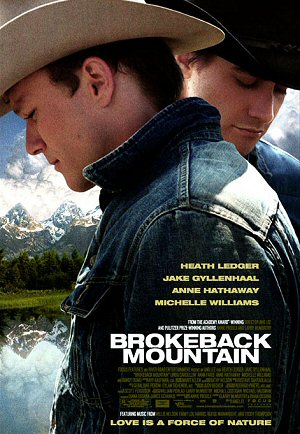
I think year-end critics awards will help. I know Oscar watchers will be surprised if Toni Collette doesn’t catch on as a Best Actress contender; ditto Shirley MacLaine for Best Supporting Actress.

And if you ask me Norman Lloyd’s brief but elegant turn as a blind and bedridden hospital patient easily warrants a Best Supporting Actor nom.


The Diaz-only “teaser” one-sheet for In Her Shoes (l.) and the far less visible Collette-Diaz version that gives both plus Shirley Maclaine a shared aboe-the-title billing
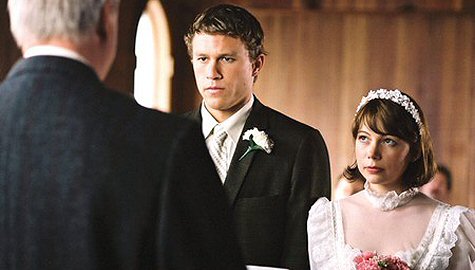
Lloyd has been acting and producing all his life (he had an ongoing role as a staff doctor on St. Elsewhere in the `80s), but his In Her Shoes turn is the charm. His gentle, sharp-witted ex-college professor — a performance that takes off and comes in for a landing in the space of a single scene — is the most memorable thing he’s done since Frank Fry in Saboteur (’42). It’s a comeback after 63 years.

For the first 40 minutes or so, Cameron Diaz doesn’t seem to be doing much more than playing her standard ditz-babe, but once she arrives in Florida and hooks up with MacLaine things start to improve. Then she meets up with Lloyd and performs her best scene in the film, and does herself proud.

But there’s no washing away the stain of The Sweetest Thing and the two Charlie’s Angels films. In my heart and mind those three were abominations…war crimes. Granted, there’s a balance factor from Diaz’s work in Vanilla Sky, Any Given Sunday and There’s Something About Mary, but any and all McG associations must be condemned in perpetuity.

The only other thing throwing me is that Fox is still using that one-sheet with just Diaz alone on their official site. Once again, big studio marketers are selling an idea they think will put arses in seats (hey, girls-who-buy-In Touch-and-Us in the supermarket…another giggly-ditzoid Cameron Diaz film!) instead of selling the movie they have.

Diaz, Shirley Maclaine

I was under the impression that the Diaz one-sheet was just a teaser poster and that the real In Her Shoes one-sheet (with Collette and Diaz pictured side-by-side, and their names along with MacLaine’s sharing above-the-title space) was the keeper.

Diaz is the one they paid $15 million-plus to star in this movie, and nobody really knows Collette, etc., but I still don’t get it. This is a really good sister movie…a heart movie…and Fox seems to be trying to dissuade people who like this sort of thing (including sophisticated filmgoers) from putting this film on the top of their lists.

Then again I’m told that last weekend’s sneak was well attended, and reactions have been very good. This is primarily a woman’s film, and naturally Fox is going to pitch to the core constituency.

“You like the picture, fine…and men may like it,” a marketing guy told me this morning. “But women love it.”

In the hands of Gary David Goldberg (Must Love Dogs), Roger Kumble (The Sweetest Thing), Audrey Wells (Under the Tuscan Sun) or the evil McG, In Her Shoes would have almost certainly been a lesser thing.


Toni Collette, Curtis Hanson and Cameron Diaz preparing to shoot a first-act, out-on-the-town scene

But Fox went with Curtis Hanson, and that decision — combined with Susannah Grant’s way-above-average chick-flick script (based on the novel by Jennifer Weiner) — has made a big difference.
Hanson has brought the same sureness of tone, knack for economical story-telling and clarity of presentation evident in 8 Mile, Wonder Boys and L.A. Confidential to this thing. It’s a film that’s been expertly finessed and perfectly music-cued and made to feel emotionally grounded.

And the point is made again — it’s the singer, not the song.

Regarding Violence

If you’ve seen David Cronenberg’s A History of Violence, you know it’s a philosophical double-dealer, and this is what makes it a complex, cut-above film. It’s not just saying violence is a kind of terrible virus — it’s also saying it has a way of turning us on.

When Jack (Ashton Holmes), the son of cafe owner Tom Stall (Viggo Mortenson), defuses a potentially violent encounter with a school bully by sarcastically acknow- ledging the other guy’s alpha male superiority, etc., you admire Jack for being a hip and clever guy.


Viggo Mortenson as small-town nice guy Tom Stall in David Cronenberg’s A History of Violence

But when they meet a second time and Jack, inspired by his father’s having become a hero because he killed a couple of bad guys, wails on the bullies and leaves them bruised and groaning, several people in the theatre (at L.A.’s Grove plex) were clapping and whoo-whooing.

Is there anyone out there who thinks Cronenberg didn’t deliver this scene in just the right way so he would get this reaction?

And of course, the steam that comes hissing out of Edie Stall (Maria Bello) isn’t just about feelings of betrayal.

Edie is furious, naturally, when she realizes her husband has been lying to her for years about his past. But when she and Tom have that end-of-Act-Two fight and she goes “fuck you, Joey” and walks off and Tom grabs her by the ankle and they do that thing on the stairs (a scene that wasn’t scripted, by the way…it just “happened” when they shot it), it’s obvious that Tom’s killer moves have lit a fire in Edie’s furnace.


Jack Stall (Ashton Holmes) and the high-school baddies

And yet the violence that has happened has obviously stunned and hurt this family of four. In that haunting final scene, Cronenberg shows us that Jack and his younger sister are willing to forgive and forget as they offer food to Tom, but there’s not much assurance that things will henceforth be fine…Cronenberg leaves us in limbo.

That’s filmmaking, pally. Lob the ball to the audience in the final frame and let them sort it all out…nice.

One beef with this film: Peter Suschitzky’s cinemography looks like it was soaked in Bolivian coffee during lab processing. I started to wonder if the projector lamp at the Grove’s theatre #1 was dying, but the lamps in the other theatres were fine. The last film I remember being this muddy-looking was Fight Club.

Grabs


Waiting in a very long line of cars trying to get onto the Fox lot for Tuesday night’s screening of Domino — 9.27, 7:25 pm.

Wilshire and Brockton on Sunday, 9.25, 4:50 pm…following a long bike ride from Brentwood to Venice and back, which I was very glad to do because it caused me to re-realize how much nicer, cleaner and more aesthetically pleasant Santa Monica and Venice are than the shittier areas of Williamsburg, Brooklyn. Okay, so the spiritual element isn’t as vibrant here as it is in New York City, but the women are dishier and the leaves are bigger and more plentiful, and the sea smells better standing on the beach in Santa Monica than it does in Far Rockaway

Taken from the vantage point of the Beverly Hills Public Library on Santa Monica Blvd., and looking northeast — Sunday, 9/25, 6:15 pm.

Plays High, Sold Low

Plays High, Sold Low

In Her Shoes may or may not be appearing to handicappers as an awards-level thing. I don’t care to argue this point, but every so often there’s a disconnect between my views and those of jaded ivory-tower elites that just staggers me.
On the other hand, if I hadn’t yet seen it and had come upon Liz Smith’s rave on the film’s website, I might have a moment of pause. Smith guarantees “you will laugh and cry in equal measure because this is simply a wonderful film…one of the best in years” — fine.


(l. to. r.) Variety screening series host Pete Hammond, In Her Shoes star Toni Collette, and director Curtis Hanson during post-screenign q & a at Hollywood’s Arclight — Monday, 9.26, 9:50 pm.

But then she raves, “When you see a movie that looks this good from the get-go, you just know you’re in for a terrific time.” I know what Smith is trying to say, but “looks” aren’t worth a damn in the eyes of Sri Vishnu, and a promise of cosmetic attractiveness usually implies a lack of inner character.
Trust me, In Her Shoes is much better than this.
I know the film has been working on an emotional level at the screenings I’ve attended, and so does 20th Century Fox or they wouldn’t be giving it another nationwide sneak this weekend…the movie sells itself.
< ?php include ('/home/hollyw9/public_html/wired'); ?>
The cynical view is that they’re doing two sneaks in a row because they can’t figure out how to get the word out otherwise, as indicated by the fact that it opens in less than two weeks and it isn’t really tracking. (Although that may change with Thurs- day’s tracking report, which will reflect last weekend’s sneak.)
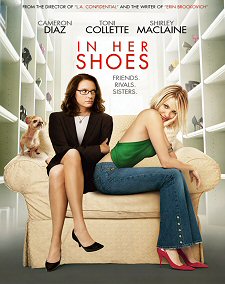
I think year-end critics awards will help. I know Oscar watchers will be surprised if Toni Collette doesn’t catch on as a Best Actress contender; ditto Shirley MacLaine for Best Supporting Actress.
And if you ask me Norman Lloyd’s brief but elegant turn as a blind and bed-ridden hospital patient easily warrants a Best Supporting Actor nom.


The Diaz-only “teaser” one-sheet for In Her Shoes (l.) and the far less visible Collette-Diaz version that gives both plus Shirley Maclaine a shared aboe-the-title billing
Lloyd has been acting and producing all his life (he had an ongoing role as a staff doctor on St. Elsewhere in the `80s), but his In Her Shoes turn is the charm. His gentle, sharp-witted ex-college professor — a performance that takes off and comes in for a landing in the space of a single scene — is the most memorable thing he’s done since Frank Fry in Saboteur. It’s a comeback after 63 years.
For the first 40 minutes or so, Cameron Diaz doesn’t seem to be doing much more than playing her standard ditz-babe, but once she arrives in Florida and hooks up with MacLaine things start to improve. Then she meets up with Lloyd and performs her best scene in the film, and does herself proud.
But no acting noms. She’s good but Collette has it all over her. And there’s no washing away the stain of The Sweetest Thing and the two Charlie’s Angels films. In my heart and mind those three were abominations…war crimes. Granted, there’s a bit of a balance factor from Diaz’s work in Any Given Sunday and There’s Something About Mary, but I’ve listened to her speak in person and I still see her as a poster girl for vapidity.
The only other thing throwing me is that Fox is still using that one-sheet with just Diaz alone on their official site. Once again, big studio marketers are selling an idea they think will put arses in seats (hey, girls-who-buy-In Touch-and-Us in the supermarket…another giggly-ditzoid Cameron Diaz film!) instead of selling the movie they have.

Diaz, Shirley Maclaine

I was under the impression that the Diaz one-sheet was just a teaser poster and that the real In Her Shoes one-sheet (with Collette and Diaz pictured side-by-side, and their names along with MacLaine’s sharing above-the-title space) was the keeper.
Diaz is the one they paid $15 million-plus to star in this movie, and nobody really knows Collette, etc., but I still don’t get it. This is a really good sister movie…a heart movie…and Fox seems to be trying to dissuade people who like this sort of thing (including sophisticated filmgoers) from putting this film on the top of their lists.
Then again I’m told that last weekend’s sneak was well attended, and reactions have been very good. This is primarily a woman’s film, and naturally Fox is going to pitch to the core constituency.
“You like the picture, fine…and men may like it,” a marketing guy told me this morning. “But women love it.”
In the hands of Gary David Goldberg (Must Love Dogs),Roger Kumble (The Sweetest Thing), Audrey Wells (Under the Tuscan Sun) or the super-demonic McG, In Her Shoes would have almost certainly been a lesser thing.


Toni Collette, Curtis Hanson and Cameron Diaz preparing to shoot a first-act, out-on-the-town scene

But Fox went with Curtis Hanson, and that decision — combined with Susannah Grant’s way-above-average chick-flick script (based on the novel by Jennifer Weiner) — has made a big difference.
Hanson has brought the same sureness of tone, knack for economical story-telling and clarity of presentation evident in 8 Mile, Wonder Boys and L.A. Confidential to this thing. It’s a film that’s been expertly finessed and perfectly music-cued and made to feel emotionally grounded.
And the point is made again — it’s the singer, not the song.

Regarding Violence

If you’ve seen David Cronenberg’s A History of Violence, you know it’s a philoso- phical double-dealer, and this is what makes it a complex, cut-above film. It’s not just saying violence is a kind of terrible virus — it’s also saying it has a way of turning us on.
When Jack (Ashton Holmes), the son of cafe owner Tom Stall (Viggo Mortenson), defuses a potentially violent encounter with a school bully by sarcastically acknow- ledging the other guy’s alpha male superiority, etc., you admire Jack for being a hip and clever guy.


Viggo Mortenson as small-town nice guy Tom Stall in David Cronenberg’s A History of Violence

But when they meet a second time and Jack, inspired by his father’s having become a hero because he killed a couple of bad guys, wails on the bullies and leaves them bruised and groaning, several people in the theatre (at L.A.’s Grove plex) were clapping and whoo-whooing.
Is there anyone out there who thinks Cronenberg didn’t deliver this scene in just the right way so he would get this reaction?
And of course, the steam that comes hissing out of Edie Stall (Maria Bello) isn’t just about feelings of betrayal.
Edie is furious, naturally, when she realizes her husband has been lying to her for years about his past. But when she and Tom have that end-of-Act-Two fight and she goes “fuck you, Joey” and walks off and Tom grabs her by the ankle and they do that thing on the stairs (a scene that wasn’t scripted, by the way…it just “happened” when they shot it), it’s obvious that Tom’s killer moves have lit a fire in Edie’s furnace.


Jack Stall (Ashton Holmes) and the high-school baddies

And yet the violence that has happened has obviously stunned and hurt this family of four. In that haunting final scene, Cronenberg shows us that Jack and his younger sister are willing to forgive and forget as they offer food to Tom, but there’s not much assurance that things will henceforth be fine…Cronenberg leaves us in limbo.
That’s filmmaking, pally. Lob the ball to the audience in the final frame and let them sort it all out…nice.
One beef with this film: Peter Suschitzky’s cinemography looks like it was soaked in Bolivian coffee during lab processing. I started to wonder if the projector lamp at the Grove’s theatre #1 was dying, but the lamps in the other theatres were fine. The last film I remember being this muddy-looking was Fight Club.

Grabs


Waiting in a very long line of cars trying to get onto the Fox lot for Tuesday night’s screening of Domino — 9.27, 7:25 pm.

Wilshire and Brockton on Sunday, 9.25, 4:50 pm…following a long bike ride from Brentwood to Venice and back, which I was very glad to do because it caused me to re-realize how much nicer, cleaner and more aesthetically pleasant Santa Monica and Venice are than the shittier areas of Williamsburg, Brooklyn. Okay, so the spiritual element isn’t as vibrant here as it is in New York City, but the women are dishier and the leaves are bigger and more plentiful, and the sea smells better standing on the beach in Santa Monica than it does in Rockaway

Taken from the vantage point of the Beverly Hills Public Library on Santa Monica Blvd., and looking northeast — Sunday,9/25, 6:15 pm.

Knockout

I liked so many films in Toronto I was looking forward to trashing two or three upon my return to Los Angeles. So to get things rolling I went to a screening last night (Thursday, 9.22) of Rodrigo Garcia’s Nine Lives (Magnolia) and…shit, another good one.
It’s nine interwoven shorts about women in relationships that aren’t really working, relationships they’d like to be rid of on one level but can’t quite extricate themsel- ves from, and what’s holding them.


Glenn Close, Dakota Fanning in Rodrigo Garcia’s Nine Lives (Magnolia)

Each story is a part-muddle, part-riddle and a fascinating drill into some aroused places in the heart, and five out of the nine are direct hits.
I’ve now seen two dramas over the last week and a half about female turmoil and tough choices, but which operate well beyond the usual chick-flick realm….this and In Her Shoes.
Nine Lives played Sundance last January and then the L.A. Film Festival three months ago…why haven’t I heard anything? Am I alone on this one? I don’t care.
Once again we have a south-of-the-border director — Rodrigo Garcia, a colleague of the great Alejandro Gonzalez Innaritu — hitting the ball deep into left-center field and scoring a ground-rule double, if not a triple.
Nine Lives isn’t quite a homer but it’s much better than I expected. It has that same connective-tissue, life-is-short, death-is-just-around-the-corner thing that we’ve all gotten to know through Innaritu’ Amores Perros and 21 Grams.


Nine Lives director-writer Rodrigo Garcia

Neither Innaritu or his screenwriting partner Guillermo Ariagga (who also wrote The Three Burials of Melquiades Estrada) have a co-writing credit, but they might as well have. Garcia is clearly coming from the same place…another Mexican heavy- cat soul man.
Garcia’s writing and the acting are exceptional all through it, and there are two pieces in particular about obsessive sexual love that knocked me on the floor.
The best of the two costars Robin Wright Penn and Jason Isaacs. Set entirely in the aisles of an L.A. supermarket, it’s a marvel of tight writing, dancing camera work, perfectly-pitched acting and emotional sizzle.
The other is a fascinating piece about a woman (Amy Brenneman) and her father attending a funeral of a woman who’s committed suicide, and the soon-enough realization that the woman is a former wife of the deceased woman’s deaf husband (William Fichtner), and that their attraction is not only still going on but may have pushed the wife into suicide, and that their feelings are so urgent that Brenneman and Fichtner can’t help finding a private room and closing the door.
I don’t know which of the two is more of a jaw-dropper, but together they’re worth the admission, the popcorn and having to watch the ads before the trailers.
There are at least three other strong entries. About a financially struggling, clearly frustrated 40ish couple (Stephen Dillane, Holly Hunter) visiting a couple (Isaacs again, Molly Parker) they believe to be on a happier, more comfortable plane. About a terrified wife (Kathy Baker) preparing for breast-removal surgery and bitching at her husband (Joe Mantegna) as she works through her feelings. And about a loving mother (Glenn Close) and her young daughter (Dakota Fanning) visiting a graveyard.


Nine Lives costars Robin Wright Penn, Aidan Quinn at last January’s Sundance Film Festival

The cast also includes Elpidia Carillo, Lisa Gay Harden, Ian McShane, Mary Kay Place, Sydney Tamiia Poitier, Aidan Quinn, Miguel Sandoval, Amanda Seyfried and Sissy Spacek.
The other four are decent, good enough, carry the ball, etc. A movie like this is like a relay race. Not every segment can bring the fans to their feet.
Nine Lives will open in Los Angeles and New York on 10.14, and will start fanning out the following week.