Regarding “Violence”

Regarding Violence

If you’ve seen David Cronenberg’s A History of Violence, you know it’s a philoso- phical double-dealer, and this is what makes it a complex, cut-above film. It’s not just saying violence is a kind of terrible virus — it’s also saying it has a way of turning us on.
When Jack (Ashton Holmes), the son of cafe owner Tom Stall (Viggo Mortenson), defuses a potentially violent encounter with a school bully by sarcastically acknow- ledging the other guy’s alpha male superiority, etc., you admire Jack for being a hip and clever guy.
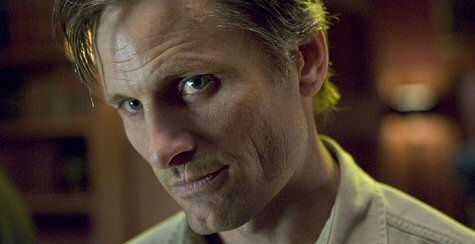

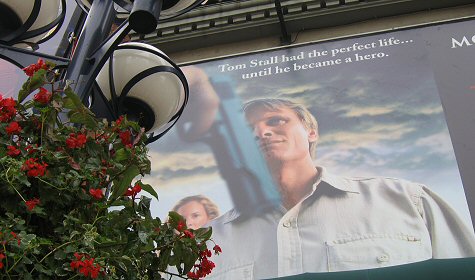
Viggo Mortenson as small-town nice guy Tom Stall in David Cronenberg’s A History of Violence

But when they meet a second time and Jack, inspired by his father’s having become a hero because he killed a couple of bad guys, wails on the bullies and leaves them bruised and groaning, several people in the theatre (at L.A.’s Grove plex) were clapping and whoo-whooing.
Is there anyone out there who thinks Cronenberg didn’t deliver this scene in just the right way so he would get this reaction?
And of course, the steam that comes hissing out of Edie Stall (Maria Bello) isn’t just about feelings of betrayal.
< ?php include ('/home/hollyw9/public_html/wired'); ?>
Edie is furious, naturally, when she realizes her husband has been lying to her for years about his past. But when she and Tom have that end-of-Act-Two fight and she goes “fuck you, Joey” and walks off and Tom grabs her by the ankle and they do that thing on the stairs (a scene that wasn’t scripted, by the way…it just “hap- pened” when they shot it), it’s obvious that Tom’s killer moves have lit a fire in someone’s furnace.
And yet the violence that has happened has obviously stunned and hurt this family of four. In that haunting final scene, Cronenberg shows us that Jack and his younger sister are willing to forgive and forget as they offer food to Tom, but there’s not much assurance that things will henceforth be fine…Cronenberg leaves us in limbo.
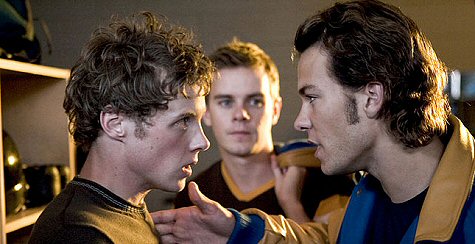

Jack Stall (Ashton Holmes) and the high-school baddies

That’s filmmaking, pally. Lob the ball to the audience in the final frame and let them sort it all out…nice.
One beef with this film: Peter Suschitzky’s cinemography looks like it was soaked in Bolivian coffee during lab processing. I started to wonder if the projector lamp at the Grove’s theatre #1 was dying, but the lamps in the other theatres were fine. The last film I remember being this muddy-looking was Fight Club.

Knockout

I liked so many films in Toronto I was looking forward to trashing two or three upon my return to Los Angeles. So to get things rolling I went to a screening last night (Thursday, 9.22) of Rodrigo Garcia’s Nine Lives (Magnolia) and…shit, another good one.
It’s nine interwoven shorts about women in relationships that aren’t really working, relationships they’d like to be rid of on one level but can’t quite extricate themsel- ves from, and what’s holding them.
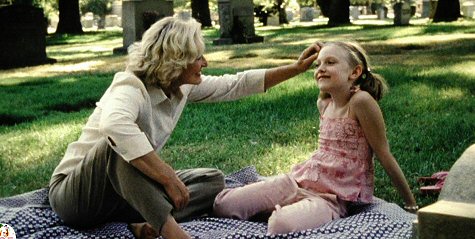

Glenn Close, Dakota Fanning in Rodrigo Garcia’s Nine Lives (Magnolia)

Each story is a part-muddle, part-riddle and a fascinating drill into some aroused places in the heart, and five out of the nine are direct hits.
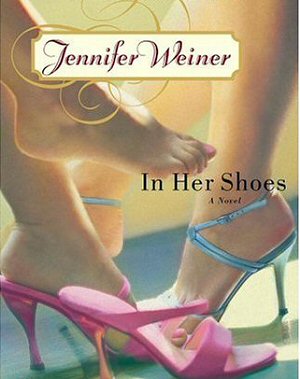
I’ve now seen two dramas over the last week and a half about female turmoil and tough choices, but which operate well beyond the usual chick-flick realm….this and In Her Shoes.
Nine Lives played Sundance last January and then the L.A. Film Festival three months ago…why haven’t I heard anything? Am I alone on this one? I don’t care.
Once again we have a south-of-the-border director — Rodrigo Garcia, a colleague of the great Alejandro Gonzalez Innaritu — hitting the ball deep into left-center field and scoring a ground-rule double, if not a triple.
Nine Lives isn’t quite a homer but it’s much better than I expected. It has that same connective-tissue, life-is-short, death-is-just-around-the-corner thing that we’ve all gotten to know through Innaritu’ Amores Perros and 21 Grams.
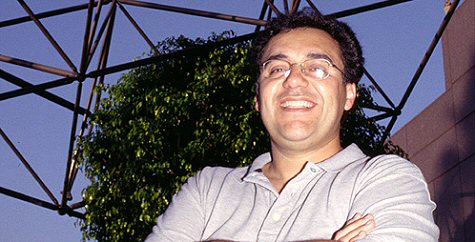

Nine Lives director-writer Rodrigo Garcia

Neither Innaritu or his screenwriting partner Guillermo Ariagga (who also wrote The Three Burials of Melquiades Estrada) have a co-writing credit, but they might as well have. Garcia is clearly coming from the same place…another Mexican heavy- cat soul man.
Garcia’s writing and the acting are exceptional all through it, and there are two pieces in particular about obsessive sexual love that knocked me on the floor.
The best of the two costars Robin Wright Penn and Jason Isaacs. Set entirely in the aisles of an L.A. supermarket, it’s a marvel of tight writing, dancing camera work, perfectly-pitched acting and emotional sizzle.
The other is a fascinating piece about a woman (Amy Brenneman) and her father attending a funeral of a woman who’s committed suicide, and the soon-enough realization that the woman is a former wife of the deceased woman’s deaf husband (William Fichtner), and that their attraction is not only still going on but may have pushed the wife into suicide, and that their feelings are so urgent that Brenneman and Fichtner can’t help finding a private room and closing the door.
I don’t know which of the two is more of a jaw-dropper, but together they’re worth the admission, the popcorn and having to watch the ads before the trailers.
There are at least three other strong entries. About a financially struggling, clearly frustrated 40ish couple (Stephen Dillane, Holly Hunter) visiting a couple (Isaacs again, Molly Parker) they believe to be on a happier, more comfortable plane. About a terrified wife (Kathy Baker) preparing for breast-removal surgery and bitching at her husband (Joe Mantegna) as she works through her feelings. And about a loving mother (Glenn Close) and her young daughter (Dakota Fanning) visiting a graveyard.
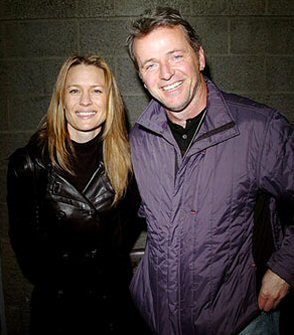

Nine Lives costars Robin Wright Penn, Aidan Quinn at last January’s Sundance Film Festival

The cast also includes Elpidia Carillo, Lisa Gay Harden, Ian McShane, Mary Kay Place, Sydney Tamiia Poitier, Aidan Quinn, Miguel Sandoval, Amanda Seyfried and Sissy Spacek.
The other four are decent, good enough, carry the ball, etc. A movie like this is like a relay race. Not every segment can bring the fans to their feet.
Nine Lives will open in Los Angeles and New York on 10.14, and will start fanning out the following week.

Moonlighting

After seeing A History of Violence at the Grove, I went to see Kate Krystowiak’s Aftermath, a 28-minute short that she stars in and wrote the script for, at the Laemmle Fairfax last night (9.24).
An above-average effort, it’s an emotionally upfront piece about a romantically impressionable woman named Sara who suffers an emotional bruising from an attractive young guy who moves into her place. The hurt is a result of your typical modern-asshole-boyfriend tendencies (egotism and an inability to share intimacy, for the most part), but also from Sara’s willingess to turn a blind eye at the get-go.
Aftermath could stand some tightening and re-shuffling here and there (film festi- vals don’t like shorts that aren’t 15 minutes long or less), but the hurt that comes out of Krystowiak’s Sara character feels very real.
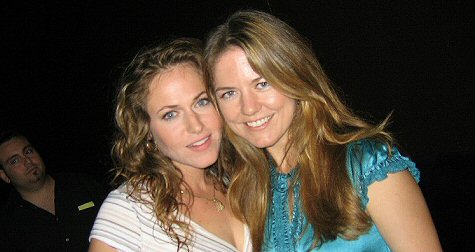

Aftermath editor Teresa Bianca Sciortino, star-writer Kate Krystowiak at Guys — Saturday, 9.24, 12:25 am. The film’s director, Jon Palardis, is visible to the left.

There are two things missing: hot sex and empathy for Sara. There’s a revelation near the end that the boyfriend (Charlie Capen) talked about himself incessantly during their first date and didn’t ask Sara a single question….hello? This is the kind of guy a girl might want to rape or have an affair with, but move in with…?
An audience will empathize with the participants in an ill-fated relationship if it’s about fantastic Olympic-level schtupping, but it’s hard to put yourself in the shoes of a character who ignores warning signs as blatant as the one referred to at the end of this film…sorry, but that’s a fact.
Krystowiak has a quality when she’s confident enough to just be still and let what seems like a kind of natural Polish sadness in her leak out. She needs to just “be.” She has a kind of eastern-European, slightly off-pretty soulfulness…and the less she smiles and tries to sell her perkiness, the more this comes through.
Krystowiak needs to be brought out by a director with the chops of a Krzysztof Kieslowski or a Jerzy Skolimowski. She could have nailed Jane Asher’s part in Deep End, or been the sensuous-girlfriend-in-the-TV-screen in Skolimowski’s Moonlighting.
There was an okay after-party at Guys, a bar right between Jerry’s Deli and Dom- inick’s on Beverly near San Vicente. $10 bucks to get in, $10 bucks a drink… fuck…but it’s mostly an outdoor back-patio thing and I’d be lying by omission if I didn’t say that a very high percentage of the women were drop-dead gorgeous.

Where’s the Bite?

The Academy people who will vote for the Best Feature Doc are thought to be into “bite.” Okay…but how does that square with the general feeling that March of the Penguins, a doc so without bite it could be said to be all gums, is favored to win?
And if weren’t for this ice-frosted Waiting-for-Godot movie, the big favorite would probably be Mad Hot Ballroom, and how “bite” is that? Cute fifth-graders learning to dance and romance and grow up…?


Murderball

I know it’s a crying shame that Eugene Jarecki’s Why We Fight, my hands-down choice for the year’s best documentary, is out of the game in part because it aired twice on England’s BBC 4 on 3.23.05.
A brilliant summation on the militant tendencies of U.S. foreign policy over the past 60 years, Why We Fight had a one-week Academy qualifying run in a Marina del Rey theatre last August, and the Academy rulebook states that “no type of tele- vision or internet transmission shall occur at any time prior to the first day of the Qualifying Exhibition”…so that’s that.
I’ve heard that Jarecki has an argument with the Academy…something about a vaguely-worded announcement about a rule-change, which led to a misunder- standing about the allowability of the BBC airing…or some such shit. I called Jarecki four times yesterday to get into it, but he didn’t get back.
On Friday morning I read in a Gregg Kilday piece in the Hollywood Reporter that Why We Fight has also “been ruled ineligible because it has had at least three TV airings in Norway, Sweden and Finland.”
What other docs might wind up nominated? I mean, if you give a shit about this stuff. I’m right on the verge of not caring. It’s also my life, my strife…I shouldn’t admit to this.
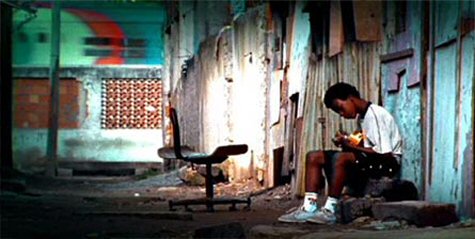

Favela Rising

Naturally, obviously, incontestably…Penn Jillette and and Paul Provenza’s The Aristocrats, a doc that people saw and got all over and kept playing and playing, mainly (I think) because it works on at least three different levels, being (a) funny, (b) appalling and yet a surprisingly warm “family film,” and (b) an educational riff about the nature of creativity. It was such an obvious choice I forgot to put it into this piece when I wrote it late yesterday.
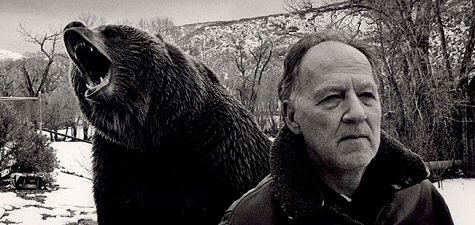
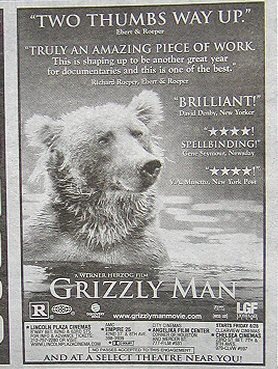
I also forgot to mention Werner Herzog’s Grizzly Man (Lion’s Gate)…I must have a screw loose. It’s only one of the year’s best films bar none.
Alex Gibney’s Enron: The Smartest Guys in the Room…right? Smart, sharp, hard-driving, amusing…important subject, well-reviewed…gotta be there.
And Murderball, of course. Original, intense, fierce…the rumble spreading for the last few months…it’s sunk in to the level where even Academy people are hearing it…Murderball-it.
And Marc Levin’s Protocols of Zion, a 93-minute doc about anti-Semitism and the post-9/11 scattershot blame game.
And David LaChappelle’s Rize, about the South Central dance thing…I guess. I’m not feeling the energy right now, but that’s just me.
A Brazilian doc called Favella Rising might cause a stir. It’s about a onetime drug-dealer named Anderson Sa who evolved into a kind of Malcolm X-like social revolutionary… leading a rebellion against “teenage drug armies and sustained by corrupt police,” blah blah….fine.
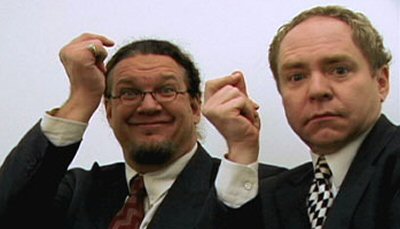

Penn and Teller delivering the now-infamous, staggeringly unfunny punch line.

And I’m told that Darwin’s Nightmare could register. A doc on the effect of fishing the predatory Nile perch in Tanzania’s Lake Victoria…hmmm. A metaphor about voracious appetites of all shapes and origins.
If Martin Scorsese’s No Direction Home: Bob Dylan had cared to qualify itself (i.e., by playing in some obscure New York or Los Angeles theatre last March and then going with the PBS airing and DVD release six months later), it would almost certainly be one of the five. This is a film with bite, snap, brass and bazookas.

This Is Bad

I can’t overstate what a besotted, drugged-out feeling it is to be back in Los Angeles…to once again stand on the roof of a certain West Hollywood high-rise and smell the faintly noxious air and gaze out at the milky haze and tell myself, “It’s okay…despair not.”
There is only way to live in this town and that’s to crawl into the cave of your own head and your work, and to feed off screenings and DVDs and the faces and bodies of pretty women, and to savor those special times in which you happen to be in the company of similarly diseased and/or disgruntled persons like myself.
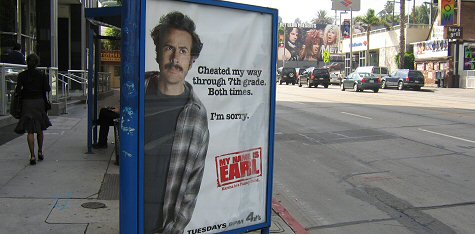

Sunset Boulevard in West Hollywood — Tuesday, 9.20, 1:40 pm.

Like, for instance, the amazing Joss Whedon.
I would find it astonishing to find myself in the pasta-and-sauces department of Pavilions and all of a sudden…Whedon! Just standing there in boring clothes like a regular mortal and telling himself, “I can’t eat pasta any more, certainly not in the evening. Face it — those days are over.”
A portion of my L.A. lethargy is indicated by the fact that I’m back to reading Defamer and going “hyeh-hyeh” like Beevis and Butthead. I didn’t go to Defamer once during the Toronto Film Festival, and not all that much when I was living in Brooklyn. I like Defamer — it’s a very well-written thing and a necessary component — but you have to be a little sick in your soul to be into it in the first place.
I could feel the old vibe swirling around me like that banshee from Darby O’Gill and the Little People, so I did the sensible thing and evacuated myself off the roof of the high-rise and made my way over to Tower Records and bought the DVD of No Direction Home: Bob Dylan.
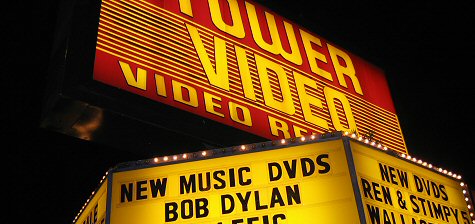
I tried to wangle a freebie from the Paramount Home Video publicist who took Martin Blythe’s place, but she didn’t call back until today. I tried to buy it yesterday at Laser Blazer in the early afternoon, only to be told it had sold out. The Tower Video guys, who had plenty of copies, said it was moving moderately well but nothing to write home about.
I nodded off for about 20 minutes when I saw David Cronenberg’s A History of Violence in Cannes and I didn’t get around to it in Toronto, so tonight I get to absorb the whole thing at the American Cinematheque, more or less alert…down for it.


Looking due north from the roof of a condo building at Alta Loma and Holloway — Tuesday, 9.20, 8:45 am.

That means blowing off the all-media of Flightplan, but sometimes you just have to say no.
I’m a little surprised to be riffing rather indulgently about the stink of Los Angeles seeping back into my bones (that’s a Charles Bukowksi line), and I promise to get back into matters of substance fairly soon.
Except melancholia is a matter of substance if you live here.
I’ve got a screening conflict next Tuesday evening — Tony Scott’s Domino vs. Joss Whedon’s Serenity. Well, not really. I would be squirming a bit if Whedon and I were talking in the pasta-and-sauces aisle right now and he was asking me, “So, are you going?”…but we’re not so I’m cool.
The only thing that gives me concern about Domino is an observation in David Katz’s profile of Keira Knightley in the current issue of Esquire. He says that Domino is “a messy movie, often intentionally, often not.”

Turnaround

For years the notion of Catherine Keener being in this or that film was not, for me, a reason to celebrate. She always seemed to play users, takers, manipulators… usually more pissed off than not.
Not each and every time, but I know this impression started to take hold in the late ’90s. I liked her frustrated actress character in Living in Oblivion back in ’96, but I remember going “whoa” after she played the heartless Maxine in Being John Malkovich.
I forget how many other razor-blade women she played in other films, but it seemed as if there were more than a few.
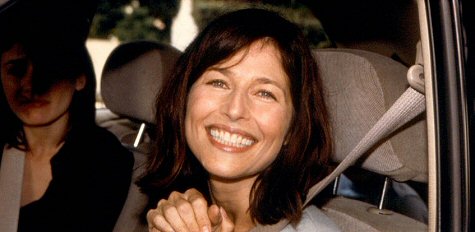

Capote costar Catherine Keener.

Now I feel rather differently, and all due to Keener’s last four roles — Daniel Day Lewis’s would-be signficant other in The Ballad of Jack and Rose, the quip-smart government agent in The Interpreter, Steve Carell’s sweet, spiritually-centered love interest in The 40 Year-Old Virgin, and Harper Lee, Truman Capote’s patient, all-seeing best friend, in Capote.
The Capote performance ought to result in a Best Supporting Actress nomination. It really and truly should — I can’t imagine anyone saying “no, I disagree” — and not just because Keener is so moving and touching in this role, but because of her image change.
I’m presuming I’m not the only person with this impression. Keener has always been a “good” actress, but now I think of her in terms of who I perceive her to be possibly be, based on an amalgam of the last four roles.
I was thinking of mentioning this during last night’s discussion at the Los Angeles County Museum’s Leo S. Bing Theatre after a screening of Capote, but it seemed too kiss-assy.
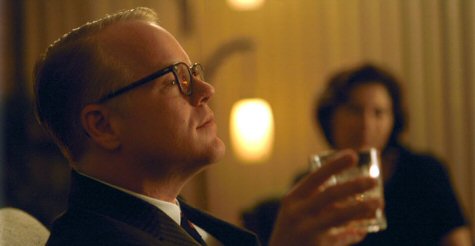
Keener, looking great, was sitting there along with her Oscar-worthy cohorts — director Bennett Miller, Philip Seymour Hoffman (a lock for Best Actor), Clifton Collins, Jr. (near-lock for Best Supporting Actor), and screenwriter Dan Futterman (ditto in the Best Adapted Screenplay category).
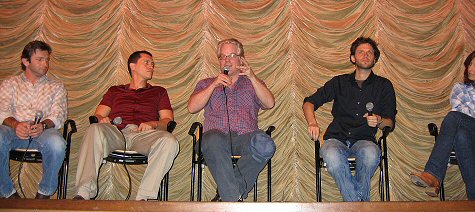

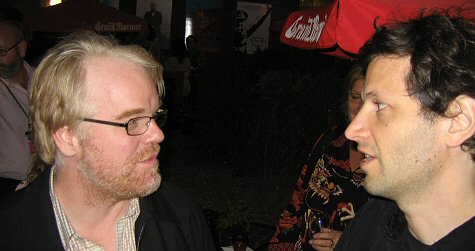
(l. to r.) Capote screenwriter Dan Futterman, star Philip, costar Clifton Collins, Jr., star Philip Seymour Hoffman, director Bennett Miller, and a portion of costar Catherine Keener at L.A. County Museum’s Leo S. Bing theatre — Tuesday, 9.20, 9:50 pm.

LACMA’s film department head Ian Birnie asked each a single question, and then asked the audience to chime in.
I asked Hoffman and Miller if they had somehow tried to suggest that Hoffman, who’s about 5’10” or so in real life, was closer to Truman Capote’s height of 5’2″. It sure seems this way in the film. They ignored my question, but Miller delivered a good line: “Philip lost 40 pounds and 4 inches for this role.”
I also asked about a little kid whom Capote happens to notice during a brief visit to a grocery store. About three years old, the kid has a toy pistol and does a kind of Diane Arbus-y routine for Capote with two or three grotesque expressions. Miller said this scene was some kind of tribute to Arbus….whatever.
A woman friend who came with me called Capote “one of the best films I’ve ever seen.” It sure as shit is one of the best of the year, a fact expected to be acknow- ledged by the Academy.
Wait a minute…have I said this before?

Shrinking Hoffman

“Since the Capote panelists didn’t answer your question about making Philip Seymour Hoffman appear shorter for his role, I thought I’d offer the following tidbit from our October issue, which offers insights from cinematographer Adam Kimmel:
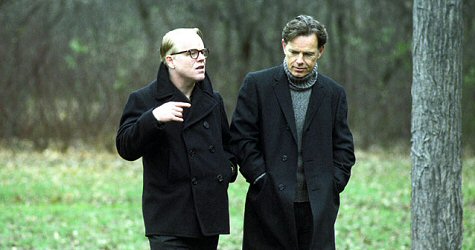
“‘One overriding concern occupied the filmmakers from start to finish: how to make Hoffman appear as petite as Capote,” it reads. “The actor is 5 or 6 inches taller than the 5’ 2” Capote, and has a broader physique.

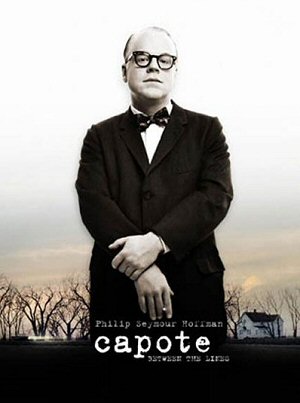
Capote

“‘In testing and during our first week of shooting, we learned which combination of wardrobe, lenses and framing would make Phil appear smaller,’ says Kimmel. ‘To help with the illusion, the actors who shared the frame with Hoffman frequently stood on boxes during stationary scenes, or walked on small, elevated platforms during walk-and-talks.
“The first time Capote and Lee see the Clutter farm, they are shown in a wide shot, with their backs to the camera. Keener, who is roughly the same height as Hoffman, is standing on a box that added 4″ to her height.” — Stephen Pizzello, Executive Editor, American Cinematographer.

Dylan/Scorsese

“You hit it with your words on the Dylan documentary. It’s a great portrait of America by Scorsese, an indisputable version of why Dylan had to crash at the end of that period, and a true inspiration for all of us to keep on and to keep on creating (Dylan being a real example of James Joyce’s description of an artist, one who has to live by ‘cunning and exile.’)
“I’ve been lucky to see Dylan perform a lot, from his comeback tour with The Band in ’75 (still one of the best shows ever) to all three nights that he played last Spring here in St. Louis at a small venue. (Lots of people came to that out of curiousity and were stunned by the music — you could see their respect and joy grow throughout those evenings.)
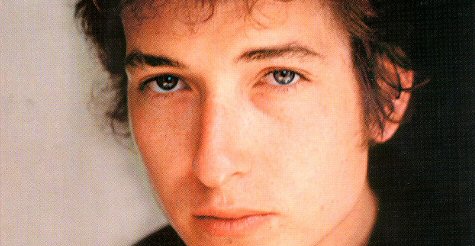
“He’s an endless source of a rock ‘n roll beat and a poetic charge. I have a new favorite lyric – from one of his songs I didn’t know, ‘Up To Me,’ which is covered on a recent tribute album by Roger McGuinn — ‘I’ve only smiled once in 14 months and I didn’t do it consciously.’
“But along with the interviews in No Direction Home, some of his utterances knock me out as well. When questioned why he agreed to appear along with his sacred music in, of all things, a Victoria’s Secret commercial, he reportedly said, ‘Was I not supposed to do that?'” — Joe Hanrahan.

This Is Bad

This Is Bad

I can’t overstate what a besotted, drugged-out feeling it is to be back in Los Angeles…to once again stand on the roof of a certain West Hollywood high-rise and smell the faintly noxious air and gaze out at the milky haze and tell myself, “It’s okay…despair not.”
There is only way to live in this town and that’s to crawl into the cave of your own head and your work, and to feed off screenings and DVDs and the faces and bodies of pretty women, and to savor those special times in which you happen to be in the company of similarly diseased and/or disgruntled persons like myself.


Sunset Boulevard in West Hollywood — Tuesday, 9.20, 1:40 pm.

Like, for instance, the amazing Joss Whedon.
I would find it astonishing to find myself in the pasta-and-sauces department of Pavilions and all of a sudden…Whedon! Just standing there in boring clothes like a regular mortal and telling himself, “I can’t eat pasta any more, certainly not in the evening. Face it — those days are over.”
A portion of my L.A. lethargy is indicated by the fact that I’m back to reading Defamer and going “hyeh-hyeh” like Beevis and Butthead. I didn’t go to Defamer once during the Toronto Film Festival, and not all that much when I was living in Brooklyn. I like Defamer — it’s a very well-written thing and a necessary component — but you have to be a little sick in your soul to be into it in the first place.
< ?php include ('/home/hollyw9/public_html/wired'); ?>
I could feel the old vibe swirling around me like that banshee from Darby O’Gill and the Little People, so I did the sensible thing and evacuated myself off the roof of the high-rise and made my way over to Tower Records and bought the DVD of “No Direction Home: Bob Dylan.”
I tried to wangle a freebie from the Paramount Home Video publicist who took Martin Blythe’s place, but she didn’t call back until today. I tried to buy it yesterday at Laser Blazer in the early afternoon, only to be told it had sold out. The Tower Video guys, who had plenty of copies, said it was moving moderately well but nothing to write home about.
I nodded off for about 20 minutes when I saw David Cronenberg’s A History of Violence in Cannes and I didn’t get around to it in Toronto, so tonight I get to absorb the whole thing at the American Cinematheque, more or less alert…down for it.


Looking due north from the roof of a condo building at Alta Loma and Holloway — Tuesday, 9.20, 8:45 am.

That means blowing off the all-media of Flightplan, but sometimes you just have to say no.
I’m a little surprised to be riffing rather indulgently about the stink of Los Angeles seeping back into my bones (that’s a Charles Bukowksi line), and I promise to get back into matters of substance fairly soon.
Except melancholia is a matter of substance if you live here.
I’ve got a screening conflict next Tuesday evening — Tony Scott’s Domino vs. Joss Whedon’s Serenity. Well, not really. I would be squirming a bit if Whedon and I were talking in the pasta-and-sauces aisle right now and he was asking me, “So, are you going?”…but we’re not so I’m cool.
The only thing that gives me concern about Domino is an observation in David Katz’s profile of Keira Knightley in the current issue of Esquire. He says that Domino is “a messy movie, often intentionally, often not.”

Turnaround

For years the notion of Catherine Keener being in this or that film was not, for me, a reason to celebrate. She always seemed to play users, takers, manipulators… usually more pissed off than not.
Not each and every time, but I know this impression started to take hold in the late ’90s. I liked her frustrated actress character in Living in Oblivion back in ’96, but I remember going “whoa” after she played the heartless Maxine in Being John Malkovich.
I forget how many other razor-blade women she played in other films, but it seemed as if there were more than a few.


Capote costar Catherine Keener.

Now I feel rather differently, and all due to Keener’s last four roles — Daniel Day Lewis’s would-be signficant other in The Ballad of Jack and Rose, the quip-smart government agent in The Interpreter, Steve Carell’s sweet, spiritually-centered love interest in The 40 Year-Old Virgin, and Harper Lee, Truman Capote’s patient, all-seeing best friend, in Capote.
The Capote performance ought to result in a Best Supporting Actress nomination. It really and truly should — I can’t imagine anyone saying “no, I disagree” — and not just because Keener is so moving and touching in this role, but because of her image change.
I’m presuming I’m not the only person with this impression. Keener has always been a “good” actress, but now I think of her in terms of who I perceive her to be possibly be, based on an amalgam of the last four roles.
I was thinking of mentioning this during last night’s discussion at the Los Angeles County Museum’s Leo S. Bing Theatre after a screening of Capote, but it seemed too kiss-assy.
Keener, looking great, was sitting there along with her Oscar-worthy cohorts — director Bennett Miller, Philip Seymour Hoffman (a lock for Best Actor), Clifton Collins, Jr. (near-lock for Best Supporting Actor), and screenwriter Dan Futterman (ditto in the Best Adapted Screenplay category).


(l. to r.) Capote screenwriter Dan Futterman, star Philip, costar Clifton Collins, Jr., star Philip Seymour Hoffman, director Bennett Miller, and a portion of costar Catherine Keener at L.A. County Museum’s Leo S. Bing theatre — Tuesday, 9.20, 9:50 pm.

LACMA’s film department head Ian Birnie asked each a single question, and then asked the audience to chime in.
I asked Hoffman and Miller if they had somehow tried to suggest that Hoffman, who’s about 5’10” or so in real life, was closer to Truman Capote’s height of 5’2″. It sure seems this way in the film. They ignored my question, but Miller delivered a good line: “Philip lost 40 pounds and 4 inches for this role.”
I also asked about a little kid whom Capote happens to notice during a brief visit to a grocery store. About three years old, the kid has a toy pistol and does a kind of Diane Arbus-y routine for Capote with two or three grotesque expressions. Miller said this scene was some kind of tribute to Arbus….whatever.
A woman friend who came with me called Capote “one of the best films I’ve ever seen.” It sure as shit is one of the best of the year, a fact expected to be acknow- ledged by the Academy.
Wait a minute…have I said this before?

Grabs


Billboard above Viper Room — Tuesday, 9.20, 10:50 pm.

Another depressing landscape.

Self-explanatory — Tuesday, 9.20, 10:45 pm.

Aboard Northwest Airlines #1411, Memphis to Los Angeles — Monday, 9.19, 5:50 pm.

Kings

“I’ve seen Steve Zallian’s All The King’s Men, and it felt to me like a very mature, richly adult political drama that carries considerable end-of-year pedigree.
“Major kudos, first and foremost, to Zallian for his subtle way of telling a story. All too often in telling convoluted, multilayered stories of this kind, filmmakers rely on excessive exposition to make sure that anyone can follow the plot without having to pay too much attention.
“Zallian goes the other route — details and plot twists are implied rather than explained, and this technique affords the film much more credibility.


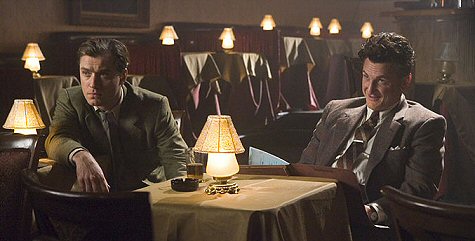
Jude Law, Sean Penn in Steven Zallian’s All The King’s Men

“Performances are strong all around, though Tony Soprano.. er, James Gandolfini struggles a bit with his Southern accent.
“There are two leads, Sean Penn’s Willie Stark — a wildly passionate and utterly corrupted Southern governor — and Jude Law as a tortured and crestfallen reporter named Jack Burden.
“Penn seems to be a much stronger contender for your Best Actor Oscar balloon. He delivers exactly what Academy voters are thought to love, giving a bombastic, almost Pacino-esque performance. And yet I would be much more excited to see Law’s performance be rewarded come awards season.
“And Zallian’s camera work compliments his sophisticated script nicely.
“What was shown was a work in progress (visually grainy, using pieces of the musical scores from Fargo and The Shawshanbk Redemption, to be sure, but one that shows significant promise.” — John McGilicutty

Down by Whedon

“In response to your Wired item about Joss Whedon, my first advice to you is this: as you prepare to rip or praise him in whatever fashion you intend, remember to tread very, very lightly.
“The man’s fan base is as rabid as that for any geek property out there, and if you do decide to trash him, you should be prepared for hate mail on the level of whatever Star Wars or Lord of the Rings flaming you’ve received over the years.
“Now, that being said, the idea of ‘getting’ Whedon is not something you will be able to do from just watching Serenity. It’s an impossibility.


From Joss Whedon’s Serenity

“The film is a continuation of a TV show that only a small but very devoted group of people watched in its original incarnation and more discovered later on DVD. Whedon’s appeal cannot and will not be understood by those coming to the film cold which, I feel, will kill it financially. If it does manage to catch on beyond the fan base, then great. But I don’t think anybody, beyond his most ardent followers, is expecting much.
“As for critics and columnists (like yourself) who are coming to the film cold, I fear that the response will be mixed to negative, as they will be reviewing the film on its own merits and not as a part of the larger whole. There is nothing wrong with this — it is their job. The best thing I can say to them and you is please, go easy.
Serenity is a gift to Whedon’s fans, to provide closure on a TV series that they watched and enjoyed and which was snatched from them far too soon. I feel that a theatrical film was absolutely the wrong way to go on this, and that the property would have been much better off in a miniseries or TV movie on the Sci-Fi channel, in hopes of finding a new TV life.
“But Universal is taking a chance on Whedon and I truly hope that it works out for them.
“As for ‘getting’ Whedon, there’s really not much to get beyond the fact that the man has produced some great, great television (Buffy the Vampire Slayer and its spinoff Angel).


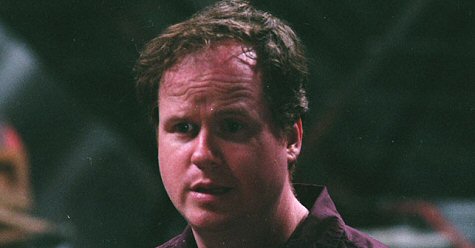
Serenity creator Joss Whedon

“His appeal can be gleaned from the fact that he takes high-concept approaches to well-worn genre shows (in Firefly’s case, the space opera and the western), fills them with sparkling wit and humor, and populates them with real, fully-dimensional characters that think and feel and hurt, where actions have real consequences and tragedy doesn’t always beget triumph.
“For years, Whedon managed to do the impossible in creating TV that didn’t take itself too seriously while, at the same time, taking itself absolutely seriously. He elevated genre television in the same way that David Chase elevated dramatic television with The Sopranos. This is what his fans reacted to, and why they continue to follow him into whatever avenue he chooses to pursue. I proudly count myself among them.
“Jeff, I don’t see you as the kind of person who will see Serenity, and rush out to pick up any of Whedon’s TV work on DVD, but this is really the only way to understand his appeal. The movie itself won’t do it. Just don’t judge the man on this film alone (or his spotty film record thus far). It’s not fair to him or to the fans that respect him.” — Mark of Boston, Mass.


East side of Broadway and 44th street, looking north — February 1963.

Toronto’s Eleven

Toronto’s Eleven

I’ve only been coming here since ’98, but it seemed to me like the best Toronto Film Festival ever. Too many good films, too many I didn’t get to see, the energy always there…every day felt like a full deck.
I saw (or re-saw) eleven films here that I know will matter in terms of awards or box-office or causing some kind of a stir over the next thirteen and a half weeks, and that felt fairly bountiful.


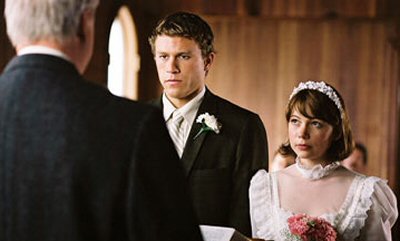
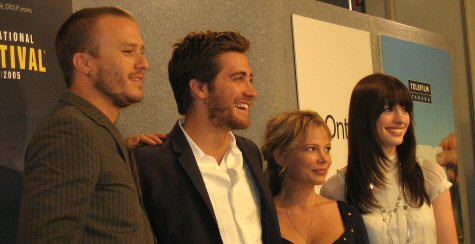
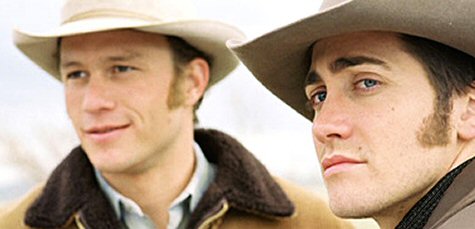
Brokeback Mountain costars Heath Ledger, Michelle Williams

I’m just sorry that the festival fathers didn’t re-show some of the favorites this past weekend (like they used to) so I could’ve seen some of the films that I couldn’t get to for whatever reason. Now I won’t get to see Bettie Page until next year…not good.
The goodies, in order of admiration…
< ?php include ('/home/hollyw9/public_html/wired'); ?>
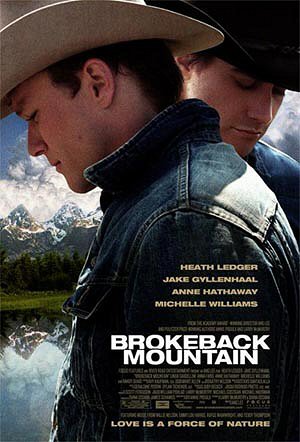
1. Brokeback Mountain: I didn’t expect to be as moved as I was. Not a “gay cowboy” movie, but a film about the costs of love denied and lost. My idea of a profoundly sad film, and obviously a love story of a strikingly original cast… certainly in terms of multiplex movies. Oscar potential: A probable Best Picture candidate (if it doesn’t tank financially). Ditto Ang Lee for Best Director. Heath Ledger, who gives the best performance of his career here, will almost certainly snag a Best Actor nom. Commercial prospects: No telling, although I’d like to say quality sells itself and let it go at that. I know this movie is a kind of break- through, and therefore a marketing challenge as far as the cultural foot-draggers are concerned.
2. No Direction Home: Bob Dylan: An electrifying music-history saga, a powerful American epic and Martin Scorsese’s finest film since My Voyage in Italy. Oscar prospects: It’s not going out theatrically so Oscar doesn’t figure. Commercial potential: The numbers for the doc’s PBS airing on 9.26 and 9.27 should be huge; ditto the sales and rental for the DVD (in stores on Tuesday, 9.20).


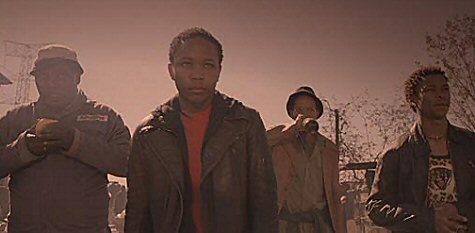
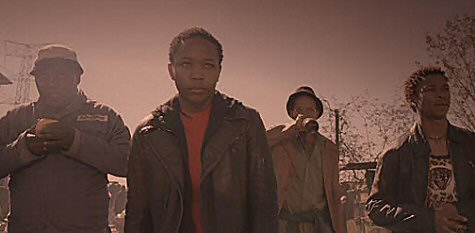
The Tsotsi gang

3. Capote: Searing, fascinating drama about a writer who pours his heart out and uses every ploy in the book to produce a groundbreaking novel, but loses his soul in the process. So deft and mature it’s almost like Louis Malle directed it. Oscar prospects: Phillip Seymour Hoffman’s performance as Truman Capote is an absolute lock for a Best Actor nomination, and I really think the film is good enough to be in the running for a Best Picture nomination. Clifton Collins, Jr. deserves a nom for Best Supporting Actor, Bennett Miller for Best Director, and Dan Futterman for Best Adapted Screenplay. Commercial potential: Everyone who’s ever heard the name “Truman Capote” is going to want to see Hoffman. One of those films that every semi-educated soul over the age of 25 or 26 is going to have to see…right?
4. Tsotsi: Emotionally pungent drama about the spiritual awakening of a socio- pathic teenage killer after he finds an infant boy in the back seat of a car he’s stolen. Winner of Toronto Film Festival’s audience award. Oscar prospects: A shoo-in for Best Foreign Language Film (it’s spoken in “Tsotsi-taal,” a mixture of several tongues), but obviously only if it gets picked up right away and pushed into theatres before 12.31. Commercial potential: A toughie…will depend very much on word-of-mouth, reviews, how good the marketing campaign is, etc.
5. A History of Violence: David Cronenberg’s strongest and most commercial film since The Fly. Oscar prospects: Limited, although William Hurt could push through with a Best Supporting Actor nomination. Commerical potential: On the modest side.


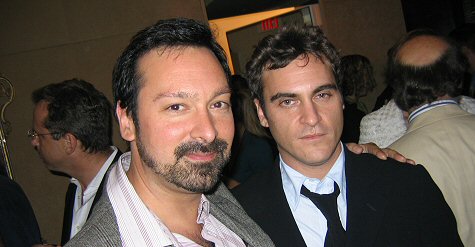
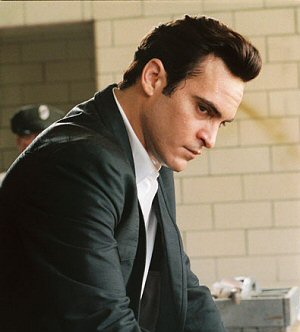
Walk the Line director James Mangold (l.), star Joaquin Pheonix

6. In Her Shoes: Best upscale chick flick since Terms of Endearment. Oscar prospects: Forget what Manohla Dargis or Stephanie Zacharek may or may not say about it — the fact that it emotionally connects means Shoes could go all the way and land noms for Best Picture, Best Director (Curtis Hanson), Best Screen- play, Best Actress (Toni Collette), etc. An assured Best Supporting Actress nom for Shirley MacLaine. Commercial potential: Very big, although Fox is going to have to work hard at first to sell it to the women who don’t read reviews, or who move their lips when they do.
7. Walk the Line: Admirably pared-down, ultra-believable Johnny Cash biopic…rooted and steady on its feet. Oscar prospects: Guaranteed Best Actor and Best Actress noms for Joaquin Pheonix and Reese Witherspoon; possible Best Picture and Best Director (James Mangold). Commercial potential: I don’t think it’s going to do what Ray did, but reasonably spirited business seems likely.
8. Thank You for Smoking: Sharp, clever, quippy…lacking in emotional gravitas. Oscar prospects: Not that kind of thing. Commercial potential: Good to pretty good.
9. Mrs. Henderson Presents: Not a massive home run but a very brisk serving of rudely effete British humor in a perky period vein. A lively near-perfect film for the over-30 (or do I really mean over-40?) crowd. Oscar prospects: A better-than- decent chance of Dame Judy Dench landing a Best Actress nomination…if the Weinstein Co. campaigns hard and smart for it. Commercial potential: Rather good.


Why We Fight director Eugene Jarecki during q & a at Cumberland plex during Toronto Film Festival

10. Sketches of Frank Gehry: Sydney Pollack’s doc is a highly intelligent look at an exceptional man, and a profound contact high. Oscar prospects: There’s no theatrical distribution deal, and even if it lands one it may be too late (or so I understand) due to Academy rule about August deadline. Commercial potential: The only viewing opportunity for sure right now is a PBS “American Masters” airing in the fall of ’06.
11. Why We Fight: Eugene Jarecki’s doc about the carrot-and-stick relationship between American interventionism over the decades and the military-industrial complex is utterly fascinating, well-sculpted, and stirring. Oscar prospects: Good potential to figure among the Best Feature Doc nominees. Commercial potential : Good.
As for the rest…
The Modest but Very Welcome Return of Steven Soderbergh: Bubble
Good, Fairly Good, Decent: Mary (dir: Abel Ferrara), Cache (dir: Michael Haneke), Tristram Shandy (dir: Michael Winterbottom…although I’m leaning on the word of trusted sources, as I was shut out of the press screening last Monday), Everything is Illuminated (dir: Liev Schreiber), Imagine Me and You (dir: Ol Parker), L’enfer (dir: Davis Tanovic), Vers le Sud (dir: Laurent Cantet).
Shortfalls: North Country, Stoned, John & Jane, Romance & Cigarettes, Lie With Me.


Capote costars Catherine Keener, Phillip Seymour Hoffman

Near-wipeout: Elizabethtown…but an obit would be premature at this stage, as a re-edit is in the works.
Wipeouts: Tideland, Revolver, Wassup Rockers, The Cabin Movie, Mrs. Harris.
If only the music grabbd me…: The Devil and Daniel Johnston.
Gloob gloob: Shopgirl, The President’s Last Bang, The White Masai, Mistress of Spices, Sorry Haters.
Martyr-Ball: The War Within, Paradise Now
Missed ‘Em: Leonard Cohen: I’m Your Man, Iberia, Tristram Shandy, The Matador, Edison, Jesus is Magic, The World’s Fastest Indian, The Proposition, The Notorious Bettie Page, Wah-Wah, Tim Burton’s The Corpse Bride (didn’t care that much about seeing this one), Oliver Twist, Bee Season.

Bad Guy and a Baby

Gavin Hood’s Tsotsi has become the big stand-out at the end of the Toronto Film Festival.
It was first shown on Wednesday night, right opposite the In Her Shoes viewing at Roy Thomson Hall, and by this time many of the top-tier journalists had left town, so there haven’t been a lot of insiders hopping up and down about it. And yet today — Saturday, 9.17 — it won the Toronto Film Festival People’s Choice award.


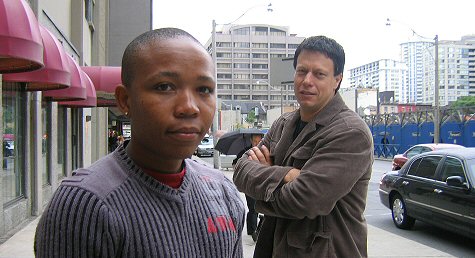
Tsotsi star Presley Chweneyagae (l.) and the film’s director-writer Gavin Hood outside Toronto’s Sutton Place hotel — Friday, 9.16, 8:55 am.

I also know Tsotsi has aroused the persistent passions of at least one would-be distributor. And that it touched enough people at the recently-wrapped Edinburgh Film Festival to win the Audience Award, along with the Michael Powell award for Best New British Feature.
Even the notoriously hard-nosed critic Len Klady told me early this afternoon, “I hear it’s very good.”
As I waited to see it Thursday afternoon I thought I might be in for another hyper- cut City of God crime-in-the-slums movie, but it was something quite different.
Set in a rancid Johannesburg shantytown, Tsotsi (pronounced “Sawt-see”) is about an ice-cold teenage thug (Presley Chweneyagae) who discovers a small spring of compassion in himself when he starts to care for an infant boy who happens to be in the back seat of a car he’s stolen.
What is this film doing exactly? It’s reminding audiences in a believably non-sappy way there are sparks of kindness in even the worst of us. It’s a rather Christian- minded movie, in a sense.
It may sound sentimental and manipulative, but it’s not. But neither is it sadistic or repellent in some flashy, gun-fetish way. It’s real and unblinking, but it also lets you feel what’s happening. But not too much…just enough.


Tsotsi star Presley Chweneyagae

Emotions suppressed but leaking out anyway…the emotion you’d rather not feel but which won’t leave you the fuck alone…the emotions that you stopped letting in when you were eight or nine but have always been there…conveying these in a film is always a stronger, more poignant thing than having some emotionally healthy actor or actress cry their eyes out or hug everyone to death…please.
I said this in a Wired item posted on Friday morning, and here it is again: unlike Luc and Jean-Pierre Dardenne’s Palme d’Or-winning L’enfant, which it vaguely resembles, Tsotsi has a potential to snag some decent coin as well as Oscar nominations (Best Foreign-Language Film, Best Actor, etc.), critics awards, Golden Globe awards, etc.
How do I know Tsotsi will sell tickets? Because my good and kindly Toronto friend Leora Conway, who know what she knows but isn’t tremendously knowledgeable or sophisticated about movies, went apeshit after seeing Tsotsi at the Wednesday night premiere…she was beaming when she told me about it afterwards, and said it made her cry at the end.
Bad guys and wailing babies…it’s bound to be the very next phase. Tsotsi, L’enfant and Michael Davis’s Shoot ‘Em Up, the comically violent Don Murphy-New Line movie with Clive Owen as a gun-toting Man of Few Words protecting a baby who’s only a day or two old. Any others?
Wait a minute…I see a TV series in this. A wise-cracking yuppie assassin (think John Cusack) whose girlfriend dies just after giving birth..this hard-assed guy has to juggle diapers and nanny-care while taking care of business. And he’s got a nosey female neighbor who’s secretly hot for him.


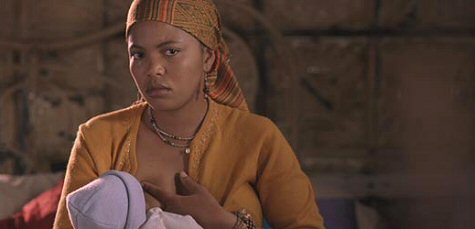
Tsotsi costar Terry Pheto as Miriam, a single mom who establishes a bond with Chweneyagae’s street thug.

I had breakfast early this morning with Hood, Tsotsi‘s director and writer (the film is based on a novel by South African playwright Athol Fugard), and Presley Chweneyagae, who plays the title role, at the Sutton Place hotel, and we batted it around some.
Hood said he’s always been “terrified” of sentimentality and “being mushy” in movies, and says that his mantra during shooting was that “there’s always got to be more going on within a character than what he lets out.”
Hood said he wanted to use formal compositions and a slower editing style than the one popularized by City of God “because I didn’t want to seem like I was saying ‘me too’…I didn’t want to come in second.”
Hood says he feels more of an affinity with the shooting style of director Walter Salles (The Motorcycle Diaries) and particularly Sales’ Central Station than he does with City of God director Fernando Meirelles.
The language that Chweneyagae and his costars speak is known as “Tsotsi-taal” (the first word meaning “thug” and the second meaning “language”). It’s a mixture of several tongues including English, Afrikaans, Zulu, Xhosa, Sothu and Tswana.
To qualify for Academy consideration, Tsotsi is opening in South Africa today for one week.


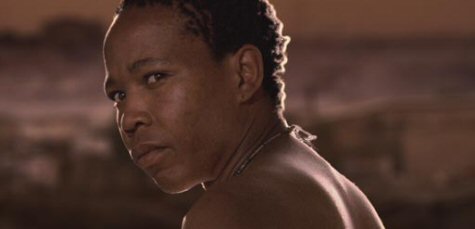
Tsotsi gang (l. to r.): Aap (Kenneth Nkosi), Tsotsi (Presley Chweneyagae), a failed teacher (Mothusi Magano) and Butcher (Zenzo Ngqobe)

Hood showed the finished film to Fugard, 87, at his San Diego home just before the Toronto Film Festival began. Fugard was delighted and wrote that Tsotsi “is everything in my wildest dreams that I hoped it would be…it is far and away the best film that has been made of something I have written [and] it will rank as one of the best films ever to come out of South Africa.
This is one of those “it” films. I could feel the rooted energy from the get-go…from Hood’s hard-edged direction, the elegant photography and Chweneyagae’s mesmerizing performance as an ice-cold psychopath who now and then devolves into a terrified three-year-old. It all coagulates into something steady and whole.
If I know anything about this business, somebody is going to pick this film up fairly soon. But they’ll need to move quickly once they do, so hubba-hubba and chop- chop.

Reasons to Believe

A thought hit me when I was writing my column from Toronto on the evening of 9.11.01, but I didn’t have the brass to write it down.
It was my suspicion that no one in the news media in the coming weeks or months would ever be permitted to explore (or even discuss on a talk show like, say, Chris Matthews’ “Hardball”) what might have motivated the 9.11 attackers to do what they did.
It seemed fairly obvious that the news media were already locked into characterizing the Al Qeada plotters as nothing more or less than harbingers of pure evil, and that allowing for the possibility that United States foreign policy might have had something to do with their anger would simply never be acknowledged.


Not from Eugene Jarecki’s Why We Fight, although it could have been used if Jarecki had so chosen.

Eugene Jarecki’s Why We Fight, which I finally saw Thursday afternoon at Toronto’s Cumberland cineplex, isn’t the first doc to explore why so many people around the world hate our guts, but it’s one of the most precise and persuasive.
This is a cleanly composed, very perceptive explanation of how the American military-industrial complex basically runs everything and everyone, from the U.S. President to the U.S. Congress to the slant of our foreign policy.
Sony Pictures Classics will be releasing Jarecki’s doc in January 2006. It’s already been qualified, I’ve been told, to compete for the best feature-length documentary Oscar.
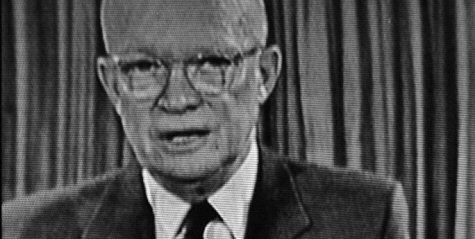
The news-clip centerpiece, as you might imagine, is former president Dwight D. Eisenhower’s farewell address warning about the influence of the burgeoning military-industrial complex. Jarecki then goes on to show exactly how prophetic Ike was.
This will seem like boilerpate stuff to some, but Jarecki and his sources explain how and why the U.S. decided at the end of World War II to become a permanent roving super-power with the technological ability (if not necessarily the political will) to strike any adversary in any country at any time.


Why We Fight director Eugene Jarecki during q & a following Thursday afternoon’s screening at the Cumberland plex — 9.15, 5:50 pm.

The film’s title is borrowed from a jingoistic Frank Capra doc made during World War II that explained the necessity of defeating Japan and Nazi Germany.
The movie says that for roughly the last 60 years, the U.S. has been led by a basic need for constant military adventurism for the sake of domestic corporate profits, which are then spread around to political supporters in government.
Fight shows how there are four branches of Eisenhower’s complex today — the military, the weapons-making industry, the U.S. Congress and conservative think tanks — and how they all feed into each other.
Gore Vidal is one of Fight‘s talking heads, supplying his view at one point that “we live in the United States of Amnesia.”
But Jarecki is smart enough to stay away from staunch liberals for the most part, speaking mostly to establishment or conservative types such as Sen. John McCain, high-level CIA veteran Chalmers Johnson, William Kristol, Richard Perle, former Lt. Gen. Karen Kwiatkowski and former president Eisenhower’s granddaughter Susan and son John.
Jarecki also talks to the wonderfully candid and articulate Charles Lewis of the Center for Public Integrity, who was more or less the star of Orwell Rolls in His Grave.


Former U.S. President Dwight D. Eisenhower delivering his farewell speech on 1.17.61.

Why We Fight is also effective when it talks to average-Joe types. The standout in this realm is an ex-cop named Wilton Sekzer, whose son was killed on 9.11 and who came to embrace a very cynical attitude about the foreign policy aims of the Bush administration, not to mention its general lack of candor about same.
Jarecki also interviews a fresh Army recruit named William Solomon, and to a couple of military pilots who dropped the first bombs in the 2003 invasion of Iraq.
On top of everything else, Jarecki is an excellent cinematographer and editor. The movie is persuasive in part because it’s been shot and cut with eye-pleasing expertise.
Eugene is the brother of Capturing the Freidmans director Andrew Jarecki, as well as the half-brother of Nic Jarecki, who made the excellent James Toback doc The Outsider. Having hung with all three, I can say with some authority they’re a clan worthy of Eugene O’Neill.

Lonesome Town

The energy is down all over the Toronto Film Festival. You can feel it on the street, at the Varsity, in the hotels…it’s over except for locals and stragglers like myself and a few clean-up screenings to get to, like tomorrow’s (9.16) showing of Martin Scorsese’s No Direction Home: Bob Dylan.

Girl Power

It was early Wednesday afternoon, and I was standing in the hallway of the 26th floor of Toronto’s Four Season’s hotel, waiting for my ten-minute quickie with In Her Shoes director Curtis Hanson.
And then a door opened about three feet away and Shoes costar Shirley Maclaine, who owns each and every scene she appears in, peeked out and said hello.
A Fox publicist sitting to MacLaine’s left smiled and nonchalantly said “hey.” I forget how Maclaine replied, but I think she was mainly looking to take a breather.


In Her Shoes star Toni Collette, snapped at Wednesday night’s post-gala party, has shed the weight she gained for the film and is now quite obviously not a brunette, as she is in the film. Director Curtis Hanson, Shirley MacLaine, Cameron Diaz and a bunch of journos (Peter Rainer among them), publicists and agents were also huddling in the VIP area.

The Fox publicist smiled and said, “Shirley, this is Jeffrey Wells, a journalist, and he really likes the film.”
“A man who likes the film…good,” said MacLaine.
The publicist turned slightly in my direction and said, “Tell Shirley what you told me.”
I looked at MacLaine and said, “I think it’s the best chick flick to come along since Terms of Endearment.”
And I know how phony that sounds. People are always tossing around suck-uppy comments at press junkets, but I really haven’t responded this strongly to a film that’s mainly about older and younger women in the same family grappling with heavy emotional life issues since that 1983 James L. Brooks film.
Really…I haven’t. And if I have I can’t think what other film I might be forgetting about.
“That’s good but it’s not a chick flick,” Maclaine said right away. “It’s really about family. Nice meeting you…bye.” And then she closed the door.


In Her Shoes director Curtis Hanson during my ten-minute interview with him at Toronto’s Four Seasons hotel — Wednesday, 9.14, 1:12 pm.

“She’s a bit of a character,” the publicist said. I was thinking to myself, didn’t MacLaine just make a point about a man liking this thing?
Trust me — In Her Shoes is a chick flick. It just happens to be a very good one, and when a particular type of movie is really exceptional that usually means it’s digging deeper and operating with more skill and finesse than other chick flicks that have gone before. And that means it has become more of a plain old good movie than just a chick flick…even though it started out that way.
It was finally time for my ten-minute Curtis Hanson interview. I’ll get into this sometime over the next two or three days, but Curtis was his usual robust and articulate self and I wished we could’ve had…oh, maybe two or three minutes more? Should I shoot the moon and wish for an extra five?
When I was told I would only have ten minutes with Hanson, I coughed and shifted my weight and leaned forward and said, “Ten minutes?” I felt insulted. Why not eight minutes? Why not two? The haiku interview!
I wrote a blurb-sized review of In Her Shoes yesterday for the Wired box. I’ll try and write more this weekend…maybe.

Line Walker

Walk The Line holds up and then some. I liked and respected it after seeing it the first time (i.e., last July), but didn’t quite love it. I saw it again Tuesday morning and while I’m still not 100% wowed by the love story element, I have an even greater respect for how lean and down-to-it and well-assembled this film is.
I’ll say it again for the sake of emphasis: this movie, very neatly, is analogous to a Johnny Cash song — solid and straight, no b.s. or flaky embroidery. And it’s very conceivable it could punch through as a Best Picture nominee because of these attributes alone.


Walk the Line director and co-writer James Mangold (l.) with star Joaquin Phoenix at 20th Century Fox’s post-screening party for Walk the Line — Tuesday, 9.13, 10:10 pm.

Oh, and that item I ran about director James Mangold having allegedly trimmed a bit out of the opening scenes of Walk the Line so it would lessen resemblances to Ray? Bogus. Mangold is telling journalists that the film has been locked for the last four months, and the version I saw this morning in Toronto was precisely the same one I saw in Manhattan, so sorry for briefly muddying the waters.
After seeing four movies today — Walk the Line, the very authentic and unsettling Paradise Now, John & Jane (see review below) and Larry Clark’s lazy, totally masturbatory Wassup Rockers — I strolled over to the Walk the Line party at the Chanel store on the north side of Bloor between Bay and Avenue Road.
The small VIP room was upstairs and very poorly ventilated. No sooner did the Fox publicists wave me into this inner sanctum when Joaquin Phoenix and a friend of his both lit up cigarettes, and you could really smell it.
Daily Mail columnist Baz Bamigboye and I spoke with Phoenix for a few minutes. He’s a nice guy, cool dude. I loved hearing that he hasn’t seen Walk the Line yet, either in a screening room or with an audience, and he has no plans to see it in the foreseeable future. He laughed when he said this, and his laugh has a very slight tone of perversity.


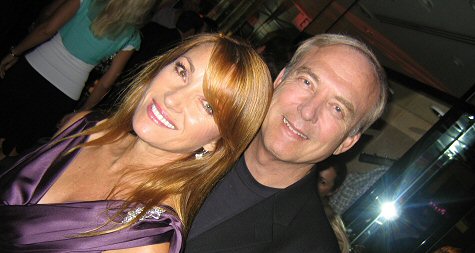
Jane Seymor and husband James Keach, producer and ground-floor instigator of Walk the Line at same after-party — Tuesday, 9.13, 9:55 pm.

I complimented Phoenix on his ultra-realistic fight scene with Mark Wahlberg in The Yards, which is one of the all-time greats. I was surprised to hear that he and Wahlberg didn’t have a stunt guy advising them, but worked out the rollin’ and tumblin’ on their own. They wore knee pads and just told each other, “Okay, I’m gonna hit you and you’re gonna fall down the stairs and then…”, etc.
Mangold, dressed in a tweed jacket and just as warm as I was, was friendly and gracious. I asked him about the film’s best scene, which he wrote, in which Sun records owner Sam Phillips tells Cash and his band during an audition that he doesn’t believe Cash’s signing of a gospel tune, and that he needs to sing some- thing tough and real, etc. Mangold agreed it’s one of the film’s best, and he toasted actor Dallas Roberts, who plays Phillips, for making the scene play as well as it does.
I also spoke to producer James Keach, who knew Cash for several years and tried, with Cash’s approval, to launch his own Cash biopic for a long while before he tied in to the Fox/Mangold/Phoenix project.
Keach and I talked about Cash’s first wife, Vivian, and how the way she’s written and the actress who plays her, Ginnifer Goodwin, makes her seem like the world’s biggest complainer and worst marital partner…a total drag.
What did they get married for? I asked Mangold. Was it sex or…? Mangold said Cash once told him he got married to Vivian because he considered her a dead ringer for Pier Angeli, who was (allegedly) the great love of James Dean’s life.

Curried Hell

Girl Power

It was early Wednesday afternoon, and I was standing in the hallway of the 26th floor of Toronto’s Four Season’s hotel, waiting for my ten-minute quickie with In Her Shoes director Curtis Hanson.
And then a door opened about three feet away and Shoes costar Shirley Maclaine, who owns each and every scene she appears in, peeked out and said hello.
A Fox publicist sitting to MacLaine’s left smiled and nonchalantly said “hey.” I forget how Maclaine replied, but I think she was mainly looking to take a breather.


In Her Shoes star Toni Collette, snapped at Wednesday night’s post-gala party, has shed the weight she gained for the film and is now quite obviously not a brunette, as she is in the film. Director Curtis Hanson, Shirley MacLaine, Cameron Diaz and a bunch of journos (Peter Rainer among them), publicists and agents were also huddling in the VIP area.

The Fox publicist smiled and said, “Shirley, this is Jeffrey Wells, a journalist, and he really likes the film.”
“A man who likes the film….good,” said MacLaine.
The publicist turned slightly in my direction and said, “Tell Shirley what you told me.”
I looked at MacLaine and said, “I think it’s the best chick flick to come along since Terms of Endearment.”
< ?php include ('/home/hollyw9/public_html/wired'); ?>
And I know how phony that sounds. People are always tossing around suck-uppy comments at press junkets, but I really haven’t responded this strongly to a film that’s mainly about older and younger women in the same family grappling with heavy emotional life issues since that 1983 James L. Brooks film.
Really…I haven’t. And if I have I can’t think what other film I might be forgetting about.
“That’s good but it’s not a chick flick,” Maclaine said right away. “It’s really about family. Nice meeting you…bye.” And then she closed the door.
“She’s a bit of a character,” the publicist said. I was thinking to myself, didn’t MacLaine just make a point about a man liking this thing?


In Her Shoes director Curtis Hanson during my ten-minute interview with him at Toronto’s Four Seasons hotel — Wednesday, 9.14, 1:12 pm.

Trust me — In Her Shoes is a chick flick. It just happens to be a very good one, and when a particular type of movie is really exceptional that usually means it’s digging deeper and operating with more skill and finesse than other chick flicks that have gone before. And that means it has become more of a plain old good movie than just a chick flick…even though it started out that way.
It was finally time for my ten-minute Curtis Hanson interview. I’ll get into this sometime over the next two or three days, but Curtis was his usual robust and articulate self and I wished we could’ve had…oh, maybe two or three minutes more? Should I shoot the moon and wish for an extra five?
When I was told I would only have ten minutes with Hanson, I coughed and shifted my weight and leaned forward and said, “Ten minutes?” It felt insulting at first glance. Why not eight minutes? Why not two? The haiku interview!
I wrote a blurb-sized review of In Her Shoes yesterday for the Wired box. I’ll try and write more this weekend…maybe.

Line Walker

Walk The Line holds up and then some. I liked and respected it after seeing it the first time (i.e., last July), but didn’t quite love it. I saw it again Tuesday morning and while I’m still not 100% wowed by the love story element, I have an even greater respect for how lean and down-to-it and well-assembled this film is.
I’ll say it again for the sake of emphasis: this movie, very neatly, is analogous to a Johnny Cash song — solid and straight, no b.s. or flaky embroidery. And it’s very conceivable it could punch through as a Best Picture nominee because of these attributes alone.


Walk the Line director and co-writer James Mangold (l.) with star Joaquin Phoenix at 20th Century Fox’s post-screening party for Walk the Line — Tuesday, 9.13, 10:10 pm.

Oh, and that item I ran about director James Mangold having allegedly trimmed a bit out of the opening scenes of Walk the Line so it would lessen resemblances to Ray? Bogus. Mangold is telling journalists that the film has been locked for the last four months, and the version I saw this morning in Toronto was precisely the same one I saw in Manhattan, so sorry for briefly muddying the waters.
After seeing four movies today — Walk the Line, the very authentic and unsettling Paradise Now, John & Jane (see review below) and Larry Clark’s lazy, totally masturbatory Wassup Rockers — I strolled over to the Walk the Line party at the Chanel store on the north side of Bloor between Bay and Avenue Road.
The small VIP room was upstairs and very poorly ventilated. No sooner did the Fox publicists wave me into this inner sanctum when Joaquin Phoenix and a friend of his both lit up cigarettes, and you could really smell it.
Daily Mail columnist Baz Bamigboye and I spoke with Phoenix for a few minutes. He’s a nice guy, cool dude. I loved hearing that he hasn’t seen Walk the Line yet, either in a screening room or with an audience, and he has no plans to see it in the foreseeable future. He laughed when he said this, and his laugh has a very slight tone of perversity.


Jane Seymor and husband James Keach, producer and ground-floor instigator of Walk the Line at same after-party — Tuesday, 9.13, 9:55 pm.

I complimented Phoenix on his ultra-realistic fight scene with Mark Wahlberg in The Yards, which is one of the all-time greats. I was surprised to hear that he and Wahlberg didn’t have a stunt guy advising them, but worked out the rollin’ and tumblin’ on their own. They wore knee pads and just told each other, “Okay, I’m gonna hit you and you’re gonna fall down the stairs and then…”, etc.
Mangold, dressed in a tweed jacket and just as warm as I was, was friendly and gracious. I asked him about the film’s best scene, which he wrote, in which Sun records owner Sam Phillips tells Cash and his band during an audition that he doesn’t believe Cash’s signing of a gospel tune, and that he needs to sing some- thing tough and real, etc. Mangold agreed it’s one of the film’s best, and he toasted actor Dallas Roberts, who plays Phillips, for making the scene play as well as it does.
I also spoke to producer James Keach, who knew Cash for several years and tried, with Cash’s approval, to launch his own Cash biopic for a long while before he tied in to the Fox/Mangold/Phoenix project.
Keach and I talked about Cash’s first wife, Vivian, and how the way she’s written and the actress who plays her, Ginnifer Goodwin, makes her seem like the world’s biggest complainer and worst marital partner…a total drag.
What did they get married for? I asked Mangold. Was it sex or…? Mangold said Cash once told him he got married to Vivian because he considered her a dead ringer for Pier Angeli, who was (allegedly) the great love of James Dean’s life.

Curried Hell

For three days I’ve been looking for a new film that would provoke a really strong reaction (the last was Sydney Pollack’s Sketches of Frank Gehry, which I saw on Saturday) and it finally happened this afternoon when I saw Ashim Ahluwalia’s John & Jane.
It’s basically about those Bombay or New Delhi guys we talk to all the time for tech support and who sometimes cold-call to try and sell us worthless crap…those repulsively polite Indian humanoids who’ve brought so much irritation and frustration and pure sputtering rage into our lives…ah, yes.


Image from Ashim Ahluwalia’s John & Jane

I don’t hate John and Jane, but I can’t say I enjoyed watching it.
I may have felt a tiny bit oppressed by the elitist buzz that decreed early on (as ascertained in a Peter Howell piece than ran a week ago last Saturday) this was a must-see. But I could see right off it’s a worthy, decently made thing as well as humanistic statement of sorts — half-compassionate, half-ironical.
Ashluwalia is clearly trying to lend a sad human face and some kind of darkly ironic perspective to the economic scourge that is Indian outsourcing.
But I loathe and despise those Indian phone-center workers, mainly because 90% of them are morons when it comes to any kind of serious technical challenges regarding PDA’s or computer hardware or e-mail issues.
They tie you up with their ninny-nanny questions and they waste your time and sometimes come close to destroying entire work days, and if I could clap my hands and eliminate all instances of Americans like me ever again speaking with Indian tech support guys between now and the end of time, I would clap my hands.
You sit and watch John & Jane and you say, “Okay, here they are in the flesh…those relentlessly considerate and persistent boobs I’ve been speaking with from time to time over the last few years…and it turns out they might be more miserable than myself.

“They feel economically fucked over by the companies they work for,
and some want better lives and some have the discipline and focus to perhaps raise themselves to the next level…but they all seem to lead spiritually depleted (or at least wanting) lives, and a couple of them seem so brainwashed by the lure of the American materialistic dream that it’s making me slightly ill.
“And…what am I supposed to take from this? I still despise these guys. I still hate that I’ve wasted so many hours of my life talking to them. So what exactly am I getting from this movie other than a reminder that we’re all fucked one way or the other?”
Just before seeing John & Jane I caught a noon screening of Hany Abu-Assad’s Paradise Now, the Warner Independent release (Nov. 11) about a couple of Middle Eastern childhood friends recruited to become suicide bombers against a target in Tel Aviv.
After seeing both I realized I’d like to see a hybrid that blends the two. It would be about two American lonely guys who so hate Indian phone centers that they’ve gone a little bit wacko. They assemble a Fight Club-like team of 12 or 15 guys to fly over to India to become suicide bombers — martyrs for the cause of wiping out as many Indian phone-bank centers as they can.
What sustains them, of course, is a belief that Americans back home will privately think of them as heroes. I don’t know that I’d feel quite that way myself if this were to actually happen, but I must say my reactions would probably be mixed.

Fresh Grabs


Brokeback Mountain director Ang Lee at beginning of interview at Toronto’s Park Hyatt — Monday, 9.12, 11:35 am.

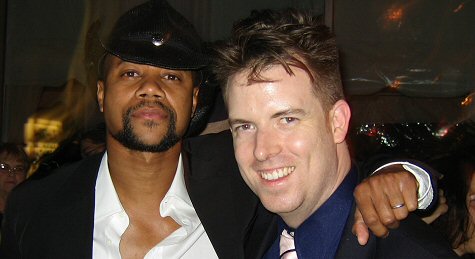
Pick Up The Mic director Alex Hinton (r.) and Cuba Gooding at a party for Hinton’s film, known in festival circles as an explosive documentary on the world of queer hip-hop, on the penthouse floor of the Manulife building — Sunday, 9.11, 11:50 pm. Producer Steve Nemeth (a good guy) was there, and Jeff “the Dude” Dowd and Mickey Cottrell invited me, and the view…

…of the Toronto nightscape was awesome — Sunday, 9.11, 11:35 pm.

Charlotte Rampling, easily the most alluring and delectable woman I have gazed upon so far at the Toronto Film Festival (and that covers a lot of hotties). In town to promote Laurent Cantet’s Heading South (Vers le Sud), in which she costars, Rampling was sitting at a party thrown on Monday, 9.12, by Catherine Verret and the French Film Office. The location was Prego, at 150 Bloor Street.

Jeff Stanzler, the very sharp and engaging director-writer of Sorry Haters, at IFC pizza party at Prego thrown from 5 to 7 pm on Monday, 9.12. Haters‘s next festival showing is on Friday evening, 9.16, at the Cumberland.

A post-screening discussion of Abel Ferrara’s Mary at Isabel Bader theatre on Sunday evening. Ferrara sat on the edge of the stage and let go with his usual raspy-voiced moody-genius colorful-downtown-guy number as he answered questions. Costar Matthew Modine stood directly behind Ferrara. Standing next to Modine was the film’s editor, Langdon Page.

The War Within director and co-writer Jeff Castelo, about a young Pakistani guy whose plan to blow himself up as part of an attack on New York City is re-examined at the 11th hour. Castelo grew up in Mountainside, New Jersey, which is walking distance from my hometown of Westfield, N.J. Pic was taken at HDNet/Magnolia Films breakfast at Toronto’s Windsor Arms hotel — Monday, 9.12, 8:40 am. (Notice the partially shadowed features of Bubble director Steven Soderbergh, sitting behind Castelo and to his left.)

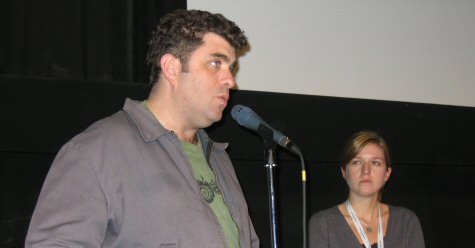
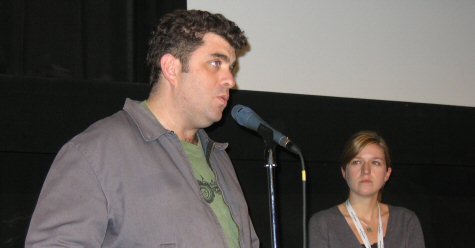
During the q & a that followed Monday evening’s public screening of Liev Schrieber’s Everything is Illuminated, a broadly played road movie about a young Jewish American lad (Elijah Wood) visiting the Ukraine to commune with his family’s roots and history. That’s director-writer Schreiber standing at left in front of the mike, with Wood and costar Eugene Lutz to the right.

Karen Young (l.) and Louise Portal, costars with Charlotte Rampling in Laurent Cantet’s Heading South, at Monday’s French Film Office party at Prego — 9.12, 12:45 pm

I realize I just ran a shot of the Elgin theatre prior to a screening last weekend, but here’s another one…taken just before Monday afternoon’s showing of Michael Haneke’s Cache (a.k. a., Hidden) — 9.12, 2:55 pm

Master Builder

Sydney Pollack’s Sketches of Frank Gehry, which I caught yesterday at a public screening at the historic Elgin theatre, is a stirring, hugely likable portrait of the most daring and innovative architect of our time.
As corny as this sounds, Sketches left me with a more vivid feeling of celebration and with more reasons to feel enthused and excited about life than anything I’ve seen so far at this festival.


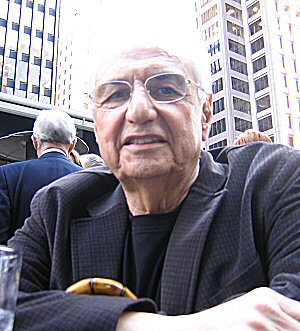
Director Sydney Pollack, architect Frank Gehry at Saturday afternoon’s cocktail party for Sketches of Frank Gehry in downtown Toronto — 9.10, 6:25 pm.

I knew a few things about Gehry before seeing this film, but not a whole lot. Now I feel like I know a few things. The man is the Pablo Picasso of architects. He’s a risk-taker who lives big and tosses the creative dice all the time and really goes for it. And I now know about his significant creations (the most famous being Disney Hall in downtown Los Angeles and a seaside museum in Bilbao, Spain), how he creates, who he mostly is, where he’s been.
Sketches is more than just a meet-and-understand-Frank-Gehry movie — it’s a contact high.
It’s a film that lets you into the head of a genius in a very relaxed and plain-spoken way, and it lets you share in the sense of being a person of Gehry’s magnitude — a guy who has created a kingdom out of a supreme confidence in his dreams, but at the same time someone honest enough to admit he doesn’t precisely know what he’s doing much of the time.
This is partly due to Gehry having been very open and unguarded with Pollack as the doc was being shot, and partly due to Pollack having sculpted this film in a way that feels more personal and congenial and relaxed than your typical portrait- of-a-noteworthy-person movie.
And yet Pollack doesn’t relent in passing along all the information we need to know about Gehry. It’s all done with total thoroughness and clarity of purpose.


Gehry’s Guggenheim museum in Bilbao, Spain.

I met and spoke with Gehry and Pollack at a nice cocktail party on Wellington Street late yesterday afternoon, courtesy of publicist Amanda Lundberg. What a pleasure to hang with these guys. I left the party feeling wise and steady and optimistic about everything.
Sketches of Frank Gehry will air on the PBS “American Masters” series in late ’06, but Pollack first wants it to play theatrically. This should happen. I can see this film being an essential “see” with people of a certain stripe, and yet a ten year-old kid could watch it and understand almost everything.
I can only repeat that the film is much more than just a sturdy documentary — it’s a profound turn-on. I’ve looked at Gehry’s buildings and designs — those weirdly bent and sloping pieces of steel and sheet metal and glass and what-have-you — but I never really “saw” them until yesterday.
There’s a wonderful edit right at the beginning of the film, which I won’t spoil by describing in too much detail. Suffice that it takes Gehry’s doodly drawings and brings them into full-metal aliveness in a single stroke.
There’s another delicious moment when Julian Schnabel is asked about Gehry’s press critics, and he refers to them as “flies on the neck of a lion…they’re the sort of people who complain that Robert Duvall’s character in Apocalypse Now is over the top.”


Terry Gilliam, Jodelle Ferland during shooting of Tideland

Just before the Gehry party I saw Terry Gilliam’s Tideland, which everyone I’d spoken to had warned me away from. (One guy told me it’s the worst film of the festival so far; another called it “unreleasable.”) This is why I wanted to see it, frankly. I like seeing films that everyone has trashed because I always seem to find something about them that I like or admire.
But not this time. Tideland feels Gilliam-esque (visually alluring and semi-pastoral at times with a Fisher King-like fetish for dust and grunge and curio clutter) but it was very tough going, for the most part. I’m talking about zero tension, funereal pacing, no engagement in the characters to the point of engendering hostility, a maddening sense of directorial indulgence, etc.
“It is [Gilliam’s] willingness to push his material to the extreme edge that makes him a true original,” says Toronto Film Festival director Piers Handling in the program notes. This signature has also resulted in two critically dumped-on movies in a row (this and The Brothers Grimm.)
Tideland is basically about the fantasy life of a little girl named Jeliza-Rose (Jodelle Ferland), a sire of junkie parents (Jeff Bridges, Jennifer Tilly) who both dead of overdoses, leaving the kid to imagine voices, play with tiny doll heads she wears on the tips of her fingers and explore her imaginings to her heart’s content.
She eventually becomes friends with a moron named Dickens (Brendan Fletcher) and his witch-like sister Dell (Janet McTeer), and now we have three wackos living in their dreams and acting weird for weird’s sake, or for Gilliam’s sake…whatever.


During shooting of Tideland.

I really can’t do this, I told myself. I can’t sit through another Terry Gilliam stylistic free-for-all masturbation movie. Others had the same notion. Two guys in front left somewhere around the 45 minute mark. Then another one left, and then another. I’ve seen this domino effect before. People say to themselves, “If all these guys are leaving, this gives me an excuse to leave too.”
I turned to Chicago Tribune critic Mark Caro, who was sitting to my immediate left, but he was toughing it out. I said to myself, “If Caro goes, I go….and I won’t feel as guilty about walking out on a Terry Gilliam movie.” Another guy left. A woman left. Caro was looking around and chuckling at the exodus, but he wouldn’t budge. So I decided to be a man and just do it on my own.
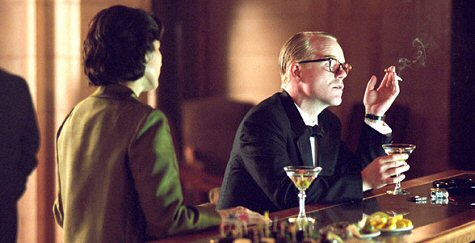
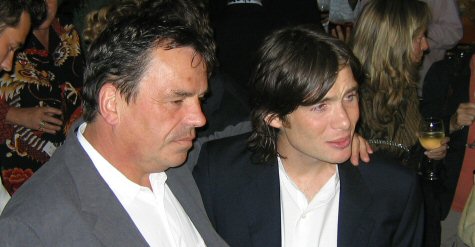
I next went to a warm, family-friendly dinner party thrown by Sony Classics. It was attended by the Capote crew (director Bennett Miller, actors Phillip Seymour Hoffman, Clifton Collins, Jr., and Catherine Keener, screenwriter Dan Futterman), Breakfast on Pluto director Neil Jordan and star Cillian Murphy, Why We Fight director Eugene Jarecki, and The Devil and Daniel Johnston director Jeff Feuerzig, along with the usual pack of journo-critic freeloaders.
Feuerzig was nice about my having thrown water on his film a couple of days ago. He asked me to see the entire film some day, and I promised I would.
What I actually said in my piece was that I don’t care for Johnson’s music, and without that affinity I couldn’t muster any interest in his emotional and psychological troubles. (Whereas I could when it came to Brian Wilson’s story in I Just Wasn’t Made For These Times because I love Wilson’s music.)


Capote star Phillip Seymour Hoffman (l) and the film’s director Bennett Miller at Sony Classics party at Margaret’s Brasserie — Saturday, 9.10, 7:35 pm.

It felt briefly odd to hear Hoffman speak in his own voice, which is sort of deepish and a tiny bit guttural, rather than his mincing Truman Capote voice, which everyone loves. The crowd at the public screening at the Elgin was obviously eating it up. There was strong laughter here and there. The “Bergdorf’s” line got a big response.
After the Sony thing ended I went to the Brokeback Mountain party and said howdy to Heath Ledger, Terry Gilliam (I didn’t bring up Tideland), producer James Schamus, film journalist Paul Cullum, New York Times reporter Sharon Waxman, the Focus Features publicity team and I forget who else.

Smash-up

It’s a two-bit irony, but there’s no denying it: the professional failure that Orlando Bloom’s character goes through in the opening of Elizabethtown, which is massive and absolute, is not unlike the sense of almost total failure that seems to be enveloping the film and its director-writer Cameron Crowe right now, at the Toronto Film Festival.
Crowe is going to be trimming Elizabethtown down by several minutes, perhaps as much as 15 or 20, but there are so many things in this undisciplined movie that have seemed to so many people at this festival to be terribly wrong, that it seems damn near unfixable.
It could work for some people in the ticket-buying world, but this movie is for all practical purposes finished with the critics and journos who’ve been nothing but supportive of Crowe’s films in the past.


Elizabethtown director-writer Cameron Crowe.

A day and a half has passed since I saw Elizabethtown at Friday evening’s press screening, and I’m still shattered by the half-failure of it. So bummed and turned around, in fact, that I couldn’t summon the courage to attend the Elizabethtown press conference that happened about an hour ago. (It’s now about 12:20 pm.) I thought it would hurt too much to listen to what I was sure would be a display of forced gaiety.
Yeah, half-failure. This is a movie that stabs itself in the chest over and over during the first hour or so, but then it finds itself somewhere near the halfway point and becomes…well, not a movie exactly but a meditation about what it is in life that is joyful and soul-restoring, and which generally keeps us going.
Elizabethtown starts out on a note of futility and plans of bloody suicide, with Orlando Bloom ready to pack it in after a winged running shoe he’s designed has resulted in a loss of nearly a billion dollars.
Then he’s saved, in a way, by news of the death of his father. He forgets about “the plan” and flies to Kentucky to take care of the funeral arrangements. And on the way he meets a plane stewardess (Kirsten Dunst) who’s so oppressively perky and Jean Arthur-ish that…I’m getting ahead of myself and not completing my thought.
Which is this: if you forget about Elizabethtown not working as a real movie — minus most of the disciplines, character shadings and payoffs we’ve seen in Crowe’s previous films — if you forget all that stuff and just go with the meditative flow, it starts to work after the first hour or so.


Orlando Bloom

You can’t really believe in it — the movie is way too un-tethered — but you can sorta roll with it and feel the vibe. I did, at least.
I was not having a miserable time at the end, and some (but not all) of the middle is pretty good. The problem, for me, is in the first hour, and I don’t know where to start, or even if I want to.
It’s not just that the crash-and-burn opening (Bloom saying “I’m okay” over and over, his girlfriend leaving him because he’s failed, every last person in the office eyeballing him) is too Jerry Maguire-ish. It feels completely artificial every step of the way, and keeps hitting you with stuff you can’t help but disbelieve or gag on.
I can’t catalogue everything that falls apart in this section, but for openers Crowe doesn’t tell us why the running shoe has died, or why the company didn’t do any product testing, or why Alec Baldwin, the big boss, would sink $900 million-plus into launching a single line…I didn’t believe a second of it.
When something awful has happened to you, people who know you don’t usually look directly at you. Certainly not in a group situation. They usually avoid eye contact because they don’t want to deal with your pain, because they’re afraid it might be catching.
The suicide stabbing device that Bloom nearly uses on himself seems ridiculous. With all the suicide options out there, who in the world would think of stabbing themselves to death with a big knife tied to a workout contraption?


Kirsten Dunst

There has never been a flight from Seattle to Kentucky in the history of aviation with only one passenger on the plane.
There’s an argument with an Elizabethtown local about what color suit his deceased father should wear — they want brown, Bloom insists on blue. And then there’s a shot of the body in the coffin and Bloom’s father is wearing a suit of…dark gray!
When Orlando Bloom’s character finds out that his father has died and he flies off to the bluegrass state, there’s no real reason for his mom (Susan Sarandon) and sister to not come with him.
Sarandon, we are told, starts taking dance lessons right when she learns of her ex-husband’s death, and a mere four days later she’s found a teacher, had a lesson or two and learned enough to cautiously perform a tap-dance routine in front of the Kentucky family…pretty fast work!
I was in shock. I was in denial. I couldn’t accept that this movie was misfiring as badly as it was. But then, finally, the fog lifted. It’s not that Elizabethtown started being good but that it stopped making me groan, and the movie’s basic theme — what makes us stay in love with life? — started to find its feet.


Dunst, Bloom on Elizabethtown set

Someone has written that “those magical moments that survive in memory from the weakest of Crowe’s works are simply nowhere to be found.” No — the last third is actually pretty good, or at least there’s a way to roll and groove with it. That is, if you follow my instructions.
It starts sometime after the all-night cell phone conversation scene (Bloom and Dunst never recharge their phones, and why should they?), and then it starts to grow and build. I actually liked the final road-trip sequence, which a lot of people have told me they couldn’t stand.
Bloom isn’t great in the role, but he’s not bad. The relentlessly positive perkiness coming out of Dunst starts to wear you down after a while. Bruce McGill, Alec Baldwin and Susan Sarandon are…okay. But nobody kills.
About 70 minutes into the film, a certain high-profile movie guy whom everyone knows got up and left the theatre. (He came back later, he says.) As he left to go out through the right-side tunnel, he very briefly turned and looked at the audience as if to say, “I’m a little bit surprised there are so many you continuing to sit there and watch this thing.”
About ten minutes later two major critics sitting a row in front of me got up and left. I’ve walked out on plenty of films but almost never one directed by a name-brand guy like Crowe. Wait a minute…I just walked out on a Terry Gilliam film yesterday. And I admit to being so miserable watching Martin Scorsese’s Kundun that I shut my eyes and fell asleep. But I was still shocked when I saw those two guys get up and bolt.

I wish there was some way for me to believe this movie isn’t dead, dead…deader than dead. But I really think it is.
The next chapter in the Elizabethtown saga will be upon us when an F.X. Feeney-like savior comes along and says, “No, no…you guys missed it! This movie is brilliant. It’s just that Crowe decided to take a big leap over the usual narrative devices and you guys were too constipated or conservative-minded to get what he was doing!”
I am not that guy, but I say again: forget about Elizabethtown doing what you’d like it to do (i.e., delivering the goods the way Billy Wilder used to) and just wait for the here-are-the-things- that-make-life-worth-living portions, which mostly unfold in the second half.

Toronto Shake

Master Builder

Sydney Pollack’s Sketches of Frank Gehry , which I caught yesterday at a public screening at the historic Elgin theatre, is a stirring, hugely likable portrait of the most daring and innovative architect of our time.
As corny as this sounds, Sketches left me with a more vivid feeling of celebration and with more reasons to feel enthused and excited about life than anything I’ve seen so far at this festival.


Director Sydney Pollack, architect Frank Gehry at Saturday afternoon’s cocktail party for Sketches of Frank Gehry in downtown Toronto — 9.10, 6:25 pm.

I knew a few things about Gehry before seeing this film, but not a whole lot. Now I feel like I know a few things. The man is the Pablo Picasso of architects. He’s a risk-taker who lives big and tosses the creative dice all the time and really goes for it. And I now know about his significant creations (the most famous being Disney Hall in downtown Los Angeles and a seaside museum in Bilbao, Spain), how he creates, who he mostly is, where he’s been.
Sketches is more than just a meet-and-understand-Frank-Gehry movie — it’s a contact high.
< ?php include ('/home/hollyw9/public_html/wired'); ?>
It’s a film that lets you into the head of a genius in a very relaxed and plain-spoken way, and it lets you share in the sense of being a person of Gehry’s magnitude — a guy who has created a kingdom out of a supreme confidence in his dreams, but at the same time someone honest enough to admit he doesn’t precisely know what he’s doing much of the time.
This is partly due to Gehry having been very open and unguarded with Pollack as the doc was being shot, and partly due to Pollack having sculpted this film in a way that feels more personal and congenial and relaxed than your typical portrait- of-a-noteworthy-person movie.
And yet Pollack doesn’t relent in passing along all the information we need to know about Gehry. It’s all done with total thoroughness and clarity of purpose.


Gehry’s Guggenheim museum in Bilbao, Spain.

I met and spoke with Gehry and Pollack at a nice cocktail party on Wellington Street late yesterday afternoon, courtesy of publicist Amanda Lundberg. What a pleasure to hang with these guys. I left the party feeling wise and steady and optimistic about everything.
Sketches of Frank Gehry will air on the PBS “American Masters” series in late ’06, but Pollack first wants it to play theatrically. This should happen. I can see this film being an essential “see” with people of a certain stripe, and yet a ten year-old kid could watch it and understand almost everything.
I can only repeat that the film is much more than just a sturdy documentary — it’s a profound turn-on. I’ve looked at Gehry’s buildings and designs — those weirdly bent and sloping pieces of steel and sheet metal and glass and what-have-you — but I never really “saw” them until yesterday.
There’s a wonderful edit right at the beginning of the film, which I won’t spoil by describing in too much detail. Suffice that it takes Gehry’s doodly drawings and brings them into full-metal aliveness in a single stroke.
There’s another delicious moment when Julian Schnabel is asked about Gehry’s press critics, and he refers to them as “flies on the neck of a lion…they’re the sort of people who complain that Robert Duvall’s character in Apocalypse Now is over the top.”


Terry Gilliam, Jodelle Ferland during shooting of Tideland

Just before the Gehry party I saw Terry Gilliam’s Tideland, which everyone I’d spoken to had warned me away from. (One guy told me it’s the worst film of the festival so far; another called it “unreleasable.”) This is why I wanted to see it, frankly. I like seeing films that everyone has trashed because I always seem to find something about them that I like or admire.
But not this time. Tideland feels Gilliam-esque (visually alluring and semi-pastoral at times with a Fisher King-like fetish for dust and grunge and curio clutter) but it was very tough going, for the most part. I’m talking about zero tension, funereal pacing, no engagement in the characters to the point of engendering hostility, a maddening sense of directorial indulgence, etc.
“It is [Gilliam’s] willingness to push his material to the extreme edge that makes him a true original,” says Toronto Film Festival director Piers Handling in the program notes. This signature has also resulted in two critically dumped-on movies in a row (this and The Brothers Grimm.)
Tideland is basically about the fantasy life of a little girl named Jeliza-Rose (Jodelle Ferland), a sire of junkie parents (Jeff Bridges, Jennifer Tilly) who both dead of overdoses, leaving the kid to imagine voices, play with tiny doll heads she wears on the tips of her fingers and explore her imaginings to her heart’s content.
She eventually becomes friends with a moron named Dickens (Brendan Fletcher) and his witch-like sister Dell (Janet McTeer), and now we have three wackos living in their dreams and acting weird for weird’s sake, or for Gillam’s sake…whatever.


During shooting of Tideland.

I really can’t do this, I told myself. I can’t sit through another Terry Gilliam stylistic free-for-all masturbation movie. Others had the same notion. Two guys in front left somewhere around the 45 minute mark. Then another one left, and then another. I’ve seen this domino effect before. People say to themselves, “If all these guys are leaving, this gives me an excuse to leave too.”
I turned to Chicago Tribune critic Mark Caro, who was sitting to my immediate left, but he was toughing it out. I said to myself, “If Caro goes, I go….and I won’t feel as guilty about walking out on a Terry Gilliam movie.” Another guy left. A woman left. Caro was looking around and chuckling at the exodus, but he wouldn’t budge. So I decided to be a man and just do it on my own.
I next went to a warm, family-friendly dinner party thrown by Sony Classics. It was attended by the Capote crew (director Bennett Miller, actors Phillip Seymour Hoffman, Clifton Collins, Jr., and Catherine Keener, screenwriter Dan Futterman), Breakfast on Pluto director Neil Jordan and star Cillian Murphy, Why We Fight director Eugene Jarecki, and The Devil and Daniel Johnston director Jeff Feuerzig, along with the usual pack of journo-critic freeloaders.
Feuerzig was nice about my having thrown water on his film a couple of days ago. He asked me to see the entire film some day, and I promised I would.
What I actually said in my piece was that I don’t care for Johnson’s music, and without that affinity I couldn’t muster any interest in his emotional and psycholo- gical troubles. (Whereas I could when it came to Brian Wilson’s story in I Just Wasn’t Made For These Times because I love Wilson’s music.)


Capote star Phillip Seymour Hoffman (l) and the film’s director Bennett Miller at Sony Classics party at Margaret’s Brasserie — Saturday, 9.10, 7:35 pm.

It felt briefly odd to hear Hoffman speak in his own voice, which is sort of deepish and a tiny bit guttural, rather than his mincing Truman Capote voice, which everyone loves. The crowd at the public screening at the Elgin was obviously eating it up. There was strong laughter here and there. The “Bergdorf’s” line got a big response.
After the Sony thing ended I went to the Brokeback Mountain party and said howdy to Heath Ledger, Terry Gilliam (I didn’t bring up Tideland), producer James Schamus, film journalist Paul Cullum, New York Times reporter Sharon Waxman, the Focus Features publicity team and I forget who else.

Smash-up

It’s a two-bit irony, but there’s no denying it: the professional failure that Orlando Bloom’s character goes through in the opening of Elizabethtown, which is massive and absolute, is not unlike the sense of almost total failure that seems to be enveloping the film and its director-writer Cameron Crowe right now, at the Toronto Film Festival.
Crowe is going to be trimming Elizabethtown down by several minutes, perhaps as much as 15 or 20, but there are so many things in this undisciplined movie that have seemed to so many people at this festival to be terribly wrong, that it seems damn near unfixable.
It could work for some people in the ticket-buying world, but this movie is for all practical purposes finished with the critics and journos who’ve been nothing but supportive of Crowe’s films in the past.


Elizabethtown director-writer Cameron Crowe.

A day and a half has passed since I saw Elizabethtown at Friday evening’s press screening, and I’m still shattered by the half-failure of it. So bummed and turned around, in fact, that I couldn’t summon the courage to attend the Elizabethtown press conference that happened about an hour ago. (It’s now about 12:20 pm.) I thought it would hurt too much to listen to what I was sure would be a display of forced gaeity.
Yeah, half-failure. This is a movie that stabs itself in the chest over and over during the first hour or so, but then it finds itself somewhere near the halfway point and becomes…well, not a movie exactly but a meditation about what it is in life that is joyful and soul-restoring, and which generally keeps us going.
Elizabethtown starts out on a note of futility and plans of bloody suicide, with Orlando Bloom ready to pack it in after a winged running shoe he’s designed has resulted in a loss of nearly a billion dollars.
Then he’s saved, in a way, by news of the death of his father. He forgets about “the plan” and flies to Kentucky to take care of the funeral arrangements. And on the way he meets a plane stewardess (Kirsten Dunst) who’s so oppressively perky and Jean Arthur-ish that…I’m getting ahead of myself and not completing my thought.
Which is this: if you forget about Elizabethtown not working as a real movie — minus most of the disciplines, character shadings and payoffs we’ve seen in Crowe’s previous films — if you forget all that stuff and just go with the meditative flow, it starts to work after the first hour or so.


Orlando Bloom

You can’t really believe in it — the movie is way too un-tethered — but you can sorta roll with it and feel the vibe. I did, at least.
I was not having a miserable time at the end, and some (but not all) of the middle is pretty good. The problem, for me, is in the first hour, and I don’t know where to start, or even if I want to.
It’s not just that the crash-and-burn opening (Bloom saying “I’m okay” over and over, his girlfriend leaving him because he’s failed, every last person in the office eyeballing him) is too Jerry Maguire-ish. It feels completely artificial every step of the way, and keeps hitting you with stuff you can’t help but disbelieve or gag on.
I can’t catalogue everything that falls apart in this section, but for openers Crowe doesn’t tell us why the running shoe has died, or why the company didn’t do any product testing, or why Alec Baldwin, the big boss, would sink $900 million-plus into launching a single line…I didn’t believe a second of it.
When something awful has happened to you, people who know you don’t usually look directly at you. Certainly not in a group situation. They usually avoid eye contact because they don’t want to deal with your pain, because they’re afraid it might be catching.
The suicide stabbing device that Bloom nearly uses on himself seems ridiculous. With all the suicide options out there, who in the world would think of stabbing themselves to death with a big knife tied to a workout contraption?


Kirsten Dunst

There has never been a flight from Seattle to Kentucky in the history of aviation with only one passenger on the plane.
There’s an argument with an Elizabethtown local about what color suit his deceased father should wear — they want brown, Bloom insists on blue. And then there’s a shot of the body in the coffin and Bloom’s father is wearing a suit of…dark gray!
When Orlando Bloom’s character finds out that his father has died and he flies off to the bluegrass state, there’s no real reason for his mom (Susan Sarandon) and sister to not come with him.
Sarandon, we are told, starts taking dance lessons right when she learns of her ex-husband’s death, and a mere four days later she’s found a teacher, had a lesson or two and learned enough to cautiously perform a tap-dance routine in front of the Kentucky family…pretty fast work!
I was in shock. I was in denial. I couldn’t accept that this movie was misfiring as badly as it was. But then, finally, the fog lifted. It’s not that Elizabethtown started being good but that it stopped making me groan, and the movie’s basic theme — what makes us stay in love with life? — started to find its feet.


Dunst, Bloom on Elizabethtown set

Someone has written that “those magical moments that survive in memory from the weakest of Crowe’s works are simply nowhere to be found.” No — the last third is actually pretty good, or at least there’s a way to roll and groove with it. That is, if you follow my instructions.
It starts sometime after the all-night cell phone conversation scene (Bloom and Dunst never recharge their phones, and why should they?), and then it starts to grow and build. I actually liked the final road-trip sequence, which a lot of people have told me they couldn’t stand.
Bloom isn’t great in the role, but he’s not bad. The relentlessly positive perkiness coming out of Dunst starts to wear you down after a while. Bruce McGill, Alec Baldwin and Susan Sarandon are…okay. But nobody kills.
About 70 minutes into the film, a certain high-profile movie guy whom everyone knows got up and left the theatre. (He came back later, he says.) As he left to go out through the right-side tunnel, he very briefly turned and looked at the audience as if to say, “I’m a little bit surprised there are so many you continuing to sit there and watch this thing.”
About ten minutes later two major critics sitting a row in front of me got up and left. I’ve walked out on plenty of films but almost never one directed by a name-brand guy like Crowe. Wait a minute…I just walked out on a Terry Gilliam film yesterday. And I admit to being so miserable watching Martin Scorsese’s Kundun that I shut my eyes and fell asleep. But I was still shocked when I saw those two guys get up and bolt.

I wish there was some way for me to believe this movie isn’t dead, dead…deader than dead. But I really think it is.
The next chapter in the Elizabethtown saga will be upon us when an F.X. Feeney-like savior comes along and says, “No, no…you guys missed it! This movie is brilliant. It’s just that Crowe decided to take a big leap over the usual narrative devices and you guys were too constipated or conservative-minded to get what he was doing!”
I am not that guy, but I say again: forget about Elizabethtown doing what you’d like it to do (i.e., delivering the goods the way Billy Wilder used to) and just wait for the here-are-the-things- that-make-life-worth-living portions, which mostly unfold in the second half.

Grabs


Poster on Yonge Street just south of Bloor.

Brokeback Mountain cast (Heath Ledger, Jake Gyllenhaal, Michelle Williams, Anne Hathaway) prior to Saturday afternoon’s press conference — 9.10, 2:38 pm.

Mrs. Henderson Presents director Stephen Frears, producer-star Bob Hoskins at beginning of press conference at Sutton Place hotel — Friday, 9.9, 12:30 pm.

Frank Gehry at Saturday’s post-Elgin-screening party for Sydney Pollack’s Sketches of Frank Gehry

Snapped at Sony Classics party — the sock-wearer was very obliging.

Capote screenwriter Dan Futterman, costar Cliffton Collins, Jr. at Sony Classics party — 9.10, 8:25 pm.

Breakfast on Pluto director Neil Jordan, star Cillian Murphy at Saturday evening’s Sony Classics party.

Sony Classics co-chief Tom Bernard, Capote director Bennett Miller

Elgin theatre, a bit prior to showing of Sketches of Frank Gehry — Saturday, 9.10, 11:55 am

Hurtin’

Friday was a very emotional and in some ways startling day at the Toronto Film Festival, in some ways pleasant and other ways not so.
The biggest heartbreaker and shocker was finally seeing Cameron Crowe’s Elizabethtown. I wish I had the time to get into it this morning but I don’t. I’ll try and tap something out later this afternoon.
I had a lot of reactions to this film that I need to sort through, and while some (half?) are positive or on the positive side…and it really breaks my heart to say this because I regard Cameron as a hugely talented guy and a first-rate hermano, and because I read the Elizabethtown script a year or so ago and was quite touched by it…but dammit, there are also more than a few negatives.


Heath Ledger, Jake Gyllenhaal in Ang Lee’s Brokeback Mountain. (I’m getting a little tired of running this image over and over — I wish I could find some other decent two-shot of these guys.)

I have to also report that the reaction of the critics and journos I spoke to after last night’s screening was, sorry to say, extremely negative. I’m talking walkouts, people washing their hands, shaking their heads, etc. It was shattering for me personally, and I can’t imagine how things must feel from Crowe’s side of the fence.
It was announced before last night’s screening that Crowe is doing a re-edit of the film, and that the final version will be signficantly different than the one everyone was about to see…making it clear that Crowe and Paramount are reeling from the reaction that resulted from the Venice Film Festival showings.
I have to leave for an Ang Lee-James Schamus interview in about 25 minutes, so let’s move on to a less anguished confession, which is that Friday’s penultimate high, far and away, was seeing Ang Lee’s Brokeback Mountain.
I’d been hearing from friends who saw it at Telluride that it’s an immensely moving film about love denied, but even with this advance preparation I was a bit surprised.
Brokeback Mountain is a tremendously sad film in the finest way imaginable. It’s not a downer but a profound and very touching tragedy, between which there is a very marked difference.
I will no longer feel comfortable calling this (as everyone else has for the last several months) a “gay cowboy” film because it’s good and profound enough creation that calling it that (a fair if blunt description) is like calling Lawrence of Arabia the story of a gay sadomasochistic British adventurer in white robes on a camel.

I’m saying that the carefully rendered heart of this film, along with the artistic conviction and craftsmanship that have combined to push the essence of it through, are much stronger than the nominal subject matter.
Brokeback Mountain is Ang Lee’s most emotionally moving film ever. It is certainly going to be on almost everyone’s ten-best list, and it may well be nominated for Best Picture by the Academy. It is that good, that strong.
I never thought I’d say this because I don’t tend to like (i.e., respond to with comfort or true openness of feeling) gay-guy love stories, but I felt this one…it got through and I let it in.
And apart from the guiding hand of Ang Lee, this happened to a large extent because of Heath Ledger’s tortured inhabiting of Ennis del Mar, the more repressed and tragic of the two lead characters.
Jake Gyllenhaal gives everything he has to the role of Jack Twist, and he nails it as well as anyone could, but Ennis suppresses his feelings more forcefully and fearfully (it’s not just his words that sound like they’re sitting somewhere deep in his stomach and afraid to come out), and his life is therefore much more screwed up than Jack’s as a result, and so he gets you all the more.
Ledger gives the performance of his life in this film. He will win awards, he will get great reviews…his career has been pretty much saved by this film.
And he will almost certainly be nominated for…I don’t know what category they’re going to put him in but they should push for Best Supporting Actor. Who knows if he’ll win or not, but he makes this character and the burden he carries into a searing and poignant thing.

Jammed

I saw three films start-to-finish on the opening day of the Toronto Film Festival, which was yesterday (i.e., Thursday the 8th): Imagine Me and You, Shopgirl, L’Enfer. And their respective grades are a B, a C-minus and an A-minus.
I also toughed my way through about 60% of the wildly overpraised The Devil and Daniel Johnston until I reached the point of sufficient saturation.


Early evening crowd prowling Cumberland Road, a big party street one block north of Bloor — Thursday, 9.8, 7:35 pm.

I also saw out of mild curiosity the last 20 or 25 minutes of The President’s Last Bang, a Korean-made drama about maneuvers surrounding the assassination of President Park Chung-hee.
I’m going to try and set things straight about Johnston a few graphs from now, but first…
Imagine, which Fox Searchlight picked up last week, is a commercially-angled, British-made lesbian love story made for straights and squares. It deals in subtle turns and sometimes bittersweet humor, and it avoids the farcical and steers clear of clichés (for the most part) until the final act.
Is it a great or exceptional film? No, but it’s not half bad for what it is. It’s probably the most accessible and sympathetically-constructed movie about a girl falling for a girl I’ve ever seen. I felt comfortable with the emotionality…I let it in.


Matthew Goode, Piper Parabo in Imagine Me and You

It didn’t make me fume or seethe in my seat, and for someone who had very little use for Four Weddings and a Funeral and wanted to club Love Actually over the head with a tire iron, that’s saying something.
It stars Piper Parabo (Coyote Ugly), Lena Headey (the female lead in Terry Gilliam’s The Brothers Grimm) and Matthew Goode, and the story is basically about Rachel (Perabo) discovering not long after marrying Heck (Goode), a financial trader of some sort, that she’s flipped for Luce (Heady), who runs a London flower shop.
Parts of it are good enough that I was reminded, vaguely, of another London-based story about a person involved in both a gay and hetero romance at the same time — John Schlesinger’s Sunday Bloody Sunday.
Ol Parker, the director-writer of Imagine Me and You, obviously had no interest in rising to the level of this 1971 film, but he exhibits an aptitude for similar delicacies and emotional finessings from time to time.
There’s too much happiness in the finale, and the producers should have dropped the idea of using the Turtles’ “Happy Together” (the `60s pop song that contains the line, “Imagine me and you..I do…I think about you every night…it’s only right…” etc.)


Claire Danes, Steve Martin in Shopgirl

The big-city critics are probably going to tear Imagine apart, but you can’t trust big-city critics when it comes to films like this….you have to open your pores and listen to your small intestines. I don’t know why I just wrote that.
Shopgirl is said to be based on Steve Martin’s dry, somewhat downbeat novella of the same name. It’s not, actually.
Someone at Disney said, “We can’t really do Steve’s book…we have to settle for taking the basic story line and then broadening it out and adding extra moods and colors and beefing up the Jason Schwartzman character so we can get the kids to come see it.”
And then the director, Anand Tucker, decided to add syrupy violin music and splashes of artsy-fartsy digital photography here and there, and the end result is simultaneously too much and not enough. It seems overly fussed with, as if portions of it were re-shot and re-edited. A lot of it feels awkwardly stitched together and tonally lumpy.
If everyone had said, “Let’s make a little movie that’s really based on Steve’s book for next to nothing and worry about pocketing the big paychecks on the next job,” it might have worked…maybe.

It’s basically the story of Mirabelle (Claire Danes), a would-be artist who’s slowly dying of boredom selling gloves at the Beverly Hills branch of Saks Fifth Avenue (i.e., the one in which Winona Ryder was busted for shoplifting). For what it’s worth, Danes gives the film’s best performance by far…but then she’s always good.
The movie spends 15 or 20 minutes setting up her relationship with a poor amplifier technician named Jeremy (Schwartzman) before Ray Porter (Martin) comes into the store and sweeps Mirabelle off her feet with some genteel moves that include lavishing her with nice gifts and paying off her college loan.
You know Danes isn’t going to last with Martin and will end up with Schwartzman, etc., but I wasn’t prepared for the depressing fact that Martin is looking older and puffier than I’d prefer. I don’t know if it’s cosmetic surgery or whatever, but he should try and go back to looking precisely the way he did when he made All of Me, or at least The Spanish Prisoner.
And it’s understandable that Martin’s Ray Porter doesn’t say any sharp zingy lines because he’s this slightly dull guy from Seattle, but it would have been cool regardless if he had been written as a Steve Martin-ish wise-ass.
Danis Tanovic’s No Man’s Land (’01) was a gripping, beautifully composed political film and anti-war statement that ranked alongside Paths of Glory.
Now it’s four years later and Tanovic has delivered L’Enfer (i.e., The Inferno), a dark French family melodrama about dysfunction and woundings being passed along from one generation to the next.


Danis Tanovic

It costars Emmanuelle Beart, Karin Viard, Marie Gillain, Carole Bouquet, Jacques Gamblin and Guillaume Canet.
L’Enfer is extremely well made, beautifully photographed and cut, well cast and perfectly acted. It didn’t rock my world like No Man’s Land did, but it definitely imparts an aura of profound penetration, although in a more intimate vein.
And it has a killer ending. Perhaps not quite as zinger-like as the last five minutes of Woody Allen’s Match Point, but close enough.
Everyone I spoke to after the screening said they liked it, respected it, etc. But I think deep down they were a tiny bit disappointed. I don’t quite understand why I’m having trouble coming up with more flattering things to say about a film I’ve given an A-minus to. I probably just need a few hours to let it rumble around inside.
The Devil and Daniel Johnston is a smartly-made doc about Johnston, a real-life guy famous for being a sensitive genius-level songwriter-performer who peaked in the mid `80s but couldn’t hack the rough and tumble (i.e., getting rejected by girls, etc.) and went into a psychological tailspin.
To me, the guy is/was Brian Wilson, but with one big difference: I’ve worshipped Wilson’s music for decades while Johnston’s music — dinky little woe-is-me, I-hurt-so-bad ditties sung with a whiny voice — doesn’t do a thing for me, or didn’t when I heard them during my anguished exposure to this film.


Daniel Johnston

I’m not saying Johnston’s work doesn’t deserve respect. People who know alternative music better than me think it’s great, or at least that it used to be.
I’m saying that if I’m going to sit through a doc about a guy who went down the rabbit hole adn lost his marbles, I need to be a bit invested by way of the music he made (or is still making). That’s how I got into Don Was’s Brian Wilson doc I Just Wasn’t Made For These Times, which I thoroughly loved.
For what it’s worth, director Jeff Feuerzig knows how to cut and pace and explore a tough subject in a way let’s you see right down to the core. I just didn’t care to spend more than an hour in Johnston’s company.
I’ve known a lot of brilliant nutters who might have been Mozart or Joan of Arc or Isadora Duncan if they hadn’t been mentally unstable or taken too much acid, etc. Sorry, but these stories have been done to death.

Today, 9.9

…is a day for at least five films, two press conferences and one party.
Mrs. Henderson Presents at 9 ayem, and then Tim Burton’s The Corpse Bride, Jesus is Magic, followed by press conferences for Shopgirl and Mrs. Henderson (if I can fit them in), and then screenings of Brokeback Mountain and Elizabethtown.
The party is in honor of Sarah Silverman and Jesus is Magic, starting around 9 or 10 pm.

Grabs


Cumberland Road cafe near Bellair

Ad on Bay Street, north of Bloor.

Cash It

Walk the Line (20th Century Fox, 11.18), a frank, straight-from the-shoulder biopic about the late Johnny Cash, is making a lot of moves right now. It played Telluride last week and will hit the Toronto Film Festival very soon, so I guess it’s time to jump in.
I was cool with it, felt good about it and admired it in most of the ways that usually count. For above all (and because there are many pleasures in the way it unfolds), Walk the Line is a solid, strongly composed thing — cleanly rendered and always touching the bottom of the pool.


Walk the Line costars Joaquin Phoenix (as Johnny Cash) and Reese Witherspoon (as June Carter)

Just as George Clooney’s Good Night, and Good Luck plays, appropriately, like a live 1950s TV drama, Walk the Line is constructed and delivers like a good Johnny Cash song…no b.s., down to it, aching emotions right there on the sleeve.
It’s easily Mangold’s best film ever, and from the guy who directed Girl Interrupted, the respectable Cop Land, the unsettling Identity, the nicely composed Kate & Leopold and the excellent Heavy, that’s saying something.
And you can definitely take Joaquin Phoenix and Reese Witherspoon’s performances as Cash and the apple of his eye, June Carter, to the bank. They’re both spot-on…fully believable, living and breathing on their own jazz, and doing their own singing and knocking down any resistance or concerns you might have about either one being able to inhabit or become the real deal.
Phoenix is a lock for a Best Actor nomination, and Witherspoon for a Best Actress nom — no question.
And yet the more I think back upon Walk the Line, the less certain I feel about its chances in the Best Picture competition.
Who cares, right? It is what it is, and let the Academy go twiddle their thumbs. You will not in any way feel burned by this movie, and in many ways it will leave you with a feeling of finely-honed honesty and conviction…isn’t that the bottom line?


Johnny Cash and Elvis Presley, backstage after a show they gave in ’56.

But I have to be dirt straight and say that the story of the film, which can basically be boiled down to “when will Johnny and June finally get married?”, didn’t exactly throttle me.
Walk the Line is very austere and manly, but when you look at it in sections, it’s just a standard showbiz saga progression thing…this happened, that happened, this happened, etc.
But the real reason it might run into trouble with the Academy is one that David Poland alluded to in the mid-summer but didn’t touch last week in his review out of Telluride, which is that Walk the Line is a bit too much like Ray…it’s too deja-vu.
Both films tell stories about a famous but flawed musical performer…the boy-born-into-southern-poverty thing, the rural hand-to-mouth upbringing, the sympathetic loving mother, the brother dying in childhood and marking the singer-to-be for life, an early marriage followed by drug abuse and infidelity, the cleanup detox scene, etc.
And frankly? It doesn’t get you emotionally all that much, although it does get you in retrospect because it feels honest and solid and doesn’t flit around. This movie never snickers or leers or tugs at your shirtsleeves — it says it plain, take it or leave it. And that grows on you.

The basic arc of this thing is, when will Johnny Cash attain a state of togetherness and a lack of encumbrance due to this or that gnarly issue (drug problems, marriage to first wife, etc.) to finally win over June Carter and get her to accept his marriage proposals? When will Johnny and June finally get hitched? That’s the basic shot.
It’s not meant as a put-down, but I don’t happen to feel that this or that woman (I don’t care how beautiful or giving or strong-of-spirit she is) can save any man’s life. Happiness can only be self-created — it must come from within. I understand and respect that Johnny felt differently and needed June like a rose needs rainwater, etc., but I couldn’t empathize.
But I did feel it…that’s the odd thing. I felt a sense of absolute completeness, of bare-boned reality and complexity…in no persistent way did Walk the Line make me feel under-nourished.
Make of this what you will. I obviously can’t figure it out myself, but I’ve tried to be true to the spirit of this film by just saying it and letting the chips fall.

Grabs 2


Inside Varsity cinemas, taken right after screening of L’Enfer around 7 pm.

Ditto

Vera Wang store on prince Arthur Ave. near Avenue Road — Thursday, 9.8, 8:10 pm.

Cash It

Cash It

Walk the Line (20th Century Fox, 11.18), a frank, straight-from the-shoulder biopic about the late Johnny Cash, is making a lot of moves right now. It played Telluride last week and will hit the Toronto Film Festival very soon, so I guess it’s time to jump in.
I was cool with it, felt good about it and admired it in most of the ways that usually count. For above all (and because there are many pleasures in the way it unfolds), Walk the Line is a solid, strongly composed thing — cleanly rendered and always touching the bottom of the pool.


Walk the Line costars Joaquin Phoenix (as Johnny Cash) and Reese Witherspoon (as June Carter)

Just as George Clooney’s Good Night, and Good Luck plays, appropriately, like a live 1950s TV drama, Walk the Line is constructed and delivers like a good Johnny Cash song…no b.s., down to it, aching emotions right there on the sleeve.
It’s easily Mangold’s best film ever, and from the guy who directed Girl Interrupted, the respectable Cop Land, the unsettling Identity, the nicely composed Kate & Leopold and the excellent Heavy, that’s saying something.
< ?php include ('/home/hollyw9/public_html/wired'); ?>
And you can definitely take Joaquin Phoenix and Reese Witherspoon’s performances as Cash and the apple of his eye, June Carter, to the bank. They’re both spot-on…fully believable, living and breathing on their own jazz, and doing their own singing and knocking down any resistance or concerns you might have about either one being able to inhabit or become the real deal.
Phoenix is a lock for a Best Actor nomination, and Witherspoon for a Best Actress nom — no question.
And yet the more I think back upon Walk the Line, the less certain I feel about its chances in the Best Picture competition.
Who cares, right? It is what it is, and let the Academy go twiddle their thumbs. You will not in any way feel burned by this movie, and in many ways it will leave you with a feeling of finely-honed honesty and conviction…isn’t that the bottom line?


Johnny Cash and Elvis Presley, backstage after a show they gave in ’56.

But I have to be dirt straight and say that the story of the film, which can basically be boiled down to “when will Johnny and June finally get married?”, didn’t exactly throttle me.
Walk the Line is very austere and manly, but when you look at it in sections, it’s just a standard showbiz saga progression thing…this happened, that happened, this happened, etc.
But the real reason it might run into trouble with the Academy is one that David Poland alluded to in the mid-summer but didn’t touch last week in his review out of Telluride, which is that Walk the Line is a bit too much like Ray…it’s too deja-vu.
Both films tell stories about a famous but flawed musical performer…the boy-born-into-southern-poverty thing, the rural hand-to-mouth upbringing, the sympathetic loving mother, the brother dying in childhood and marking the singer-to-be for life, an early marriage followed by drug abuse and infidelity, the cleanup detox scene, etc.
And frankly? It doesn’t get you emotionally all that much, although it does get you in retrospect because it feels honest and solid and doesn’t flit around. This movie never snickers or leers or tugs at your shirtsleeves — it says it plain, take it or leave it. And that grows on you.

The basic arc of this thing is, when will Johnny Cash attain a state of togetherness and a lack of encumbrance due to this or that gnarly issue (drug problems, marriage to first wife, etc.) to finally win over June Carter and get her to accept his marriage proposals? When will Johnny and June finally get hitched? That’s the basic shot.
It’s not meant as a put-down, but I don’t happen to feel that this or that woman (I don’t care how beautiful or giving or strong-of-spirit she is) can save any man’s life. Happiness can only be self-created — it must come from within. I understand and respect that Johnny felt differently and needed June like a rose needs rainwater, etc., but I couldn’t empathize.
But I did feel it…that’s the odd thing. I felt a sense of absolute completeness, of bare-boned reality and complexity…in no persistent way did Walk the Line make me feel under-nourished.
Make of this what you will. I obviously can’t figure it out myself, but I’ve tried to be true to the spirit of this film by just saying it and letting the chips fall.

Bears vs. Birds

Conventional wisdom says it’s too early to make any calls in the Best Feature Documentary race…except this isn’t quite accurate.
There are two developments that are very much in the wind right now. The first is the near-certainty of March of the Penguins being one of the nominated five. The second is a faintly odorous possibility that Werner Herzog’s Grizzly Man, which is ten times the movie that Penguins desperately wishes it could be, might not even be nominated.

There’s some chit-chat about the Academy’s documentary branch getting picky over Penguins because the U.S.-released version isn’t the film that was acquired by Warner Independent, but a re-do of the original French-made doc…but I don’t foresee anything stopping its Oscar ascendancy.
Penguins has made way too much money ($63,566,739 domestic as of 9.5, and $79 million worldwide) and the icky cuddly factor — those tuxedoed Emperors endlessly trudging across Antarctic wastelands and protecting their unhatched eggs — is too oppressive and pernicious.
On 9.6 Gold Derby columnist Pete Hammond went so far as to float the possibility of March of the Penguins being a Best Picture long shot, since “several [Academy] members have been mentioning [Penguins] as their absolute favorite film of the year.”
The notion of this very handsomely photographed but exceedingly bland and cutesy-poo doc even being floated as a Best Picture possibility is, of course, appalling. “At any rate,” Hammond continues, “Best Picture or not, Penguins is the elephant in the room, the 800-pound gorilla in this year’s documentary race.”
Of course, there’s another three and a half months to go, and with this a chance that some other fine docs might punch through and elbow the penguins aside.

Docs like Eugene Jarecki’s Why We Fight (Sony Pictures Classics) or Steve James’ Reel Paradise (Wellspring), or three docs about to be seen at the Toronto Film Festival that are generating solid buzz — John & Jane, The Giant Buddhas and The Smell of Paradise.
Of course, if the people who nominate docs didn’t have such oddball tastes (their past preferences have indeed been comical), they would be telling Hammond and others who regularly poll them for shifts in the wind that Grizzly Man is as much of a lock as Penguins …right?
March of the Penguins is a fairly good film, but Grizzly Man is a great one.
The only reason Penguins is being talked up as a Best Doc gorilla is because it’s commercial, and the reason it’s commercial is because it reeks of endearment. Or rather, because women and older couples have found the birds adorable, and because a disturbingly high percentage of top-drawer critics have given Penguins raves or enthusiastic passes. (It got a 94% positive rating from the Rotten Tomatoes elite.)
And one of the reasons Grizzly Man doesn’t have the buzz it deserves is because it’s only made $1,732,539 so far. (Actually, for a doc about a guy who winds up getting eaten by a bear, a domestic haul that’s approaching $2 million isn’t bad.)

Of course, people who know movies know that future moviegoers will be watching Grizzly Man with utter fascination 100 or 200 years from now while Penguins will have been long since tossed onto the sentimental slag heap.
Grizzly Man is thoughtful, disturbing, eye-opening high art and not in the least way an exercise in obvious emotional pandering.
I’m just as friendly with Laura Kim and Mark Gill and I’m just as happy that Penguins has rescued Warner Independent from financial trouble as the next guy. But sentiment and rooting for friends is not what this story is about.
“I share your general view of the sentimentality of Penguins vs. the harder, more unsparing perspective of Grizzly Man,” says Variety critic Robert Koehler. “But within the extremely limited context of Oscar viability, Penguins clearly has the edge.
“Still, there’s considerable space for [people] to enjoy both films on their various levels. After all, there are some extraordinary sequences of pure wildlife survival in Penguins, and the sheer technical capacity to be able to film the animals at such intimate range has to be regarded as a pretty amazing achievement.

“But the film’s resultant second life as a teen girl’s cuddly summer getaway movie is the result of hucksterism, and good timing.
“Herzog’s contemplation of the horrific consequences of the best-laid intentions is obviously the more considerable piece of cinema — which the Academy will also obviously overlook. (When have they ever acknowledged him?) But Oscar Schmoscar, I say — that crowd’s inability to recognize the best in non-fiction in world cinema is a running joke.
“I think you’re going overboard in pitting this as a battle between a work of art and an aw-shucks nature movie,” says L.A. Daily News critic Glenn Whipp. “Sure, it’s sentimental, but it’s also thrilling and a visual stunner. It’s not just cute penguins and to dismiss it like that is simple-minded.
“Is it as good as Grizzly Man? No…but then Grizzly Man might just be the best movie of the year. Just about any movie from 2005 suffers by comparison.”


Grizzly Man director Werner Herzog

Penguins is popular with the Academy, says Hammond, “partly because [the membership] recognizes the technical difficulty of the achievement, but also because it’s ultimately a story of pure survival and provides hope against all odds for rebirth. That’s an increasingly powerful message these days for many people. It goes beyond ‘cute penguins’.”
I’d like some opinions, please…riffs, laments, exhortations. Bears or penguins? And the odds of the Academy recognizing the worthiness of Herzog’s film and at least nominating it are…?

Reprieve

“I was reading your Wired comments about what that Variety critic said about Cameron Crowe’s Elizabethtown out of a screening at the Venice Film Festival, and I had to reply because I’ve not only read the script (as you have) but seen it.
“I got my hands on a copy of the script almost a year ago and ever since I’ve had ridiculously high expectations for this film. I was worried that I was setting myself up for disappointment with the expectations I was nursing, but I shouldn’t have worried. I got to see a work-in-progress cut last week and I loved it. Right now it would be up there with Almost Famous as my favorite Crowe film.
“The only complaint I can think of off the top of my head is the length. It wasn’t too long for me, but I can understand how others could say that it feels too long. I guess that cutting 10 to 15 minutes probably would help the pace of it, but sometimes there’s more to a film than pacing.


Elizabethtown director-writer Cameron Crowe

“Both Orlando Bloom and Kirsten Dunst are quite wonderful and have fantastic chemistry together. Bloom manages a convincing American accent and pulls off a modern-day, sword-free role extremely well while Dunst is adorably quirky. The whole cast is superb in their respective roles and the soundtrack is fantastic, just as you would expect from a Crowe film.
“I honestly don’t know why it didn’t get a better reception at Venice. The only thing I can think of is that this is a very ‘American’ movie and it may not translate well to European audiences. It will probably play better in this country than anywhere else.
“A reviewer out of Venice wrote that ‘there have been arguments on various internet boards with one side of the debate saying Elizabethtown is just like Garden State. It isn’t. They share premises — young man’s parent dies, he goes to funeral and then meets a girl — but the treatment is completely different.’
“Here are a couple of reviews that are more in line with how I saw Elizabethtown.” — Carmen with no last name.

Moment to Moment

Starting today and lasting until the end of the Toronto Film Festival, which kicks off tomorrow night and lasts until 9.18, this column will be composed with a typical catch-as-catch-can approach required by the deluge of movies to be seen and the 18-hours-a-day running around.
That means no more Wednesday and Friday turnovers. A story here, a photo there, a Word item or two popped in…whatever. If you followed this column during the Cannes Film Festival last May, you know what I’m saying. It’s going to be very whenever and woolly-bully.

Keira Defended

“I noticed you do quite a bit of bashing. Is there nothing you like? I saw you just did quite a bit of bashing of Keira Knightley. I realize you are entitled to your opinion but so am I. I’m sure Keira and her family are crying all the way to the bank.”
Wells to Keira Defender: Yeah, she’s made a good amount of money. So…?
Keira Defender replies: “I’m all for constructive criticism but all you’ve done is parasitic criticism. You’ve torn down a fair amount but done nothing to try to help. Those that can, do. Those that can’t, criticize.”
Wells to Keira Defender: You don’t seem to have read the column all that much. I like a lot of things. Check out my reviews of Capote, Grizzly Man, Constant Gardener…my appreciation of the great Rachel McAdams, etc.


Keira Knightley

Keira Defender replies: “Why not do something productive for society instead of tearing people and things down in the sadistic way you have? You can teach, read to the elderly, flip burgers. Who knows, you might actually be a stranger in paradise if you were to do something productive for the human race.”
Wells to Keira Defender: What you’re saying, Erin, is that you find it preferable that people (journalists included) exhibit no standards at all. In order to be pleasant and kind and perpetuate decency and charity, they should say that everything and everyone is wonderful, delightful, fine, etc. You are talking about a kind of fascistic order. There is no telling what’s good and what has value in this world without feeling and expressing what’s bad and cheap and undeveloped. Francois Truffaut once said that “taste is a result of a thousand distastes.”
Keira Defender replies: “I’m not saying everything is wonderful, nor will I say it. There are a fair amount of people who feel the same way. What you said about Keira is cruel.”
Wells to Keira Defender: Tough.
Keira Defender replies: “But in the meantime, Keira Knightley has far more fans than you can possibly imagine. Women want to look like and/or be her and men want to be with her.
“I conducted a poll at my local library. I had a picture of Keira and a headshot of her smiling. I asked 30 people if they thought she was pretty or if her smile was nice. I received quite a few positive responses and less than ten negative ones. What’s that tell you?
Wells to Keira Defender: Less than ten negatives out of thirty people questioned? In other words, what…eight or nine? What does that tell you?

Keira Defender replies: “I sent along the links and a copy of my letter to some folks and they feel the same way. Those that responded loved my letter. Keira already has a low enough opinion of herself. She doesn’t need people making cruel remarks to help enhance that idea.”
Wells to Keira Defender: Says who? How do you know what opinion she has of herself?
Keira Defender replies: “I read.”
Wells to Keira Defender: You “read”? What, the supermarket tabloids?
Keira Defender replies: “Perhaps it would do you a great deal of good if you were to stop being so cruel and try to be fair and just. If you wish to respond by calling me names or belitting me, don’t bother writing back. I have very easy access to the delete button. I fear no living man. Critique that.” — Erin Hopkins, 23 years old, from “California” (she wouldn’t say what part of California or the name of her town).

Roth Hostel

“Any chance you will be checking out the work print of Eli Roth’s Hostel in Toronto?
“It’s playing at midnight on the last night of the festival, and I’m dying to hear if it’s any good…or just pure schlock.
“Not sure if you’re familiar with Roth’s Cabin Fever, which made a splash at the festival three years ago. It’s actually nothing special, just a good little horror movie, but Tarantino loves him and exec produced Hostel, I believe.” — Mike Winton.
Wells to Winton: Honestly? Tarantino being a fan and exec producer on this one scares me a bit. That says to me, “Watch it.”

Grabs


A kilometer to the west of Osgoode, Ontario, roughly a half hour’s drive south of Ottawa.

Rideau canal, south of Ottawa.

Ontario College of Art in downtown Toronto.

Colin Farrell, Salma Hayek in scene from Robert Towne’s Ask the Dust, which didn’t play last week’s Tellruide Film Festival despite whispered expectations.

Campbell House, downtown Toronto.

Also about a kilometer west of Osgoode, Ontario.

Limits of Charm

Limits of Charm

It’s not “nice” to have a Keira Knightley problem. Speaking against a beautiful spirited young woman never wins you any favors. It is seen as impolite and ungentlemanly, and perhaps even uncouth. But I can’t suppress it any longer.
She’s 20 years old and beautiful and a near-star…her face on the one-sheets, her name in the gossip columns. And she keeps making film after film. Her next outing is Domino (New Line, 10.14), a Tony Scott urban actioner, and then comes Pride and Prejudice (Focus Features, 11.18) and then, early next July, Pirates of the Caribbean: Dead Man’s Chest.


Keira Knightley

And I swear to God she doesn’t have it. I don’t mean sex appeal or vivaciousness or any of that natural-aura stuff. I mean she doesn’t have “it.” And it’s not for lack of experience. She’s been acting since she was five or six, or for the last 14 or 15 years.
Everything she’s in, in every role she played except one, I’ve never believed her. Certainly not for the last couple of years, since she became a big name. I went with her performance in Bend It Like Beckham (which seemed natural and unforced), but everything since has felt arch, postured, projected.
< ?php include ('/home/hollyw9/public_html/wired'); ?>
There’s an unfussed-with, straight-from-the-heart vibe you can sense when an actor or actress is in the zone, and Knightley doesn’t seem to know the first thing about this.
It was her performance in The Jacket that woke me. There was a scene in which her character got extremely angry and defensive when Adrien Brody tried to explain his relationship to her, and I remember being pulled out of the film by Knightley’s overplaying…the way her eyes glared and went nutso and she opened her mouth and trembled with what was supposed to be rage or fear.
I saw her play Julie Christie’s Lara role in a 2002 TV miniseries of Dr. Zhivago …about ten or fifteen minutes worth, I should say…and found it draining. Christie put soul and sensuality and a certain disciplined cultivation into her performance in David Lean’s 1965 version. Knightley’s performance wasn’t in the same galaxy.


As Guinevere in King Arthur

She’s felt the same way to me in Love Actually (I didn’t feel a hint of genuine emotion from her in that abominable film) and King Arthur (nothing but nothing happened between her and Clive Owen) and Pirates of the Caribbean, etc.
Now it’s gotten to the point of my going “uh, oh” when I hear she’s in something.
I’ve seen Knightley in Pride and Prejudice (Focus Features, 11.18) and I’ve told a publicist I won’t get into it until it plays at the Toronto Film Festival. But I think at this point she needs to be drop-dead exceptional in Domino (New Line, 10.14).
She’s got to be good enough in it so people like me don’t just say, “Oh, she’s better in this one.” She’s got to be good enough so that she doesn’t get in the way of whatever the movie is trying to do. She’s got to just be and then flow with it.
People are delighted with Knightley…that young, beautiful, Audrey Hepburn-ish quality, and the way she seems to add fizz to any movie she’s in. (“Seems” being a relative term.) And I know all the guys crave her and dream about her. Last year London’s Tatler called her the most desirable single woman in the England.
But there’s nothing about her that sticks or sinks in. Whatever it is that Rachel McAdams possesses and dispenses, Knightley has not.

All she has is her youth, her sexual spirited-ness (that playful, slightly taunting thing she does with her eyes whenever a male costar is sniffing around), and her good looks…but there’s even something a tad off in that department.
I do know that when Knightley smiles something odd happens. I don’t know if “smile” is really the right word. Her eyes compress into feral little slits and little bags bunch up above and below, and it looks a bit scary. And then her mouth opens and her almost-fearsome teeth are exposed (she could play a vampire at a drop of a hat) and there’s a slight glint of madness in all of this as her head tilts back and she lets go with a throaty “hah-hah-hah!”
Granted, a certain exuberant joie de vivre gushes out, but just as some people are said to have intoxicating smiles, can’t the opposite be true as well?
I was at a party last January for Inside Deep Throat at the Sundance Film Festival, and I was talking to Donnie Darko director Richard Kelly, and Knightley — her hair cropped like it is in Domino — was there. She and Kelly had been together on the Domino set (he wrote the excellent script) and they had a brief chat at the party, and when they finished Kelly told me Knightley made him weak in the knees in a very special way.
That’s probably what most guys want from actresses, to feel aroused and desiring. There’s nothing wrong with that, and we might as well let it go at that.
As Robert Mitchum’s character said in Out of the Past, “I can let it all go.”


With Adrien Brody on the set of The Jacket

Yer Blues

I never liked John Landis’ The Blues Brothers (1980). I’ve always found it obnoxious, egoistic, forced, unfunny. I had always heard it was a big cocaine movie, and I always believed that story because the film has a cranked-up quality.
I was a pretty big fan of John Belushi and Dan Aykroyd’s before it came out. I remember going to see them perform a Jake and Elwood blues concert at Carnegie Hall in ’80 or thereabouts, and having a pretty good time. But I cooled down on these guys big-time after The Blues Brothers.
I remember having a breakfast interview with Landis at a New York hotel with a Universal publicist sharing the table. It was 1982 and we were talking about An American Werewolf in London, which I liked. And I remember Landis wolfing down his soft-boiled eggs and toast and home fries and slurping his coffee as I poked around with my chickenshit questions (i.e., ones that didn’t try to challenge or probe as much as kiss ass).


Dan Aykroyd, John Belushi in late ’70s Blues Brothers mode.

And then, out of nowhere, an unfortunate but honest question came out. I asked Landis about the discrepancy between the “enormity” of The Blues Brothers — the massive over-whacked scale of the thing, like those ridiculous car chases through Chicago with fifty or six cop cars after Jake and Ellwood’s — and the “humble origins” of the Chicago blues.
“That movie was not about the humble origins of the Chicago blues,” Landis retorted. “It was a musical comedy in the style and attitude of ‘Saturday Night Live’…”
But it was about Chicago blues music, I said, and the music came from black guys who’d moved up from the south and lived on the South Side, taking from the ache and the rough-and-tumble of life and turning it into blues numbers, and the movie was funny and all” — I was lying when I said this — “but it just didn’t seem…”
“It wasn’t a documentary!” Landis repeated. He was getting pissed, and the Universal guy was looking concerned and gesturing with his hand, telling me to let it go. So I turned the subject back to American Werewolf and the mood was cool again.
In any case, I was a bit startled to read some very kind and admiring comments about the new Blues Brothers DVD the other day from Dave Kehr, the New York Times DVD guy.
The Blues Brothers “may have arrived near the end of one tradition” — i.e., the old-school movie musical — “but it helped to found another: the ‘Saturday Night Live’ spin-off.

“Giving a feature-length depth and interest to characters conceived for (and through) sketch comedy is no easy proposition, as the many disastrous SNL vehicles over the years have copiously demonstrated.
“But Jake and Elwood have a staying power unusual for the form, perhaps because Mr. Aykroyd (who wrote the script with Mr. Landis) draws so affectionately and authoritatively on the blues tradition that stands behind them.”
This is precisely what the film doesn’t do. It gives, as Kehr notes, “slam-bang [musical] production numbers” to James Brown, Cab Calloway, Ray Charles and Aretha Franklin, but there’s never a feeling that the film is really “with” them.
The Blues Brothers was a jape, a flamboyant showboat and a kind of musical put-on. It was Landis, Belushi and Aykroyd leading a splashy Hollywood parade that was mainly about money and enormity and drugs and bloat.

Whackings

I asked a tongue-in-cheek question in Wednesday’s column: “If Hollywood was run like the mythological mafia and you, the reader, were the boss of all the families with absolute control, who in the Hollywood filmmaking game would you decide to whack for the good of the industry?”
And here’s what came in…a torrent. I think it’s safe to say there’s a lot of anger out there. It’s also apparent that the most famously loathed Hollywood figures (Michael Bay, George Lucas, Brett Ratner, Jan de Bont, Cuba Gooding, et. al.) of recent years are still tops of the pops.
Here and there I’ve inserted in a Wells exception at the end of whatever statement I think is unfair or incorrect.
“Oh good God, where do you begin with this list? So many awful, worthless, snot-nosed filmmakers and actors, so little time. But here are a few….
Martin Lawrence. Crimes: Every single starring movie this big zit has ever appeared in should be stomped out. To call Lawrence an actor or a comedian is an offense to anyone who ever took the profession seriously. Without question the single unfunniest person to ever sully a movie screen.

Adam Sandler — Crimes: Big Daddy, Billy Madison, Little Nicky, Mr. Deeds, helping give Rob Schneider work, etc, etc, etc. Nowhere near as awful as Lawrence, and PT Anderson managed to make Punch Drunk Love work nicely, but I’d sacrifice that swell little movie if every other lazy piece of crap Sandler has made, or nursed along, would disappear with it.
Rob Schneider — So obvious it needs no explanation.
Rob Reiner — Crimes: Everything he directed after A Few Good Men. Reiner is a tragedy — a director who started out very impressively (This is Spinal Tap, Misery) and seemed infallible until he flipped over and decided to suck at everything.
Rob Cohen — Crimes: direction of Dragonheart, The Fast and Furious, XXX, Stealth. Whacking not necessary. Will probably commit suicide in wake of Stealth. It’s a bad time to be named Rob.
[Wells exception: Rob Cohen has his issues, as we all do, but The Fast and the Furious is a great B movie in the Sam Arkoff tradition, and, I think, his best film ever.]
Michael Bay — Too easy! Let him live so we can continue to revel in telling him how much he sucks.
George Lucas — WAY too easy!
Chris Columbus — Crimes: Home Alone 2, his Harry Potter movies, Bicentennial Man, etc.
Cuba Gooding, Jr. — Crimes: Snow Dogs, Chill Factor, Rat Race, Instinct…worst post-Oscar career ever. Two final words: Boat Trip. Probably begging Jamie Foxx for a job as we speak.” — Erik Ainsworth


Brett Ratner

“I think a lot of the people who’d be whacked would be the backroom players, by which I mean the ones who seem to inhibit creative people by trying to make the movies more of a product and business and less of an art form.
“It goes from the ridiculous (Jon Peters and his quest to make Batman more merchandisable than God, Tom Rothman and his hiring Brett Ratner to direct X3 as a big FU to Bryan Singer) to the not-so-ridiculous (Walter Parkes for emasculating Cameron Crowe’s Untitled, every development exec who has given Terry Gilliam and Martin Scorsese hell for anything, etc.)…but either way these guys all need to go on a ride to the New Jersey Meadowlands.
“I think, and not to sound like a geek, that the above phenomenon happens most with geeky movies, so things like The Watchmen (which I’ve never read, but the idea of Paul Greengrass doing a comic book/superhero movie gets me jazzed), Gilliam’s Good Omens, Quixote, etc., tend to get scrapped because of this focus on merchandising and tie-ins and all of the stuff that has nothing to do with filmmaking, but everything to do with product.
“Not to say this isn’t a business — it is, and companies are investing hundreds of millions of dollars in making movies, and need to show returns to keep making movies — but when it’s entirely about product, the real reason why you’re in the movie-making business kind of flies out the window…I don’t know if there’s a slump or not, but as someone said, the easiest way to bring crowds into the movie theatres is just to make better movies. People who don’t get that don’t deserve to work in Hollywood.
“And the senior executive at Warner Bros. who made the call to hire Chris Columbus to direct the first two Harry Potter films…unless this person was also behind hiring of Alfonso Cuaron….whack!

“I’m torn on the Weinsteins, because they did screw with Scorsese on Gangs of New York, Gilliam on The Brothers Grimm, and they spiked Spike Lee’s version of Rent. (Which led to Chris Columbus directing it!) But they’ve also being pushing the envelope for 20 years trying to get films that no one else makes made. For that, I’d spare them.” – Sridhar Prasad.
“Is whacking the way to go? Are we past the point of reprogramming? Locking up Michael Bay, McG, etc. in your prison and then forcing them to watch good movies 16 hours a day, until they can’t comprehend the shit they made before? It might be kinda fun to see how long it would take to break them.” — James Watson, Tallahassee, FL.
“At the very top of my hit list would be Tom Cruise. His recent actions and public behavior sets a bad example for the organization as a whole. He needs to be reprimanded and made an example of in the most obvious way possible.
“Taking out Cruise would be a very Fredo-esque hit, and one that could set in motion the downfall of the family if not handled properly. Regardless, I can’t think of a stronger way to send a message to any who would follow in his footsteps. Though he is at the top of the list, he is by no means to be the first to be dealt with, rather the last. It makes the job that much more poignant.
“The second one to be iced would be Brett Ratner. Making horribly bad big-budget cinema is okay, but a minimum standard must be set. Here is that bar.
“Rounding out the list to make a solid three would be Ben Affleck. I like Ben, so he wouldn’t actually be a full-on hit. Just a warning, broken legs or a trashed mansion….something like that. You got one more chance kid, better make it work.


Tom Cruise

“So there you have it, in this order: Affleck (a warning), Rattner (a message) and Cruise (an example).” — Gabriel Groves
“Okay, first off, this wouldn’t be a one-shot deal. This would be about sending a message. Those who survived would have to live in fear of me. So here goes…
Steven Spielberg. I worship this guy at the altar, but if he were to get clipped, imagine the fear this would instill in Michael Bay and Rob Cohen, wondering what in God’s name might happen to them, etc. They wouldn’t be able to sleep.
Mark Wahlberg. His last bit of Boogie Nights goodwill went away with `I got the rock now.’
Larry or Andy Wachowski. I’d make Keanu pick which one survives, Sophie’s-Choice style. Somebody has to pay for the total Matrix collapse of ’03, and you can only blame Joel Silver to a certain extent.
“And finally, ironically, compassionately…Francis Ford Coppola. To put the poor man out of his misery.” — John Sheridan
“For the good of Hollywood and the moviegoing public, I propose that first in line to be whacked (metaphorically, of course) should be either John Carpenter or John Landis. Preferably both.
“Don’t get me wrong, they’ve both contributed just fine in the past. Halloween, The Thing, The Blues Brothers, An American Werewolf in London..but that was then, this is now. The creative well’s dried up, they’re going through the motions and when a studio somehow forgets what dross Ghosts Of Mars or Beverly Hills Cop III really were, millions of dollars get wasted on their next cinematic atrocity. Money that could have been spent on up-and-coming talent.
“They’re like pet dogs. Years ago, they were bright-eyed and bushy-tailed, full of energy and good fun to be with. Now you’ve got to spend your time around their embarrassingly insipid shit. It’s better for you…better for the dogs…that they get put down.” — Phil Guest, Bournemouth, UK.


Marlon Brando as Vito Corleone in The Godfather.

Michael Bay. Car chase. Slow-motion shooting. Then blow him up. Let him sleep with the birds.” — Chris Andrien
“Hit #1: Brett Ratner and fast, before he can do any more damage to X3.
“Hit #2: Everyone at Dark Castle Entertainment except Robert Zemeckis, although I still might kneecap him for producing Gothika.
“Hit #3: George Lucas, for perverting everything good about Star Wars for more money than anyone could ever spend in a lifetime.
“Hit #4: Uwe Boll, who somehow got $60 million for something called Dungeon Siege, and without the help of anyone at Dark Castle. It’s insulting to guys in angora sweaters everywhere to call this guy our generation’s Ed Wood.
“Hit #5: Jan De Bont, and here’s why: Speed 2, The Haunting, Tomb Raider 2 and The Haunting. Men of good conscience need to do whatever’s necessary to keep that man from getting behind a camera again, and he’s already prepping a movie about a giant Megalodon shark. Put Luca Brasi on this one.” — Man with No Name
“If I were the Hollywood Don, I would just start killing all the big names who’ve failed in egregious ways to live up to the promise of their earlier careers….in order to scare all the young guys. The following filmmakers would need to die:
“1. Ben Stiller. The man has to go for the sake of his comedies. He’s been making the same movie with the same character for too many years.
“2. Steven Spielberg or George Lucas. Major complacency from two guys that have defined the whole blockbuster system is too much. If I’m the big boss, they get put in a room together and whoever walks out still has a job.
“3. Oh, and while I’m at it? No rappers in movies. The few good actor rappers, like Mos Def, will just have to be cut for the general good…sorry.
“4. Same thing as #3 for pop stars.
“5. Same thing as #2 and #3 for models and any cast member of SNL. Stick to short skits and assume that your brilliant idea won’t translate into a 100-minute feature film.


Ben Stiller

“6. Quentin Tarantino. His movies are not good enough to come out once every five years or whatever.
“7. Wes Craven. Red Eye shows he still has it, but someone must take the blame for the rush of crappy horror films, especially the recent onslaught of PG-13 shitbombs. I’d blame him since Scream really got the ball rolling. I think the money it made convinced too many smaller studios to come out with similar splatter flicks and forced the big companies to cash in with all the horror fluff we see today.
“8. No more sports movies or movies based on extreme sports. Miracle and The Rookie were decent, but you also have ones like Torque , The Bad News Bears, Motorcross, The Fast and the Furious, etc. etc.
“9. Tim Burton. Too many movies nowadays think quirky characters or inventive set design equals good.
“10. Eddie Murphy. I’d make him an example of talented people who must stay in the genre that made them famous. His death would serve as a warning to Chris Rock, Dave Chappelle, and others.
“The following who would get a sound beating and be threatened with worse:
“1. Robert DeNiro. He had a free pass from me until about five years ago. I’ll let Meet the Parents/Focker thing go, but him being in every other “thriller” that comes out has to stop. Have your career go out with a bang.
“2. Ben Affleck. I’m convinced he can act, so perhaps scaring him to death will inspire some better performances and/or script selections.
“3. Brad Pitt. Same thing as Affleck. More films like Fight Club and 12 Monkeys and less Mr. and Mrs. Smith, Troy, etc….or else!
4. Anyone thinking of a sequel or making a movie that may require a sequel. All must be approved.” — Jason Tanner

“To do any good with an epidemic as large as the creative-deprivation tank known as Hollywood, you’d need something larger than Corleone ordering a hit — something along the lines of Stalin ordering a purge is what’s needed. The film business is one asylum that needs to be run by the inmates. To `what do you call 500 lawyers at the bottom of the ocean?’ I would add bean-counters and development executives.” — David Ludwig
“If you were looking for a power play you might seriously have to consider a big player like George Lucas. Put a stop to the man who felt that CGI was more important than story. The film industry might just be the better for it.
Angelina Jolie. All of the Hollywood wives would rejoice. She won’t be done until somebody stops her.
Michael Bay. Enough is enough.” — James Kent
“You don’t have to whack Tim Burton and Kenneth Branagh, but you might want to break their thumbs for squandering real ability on masturbatory, self-indulgent junk. I would do a quick knee-capping on George Lucas” — Griff Griffis
“Don’t take this personally, but as the Don I would whack all the critics and sites that spend an inordinate amount of time dissecting and criticizing every movie several months before it comes out.
“I’m speaking specifically of sites like Ain’t It Cool News. Much like Fox News has the effect of feeding and reinforcing the viewpoints of the converted that follow it, AICN uses its clout to try to mold films into the vision of the guys that run the site. This predigesting is another thing contributing to the demise of movies.
“I’ve read good reviews on AICN, but most of the time, AICN’s pieces start something like, `I truly hope this movie is good, but the signing of so-and-so as director/star etc. really has me worried.’ From that point on, the movie doesn’t have a chance.
“Or, alternatively, ‘The news out of the latest Spielberg/Lucas/Jackson flick has my geek heart aflutter.’ The result of these posts is that, no matter how big a piece of shit the movie eventually turns out to be, Knowles and his crew will support it with their last breaths.


The widely despised McG, captured, one presumes, on the set of one of the Charlie’s Angels films.

“This stuff creates a bizarre pack mentality and buzz which pigeonholes a movie long before it has a chance to stand or fall on its own merits. I single out AICN because it’s the site I’m most familiar with, but they’re not the only offenders. It’s a shame that some movies can barely get a fair shake any more, simply because they had the misfortune of using a non-genre director, while others get accolades simply because some faded fanboy god is in the director’s chair.
“Luca, Luca…my very good friend.” — Rich Swank, Orlando.
Michael Bay and Jerry Bruckheimer — kings of the big, dumb, stupid movies that have ripped the heart out of filmmaking. Soul-less, plot-less, script-less, their movies are all about blowing things up, and VERY loud soundtracks. They’re obscenities. Tie them to cement shoes, and dump ’em both in the Pacific. The film world will be lots better off without ’em. “– Lewis Beale
“If I were going to execute people, I’d start with Keanu Reeves. His movies qualify as crimes against humanity. In fact, just about everyone associated with Point Break would get at least a near fatal beating. Also, McG’s body would mysteriously turn up at the bottom of a mine shaft.
[Wells exception: Keanu has been pretty good in more than a few films. He was perfect in The Matrix and in the Bill and Ted movies and in River’s Edge. And what’s so terrible about Point Break?]
“I’d give the horse in the bed treatment to Tom Hanks to warn him to never make another movie like The Terminal again; in fact, never do any kind of movie that requires an accent again. I’d also take a hammer to Spielberg’s hands until he recut War of the Worlds so that the son dies. ” — Brad Sims
“The #1 person on my hit list would have to be Joel Schumacher. Next would be George Lucas. Before the most recent Star Wars trilogy I would have simply had my goons dangle him out of a window until he agreed to hire a writer to redo the crap Lucas calls dialogue just so I wouldn’t have to stick my fingers in my ears and hum loudly in the theater during the love scenes.
“I’m not a big Star Wars fan and haven’t been since I turned 15 or 16 but most of my friends are and they don’t appreciate that loud humming let alone the sound of me shifting uncomfortably in my seat after/during every bad line.” — Jon Scott


John Landis

“If I were the absolute Don Corleone of Hollywood, these are people who would need to go…
Peter Jackson and New Line, and Mr. and Mrs. Wachowski. You must pay for your sins, and those sins include forcing people to pay to see more than one movie to get closure. No matter how you dress it up, you still have to tell a story.
“Anyone who is so unoriginal that they have to produce remakes of old movies that don’t need to be remade and shouldn’t be remade, especially by decent filmmakers trying to cash a check.
“Anyone making a film for the express purpose of depressing you into winning an Oscar because their film is important. Hello, Mr. Minghella? This is your mountain. Sure is cold now, isn’t it?
“Actors so determined not to be typecast that they will sign on to any piece of crap just to break the mold, and refusing to listen to that little voice in their head that says that it just isn’t right. With that goes the managers and agents and entourage feeding these actors the ego boosting b.s. at the expense of all of us.
“Filmmakers not named Wes Anderson playing madlibs cinema. Anderson perfected the genre with The Royal Tenenbaums, but now you have so many people trying to do it. Garden State had the same problems (Portman in a helmet, Gulf War cards, etc.? )” — Evan Boucher.

Shoes Again

“I saw Curtis Hanson’s In Her Shoes at an early press screening a few weeks ago, and your source is right on the money. It’s a terrific film that is destined to go over very well with audiences, if Fox can bring them in.
“Another critic said, ‘Women will love it because of the relationship between the sisters and guys will love it because Cameron spends a lot of her time in her underwear or in a skimpy bikini.’ But it’s more than that. It’s witty, credible and exceptionally well-played by everyone, including MacLaine, who comes into the picture halfway through and becomes kind of the touchstone for the second half of the story.


Cameron Diaz as she appears in Curtin Hanson’s In Her Shoes (20th Century Fox, 10.7)

“I also appreciated how the screenplay doesn’t throw in a last-minute tragedy to get the tears flowing. The tensions and the happier moments between the sisters felt genuine because Diaz and Collette get ample time to really establish the personalities of these women.
“Collette is an overachieving lawyer who thrives in the workplace and doesn’t really know how to function outside of it. She operates almost entirely on brain power, but she doesn’t have much time for compassion or even relaxation. Diaz plays a troubled, dyslexic cutie with unrealistic expectations from life.
“In one of the film’s most painful scenes, she skips out on a job interview her sister set up for her to zoom up to New York for an audition to be an MTV host. She’s bubbly enough, but she can’t follow the teleprompter.
“Ashamed of her lack of education, she forces herself to play the ditzy good-time gal who can always get free drinks, even though she’s becoming aware of the fact she can’t get away with that forever.
“Collette tells her something that’s cruel but true, along the lines of `young, promiscuous women are considered fun, but middle-aged promiscuous women are just pathetic.’ (I cringed, because I’ve actually said that same thing to someone I know who was on a similar course.)

“MacLaine’s character is outwardly strong, but a bit lonely, the kind of person who takes care of everyone else so well in order to avoid considering her own needs. Her scenes with Diaz (who initially sees MacLaine as someone she can sponge off of, but quickly figures out that’s not going to be the case) are just terrific.
“I give a lot of credit to Hanson, who took what could have been chick-flick soap opera and turned it into a movie that’s going to connect with a whole lot of people, like As Good As It Gets, which it often reminded me of.
“If I can squeeze it into my schedule, I would happily see it again in Toronto. One thing to note: The print we saw (about 90 % complete) ran about 125 minutes and the Toronto Film Festival page lists it as being 130 minutes, so unless they beefed it up at the last minute it’s not quite as long as you were told.” — James Sanford

Reading Blood

“It’s good you’re going to grab Truman Capote’s ‘In Cold Blood’ for another read. It’s been one of those for me that, about once a year, it’ll be a rainy Sunday or something, nothing else to do, and I’ll say, ‘Think I’ll read ‘In Cold Blood’ again,” and then spend the better part of the day with it.

“I know there’d been a lot of random murder-robberies before the Clutter killings, but this one, and what Capote did with it, I think ended a lot of our innocence. I went to college in Kansas and saw the movie in Wichita when it hit, about a decade or so after the murders, surrounded by those infinite plains and very interested Kansans.
“I had a similar, more pointed experience a few years later in Wichita Falls, Texas, viewing the premiere of The Last Picture Show, which was shot in black-and-white the year before in the area, surrounded then by local extras in the film, the small group of movie aficionados in the town, and more of those infinite plains.) — Joe Hanrahan.
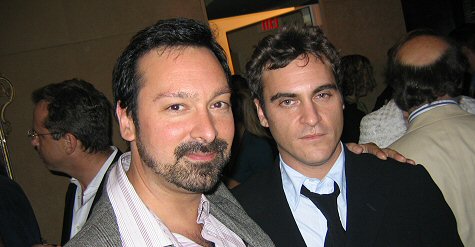
Keira

“I think Keira Knightley is easily the most over-rated actress that my country has ever produced. Every film she’s in she always has her mouth slightly open, giving the impression that she’s a zombie. (She has the acting talents of one) I saw her in that Dr. Zhivago drama, and she looked like a lost child in it, drawing me out of the story. (I haven’t seen the David Lean version).
“You are spot on saying that she hasn’t got ‘it’ like, say, Natalie Portman. I realize she’s only 20, but at the moment she has a lot of catching up to do to get anywhere near our best actress working at the moment, Kate Winslet.” — Ben Colegate, London, England.

Keira Knightley and Johnny Depp in Pirates of the Caribbean.
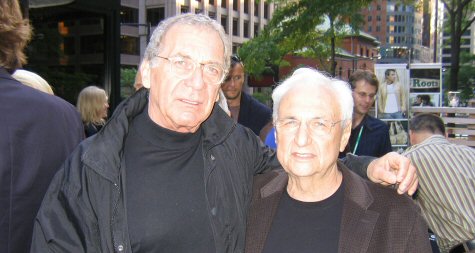
“Oh my God, it is so refreshing to see your comments about Keira Knightley! I’ve been wondering what is wrong with me, because in every film I’ve seen her in (except maybe Bend it Like Beckham) I’ve failed to see what the hype is all about.
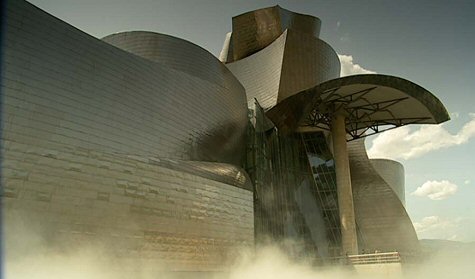
“She definitely does not have ‘it.’ I don’t think she’s a good actress at all, and, in fact, her looks bug me to no end as well. It’s that pouty mouth, I guess, it has one expression…pouty. She is actually the main reason I have no desire to see Pride and Prejudice, and at this point I’m real ‘iffy’ on whether or not to see Domino. I’ll wait until I read more reviews and hear from friends.
“Your comparison to Rachel McAdams is a good one. In my mind, however, perhaps because her looks are similar, every time I see Keira I think about Natalie Portman. Natalie is also young, also has been acting for a long time. But Natalie definitely has ‘it.’ I think she has talent in spades, has been getting better and better and will be seeing lots of critical acclaim and award attention in the future. I don’t see that for Keira.
“Thanks for making me feel I’m not alone.” — Cindy Wick

Grabs


Pub in Yorkville area of Toronto, about five blocks from where I’m staying.

On St. George, just north of Bloor.

My last Manhattan shot of the summer — bootleg DVDs laid out on the cement floor of the Union Square L line.

Truman Show

Truman Show

I’ve seen Bennett Miller’s Capote (Sony Classics, 9.30) twice now, and I’m afraid I’ve got it bad. I love this film…so much that my reasons for feeling this way are a bit more personal than usual.
Why get into it now, a little more than four weeks before it opens? Because I’m in Toronto and for me, the festival has begun (advance screenings are happening left and right for local press), and because everyone will be giving Capote pats on the back once the festival starts on 9.9 so I might as well pat first.


Phillip Seymour Hoffman as the conflicted, terrier-like Truman Capote in Bennett Miller’s Capote (Sony Classics, 9.30)

I’m taken with Capote partly because it’s about a writer (Truman Capote) and the sometimes horrendously difficult process that goes into creating a first-rate piece of writing, and especially the various seductions and deceptions that all writers need to administer with skill and finesse to get a source to really cough up.
And it’s about how this gamesmanship sometimes leads to emotional conflict and self-doubt and yet, when it pays off, a sense of tremendous satisfaction and even tranquility. I’ve been down this road, and it’s not for the faint of heart.
< ?php include ('/home/hollyw9/public_html/wired'); ?>
But I’m also convinced that Capote is exceptional on its own terms. It’s one of the two or three best films of the year so far — entertaining and also fascinating, quiet and low-key but never boring and frequently riveting, economical but fully stated, and wonderfully confident and relaxed in its own skin.
And it delivers, in Phillip Seymour Hoffman’s performance as Capote, one of the most affecting emotional rides I’ve taken in this or any other year…a ride that’s full of undercurrents and feelings that are almost always in conflict (and which reveal conflict within Capote-the-character), and is about hurting this way and also that way and how these different woundings combine in Truman Capote to form a kind of perfect emotional storm.
It’s finally about a writer initially playing the game but eventually the game turning around and playing him.

Hoffman is right at the top of my list right now — he’s the guy to beat in the Best Actor category. Anyone who’s seen Capote and says he’s not in this position is averse to calling a spade a spade.
I’m not talking about Hoffman doing a first-rate impression of a famously effeminate celebrity author of the ’60s and ’70s. I’m speaking of his ability to make us feel the presence of Capote’s extraordinary talent and sensitivity and arrogance…a self-amused cocky quality born of extraordinary smarts and a feisty temperament that could suddenly veer into aloofness or even cruelty and at other times devolve into childlike vulnerability.
There’s always a sense of at least two and sometimes three or four rivers running through this character at once, all of it vibrating and churning around in Hoffman’s liquidy eyes and, when things get especially difficult, his nearly trembling pinkish- white face, and in the way he walks and gestures and shrieks with laughter at parties, and in the way he occasionally just stands utterly still. It’s an astonishing piece of work.
A friend thinks Hoffman isn’t small enough to play Capote, who was about 5′ 2″. Other naysayers may be heard. There’s a tradition of straight actors portraying flamboyant queens (I’m thinking way back to Cliff Gorman’s performance in William Freidkin’s The Boys in the Band) that hasn’t dated all that well, but Hoffman is doing so much more in this film that the comparison isn’t worth mentioning.
I can’t stop re-running my favorite parts of Hoffman’s performance. There are so many lines and moments, but to describe them would only muck it up. Maybe later…


Truman Capote, Kansas Bureau of Investigation chief Alvin Dewey, and Dewey’s wife Marie in ’60 or ’61.

Capote is fundamentally about “In Cold Blood,” Capote’s groundbreaking non-fiction novel that came out in early ’66.
The book was about the murder of the four members of the Clutter family of Holcomb, Kansas, and their killers, Dick Hickock (Mark Pellegrino) and Perry Smith (Clifton Collins, Jr.). The film is about Capote’s researching and writing of the book, a process that lasted from November 1959 until the summer of ’65, and which pretty much tore Capote to shreds.
The core material has to do with a kind of love affair that happened between Capote and Smith during the death-row interviews conducted by Capote from the time of the murderers’ conviction in early 1960 until the hangings of Smith and Hickock in April ’65. Capote fell in love with Smith because they had shared similar traumatic upbringings (alcoholic mothers, family suicides) and because Smith had certain poetic-artistic aspirations.
“It’s like we grew up in the same house, except one day Perry went out the back door and I went out the front,” Capote tells his longtime friend and confidante Nelle Harper Lee (Catherine Keener), the author of “To Kill a Mockingbird.”
He really feels for Smith…you can see it, feel it…but Capote is scrutinizing enough to step back at every juncture and eyeball his relationship with Smith in literary terms. After persuading Smith to let him read his diaries, Capote tells Lee that this sad, doomed, hugely conflicted man is “a gold mine.”
The fascination is in watching Capote play Smith like a pro while getting more and more caught up with him emotionally. He gets the two killers an attorney following their conviction so he can get their execution delayed so he can get their full story. And then he lies to Smith time and again.


Mark Pellegrino (left, seated) as Dick Hickock and Clifton Collins, Jr., as Perry Smith in Capote.

The real Hickock and Smith, upon their arrival in Kansas in early January after being arrested in Las Vegas, Nevada.

And after he’s gotten most of their story he begins to acknowledge that he wants them executed so his book will have a finale, even though his feelings for Smith have always been, as far as it goes, earnest.
There’s a nice scene when Capote tells Kansas Bureau of Investigation chief Alvin Dewey (Chris Cooper) that he’s decided to call his book “In Cold Blood,” and Dewey says, “Is that a reference to the crime, or the fact that you’re still talking to the killers?”
When their long-delayed death sentences are finally at hand, Capote’s feelings come to a boil. His last meeting with them, moments before the end, is choice. Tears flooding his eyes, Capote tells them both (but particularly Perry), “I did everything I could…I truly did.” Which was true, in a manner of speaking.
I never figured Bennett Miller would direct Capote quite so well. He’s never directed a feature and has mainly confined himself to TV commercials, although he directed a very fine 1998 documentary called The Cruise, a black-and-white portrait of the great Timothy “Speed” Levitch.
To me, Capote feels as controlled and precise, as emotionally on-target and penetrating as any film by Louis Malle. You could run it with Damage and Atlantic City at the Museum of Modern Art, and it would feel like the exact same guy calling the shots.
I was especially taken with Miller’s decision to shoot Capote in widescreen Panavision (2.35 to 1). Stories of this sort — internal, intimate, dialogue-driven — are usually shot in 1.85 to 1 (or on video). Was Miller thinking about creating some kind of visual relationship to Conrad Hall’s widescreen photography in Richard Brooks’ In Cold Blood, even though that 1967 film was shot in black and white?

And a sincere tip of the hat to screenwriter Dan Futterman, who worked on the screenplay for a long time before getting it right. It’s based on Gerald Clarke’s “Capote,” which is probably the best Capote biography.
Futterman has known Miller since they were twelve, and they’ve both known Hoffman since ’84 (i.e., the year Capote died of alcoholism) when they met at a summer theatre program in Saratoga Springs,
Every performance in Capote feels rooted and lived-in…nobody seems to be “acting” in the slightest.
Clifton Collins (previously best known as the gay Mexican assassin in Traffic) is as good as Hoffman. He plays it subdued and far less animated, but he lets you see into Smith’s tormented soul, and I didn’t think once about Robert Blake’s strong performance as Smith in the 1967 film.
Keener’s Lee is restrained and exacting and yet she’s fully “there.” And Cooper’s Dewey delivers just the right mix of gruff Midwestern conservatism and emotional suppleness. (He’s a tiny bit warmer than John Forsythe’s Dewey was in Brooks’ film.) Dewey’s wife Marie, a friendly and sophisticated soul, is warmly and agreeably captured by Amy Ryan. And I love Bob Balaban’s small but succinct performance as former New Yorker editor William Shawn, who was in Capote’s literary corner the whole time.
The lesser lights are Bruce Greenwood, as Capote’s significant other Jack Dunphy, who hasn’t much to say or do, and Mark Pellegrino’s Hickock, who isn’t nearly as emotional or gregarious as Scott Wilson was in the Brooks film, although he seems like more of a killer than Wilson did.


Gravesite in Garden City, Kansas — a mid-sized city to the east of Holcomb.

Photo in June 1960 high-school yearbook.

Capote may not sell as many tickets as Crash did, but it will be astonishing if people of taste or discernment don’t see it and tell their friends, etc. I realize that the number of people who read books, much less those who remember “In Cold Blood” or who remember Capote from his talk-show appearances, is relatively small. But if the word-of-mouth is good…
The challenge to Sony Pictures Classics is to keep the inevitable talk going into Oscar season and keep flogging it with the Academy.
After I send this column off today I’m paying a visit to a bookstore and buying “In Cold Blood” again. I haven’t read it since I wrote a book report about it in my senior year of high school.

Mafia Rules

I have this idea for a piece I’d like to run on Friday. I’m going to need write-in replies sent no later than midday Thursday.
The idea is, if Hollywood were run like the mythological mafia and you, the reader, were the boss of all the families with absolute control, whom in the Hollywood filmmaking game would you decide to whack for the good of the industry?
Not because they’re not nice people or aren’t skilled or have nice smiles, but whom would you eliminate in order to strengthen the industry and discourage bad tendencies, etc.? Remember that being the boss is a lonely job because somebody has to make the tough calls.


“I ask you, Don Corleone, please…spare Michael Bay.”

If I was Don Corleone of Hollywood and Hollywood was a real mafia society, I would put a general preemptive contract on anyone planning to make a film like Love Actually.
I would also put a contract, no offense, out on Johnny Knoxville. Somebody needs to pay for The Dukes of Hazzard, and Seann William Scott gets a temporary pass because he’s trying to redeem himself by making Southland Tales for Richard Kelly.
I would also take out Michael Wilson and Barbara Broccoli, the 007 producers.
I don’t think I need to say this, but I don’t believe in whacking people in the real world. I don’t even like stepping on bugs.
If I were an actual (i.e., actual mythological) mafia don I would build a secret private jailhouse — a maximum security prison out in some remote corner of the world — and then I would kidnap the guys who need to be whacked and send them to this jail, and they’d stay there with three hots and a cot until I died or got whacked myself.
My inspiration for this piece is Anthony Quinn’s Col. Andrea Stavros character in The Guns of Navarone.


David Niven, Gregory peck, Anthony Quinn in poster art for J. Lee Thompson’s The Guns of Navarone.

Quinn, Gregory Peck and David Niven are discussing the fate of Anthony Quayle’s Lucky character, who was broken his leg during a climb, and they’ve come up with two possible scenarios — take him with them on their mission to blow up the guns, or leave him to be found by the Germans.
And Quinn says, “There is, of course, a third option. One bullet now. Better for him, better for the mission.” Quinn is not playing a monster, just a hard-nosed commando.
And I’m channeling this spirit because, as Marlon Brando’s Colonel Kurtz would undoubtedly agree, doing the hard necessary thing is not always an act of kindness.

Hooligans

“After reading your take on Lexi Alexander’s Green Street Hooligans, I felt I had to give you a UK perspective on the movie. I watched what has been re-titled Green Street for UK audiences at a London preview last week.
“To me, and to most of the preview audience I saw the movie with, football hooliganism is old news. It was a hot button issue in the 1980s (when Alan Clarke’s The Firm was made) but since then most of the biggest firms have been busted.
“Thankfully, hooliganism has been mostly stamped out by no-tolerance policing, video surveillance at all games and better intelligence. It still exists, but it has gone underground.

“I grew up in a mainly working class neighborhood in a city called Portsmouth, on the south coast of England. Much like the movie, Portsmouth had a poor football club (although they’ve gotten a lot better) and an infamous firm of football hooligans (the 657 crew). Hooliganism was born out of a culture of binge drinking and violence.
“The idea forward by the movie that these firms only ever targeted their counterparts in rival firms is at best a simplification and at worst a glamorization of what they did.
“Often hooligans would simply pick off hapless away supporters who got lost in a strange city. If Pompey lost a match, hooligans would often run riot through the city vandalizing property and beating up any rival fans they could find, or failing that, anyone who wasn’t white.
“For a good drama about football hooligans, which exposes the hooligan’s links to British neo-nazi groups, I recommend I.D.’ (1995) directed by Philip Davis. I realize that the `stand by your friends whatever’ code that Green Street espouses is appealing, but please don’t confuse this with the mindless thuggery of real football hooliganism.
“I must also take issue with the way you characterize ‘this bizarre world of Brit football fanaticism.’ Football hooligans are not true football fans; they are in it for the violence. If you want a picture of Brit football fanaticism as opposed to hooliganism then check out the original version of Fever Pitch(1997), directed by David Evans.

“As for the movie itself, while the action sequences do have a real energy to them, the flat dialogue scenes in-between fatally hamstring the film. This is best illustrated by the opening scene in Harvard which, as you admit, `isn’t a very convincing beginning,’ and by the clunky scenes in which Matt Buckner (Elijah Wood) is tutored in cockney-rhyming slang. These scenes had the London preview audience chuckling and shaking their heads.
“The other problem is Elijah Wood’s inability to be convincing in his fight scenes. Although his character starts out as useless, after he becomes a seasoned member of the Green Street Elite he is supposed to have toughened up and learned to give and take a punch. However Wood continues to flail around in an embarrassing fashion in all his fight scenes, which may explain the director’s decision to shoot most of his fight in slo-mo (to try and disguise this).
“I agree that Charlie Hunnam is the real star of Green Street. He certainly makes the film watchable. I was surprised to learn that he is British though as I had assumed from the movie that he was Australian. His is a charismatic performance, but his London accent frequently slips into a bizarre almost Aussie accent. I guess your have to have lived in London for a few years in order to pick up on this, but I was wincing in places.
“Alan Clarke’s The Firm is a great film, which I strongly urge you to see. Like Scum it acknowledges the attraction that violence holds for some young men while simultaneously exposing the rotten culture that spawned it.” — Clive Ashenden
“Alan Clarke’s The Firm, which you mentioned in your piece about Green Stret hooligans, is a superb portrait of hooligan life (and probably more relevant, as the `80s were the pinnacles of English football hooliganism), featuring Gary Oldman’s best performance, before he took a liking for expensive scenery.


The U.S. release one-sheet (l.) and the British release version (r.)

“I’m not sure about the Green Street Hooligans flick. During the `70’s and `80s English hooligans were the worst — real scum who killed and maimed across Europe. Since all English clubs were banned following the Heysel tragedy, English football has come a long way, with a more family atmosphere at the grounds and less trouble at matches.
“For those who don’t recall, the Heysel disaster of May 29, 1985, led to the deaths of 39 fans and a five-year blanket ban on English clubs in European football.
“Juventus fans were given tickets adjacent to the Liverpool contingent who began by throwing stones and bottles, then charged the very thin blue line of under-equipped, poorly trained Belgian police. A section of Liverpool followers then stampeded towards the rival fans.
“A retaining wall separating the Liverpool followers from Juventus supporters in sector ‘Z’ collapsed under the pressure and many were crushed or trampled when panicking Juventus fans tried to escape.
“Thirty-nine Italian and Belgian fans died and hundreds were injured.
“I’ve been abroad and in the company of English hooligans. There isn’t a family/loyalty/ love equation going on. They use the cover of football support and rivalry to justify fighting with anyone and everyone who crosses their path. I’ve seen cars packed with holidaying families assaulted by `fans’ for the crime of hooting their horn.
“It’s just a booze-fueled, pack-animal mentality. Nothing more, nothing less.


The lads doing what they know, love and do best in Lexi Alexander’s Green Street Hooligans (Odd Lot, 9.9)

“Do we need another hooligan movie? I think not. No matter how hard any director tries, these films ultimately serve to sate those who wish to glorify and glamourize the worst side of our national sport.” — Dylan Glover, UK.
The Firm, like a lot of Alan Clarke’s work, was commissioned by the BBC. This is when the Beeb wasn’t afraid to premier new, once-off dramas by Mike Leigh, Ken Loach et al. on a weekly basis and around the time when the broadcaster fell afoul of the establishment with its astonishing Sunday night drama one-two punch of Alan Bleasdale’s The Monocled Mutineer and Dennis Potter’s The Singing Detective.
“It’s been a long while since I saw the firm but Gary Oldman’s portrayal of the main protagonist, Bex, really made punters and critics sit up and take notice. Shot on video, there’s little overtly cinematic about The Firm but its status as a cautionary tale of the Thatcher era — moneyed-up working class males in a more feminist-minded era take to soccer hooliganism as proxy warfare — stands unchallenged.
“I recall that The Firm (never released theatrically) played well across ages and interests because it didn’t stint on the violence, its origins or its consequences. Leach/Loach repertory player, Lesley Manville, was also top notch as Bex’s wife. Oldman himself was profoundly influenced by Clarke when he made his directorial debut, The War Zone, and it’s just a shame he’s been unable to find a script of its ilk since them.” — Neil King.

Grabs


Bloor Street facing east, downtown Toronto — Wednesday, 9.1, 11:25 am.

Coming into Toronto on Continental Airlines — Tuesday, 8.30, 12:55 pm.

Adjacent to Metro North train platform in Bethel, Connecticut — Sunday, 8.28, 1:40 pm.

Lexington and 54th — Monday, 8.29, 6:50 pm.

Brill building lobby (reverse angle of shot that ran in last Friday’s column).

Has the ripple effect of the failure of The Island extended to the sales of “Island Puma” shoes that Ewan MacGregor and others wore in the film? I have no hard data to back this up, but I do know that Puma’s of this sort sell for $90 or $100 bucks, and yet these black-and-white Puma’s were being offered on sale last week on 14th Street…these plus another pair for $80.

Ruffians

It doesn’t aspire to high art or try for the sort of emotional engagement that makes you choke up, but Lexi Alexander‘s Green Street Hooligans (Odd Lot, 9.9) is nonetheless a very intense emotional hybrid thing, which is to say a sports movie and a bloody gang-violence movie mashed into one.


The lads doing what they know, love and do best in Lexi Alexander’s Green Street Hooligans (Odd Lot, 9.9)

I don’t know how well this mostly London-based film is going to do in the States given the exotic milieu and the thuggish attitudes (i.e., the world of boozed-up, ultra-violent British soccer fans), but it’s vibrant and original enough to warrant being seen and grappled with. It sure as shit is an experience and an education.

And it’s absolutely a career springboard for British actor Charlie Hunnam, who steals the show with a second-banana performance as a violent, in some ways immature, soccer fan who is nonetheless man enough to bring a sense of balance and compassion to an otherwise loutish lifestyle.
Hunnam starred in Nicholas Nickleby, and was in Cold Mountain, a Katie Holmes thriller called Abandon and the British TV series Queer as Folk, but who noticed? Now this 25 year-old has punched through.

The superficial tag is to call him a younger Brad Pitt with a Brit accent. What matters is that he conveys an inner groundedness and conviction on top of a sense of basic decency that you find yourself recognizing and responding to right away.

Hunnam is not just the star of Green Street Hooligans — he’s a star waiting to happen. Maybe. If he’s lucky and has the right agent and can do an American accent. (There seems to be some question whether or not he appears in Robert Towne’s Ask the Dust, which will debut at the Tellruide Film Festival in a few days). Whatever happens, he’s got it inside.


Charlie Hunnam

Green Street Hooligans is a story about a young American (Elijah Wood) on a visit to London who gets caught up in the violent world of English soccer fandom by joining a “firm,” which is a term for a gang that asserts and defends the honor of a given soccer team by parading around after soccer matches and confronting other firms and kicking their ribs in, or vice versa.

It sounds repulsive and cro-Magnon on one level, but European guys take soccer (which, of course, they call football) very seriously. And a lot of British working- class dudes are extremely furious about…well, I don’t know what precisely but apparently a lack of opportunity within a still-fairly-restrictive social caste system and having to make do with certain economic terms. I’ve been to London a few times and have felt this. The social-rage levels over there are much more intense among the disenfranchised than they are here.

And there are elements that go with being a firm member…tribal love, loyalty, security…that you’re not ever going to find vegging out in front of a computer or a TV, so there’s something to be said for it.
If you’re at all receptive to the values I’m speaking of and you can roll with fairly realistic depictions of street violence, Green Street Hooligans is affecting in a hormonal, territorial way. If it doesn’t exactly speak to Americans where they live in terms of being avid sports fans, it certainly is different and bracing and a movie to kick around and talk about and send your friends to.

Unless, that is, you happen to be one of those absent-sports-gene types who just doesn’t feel it or get it, in which case it may seem too exotic and what-the-hell?


The U.S. release one-sheet (l.) and the British release version (r.)

I’m kind of in this camp (my favorite spectator sports are tennis and baseball), but I get what the film is putting across and I respect the effort and the craft that Alexander and co-screenwriters Dougie Brimson and Josh Shelov have put into making this world come alive.
The German-born Alexander, a late twentysomething who grew up with football fandom and knows this universe fairly well, has made a name for herself with Hooligans and has already gotten a gig out of it — a thriller for Disney called Labor Day.

When you`re watching Hooligans…I’m sorry, Green Street Hooligans …you have to keep telling yourself, “A young woman directed this, a young woman directed this.” But then Alexander is a former World Kickboxing champion who used to scrap with a Mannheim, Germany, firm for three years, so…

Green Street Hooligans won both the grand jury prize and the audience award for best feature at the South by Southwest festival last March, which should indicate something.

(It used the original British title of Hooligans at that Austin venue, and I can’t quite understand why the distributor, Odd Lot Releasing, feels that adding the words Green Street makes the film more appealing to U.S. audiences.)

Wood’s character, a Harvard journalism major named Matt Buckner, is the audience’s tour guide into this bizarre world of Brit football fanaticism. He gets into it by getting kicked out of Harvard only three weeks or so before graduation when his snotty fortunate-son roommate arranges for him to take the rap for cocaine found in their dorm suite.

(This isn’t a very convincing beginning. In Josh Shelov’s original script Matt gets the boot after he and some classmates are accused of having cheated on an exam, and he is specifically ousted because his friends don’t stand up for him — an issue of loyalty that is dealt with later in the film.)

Matt flies from Logan to London to visit his sister Shannon (Claire Forlani), who’s married to a steady-seeming guy with a vaguely pissy attitude named Steve (Marc Warren). But Matt has arrived on a day when Steve is taking Shannon to see Chicago in the West End, so he’s temporarily placed in the care of Steve’s wild-assed brother, Pete (Hunnam).

Suspicious of this wimpy-looking yank, Pete reluctantly takes Matt to his local pub to meet his crew, who are called the GSE — i.e., Green Street Elite, a two-fisted firm devoted to the West Ham soccer…I mean football team.

Matt is regarded with some distance but then wins the respect of the firm when the GSE gets into a street fight with another firm and he throws himself into battle with real ferocity.

I had trouble with watching this at first, with Wood being so small and sensitive-seeming with those big watery eyes of his. But then I understand and sympathize with his having wanted to de-wimpicize and add some machismo to his persona after playing Frodo in the Rings films. (Has there ever been a more dewy-eyed, super-weenyish lead character in a major franchise?)

Trouble arises when a GSE member named Bovver (Leo Gregory) uncovers evidence that suggests (without actually proving) that Matt may be an undercover journalist secretly writing a story about the firm. This leads to all kinds of betrayals and soul-searchings and double-backs, and eventually the GSE gang going up against an especially hated firm whose leader has been nursing a particular rage against Pete’s family for years.


Hunnam again…seemingly two or three years ago.

It’s not hard to step back in the middle of all this and ask yourself, “Why don’t these guys just chill and pull back from this stupid-ass gang attitude that necessitates getting into fights all the time?” It seems so primitive and stupid and unenlightened, etc. I understood the meaning of it and felt it to a certain extent, but it wasn’t exactly coursing through my veins.

Then I read Lexi Alexander’s explanation for the behavior of these guys (who are legion over Europe), and I started to feel it a bit more. As I mentioned earlier, she was part of a firm in Mannheim, Germany, for three years (accepted by the males because of her black belt kick-boxing abilities) and knows the turf.

“Reliable. Protective. Loyal. Consistent. That’s what I remember most about the firm…which was more than you could say about any of our parents,” she writes. “The firm was our family. What we missed at home, we found in each other..in our firm. The riots were about proving our love, because obviously a bunch of guys don’t walk around telling each other, ‘I love you, man.’

“Standing next to your friend when you’re facing thirty guys who want to punch your face in — that’s love.

“Coming back for somebody who fell or was left behind, despite the fact that you’re most likely going to get your ass kicked — that’s love.
“Watching your mates out of the corner of your eye in a fight, and making sure you come to [their] rescue when needed — that’s love.
“Getting arrested and not remembering anyone’s name when the cops question you — that’s love.”

The message of this film, she says, is never abandon a friend when the chips are down.


Green Street Hooligans director Lexi Alexander, star Elijah Wood at Austin’s Draft House after South by Southwest screening last March.

“When your friend is sick, don’t run. When your friend has a crisis, don’t run. When your friend is going through a streak of bad luck, don’t run. When your friend is being treated unjustly, stand behind him/her, or better yet, stand in front. And when you become successful, don’t leave your friends behind.”

That gets me. I know that if I had a dollar for every fair-weather friend I’ve ever had, I could buy a new 100 gig computer. I know I could certainly use a friend or two with a “firm” attitude. Couldn’t we all?
On the other hand, I haven’t punched or even shoved anyone since I was in the seventh grade. And I need my fingers to be agile and unswollen because I have to type all the time. And British blokes can afford to lose a couple of teeth now and then because they have a good national health care system to turn to — I don’t.

There’s a 1988 Gary Oldman film called The Firm (dir: Alan Clarke) that covers the same territory. Here’s the Amazon page for a buyable Alan Clarke DVD package that includes The Firm. I hear it’s strong and worth seeing. Anyone…?

Toronto Feed

“I read your mention about showing caution when it comes to Michael Caton Jones and particularly his Shooting Dogs, which will show at the Toronto Film Festival.
“Well, I saw it in Cannes and it’s very good — a decent, solid drama about the Rwanda massacre of ’94. It’s a fuck-Schindler-Benigni kind of film. No heroes, no innocent little girls, no redemption. And the carnage is great.
“I’ve read ‘A Time for Machetes,’ the Jean Hatzfeld book about the massive killings, and MCJ was pretty precise about a lots of things.


Hugh Dancy, John Hurt in Michael Caton Jones’ Shooting Dogs.

“Otherwise…
“Cronenberg’s History of Violence, as you know, is splendid. This thing grows in your brain (nyuk-nyuk) many days after the screening. I loved it. You have to see it again.
Free Zone: Crap. Arghh. A cheater. Kiarostami without the ideas, Panahi without the balls. Step aside, you don’t need this.
Cache: Amazing. Dry, cool, disturbing. Did you saw Haneke’s Code Unknown, which was one of the major influences on the 21 Grams narrative? This thing has the same eerie feeling. It’s funny, it works like a twin film with the Cronenberg piece. Besides, Auteuil and Binoche are the best married couple I ever seen in the screen in years. They just nail the atmosphere of ten-years-of-marriage in a way that Kidman-Cruise-Kubrick never did.
L’ Enfant: It’s not as good as Rosetta, but…hmmm, I don’t remember anything good as Rosetta, so…nut it’s very good, it’s worth a look and the only problem is the age of the principal actor. I will leave you to discover on your own what I mean by this.” — Daniel Villalobos, Santiago, Chile.

Just Six

“Dunno if you get the Encore cable channels but Stuart Samuels’ Midnight Movies doc, which is playing Toronto, has been airing there all month.
“It’s an interesting movie that I caught late one night, and while I had hoped it would cover a broad spectrum of films it actually focuses on just six films — El Topo, Night of the Living Dead, Eraserhead, Pink Flamingos, The Harder They Come and The Rocky Horror Picture Show.
“While it’s something I enjoyed watching on TV, and I like five of the six movies, I would’ve felt a little let down if I’d seen it in a theater. It’s not bad, it just didn’t tell me much that I didn’t already know. Still, I always enjoy John Waters interviews and this one has plenty.” — Neil Harvey.

Grabs


Thursday, 8.25, 7:50 pm.

Fifth Avenue strollers from various walks of American life and of different faiths and political persuasions contemplating the notion of being gay and up for action — Friday, 8.26, 4:20 pm. I took a series of these photos, and for nearly 30 seconds an older woman and her daughter — tourists, I was fairly certain — who happened to be approaching stood to the side and waited for me to finish. It didn’t occur to them that someone shooting a street scene might be cool with a woman or two walking in front of the camera just as he/she snaps a photo. It could make for a more interesting shot…who knows? But this didn’t occur to them, and so they stood there for almost 30 seconds waiting for me to finish. That’s mainstream America for you. Very polite.

Sixth Avenue and 47th Street, or something like that — 8.25, 5:45 pm.

While speed-marching over to Dolby Screening Room (1350 Ave. of Americas) to see Lord of War — 8.25, 5:42 pm.

Iraqi War 101

“I believe you’re familiar with our Iraq doc Gunner Palace. Last week I devoured your column about the upcoming slate of 9/11 and terror films. It was a needed piece. For me especially, as the theme of reality vs. fiction has been at the top of my mind lately.
“Last May I was invited to a DGA panel discussion where they screened parts of Gunner Palace ‘against’ Iraq-themed episodes of ER and JAG as well as the pilot for Bochco’s Over There. Without going into critic mode, I must say it was surreal to sit in a theater watching fictional scenes from a reality that I was preparing to return to in ten days.
“In the last six months, GP has become something of an Iraq War 101 for creative execs. As you must know, there are at least 10 Iraq projects floating around and development people are looking for interesting takes on Iraq, so every so often we get a call.
“In the beginning I was resistant to the whole idea of fiction — that is, until I had the experience of trying to market a distinct reality to a tabloid nation. We’ve had a fantastic run with GP –I’ve only been home six weeks since January — and the film has been held up as emblematic, but we’ve also been keenly aware of both an audience disconnect and war fatigue.

“However, at the same time, I’ve sensed that the disconnect comes largely from an emotional inability to relate to the subject, a faraway reality, and I’ve perceived a certain hunger to understand the war beyond the rants of pundits.
“Your 9/11 piece raised interesting questions. In regards to this ongoing war, I’ve asked myself, when is soon too soon? Perhaps now is the time — and the public doesn’t need a decade for collective memory to simmer — rather, perhaps there is an urgency to get it right, to tell it like it is.
“I found this Roger Ebert quote the other day:
“‘Whether we are for the war or against it, we all know it is a terribly complicated struggle. There is a desperate need in this country for a film that will depict the war in honest terms.”
“I have not been one for emotional button-pushing, especially about a war that has become all too personal to me, however, as flawed as fiction often is, it has the ability to evoke very real emotions. The Deer Hunter comes to mind. Inaccurate? Without a doubt — down to the last detail — but it captured the emotional essence of an experience. From another war, another time, came The Battle of Algiers — fiction, yes, but a fiction so steeped in reality that it was banned in France. Something to aspire to…no?
“So I surrender to fiction and the urge to at least get it right, to answer Ebert’s call to arms, remembering what a 19 year-old soldier had to say about his experience in GP: ‘For y’all this is just a show, but we live in this movie.” — Mike Tucker

Out There

“Those Walk the Line wildpostings are all over San Francisco too. I saw them the other day and thought, isn’t that opening like months from now? I really like the look of it, and the heavy use of graphics over photos. Seems unorthodox for a biopic.” — Tom Kelly, San Francisco, CA.

Grabs 2


You don’t have to put a caption under every damn photo.

The lobby of the famous Brill building on Broadway and 48th (or is it 49th?) I took this last night around 7:35 pm, just after slipping out of a preview screening of Pride and Prejudice upstairs. A romantic breakup scene in Alexander MacKendrick’s Sweet Smell of Success was filmed right here roughly 48 years ago. Susie Hunsecker (Susan Harrison), terrified sister of ruthless columnist J.J. Hunsecker (Burt Lancaster), has just called it quits with jazz musician Steve Dallas (Martin Milner). Dallas and his manager Frank D’Angelo (Sam Levene) walk down the hallway and out of the building as a glum-faced Susie leans against the wall near the elevators. As they’re standing outside on Broadway, Milner says to Levene, “Look inside and tell me if she’s still standing there.” Levene looks. “She’s still standing there,” he says.

This newspaper ad on behalf of Werner Herzog’s Grizzly Man is apparently aimed at the March of the Penguins crowd. You almost want to pet this guy. Timothy Treadwell, the “star” of Grizzly Man did, in fact, pet a few until one day…

A block or two west of CBGB’s — Sunday, 8.21, 4:40 pm.

Thursday, 8.25, 5:55 pm.

Change of Season

The winding down of the ’05 summer is fortunate in two respects: it’s getting a tiny bit cooler in the city (there was a transcendent breeze travelling southward down Broadway Monday night around 9:30 pm), and it gives me something to write about during a flat week.
It felt to me like an above-average summer. At the end of each year I always come up with a list of 40 or 45 films that were good, very good or excellent, and here we had a summer providing about 21 first-raters, or just over five per month. (I’m going by the perimeters of May 1st through August 30th.) Not bad for a season that’s thought to be mainly about flotsam and popcorn and yeehaw.


Ralph Fiennes in Fernando Mierelles’ The Constant Gardener (Focus Features, 8.31)

I’ve written enough about the good ones in past columns, so I’m going to have more to say about the problems and irritants. But starting at the top…
GOOD AS IT GOT (in the following order): Hustle & Flow, The Constant Gardener, Cinderella Man, Last Days, Crash, The Beautiful Country, Grizzly Man, Wedding Crashers, Batman Begins, Mad Hot Ballroom, The Beat That My Heart Skipped, The Aristocrats, Broken Flowers, Kingdom of Heaven, The White Diamond, Layer Cake, Cronicas, My Summer of Love, This Divided State, Tell Them Who You Are, War of the Worlds.

That was the good news, although I’m presuming very few even had the option of seeing The White Diamond, a Werner Herzog doc I wrote about in the June 8 column, or Mark Wexler’s Tell Them Who You Are, a feisty portrait of the director’s relationship with his overbearing dad, the award-winning cinematographer Haskell Wexler.
The lesser films were tedious, grueling or worse. I am one who feels especially dispirited by cheesily commercial films made by directors and writers whom I know are capable of delivering much smarter and craftier stuff, and…well, I guess I should leave Judd Apatow and The 40 Year-Old Virgin alone. (I’ve been warned by readers.)
But this isn’t an obsession thing of mine. It’s a sum-up piece and Virgin has made a big splash, but it’s really not fit to lick the boots of The Wedding Crashers and deserves to be called the SUMMER’S MOST OVER-PRAISED SO-SO COMEDY.


Russell Crowe, Renee Zellwegger in Ron Howard’s Cinderella Man

Just gonna zotz out the rest…
PUTRID, REPUGNANT, MALIGNANT…NOT TO MENTION ONE OF THE MOST BREATHTAKING CAPITULATIONS & SELL-OUTS IN HOLLYWOOD HISTORY BY A TALENTED DIRECTOR WHO KNEW BETTER: Doug Liman’s Mr. and Mrs. Smith, which way too many people gave a pass to with the rationale that it was harmless fluff.
MOST ATTENTION-GETTING WIPEOUT & ACROSS-THE-BOARD CAREER DAMAGER: The Island. The bitch-slapping of Michael Bay may not have been such a bad thing for the guy. The only way Bay is going to do better work (and I know he’s capable of it) is to be woken up from the narcotized pipe dream of being Michael Bay (muscle cars, bimbo girlfriends, parking in handicapped spaces, etc.), and it’s a safe bet that the staggering failure of The Island has made him reconsider his whole program. Producer Walter Parks got slapped around also when he said insufficient star wattage on the part of Island costar Scarlett Johansson was one of the reasons the film tanked; the take-no-guff Johansson fired right back and set him straight.
MOST LOATHSOME BIG-STUDIO RELEASES AFTER PREVIOUS TWO: The Dukes of Hazzard, Star Wars, Episode 3: Revenge of the Sith, Bewitched.


The Beat That My Heart Skipped

SEX SCENES SO BORING AND UNAPPETIZING THAT THOUSANDS OF COUPLES MIGHT HAVE BEEN PERSUADED TO PUT ASIDE SEXUAL ACTIVITY FOR A BRIEF PERIOD: Michael Winterbottom’s 9 Songs.
NOTEWORTHY ON-SCREEN IMPROV: After Kieran O’Brien playfully blindfolds Margo Stilley in 9 Songs, she says, “I can’t see!”
A MOVIE THAT PERSUADED ME TO THINK NEGATIVELY ABOUT A BIRD SPECIES THAT I’VE HAD NOTHING AGAINST MY ENTIRE LIFE: March of the Penguins. You can sing the praises of this doc all you want, but those Emperor penguins spend way too much time trudging across Antarctic wastelands and sitting on unhatched eggs during blizzards. The success of this film was mainly driven by women and old people. Tell me one regular guy you know who went to this thing on his own (or with his regular-guy friends) and came back going, “Amazing!” I don’t want to see any animals suffer, but it would have enlivened things if a few more penguins had been eaten by predators.
AS A LIVE-ACTION DIRECTOR, IT’S TIME TO FACE THE FACT THAT TIM BURTON MAY BE OVER: Charlie and the Chocolate Factory.
NOT ENOUGH: Monster-in-Law, The Untold Story of Emmett Louis Till, Bad News Bears, Dark Water, Asylum, The Chumscrubber, Lila Says , Rize.


Christian Bale in Chris Nolan’s Batman Begins

FLATLINERS: The Longest Yard, Madagascar, Kings and Queen, Lords of Dogtown, Must Love Dogs , Fantastic Four, Stealth, The Brothers Grimm, Heights.
WANTED TO SEE ‘EM, MISSED THE SCREENINGS, COULDN’T SEE FORKING OVER TEN BUCKS, ETC.: Howl’s Moving Castle, High Tension, The Devil’s Rejects, November, Mysterious Skin, Murderball, The Edukators .
WOULDN’T SEE ‘EM AT THE POINT OF A KNIFE: The Sisterhood of the Travelling Pants, The Honeymooners, Herbie: Fully Loaded .
NOT HALF BAD: Yes, Red Eye, Four Brothers, Reel Paradise, House of Wax, Dominion: Prequel to The Exorcist, The Great Raid, The Last Mogul , Me and You and Everyone We Know, George A. Romero’s Land of the Dead.
BIGGEST ACTOR BREAKTHROUGHS: Rachel McAdams (The Wedding Crashers, Red Eye), who could wind up doing it all. Terrence Howard (Hustle & Flow, Crash), who deserves a Best Actor nomination hands-down for his Memphis pimp. Vince Vaughn (Wedding Crashers…can’t wait for his tortured deejay movie for director David O. Russell). And Amy Adams (Junebug), although she needs to move beyond that sweet and trusting magnolia-blossom thing.
LEAST INTRIGUING NEW ACTOR (and a possible speed-bump for Clint Eastwood’s Flags of our Fathers): Jesse Bradford , the costar of Heights who, in that film, wore a fixed expression that said, “I’m not really getting what’s going on…I’m not sure what to say or do…maybe if I just stand here long enough looking like a stubble-faced bowling pin with legs, events will sort themselves out.”


Jesse Bradford at Sundance Film Festival, looking a lot less clueless and confused than he does in Heights…so maybe it’s not a terminal problem.

SUMMER’S BIGGEST STOCK-DROPPERS: Tom Cruise and Will Ferrell. Will Cruise ever get back the lustre he had in the wake of Jerry Maguire, or are emperors forever disempowered once the public has seen them without their aura of mystery and velvet robes? When Ferrell came out of the shadows of that bungalow to talk with Owen Wilson in that third-act scene in Wedding Crashers, you could almost hear the film’s energy collapse and an instant consensus form in the audience that he didn’t belong and was way overdoing it. Plus he was ickily unfunny in Bewitched . This sounds incredible for a guy who’s only been a marquee draw since Old School, but he may already be heading downhill.
COLD-SHOULDERED, UNDER-ATTENDED, INSUFFICIENTLY LOVED: Cinderella Man, Kingdom of Heaven, Tell Them Who You Are, My Date With Drew.

Toronto Jam

This year’s Toronto Film Festival (Sept. 8th through 17th) is a big problem in the best way imaginable: there are too many good films to see in only nine days. I gripe about this every time the schedule is announced, but this year is really a bitch.
I’ve come up with 69 films I’d like to see (or in some cases, see again). If I run around like an animal and the screening times mesh perfectly with my column-writing schedule (which never happens) and I don’t get shut out of any films (which happens a lot at this festival), I’ll be able to catch four per day or 36 films.

That means I’m going to have to forget about seeing 33 films that I’d definitely see under free-and-clear circumstances. This means I have to start crossing a lot of ’em off…a tough but necessary task.
Imagine a filmmaker having just finished a film into which he/she has invested every last drop of blood, sweat and tears, only to read some journalist talking about taking a few whiffs and calibrating the angle of the dangle and going, “Naah, I don’t think I’ll see that one.”
I’d like to hear anything from anyone out there because these lists are always changing, but at first glance here’s what’s doing. The films I’d like to see but have doubts about are italicized; keepers (i.e., films most likely to connect with paying audiences because they look commercial or will prove aesthetically exceptional) are boldfaced.
WORLD CINEMA (4): River Queen, director: Vincent Ward. (financing problems, Samantha Morton problems…a sturm und drang movie); Shooting Dogs, director: Michael Caton-Jones (always approach an MCJ film with caution); Le Temps qui reste, director: Francois Ozon (haven’t heard anything to quicken my pulse); Tsotsi, director: Gavin Hood (Athol Fugard source material…being schmoozed into seeing this by Donna Daniels and Emily Lowe.) Keeper total: 0.


Jason Statham in Guy Ritchie’s Revolver

DIALOGUES: TALKING WITH PICTURES (4): Midnight Movies: From the Margin to the Mainstream, director: Stuart Samuels (talked to Samuels in Cannes even though I hadn’t see it…love the subject but I may miss it again); My Dad Is 100 Years Old, director: Guy Maddin (maybe, but The Saddest Music in the World didn’t do it for me); Open City, director: Roberto Rossellini (never seen a decent print, I’d love to see it with a hip crowd, and I’ll probably blow it off); William Eggleston in the Real World director: Michael Almereyda (not feeling it). Keeper total: 0.
DISCOVERY (1): Stoned, director: Stephen Woolley (missed the market screenings in Cannes…I was told it wasn’t so hot…I’d like see it anyway because it’s about the death of Brian Jones). Keeper total: 0.


The White Masai

MASTERS (11): Breakfast on Pluto, director: Neil Jordan (seeing it here Friday); Brokeback Mountain, director: Ang Lee (will someone please arrange an impromptu screening of Andy Warhol and Paul Morrissey’s Lonesome Cowboys during the festival?); Bubble, director: Steven Soderbergh (for the last few years Soderbergh has been like Mickey Mantle during one of his slumps…the fans in the stands going, “Hit one out of the park, Mick!” with their fingers crossed); Cache, director: Michael Haneke (missed it in Cannes where it almost won the Palme d’Or…have to see it); L’ Enfant, directors: Jean-Pierre Dardenne, Luc Dardenne (the Palme d’Or winner at last May’s Cannes Film Festival); Free Zone, director: Amos Gitai (saw it in Cannes, wouldn’t mind catching it again… fascinating road movie that takes you through Israel and Jordan…fine Natalie Portman performance…satisfying in a minor key); Iberia, director: Carlos Saura (waiting to hear something); No Direction Home: Bob Dylan, director: Martin Scorsese (how can I miss this?…then again, one wonders what fresh new aspect of Dylan-the-sourpuss can Scorsese be expected to uncover?); Tideland , director: Terry Gilliam (there’s no missing a Gilliam); The Best of Our Times, director: Hsiao-hsien Hou (maybe); and Takeshis, Takeshi Kitano‘s latest about a celebrity confronting a double. Keeper total: 7.


Cameron Diaz in an alleged still from Curtis Hanson’s In her Shoes

MIDNIGHT MADNESS (2): The Great Yokai War, director: Takashi Miike (maybe); Sarah Silverman: Jesus is Magic, director: Liam Lynch (liked her in The Aristocrats…she played the nagging-bitch girlfriend in School of Rock). Keeper total: 0.
REAL TO REEL (6): a/k/a Tommy Chong, director: Josh Gilbert (definite interest so far); A Conversation with Basquiat, director: Tamra Davis (ditto); The Devil and Daniel Johnston, director: Jeff Feuerzig (heard good things when it played Sundance); Leonard Cohen: I’m Your Man, director: Lian Lunson (gotta catch this one); Twelve Disciples of Nelson Mandela, director: Thomas Allen Harris (definitely intrigued); and Why We Fight, director: Eugene Jarecki. Keeper total: 3.


Dame Judi Dench in Stephen Frears’ Mrs. Henderson Presents

SPECIAL PRESENTATIONS (18): Art Project: Ghosts of Woodrow, director: Graeme Patterson (waiting to hear something); Bee Season, director: Scott McGehee, David Siegel (Tom Luddy having chosen it to play Telluride Film Festival ought to mean something); Capote, director: Bennett Miller (seeing it in NYC this week); Dave Chappelle’s Block Party, director: Michel Gondry (Chappelle’s flake-out/disappearing act a while back…does that make this film more or less intriguing?); Everything Is Illuminated, director: Liev Schreiber (might see it here); The Notorious Bettie Page, director: Mary Harron (essential for the period trimmings and sexy-photo stuff alone…Harron did an excellent job with American Psycho); Oliver Twist, director: Roman Polanski (can’t blow off Polanski, although I suspect he probably shot his last meaningful wad with The Pianist); Romance & Cigarettes, director: John Turturro (can’t bypass a singing James Gandolfini); Shopgirl, director: Anand Tucker (I’m hearing not great but fairly decent); Sketches of Frank Gehry, director: Sydney Pollack (gotta show respect to Pollack and Gehry); Slow Burn, director: Wayne Beach (waiting); Thank You For Smoking, director: Jason Reitman (sounds a bit obvious, but maybe): Tim Burton’s Corpse Bride, directors: Mike Johnson, Tim Burton (Burton is better with puppets than people, but it looks like The Nightmare before Xmas again); Tristram Shandy: A Cock and Bull Story, director: Michael Winterbottom (9 Songs didn’t do anything for Winterbottom’s rep, but this is supposed to be fairly good); Trust the Man, director: Bart Freundlich (always approach a Freundlich film with caution); Vers le Sud, director: Laurent Cantet (waiting to hear something); Wah-Wah, director: Richard E. Grant (ditto), The World’s Fastest Indian, director: Roger Donaldson (good buzz from Oz exhbitors about this one during their recent Australian Gold Coast convention, but Donaldson being from New Zealand suggests it should probably be taken with a grain). Keeper total: 10.


Charlize Theron in Niki Caro’s North Country

VIACOM GALAS (15): Dreamer: Inspired by a True Story, dierctor: John Gatins (any movie with the word “dreamer”…holding off for now); Edison, director: David J. Burke (waiting to hear something); Elizabethtown, director: Cameron Crowe (essential); L’ Enfer, director: Danis Tanovic (don’t know anything); A History of Violence, director: David Cronenberg (missed about 20 minutes worth in Cannes when I nodded off…want to see it again anyway); In Her Shoes, director: Curtis Hanson (exhib calls it an above-average chick flick and a little on the “commercial” side…Hanson-as-director means this has to be seen, but a serious film maven must always approach any film starring Cameron Diaz with a certain caution); The Matador, director: Richard Shepard (Sundance buzz was fairly good but nothing spectacular); Mrs. Harris, director: Phyllis Nagy (Bening and Kingsley…essential viewing for these two alone); Mrs. Henderson Presents, director: Stephen Frears (there’s no blowing off a Frears film); The Myth, director: Stanley Tong (skeptical); North Country, director: Niki Caro (return of Whale Rider director is an exciting prospect, but true-life story about a sexually harassed mine-worker sounds like a snooze, even with Charlize Theron in the role); Pride and Prejudice, director: Joe Wright (seeing it in NYC this week); Proof, director: John Madden (seen it, wrote about it); Revolver, director: Guy Ritchie (guarded optimism…post-Swept Away Ritchie requires extreme caution); The Three Burials of Melquiades Estrada, director: Tommy Lee Jones (fell for it in Cannes, looking to see it again); Walk the Line, director: James Mangold (saw it a few weeks ago, looking to go again just for the enjoyment); Water, director: Deepa Mehta (heard nothing); The White Masai, director: Hermine Huntgeburth (based on autobiographical book by Corinne Hofmann about a European white woman who falls head over heels for a Masai tribesman, blows off her boyfriend, uproots her life, etc.) Keeper total: 9.


Actual Bettie Page (i.e., receiving discipline) and not Gretchen Mol portraying the famous ’50s pin-up girl in Mary Harron’s The Notorious Bettie Page

VISIONS (6): 50 Ways of Saying Fabulous, director: Stewart Main (no hints); L’ Annulaire, director: Diane Bertrand (ditto); Brothers of the Head, directors: Keith Fulton, Louis Pepe (return of the Lost in La Mancha guys); Mary, director: Abel Ferrara (respect must be paid to Abel Ferrara, despite all the crap); The Piano-tuner of Earthquakes, directors: Timothy Quay, Stephen Quay (no hints); Wassup Rockers, director: Larry Clark (no clues). Keeper total: 2.
Add ’em up and at this early stage we’re looking at a grand keeper total of 31. Truth be told, I rarely seem to get to more than 25 or so films during a typical festival, although I’d love to crack 30 this time.

Grabs


Through windows of Dean & Deluca, SE corner of Broadway and Prince — Sunday, 8.21, 8:20 pm.

Only in New York City do you get this kind of stark aesthetic juxtaposition…one of the most beautiful dining-room decoration stores on the planet on the inside, and all kinds of heavy scaffolding and splattered paint and cheap-ass graffiti on the mailboxes outside.

Martin Scorsese, Matt Damon on set of the upcoming The Departed

James Mangold’s Walk the Line won’t be out until 11.18, but the 20th Century Fox marketing team is plugging it like a sonuvabitch. The Johnny Cash biopic has tribute pieces running in this week’s Time and Newsweek (particularly about Joaquin Pheonix and Reese Witherspoon’s performances) and now Fox has wild-posting all over Manhattan construction sites…which is fairly unusual for a film that won’t be opening for another three months.

Journos and industry types know Eamonn Bowles as the president of Magnolia Pictures, but he’s also the head of a kick-butt Iggy Pop-ish bar band called The Martinets. I saw them play last night at the Knitting Factory Tap Bar on Leonard Street (between B’way and Church), and was blown away — they’re really fast, tight and rock-sharp. The sound is raw and catchy and they all play like pros. Bowles sings like a mad banshee and plays electric guitar like a ringin’ a bell. It’s not just the usual bar-band “noise” but crafty, well-shaped material with intellectually pointed lyrics. I asked Bowles if Mark Cuban, the part-owner of Magnolia and a guy who reportedly gets around, has dropped by to catch the act. Bowles said nope.

All the milk that’s about to go bad and turn into cottage cheese, they send it to grocery stores in my Brooklyn neighborhood. I bought this last Sunday. The guarantee said it would be good until 8.25, and the next day all these gross little white globs poured out while I was trying to put milk in my coffee.

Playground at Spring and Mulberry — Sunday, 8.21, 5:45 pm.

Rice to Riches, located on Spring near Mulberry, is a stand-alone store that sells flavored rice puddings. Fantastic tasting, very filling, etc.

Facing south on La Guardia (I think…memory’s a bit hazy) — Sunday, 8.21, 7:15 pm.

Not Bali Hai

Not Bali Hai

Steve James’ Reel Paradise is lying in wait at your local theatre like a King Cobra. Buy a ticket and watch it and it will bite you and poison to death any Marlon Brando Mutiny on the Bounty South Sea island fantasies you may be nurturing.
Paradise says that watching a good movie can create a kind of paradise in your head, and that turning people on to an exciting or nourishing film can be a wonderful thing. It also says that an alleged tropical getaway like Fiji (and, by extension, other South Sea locations) can be vaguely boring and economically strapped with low-rent thieves ready to sneak in and steal your computer if you’re not careful.


The Pierson family (l. to r.): Georgia, John, Janet, Wyatt in Steve James’ Reel Paradise

And you’d better watch out for your teenaged daughter while you’re there also because life is a struggle and a pain everywhere, and nothing about South Sea life is particularly safe or comforting or tranquil. In short, there are no getaway places. Your life is your life and that’s that.
I don’t know why I used the image of a King Cobra to describe this film. It’s more of a mongoose, really. A thoughtful, life-can-be-gnarly-but-whaddaya-gonna-do? movie made by folks I happen to know and like and respect.
< ?php include ('/home/hollyw9/public_html/wired'); ?>
I guess all I’m really saying is that I don’t think I’ll be visiting Fiji during my next South Seas vacation, but if you’re looking to spend your movie money this weekend on something more layered than Judd Apatow’s The 40 Year-Old Virgin, here’s a way to go.
It’s a doc about what happened three years ago to John Pierson — the former “Split Screen” host, movie-book author (“Spike, Mike, Slackers & Dykes”), producer’s rep and all-around movie community good guy — during a year-long stay in Taveuni, Fiji, where he and his family showed free movies to the locals at a place called the Meridian 180.
Pierson discovered this funky, barn-like theatre on a visit to Tavenui — an agricultural island of about 10,000 residents — in 1999. When the Meridian shut down in ’02 Pierson somehow managed to buy it and then talk his family — wife Janet, 16-year-old daughter Georgia and 13-year-old son Wyatt — into making the trek.


John Pierson addressing crowd at Taveuni’s Meridian cinema prior to another night’s showing.

And then James showed up with his camera in the summer of ’03 to document the final month of their stay. And what he got is that life without cultural resources or the usual modern-age distractions can be a bit flat. Taveuni is a poor island with no public electricity, no high-end restaurants, no video rental stores…Nothingville.
But the film also shows that good movies can have a kind of religious effect upon the locals, and that Pierson became, during his stay, a kind of parish priest.
Gut-level movies — comedies, thrillers — fared the best here. The Fiji folks haven’t had much education and are fairly low-rent in their tastes. They want to laugh or be thrilled or be scared. You get the idea that even if prints of, say, films by Robert Bresson were available to Pierson in Fiji, he wouldn’t have dreamt of showing them.
The obvious association is the scene in Preston Sturges’ Sullivan’s Travels when the chain-gang prisoners start laughing uproariously at a Pluto cartoon. A good laugh is all some people have, etc.
The biggest real-life issue in the film is computer robbery and the suspicions that arise about which local might be the culprit. Plus the projectionist Pierson has hired is a real slacker. And there’s also Georgia’s involvement with a local kid whom her parents have reason to disapprove of.


Georgia Pierson (l.) and friend in Reel Paradise.

Put aside the movie-religion aspects and Reel Paradise boils down to a series of lessons about what a real downmarket tobacco-road place Taveuni is, a laid-back culture without much to attract people like myself.
Variety critic Todd McCarthy says Reel Paradise is analogous in some ways to Peter Weir’s The Mosquito Coast. As I watched it I was thinking more about Franklin J. Schaffner’s Papillon.
My mind was also drifting back to that speech that Kirk Douglas gives in Ace in the Hole about the four spindly trees in front of Rockefeller Center providing more than enough in the way of nature’s splendor, etc.

Being There

Almost no one paid to see The Great Raid when it opened last weekend, and most of the critics were bored by it. (It only got a 36% favorable on Rotten Tomatoes.) I wasn’t exactly over-the-moon about it myself, but at no time did it anger or frustrate me, and there’s a kind of distinction in that.
The one aspect that got me 100% was the decision on the part of director John Dahl to make an anachronistic war film. The Great Raid isn’t boring, exactly – it’s just a movie that’s true to the era it’s depicting, and therefore feels out of synch with our times. Which, of course, is partly the point.
The Great Raid is a 98% true World War II story, and not just in factual terms. It’s the story of a raid in early 1945 by a commando team of about 100 soldiers and volunteers, led by some U.S. Army noncoms, upon a Japanese prison camp in the Philippine boonies. It led to the freeing of just over 500 prisoners, soldiers who might have died at the hands of their captors if the raid hadn’t happened.


Benjamin Bratt, James Franco in John Dahl’s The Great Raid.

You can say, “Yeah, and so what?” But this is what the movie’s about, and Dahl has not only paid respect to the story but the era when it happened.
Is The Great Raid the most suspenseful, excitingly paced war film anyone’s ever seen? Obviously not or it wouldn’t have died last weekend. It’s not exactly sluggish but it feels…dutiful. A movie “doing its duty” in trying to recreate a bygone era by adopting an anachronistic style.
And in this sense, Raid‘s stolid qualities — the feeling that it might be your grandfather’s idea of a satisfying World War II film — work in its favor. Not in its commercial favor, obviously, but Dahl did what he did for the right time-machine reasons.
It isn’t just that Dahl has heaped on period realism in terms of dialogue, character shadings and carefully-chosen props and wardrobe (guns, uniforms, women’s hair styles…all highly authentic and just so). It’s also the stolid framing and the unhurried old-fashioned pacing of the thing. It’s Dahl saying to us and himself, “To hell with 21st Century action movie appetites and standards…we are not playing that game.”
The only here-and-now aspect is the faded, sepia-like color…but even the desaturation seems to line up with the old-fogeyness of the thing. It opens the door to an imagining that an original version might have been shot in vivid Technicolor but then faded over the years.


Day-for-night still from The Great Raid, meaning this scene looks a lot duskier in the actual film.

The Great Raid doesn’t feel as if it was shot in ’45 and then put in a storage facility and kept there for 60 years. It would have had to have been filmed in monochrome in a 1.33 to 1 aspect ratio to achieve that illusion. But it does feel like it could have been made in 1955 or thereabouts. If this had actually happened it would have costarred Aldo Ray, Jeff Chandler and George Nader.
As is, the performances (by Benjamin Bratt, James Franco, Joseph Fiennes, Connie Nielsen, Marton Csokas) feel like earnest imitations of the kind of acting that Bill Holden or Jeffrey Hunter or June Allyson used to deliver in boilerplate war flicks of the 1950s.
And I admire the exacting ways that Dahl made it feel so old-fashioned. He knew there would be critics saying “too slow” or whatever, but he was too hard-core to spritz it up (like some period films I’ve seen) and make it feel, say, like a film that was half ’45 and half ’05.
I could go on and on about period films that got the haircuts wrong or had performances or dialogue that felt wrong. It’s not rampant but it happens. Period films are sometimes over-decorated or over-polished. The cars are too new or the actors are too present-day in their speech patterns or accents, or there’s too much CGI (like in Troy).


Marton Csokas in The Great Raid

You can argue that the verisimilitude in The Great Raid doesn’t matter that much because the story plods along and there’s not enough in the way of suspense or story tension, and I wouldn’t argue with you. But I didn’t mind it too much because the period immersion is so complete.
And I just had to slap myself to keep from nodding out. I am boring myself as I finish a piece about a movie that’s a little bit boring for the right creative reasons.
Honest footnote: I have to admit that I was glad when the Japanese soldiers dragged Csokas (the lover in Paramount Classics’ Asylum) and shot him in the head. Csokas speaks with an oddball accent in the film hat includes a bizarre throaty sound he gives to vowels, and so I was glad to rid of him.

By The Way…

Another movie that gets it right in a historical atmosphere sense is George Clooney’s Good Night and Good Luck, which I saw the other night.
It’s not just that the factual newsroom tale, which happened in 1954, has been shot in black and white, but that it feels like one of those live high-quality 1950s television plays, which were routinely seen on Kraft Television Theatre (ABC, 1953-55), Four Star Playhouse (CBS, 1952-56), Ford Theater (NBC, 1952-56) and so on.


David Straitharn in Good Night, and Good Luck

My immediate response was that I really liked and admired the austerity and the realism of Good Night, and Good Luck. It felt like it was happening in the actual 1954…almost. It didn’t feel like ’54 by way of 2005…and I liked that it got right down to the matters at hand and stayed with them.
It really is terrific when you feel a filmmaker striving as hard as Clooney, who costars as well as directs, to give a sense of time and place and also the mentality that informed an era…the way it most likely felt.
I probably won’t get into the merits of Good Night, and Good Luck until it shows at the New York Film Festival in late September (Warner Independent is opening it on October 7), but it’s a thoughtful, respectable film with first-rate acting and an honorable theme and a terrific performance by David Straitharn as legendary newsman Edward R. Murrow.

Honor of Lying

From a celebrity’s perspective, truth-telling is a selective process these days. That’s a way of saying that pretty much every celebrity lies right through his or teeth when it comes to public statements. But it’s okay because they’re well motivated.
They’re lying because they despise the media and feel that dealing with a corrupt and disreputable entity means all bets are off. And I think I understand the ethical system they’re embracing because it was explained in a couple of respected ’60s westerns.
Sam Peckinpah’s The Wild Bunch is one of them. I’m thinking of a scene in which William Holden’s Pike Bishop expresses moral support for Robert Ryan’s Deke Thornton because he gave his “word” to a bunch of “damned railroad men,” and Ernest Borgnine’s Dutch Engstrom defiantly argues, “That ain’t what counts! It’s who you give it to.”


Director Sam Peckinpah, star William Holden on the set of The Wild Bunch

Burt Lancaster says the same thing in The Professionals when he discusses flexible ethics with Lee Marvin. When Marvin reminds Lancaster that he’s given his “word” to Ralph Bellamy’s J.W. Grant, a millionaire railroad tycoon, Lancaster replies, “My word to Grant ain’t worth a plug nickel.”
Tom Cruise is J.W. Grant-ing, in effect, when he says he’s in love with Katie Holmes and wants to marry her and so on. He’s saying, “This is what you’re going to get from me and if you don’t think I’m being honest then that’s too fucking bad because my life is my own and you guys don’t rate the real truth because you’re scumbags and you pass along tabloid fairy tales.”
Brad Pitt and Angelina Jolie lied and lied and lied and lied (and told their publicists to lie and lie and lie and lie) about their relationship, and they felt just totally fine about it because their word to the tabloid press is commensurate with the degree of respect they have for it.

I don’t really believe this, but I like to tell myself that Bill Clinton lied about his history with Monica Lewinsky because he felt that the news media (and the Republicans pushing things along in the late `90s) had no honor or legitimacy in trying to explore his sex life. Looking right at the TV cameras and saying nothing happened was completely honorable because the news media deserved to be lied to.
I can see this. I can see how people being hammered about personal matters might start thinking this way. But then again…
If you’re willing to lie to someone, you’ve opened the door to dissing them in other ways. Just as Lancaster and Holden and friends were fine with lying to railroad men as well as stealing their money and possibly shooting them during hold-ups, I’ll bet celebrities are thinking about different ways of smacking around tabloid reporters.
That photographer who got shot with a BB pellet while standing outside Britney Spears’ Malibu home…? Just the beginning.

9/11 Movies

“Do we really need dramas about 9/11 so we can exploit the tragedy and suffering and add to the hysteria? It’s bad enough we have a manufactured war. Do we need manufactured crap to incite us further?” — Edward Klein
“I don’t know what bothers me exactly about the 9/11 movies coming out. There were plenty of movies about WWII, and a lot of them made during the war, but those were sort of rah-rah propaganda movies about a war that was absolutely necessary. The Vietnam films seemed hell-bent on showing us the real story behind a war that no one seemed to understand, and many of them revealed the suffering that the troops went through before and after the war.
“But those 9/11 films that are being prepared seem pointless. Why make one? What…there’s no actual footage? People have yet to see what happened? That’s not an argument since it was the single most videotaped event in the history of the world.

“So it must be a desire to reveal what people inside the towers and their families have dealt with during and since that day. No, since there have been countless news reports and documentaries and books and official reports letting us know the horrors of the attack and it aftermath.
“So what could possibly be motivating filmmakers about to start on their 9/11 movies…?
“The whole thing reeks of sickening commercialism. Greedy Hollywood vulture fuckheads who have no shame in exploiting people’s emotions and patriotism for a buck. This is example #5930 of how Hollywood is bereft of ideas. And I love how these guys have somehow talked themselves into thinking that they’re going to be doing some kind of service to mankind.
“It reminds me of the moment at the Oscars when James Cameron, holding his Best Picture award, asked the bejeweled, collagen-injected crowd for a moment of silence in memory of the victims of the Titanic disaster. It was both tasteless and ridiculous, and that event was almost 100 years old at the time. Just imagine how tasteless and ghoulish a 9/11 movie will be a mere five years after the tragedy.” — Mark Smith.

“I don’t see much in a script that attempts to retell an individual story from the events of 9/11. Anyone with a digital cable box can see documentaries from every point of view nightly on cable . HBO had an effective film several years ago that told the story of a boy whose mother was stuck in the towers and died that day.
“Hollywood could use 9/11 in a plot device for a romance — strangers fall in love while searching for a mutual friend who is missing. A sci-fi scenario where a character time travels and ends up in the towers. I think an audience could be accepting of 9/11 in film as long as it is not that literal. Spike Lee used 9/11 as a minor character in 25th Hour. — Ken Ridge, Hazlet, New Jersey.

Grabs


42nd Street between 7th and 8th Avenues — Thursday, 8.19, 10:25 pm.

Bedford Avenue underground — Thursday, 8.19, 7:35 pm.

Not Bali Hai

Not Bali Hai

Steve James’ Reel Paradise is lying in wait at your local theatre like a King Cobra. Buy a ticket and watch it and it will bite you and poison to death any Marlon Brando Mutiny on the Bounty South Sea island fantasies you may be nurturing in your soul.
Paradise says that watching a good movie can create a kind of paradise in your head, and that turning people on to an exciting or nourishing film can be a wonderful thing. It also says that an alleged tropical getaway like Fiji (and, by extension, other South Sea locations) can be vaguely boring and economically strapped with thieves ready to sneak in and steal your computer if you’re not careful.


The Pierson family (l. to r.): Georgia, John, Janet, Wyatt in Steve James’ Reel Paradise

And you’d better watch out for your teenaged daughter while you’re there also because life is a struggle and a pain everywhere, and nothing about South Sea life is particularly safe or comforting or tranquil. In short, there are no getaway places. Your life is your life and that’s that.
I don’t know why I used the image of a King Cobra to describe this film. It’s more of a mongoose, really. A thoughtful life-can-be-gnarly-but-whaddaya-gonna-do? movie made by folks I happen to know and like and respect.
< ?php include ('/home/hollyw9/public_html/wired'); ?>
I guess all I’m really saying is that I don’t think I’ll be visiting Fiji during my next South Seas vacation, but if you’re looking to spend your movie money this weekend on something more substantial and alert than Judd Apatow’s The 40 year-Old Virgin, here’s a good alternative.
It’s a doc about what happened three years ago to John Pierson — the former “Split Screen” host, movie-book author (“Spike, Mike, Slackers & Dykes”), producer’s rep and all-around movie community good guy — during a year-long stay in Taveuni, Fiji, where he and his family showed free movies to the locals at a place called the Meridian 180.
Pierson discovered this funky, barn-like theatre on a visit to Tavenui — an agricultural island of about 10,000 residents — in 1999. When the Meridian shut down in ’02 Pierson somehow managed to buy it and then talk his family — wife Janet, 16-year-old daughter Georgia and 13-year-old son Wyatt — into making the trek.


John Pierson addressing crowd at Taveuni’s Meridian cinema prior to another night’s showing.

And then James showed up with his camera in the summer of ’03 to document the final month of their stay. And what he got is that life without cultural resources or the usual modern-age distractions can be a bit flat. Taveuni is a poor island with no public electricity, no high-end restaurants, no video rental stores…Nothingville.
But the film also shows that good movies can have a kind of religious effect upon the locals, and that Pierson became, during his stay, a kind of parish priest.
Gut-level movies — comedies, thrillers — fared the best here. The Fiji folks haven’t have much education and are fairly low-rent in their tastes. They want to laugh or be thrilled or be scared. You get the idea that even if prints of, say, films by Robert Bresson were available to Pierson in Fiji, he wouldn’t have dreamt of showing them.
The obvious association is the scene in Preston Sturges’ Sullivan’s Travels when the chain-gang prisoners start laughing uproariously at a Pluto cartoon. A good laugh is all some people have, etc.
The biggest real-life issue in the film is computer robbery and the suspicions that arise about which local might be the culprit. Plus the projectionist Pierson has hired is a real slacker. And there’s also Georgia’s involvement with a local kid whom her parents have reason to disapprove of.


Georgia Pierson (l.) and friend in Reel Paradise.

Put aside the movie-religion aspects and Reel Paradise boils down to a series of lessons about what a real downmarket tobacco-road place Taveuni is, a laid-back culture without much to attract people like myself.
Variety critic Todd McCarthy says Reel Paradise is analagous in some ways to Peter Weir’s The Mosquito Coast. As I watched it I was thinking more about Franklin J. Schaffner’s Papillon.
My mind was also drifting back to that speech that Kirk Douglas gives in Ace in the Hole about the four spindly trees in front of Rockefeller Center providing more than enough in the way of nature’s splendor, etc.

Being There

Almost no one paid to see The Great Raid when it opened last weekend, and most of the critics were bored by it. (It only got a 36% favorable on Rotten Tomatoes.) I wasn’t exactly over-the-moon about it myself, but at no time did it anger or frustrate me, and there’s a kind of distinction in that.
The one aspect that got me 100% was the decision on the part of director John Dahl to make an anachronistic war film. The Great Raid isn’t boring, exactly – it’s just a movie that’s true to the era its depicting, and therefore feels out of synch with our times. Which, of course, is partly the point.
The Great Raid is a 98% true World War II story, and not just in factual terms. It’s the story of a raid in early 1945 by a commando team of about 100 soldiers and volunteers, led by some U.S. Army noncoms, upon a Japanese prison camp in the Philippine boonies. It led to the freeing of just over 500 prisoners, soldiers who might have died at the hands of their captors if the raid hadn’t happened.


Benjamin Bratt, James Franco in John Dahl’s The Great Raid.

You can say, “Yeah, and so what?” But this is what the movie’s about, and Dahl has not only paid respect to the story but the era when it happened.
Is The Great Raid the most suspenseful, excitingly paced war film you’ev ever seen? No. It’s not exactly sluggish but it feels…dutiful. A movie “doing its duty” in trying to recreate a bygone era by adopting an anachronistic style. And in this sense Raid‘s stolid qualities — the feeling that it might be your grandfather’s idea of a satisfying World War II film — work in its favor.
Not in its commercial favor, obviously, but Dahl did what he did for the right time-machine reasons.
It isn’t just that Dahl has heaped on period realism in terms of dialogue, character shadings and carefully-chosen props and wardrobe (guns, uniforms, women’s hair styles…all highly authentic and just so). It’s also the stolid framing and the unhurried old-fashioned pacing of the thing. It’s Dahl saying to us and himself, “To hell with 21st Century action movie appetites and standards…we are not playing that game.”
The only here-and-now aspect is the faded, sepia-like color…but even the desaturation seems to line up with the old-fogeyness of the thing. It opens the door to an imagining that an original version might have been shot in vivid Technicolor but then faded over the years.


Day-for-night still from The Great Raid,meaning this scene looks a lot duskier in the actual film.

The Great Raid doesn’t feel as if it was shot in ’45 and then put in a storage facility and kept there for 60 years. It would have to have been filmed in monochrome in a 1.33 to 1 aspect ratio to achieve that illusion. But it does feel like it could have been made in 1955 or thereabouts. If this had actually happened it would have costarred Aldo Ray, Jeff Chandler and George Nader.
As is, the performances (by Benjamin Bratt, James Franco, Joseph Fiennes, Connie Nielsen, Marton Csokas) feel like earnest imitations of the kind of acting that Bill Holden or Jeffrey Hunter or June Allyson used to deliver in boilerplate war flicks of the 1950s.
And I admire the exacting ways that Dahl made it feel so old-fashioned. He knew there would be critics saying “too slow” or whatever, but he was too hard-core to spritz it up (like some period films I’ve seen) and make it feel, say, like a film that was half ’45 and half ’05.
I could go on and on about period films that got the haircuts wrong or had performances or dialogue that felt wrong. It’s not rampant but it happens. Period films are sometimes over-d√É∆í√Ǭ©corated or over-polished. The cars are too new or the actors are too present-day in their speech patterns or accents, or there’s too much CGI (like in Troy).


Marton Csokas in The Great Raid

You can argue that the verisimilitude in The Great Raid doesn’t matter that much because the story plods along and there’s not enough in the way of suspense or story tension, and I wouldn’t argue with you. But I didn’t mind it too much because the period immersion is so complete.
And I just had to slap myself to keep from nodding out. I am boring myself as I finish a piece about a movie that’s a little bit boring for the right creative reasons.
Honest footnote: I have to admit that I was glad when the Japanese soldiers dragged Csokas (the lover in Paramount Classics’ Asylum) and shot him in the head. Csokas speaks with an oddball accent in the film hat includes a bizarre throaty sound he gives to vowels, and so I was glad to rid of him.

By The Way…

Another movie that gets it right in a historical atmosphere sense is George Clooney’s Good Night and Good Luck, which I saw the other night.
It’s not just that the factual newsroom tale, which happened in 1954, has been shot in black and white, but that it feels like one of those live high-quality 1950s television plays, which were routinely seen on Kraft Television Theatre (ABC, 1953-55), Four Star Playhouse (CBS, 1952-56), Ford Theater (NBC, 1952-56) and so on.


David Straitharn in Good Night, and Good Luck

My immediate response was that I really liked and admired the austerity and the realism of Good Night, and Good Luck. It felt like it was happening in the actual 1954…almost. It didn’t feel like ’54 by way of 2005…and I liked that it got right down to the matters at hand and stayed with them.
It really is terrific when you feel a filmmaker striving as hard as Clooney, who costars as well as directs, to give a sense of time and place and also the mentality that informed an era…the way it most likely felt.
I probably won’t get into the merits of Good Night, and Good Luck until it shows at the New York Film Festival in late September (Warner Independent is opening it on October 7), but it’s a thoughtful, respectable film with first-rate acting and an honorable theme and a terrific performance by David Straitharn as legendary newsman Edward R. Murrow.

Honor of Lying

From a celebrity’s perspective, truth-telling is a selective process these days. That’s a way of saying that pretty much every celebrity lies right through his or teeth when it comes to public statements. But it’s okay because they’re well motivated.
They’re lying because they despise the media and feel that dealing with a corrupt and disreputable entity means all bets are off. And I think I understand the ethical system they’re embracing because it was explained in a couple of respected ’60s westerns.
Sam Peckinpah’s The Wild Bunch is one of them. I’m thinking of a scene in which William Holden’s Pike Bishop expresses moral support for Robert Ryan’s Deke Thornton because he gave his “word” to a bunch of “damned railroad men,” and Ernest Borgnine’s Dutch Engstrom defiantly argues, “That ain’t what counts! It’s who you give it to.”


Director Sam Peckinpah, star William Holden on the set of The Wild Bunch

Burt Lancaster says the same thing in The Professionals when he discusses flexible ethics with Lee Marvin. When Marvin reminds Lancaster that he’s given his “word” to Ralph Bellamy’s J.W. Grant, a millionaire railroad tycoon, Lancaster replies, “My word to Grant ain’t worth a plug nickel.”
Tom Cruise is J.W. Grant-ing, in effect, when he says he’s in love with Katie Holmes and wants to marry her and so on. He’s saying, “This is what you’re going to get from me and if you don’t think I’m being honest then that’s too fucking bad because my life is my own and you guys don’t rate the real truth because you’re scumbags and you pass along tabloid fairy tales.”
Brad Pitt and Angelina Jolie lied and lied and lied and lied (and told their publicists to lie and lie and lie and lie) about their relationship, and they felt just totally fine about it because their word to the tabloid press is commensurate with the degree of respect they have for it.

I don’t really believe this, but I like to tell myself that Bill Clinton lied about his history with Monica Lewinsky because he felt that the news media (and the Republicans pushing things along in the late `90s) had no honor or legitimacy in trying to explore his sex life. Looking right at the TV cameras and saying nothing happened was completely honorable because the news media deserved to be lied to.
I can see this. I can see how people being hammered about personal matters might start thinking this way. But then again…
If you’re willing to lie to someone you’ve opened the door to dissing them in other ways. Just as Lancaster and Holden and friends were fine with lying to railroad men as well as stealing their money and possibly shooting them during hold-ups, I’ll bet celebrities are thinking about different ways of smacking around tabloid reporters.
That photographer who got shot with a BB pellet while standing outside Britney Spears’ Malibu home…? Just the beginning.

9/11 Movies

“Do we really need dramas about 9/11 so we can exploit the tragedy and suffering and add to the hysteria? It’s bad enough we have a manufactured war. Do we need manufactured crap to incite us further?” — Edward Klein
“I don’t know what bothers me exactly about the 9/11 movies coming out. There were plenty of movies about WWII, and a lot of them made during the war, but those were sort of rah-rah propaganda movies about a war that was absolutely necessary. The Vietnam films seemed hell-bent on showing us the real story behind a war that no one seemed to understand, and many of them revealed the suffering that the troops went through before and after the war.
“But those 9/11 films that are being prepared seem pointless. Why make one? What…there’s no actual footage? People have yet to see what happened? That’s not an argument since it was the single most videotaped event in the history of the world.

“So it must be a desire to reveal what people inside the towers and their families have dealt with during and since that day. No, since there have been countless news reports and documentaries and books and official reports letting us know the horrors of the attack and it aftermath.
“So what could possibly be motivating filmmakers about to start on their 9/11 movies…?
“The whole thing reeks of sickening commercialism. Greedy Hollywood vulture fuckheads who have no shame in exploiting people’s emotions and patriotism for a buck. This is example #5930 of how Hollywood is bereft of ideas. And I love how these guys have somehow talked themselves into thinking that they’re going to be doing some kind of service to mankind.
“It reminds me of the moment at the Oscars when James Cameron, holding his Best Picture award, asked the bejeweled, collagen-injected crowd for a moment of silence in memory of the victims of the Titanic disaster. It was both tasteless and ridiculous, and that event was almost 100 years old at the time. Just imagine how tasteless and ghoulish a 9/11 movie will be a mere five years after the tragedy.” — Mark Smith.

“I don’t see much in a script that attempts to retell an individual story from the events of 9/11. Anyone with a digital cable box can see documentaries from every point of view nightly on cable . HBO had an effective film several years ago that told the story of a boy whose mother was stuck in the towers and died that day.
“Hollywood could use 9/11 in a plot device for a romance — strangers fall in love while searching for a mutual friend who is missing. A sci-fi scenario where a character time travels and ends up in the towers. I think an audience could be accepting of 9/11 in film as long as it is not that literal. Spike Lee effectively used 9/11 subtly as a minor character in 25th Hour. — Ken Ridge, Hazlet, New Jersey.