Too Fast Farewell

It can sometimes take a while — two or three days, I mean — for the real soul of a place to be felt.
I’ve met several more good people at the Mar del Plata Film Festival since arriving here last Thursday evening (and composing Friday’s column, which took a while), and the warmth — not just the efficiency or commitment to the staging of a first-rate event — has been seeping through.


Close to the beach in Mar del Plata — I know not specifically where.

Of course, a visiting Hollywood journalist would be treated with all kinds of caring and graciousness. I’m speaking of something beneath this.
It would be facile to try and sum up Argentina’s basic attitude in one or two sentences, but Ines Vionnet, a whip-smart Buenos Aires woman who translated my comments during Saturday’s “master class” with Hugh Hudson, seemed to put her finger on something when she told me last night, “This is a sad country.”
In some ways, Argentina is Europe of a different latitude. Things have been hard here economically (the peso devaluation of late ’01 was devastating), but I’m not feeling much depression or bitterness from anyone. I’m getting more of a world-weary positivism, if that makes any sense. One day at a time, comme ci comme ca, life is what you make it. I’ve been speaking only with artist or professional class types, of course, but my four days here have reminded me that laughter in the wake of hard times means a lot more than the usual kind.
< ?php include ('/home/hollyw9/public_html/wired'); ?>
A special thanks to Angeles Anchou, who served as my “angel” (a festival term for someone who facilitates, translates, gets you into parties). And also to Tomas Posse, a young cinematography student who handled the DVD clips during the Hudson seminar. (Tomas was very upset when he lost his notes for the clip cues just before we started, but the presentation came off fine regardless — he proved himself a pro under pressure.)
And a heartfelt thanks to Miguel Pereira, the festival’s affable and gracious president, for having me here and taking the time to make me feel welcome and appreciated, and also for introducing me to the beautiful Esther Goris, who played the charismatic lead in Juan Carlos Desanzo’s Eva Peron (1996), which was billed in some quarters as “Argentina’s answer to Evita !”
Dylan Kidd, the director of P.S., a competition entry, was hanging around the Hermitage bar and in fairly good spirits. Ditto director Luis Mandoki (Voces Inocentes), whom I didn’t speak to. Federico Luppi, whose performance as an elderly vampire in Guillermo del Toro’s Chronos has never left me, was here and there, but I didn’t say hello to him either, mostly out of embarrassment over my lousy Spanish.
I’m off to the airport in an hour or so. I’ll have about six hours to wander around Buenos Aires (Nine Queens director Fabian Beilinsky has suggested a couple of excellent restaurants in the San Telmo district) before flying back to Los Angeles late this evening.

Beaten, Bruised, Hurting

No, not me. I’m relatively fine. I’m talking about the people of Argentina, or at least how they’ve recently been portrayed.
I’m basing this observation on descriptions of recent and noteworthy local films that I read about in a catalogue during a Thursday afternoon bus ride from Buenos Aires to Mar del Plata.
There are films being made in Argentina these days that strive to entertain. The usual sex comedies, romantic whimsy films, youths-experimenting-with-this-or-that films, child-rearing dramas, tango movies…whatever. But social realism is the burn-through right now.


Avenida Nueve de Julio in Buenos Aires — Thursday, 3.10.05, 11:45 am.

Of the 86 films listed in the 2004-2005 Cine Argentino catalogue, there are 34 or 35 that are specifically about (or were largely inspired by) two social traumas that have had devastating impacts — the political atrocities and murders carried out by Argentina√ɬ¢√¢‚Äö¬¨√¢‚Äû¬¢s military dictators from ’76 to ’83, and the foreign-loan default and currency devaluation of late ’01, a kind of economic 9/11 that decimated living standards and brought despair and depression into tens of millions of lives.
Of these 35 films, ten are focused on or inspired by the dictatorship and the “disappeared,” and 25 are about the agony and hopelessness that comes from poverty and being jobless and having little if any prospects. They√É‚Äö√Ǭ¥re mostly straight dramas with docs here and there, but altogether we’re talking about a world of hurt.
Painful stories are always more involving than stories that avoid this, or go in the opposite direction. As callous as it sounds, difficult and/or traumatic times tend to produce better films.
Argentina√ɬ¢√¢‚Äö¬¨√¢‚Äû¬¢s only success at winning a Best Picture Foreign Film Oscar was The Official Story (’85), about an investigation into political murders by the military junta and their political allies in the Argentine government. (In fact,Story is the only Latin American film to win in this category.) Maybe a film dealing with the financial catastrophe will be the next one to register.
Here are some passages from the synopses for these 35 films, all of which convey the general notion that life in Argentina has been terrible or damn close to it:


Take-out delicatessen near Mar del Plata. Divide the prices by three, and that’s your cost in dollars.

“In a country corrupted by poverty…” (from a synopsis of Eduardo Pinto√ɬ¢√¢‚Äö¬¨√¢‚Äû¬¢s Palermo Hollywood ).
“In the ’76 to ’83 period, thousands were kidnapped and murdered with absolute impugnity…[and] new-born babies of women pregnant at the time of their abduction were illegally taken away and adopted by other people. The disappearance of [these] children is one of the darkest legacies of this period.” (from a synopsis of Benjamin Avila√ɬ¢√¢‚Äö¬¨√¢‚Äû¬¢s Nietos (Identidad y Memoria ).
“Through all this time, the majority of the population had to survive below the poverty line, and marginality and unemployment grew at an accelerated rate, while politicians concocted obscure plans to cover the fact that the foreign debt was the cause and affect of an almost bankrupt coun try” (from a synopsis of Diego Musiak’s La Mayor Estafa al Pueblo Argentino).
Paula, a Buenos Aires actress, “wakes up one day and finds out her gas service has been cut off due to lack of payment. [And then] her boss fires her, the landlord threatens to evict her since she is four months late with the rent, her bank account balance is in the red, her father and friends refuse to help her, and even the director of a play she√ɬ¢√¢‚Äö¬¨√¢‚Äû¬¢s in offers an indecent proposal.


Movie poster in central Buenos Aires — Thursday, 3.10.05, 11:05 am.

“What follows is an odyssey which drives a typical middle-class woman to relinquish her innocence, sink into a sordid Buenos Aires, and discover a universe not as safe as it once seemed to be.” (from a synopsis of Alejandro Chomski√ɬ¢√¢‚Äö¬¨√¢‚Äû¬¢s Hoy y Manana).
“Bernardo is 50. He feels overwhelmed, confused and almost devastated by a society that is, little by little, falling to pieces” (from a synopsis of Luis Barone√ɬ¢√¢‚Äö¬¨√¢‚Äû¬¢s El Tigre Escondido).
“These are good, hard-working, desperate men tyring to overcome the despair generated by unemployment and to rebuild their lives, but their efforts crash against the crude reality, which seems to keep pushing them to the edge” (from a synopsis of Nicolas Tuosso√ɬ¢√¢‚Äö¬¨√¢‚Äû¬¢s Proxima Salida).
“The documentary reviews the 1976-2001 period, depicting the economic, social, political and moral decadence of those years in Argentina…[and explores] what this battered South American country√ɬ¢√¢‚Äö¬¨√¢‚Äû¬¢s inhabitants, always ready to put up a fight even against the most catastrophic developments, had to go through” (from a synopsis of Fernando Solanas√ɬ¢√¢‚Äö¬¨√¢‚Äû¬¢s Avila√ɬ¢√¢‚Äö¬¨√¢‚Äû¬¢s Memoria del saqueo ).


Buenos Aires street — Thursday, 3.10.05, 10:50 pm.

Estoy Aqui

There’ll be no summing up the essence of the Mar del Plata Film Festival in this column, or even a stab at a semi-comprehensive overview. Not after what I’ve been through over the last 40 hours, which has put me in a fatigued and grimy mood.
I guess this was in the cards when I knew I’d be flying 6100 miles one-way.
I√ɬ¢√¢‚Äö¬¨√¢‚Äû¬¢ve been sniffing things out since pulling into this Argentinean resort town last night around 7 pm…”sniffing” being a euphemism for not really getting into it and hanging back and scowling with a drink in my hand and leaning against walls.


View of Atlantic Ocean from sixth-floor hotel room at the Hermitage in Mar del Plata — Thursday, 3.10.05, 7:45 pm.

I’d never heard of this festival until Phillip Noyce (The Quiet American, Rabbit Proof Fence) turned me on to it a couple of months ago. (He was here last year.) It’s very well-run and tastefully programmed, and, in my judgment, as “good” of a film festival as Karlovy Vary or Locarno or San Francisco.
I guess the festival organizers flew me down here so I’d pass the word along to the Hollywood community that it’s cool to visit and that the vibe is all right. Yes, this is so. The people behind the Mar del Plata Film Festival are committed and energetic and as much in love with film as Tom Luddy or Geoff Gilmore or anyone else in the film festival universe, and you can feel this we-really-and-truly-care vibe everywhere you turn.
The festival website, the festival-at-a-glance brochure, the daily printed schedules, the publicity element…it’s all totally first-rate.
I’m just not feeling huge electrical currents so far. I thought I might luck onto some bat-out-of hell Argentinean film that everyone will be clamoring to see when it plays at Tellruride or Toronto six months from now, but I don√ɬ¢√¢‚Äö¬¨√¢‚Äû¬¢t know what this film might be might be since no one from the festival is telling me anything, and I’ve been too shagged to ask.

Clenched

I’ve been in a place between fuming and despair for the last twelve hours or so. I’m delighted, actually. I just like to hide my feelings when I√ɬ¢√¢‚Äö¬¨√¢‚Äû¬¢m feeling good. Late last night I donated my $400 digital camera to some Mar del Plata citizen, and I just want to go out on the streets and give the world a big hug.
I donate valuable possessions whenever I’m really tired. My brain stops working and I start forgetting.


One of the last photos taken on my disappeared Fuji digital camera.

Sometime between my sitting in an Italian restaurant right around the corner from the Hermitage hotel (a superb five-star operation and the headquarters for the festival) around 11:45 pm and walking into my hotel room five or ten minutes later, the device was left behind and the new owner was rejoicing.
Ten minutes later, he/she was starting to take shots and try out different exposure settings.
The only way I can stop feeling angry is to take a Born Into Brothels attitude and hope that some poor teenage kid (or the parent of one) found it and this will lead to the young person discovering he/she has real potential or talent as a photographer, etc.

Trip

It took fifteen and a half hours to fly to Buenos Aires from L.A., for which I blame Delta Airlines because they take you all the way to Atlanta before heading south.
I would have much preferred flying straight to Panama City, say, and stretching my legs for an hour or so and then going from there. I left LAX on Wednesday at 12:30 pm, and arrived Thursday about 9 am, or 4 am L.A. time. (Buenos Aires is two hours later than Atlanta and New York.)
I ran into producer Lawrence Bender (Pulp Fiction, From Dusk to Dawn) at the luggage carousel. The Mar del Plata festival is giving him an award on Sunday, and making him the focus of a “master class” interview on Saturday. Bender stayed in town on Thursday to night to celebrate the opening of a friend’s hotel.
And then Gabriela, an extremely bright volunteer from the Argentine Film Institute, gave me a ride into town and took me to the institute’s offices where I left my bags so I could walk around Buenos Aires a bit, which I did for a couple of hours.


Buenos Aires street — Thursday, 3.10.05, 12:55 pm.

Buenos Aires didn√ɬ¢√¢‚Äö¬¨√¢‚Äû¬¢t give me one of those “I really love it here” feelings, to be perfectly frank.
It’s generally acknowledged as a great city and all, but that’s about the people and the culture and the teemingness of it. The city itself is big and flat and endlessly sprawled…miles upon miles. It smells to me like the air has an inordinate amount of pollution. The streets feel hot and vaguely oppressive — not enough fresh air, moisture oozing out — everywhere you go. I saw a lot of weary expressions on a lot of faces.
Bureaucratically-speaking, Argentina is one of those horrid places in which doing things very thoroughly (a polite term for “very slowly”) and filling out forms is either a matter of national pride, or an example of people having been beaten down and Kafka-ized into pulp. Stuff takes a long time to figure out or get done, and you’re always being asked to fill out a form, or being handed one. It’s like Soviet Russia.
I waited at a bank to change some dollars into pesos and it took over 20 minutes to get to a teller. Then the teller said no currency exchange because I didn√ɬ¢√¢‚Äö¬¨√¢‚Äû¬¢t have my passport. (If it’s just cash, why should anyone care?) I went back and got the passport and then waited in line another 15 or 20 minutes, and then the teller made me fill out a form before giving me the 400 pesos.


Cluster of businesses in southern neighborhood of Buenos Aires, on the way out of town.

Road sign about 30 kilometers outside Mar del Plata.

But the exchange rate is great here (i.e., bad for Argentinians, good for Americans).
You can use a computer at an internet café for a full hour for only 2 pesos, or about 70 cents. Beers at a pricey hotel bar in Los Angeles or New York are at least five or six bucks, but here they’re four pesos, or about $1.40. That Italian meal I had last night just before losing my camera only ran me about 15 pesos, or a little less than six dollars.
The power of the American dollar has been destroyed by the huge Bush deficit. Euros cost about $1.32 now, which is way higher than they’ve ever been. It shows you how completely de-valued the Argentinian peso is when even the crummy dollar has serious buying power here.
A woman who works for the festival told me that even the Nicaraguan economy is doing better than Argentina’s at this stage. She also told me her monthly salary comes to about $300 U.S. She shares an apartment in Buenos Aires with another woman, she said, for which the rent is the equivalent of $275 U.S. monthly.
The area of Argentina from the airport north of Buenos Aires to Mar del Plata is totally flat. I√ɬ¢√¢‚Äö¬¨√¢‚Äû¬¢m told there are other portions of the country with contour, but the part I was driven through yesterday was like southern New Jersey, Wisconsin, Texas. Not the slightest mound or gulley or sinkhole anywhere…until I got to Mar del Plata, which has a hilly area close to the beach.
The double-deckered bus from Buenos Aires to Mar del Plata has big, cushy, sofa-like seats, as nice as the ones in the first-class section of 747s or 767s. I slept like a rock.


Melanie Griffith in A Stranger Among Us, as seen on 17″ screen on the double decker bus from Buenos Aires to Mar del Plata.

And the TV monitors actually work and have programming, which the monitors on U.S. buses never do. It’s a very weird thing to wake up from a long nap and see Melanie Griffith playing a cop in A Stranger Among Us on a little TV screen, with Spanish subtitles, just above your seat.
The waves are very slight in front of the Hermitage Hotel on Mar del Plata beach. The Atlantic Ocean here is almost like one of the Great Lakes, or the Long Island Sound off the coast of Connecticut.
Don’t get me started on my Mar del Plata computer problems.
The broadband hookup in the hotel room won√ɬ¢√¢‚Äö¬¨√¢‚Äû¬¢t work for my Toshiba laptop (I’m being told it’s my computer’s fault, even though the computer and I have been online with all kinds of plug-ins and dial-ups and wireless devices).


Festival “angels” who picked me up at Mar del Plata bus station and drove me to the hotel.

Since none of the computers at the internet cafes are new enough to read information off a USB data plug-in thing (they don’t even have the receptacles), I’m forced to file in the press room downstairs between the hours of 9 am and 6 pm, which sucks.
It’s impossible to figure out how to type the “@” sign on an Argentinian keyboard — someone has to show you. The “@” sign shares the number 2 key, but this key is a red herring…just something to throw you off. You have to press down the ALT key and then type 6 and 4, but not the ones on the top keyboard row. You have to type the 6 and 4 that are part of the far-right keyboard cluster.


Subway stop near Avenida Nueve de Julio in Buenos Aires — Thursday, 3.10.05, 12:40 pm.

Posters on Avenida Nueve Julio.

State of Siege

I’ve been thinking and calling around about Steven Spielberg’s “Untitled Munich Project” for the last couple of days, and decided it’s in the cards for it to be something more than a revenge flick. I’m thinking it pretty much has to be.
It’s about the 1972 murders of Israeli athletes during the Munich Olympic games, partly…but mainly the response to this atrocity by Mossad, or Israel’s CIA. And the moral and ethical mucky-muck that results, I gather.


A member of Black September standing on balcony of Israeli athletes’ condo in Munich’s Olympic Village during September 1972 hostage stand-off.

This will be the heart of it, I presume. It can’t just be a Black Sunday-like piece about killing Palestinian terrorists. It might be this, I suppose, but I can’t see the humanist New York playwright Tony Kushner (Angels in America ) writing a get-the-bad-guys procedural. Can you?
That recent rumor about the Munich project having a working title of Vengeance isn’t true, but it explains why some people are thinking it’s about payback.
< ?php include ('/home/hollyw9/public_html/wired'); ?>
This will be Spielberg’s second major-league feature having to do with lethal aggression against Jews, the first being Schindler’s List, and he knows this latest effort will be compared to his 1993 Oscar winner, so he’s got to…you know…make it complex, high-minded, morally probing.
Spielberg and his team will be shooting the Munich project in various European and Middle East locations starting in late June (just as Spielberg’s War of the Worlds opens worldwide, on 6.29), and Universal is planning to open it on 12.23, in a clear angling for Oscar gold.
I’m guessing it’ll be a super-charged, early-William Freidkin thriller about the futility of seeking revenge, with a theme that says, in so many words, “If we all keep taking an eye for an eye, pretty soon the world will be blind.”


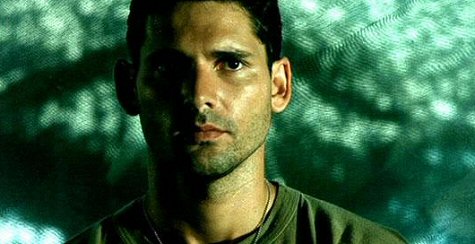
Eric Bana

This line comes from a 1986 TV movie, Sword of Gideon, which was based on the same true-life story the Spielberg-Kushner film is apparently about.
Spielberg’s spokesperson Marvin Levy will only say it’s about the “aftermath” of the ’72 killing of 11 Israeli athletes during the Munich games by the Palestinian terrorist group called Black September.
Two athletes were killed during a hostage-taking and stand-off situation with German authorities at Munich’s Olympic village. Nine more were killed by a grenade blast at Munich’s Furstenfeldbruck airport when authorities tried to shoot it out with the terrorists.
I haven’t read Kushner’s script, but one of the film’s vantage points is that of “Committee X,” a high-ranking group of Israeli officials, chaired by Israeli premiere Golda Meir and Defense Minister Mosha Dayan, and the assassination campaign they ordered Mossad to carry out — to murder every strategist and supporter known to have in some way supported Black September’s Munich operation.
The operation was known in some circles as Operation Wrath of God.
The idea behind the campaign, which was known as the kidon (Hebrew for bayonet) and run by senior Mossad agent Mike Harrari, was to strike terror in the hearts and minds of the plotters. It was primarily for the sake of revenge, I’m sure, but also to try and psychologically deter similar operations.


Remnants of charred helicopter at Munich’s Furstenfeldbruck airport, on the morning after the killings of nine Israeli athletes.

Mossad started with a list of 11 names, but the people they wound up killing numbered 18, by one count.
Harrari’s plan was to be absolutely precise and avoid collateral damage, and yet people who had nothing to do with the Munich killings — a Moroccan waiter, a Russian KGB agent, an Arab-looking bodyguard in Gibraltar, three Arab-looking guys who made the mistake of pulling out guns during a raid in Switzerland — died at the hands of the kidon killers. Seven in all.
Were some of these people innocent? One was, and some of the others may have been.
The Harrari figure was called “Avner” in Sword of Gideon, and was played by Steven Bauer (Traffic, Scarface). It appears that Eric Bana (Troy, The Hulk), who’s been cast as the lead in the Spielberg film, will play Harrari, or a character based upon him. (Levy told me he’s not playing a Black September guy, so that narrows it down.)
The IMDB says Daniel Craig (Layer Cake, Undying Love) has also been cast. (Probably as one of the villains, right?) The usual Spielberg team — producer Kathy Kennedy, dp Janusz Kaminski, editor Michael Kahn, composer John Williams — have signed on. (Williams worries me. His music could have a gauzy effect.) Barry Mendel is also producing.
Eric Roth (The Insider) and Charles Randolph (The Life of David Gale ) worked on the Munich project before Kushner came aboard (I think) sometime last year.


Untitled Munich Project screenwriter Tony Kushner

Art is in no way obliged to tow the current political line, but I wonder what impact, if any, the Munich project may have upon the political ebb and flow, especially if it turns out to be good and popular and deserving of awards.
There’s been some movement in the Israeli-Palestinian peace process lately, especially since the death of Yassir Arafat, with Israel giving back territory and whatnot. And the Munich movie could, at least in terms of the straight action elements, revive feelings of hate in certain quarters.
I would assume that Spielberg and his crew will have to be fairly careful with security issues when they’re shooting this summer, especially in the Middle East.
“What I find interesting about this is that it seems simple on its face…a good and evil story,” said Democratic strategist and West Wing consultant Lawrence O’Donnnell.
“This is not something anyone can predict, but I’m sure Tony Kushner will find the complexity in the story. I don’t think it would be premature to have an expectation for something great here. This will not be Raid on Entebbe.”
“Steven was pretty clear even last year that he did not want any preconceptions about what this [film] would be,” Levy said yesterday.
I know, I know…I should just shut up until someone slips me a copy of the script.

If You’re Interested…

There’s a pretty good blow-by-blow about the Munich murders and the Mossad revenge on a website called Special Operations.com. Here’s the link .
The mini-history, written by Thomas B. Hunter, is based on a book by Alexander Calahan called “Countering Terrorism: The Israeli Response to the 1972 Munich Olympic Massacre and the Development of Independent Covert Action Teams,” (Marine Corps Command and General Staff College, April 1995).

Quickies

You have to hand it to Spielberg this year — he’s really kicking ass with the finishing of the visually revved-up War of the Worlds (Martian space ships…c’mon), and then shooting, editing and wrapping the Munich project in just six months…July to December.
And then right into that Liam Neeson Abraham Lincoln biopic, right? I can’t wait for that one. Neeson will kill as Honest Abe.
When I say fast shoots I really mean fast post-production periods. I can only think of three or four off the top of my head.


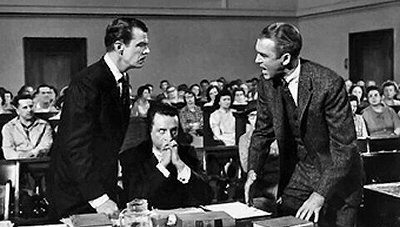
James Stewart (right) and Goerge C. scott (seated) in Anatomy of a Murder.

Million Dollar Baby, of course, began shooting in the summer of ’04 and was done by last November. Remember that Spielberg put both Jurassic Park and Schindler’s List into theatres, so I guess the latter was a fairly fast one.
For some reason I recall that the making of Floyd Mutrux’s American Hot Wax (1978), was fairly fast, or at least was in theatres only three of four months after finishing principal photography.
The fastest big-studio movie I’ve ever read about was Otto Preminger’s Anatomy of a Murder (1959), the Jimmy Stewart courtroom drama. According to the liner notes on the DVD, Murder shot for eight weeks and wrapped on May 15, 1959. It opened in big-city theatres about six weeks later, on July 2nd.

Cowards

Andy and Larry Wachowski have gotten so caught up in their hiding-away syndrome that they’re producing V for Vendetta, an apparently thoughtful, Matrix-resembling action drama they wrote and developed years ago, rather than expose themselves to the threatening immediacy of being on the set and yelling “action!” and “cut!” and dealing with grips and best boys.
In their place, they’ve hired a talented flunky — James McTiegue, who worked as first assistant director on the Matrix trilogy — to “direct” the film. This strategy will allow the brothers to give McTiegue guidance (i.e., explain exactly what to do) as they keep a watch on things, perhaps from some heavily-fortified cyber-bunker several hundred feet below the streets of Berlin.
V for Vendetta is about to start shooting for ten weeks or so in Berlin.
The Wachowski’s will never be free from the fish net of their own making until they drop the super-secretive routine and stop cowering and “come out” and embrace (or at least accept) the occasionally rude and insensitive rough-and-tumble of the business, including dealing with the press and walking down streets and going into drugstores to fill their own prescriptions.


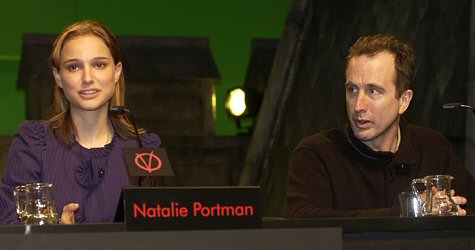
V for Vendetta star Natalie Portman and director James McTeigue at last week’s press conference in Berlin.

Larry can wear anything he wants and be anyone he wishes to be, but the boys can’t be Glenn Gould or Thomas Pynchon any longer. After a certain point the hiding of one’s face becomes tedious.
V for Vendetta, a tale about violent revolution in a futuristic London under the boot of a totalitarian government, is being filmed in Berlin with Natalie Portman in the lead role of “Evey.” Unfortunately, Portman will be losing weight and shaving her head for the role. James Purefoy is costarring.
The story is about “the people” helping to bring down an oppressive government, with Evey being a sort-of terrorist type with an ambiguous strain — i.e., is she good or bad or…?
“It√ɬ¢√¢‚Äö¬¨√¢‚Äû¬¢s a very human story and because it√ɬ¢√¢‚Äö¬¨√¢‚Äû¬¢s human it√ɬ¢√¢‚Äö¬¨√¢‚Äû¬¢s not black and white,” Portman said at a Berlin press conference last week. “It is much more complicated and ambiguous than one person is good, one person is bad, the government is good, the people are bad, or the government is bad the people are good…it√ɬ¢√¢‚Äö¬¨√¢‚Äû¬¢s a lot more complex.”
Silver was asked about the Wachowskis’ game plan and general reclusiveness.
“When they wrote the script it was before they had directed anything, so maybe they were thinking at some point they would [direct it],” he answered. “Their intention following The Matrix was to take some time off from directing so they√ɬ¢√¢‚Äö¬¨√¢‚Äû¬¢re producing the picture with us.”
The Wachowskis were last seen by the public in the summer of ’03 when Matrix Reloaded opened to vague and then growing disappointment, and they damn sure haven’t been seen since Matrix Revolutions opened later that year and the whole mythology came crashing down in an anguished heap, with the spirit of the first Matrix film having been totally abandoned and traded in for something else.
“They√ɬ¢√¢‚Äö¬¨√¢‚Äû¬¢re here [in Berlin] and they√ɬ¢√¢‚Äö¬¨√¢‚Äû¬¢re very involved and they√ɬ¢√¢‚Äö¬¨√¢‚Äû¬¢re kind of support for James and they√ɬ¢√¢‚Äö¬¨√¢‚Äû¬¢re very anxious for James,” Silver said about the brothers.
They may be anxious about James McTeigue, but the plan is not fundamentally about supporting him or even his gifts as a director — the plan is about Larry and Andy needing to work in the shadows.
Their screenplay is based on the V For Vendetta graphic novel by Alan Moore and illustrator David Lloyd, which was originally published by DC Comics as a ten-part series in 1988.
Warner Bros. will open V For Vendetta on 11.4.05.

Stand Back

Believe it or not, I’m on my way to Argentina today (Wednesday) and the Mar del Plata Film Festival, where I’ll be poking around for a grand total of four days.
The festival organizers have invited me down to cover, and to also moderate a “Master Class” session on Saturday with director Hugh Hudson (I Dreamed of Africa, Chariots of Fire, Greystoke). I’ll run some photos and whatever stories I can come up with.

I’m also going to work in an exploration of Buenos Aires for a few hours on Sunday. When opportunity knocks, it’s usually a good idea to grab it. I would never have managed a trip down there on my own dime. I’ve never really wanted to, I mean.
Any Argentinan journalists or filmmakers who may be in Mar del Plata for the next few days are invited to get in touch. I’d like to know what’s doing.
I wonder if Fabian Beilinsky, the director of Nine Queens whom I met in Toronto two or three years ago, will be in the neighborhood?

Poet’s Return

I had to shut down the chat room after getting hacked twice over the Christmas holidays, but we have a new server now and new composing software (i.e., Movable Type), and I’m told by Brian Walker, Hollywood Elsewhere’s Man in Ohio, that the message boards and maybe even a chat-room screen will be back up by the end of the week.
I hope everyone gets into the habit again. I’ll do what I can to visit more often and get involved with whatever’s being chewed on and batted around.

Sorry for taking the thing down but getting hacked like that was awful…awful….and chat rooms are the most vulnerable spot in a site like this, and I didn’t want to risk any further invasions.
There’s also a new column coming soon by Sweden’s Nic Kockum (there’s been talk about calling it “Viking Gangbang”) and an L.A. socio-political industry column by the great Flint Wainess, a screenwriter and founder of the always fascinating www.breakupnews.com.

Dreams May Come

Dreams May Come

The shooting and projecting of movies on 35mm film is a dying practice, and it won’t be long before everything is digital this or that…no argument there.
But when will digital projection really be here, and from what digital source or delivery system will movies be obtained and projected — satellite transmission, fibre optic cable, pirate-proof DVDs?
I don’t know how long it will all take, but probably a while. Five years, ten years. Big changes in the way things are done never happen until economic conditions demand them…until the captains of industry feel the flames licking their feet.

But while we’re waiting and trading scnearios, here’s one that’s been passed along that’s more diverting than most. Some of it is fact, the basic thrust of it seems sensible, and the parts that aren’t verified or have been denied seem…well, intriguing. And digging it all up and learning a bit about the world of digital tomorrows was fun.
It involves Regal Entertainment, the 6,273 screen chain composed of Regal Cinemas, United Artists Theatres and Edwards Theatres, and a purported, unverified but logical-sounding plan said to be under consideration by the chain’s owner, reclusive Denver billionaire Phillip Anschutz, to move a significant portion of Regal into a sophisticated digital projection mode.
< ?php include ('/home/hollyw9/public_html/wired'); ?>
The scenario, which has been derided as “conjured,” “colorful,” “nonsense” and having “no basis in fact” by Anschutz’s spokesperson Jim Monaghan, is two-fold — partly about a new middle-American, family-values digital distribution network that may be in the offing, and partly about a nationwide fibre-optic delivery system for films to be shown digital in theatres.
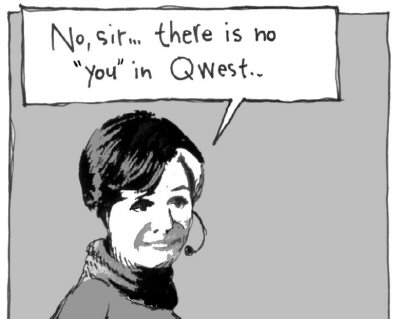
The technical speculation is that movies (in the form of digital feature-film data) could theoretically be sent from a digital switching center (possibly from the St. Louis headquarters of Qwest, the phone company owned by Anschutz) over a vast network of fibre optic cable that’s been laid down by Anschutz alongside the tracks of his Union Pacific railroad company, which he also owns. The films would then be relayed to Regal theatres, booths and projectors and thereby projected.
In so doing, the theory goes, Anschutz would become not just a major digital distributor of movies (through Regal Cinemedia, the division of Regal that attends to the digital potential side) but also, producing-wise, a major market force for G and PG-rated films through Anschutz’s two production companies, Bristol Bay and Walden Media.
Anschutz, in short, would one day be the Big Kahuna of not just a digital-projection empire, but the driver of a kind of ideological market force that, in part, would deliver family-friendly films produced by the Anschutz Film Group, the parent of Bristol Bay and Walden Media.

An indicaton of Anshutz’s game plan lies in the fact that he financed Taylor Hackford’s Ray to the tune of $35 million, but only upon an insistence that Hackford deliver a PG-13 film.
As Associated Press reporter Sandy Shore reported on 2.27, “Anschutz is a devout Presbyterian, but associates say he doesn’t try to influence projects with his beliefs.” Hackford told Shore he and Anschutz “disagreed” about the PG-13 rating, but once Hackford backed off from wanting to possibly deliver an R-rated film, Anschutz “left him alone to make the film.”
“He’s a conservative Republican and he knows I’m a liberal Democrat,” Hackford told the reporter “That didn’t mean we couldn’t talk about business.”
The technical speculation is that Anschutz has a contingency plan to eventually bring cinema-grade digital projection (i.e., with a 2K capacity, in keeping with today’s higher standards, or possibly a 4K capacity) to many of Regal Entertainment’s 6273 screens, which are mainly located in the Midwest and southwest.
Before going into total pooh-pooh mode Friday morning, Monaghan said that the cost of installing cinema-grade digital projection systems is the big question mark facing Regal and other theatre chains. “Nobody has figured out how to pay for it,” he said.
And Lauren Leff, spokesperson for Regal Cinemedia, was careful to point out that
“the Christie L6 projectors Regal currently has installed to operate…do not meet the standards Hollywood is working toward for future projection of full-length digital cinema features.”
There are three ways to deliver digital movies to theatrical movie screens — satellite, fibre optic and specially encoded DVDs.
Nicole Sperling wrote last October in the Hollywood Reporter that Sony Pictures, Warner Bros. and the Walt Disney Co. were in “exploratory talks” to form a joint venture to facilitate the installation of digital cinema systems.
As I understand it, the primary idea is to come up with a way of distributing and projecting cinema-grade digital images (i.e., more or less indistinguishable from top-grade 35mm projection) through specially-encoded or encrypted DVDs.

The major Hollywood distributors formed a consortium two and a half years ago called the Digital Cinema Initiative with a plan to develop digital projection technology and settle on certain operational standards, which would be organized and facilitated by the Society of Motion Picture and Television Engineers (SMPTE).
Leff told me Regal Cinemedia is keeping its eye on what DCI (and/or the three above-named studios) will finally decide upon. And yet Anschutz has an enormous investment in a nationwide fibre-optic cable network, which seems to indicate his possible leanings regarding digital projection plans.
I’m a bit fuzzy here and there (I only have one body, two phones and eight hands), but more than a dozen years ago AT&T approached Anschutz with a proposal to pay a fee for permission to lay down a fiber optic cable along the entire Southern Pacific and Union Pacific right of way — in other words, all over America. Anschutz said no but we will do it for you, for a fee.
Anschutz took ATT’s money, dug the trench and used their money to buy a fiber optic cable three times bigger than AT&T’s (about six inches wide, one guy told me) and put it right down beside the smaller-capacity AT&T cable and covered it up. The cable was eventually utilized by QWest, Anschutz’s phone company.
As Lewis MacAdams put it in his 1998 profile of Anschutz in Los Angeles magazine, “Emulating the way the telegraph came west with the rails, Anschutz used the railroad’s vast right-of-ways — many of them originally granted by the federal government for building the transcontinental systems — to lay an information pipeline: Qwest, the world’s most advanced, high-capacity fiber-optic network.
“When Qwest is fully deployed [at the end of ’99], according to Wired magazine, it will have greater capacity than AT&T, MCI, Sprint and WorldCom combined to almost instantly transmit very large data files or images between 125 American cities, Europe and Mexico,” MacAdams reported.
The idea, I’ve been told (and I realize I’m repeating myself, and that I sound a bit breathless) is to send digital movie data through this fibre optic network from some kind of digital switching center under the auspices of QWest in St. Louis, which would be using a massive Cray computer as its brainiac nerve center.
I agree — the supposed plan sounds around-the-corner and not-yet-real. And if I were Monaghan, and my boss was a secretive, reclusive super-rich tycoon who refuses to deal with the press, as Anschutz does, I might say it’s all bogus too. And some of it might be.


And yet the idea makes sense, and much of what I’ve heard is verified, so I think Monaghan, a nice guy, may be stonewalling a bit.
This morning Monaghan wrote and said “there is no plan in existence…or in thought…the likes of which you have described to us by telephone and by e-mail.”
I replied, “You’re saying Phillip Anschutz has no plan or intention whatsover to eventually introduce a digital projection system within a portion (large or otherwise) of Regal Entertainment’s 6200-plus screens?

“With QWest’s vast investment in a huge fibre optic network and the capacity of this network to handle huge information files…..you can’t be saying Anschutz intends to stay with 35mm film projection in his theatres and has no plans to bring in cinema-grade digital projection for showing movies.”
Monaghan said, “You have asked me to sort out that which is factual from that which is inaccurate in terms of the information you. As the core of your information and beliefs [as convyeyed in your e-mail] is completely untrue and has absolutely no basis in fact, all of the detail supporting that false premise is moot.”
I replied, “You’re saying that the ‘core’ of the information/belief as passed along in my e-mail letter — that Anschutz is developing a system by which digital movie files could be fed to Regal Entertainment cinemas through QWest’s vast fibre-optic network…you’re saying this is complete fantasy and without a factual basis of any kind?
“I’m sorry to be blunt, Jim, but nobody in exhibition or distribution would accept that Anschutz is intending to have 35mm film projection be the technological cornerstone of his projection systems over the next five to ten years and not develop an integrated digital projection system of some kind.
“Every player in the distribution world accepts that digital is coming, is inevitable. It’s all a matter of cost and timing…i.e., when? I’d like to buy what you’re saying, but there is simply no logical way to accept that digital cinema delivery in Regal in the future is some kind of pie-in-the-sky, pot-in-the-pipe concept.
“Given this inevitability, which of the three digital cinema delivery modes, any reasonable person would ask, would Anschutz be investing in?
“The disc mode is said to be close to being finalized and worked out by SMPTE for that consortium of Hollywood distributors, so it’s possible Anschutz could be looking at this as a possibility. Is this the more likely possibility?
“He could also be looking at satellite feeds as the most economical and effective option….is he? (Satellite feeds can be affected by weather, so this is not a very secure option, I’ve heard.)

“It seems like the most logical option for Anschultz, given his huge investment in fibre optic, is to plan for the digital delivery of movies via QWest’s fibre optic network.”
Monaghan concluded, “Having been told by two [public relations reps] associated with both the Anschutz Company and Regal Entertainment that there is no basis in fact for the very colorful story you have somehow conjured, we do not expect to see any of this nonsense on your website or in any other medium.”
To which I replied, “I didn’t maintain that all of the reports and suppositions in my letter were factual, but I know that Anschutz’s investment in his vast fibre optic network is considerable. Elemental logic dictates that he would be loooking at deploying this network as part of a delivery-of-digital-movies strategy.
“I’m not saying I know that Anschutz is, in fact, doing this, but to characterize the basic elements of what I conveyed in yesterday’s e-mail as ‘conjured,’ ‘colorful’ and ‘nonsense’ with ‘no basis in fact’ defies credibility.
If this story came to you on the good authority of someone else,” Monaghan wrote, “and you feel compelled to believe them and not us, then I would expect anything you write to be fully disclaimed. That is, that you would identify the individual or individuals who have provided you this information … as well as our position that the story is completely untrue.
“I understand your position and thank you for conveying it,” I replied, “and I appreciate [the value of] your time and the courtesy that you’ve paid to me. At the same time, I hope you understand how difficult it is for me, and for anyone with a rudimentary understanding of the realities of 21st Century theatrical exhibition or distribution, to accept what you’re telling me as entirely candid.”

Monaghan had the last word when he wrote back this afternoon. “My answer was and is [that] there is no such plan,” he said. “If you find that answer misleading, so be it. To have answered in any affirmative manner would have been misleading.
“For you to twist that answer, however, to suggest that I’m claiming that Anschutz and/or Regal Entertainment ‘intends to stay with 35mm film projection’ is one of the most [amateurish] attempts at bogus journalism that I’ve seen in a long while.
“Of course the industry will change, and I assume that Regal will be competitive in whatever future environment presents itself. That’s not to say, however, that Anschutz or anyone else I know has a plan or is now developing a digital projection system.”

Blam Blam

Blam Blam

It’s unusual for a 44 year-old guy from the fringe indie or straight-to-video world landing a directing gig with a mainstream studio like New Line.
Unusual because of age-ism (i.e., generational tribalism and the belief that new directors have to be in their late 20s or early 30s with two or three MTV music videos to their credit), and because of an unwritten stipulation that if a director hasn’t gotten on-board with a high-profile producer or distributor by age 40, he/she is probably “done” and been relegated to the sidelines.


No, this isn’t Gus Spielberg, Steven’s younger, smarter brother who lives in Arizona — it’s Shoot “Em Up writer-director Michael Davis.

A noteworthy exception is Michael Davis, a Steven Spielberg lookalike whose success story is about one of the longest gestations in Hollywood history.
New Line has just committed to fund production of Davis’s script, a John Woo-type urban actioner called Shoot ‘Em Up, with Davis directing.
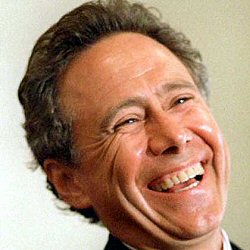
New Line president Bob Shaye has made it clear he wants the high-octane action flick rolling by September. He’s also signed Davis to a two-picture option agreement, and I’m told that Davis is now being wooed by agents for representation.
< ?php include ('/home/hollyw9/public_html/wired'); ?>
This is serious pay-dirt for a 1987 USC grad who’s directed a few lower-profile, straight-to-video films (the most admired is Eight Days a Week, winner of the audience award at the 1997 Slamdance Film Festival), and who has also worked as a storyboard artist off and on for roughly fifteen years, never quite putting his mitts on the brass ring.
I’ve read Shoot `Em up and it feels to me like a great New Line genre film in the tradition of The Hidden, the first Rush Hour, Blade and so on. It’s fast, punchy, sardonically funny, and aimed at younger guys and connoisseurs of action choreography-for-its-own-sake.
Journos are always being told that major stars are interested in playing a role in this or that script, but the talk is apparently valid this time. A serious “big name” is eye-balling Shoot `Em Up‘s lead male role, “Mr. Smith,” a terse hard-boiled type with the usual Joffrey Ballet abilities during gun fights.


A stick-figure image from Michael Davis’s 17-minute animatic Shoot ‘Em Up tape that conveys the choreography of the action scenes.

Why would a major star be looking at what sounds on the surface like a rote New Line actioner being made “for a price”? Because Shoot `Em Up ain’t rote.
The crusty, cynical noir-flavored tone is familiar, but the big action scenes have a kicky “haven’t been here before” quality. They take the Hong Kong Woo aesthetic to absurd new heights, but in a way that feels freshly insane, oddly logical and edgy-funny. It’s screwball formula nihilism with a twist.
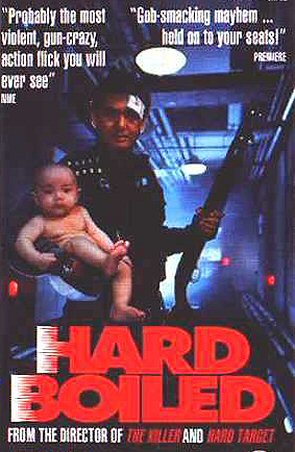
Woo fans have seen a certain aspect of it before. The central Shoot `Em Up hook — a tough guy loner protecting a new-born baby boy from an army of goons trying to bring his just-begun life to a close — is borrowed from a sequence near the end of Woo’s Hard Boiled (’92).
Apart from the script itself, the element that sold Shoot ‘Em Up more than anything else was Davis’s decision to compose a 17-minute animatics reel, made from roughly 17,000 line drawings, which gives the viewer an idea of how the action scenes will play. (I could describe the action sequences and all, but this would spoil the fun down the road…right?)
I got a look at this tape last weekend and it definitely sells you on Davis as well as the piece itself. You figure any guy who cares this much about explaining how the action stuff will play has his gear wired tight and can be trusted to make it happen on film.
The people who pushed Shoot ‘Em Up into “go” project status are producer Don Murphy (along with his Angry Films team Rick Bennattar and Susan Montford, who will co-produce), New Line creative executive Jeff Katz and vp development Cale Boyter.


Copy insert from Davis’s animatic Shoot ‘Em Up tape.

Murphy had known Davis from USC film school in the late ’80s, and had kept in touch with him over the years. He knew he finally had something to push and maybe sell when Davis showed him the Shoot `Em Up script in the fall of ’03. It was hard and fast and could be made relatively cheaply…but Murphy wasn’t certain he could sell Davis as the director.
Murphy pushed it with New Line execs, although the first exec to make a call on it — senior vp production Stokely Chaffin — didn’t care for the “newborn baby dodging bullets” angle and said no. Murphy persisted and found an ally in Katz, who says he found the script “on the scrap heap…sometimes that’s how you find your little gems.”
Katz sent it along to Boyter, and the two of them eventually took it production chief Tobey Emmerich, who passed it along to Shaye.
Early on Murphy told Davis that “the biggest thing you can give me is some reason why [New Line] would let you direct it.” The animatics tape was the answer. “It said, look, he’s already visualized this thing, and look at how well these sequences play even with stick-figure drawings,” says Murphy. In so doing, Davis “really went the extra mile.”
Murphy knew Davis slightly “when I went to USC grad school in the late ’80s,” he says, “although he was two years ahead of me. He was one of those guys you meet and figure right away when they get out of school they’re going to be the schizzle. His shorts were great and he had an agent when he was still in school. But then we all got out and did what we did, and with Michael it was like…what happened?”
“I made some mistakes,” Davis says. “I was not politically savvy. I was an innocent and had no sense of politics and because I didn’t understand the political landscape in Hollywood, it hurt me. I always thought just sheer talent would be enough. I had an agent in film school. I could have gone with Richard Lovett or Jeremy Zimmer, but I went with a boutique agency instead.
“I also didn’t invest in networking and socializing. I just didn’t follow up on meetings. I guess I’m such a perfectionist….I didn’t want to just call up and be the fuller brush man, and I had too much self-doubt to just put myself out there and call these people.

“Stacy Sher at Jersey tried to help me get my first agent, and she’d take me out to lunch, wondering what I’d be doing. I didn’t keep up with her. I didn’t return the effort she put into me.”
The balancing factor was Davis’ way with a stand-out concept or oddball scene.
For Eight Days a Week he came up with the idea of a young horny protagonist having sex with food (i.e., shtupping a watermelon). If you ask me this bit was ripped off by the makers of American Pie. (How could the Weitz brothers claim otherwise?) Davis says he was “up” for directing that film until a certain Universal executive remembered the studio’s “mandate for hiring 25 year-old directors! I was too old…I was in my 30s!”
(John Hughes, one of Hollywood’s most successful miners of the teen aesthetic, was in his 30s when he made all those ’80s teen comedies. He turned 40 in 1990.)
Davis was a year or two ahead of Murphy at USC, graduating in ’87. He was a bit more contemporary with Jay Roach, Steven Sommers, Michael Lehman, John Turtletaub.
Davis has written 33 screenplays (ten of them produced) and directed five movies based on his scripts, the best of these being Eight Days a Week and 100 Girls, which went to video in the U.S. and “opened on 100 screens in France.” He’s done storyboard work for Pee-wee’s Playhouse and Tremors.
Murphy always “made me feel comfortable,” Davis recalls. “Over the years I’d send him my latest straight-to-video movie, and he always returned my phone calls. His attitude was always, ‘What can I do to help you?'”
It was a seven-month process, he says, before Shoot `Em Up got traction at New Line.
“Most producers shotgun things,” says Davis. “They send a script out, and if it doesn’t get heat they move on. Don is different.
“Jeff Katz liked Shoot ‘Em Up, but it stalled with Stokely. Don being Don, he wouldn’t let them pass on it. Katz loved the material..he was saying he’d never seen an action piece like this before. Then Cale Boyter saw it, got it and pushed it along. Then they all saw the reel.”
Davis “is not a young guy but this movie is happening and the agencies are going crazy for it,” says Katz.

“[Murphy] told me I had to turn myself onto this. So we had a meeting with Davis and he looks like a pudgy Steven Spielberg. He’s this very happy-go-lucky guy, and what he did was map out a very inventive way to sell the gunplay. Shaye saw the tape and said yeah, this is good, get me the script.”
Writer-directors with talent, moxie and opportunistic backgrounds have about ten years to make their mark or establish a serious foothold of some kind after leaving film school. Most get there by their late 20s or early 30s. If they haven’t made it by 40 or thereabouts…toast.
Being a late bloomer myself (I didn’t really get down to journalism until I was 27), it’s nice to know that a slightly older guy has busted through, and for the right reasons.

Oscar Balloon ’05

Here’s the first assembly of ’05 Oscar Balloon picks. The same can be found down in the new mustard-colored Oscar Balloon box at the very bottom of the column.
Anyone with a line on any film or actor or behind-the-camera filmmaker of any stripe that they believe (and I mean on the basis of having read a script or actually having heard or been told something substantive, as opposed to hunches or assumptions) should be included, please forward the info and if it sounds credible, I’ll put it in.
BEST FEATURE: The Producers (Universal); All The King’s Men (Columbia); Untitled Spielberg Munich Olympics Project (Universal), Memoirs of a Geisha (Columbia); The New World (New Line); Jarhead (Universal), Elizabethtown (Paramount); Walk The Line (20th Century Fox); Cinderella Man (Universal); Syriana (Warner Brothers); Oliver Twist (Sony/Columbia).
BEST DIRECTOR: Steven Spielberg (Untitled Munich Olympics Project ); Ron Howard (Cinderella Man); Sam Mendes (Jarhead), James Mangold (Walk The Line), Terrence Malick (The New World); Rob Marshall (Memoirs of a Geisha); Roman Polanski (Oliver Twist).
BEST ACTOR: Matthew Broderick (The Producers); Viggo Mortensen (A History of Violence); Colin Farrell (Ask The Dust; The New World); Joaquin Phoenix (Walk The Line); Jake Gyllenhaal (Jarhead), Russell Crowe (Cinderella Man), Johnny Depp (The Libertine); Sean Penn (All The King’s Men); Eric Bana (Unititled Spielberg Munich Olympics Project).
BEST ACTRESS: Cameron Diaz (In Her Shoes); Gwyneth Paltrow (Proof), Zhang Ziyi (Memoirs of a Geisha); Reese Witherspoon (Walk The Line); Salma Hayek (Ask The Dust).
BEST SUPPORTING ACTOR: Nathan Lane (The Producers); Jamie Foxx (Jarhead), Peter Sarsgaard (Jarhead), Ben Kingsley (Oliver Twist); Paul Giamatti (Cinderella Man); James Gandolfini, Anthony Hopkins, Jude Law (All The King’s Men).
BEST SUPPORTING ACTRESS: Susan Sarandon (Elizabethtown); Hope Davis (Proof, The Weather Man); Toni Collette, Shirley MacLaine (In Her Shoes); Kate Winslet, Patricia Clarkson (All The King’s Men).
BEST ORIGINAL SCREENPLAY: Terrence Malick (The New World); Cameron Crowe (Elizabethtown).
BEST ADAPTED SCREENPLAY: Mel Brooks and Thomas Meehan(The Producers); Stephen Gaghan(Syriana), Steve Zaillian (All The King’s Men), William Broyles, Jr.(Jarhead), Susannah Grant (In Her Shoes).

Brando Blow-off

“You’re absolutely right about Brando getting short shrift at the Oscars. At least they kept the show reasonably brisk, but a full-up Brando tribute wouldn’t have consumed that much more time.” — Jay Smith
“I felt exactly the same way about Brando — he was robbed. It was insulting and stupid. Anything to do with Brando refusing to take his Oscar in ’73? An oversight? Who is responsible? They had a great opporunity to salute a legend and they lost it. Imagine the quotes they could have got from all the living Oscar-winning actors…De Niro, Pacino, etc. Shameful.” — Dale Launer, director-screenwriter.
“Maybe he wasn’t liked, maybe he didn’t play the game, maybe he took some air of the idea that someone could walk away…but tell me who did more for the performances and the quality of work that the whole night is supposed to be about? Oh right…Johnny Carson.” — Tom Van


Marlon Brando

“You were right on target with your Brando comments. He’s probably the greatest thespian who has ever lived, and he delivered the best acting performance in cinematic history in Last Tango in Paris. I wonder if the oversight had anything to do with his personal troubles in his final years. If so, shame on the Academy.” — Ron Cossey
“Damned right they should have done a special thing for Brando, with Scorsese or somebody putting his complex and contradictory career into perspective. (Forget comedians– why doesn’t Scorsese just host the whole thing with commentary over the clips and footnotes at the bottom of the screen?)
“But Brando isn’t the only one who deserved that kind of separate attention– and I suspect this is the reason they didn’t do it. If they’d done one for him, it would have raised the question of why they didn’t do one for Ronald Reagan.
“By any decent logic, they should have acknowledged that a major place in history — not film history, but history– is held by someone who was once one of theirs. The problem, of course, is that a lot of people in Hollywood hated him as president, and if they were forced to recognize that maybe they were wrong then and that he did play a crucial role in ending a vast and terrible tyranny, they’d have to consider the possibility that they could be wrong about Bush and what’s happening in the middle east right now. And that, of course, won’t do.
“So instead of honoring either Brando or the man who said ‘Mr. Gorbachev, tear down this wall,’ the Academy chickened out by flashing them wordlessly on screen to bookend Fay Wray and Russ Meyer. But after all, how could we expect mere mortals like them to merit the level of loving tribute Hollywood reserved last night only for a true idealist and saint like the gulag-builder Che Guevara? Team America has never seemed more prescient.” — Mike Gebert.

“It’s baffling to me that there was evidently no influential figure to push for a Brando tribute reel.” — Josh Martin.
“It seems clear to me that The Academy didn’t produce any special tribute to Brando because they didn’t feel they owed him anything. I can understand that. After all, he dissed them first. How could they give him special treatment after what he did while reducing other loyal members of the academy to a second each in a montage?
“Separate special memorials eat up too much time anyway. If they were that big a star (like Brando), they had enough press when they actually died. I had my fill of ’50s film clips of Marlon on MSNBC last summer. We didn’t need another review of his career last night. I can understand when they do it for Johnny Carson or Bob Hope because they had a special relationship with the actual Academy Awards TV program.” — P. Mccarthy.

Oscar Fallout

“I wasn’t looking forward to the Oscars this year, and almost didn’t watch for almost the first time I can remember. I’m not a fan of Chris Rock. But I did watch, and I enjoyed it, though it didn’t rank with the more memorable shows. Perhaps the straitjacket of the show actually made Rock funnier to me. You’re right about Johnny Carson, and, yeah, they should give Steve Martin whatever he wants next time.
“The Pepsi Spartacus commercial was such an affront to me that I will go out of my way to avoid Pepsi at all costs until the memory of that ad fades. Ugh. Sean Penn coming to Jude Law’s defense only seemed to play into the perception of him not having much of a sense of humor. Yeah, Clint should have been nominated for his M$B score. And yup, Collateral deserved more than a nod for Best Cinematography.


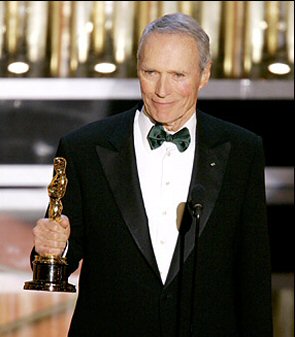
Clint Eastwood, director-producer of Million Dollar Baby and winner of the Best Director Oscar.

That The Aviator won is almost criminal, because the replication of early two-strip Technicolor processes left me scratching my head wondering if I was seeing a bad reel in the print when I saw the blue peas — and I’m a moviegoer who loved the Technicolor history documentary on the Robin Hood DVD! Who exactly got the homage to early color that they were doing? (I didn’t get it until I looked up the film’s trivia section at IMDB.) That conceit was the worst part of that movie. I had no problems with the CGI effects, and I’m usually pretty hard on that.” — Jay Smith
“The evening ultimately turned into a high mass for Clint Eastwood — the patron saint of on-time and under-budget filmmaking; the Hollywood trooper; the team player; the heartbreak kid; the poster boy for ageism in reverse; the proponent of simple storytelling for simple folk; the guardian against mass market/CGI-driven entertainment; the let’s-not-do-a-first-take,let’s-use-the-rehearsal-footage waste-management pro.
“I know you’re a fan of Million Dollar Baby but when it comes right down to it, the movie is nothing more than an old-fashioned melodrama torn from the pages of Warner Bros.’ own playbook from the 30s and 40s — only then they had actors with the grit and seeming street smarts to bring it all to vivid life: talents like Cagney, Bogart, Garfield, Pat O’Brien and the Dead End Kids. Now we have Clint playing Clint and Morgan Freeman tackling a role no different than all those serial killer movies at which he’s become so expert.” — Steve Chagollan
“Do you think that Collateral might have lost the cinematography Oscar because it was shot digitally? The images of LA at night were stunning, and to shoot so many scenes in the taxi…amazing work. That said, Robert Richardson√ɬØ√Ǭø√ǬΩs Aviator cinematography was worthy of the Oscar. The recreation of the Technicolor processes was amazing and the overall look of the film well worthy of the Award.” — Edward C. Klein, Salem, Oregon.

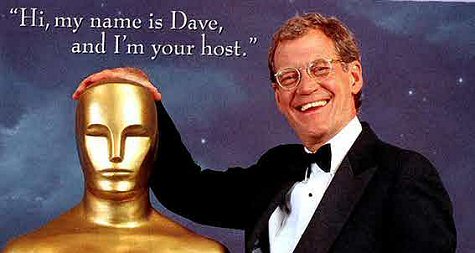
“I think the funniest moment at the Oscar in the last ten years was the Dave Letterman-hosted 1995 ceremony (a year that honored Forrest Gump and Pulp Fiction in different ways). There was that skit with several top names — Jack Lemmon, Martin Short, Paul Newman, Albert Brooks — acting to a sock monkey. The runner-up would be Billy Crystal’s intro to the 2000 ceremony, complete with Crystal spoofing Spartacus and showing up in drag as Mrs. Robinson.
Michael Bergeron
“I can’t really stand it that so many people are crying over Eastwood not getting nominated for best score. Guarantee that if Lennie Niehaus wrote the same music note for note, no one would have cared (see Unforgiven). The real tragedy (well, not tragedy….life will go on) is that there were several great scores this year that came up empty in the awards department, while the five Oscar nominees ranged from okay to…okay.
Spartan, The Incredibles, I, Robot (the movie sucked but Beltrami knocked the music out of the park), The Motorcycle Diaries, Friday Night Lights and Kinsey are just a handful of great scores that went mostly unmentioned this year, yet everyone is crying over Eastwood’s ten notes. If he wasn’t going to win for Mystic River, he sure as hell wasn’t going to be recognized for Million Dollar Baby.
“It’s not even that the score was bad — it served its purpose. But there were far, far, far many better ones deserving of recognition, and now their composers have to sit around being told how Eastwood is superior to them too. If Danny Elfman or Carter Burwell haven’t won an Oscar yet, I think Eastwood can stand to miss out a few more times.” — Eddie Goldberger

Pepsi Spartacus

“So you liked Kirk Douglas and the gladiator army selling Pepsi — have you seen the ad with Gene Kelly’s Singing in the Rain remixed to sell VW Golfs? Here’s the link . The spot is pretty seamless, but I can’t help but cringe. I’ve been told that if I were to ever associate msyelf with something similar, I would be killed.

“Similar, but not selling anything, was the video mashup of the Beatles and Jay-Z. Someone took the initiative and blended A Hard Day’s Night footage with Jay-Z clips. Amusing if only to guess which Beatle would be the DJ and which was going to bust a move. [Editor’s Note: There was a link in this letter to the Jay Z video, but it didn’t work. If anyone has found one that works, please send it along.] — Chris Clark

Day and Date

“DVD’s or pay-per-view simultaneous with a theatrical opening sounds like a dream come true to me.
“Theatres won’t die out — they’d just be thinned out. Then maybe
a large percentage of the annoying crowd (families with 30 children in tow, talkers, etc.) would stay home. It’d be cheaper to rent a flick for $12 then it would be to pay admission for every child in your neighborhood. Ticket prices would go up, sure, but then maybe the quality of the experience would too.
“I’ll be honest — it’s getting harder and harder to pay upwards of $10 a person to see a movie maybe three days into the run and already there are a ton of scratches, pops and cigarette burns, not to mention faulty sound equipment. The experience is about as good sometimes for big budget fare in the theatre as it would be in my living room.” — Shawn Robare.

Asian Bootlegs

“Consider two developments regarding bootleg DVDs here in Asia:
“Movies open here on Thursdays…. the co-ordinated global released films actually get shown here one to two days sooner than the USA (by the time difference). The ticket prices vary from $2 to $8 for the equivalent service of a first class international flight (electric reclining seats and waitress service).
“I don’t subscribe to the bootleg industry, but apparently the bootlegs are now ‘off the master’ and nearly as good as the released DVD. Somebody is selling out at the major studios. I saw a snippet of a friend’s Million Dollar Baby copy and it was perfect.” — Paulus.


Crowds in Calcutta waiting for fresh shipments of pirated DVDs. Well, not really.

“You presented some interesting ideas about the future of film distribution. I for one would hate not to be able to see films on a big screen. I don√ɬØ√Ǭø√ǬΩt care how big a screen I have at home — I want the magical experience in a darkened theater.
“One scenario you didn√ɬØ√Ǭø√ǬΩt mention was digital projection. I haven√ɬØ√Ǭø√ǬΩt been able to see a film presented in this format, but from what I√ɬØ√Ǭø√ǬΩve heard it√ɬØ√Ǭø√ǬΩs stunning. If theaters start showing films this way and the films are worthy, just maybe people will start to fill the theaters again.
“Of course it doesn√ɬØ√Ǭø√ǬΩt help that they charge a small fortune to get in the door. My family and I wait until films come to the local Theater Pub where a ticket is $3 and you can enjoy dinner and a beer or glass of wine and see a decent film the way it was meant to be seen. And you don√ɬØ√Ǭø√ǬΩt have to put up with the poorly managed Regal Cinemas where all they want is your hard earned money and could care less if the film is focused or the sound is properly adjusted. And don√ɬØ√Ǭø√ǬΩt get me started on the conditions of the bathrooms!” — Edward C. Klein, Salem, Oregon.

Flipside

“I realize you liked Rock’s Oscar bit when he interviewed patrons at L.A.’s Magic Johnson complex. I’ve read a few other critics (including Tom Shales) who also seemed to like it. But you and Shales and the others may just be deluded honkies.
“Another interpretation of Rock’s interviews is that ‘urban’ audiences may just be completely out of touch with real cinematic quality. Unlettered, culturally limited boobs (as opposed, of course, to the hip, smarty-pants Rock). If a white guy had done those interviews, after all, the bit would have been correctly derided as racist, condescending and patronizing, as someone making fun of the less educated.


Chris Rock.

“But it’s better — okay, at least — if Rock (looking silly indded with earrings in both lobes) does it, right? Are you guys sure of that? And the presence of Albert Brooks is no guarantee either way that the skit was either racist or innocent. It just indicates how clueless Brooks himself may be about stuff like this.
“Good job on the Brando obit, by the way.
“Also, do you really imagine that, say, five years ago when you’re in a Mexican restaurant and there’s a mariachi-type version of this year’s winning song, you’ll truly remember it? I think not. Indeed, I don’t think any of us will remember any of the nominated songs one year from now.” — Richard Szathmary.

Sorry, Bud

You never cared about this stuff, and you really couldn’t care less from wherever you might be now, but I’m profoundly pissed about the Oscar producers not giving you a special tribute reel of your own last night. Pissed and ashamed and a little bit disgusted.


Marlon Brando

There’s no question you were the most influential actor of the 20th Century. No one had the same impact-grenade effect…nobody. You’ve been among the deity of reigning pop icons for as long as I can remember (along with Humphrey Bogart, Elvis Presley, James Dean, Marilyn Monroe, et. al.), and you’ll still be there 50 years from now. You rewrote the damn book.

But you were a bad (indifferent?) politician and a bit of a self-loather, and you let your unresolved screwed-up stuff define too much of your life and image over the last 45 or 50 years, and Johnny Carson, whose departure happened just recently, was better liked by the industry and public, and he was a sublime Oscar host all those years.

And so Oscar show producers Gil Cates and Lou Horvitz took the politically easy road and revealed their personal colors, not to mention the industry’s basic value system, in their decision to pay a special extended tribute to Carson and not you.

Cates and Horvitz lumped the great Marlon Brando in with all the other dear and departed during last night’s “In Memoriam” tribute…all right, they gave you the last slot at the end of the montage and used four stills instead of one or two…but it was like someone saying matter-of-factly, minus any sense of sufficient sadness or reverence, Marlon Brando is merely dead.

The Brando tribute reel that Cates and Horvitz didn’t show (and probably never even cut together) should have proclaimed — trumpeted — that Marlon Brando lived.
He lived and screamed and wept and re-ordered the universe as people knew it in 1947 in New York City, and then rocked Hollywood in the early to mid ’50s, and left them both in a state of permanent shakedown and reexamination by the time of his effective departure from creative myth-making in 1954 or ’55….and then shook things up again when he briefly re-emerged as The Man in the early ’70s.

And all the Academy could muster was a more-or-less rote acknowledgement that he left the room in 2004.

In Joseph L. Mankiewicz‘s Cleopatra (1963), a Roman officer quietly informs Roddy McDowall‘s Caesar Augustus that Marc Antony (i.e., Richard Burton) is dead.

“Is that how one says it?,” McDowell replies. “As simply as that? Marc Antony is dead…Lord Antony is dead. The soup is hot, the soup is cold. Antony is living, Antony is dead.

Shake with terror when such words pass your lips for fear they be untrue, and agony cut out your tongue for the lie! And if true, for your lifetime boast that you were honored to speak his name even in death. The dying of such a man must be shouted, screamed…it must echo back from the corners of the universe. Antony is dead! Marc Antony of Rome lives no more!”

That Aside…

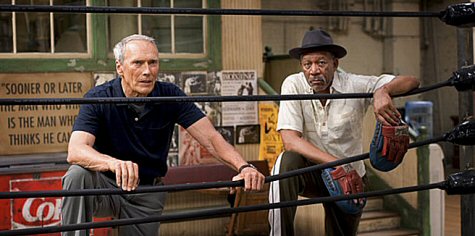
Hooray for Million Dollar Baby, Clint Eastwood, Hilary Swank, Jamie Foxx, Morgan Freeman, Spotless Mind inventor-screenwriter Charlie Kaufman…and the great Virginia Madsen, her loss notwithstanding.

Everyone was absorbing this last night, but let’s say it anyway: it was a vaguely boring, way-too-predictable show.

I didn’t hate it, didn’t love it…I just watched it, amazed at how precisely it all went according to plan. No surprises meant anything except the Best Song going to that beautiful tune from The Motorcycle Diaries, and yes, of course, the producers should have let the Argentinean composer perform it instead of Antonio Banderas and Carlos Santana.


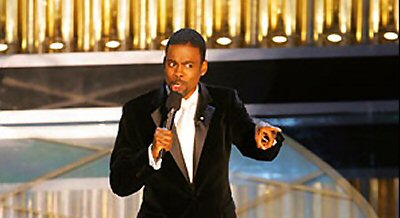
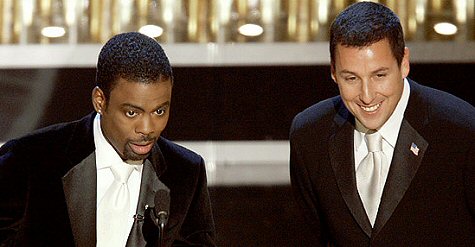
Oscar host Chris Rock, award presenter Adam Sandler during last night’s telecast.

Chris Rock’s best bit was his interviewing-the-moviegoers routine on tape from L.A.’s Magic Johnson theatre….especially Albert Brooks saying emphatically that White Chicks was the best film of the year.

But otherwise…I don’t know, the fireworks didn’t exactly go off. Rock aimed most of his stuff at the African-American viewing audience first, and the Academy crowd second. Somebody wrote this morning they should go back to Steve Martin and sign him up for five years. They should.

Those clips of Johnny Carson letting go with three or four zingers on those ’80s Oscar telecasts reminded me how sublime it can be when a host really knows the industry political stuff and how to tweak the pomp and proceedings just so.
As the show unfolded I heard these words in my head: “It’s tired…it’s fading…it’s not electric or essential…the only thing working for it is the familiarity.”

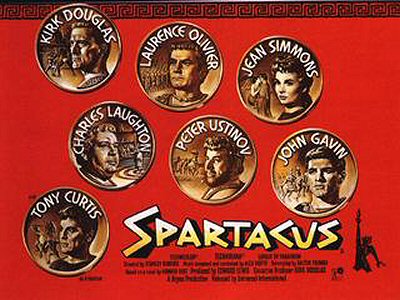
The best thing on the whole show was the CG-ed Pepsi commercial early in the show that used the “I’m Spartacus!” scene from Spartacus. Brilliantly cut and exquisitely CG’ed, and that final edit in which it appeared that the tear rolling down Kirk Douglas’s cheek was over the Roman officer drinking the Pepsi instead of Douglas….perfect. I’d like to think Stanley Kubrick enjoyed this from wherever he is. He would have respected the wit and the craft.

I understood Sean Penn jumping to the defense of Jude Law after Rock joked about his being in so many films last year, etc., but why did Rock even go with that gag in the first place? Everyone (including Law himself) was joking about his five or six movies in a row last fall. Comedy is all about timing, right?


Clint Eastwood, director-producer of Million Dolar Baby and winner of the Best Director Oscar.

Congrats to the winners of the Best Documentary Feature Oscar, Zana Briski and Ross Kauffman, for Born Into Brothels…but wasn’t this award mainly about the compassion and activism that Briski showed for those Indian kids who showed promise as photographers, and secondly for the film itself?

It’s really too bad that Clint Eastwood’s Million Dollar Baby score didn’t get nominated — his simple and elegant music in that awesome film got me more than any other composition this year. The second most impressive score of the year was James Newton Howard’s for Collateral, which wasn’t nominated.

Dion Beebe and Paul Cameron’s cinematography for Collateral was legendary from the time that Michael Mann film began to be screened late last summer. People who love film and urban noir imagery will be talking about their photography for decades to come.

No disrespect to Bob Richardson, the winner of the Best Cinematography Oscar for his work on The Aviator, but what he did wasn’t drop-your-socks awesome. It was just good professional craftsmanship.

Morgan Freeman’s Million Dollar Baby performance was Bhagavad Gita-like in its centered-ness, but I still wish Sideways‘ Thomas Haden Church had won for Best Supporting Actor. I’m glad he got the IFP Spirit Award on Saturday, and I was touched by how much he was touched.

And hooray for Sideways creators Alexander Payne and Jim Taylor winning the Best Adapted Screenplay Oscar. It couldn’t have happened to a cooler couple of guys.


Sideways director, co-screenwriter Alexander Payne (l.), and co-writer Jim Taylor at Saturday’s IFP Spirit Awards, in the press tent after winning their Best Screenplay award.

Really Big Change

Somewhere down the road, movies will probably open simultaneously in both theatres and on rental-only DVDs. Or maybe through some kind of broadband download service. And I’m not just talking across the U.S. but worldwide.

Maybe not all the movies at first, but some and then eventually more. Mostly on the part of the big distributors, and especially when it comes to the big dumb CG flicks.
This day-and-date idea has been kicked around for years, and now I’m hearing it again. I don’t like it much. It would certainly devalue and demythologize the ritual of going out to a new film on a Friday night, but I can see it happening.

Once this starts picking up steam you’ll hear a lot of squawking and a lot of (older) people exclaiming “no way!” and “are they insane?”…but just wait.

The cold, brutal fact is that the old romance of going out to the Bijou and sharing a big-screen experience with other moviegoers has been gradually diminishing among the hoi polloi for a long while.

Theatrical attendance continues to drop year after year, new ways of offering and seeing movies through new technologies are going to continue, the world is getting smaller and new distribution strategies are inevitable.

I’m not saying that people like me or the readers of this column are disconnecting from the communal thing, but people seem to be vegging out more and more, and DVDs being a bigger business these days than theatrical supports this.

Once the DVD/theatrical day-and-date strategy catches on, DVDs will be like CDs, and films playing in theatres will serve the same promotional function as bands going on tour and playing clubs and stadiums…revenue generators, for sure, and obviously offering a much more intense and exciting way of experiencing a film, but mainly serving as market-boosters for DVD sales.

Remove the day-and-date scenario, some say, and this is pretty much the case right now.

“Movies have become giant advertisements for their own DVD,” says screenwriter Scott Frank (The Interpreter, Get Shorty). “Just a few years ago DVDs and foreign business were considered ancillary,” Pollock adds. “Now they’re where most of the money is coming from, and [domestic] theatrical is ancillary.”

Think of all those couch potatoes and senior citizens (like my parents, who go out to movies maybe three or four times a year, if that) who would suddenly be part of the opening-weekend community if this idea were to happen.

The big motive for going day-and-date is that distributors would be able to slash marketing costs. They spend $30 to $40 million to open some movies theatrically (and even more for certain tent-polers), and, I’m hearing, some fairly hefty amounts to promote the DVD release of some of the bigger films (like Spider-Man 2 or Ray), so combining the two campaigns would be an obvious cost-cutter.

Variety home video editor Scott Hettrick, also the editor in chief of DVD Exclusive, says marketing budgets for DVDs can run between $1 to $5 million. But I’ve heard elsewhere that marketing budgets for super-titles, either hard cash investments or some sort of trade-barter arrangements, are much larger. The video industry is fairly secretive about the particulars.

Day-and-date releasing would also, I would think, cut heavily into video piracy revenues, especially if new films get released on DVD worldwide.

The Motion Picture Association of America has estimated for the last two years that mainstream Hollywood loses $3.5 billion in overseas revenue every year due to piracy. This figure is an estimate of the money made from the sale of bootleg DVD’s and VCD’s (i.e., video compact discs), which are available mainly in Asia.

It’s reasonable to guesstimate that out-maneuvering the pirates day-and-date with higher quality DVDs of brand-new films would result in an extra billion or two each year in revenue. Or would Asian consumers used to watching crappy-looking bootlegs not care all that much?

(According to a recent New York Times story by Ross Johnson, a reliable estimate of the 2004 revenues Hollywood earned from the sale of legitimate DVDs, as tabulated by Screen Digest, a British data company, is $11.4 billion. This is wholesale revenue drawn from an overall figure of $24.6 billion “that overseas consumers spent buying and renting home video products in 2004,” Johnson reported.)

The day-and-date rental income could be huge. As tickets in the big cities these days are $10, video store rentals for just-opened films could probably also be $10.
Video stores could even give vouchers to people renting brand-new movies and credit them with a $10 discount when and if they purchase the DVD after, say, a three-month window.

Imagine the Variety headlines about opening-weekend video-store rental numbers on top of the usual theatrical earnings…imagine $100 million dollar opening weekends for certain big titles, or higher. I’m just spitballing, but it sounds plausible.

And with a massive worldwide DVD and theatrical break, studios could probably make out better with big-budget duds like Catwoman or Alexander than under the current system, since the word-of-mouth factor would obviously count for a bit less.

And of course, not every film would necessarily be released this way. The kind of movies that would benefit from a gradual theatrical break by relying on word-of-mouth could stick to that. But theoretically, day-and-date could be a boon to the big CG movies. Especially the lousy ones.

I sound like a vp of sales making a pitch at a board meeting. And for an idea I find repellent. Day-and-date DVD and theatrical will just be one more reason for millions to stay indoors and stay clear of the hurly burly.

The idea of distributors deliberately destroying the wonder and mystique of going out to a new movie with a big crowd and enjoying the experience en masse sounds pretty close to appalling.

Okay, so theatrical releases have primarily become promotions for DVD releases…fine. But isn’t the main reason people pay millions to rent or buy DVDs because their appetite has been whetted by all the theatrical release hoopla a few months earlier — reviews, ads, word-of-mouth, etc.?

Some guys are telling me naaah, won’t happen, forget it…the studios will never cannibalize their theatrical market and kill the golden goose.

But all those plusses — reduced marketing costs, cutting into the piracy dollar, massive worldwide burn-throughs in a weekend or two, lousy movies cleaning up bigger without word-of-mouth screwing things up — probably sound enticing to bottom-line types.

The combined advertising and distribution costs in pulling off a worldwide DVD and theatrical release would, I’m assuming, be astronomical.

The last time a big studio tried to grab opening-weekend revenues from the home video market was 22 or 23 years ago when Universal offered The Pirates of Penzance on a nationwide pay-per-view basis, concurrent with the theatrical opening. The fact that no big studio has tried this since (unless I’m forgetting something) indicates something, I think.

And yet a week or two ago on Peter Bart and Peter Guber’s AMC talk show “Sunday Morning Shoot-out,” Sony honcho Michael Lynton was talking with some enthusiasm about a hypothetical super-tentpole title (Star Wars, Episode 3: Revenge of the Sith, let’s say) as a one-time pay-per-view opportunity. He speculated that such a venture could bring in the vicinity of $100 million in a single evening .
An agent told me yesterday that Mark Cuban and Todd Wagner, the guys behind 2929 Entertainment, an outfit that includes HDNet Films and Magnolia Pictures and is all about creating new pipelines and delivery systems, have been talking about releasing films simultaneously on DVD and theatrical.

I tried to speak to Cuban (or at least trade e-mails) about this yesterday through his publicist, but nothing happened.

Jeff Arnold, the founder of WebMD and head of a technical venture called The Convex Group, tried a new-fangled way last November of distributing that gauzy-looking Chaz Palmintieri film called Noel. Arnold called it a “trimultaneous” release strategy.

After opening in a limited number of theaters in mid November, Noel was sold on a “Mission Impossible” disposable DVD (unwatchable after 48 hours) for $4.99. Then it had a one-night-only airing on TNT on the Sunday after Thanksgiving. The only problem, in the view of a colleague, is that “nobody gave a shit.”

Any way you slice it, the DVD audience is getting bigger and bigger, the number of theatre admissions is declining every year (the increased earnings are due to higher ticket prices), and sooner or later we’ll be in a different world and the old communal way of seeing movies will become less and less a part of the way people live and entertain themselves.

I don’t like it, but I don’t see how to stop it. It’s the way things are going. Am I wrong?

Spirit

The Sideways sweep at Saturday’s IFP Spirit Awards — Best Feature, Best Director (Alexander Payne), Best Screenplay (Payne and Jim Taylor), Best Actor (Paul Giamatti), Best Supporting Actor (Thomas Haden Church) and Best Supporting Actress (Virginia Madsen) — was richly deserved. I mean, I would have voted that way.

I spoke to some journalists at the after-party who felt there was something a little too rote about Sideways winning everything, but naaah…it’s a great film.


Sideways costar and winner of the IFP Spirit Award for Best Supporting Actor Thomas Haden Church

I was especially pleased about Giamatti winning for Best Actor, after not even being nominated by the Academy. If only Miles hadn’t stolen that money out of his mother’s bedroom bureau drawer…who knows?

And it was touching, naturally, watching Haden Church get more than a little choked up at the podium and trying to keep his composure. I’ve loved every beat of his performance from the first time I saw it — he gave the most accurate and lived-in portrayal of a confirmed hound in the history of movies.

Eight or nine cheers to Maria Full of Grace‘s Catalina Sandino Moreno for her Best Actress win, and to Maria‘s writer-director Joshua Marston for winning the Best First Screenplay award.

Sideways costar and winner of the Best Supporting Actress Spirit Award Virginia Maden (r.) with her son, who told me in the press room that he has the same kind of digital camera.


Maria Full of Grace star and winner of the Best Actress Spirit Award Catalina Sandino Moreno.

Extremely hearty congratulations to Joe Berlinger and Bruce Sinofsky for winning Best Documentary award for Metallica: Some Kind of Monster…which the Academy didn’t even pre-qualify, much less nominate.

And I laughed at the bathroom joke that Garden State writer-director-star Zach Braff, honored for having made the Best First Feature, told in the press room. Q: Why did Piglet look in the toilet? A: He was looking for Pooh.


Three of the winners of the IFP Spirit Best First Feature award for Garden State in the press room: producer Pamela Abdy, star-writer-director Zach Braff, and producer Dan Halstead.

Pepsi Kubrick

“Jeffrey, sometimes you make no sense. That Spartacus Pepsi ad was another horrific hit on film, reducing powerful emotional scenes to branding madness.
“If you want a generation of filmgoers to equate classic movie moments with this soulless advertising, don’t complain as product placement reaches new awful levels.
“No, Kubrick would not be proud. Reducing a slave rebellion to a choice of Pepsi is the opposite of film art.” — Christian Divine.

Wells to Devine: It may be the opposite of film art, but it was very clever and a superbly rendered act of artistic defacement.

Affleck

“Ben Affleck is nowhere near as bad as many complain. I think he’s just become one of the targets of choice. I mean, how dare he win an Oscar so young, make lots of money, boink beautiful babes, and get to be a movie star/presence…gosh, he must be some kind of dickwad.

“Sure, he’s made some dogs — but so has Robert deNiro…and while Bobby D is a convincing screen presence…he’s not that different from one character to the next. Much like Affleck. But for whatever reason, DeNiro gets a pass and Affleck gets the bitchslap.

“In short…cut Affleck some slack. Even if he doesn’t do much else in his life, he co-wrote Good Will Hunting, which was a damn fine film. Most of Affleck’s critics could never create something as moving. ” — Roy “Griff” Griffis.

“Shouldn’t you probably hold off pronouncing ‘the return of Ben Affleck’ until after Truth, Justice and the American Way is actually made and shown?

No one knows as yet how he will do. He could very well tank, you know. Just because he is getting a smaller paycheck (although $500,000 is nothing to sneeze up) compared to his last one does not mean he will suddenly become a critically acclaimed actor or turn in a mind- blowing performance.

“As you wrote yourself, he, like George Reeves, is an ‘amiable, modestly talented actor’ and yes, it is true that Affleck excelled best in playing himself on film.
“Still, one wonders if he can pull this role off. He does not possess the gravitas and while he can sometimes give a decent performance, his problem is his inability to sustain one for the entire length of the film. Which is why his best performances are in films where his role is very small. He is definitely not leading-man material. This has been proven by his string of box office flops.

“Honestly, my concern is that the minute his career shows a little sign of life, he will again be shoved down our throats a la Bennifer style as he is such a tabloid magnet. He seems to like the spotlight too much, even after the Bennifer fiasco. Otherwise, why show up at Boston Red Sox games with latest girlfriend in tow?

“For this reason alone, I wish he would just disappear or change career and go become an insurance salesman or something. Anything so that we do not have to see him on TV or the newstands again. We so do not deserve another round of that.
“And if only he could take J. Lo with him. This one is 100 times worse. It is a multi-front attack! How many bad films and bad albums and bad clothing lines do untalented multihyphenated stars have to do before they sink out of sight?” — Fearful Quebecer.

“I have no particular interest in either keeping Ben Affleck a movie star or packing him off to the place where Michael Sarrazin and Craig Wasson went after seeming to be names, but I’m kind of appalled at the lazy attitudes displayed toward his career by the Hollywood insiders you quote.

“If Affleck ever had something, then can’t these supersmart and savvy folks imagine that one good script would give it to him again? And if he didn’t ever have it, what the hell were they doing writing him $12 million checks?

“Is Quentin Tarantino the only guy in the whole city capable of looking at John Travolta and Bruce Willis and imagining great parts for them instead of having Staying Alive and Hudson Hawk brand them for life? (He, rather than their agents, should be collecting 10% of every job they’ve had since.)

“The herd mentality on display in your piece is everything that’s wrong with Hollywood. I kind of do hope Affleck turns it around now, just so he can stick the same geniuses for another $12 million when he’s hot again. ” — Mike Gebert.

“You ran a line about Ben Affleck `being adaptable enough to take only $500,000 upfront for playing George Reeves, the amiable TV actor who shot himself over career problems in 1959, in Focus Features’ Truth, Justice and the American Way.'”
Only” $500,000? Only in Hollywood. Foreign films rarely pay their stars anything like even that “modest” sum. If this one doesn’t arouse a pile of mail, I’ll be both surprised and very disappointed.

“I keep thinking of him as `Been Affected,’ although my old English profs would probably have preferred `Affectless.’

“If you recall, George Reeves played Waylon (Malon?) Stark, a soldier who’d had a previous affair with Karen Holmes, the Deborah Kerr character, and tried to sum up her sexual allure to Burt Lancaster in a key scene that oozed sleaze and showed a side to Reeves’ acting talents that his subsequent work never capitalized on.” — Richard Szathmary.

Mimic

“A thought about your criticism of actors performing imitations rather than originals (i.e., Jamie Foxx doing Ray Charles and Cate Blanchett doing Hepburn.)
“This is a common criticism of actors, and yet I would submit that this criticism is merely a recent fad among middle-to-highbrow American media types. Not only do the overwhelming majority of quote-unquote ‘ordinary people’ find imitations perhaps the most thrilling and delightful kinds of performances (when the imitations are truly inspired), but Aristotle and Plato each argue that the craft of imitation (‘techkne’) is at the very heart of art-making.

“When actors, writers, and directors are imitating out of pure love for their subjects, with their soul fully inflamed, the best and most primal art is created. Imitation is not some hackish craft best left to Vegas lounge acts. Imitation — even theft, as some artists freely call it — has been responsible for some (if not most) of the greatest art of our, or any, time.

“Johnny Depp admitted happily that his Oscar-nominated (and, more importantly, universally-adored) performance in Pirates of The Caribbean was simply a Keith Richards impression. And it isn’t that Depp brought more to his performance than merely an imitation — Depp simply loves imitating Richards, and he should: he’s brilliant at it, and it makes us all laugh hysterically, even if we don’t know he’s doing Richards, or know who Keith Richards is.

“The crucial currency in the performance — that which is transmitted from artist to audience — is the artist’s love of imitating the subject. ‘Doing’ Richards wasn’t a copout for Depp — it engaged every ounce of his artistry. Interestingly, Depp’s performance was never impugned the way that Foxx’s or Blanchett’s has been, because Depp’s imitation was not overt — it was smuggled in and reappropriated.

“Why is Jim Carrey so much less inspired in his dramatic performances than in his comic ones? Because he has bought into the fallacious myth that he must create an original performance in order to become a real actor. He couldn’t be making a bigger mistake. By stripping the ecstatic mimicry out of his performances — and he is indisputably one of the greatest screen mimics of all time — he has sapped his work of its primal joy. The effect on his work has been stultifying.

“There’s no shame in imitation; far from it. As Godard once said, it’s not where you take things from — it’s where you take them to.” — Josh Shelov , screenwriter of the forthcoming Holligans, starring Elijah Wood.

Good Moves

“I disagree with Stephen Silver about Arthur Penn’s Night Moves being an all-time genuinely depressing movie. (For that, I nominate Bergman’s Cries and Whispers). What was depressing about Night Moves was its lack of recognition.

“It makes, in fact, my list of top American detective movies (in order: The Maltese Falcon, Chinatown, Night Moves, LA Confidential, Harper and The Long Goodbye) and is an outstanding example of top-rate talent (Penn, Gene Hackman, Harris Ulin, James Woods) at work.

“It has one of my all-time favorite lines. The just-caught-en-flagrante wife Susan Clark turns off the kitchen garbage disposal as it crunches on a glass, saying ‘I can’t hear myself think,’ to which the roiling husband Hackman replies, ‘Aren’t you lucky?’

“It also has a very distinctive use of music — there is a long brilliant sequence of scenes near the start of the movie, as Hackman starts to get into the case, where the music seems to stamp each successive scene as a stanza or as a chorus within a single ongoing composition.

“Finally, it also includes nude or semi-nude scenes with Clark, Jennifer Warren and Melanie Griffith.” — A Night Moves Fan.

Wells to Fan: Not to mention that Hackman line to Clark that watching an Eric Rohmer film is “like watching paint dry.”

Changes

“That was an excellent piece on day-and-date DVD releases, but I don’t think you went far enough. You alluded to new technologies and delivery systems, but I think that’s the whole ballgame.

“The future is in broadband, on-demand delivery and Digital Video Recorders (DVR). And unless something changes in the near future, the studios are about to assure that’s the case.

“As you’re probably aware, a VHS/Beta-type war is brewing over the next generationpf hi-def DVDs. Roughly half the studios (with Sony as the team leader) are supporting Blu-Ray; the other half (led by Warner Bros.) is supporting HD-DVD.

“Most consumers probably won’t make the switch right away, especially since both systems are backwards compatible with current DVDs. But the format war, if it is drawn-out enough, will likely scare off the ‘early adopters.’ This will further delay penetration of the new technology into homes.

“In the meantime, broadband compression technology will improve, and companies like Microsoft and Sony will increase their drive towards developing an all-in-one box that will act as the complete entertainment/information center for the home. We’re almost there now, anyway. Once that technology is set, distributors will be able to offer a much wider variety of on-demand films, most likely in HD.

“And if the computer is integrated with the television, you’ll also be able to download additional content like that found on a DVD. That will all be stored on a DVR for use whenever desired.

“As the I-Pod has vibrantly shown, consumers no longer need to possess intellectual property in media form. They will be perfectly happy to maintain their movie library on a hard drive, especially if those movies are available to view online at any time.

“In my opinion, DVDs have already seen their peak. Within 10 years, they will be as useless as record albums.

“The theater experience is also dying. Last night, I saw a 54” widescreen Sony LCD TV at a warehouse store for less than $2,500.00. That means even now the average consumer can put together a widescreen HD home theater experience, with Dolby Digital surround sound, for less than $3,000.00. And the prices are only going to keep dropping.

“Why pay $10 plus parking to see a movie on someone else’s schedule, in minimal comfort and at the mercy of the movie critics and ninny-nannies sitting around you?

“Besides, the media giants already have a solution for the communal experience you discuss. Microsoft runs an “X-Box Live” site, where you can play multi-player
games simultaneously and audio link via headsets.

“How hard would it be to adapt this technology so that, if you desired, you could join a film chat room with any number of people watching the movie at the same time? And you could set your own level of interraction. Just want to hear general ambient laughter or screams? That’s one setting. Want to be able to comment to the guy next to you? That’s another setting. But you’ll never have to deal with a
screaming baby or a ringing cellphone again.

“And that brings me to another issue beyond the scope of your article. The next generation may not be satisfied with simply passively absorbing a movie. Isn’t the gaming industry already bigger than the movies? Why pay James Caan $2 to 3 million to appear in a Godfather sequel when you can pay him a few thousand to do voiceovers for the Godfather video game?

“People are always going to need a place to go out on the weekends, especially young people, so I doubt the theater experience will ever totally die off. Broadway still thrives, even with all the alternate choices. But the Hollywood model as it exists today, and certainly as it existed 10 to 20 years ago, is already on life support.

“Ask not for whom the bell tolls, Mr. Ebert — it tolls for thee.” — Rich Swank, Orlando, Florida.

Jacksonesque?


I’m a tiny bit late to the party on this one, but I agree that the beatific expression and that black glove on Depp’s left hand and the cut of his hair and the fairy-tale vibe reminds me of a certain world-class creep who lives in a self-created world north of Santa Barbara. My favorite comment so far, taken from a Movie City News chatboard: “Hunter S. shot himself when he saw Johnny in that pub still.” Director Tim Burton has always operated according to his own muse, but Charlie and the Chocolate Factory (Warner Bros., 7.15) may have something to cope with…maybe.

Different Game Ben Affleck’s career

Different Game

Ben Affleck’s career may be on the ropes, but at least he seems to get that…and is doing something about it. Like being adaptable enough to take only $500,000 upfront for playing George Reeves, the amiable TV actor who shot himself over career problems in 1959, in Focus Features’ Truth, Justice and the American Way.
This may sound like a bit of a comedown for a guy who used to pocket $12 million or so per film, and who earned a lot more, reportedly, from a back-end revenue deal his agent cut over Pearl Harbor. But not when you take the long view.

Truth — the story of the 1959 death of George Reeves, the actor who played Superman on TV in the 1950s — is a modestly proportioned, character- driven period film that has a budget of $20 million (or just under), so everyone — including costars Adrien Brody and Diane Lane — is working for less. Allen Coulter, the highly respected Sopranos director, will begin shooting in the summer.
Besides, taking the Reeves role (which is kind of a co-lead — Truth is also about Brody’s character, a shamus, looking into Reeves’ suicide) is apparently part of a new Affleck career strategy of taking less money (which may not be a choice at this stage) and going for sturdier roles.
< ?php include ('/home/hollyw9/public_html/wired'); ?>
Going for roles, in other words, that echo or emulate the most respected, best-reviewed performance of his career — that of the affable smoothie lawyer suffering a spiritual meltdown in Changing Lanes.
That performance worked in part because it seemed to reflect on some level who Affleck really was: a smart, well-connected, good-looking guy cruising through life, but starting to inwardly choke over his own bullshit.
Affleck may be one of the healthiest, least screwed-up guys around in actuality, but the image of the fucked-up, soul-sick yuppie feels right on the screen.

It was also ahead of its time in a sense, as Affleck’s box-office losing streak (Gigli, Jersey Girl, Paycheck, Surviving Christmas) and all the Bennifer tabloid crap…gambling-at-the-Hard-Rock, addictions to this and that, a stumbling-around, banging-into-furniture quality to his public outings…didn’t manifest big-time until Changing Lanes went to video.
Fairly or not, people accepted the idea of a spiritually afflicted Affleck like they bought Jimmy Cagney playing gangsters and Pat O’Brien playing priests.
That’s why, I’m guessing, his forthcoming performance in Mike Binder’s Man About Town will probably work. It’s not an overly dark piece, but it’s not what you’d call “light” either. Affleck will play a Hollywood talent agent whose world starts to fall apart when he learns that his wife Nina (Rebecca Romijn) is fooling around on the side, and that a fang-toothed journalist Barbi Ling (Ling) is out to waste him with a profile piece based on his diary.
Written and directed by Binder (whose previous film, The Upside of Anger, is opening on March 11), Man About Town will probably open next fall.
And that’s why playing Reeves is a good fit. An amiable, modestly talented actor with a winning smile whose Superman success typecast him and ruined any chance of playing roles in feature films….a guy who was going downhill and knew it, and also had a bit of a drinking problem, and was carrying on some kind of affair with the wife of major studio executive at the time…another smoothie in crisis.
All Affleck has to do is gray his hair up and put on some weight (Reeves was a little beefy looking toward the end) and it’ll be like Frank Sinatra playing Pvt. Maggio in From Here to Eternity …a mouthy little guinea playing a mouthy little guinea.

Before starting on Man About Town last fall, Affleck’s last gig was starring in Paycheck, a 2003 John Woo actioner that wound up taking in less in U.S. theatres than its reported $60 million negative cost.
New York Post entertainment writer Lou Lumenick wrote in a story out today (2.23) that Affleck subsequently “dropped out” of two big-budget films at Disney, the sports drama Glory Road, in which he was replaced by Josh Lucas, and the romantic comedy The Ghosts of Girlfriends Past which is being recast.
The reason he didn’t do Glory Road, I’ve been told, is that Disney wouldn’t pay him the $4 million fee his agent wanted.
Affleck was actually mulling over the George Reeves role about two years ago. The film’s original co-director Mark Polish (who left the project with his brother Michael when Miramax balked at casting Kyle MacLachlan as Reeves) told me yesterday he’d met with Matt Damon in late `02 about playing the private detective role, and while he never spoke to Affleck about the Reeves role, Damon may have tipped him about it.
Affleck is “damaged goods, there’s no question about it,” a veteran agent said yesterday. “I don’t know what he did, exactly, to earn this [reputation]. Is he that bad an actor? No. He was good in Changing Lanes, he was good in Shakespeare in Love, he was good in Boiler Room.”
And yet, he added, “I would say he’s lucky to be getting offered [the Reeves] role.”

“He’s not getting top dollar any more, he doesn’t mean anything, and the career he had of bringing people into the theatres is over,” a marketing veteran said, speaking of Affleck. “And he wants a semblance of a career, and his agent is saying to him, you’ve got to do something to revive it.
“I don’t know what his overhead is, but the checks aren’t coming in. The big checks are gone, and no one is going to pay him the big checks. But he’s young enough to reverse himself, like Travolta did.”
Binder said during a q & a session at my UCLA Sneak Preview series a couple of weeks ago (following a showing of The Upside of Anger) that Affleck has “taken the last two years and moved on and is smart and talented enough to come at things in a whole new way.”
“This guy won an Oscar at 24 — he’s 32 now,” Binder has been quoted as saying. “He needed to stumble. He’s learned a lot from the last two years, trust me.”

Blood and Sand

It seems likely that 24 year-old Jake Gyllenhaal, who started out playing twitchy-sensitive weirdos in Donnie Darko and The Good Girl, will have a better-than-decent shot at a Best Actor trophy next year with his portrayal of Anthony Swofford (i.e., “Swoff”) in Sam Mendes’ Jarhead.
Especially since Gyllenhaal is also likely to punch through on some level with his performance as a gay-leaning cowboy in Ang Lee’s Brokeback Mountain, which Focus features is opening on 10.7.05…only five weeks before Jarhead.
Swofford was a real-life U.S. Marine who wrote the book that the film is based upon. In the script, “Swoff” becomes a sniper under the command of Jamie Foxx’s Sergeant Siek, and ends up fighting in the ’91 Gulf War.

I’m basing this on having read William Broyles’ script of Jarhead. The Universal release will probably emerge as an Oscar Awards contender in several categories after it opens on 11.11.05.
And while I’m at it: Peter Sarsgaard, whose portrayal of New Republic editor Chuck Lane in Shattered Glass broke him out of the pack, has the most hard-core and most commanding presence in Jarhead. (Gyllenhaal’s Swofford comes off as more emotionally susceptible, and even a bit unhinged.)
Knowing Sarsgaard’s capacity for intensity and staring people down and all, I feel fairly safe in saying that his performance as Troy, a sniper who has his gear wired tight at every turn of the road, is going to have an impact.
Especially, I’m thinking, with the consensus that Sarsgaard was under-recognized for his Glass performance, and everyone having admired his work in Kinsey and, more recently, his performance as a gay screenwriter in Craig Lucas’s The Dying Gaul.
Jarhead will probably resonate as a realistic portrait of the loneliness, combat craziness and other wack factors affecting the lives of American soldiers in Iraq…even though it’s centered around the ’91 Gulf War.
It doesn’t have the conflict-between-father-figures element that fortified Oliver Stone’s Platoon (it’s basically an immersion in the unsettled emotions of a combat soldier — before, during and after battle) but then every new film is a reinvention.

Mimic

If there was a last-minute Oscar rumble last week, it was over an assumption in some quarters that Cate Blanchett was a slam-dunk to win the Best Supporting Actress Oscar for delivering what could graciously be called a decent impersonation of Katharine Hepburn in The Aviator.
Add Jamie Foxx’s almost-certain win for Best Actor for “doing” Ray Charles in Ray , and that would be two Oscars for performances that are as much about sustained mimicry as anything else.

“It’s just a way for voters to make an easy call,” Oscar pulsetaker Pete Hammond said last week about the Blanchett vote. “She doesn’t have much [of a role], but she got Hepburn pretty well and it’s easy to see that and say, `Yeah, give her the award.”
I’ve said this too many times, but withholding the Oscar from the actress who really deserves it — Sideways‘ Virginia Madsen — seems close to appalling.
Especially when you consider what Blanchett reportedly said when she accepted a similar acting honor from the BAFTA Awards a little while back. She looked up from the podium, smiled and said to Hepburn’s ghost, “I’m sure you’re pleased you weren’t allowed to see this.”

Last week the word started getting around that the leading contender for next year’s Mimicry Oscar will be Joaquin Phoenix, for an allegedly dead-on portrayal of country singer Johnny Cash in James Mangold’s Walk The Line.
20th Century Fox’s decision to release this biopic on 11.18.05 is an obvious Oscar positioning move, and it won’t hurt that Cash’s legend has been on the ascent since his death in September ’03. A similar synergy helped Taylor Hackford’s Ray when it opened four and a half months after Charles’ death in June ’04….as cynical as that sounds.

Missing It

“I’m 15, and I saw Sideways before it opened and loved it every bit as much as you did. But I only have two friends who are around my age who liked it as much as I.
“Everyone else I’ve talked to has not had a positive reaction to the movie. ‘I didn’t understand why they were friends,’ one said. I told another to watch it again in a few years and he said, ‘If I don’t like it now why would I ever like it?’ Even
some adults, like my substitute teacher in English, thought that it was so unlikable and couldn’t muster up any sympathy towards the Paul Giamatti character.
I figured you’d be the best guy to ask why don’t more people of my age understand Sideways?” — Jeremy Fassler.
Wells to Fassler: I haven’t a clue as to why your English teacher found it unlikable, but he probably needs to get out more. That or Giamatti’s character reminded him of something in himself on some level, and he didn’t like thinking about that. Your friends not liking it is probably about life-experience issues. My 16 year-old son Jett says “several” of his friends liked it fine.

Policeman

“Like you, I was pleased to see The Laughing Policeman released on DVD. It marked the middle of three solid performance by Walter Matthau during the early 1970’s in hard-boiled crime dramas, coming between Charley Varrick (which I am boycotting on DVD until it is released in matted 1.85) and The Taking of Pelham One-Two-Three (which has been available for quite some time on a budget- priced DVD).
“Many serious actors would love to have three consecutive films like this on their resume, let alone a comic like Matthau. He acquitted himself well in all three, especially in Varrick, which called for a more well-rounded character.

“Sadly, none of the films performed particularly well at the box office and they are all pretty well forgotten today save for buffs like ourselves.
“The DVD releases of Varrick and Policeman are about as bare-bones as it gets. For whatever reason, Matthau returned to doing what eventually became his Grumpy Old Man shtick after Pelham and never really returned to serious drama the rest of his life.
“While I am still upset at the shabby treatment given Charley Varrick on DVD, it is good to see these movies get some belated recognition.
“Another movie of this era which is long overdue for a DVD is Arthur Penn’s Night Moves with Gene Hackman — a film that qualifies for your list of genuinely depressing films.” — Steven R. Silver

Folks Night


A moment with Paul Reiser, writer-producer and co-star of The Thing About My Folks, at UCLA Wadsworth Theatre during discussion following screening — Monday, 2.21.05, 9:25 pm. Thanks to Reiser, producer reps Jeff Dowd and David Garber, and publicist Mickey Cottrell for helping to arrange the screening.

We’ll Call You A couple

We’ll Call You

A couple of months ago I wrote a tough piece about my disappointment with Steven Soderbergh’s output over the last three or four years, and then Soderbergh let me have it at a Sundance party a few weeks later and I heard what he was saying (or feeling), so here’s something olive-branchy:
Unscripted, a half-hour HBO series that Soderbergh and his Section Eight partner George Clooney have exec produced (with Clooney directing now and then), is the best original thing I’ve seen on the tube in a long, long time.

It’s mainly about three hard-luck actors more or less playing themselves (Krista Allen, Bryan Greenberg, Jennifer Hall) and dealing with the usual thespian woes — auditions, rejections, agent relations, more auditions, lost parts, occasional couplings, etc.
It feels honest, economical, “real”…and I say that knowing that it’s pretty easy to fake a reality atmosphere in any guise. It’s a concise and beautifully edited thing, there isn’t a false note in any aspect of it, and it’s pretty close to dazzling. K Street, the last Section Eight HBO show, was good but this is better.
< ?php include ('/home/hollyw9/public_html/wired'); ?>
I’ve only seen two of the ten episodes and there are only two more episodes to go…but there will be re-runs and a DVD box set later this year. It plays Sundays at 10 pm.
The great Frank Langella co-stars as a 60ish acting teacher, Goddard Fulton, who also gets kicked around and his face smudged. Nobody has it easy in this show. Things are tough all over.
“The truth of the matter is [that] less than five percent of [union actors] make all the money,” Clooney says on the show’s website. “And that’s just the people in the union. There are so many actors that get up every morning and — forget getting a job — they try to get an agent. Or an audition. We’re trying to show what it is that we do. It’s completely unlike the way it’s usually portrayed.”

It’s been claimed that the show doesn’t use prepared dialogue, that it’s all improv and things like rehearsals, retakes or reshoots don’t figure. (I can believe this.) The series has allegedly been shot in “real offices” and during “real film productions,” with the actors sometimes crossing paths with “real-life Hollywood stars and directors”…as far as that goes, fine.
Clooney, Soderbergh and Grant Seslov are the executive producers of Unscripted. It’s produced by Michael Hissrich and Joanne Toll; the episodes have been directed by Clooney and co-exec producer Grant Heslov.
Episode #9 of Unscripted preems on Sunday, 2.20, with another airing the following night (i.e., Monday) at 9:30 pm on HBO2 and then Wednesday, 2.23 at 10 pm on regular HBO.

Looksee

Wandering movie journos who haven’t seen Paul Reiser and Raymond DeFelitta’s The Thing About My Folks have a shot at seeing it on Monday, 2.21, at my UCLA Sneak Preview class, which begins at 7pm at the Wadsworth.
RSVP to Sarah Rose Bergman at 310.572.1500 or write jeffdowdassist@aol.com.
If this invite isn’t ringing any bells, I wrote about this amiable little film in my February 8th column . Some distribs think it plays too old, but I’m convinced it’ll play big with the crowd that went to see My Big Fat Greek Wedding. I could be wrong, but I’m not.

Heart on Sleeve

All you have to do is click on this to see where Born Into Brothels is coming from.
It has a video-and-music reel showing Calcutta kids experiencing the joy of taking photos. Acquainting impoverished kids with photography and trying to save them from a squalid life of prostitution (or worse) is what the film’s co-director, Zana Briski, is up to in this unusual documentary. In short, activism rather than the usual impartial neutrality.
In the manner of a wildlife documentarian running out into an African plain to save a zebra from a pursuing lion, Briski (and her filmmaking partner Ross Kaufman — both pictured below) strive to save as many kids as they can from the certain spiritual death that comes to anyone who lives among squalor and prostitutes.

This Oscar-nominated film may have begun as an exploration of children growing up in Calcutta’s whore-house district, but it became a story about trying to get the Indian government and other potential benefactors to sponsor these kids in their education as photographers.
Briski faces tough challenges, not just from the government or the kids’ parents but, believe it or not, from Catholic nuns. In this light, Brothels is an expose of the complacency that keeps unlucky or disadvantaged people where they are, and blocks anything or anyone who might give them hope.
“I just respond to what’s around me, but I wanted to make a good film,” Briski told me a couple of weeks ago. “I didn’t want to be in the film but I became a catalyst.”
The need for education and opportunity among Calcutta’s poor “is enormous…the level of suffering is staggering,” she said. “And we were confronted with it every day. It’s overwhelming for anyone who tries to work in that place. Most of the women are using some form of birth control…and there’s a lot of ignorance. Women don’t know about their bodies.”
Born Into Brothels won the ’04 Sundance Film Festival Audience Award, and is favored (I think) to win the Best Documentary Feature Oscar.

And yet Briski promised the people who helped her make the film (including the ones she interviewed) that she wouldn’t allow it to be shown in India, and she’s managed to prevent that so far. The mothers of the children portrayed in the film don’t want to be “stigmatized,” she says. Not allowing the film to be shown in India or even neighboring Pakistan is “my personal commitment,” says Briski.
When you make a promise you’d better keep it, but Brothels is full of hope and compassion and generosity, and pledging to keep this energy from being absorbed in India seems strange.
Two years ago Briski formed Kids With Cameras, a group that tries to continue the charitable efforts depicted in the film.

Go Ahead…Laugh

Even now, 31 years and five months after its theatrical debut, nobody seems to want to respect or even appreciate The Laughing Policeman. A lot of the reviews of the Fox Home Video DVD that came out two or three weeks ago have either been dismissive or ho-hummy. They should take another look.
I love this film for its gritty milieu and dinghy, matter-of-fact grimness. For me, its sullen attitude is a heavy turn-on. It’s not a great work, but I love that it doesn’t try very hard to “entertain.” It’s a film that says to its audience, “You don’t find what we’re showing you attractive or transporting? Gee, that’s too bad.”
The DVD doesn’t have any extras or voiceovers, but anyone with a taste for hardboiled noir should grab it.

You wouldn’t want to call this a “hard-charging” cop flick — “laid back” would be more like it. And yet by today’s formulaic, semi-anemic standards it’s a genuine pleasure to watch a San Francisco policier that delights in atmosphere to this degree.
It’s not just the cops who seem cynical, miserable, bitter or numb — the innocent bystanders seem this way also. You can almost smell the self-loathing despair, the perspiration, the cigarette smoke and the acidic coffee.
Directed by Stuart Rosenberg and based on a Swedish crime novel, The Laughing Policeman is about an investigation into a mass murder on a San Francisco city bus. Ten or twelve people have been mowed down by some lunatic with a “grease gun,” and the cops don’t have a clue.
A squad of detectives is assigned to the case and Rosenberg acquaints us with some of them (Lou Gossett has the juiciest second-banana role), but the ones we mainly hang with are played by Walter Matthau and Bruce Dern.
Matthau (who was about 53 when it was made) turns in his usual rumpled and grumpy routine, but when Policeman hit screens in September `73 it was seen as a major change of pace. Matthau had been a big comedy guy throughout most of the `60s and early `70s (Plaza Suite, Hello Dolly, et. al.). As a cop lacking in basic people skills, Dern does his usual insinuating obnoxious thing.
One of the big plot points is that Matthau’s partner, a guy named Evans, is among the bus victims. Matthau talks to Evans’ girlfriend (Cathy Lee Crosby), and learns that he was spending his “off” time looking into the murder of a prostitute. He also finds out that Crosby posed for erotic photos, which half-offends him and half turns him on.

This dirty-pictures element has zip to do with finding the killer, but it adds to the general down-at-the-heels sleaziness. It also tells us that Matthau has a thing for Crosby.
A strain of homophobia pops through when Matthau and Dern start to train their sights on a wealthy gay guy as a possible suspect (the term “fruiter” is heard), but this was made only three years after Stonewall so I guess we can cut the filmmakers some slack.
I just love the way Rosenberg and his crew take their time in solving the murder. The movie seems to say, “We’ll get to it, we’ll get to it…in the meantime have a donut and relax and try paying attention to the other stuff.”

Down, Down, Down

“Anyone who doesn’t immediately nominate John Frankenheimer’s Seconds as the most depressing movie ever made — by some distance — is clearly someone who has never seen the film.
“By comparison, Million Dollar Baby is Singin’ in the Rain, Monster is Gigi and Midnight Cowboy is Seven Brides for Seven Brothers. Unlike those films, nobody in Seconds achieves anything resembling a fulfilling relationship, even momentarily. The entire story is dedicated to the proposition that hope is for fools, and that the most we can wish for is an empty illusion.
“Top it all off with James Wong Howe’s askew cinematography, Jerry Goldsmith’s unsettling score, and the heartbreaking sight of Rock Hudson finally giving a brilliant dramatic performance in a film nobody saw — and you have a film that
lingers in the back of your mind for years, like a bad, bad dream you really wish you never had.” — Jack Lechner, Radical Media.

“When I read your downer movie article, the very first things that came to mind were two movies my high school film teacher Jay Kaplan showed back to back in the mid-70’s: The Heart Is A Lonely Hunter and Bang The Drum Slowly.
“Kaplan must have been some kind of masochist to inflict this on a bunch of 17 year-olds, but then again, not many happy endings in that classic era of 70’s films. For a bunch of geeky high school kids, these movies were like a one-two punch of depression. Imagine a bunch of high school seniors just sniffing away in the silence of the dark classroom.
“In the former movie, nobody saw the suicide scene coming, so when you heard Alan Arkin’s gun shots off-screen, the class was totally mortified instantaneously. Then that dissolve to his tombstone… that was killer. The class was a total wreck.
“At least with Bang The Drum Slowly, you found out the deal about halfway (‘My son is dyin’!’), but it was still a head-shaking bummer when good ol’ boy catcher Robert DeNiro did his Brian’s Song exit. My film teacher referred to the hospital parts as the infamous `shit deal scene.'” — Drew Kerr
“David Cronenberg’s Dead Ringers is an exquisitely sad film. Darren Aronofsky’s Requiem for a Dream made me feel like I’d been clocked between the eyes with a 2×4. Mike Nichols’ film Who’s Afraid of Virginia Woolf? still really stings, too. They’re therapeutic, though. True bummers are things like the new Star Wars films and Troy and Bad Boys II — black holes into which enormous amounts of money, talent and creativity disappear.” — Jason Comerford.
“Hurts…hurts so bad! Here are my All-time Downers: Pearl Harbor, Dying Young, St. Elmo’s Fire, Monsoon Wedding, All the Real Girls (I don’t care if you crib from the French or Terrence Malick….learn how to tell a tale), Beaches, Steel Magnolias, Man On Fire, The Perfect Storm.” — George Bolanis

“Most recently, I’ve heard people describe Million Dollar Baby as depressing, to which I say `huh?’ Sad, yes, but depressing? I could watch it over and over.
“For me, a good example of a really depressing movie is House of Sand and Fog. Depressing because, in my opinion, so many relatively intelligent people (like yourself) bought into this pretentious piece of excrement. It was so bad, and so well-liked by critics, that I had to call my entire way of judging films into question.
“Walking out of the theater, I asked my friend (a dim-witted soul but with an oddly good movie bullshit detector), `Was it just me, or was that a piece of shit?’ And he said `Yeah, it was.'” Mark Van Hook, Boston, Mass.
“A triple bill that would have you going for the Prozac: (1) Ironweed — just beats you down…unrelenting on every level. (2) Interiors — not even good drugs help with this one. (3) Kanal — a very difficult and fatalistic vision that grinds a viewer’s sensibilities to a pulp.” — Benjamin Moore
The Pledge. God almighty, that movie was depressing! Great cast, but oppressive and slow storyline with a downer of an ending.” — Craig Finnerty.
“Here’s your winner, hands down: Gaspar Noe’s Irreversible. Although it aspires to a fleeting moment of hope at the end (beginning), it’s about as dark and bleak a view of humanity as you’ll ever see on celluloid, with nothing remotely redemptive about it.” — Eponymous.
“Recent all-time depress-o-ganza: The Assassination of Richard Nixon. I personally adored the film, and was shocked at the critical indifference it received — it’s the most profound and acute trapped-in-the-mind-of-a-madman head trip since Taxi Driver.
“But when the relentlessness finally abated and the lights went up, I turned to my buddy — who is of the unshakable belief that there are no depressing films, only bad ones — and croaked, `That was pretty goddamn depressing.’ You know what? He agreed — he was shaken. And we talked about the thing for the next couple of hours; neither of us could get it off our minds. If that’s what a genuinely depressing film can do, then I’d argue it’s worth the tough two-hour sit.” — Tim Merrill.

“I’m picky enough to avoid most of the stinkers, but I would have to nominate Purple Rain and Moment by Moment as the two most depressing films I’ve ever seen — not because of their subject matter, but because they were so boring and a waste of my time here on earth.” — Heidi Bortner.
“You clued me into one in a much earlier column — Breaking the Waves. Before Lars von Trier became a total sadist. A movie that was sold as uplifting but was not, in any sense of the word, is Muriel’s Wedding. Though I do admire the hell out of Toni Collette. I saw Blow Up when I was 20, and at that age I thought it was completely depressing. And confusing. Natural Born Killers did not edify me in any way.” — Doug Helmreich
House of Sand and Fog…bummer! The movie throughout was taxing in its morbidness and depression … but the ending with the (spoiler) son getting killed …now, that’s what I call bleak! For the life of me, I can’t see how anyone can own this film on dvd except for the people who either acted in it or worked behind the scenes (so that they can show their friends … ‘Hey, look, that’s me in the end credits!).” — Ron Koffler
Dancer in the Dark was, for me, the most depressing movie of all time! A punch in the stomach from beginning to end. I have terrible flashbacks even now while listening to muzak for `My Favorite Things’ at the local supermarket.” — Amy Shemaitis.
“No matter how good it might have been on its merits, Monster was so goddamn depressing that I’d never watch it again. Sure, Charlize Theron is brilliant, but I can’t handle that much despair! I felt the same way about Mystic River, House of Sand and Fog and Leaving Las Vegas. It’s not like I’m some low-brow Neanderthal, either. There’s a good depressing like Million Dollar Baby. The problem is that some films are just so bleak that they don’t make for good re-visiting.
“As for so-bad-it’s-depressing, what about Life or Something Like It? That film was a real kick in the balls. I went to the bathroom three times in 90 minutes just so I could have some relief. Unfortunately, I couldn’t walk out because my wife wanted to stay. — Andrew Hager, Cockeysville, MD.

“My favorite bummers: Five Easy Pieces, The Last Detail, Last Tango in Paris, Boys Don’t Cry, Kids, Million Dollar Baby, Elephant, Raging Bull, Grey Gardens.
“Most of these are obvious choices, but they were the first ones that popped into my head. All of them, for me, have a profound undercurrent of sadness/pain running through. They have moments of naked truth that are electrifying art, almost too stark to embrace: Brando cursing at his dead wife’s corpse, the final shot of Million Dollar Baby, the two sailors walking out of the military prison into the harsh cold morning.” — Mark Smith, PhD
I’ve tried my best to just stay away from ‘depressing’ movies. There are plenty of `sad’ movies I love (Mystic River, On the Beach, The Mission, Fail-Safe come to mind). As for those who think all sad movies are depressing…well, what are you going to do? One friend of mine pretty much hates anything that has a sad ending. (One of his favorite movies is Zorro the Gay Blade, if that gives you any idea). People with tastes like that will always be around and they’re not leaving anytime soon. So why complain?
“I’ve always been interested in watching the Oscars, even though some of their Best Picture choices have been, well, wrong. But that’s all I’m interested in; I couldn’t care less about the other awards. Golden Globes, People’s Choice, MTV, CNN, Newark Critics Circle, whatever, they’re all the same. The Oscars are the big show. Who wants a People’s Choice Award or a Golden Globe?– Aaron Mastriani, El Paso, Texas.
“The recent remake of The Four Feathers is a downer. An expensive adventure movie filled with people who can’t act and all look as if they can’t wait to get back to the hotel pool in Morocco. Kate Hudson’s clearly been watching her mother’s old Laugh-In tapes for the vapid aura, and Heath Ledger’s perfected his pout. But together they have so little idea of how to create romantic tension over issues of moral commitment, and were plainly so badly directed in search of such displays, that the movie just lies there and melts. ” — Richard Szathmary

Nicole vs. Dissers

“Regarding Little Miss Brown-Shirt Nicole: I’ll bet you money that she never even saw the movies she listed as “left-wing” (Frida, Motorcycle Diaries, etc.). Please relate to Nicole that the next time she has left-wing propaganda shoved down her throat, to please do us all a favor and choke to death on it.” — Heidi Bortner.
Nicole to Heidi: “You can rest assured at night that I have seen both Frida and The Motorcycle Diaries . I have also seen Reds, The Cradle Will Rock, Guilty by Suspicion, et. al. What I have yet to see is a serious exploration of the true horror and damage that communism has caused around the world over the past 100 years.
“Most rational people know that Che was not a nice man but when I find my future brother-in-law (a 25 year-old actor…ughhh) to be seeing The Motorcycle Diaries and then claiming that communism has got a bum rap and I’m just brainwashed by the hard right-wing establishment into thinking it’s wrong, I wonder if our institutions of higher learning and our entertainment industry may be sending a skewed message.

“As for your comment that I should choke to death on the left-wing propaganda the next time…well, the tolerance and love you show in that comment makes me realize that my experiences at film school were most likely shared by many more people than myself. What school did you attend by the way?”
“I just want to say that I echo the sentiments by Nicole. Lefties can be some of the most close-minded, uninformed people I’ve come across. It’s definitely on both sides. I totally agree with her assessment of the kind of films we’ve been force-fed over the years. As a filmmaker myself, I hope to change that, at least in a small way.
“The reasons people don’t care about the film industry as much anymore is because there is such an absence of truth. Even when they do try to say something, they wind up saying things that they want to be true, not things that are actually true. But what can you say? It’s a microcosm of the world we live in. The blind leading the blind. Truth will always resonate with people. Until you see more of that on screen, people will continue not to care. ” — Dan Lowman
Nicole to Dan: Seems like you and I had similar film school experiences. I mentioned before that I had a discussion with an older very leftie reporter friend. I find older leftists much more tolerant because they have lived a life and made choices. Younger student activist types not so much. They don’t know why they believe what they believe, only what to believe and feel vindicated because they see their world view so prominently displayed so much through pop culture and the film industry.

“I believe every story has a right to be told but there seems to be a lack of a search for truth in modern day filmmakers. They are more interested in following ideology than showing both sides. I don’t need any more films showing how repressed the 50’s were. Sure films were unrealistic then to some degree in their portrayal of sexuality but are today’s films any different?
“I’ve seen black gangs, white gangs, Asian gangs and Latino gangs in real life but I’ve never seen a multi-racial gang like presented in most Hollywood films. Modern Hollywood film gangs look like a Baskin Robbins store. Is this any different than the Lucille Ball/Desi Arnaz days of each sleeping in different beds? I don’t think so. Different cultures have diferent taboos. Our artistic taboos are just now on the left instead of the right. No religion, no race, no sex inside of marriage unless it is with leather or boredom. This is no more a reflection of our world than that depicted in Pleasantville.

Stuntmen

“I agree about cookie-cutter car chases and fights. I’m a film director — Bang the Drum Slowly, Weeds, Prancer, Let’s Scare Jessica to Death — and have always had great difficulty getting stunt coordinators to do something fresh. In fact I’ve found it almost impossible. I’ve come to feel I’d be better off without them, just stage the stuff as best I could with the actors. But you can’t get proper insurance without them.
“On the other hand, in terms of awards, I think you’re wrong about stunts never adding anything thematic. Think of the fights in The Sopranos, for example, or Olivier’s codger struggle up and down basement stairs with Peck in The Boys From Brazil, or the two brothers on the beach in Big Night. They’re all off the money and awkward. Hard to get stunt coordinators to do that. — John Hancock.
“How could a nod to stuntmen devalue an award show that is already nothing more than a popularity contest? If these awards were still about the value of a performance then Paul Giamatti would have been nominated for lead actor.” — Rob Jeffers .

Heat Letdown

Regarding your deserved rant against the extra ‘scenes’ on the new WHV double-disc Heat, perhaps DVD producers should all go back to Film 101 and remember to differentiate between ‘scenes,’ ‘sequences’ and ‘shots.’

“I too am tired of being promised ‘extras’ only to find the ‘extras’ are just a foot or two of film someone found on the editing room floor.” — Susan Burchfield, Research Director, KTVI FOX 2, St. Louis, MO.

All-Time Downers

There are at least three ways to have a depressing time at the movies, and one is worth the grief.
You can sit through something shoddy, inept, sub-standard, and do everything you can to flush it out of your system when it’s over. You can also sit through a smooth, studio-funded, well-made enterprise that everyone’s loving and is making money hand over fist, but which you happen to despise with every fibre of your being.

But watching a quality downer can be edifying. (Naturally.) I’m speaking of a movie that’s totally comfortable with the idea of bumming you out, because it’s trying to be thoughtful, profound or in some way affecting. Which saves it from being a bummer.

I’m thinking about this because there’s a film opening fairly soon that belongs in the third category. I saw it a little while ago, and I’m not going to identify it except to say that it was made by good and talented people.

It’s a totally honorable effort, in short, although it doesn’t leave you with much besides a feeling of profound spiritual despair. Everything in this movie is down, down, down. Almost every character hates their life or their job or is overweight or dying…or it’s raining or the skies are overcast, or secondary characters are acting in a randomly cruel and hurtful way.

And yet it feels honest; it captures the way life actually feels at times. I’ve been there on occasion and I didn’t exactly welcome the memory, but I recognized it.

I don’t have any persuasive arguments for anyone with a bleak attitude, but I’ve always gotten a laugh from that Woody Allen/Annie Hall joke about a woman complaining about the terrible food at a restaurant and her friend saying, “I know…and such small portions!”

Life is hard, cruel, oppressive, boring…but it’s all we’ve got to hold onto and it’s better than being dead. The “honorable effort” could use a tiny bit more of this attitude.

Movies that relay or reflect basic truths will never be depressing, but those that tell lies of omission by way of fanciful bullshit always poison the air.

Sadness in good movies is not depressing — it’s just a way of re-experiencing honest hurt. Ordinary People is sad, but if you think it’s depressing as in “lemme outta here” there’s probably something wrong with you.

I’ll give you depressing: living a rich full life (children, compassion, wealth, adventure) and then dying at a ripe old age and coming back (i.e., reincarnated) as a chicken at a Colonel Sanders chicken ranch.

My beef is with movies that impart a distinct feeling of insanity by way of delirium or delusion, or a bizarre obsession. Frank Darabont’s The Green Mile (turn on the current! smell that burning flesh! cuddle that cute mouse!) and The Majestic (rancid small-town “folksiness”) are two such films. Ditto Steven Spielberg’s Always .

Martin Scorsese’s Kundun isn’t exactly a downer. It’s worse than that — it’s paralyzing. And yet Scorsese made one of the greatest spiritual-high movies ever with The Last Temptation of Christ.

On the other hand, Marty sent thousands upon thousands of moviegoers into states of numbing depression when Sharon Stone bent over in order to give Joe Pesci a blowjob in Casino.

Leaving Las Vegas, Mike Figgis’ film about a lush who’s decides to drink himself to death and doesn’t quit until he succeeds, has never been and never will be depressing. (If you’re engaged to someone who thinks it is, tell him or her it’s over — you’ll be divorcing them eventually, so you might as well get it over with.)

And yet the watching of John Huston’s Under the Volcano, about a somewhat older guy (Albert Finney) doing more or less the same thing, is akin to accidentally overdosing on generic cold medication and having to tough it out until the effects wear off.

In her review of Peter Brooks’ King Lear (’71), a profoundly dreary black-and-white thing with Paul Scofield in the title role, Pauline Kael wrote, “I didn’t dislike this film — I hated it.” I was so intrigued by this review that I eventually saw Brooks’ film, and I knew Kael wasn’t talking about what Brooks had done as much as the way his film made her feel deep down.

The Godfather, Part II is a fairly gloomy film but it doesn’t lie. It says that the ties that used to bind families and community together in the old days (the `40s and `50s) have been unraveling for some time. As Al Pacino’s Michael Corleone says to his mother in the second act, “Things are changing.”

The Matrix Revolutions is a profoundly depressing film, especially when all those hundreds of thousands of sentinels start swarming into Zion like wasps. Absolutely relentless and thundering empty-drinking-glass bullshit.

Sitting through Ron Howard’s Backdraft is like injecting an experimental psychotic drug concocted by Dr. Noah Praetorious (the frizzy-haired scientist in The Bride of Frankenstein) straight into your veins.

Most of the movies directed by Sean Penn are pretty damn depressing, but even in this context, The Crossing Guard delivers an exceptionally bleak vibe.

Kevin Bacon’s Loverboy, a well-made drama about an obsessive woman who never lets go of her insanity and is finally destroyed by it, is like being locked in a room with this character, and feels like a Bedlam-type thing.

People who think animal-death movies like Old Yeller, Bambi and The Yearling are depressing are, in the words of Claude Rains’ Captain Renault, “rank sentimentalists.”

The idea that someone saw the spirit of Ernest Hemingway in Chris O’Donnell, and cast him in In Love and War…that’s really bad.

Send in your own all-time depressing films quickly, and I’ll put them up this afternoon. And let’s not have any mentions of gross tear-jerkers like Love Story, Dying Young, etc. Let’s keep things dignified.

Nope

Stunt professionals want the Academy of Motion Picture Arts and Sciences to start handing out Oscars for Best Stunt Coordinator.

Good movie stunts will always deserve respect, but I’ve never seen a stunt in my life that, by my calculations, has lent thematic depth to the film or added to the emotional impact. Has anyone?
Stunts just aren’t in the same artisan realm as art direction, costume design, music composing or even main-title design. They’re skillful but never artful. They’re just, you know…stunts.

The people who perform them are obviously nervy professionals, but they didn’t go to Pratt or Julliard or NYU or AFI film schools to learn their craft, and I know this sounds snobby but what they bring to a film isn’t all that special or elevated.

Their work isn’t very original, for one thing. I can count on one hand the fist-fight scenes that have seemed exceptionally realistic. (That fight between Mark Wahlberg and Joaquin Phoenix in The Yards was an exception.) To my eyes, movie stunts never seem to involve average, off-balance, physically clumsy people. They’re almost always rotely performed.

And I’m getting really tired of car-chase scenes, even when they push the boundaries like the one staged in Moscow in The Bourne Supremacy. The cars in car-chase scenes always seem like they’re being driven by professional drivers — they always fishtail and spin out in a certain way, like the driver knows exactly what he/she is doing, etc.

Four stunt organizations have gotten together and written a letter to AMPAS, saying that “stunt performers are the only faction of the movie industry that must literally risk their lives for the sake of their art” and that “the talent and expertise that is required of a stunt coordinator to be both creative and safe is enormous and highly deserving of academy recognition.”

Safe, maybe, but forget creative. To me, movie stunts are the antithesis of that. Hollywood’s stunt professionals are good people, but they’re upper-level proles who are just a step or two removed from carpenters and electricians, and including them with the rest of the Oscar contenders would devalue things a bit.

Conservative Diss

“I predict that the upcoming Oscars will be the lowest rated in recent Oscar history. For the first time I will also not be watching.

“As a recent film school graduate who has loved and devoured film history since a child, I can say that I am truly bored with a great majority of the stories being told through the mainstream of the American/Western film industry. Hollywood has been in an overtly left-wing ideological paradigm for well over a generation now and certainly all of my lifetime.

“This is not a question of politics. It is a question of bad story telling. It makes films predictable.
“As someone born in the 70√¢‚Ǩ‚Ñ¢s, old-fashioned to me is not a rigid evangelical going to church on Sunday. Old-fashioned to me is wife-swapping, wicca and gay bath houses. Ideologically, for as long as I can remember, and with precious few exceptions priests, evangelicals, businessmen, corporations, conservative politicians, uptight white folk and (insert bad Hollywood stereotype here) are always the villains.

“I did not need Michael Medved to tell me the third-act twist in Million Dollar Baby. I had my suspicions as soon as I saw the religious imagery in the trailer released in November and read web-columns saying how shaken people were from the initial pre-screenings. The day it went into limited release in mid-December, I waited until about 3:30 pm (after the first early matinees), went onto some Eastwood fan chat rooms and had my thoughts confirmed.

“I have admired and championed Clint Eastwood since long before it became hip and fashionable in film circles to do so yet I found the last third of M$B very predictable. It would have been unpredictable had his character not euthanized Hillary. I don√¢‚Ǩ‚Ñ¢t for one minute believe that you thought there was a chance the film wouldn√¢‚Ǩ‚Ñ¢t end the way it did.

“I saw M$B and The Sea Inside when they were called Brian√¢‚Ǩ‚Ñ¢s Song and Whose Life Is It Anyway?. Hearing Julia Roberts in Closer talk about the taste of cum was about as shocking to someone my age as hearing Julia Roberts talk about the taste of cum.

“‘Prestige’ films like Vera Drake, Kinsey, Frida, The Motorcycle Diaries, The Hours, The Dreamers, etc. do not titillate or offend…they bore. They don’t speak to people of a younger generation because we have had their ideology rammed down our throats from birth.

“These films are well-made but indulgent and poorly researched polemics made by people who still pine for an era that no longer exists — the ’60s. The counter culture that lived 30 or 35 years ago and refuses to die bores more in my generation than the media would have you believe. The new generation of film fans are not shocked by Deep Throat. We were weaned on Trey Parker and yawn in the face of it.

“As I said to an older, very left-wing reporter friend of the family after the election who could not understand why I would support GW, I√¢‚Ǩ‚Ñ¢ve never been silenced or censored by an evangelical, but I do have first-hand experience of a raging, foaming at the mouth p.c. university student pointing his finger and saying I am a ‘poor quality human being’ because I ‘dared’ to make a short film with the phrase ‘chick√¢‚Ǩ‚Ñ¢s ass’ in it.

“I know first-hand of a film professor who found himself as the subject of a tribunal because he dared — dared! — to show an excerpt of Blue Velvet during a class on voyeurism. The more ‘enlightened progressive’ types decided that he was implicitly endorsing rape.
“Hollywood now forsakes art for ideology and films that truly break new ground artistically (The Passion of the Christ, Fight Club, Hero) are derided or not rewarded because of their ideology.

“It says something about our times and the history of film that we are constantly told how shocking, daring and controversial left-leaning films are/were (Fahrenheit 9/11, Midnight Cowboy, Last Tango in Paris, Last Temptation of Christ), yet by any standard, the most controversial film since 1915√¢‚Ǩ‚Ñ¢s Birth of a Nation was made by a conservative Catholic director who made an R-rated film about a man on a cross who died 2000 years ago.

“For a community that says it is so culturally curious about all walks of life, where are the stories depicting the plight of the millions slaughtered under Joseph Stalin?

“For every ten Hollywood love songs to Marxism/communism, where is the director who dares tell the story of those brave students who died in Tianamen Square?

“How about an Oscar-caliber film detailing the slaughter of the three million Polish Catholics killed in the Holocaust?

“For every story about how repressed America was sexually in the ’50s, how about a film detailing the pure intellectual repression caused by leftist speech codes on modern university campuses?

“Can you actually make a case that the creative team of Vera Drake is being nominated over films like Kill Bill Part 2 or Man on Fire because of quality, or is the message of the film what√¢‚Ǩ‚Ñ¢s being voted for?

“Can you make the case that in 50 years more film students will be talking about Sideways or The Aviator over The Passion of the Christ? That people such as Stanley Kubrick, Alfred Hitchock, Orson Wells, Akira Kurosawa, Ingmar Bergman, Cary Grant and Stanley Kramer never won a legitimate Oscar does more to invalidate the Oscars than anything anyone can say.

“Most modern Hollywood/Western films don√¢‚Ǩ‚Ñ¢t dare me to think — they ask me not to. I suggest that if Hollywood artists want to become relevant again, perhaps they should quit calling everyone who disagrees with them ‘uncurious’ and become a little bit more curious themselves. If they don√¢‚Ǩ‚Ñ¢t, they will find more and more Bubbas like myself who care less and less.” — Nicole DuMoulin.

Oscar Expectations

“I’m from one of the dreaded red states — Houston, Texas, to be exact. I’ve seen and loved both Sideways and Million Dollar Baby — especially the former. I suppose I’m an exception to the rule, but you’re probably right that the majority of people who have seen it live up north. That’s too bad because they’re great films.

“I for one am happy with the change in the Oscars, and I’m glad that smaller films that haven’t made $100 million or over have gotten recognition. I just wish Paul Giamatti had been nominated.” — Richard Scandrett.

“Interesting insights on the Oscars and Oscar-nominated grosses in your 2/11 column. I’m a blue-state guy living in a red state (but a weird one with a Democratic Governor and Dem-dominated state assembly who voted overwhelmingly for Bush).

“I finally caught Sideways yesterday in a pretty crowded theatre in Winston-Salem, North Carolina, and I was talking with some folks in line and in the theatre beforehand about the Best Picture nominees. I found some other reasons for both the declines in ratings and money among the ‘common man’ types (something that people in NC overwhelmingly believe they are).

“First of all, the biggest movie of the last three years, both in terms of money and Oscar nods was what? That’s right — the Lord of the Rings trilogy. Some people I talked to in the theatre said that since that experience, they haven’t seen any other ‘big’ movies that they were interested in. One guy even said he didn’t even want to give The Aviator a shot, not even on video.

“Similarly, there seems to be sort of a weird backlash against nominated ‘small’ films. People around me in line going to see other stuff said they were disappointed in Lost in Translation, The Hours…one lady even mentioned Gosford Park…other movies that were not blockbusters the last few years but were liked by critics and nominated for Oscars. They didn’t want to see Sideways or Finding Neverland.

“Also, some people just don’t like Clint Eastwood’s movies, and I’m one of them. I hated Unforgiven, tolerated Midnight in the Garden of Good and Evil and will not watch Mystic River or Million Dollar Baby. Some others in the theatre agreed.

“Anyway, I came out of Sideways very satisfied. It was a great story and well-acted. Other people seemed to enjoy it, too, although I did experience one of the great horrors of being in a movie like that: the couple with the four or five kids clearly not old or smart enough to understand a movie like that who keep getting up to go to the bathroom and get candy every five minutes. At least the parents kept them from talking.” — Marc Allen

Wells to Allen: Those people you were speaking have taken the concept of “unsophisticated” to new lows. People should see what they want to see, but it sounds to me like they’re much more into shutting doors than opening them.

“Don’t you think that the biggest problem with Oscar’s popularity is the fact that there’s an awards show on television at least once a week? It’s ridiculous. There’s the Golden Globes, SAG, some British thing, Blockbuster, MTV, People’s Choice, blah, blah, blah. There’s a complete over-saturation, to the point where these award shows seem to be more about celebrity than they do about films. I used to love the Oscars when I was younger, I never missed a second, but now I’m just burned out on the whole celebrity scene, to the extent that I don’t really want to see any of it. Not even the Academy Awards.

“For me personally, the problem is that the winners of the past two Best Picture awards have really bummed me out. Lord of the Rings: Return of the King over Mystic River for Best Picture? Its wrong to give the Best Picture award for an overall achievement, instead of the year’s best film.

“But that’s not nearly as egregious as Chicago‘s Best Picture win two years ago. I dare someone to explain to me how Chicago, which I couldn’t even sit through, is a better movie than The Pianist. Total crap.

“Every year has its Oscar omissions, but the past two years the Best Picture award should have been named the Picture that Makes People Feel the Best award. If Finding Neverland were to win this year, I don’t think that I could watch another Oscar night. Ever.” — Jeff Horst.
Wells to Horst: Don’t worry about Neverland — it’s in there strictly to round out the pack.

Damn Numbers It was being

Damn Numbers

It was being predicted a couple of weeks ago that the February 27th Oscar telecast will be among the lowest-rated in history, if not the lowest rated. Are we supposed to be concerned? All right, let’s say we are.
In the early to mid 1930s, back when Irving Thalberg had something to say about the way this town was being run, the Oscars were intended as a classy promotion for the studio’s higher-quality films.

The industry was saying to the public, “Enjoy your westerns and your Wallace Beery movies, but keep in mind that every so often the movie industry tries to make films of lasting value, and we’d appreciate your support in these efforts.”
That concept went into the toilet a long time ago, largely due to the interlocking rules of TV ratings and advertising revenues.
People are said to be scared because the Golden Globes awards telecast in mid-January attracted only 16.8 million viewers — 37% less than it enjoyed last year. But this is because it played opposite ABC’s Desperate Housewives, or so goes the rationale.
< ?php include ('/home/hollyw9/public_html/wired'); ?>
If the Oscar ratings go south, it’ll have nothing to do with Chris Rock being the new host (although I’m sure some industry journos will take a stab at this if the ratings debacle happens). Most of the blame will rest on the shoulders of three Best Picture nominees — Million Dollar Baby , Finding Neverland and Sideways — for not having sold enough tickets, and therefore weakening rooting interest on the part of mainstream viewers.
Ray and The Aviator are the Best Picture nominees that have made reasonably decent coin so far — $74 million and $77 million, respectively. Decent but not humungous.
Actually, Sideways is doing fairly okay for a small film — $15 million earned since the Oscar nominations were announced on 1.25 for a total of close to $48 million. Million Dollar Baby has taken in a post-Oscar-nom $28 million for a $36 million tally. Finding Neverland has received the smallest post-nomination benefit, bringing in almost $7 million for a $36 million gross.
What the doomsayers mean, I suppose, is that none of these films have brought in over $100 million, which implies they aren’t doing as well as they should in the hinterlands. (Most of the money, I’m assuming, has come from blue-state cities, largely because the weakest three haven’t played Bubbaland theatres until fairly recently.)

And so this means…what? That Academy members need to forget about nominating movies and filmmakers that fit their “best” criteria? (Not that they do this with any focus or sincerity now, but that’s another story.) And from here on they need to concentrate on nominating only the movies (and the people who’ve made them) that have sold the most tickets?
This, of course, would be tantamount to turning the Oscars into the People’s Choice Awards, but everything’s swirling in a downward direction anyway so why not?
The Aviator might have a chance at breaking $100 million because of all of its nominations,” Box Office Mojo’s Brandon Gray told USA Today‘s Scott Bowles in a recent piece. “But that’s a long shot. The other movies are middling performers that people don’t care about.”
People don’t care about seeing Million Dollar Baby or Sideways? What kind of dead-to-the-world, potato-chip-munching attitude is that?
On the other hand, I half sympathize with people saying “naahh, later” to Finding Neverland. It’s a decent heartfelt little film, but Kate Winslet and her coughing…oy. And it’s hard to suppress the urge to strangle Johnny Depp and be rid of his burry Scottish accent for good.
I don’t know why I’ve even getting into this. It’s appalling that people are saying that the Oscar show, or the concept of the Oscars, needs to adapt to the aesthetic vistas of a nation of rurals who wear flip-flops and don’t read Anthony Lane (much less anything hardbound) and spend too much time on the couch.
Isn’t the Oscar-choosing process polluted enough? I guess not.

My son Jett, 16, doesn’t respect the Oscars, and is saying he doesn’t care that much about watching the show this year. A lot of people have written in and said the same thing. This probably means that the show needs to change, get loose, get a new spikey haircut…but in what fashion or direction?
Or is it the movies themselves that aren’t working, or are missing, to an increasing degree, something fundamental?
A friend explains the basic problem as follows: The studios and the “dependents” aren’t making movies for the Big Middle anymore, and the backwash of this policy has been affecting interest in the Oscar awards. And it’s only going to get worse.
The studios are primarily in the super-budgeted, theme-park, Brad Pitt, make-sure-it-plays-in-Germany-and-Croatia business. Some good big-studio pics are getting made here and there, but mostly we’re getting C-level projects at A-level budgets.
(There are only two possible big-studio Oscar contenders opening between late April and Labor Day: Ron Howard’s Cinderella Man and Cameron Crowe’s Elizabethtown.)
And the smaller outfits, my friend said, are mostly about making or acquiring films aimed at better educated blue-state audiences (i.e., Sideways).
I don’t like that people have been labeling Alexander Payne’s film this way. It’s not about a couple of celestial physics instructors, but about the kind of guys everyone knows or at least rubs up against. But when you keep hearing the same things over and over, it’s hard to keep arguing.
A friend who loves Sideways took a Manhattan-raised ex-boyfriend to see it last week and he started seriously complaining about it about 45 minutes in. “I can’t take this…it’s all about drinking,” he said. He insisted on leaving. They went across the lobby and saw Hide and Seek instead.
Obviously this guy’s a lowbrow (with a past alcohol problem, I’m told, which explains his reaction) but avoidance scenarios like this have probably happened with others.

For some reason, and despite being called the Best Picture of the Year by almost every critic in the country, Sideways is doing only pretty well. It hasn’t really caught on, and I keep sensing that people are smelling something they don’t like about it. This sounds cruel, but they seem to have some kind of problem with movies starring (or are largely about or cuddle up to) balding, bearded, whiny-voiced pudgeballs.
I just can’t accept that would-be moviegoers are asking each other what they want to see on a Friday night, with one saying “what about Million Dollar Baby?” and the other saying “naaah.” I refuse to live in a world that shuttered.
And yet I think people should at least go to The Aviator, despite the several irritations. (DiCaprio is brilliant, despite his not being quite the right guy to play Howard Hughes, and it is, you know, a Scorsese film.)
It’s ironic, of course, that the one Best Picture nominee that people haven’t had to talk themselves (or their dates) into seeing, is arguably the weakest candidate. And I loved watching it last fall, and I’ll watch it again this week on DVD. What’d I say?

Smart Bomb

My natural tendency is to side with a critic or journalist when there’s some kind of scuffle, but I thought the writing that went into Owen Wilson’s hammering of New Yorker critic David Denby for his slice-and-dice of Wilson’s longtime homie and costar Ben Stiller was pretty tasty.
I know, I know…I should have run with this last Monday or Tuesday.

At the very least, Wilson’s witty tirade makes for a more elevated contretemps than the one that went down between actor Rob Schneider and L.A. Times columnist Patrick Goldstein, which was largely about Schneider’s attempt to trash Goldstein’s rep by pointing out he’s never won any journalism awards, whatever that infers.
Here’s Wilson’s thing:
“I read David Denby’s piece on Ben Stiller with great interest (“The Current Cinema,” January 24th & 31st). Not because it was good or fair toward my friend but exactly because it wasn’t,” he began.
“I’ve acted in two hundred and thirty-seven buddy movies and, with that experience, I’ve developed an almost preternatural feel for the beats that any good buddy movie must have. And maybe the most crucial audience-rewarding beat is where one buddy comes to the aid of the other guy to help defeat a villain.

“Or bully. Or jerk. Someone the audience can really root against. And in Denby I realized excitedly that I had hit the trifecta. How could an audience not be dying for a real `Billy Jack’ moment of reckoning for Denby after her dismisses or diminishes or just plain insults practically everything Stiller had ever worked on?
“And not letting it rest there, in true bully fashion Denby moves on to take some shots at the way Ben looks and even his Jewishness, describing him as the `latest, and crudest, version of the urban Jewish male on the make.’ The audience is practically howling for blood! I really wish I could deliver for them–but that’s Jackie Chan’s role.”
Here’s the link to Denby’s Stiller piece.

Downfall

There’s a nicely written, highly persuasive piece by Louis Menand in this week’s New Yorker called “Gross Points.”
Here’s Menand’s entire piece and here are some excerpts:
“The people who make the popcorn basically know what they’re doing. The people who make the movies basically don’t, at least not until the product is out there, and then it’s too late.
“The history of Hollywood is a comic routine of bad guesses, unintended outcomes, and pure luck. Half of the failures were well-intentioned, and half of the successes were, by ordinary standards of fairness and decency, undeserved. People do get rich making movies; more often than not, they’re the wrong people. That’s why moviemaking is so much fun to read about. Unless, of course, it’s your money.
“The cinema, like the novel, is always dying. The movies were killed by sequels; they were killed by conglomerates; they were killed by special effects. Heaven’s Gate was the end; Star Wars was the end; Jaws did it. It was the ratings system, profit participation, television, the blacklist, the collapse of the studio system, the Production Code. The movies should never have gone to color; they should never have gone to sound. The movies have been declared dead so many times that it is almost surprising that they were born…”

Of course, ‘death,’ in this context, does not mean ‘extinction.’ What it means depends on the speaker.
“David Thomson’s The Whole Equation: A History of Hollywood (Knopf; $27.95) is a coroner’s report. The title is misleading. The book gives roughly two hundred and ninety pages to the first fifty years of Hollywood and about eighty pages to the last fifty, and the true scope of its interest is even narrower.
“Thomson thinks that Hollywood had only two phases of first-class product: from 1927 to 1948, The Jazz Singer to the Paramount decision (the Supreme Court case that broke the studio system by forcing the studios to divest themselves of the theatre chains they owned); and from 1967 to 1975, Bonnie and Clyde to Jaws.
“If you think that our interest in movies has everything to do with our feelings about them, and if you have a tolerance for repetition, digression, first-person indulgence, and general narrative shagginess, then you are not likely to find a more affecting and intellectually absorbing book on film as a popular art. Thomson’s subject is not, strictly speaking, the history of the movies; its subject is the history of caring about the movies. That calls for something more than just the facts.
“Giants like [Independence Day, Godzilla, Pearl Harbor and the two Matrix sequels] continue to stalk through the multiplexes, shaking gold from the heavens with their thunderous, THX Certified footsteps; but inside their high-definition, digitized craniums their tiny brains are dead.
“[This] wouldn’t matter so much now if the industry didn’t care. But the industry does care. The people who make movies need to be able to take themselves more seriously than the people who make popcorn do. The situation would be simpler if everyone was certain that the movies making money today have no more creative integrity or cultural significance than a beer commercial. But no one is certain. People fear that they’ve lost the key to the distinction.

“Most autopsies of the cinema tend to be `it all started to go wrong when…’ narratives. They’re appealing in the same way those `wise old person who knows the secret’ stories that turn up in so many fantasy-adventure movies today are appealing, and they have the same shortcoming, which is that in life there never is just one secret, and there never is just one cause.
“In the case of a collaborative, semi-regulated, high-cap, worldwide, mass-market entertainment like a Hollywood movie, identifying causes is like predicting next year’s weather. A butterfly flutters its wings in Culver City, and a decade later you get The Terminator.
“One of the merits of The Whole Equation is that it avoids isolating a cause of death. It maintains a kind of analytic deep focus; it tries to take in everything. Thomson thinks that some of the explanation for what happened to the movies has to do with the movies and the people who make them, but some of it has to do with the audience. `It’s not so much that movies are dead,’ he suggests at one point, `as that history has already passed them by.’
“Today, there are thirty-six thousand screens in the United States and two hundred and ninety-five million people, and weekly attendance is twenty-five million.
“And what is the main cinematic experience? The tickets, including the surcharge for ordering online, cost about the same as the monthly cable bill. A medium popcorn is five dollars; the smallest bottled water is three. The show begins with twenty minutes of commercials, spots promoting the theatre chain, and previews for movies coming out next Memorial Day, sometimes a year from next Memorial Day.
“The feature includes any combination of the following: wizards; slinky women of few words; men of few words who can expertly drive anything, spectacularly wreck anything, and leap safely from the top of anything; characters from comic books, sixth-grade world-history textbooks, or ‘Bulfinch’s Mythology’; explosions; phenomena unknown to science; a computer whiz with attitude; a brand-name soft drink, running shoe, or candy bar; an incarnation of pure evil; more explosions; and the voice of Robin Williams.

“The movie feels about twenty minutes too long; the reviews are mixed; nobody really loves it; and it grosses several hundred million dollars.
“The blockbuster is a Hollywood tradition, but blockbuster dependence is a disease. It sucks the talent and the resources out of every other part of the industry. A contemporary blockbuster could almost be defined as a movie in which production value is in inverse proportion to content.
Troy is a comic strip, but what a lavish, loving, costly comic strip it is. The talent, knowledge, and ingenuity required to make just one of the battle scenes in that film, or one mindless James Bond chase sequence, interchangeable in memory with almost any other Bond chase sequence, would drain the resources of many universities.
“But why doesn’t anyone put more than two seconds’ thought into the story? The attention to detail in movies today is fantastic. There is nothing cheap or tacky about Hollywood’s product, but there is something empty. Or maybe the emptiness is in us.”

Forecast

David Poland ran a list this morning of some ’05 films he thinks will be Oscar nominated as of 1.25.06. I agree with all of them except two.
Forget about Columbia’s Memoirs of a Geisha. I realize how lowbrow this sounds, but any movie title with the word “geisha” is out, as it obviously portends something excessively delicate and (let’s be honest) probably dreary.
And forget Universal’s King Kong — double-triple-quadruple forget it. A remake of a classic ape movie with Andy Serkis as the ape can’t be Oscar material, and no rational person out there expects it to be…especially under the hand of Peter Jackson.

Tribute

Thing Ding When a movie

Thing Ding

When a movie is working with an audience, you can feel it.
I’m not talking about an opinion. You’re there and people are beaming and laughing and giving standing ovations when it’s over, and you can sense it coming out of every pore in the room. Guys like Variety‘s Robert Koehler can pooh-pooh all they want and it doesn’t matter — a hit is a hit is a hit.
This is the bottom-line deal with Paul Reiser’s The Thing About My Folks, an above-average, surprisingly effective father-son relationship film that I saw last Friday night at the Santa Barbara Film Festival.


Paul Reiser and Peter Falk in The Thing About My Folks.

I don’t like films that try to jerk you around and make you feel primary emotions, or ones that play the “square card” too heavily, like My Big Fat Greek Wedding did.
I understood what people saw in that film (as awful as it was) and why it comforted or charmed older audiences. Reiser’s film is plowing the same turf, but it does a better job of it.
< ?php include ('/home/hollyw9/public_html/wired'); ?>
I didn’t even want to go at first because I’d heard it was not for me, and that it was aimed at the crowd who liked Greek Wedding and so on. My plan was to maybe watch the first 45 minutes or so and then make a call. I was also feeling a bit drowsy and wasn’t in the mood for a difficult sit.
But then the story and the acting and the writing kicked in, and I flushed all the negativity out of my system and just sat up and went with it. And then the lights came up and Reiser did a q & a with the audience, and he had them eating out of his hand.
It was announced last Sunday night that The Thing About My Folks had won the Santa Barbara Film Festival’s Audience Award.
This is a kindly, amiable, recognizably human story about a middle-aged married guy (Reiser) getting to know his 75 year-old Dad (Peter Falk) over the course of a brief trip to rural New York.
The story kicks off with Sam (Falk) telling Ben (Reiser) and his wife Rachel (Elizabeth Perkins) that his wife Muriel (Olympia Dukakis), neglected for several decades due to Sam’s focusing on his business and being a bit of an emotional miser, has left him and gone off somewhere.

Attempts to find Muriel by Ben’s sisters are initiated while Ben tries to chill Sam out with an invitation to drive an hour or two north of Manhattan and look at a farm he’s thinking of buying.
What happens isn’t on the level of Eugene O’Neill, but it’s honest and sharp and, for me, sweetly satisfying. Falk kills (it’s his best role in a long, long time), Reiser is believably befuddled and sympathetic, and Dukakis comes in for a third-act score at the very end.
It’s a well written thing — tonally TV-ish, okay, but the snappy energy never flags, and there’s always an emotional point being constructed or reflected upon. And it’s nicely cut and smoothly paced. The same unpretentious homey quality that DeFelitta brought to Two Family House has been adhered to and enlarged upon.
This is not a Luchino Visconti or a Stephen Frears film, and it’s not for critics like Koehler or B. Ruby Rich, but on its own terms it works.
Here’s the weird part: audiences have been lapping it up at the Palm Springs Film Festival and the Sarasota Film Festival, and at some kind of test screening in Pasadena and another at Hollywood’s Arclight, and yet distributors have been reluctant to grab it.
Why? It’s not a kid’s film — it’s pretty much aimed at people in their 30s, 40s and beyond — and distribs aren’t sure they can sell it or “open” it.
I understand what they’re saying, but on another level this view feels bizarre. Sappy as this may sound, The Thing About My Folks really gets and expresses family values. Not the George Bush kind (culturally regressive, turning-back-the-clock) but the universal kind that most of us have dealt with in our own lives. Connecting with your elders, caring for them, understanding what they’re about.
I know what this sounds like, but Thing is better than that.

I’ve heard that one potential distributor is a tiny bit concerned about the movie’s ethnicity, that it’s a little “too Jewish.” Right…just like My Big Fat Greek Wedding was too Greek, which is why no one except Greek immigrants went to see it.
The main characters in The Thing About My Folks are New York Jews, but that’s the window dressing. It’s what inside a movie — i.e., the values it expresses — that counts.
One of the two producer’s reps for The Thing About My Folks is Jeff Dowd (a.k.a., “the Dude”), and he expressed a thought yesterday about why this film has been connecting that makes sense.
“With movies that are quality-level and playing well, there’s two kinds of buzz — good word-of-mouth and what we call compelling word-of-mouth,” Dowd said. “This movie has compelling word-of-mouth.
“You have compelling word-of-mouth when it’s value-based….like Passion of the Christ. That was a movie that culturally embraced the values of a certain audience. Fahrenheit 9/11 had a value-based appeal, and so did Greek Wedding .
“This has a value base. People want to see adult films that are positive and empowering and also entertaining, and this is a real family values film. It’s what people really go through in holding families together…without being ideological or getting into any kind of red-state thing. It’s playing just as strongly in blue states. Throw a dart at a map of the country and it’ll play there.”
Dowd’s partner repping Thing About My Folks is David Garber, who worked in the same capacity for Monster and My Big Fat Greek Wedding.
Some of the major buyers haven’t seen it yet, but some who’ve seen it have said, “I laughed, I cried, and I’m not sure I can sell it.”
I’m going to show The Thing About My Folks on Monday, February 21st, at the UCLA Sneak Preview class I’m hosting during the winter-spring season. The series is happening at the Wadsworth theatre on the Veteran’s Administration grounds, adjacent to the UCLA campus.
The 2.21 screening will kick off at 7 pm. Industry fence-straddlers are urged to get in touch with Jeff Dowd and get their own reading. Anyone else who wants to attend can enroll in the class through UCLA Extension (310.825.9971, reg. # Q9853).
Dowd is confident the film will be sold sooner or later. He understands what buyers are up against. “Right now they’re very, very busy…they’re swamped,” he says, “and there are all kinds of ways to feel uncertain about anything, but I used to be an exhibitor, and I get my information from audiences.”


Jeff “the Dude” Dowd, the real-life model of Jeff Bridges’ character in The Big Lebowski, going for a strike.

What Dowd is trying to do now is to ease buyer concerns about how the film can be sold, and on this point his pitch is simple: Paul Reiser and Peter Falk are ready to go on Oprah and other TV and radio talk shows as a team and sell the hell out of it.
“These guys are great together, and they can get on television,” says Dowd. “The producers of these shows know who they are, they know Reiser is funny and they’ll put them right on.
“This is a relationship movie, and it’s hitting the responsive chord that we all yearn for, but more than that, it’s not only saying that women like vulnerable men, but it’s about two men learning to be more romantic with women.
“We’re real enthusiastic at this point,” says Dowd. “With sports or movies, sometimes you have to climb the mountain. Hilary Swank has had to climb it. So have Jamie Foxx and Taylor Hackford. More often than not, climbing the mountain is what this business is all about.”

Dean’s Ghost

James Dean will have been dead a full fifty years as of 9.30.05 — over seven months from now. But Warner Home Video, owner of the rights to Dean’s three feature films, doesn’t want to wait that long to exploit this anniversary.
Anyone who was young in the ’50s or ’60s has a special thing for this quietly intense young actor who was the first to make something iconic and riveting out of teen angst in mainstream films, and in a way that still touches and penetrates.
Twice I’ve visited the Dean death site, which is located near the small town of Cholame off Route 46. I’ve stood next to the spot where Dean’s spirit left his body. I’ve taken it all in and felt vague stirrings of what I’ve told myself is probably some kind of historical after-vibe, and I’ll bet there isn’t a single Warner Home Video exec who’s done this or felt this, so don’t tell me.


James Dean action figure, marketed in Japan and I don’t know where else.

Every time I re-watch a Dean flick I’m still heavily impressed by those amazingly delicate chops of his, and how he managed to deliver that aching vulnerable thing with just the right amount of finesse.
But does Dean mean all that much to GenXers and GenYers? How many under-35s have seen and really enjoyed East of Eden or Rebel Without a Cause? These are great films (nobody cares much about Giant… it’s a dull film), but does the Dean legend/mystique pack that much of a punch these days?
I’ve asked my son, Jett, to riff on this in his next Sixteen column.
In any event, Warner Home Video will release a brand-new Dean DVD package on May 31 — remastered, double-disc, extra-heavy presentations of East of Eden, Rebel Without a Cause and Giant, plus a new documentary, James Dean: Forever Young, with previously unseen footage of Dean’s TV work.
And they’ll be debuting the Forever Young doc at the ’05 Cannes Film Festival, along with screenings of the three features, which have all been digitally restored.
(I wanted to ask someone at the press thing if their original negatives have been genuinely — i.e., photochemically — restored in the organic, old-fashioned way, but questions weren’t allowed.)


Aftermath of Dean car crash tragedy on 9.30.55. I’m not certain if the guy on the ground is Dean or the guy (Rolf Wuetherich) who rode with him that day…or if the photo has been faked.

Plus they’re organizing “Dean Fest,” a big three-day media festival happening in Dean’s home towns of Fairmont and Marion, Indiana (he was born in Marion, raised during his teen years in Fairmont by his aunt and uncle) from June 3rd to 5th.
I don’t know how worshipping at the altar of Dean’s memory is supposed to amount to three meaningful days for anyone of any age, but I guess the Warner folks will try and make that dog hunt.
I know — why don’t they imitate what David Cronenberg did in Crash and hire guys to drive imitations of Dean’s Posche Spyder (i.e., “Little Bastard”) and Donald Turnupseed’s black-and-white 1950 Ford Tudor, and have them smash into each other? Too perverse?
A bunch of other opportunists will be getting in on the hustle — merchandisers, piggy-backers, sweet-talkers. Peddlers of T-shirts, coffee mugs, red Rebel jackets, Dean dolls, etc.
Why am I writing about this now? Because Warner Home Video threw a press event yesterday morning at the Grove to announce the Dean bandwagon, and I had nothing else to do. All right, I was vaguely interested.


James Dean

They got Pete Hammond to be the master of ceremonies. A parade of corporate suits took turns at the mike, blah-blahing about Dean’s rebel spirit and lasting influence. Some pals and colleagues of Dean’s from the old days shared some recollections. Martin Sheen (who played Dean in a TV movie about 25 years ago) showed up also, paying tribute to Dean’s profound effect upon actors, etc.
There was no trace of Dean’s old pal Dennis Hopper, though. There should have been.
I was told the whole presentation would last a little more than an hour. I stayed for the first 90 minutes, at which point the screen presentations had completed and Hammond had introduced and interviewed six or seven of Dean’s former friends, co-workers and/or associates. There were thirteen empty chairs to go when I left.
If Dean had lived he’d be 74 today — Clint Eastwood’s age. But I don’t think it was in the cards for Dean to reach a ripe old age. Photographer Phil Stern, easily the morning’s most caustic and honest speaker, said Dean was reckless about driving and was probably nursing some kind of urge to self-destruct.
Stern said he was driving on Sunset Blvd. (near the corner of Crescent Heights Blvd.) one day in early ’55, and he nearly killed Dean after he ran a red light.
“Dean was very prescient because he structured his career in such a way that he passed away, which I believe was inevitable, in a way that precluded the possibility of people seeing him as a pot-bellied bald man,” Stern remarked.

There was something odd about friends and contemporaries of a guy known as the most influential troubled teenager in movie history…the proverbial `50s youth with a turned-up hood…there was something disorienting about Dean’s contemporaries looking so old and crochety and bent over.
Corey Allen, 70, the actor who played Buzz in Rebel Without a Cause (i.e., the one Dean had knife fight with, and who went over the cliff in the car) was white haired and bearded and carrying a cane and apparently suffering from Parkinson’s, or something like that. He seemed okay attitude-wise.
You came out of this corporate presentation knowing one thing: time sure as shit marches on, and getting old is a sonuvabitch.
I’m a huge Dean fan, and I’m very glad that East of Eden is finally coming out on DVD. (I own the laser disc version that was issued in ’93, but I threw my laser disc player into the dumpster around ’99 or thereabouts).
And as long as I’m breathing I’ll always love Leonard Rosenman’s scores for both East of Eden (especially the overture and main title pieces) and Rebel Without a Cause .


James Dean, 24, taken sometime during or after the making of Rebel Without a Cause.

But there was something seriously odious about all these bottom-line corporate suit types paying tribute to Dean’s earning potential as a brand name, but not necessarily (or at least, not believably) paying tribute to who he actually was.
There’s a line in Woody Allen’s Hannah and her Sisters in which Max von Sydow’s artist character says that if Jesus Christ were to come back to earth and see what is going on today in his name, “he would never stop throwing up.”
I was wondering what Dean would have thought of Tuesday morning’s presentation. I like to think he would have been amused in some way, shape or form. I was also imagining his ghost sitting in the seats yesterday and throwing ectoplasmic spitballs.

Dean Again

“I’m under 35 (a good 15 years under, actually) and I’ve never seen East of Eden, mostly because a good copy is hard to find, and I’ve never gotten aorund to Giant. But I want to say that me and my friend damn near worship James Dean in Rebel Without a Cause.
“His subtle performance as a tortured youth is made only more legendary by the stories of his own tortured life and tragic death. The myth of lost promise built in the themes of Rebel Without a Cause may have been solidified by his death, but they were created by his performances.
“I’m glad that Warner Brothers has decided to give his movies the big editions they deserve, although I do agree that the hype only seems to be the shallow corporate bottom line.

“Maybe Universal will want to get with the program and release a DVD of James Bridges’ 9.30.55, a movie about Dean’s death that I’m told is pretty okay.” — Michael Avalos
“I’d cut the Warner Home Video people some slack if I were you. Okay, so the Dean event was run by a bunch of suits and htey don’t get it. I wasn’t there and couldn’t say. Everybody sells out at some point, whether it’s them or someone else doing it on their behalf (remember Disney using The Doors’ “Break on Through” to promote Monsters, Inc.?
“What I do know is that there’s no other studio today putting out better DVD releases of classic titles than WHV. Hell, they may be the only reason many under-35s like myself have even heard of certain films, whether they see them or not.
“No matter what the money men do to promote the discs, the fact that they’re putting the time and money into promoting them at all is enough for me, as it’s clear to me that this is one studio that cares about their classic titles more than most.
“In this case, the announcement of double-disc East of Eden and Rebel Without a Cause set and the new doc should go far in showing who Dean was as an actor and a person rather than, as you say, his ‘earning potential as a brand name.’ His movies are getting the treatment they deserve, and that’s enough for me.” — Mark Van Hook, Boston, MA.

Strange Invaders There�s no telling

Strange Invaders

There’s no telling how good or even credible Timothy Hines’ screen adaptation of H.G. Wells’ The War of the Worlds will be, but it’s hard not to sympathize with any David facing a Goliath…especially when the kid with the slingshot got rolling on his project first.

Hines’ film cost $12 million and apparently has no formal distributor, but will open, it is being claimed, seven and a half weeks from now — on Wednesday, March 30 — in five major cities on a four-wall basis…or so I’ve been told. (Hines is claiming he has a distributor, although he won’t identify it.)

Paramount Pictures War of the Worlds (6.29), which is costing at least $150 million to produce, boasts the talents of director Steven Spielberg, star Tom Cruise and screenwriter David Koepp. Nonetheless, it will open about three months after the indie upstart.


A turn-of-the-century English military man (James Lathrop) enduring an attack by Martian invaders in Timothy Hines’ modestly-budgeted version of H.G. Wells’ The War of the Worlds.

No one thinks this will have even a slight effect upon the grosses of the Spielberg film, but the timing of the release of Hines’ film could work in his favor.

The notion of a Seattle-based, hip-pocket filmmaker beating Spielberg, Cruise and Paramount Pictures to the Martian punch is, at the very least, intriguing.

As Hines told me yesterday over the phone, “I’m not doing this on the coattails of Spielberg. I’ve been working on this film for seven years. We almost made it two years ago but 9/11 forced us to rewrite it and start over. In any event we’re not selling sizzle — we actually have the steak.”

< ?php include ('/home/hollyw9/public_html/wired'); ?>
And yet there are issues about the Hines project that are giving me concern.

For one thing, the 44 year-old Hines (House of the Rising, A Midsummer Night’s Dream) won’t tell me who his financial backers are, except to describe them as “computer industry people, and I’m not talking about Paul Allen or Bill Gates.” He said one of the individuals behind the project is “one of the largest venture capitalists in the world.”

Then there’s the issue of Hines declining to tell me who his distributor is. I was told Friday morning that he doesn’t actually have one — he and his partners are going to self-distribute (i.e., “four wall”) by booking screens outright, paying for their own advertising, etc. Hines has since declared this is “not true,” although he wouldn’t cough up specifics.

The one-sheet for Hines’ film looks half-classy, half-exploitation…passable but a little bit cheesy-looking. It’s not the sort of movie poster, I would think, that a savvy, hard-core distribution marketer would necessarily use to sell a movie with. Is this reflective in some way of the film itself?

Hines, the head of a Seattle-based company called Pendragon Pictures, has been doing a fairly skillful job of promoting his film on at least two websites aimed at sci-fi geeks, but it bothers me that the trailer won’t play, and is viewable only via Windows Media.

(Hines wrote me after this article posted on Friday and insisted “the trailers on howstuffworks.com are perfectly downloadable and have been downloaded by millions.” Good to hear…but I couldn’t download them, and a screenwriter friend who lives in New York had the same experience.)

Hines’ feature, an apparently faithful adaptation of Wells novel that’s set in 1900 England, cost a reported $20 million, although $8 million of this was sunk into an earlier version that was going to be set in the present day, but was abandoned after the 9.11 tragedy. (It was decided that a modern-day film about invading destructive Martians would seem exploitive.)

H.G. Wells’ The War of the Worlds, the official title of Hines’ project, may turn out to be a half-decent low-budgeter, a surprisingly inventive film or a grade-Z stinker, but come hell or high water it is apparently set to open in Atlanta, New York, Chicago, Seattle and San Francisco on 3.30.

A follow-up DVD release is set for 6.15 — two weeks before the Spielberg-Cruise flick hits screens.


Mechanical, spider-like Martian menace in H.G. Wells’ The War of the Worlds.

Whatever else it may turn out to be, the Spielberg-Cruise War of the Worlds is expected to be an all-out, go-for-broke CG extravaganza. It’s a modern-day spin on Wells’ allegorical tale of alien invaders (i.e., it was meant as a metaphor for British colonialism, and was actually a kind of protest about the Boer War), and will be set largely in and around Hoboken, New Jersey, with Cruise apparently playing a longshoreman.

It wouldn’t be totally out of line in a present-day context to call the Spielberg-Cruise flick a metaphor about U.S. invasion and occupation of Iraq — just think of U.S. forces as the Martians and the Iraqis as Hoboken natives.

I called around yesterday (i.e., Thursday) and found it hard to find anyone in the indie distribution community who’s seen Hines’ film, or has spoken to anyone who’s seen it.

Hines told me a story about the film’s release strategy and financial backing was expected to break in Forbes on 2.11, but I checked about this on Friday morning and it appears that the story may be delayed.

I asked Hines why his pre-release strategy didn’t involve a trade story or two in Variety or The Hollywood Reporter. He didn’t have much of a response other than to air a suspicion that trade magazine reporters are too caught up in catering to powerful Hollywood distributor-advertisers to deliver an unbiased report about a small-time producer going up against the big guys.

I asked Hines two or three times about when the film would be shown to critics, and each time he gave what sounded to me like an evasive answer. He later told me he’ll let me have an exclusive peek sometime in early March.

Here’s some verbatim excerpts from what Hines told me. I’m just running the quotes undoctored, not having time to double-check everything before my scheduled return to Santa Barbara early this afternoon:

“I’ve been wanting to make War of the Worlds since I was ten years old. We were going to make a present-day version but we had to abandon our plan after 9/11.”

[Note: I don’t know for a fact that Hines began his film in ’98, but he took out a trade ad announcing his project in the 5.7.01 issue of Daily Variety, timed for appearance during the Cannes Film Festival.]

“I’m a small independent coming out of nowhere. We’re clearly not part of the Hollywood machine. Obviously, Steven Spielberg doesn’t want to be seen as trailing in our footsteps. This is the first time ever in history in which a major studio, big-budget film will be following a smaller indie version of the same thing into the marketplace.

“We’re expecting to be trashed by critics, but my film is gorgeous. I cry every day at how well it’s coming together.

“We’re following the Wells book very closely, which partly involves using an old-fashioned idea know as story tension. The book begins with the initial landings, but the Martians don’t really show their hand until one third of the way in…but you know all the while that they’re going to emerge and start attacking, and that’s where the tension lies.”


Timothy Hines, apparently. (I haven’t met the guy or taken his photo personally.)

“I didn’t make it as an analogy to the Iraqi War, although, yes, it’s about occupiers and hubris. All through history invaders and conquerors have fallen prey to their own hubris. You see it again and again and again. Wells was protesting the Boer War with his book. He was saying Britain is going to fall one day, and it did…it was beaten by a little brown man wearing a loincloth.

“Paramount is trying to get people to compare our film with theirs on the basis of budget and special effects alone, but a satisfying film is about more than just that.

“That said, our effects are going to look as good as if not better than what you see on Star Trek, for instance. Our film, at its best, comes off as visually assured as The Matrix.”

SBIFF: The Return


Prior to the “Directors on Directing” panel at Santa Barbara’s Lobero theatre, on Saturday, 2.5.05, staged as part of the Santa Barbara Film Festival (l. to r.): the totally hidden head of Joel Schumacher (The Phantom of the Opera, Kevin Bacon (Loverboy), the partially hidden head of Terry George (Hotel Rwanda), Jeff Arch (Dave Barry’s Complete Guide to Guys ), Luis Mandoki, i.e., Mexico’s answer to Carrot Top (Voces Inocentes), Alejandro Amenabar (The Sea Inside), Michael Traeger (The Moguls), and producer-moderator Peter Guber.

(l. to r.): Bacon, Schumacher, Arch, George, Mandoki, Amenabar and Traeger.

Santa Barbara’s Haley Street looking east, State Street at the traffic light — Saturday, 2.5.05, 5:25 pm.

Mike “Mouse” McCoy (l.), pretty much the star of Dana Brown’s Dust to Glory, a rousing, fast-moving doc about the Baja 1000 race in November ’03, with Brown (r.) at an after-party at Soho, an upstairs bar just off State Street — Saturday, 2.5.05, 10:40 pm.

Thoroughbred

I have this notion that the Norman Jean Roy photo of Hilary Swank that appears on page 362 of the new Vanity Fair (as well as on a Sunset Strip billboard plugging this issue) is going to cinch Swank’s chances at winning the Best Actress Oscar.


Million Dollar Baby star Hilary Swank in 1936 Leni Reifenstahl mode, as seen on Sunset Strip billboard plugging current Oscar-themed “Hollywood” issue of Vanity Fair.

One look at this photo and you can’t help saying, “Wow…she’s on it.” If nothing else it’s a reminder of the intense physicality that Swank brought to her performance in Clint Eastwood’s boxing film.

A Swank triumph has been feeling like a strong likelihood anyway, but this photo feels like a closer of some kind. Or am I just floating on my own fizz?

Throat Session

A gala invitational screening of Randy Barbato and Fenton Bailey’s Inside Deep Throat (Universal, 2.11) happened Thursday night at Hollywood’s Arclight Dome theatre, followed by a discussion of some of the subjects raised by the film (social values, the legacy of pornography, etc.) by five prominent panelists.

Conservative talk-show host Dennis Prager brought about gasps from the mostly-liberal audience by saying he believed that damaging a child’s sense of sexual innocence was more emotionally harmful than exposing the same child to violence. He also advanced the notion of good violence (i.e., the shooting of evil Nazis) vs. bad violence.


After Thursday night’s screening of Inside Deep Throat, a discussion of sexual values by Democratic strategist/spokesperson Lawrence O’Donnell, author, filmmaker and Time critic Richard Schickel, author and syndicated columnist Arianna Huffington, conservative radio talk-show host Dennis Prager and Variety editor Peter Bart — 2.4.05, 9:25 pm at Hollywood’s Arclight Dome theatre.

Democratic spokesperson and campaign strategist Lawrence O’Donnell and Time magazine film critic Richard Schickel contended that no parent can keep his or her child in a state of idyllic innocence these days regarding sexual matters. Schickel said one needs to adopt an “existential, case-by-case, child-by-child” approach in dealing with these matters.

Moderator Peter Bart didn’t let audience members ask questions, but if he had I would have brought up the concept of good sex vs. bad sex, and why neither the film nor the panel had addressed the fundamental issue of how deeply depressing pornography is. The fact is that pornography envelops the viewer in the spiritual world of some very desperate and untalented people who are doing things that may seem hot at first, but after watching them for ten minutes or so constitute a total turn-off.


O’Donnell, Schickel, Huffington — 2.3.05, 9:40 pm at Hollywood’s Arclight Dome theatre.

I’ve always said that I would be a major porn fan if X-rated filmmakers would make their films look and feel like a 1960 Ingmar Bergman film — using moody, carefully- lighted black-and-white photography with someone of the calibre of Sven Nykvist serving as the director of photography, and using actresses like Bibi Anderson and Liv Ullman, and spoken in Swedish, of course.

I have never seen a single porno film shot in lustrous black-and-white. Has anyone? This alone indicates the skanky, donkey-like mentality of X-rated filmmakers, and their general unwillingness (inability?) to do anything other than shoot the same old boring crap.

Sharon’s Book

The first thing that got me about Sharon Waxman’s Rebels on the Backlot (Harper Entertainment) was its assurance. It’s a very smooth and soothing read.

Call me a plebian but I love inside-the-beltway books that deliver that massage-y, cruise-control, we-know-everything feeling(like Peter Biskind’s Down and Dirty Pictures and David Thomson’s The Whole Equation did) along with…you know, the other virtues.

The next thing that got me was a certain compassion for George Clooney and David O. Russell. Those poor guys…fine on their respective turfs, but put them together on the set of a physically difficult, hard-to-get-right movie like Three Kings and sparks of agitation are inevitable.


International Creative Management hotshot agent Robert Newman (i.e., “the hip indie guy”), Rebels on the Backlot author and New York Times Hollywood beat Sharon Waxman, and producer Don Murphy (From Hell, Permanent Midnight) at beginning of party for Waxman’s just-released book at Book Soup, an oasis of literacy in West Hollywood — 2.3.05, 7:05 pm.

Waxman delivers a better, more convincing story of their fight during the making of this 1999 film than anything I’ve read or heard anywhere else.

What was the hassle about? Russell, King’s director, told Clooney before filming began that he needed to break a lot of bad acting “habits,” and that he wanted Clooney “to be very still” in his role. When Kings began rolling, Russell kept on Clooney to cut down on the Clooney-isms, in response to which the TV-series veteran repeatedly “bristled.”

“Their relationship seemed doomed,” Waxman writes. Clooney “felt undermined by his director and labored under the burden of knowing he was Russell’s last choice…this led to disastrous consequences.”

Out-there guys like Russell are never a day at the beach, but David O. was only trying to bring about the aesthetically right thing. Clooney does have a lot of bad habits. That cool-smug-guy thing that he employs all the time…don’t get me started. Russell may have been the provocateur in the breakdown of their working relationship, but Clooney needed — needs — what he was trying to dispense.

It was reported two or three months ago that Russell was upset with Waxman for making him seem slightly looney-tunes in her Times profile of his methods in the making of I Heart Huckabees. Many people agreed with him to some extent, but Waxman’s book has balanced the ledger sheet. To my eyes, she’s portrayed Russell as the most doggedly exacting and perceptive high-profile director in town.

Rebels on the Backlot is essentially a story about the adventures of six cool-cat Gen-X writer-directors — the leaders of the pack who defined a certain accomplished, provocative, well-funded hipness over the least ten years: Russell, Spike Jonze, Quentin Tarantino, David Fincher, Steven Soderbergh and Paul Thomas Anderson.

“I wanted to know about who they were,” Waxman told a New York Observer writer last week. “When you are talking about films that are so personal in their vision, you can’t help but wonder from what mind or personality [those pieces of work] sprang.”

Waxman was in Park City covering the Sundance Film Festival for the New York Times, for which she handles the Hollywood beat. I could have arranged some face-time with her myself (which would have made the piece you’re reading a better one), but the festival kept shoving me around and throwing me off my game.

I’ve run into these directors at one time or another, mostly in the course of doing this or that story, but I’ve never gotten to know them. Not like I know Wes Anderson, I mean. (Hey…how come Waxman didn’t include him in the book? Focus on seven directors rather than seven, etc. Wes is as important as any of these other guys, I feel.)

Another thing that caused me to find Waxman’s book delightful is that it conveys facts that significantly add to my understanding of what these filmmakers are about…what’s driven them, scared them, briefly defeated them, inspired them.


Three Kings director David O. Russell, star George Clooney during the problematic (some would say tumultuous) shooting.

I was shocked, shocked to read that Quentin Tarantino’s background was not that of a white-trash, fast-food-eating Tennessee kid from a broken home, but one that was more or less upper middle-class.

There’s a passage about Tarantino and Steven Soderbergh’s personal lives that I find fascinating. Partly because this is exactly the kind of passage that an aggressive and brilliant male writer would never include in a book about Hollywood filmmakers. It’s mildly cool nonetheless that Waxman has shown her colors in this fashion.

Tarantino nor Soderbergh “had trouble with intimacy” and “seemed [unable] to sustain relationships with the opposite sex,” she writes.

There was “a quiet woman” who was part of Tarantino’s life about 12 or 14 years ago named Grace Lovelace “who remains -– according to many who know [Tarantino] — the true love of his life.” She reports that after he became famous Tarantino became “a serial dater of his leading ladies or his producer or the starlet of the moment.”

This is nothing compared to what she does to Soderbergh. She suggests that he may be James Spader in sex,lies and videotape, “the articulate intellectual dealing with emotions in distant, muted ways,” a guy, like Spader’s “Graham” character, “who could enjoy sex with women only through the distance of the camera eye.”

To varying degrees, all the directors in Waxman’s book come off as fickle, egoistic, thin-skinned, prickly, brusque. This is nothing strange, of course. There’s always seemed to be a basic disconnect between submissive, mild-mannered, go-along behavior and being possessed of exceptional talent, smarts and vision. I’ve noticed this time and again, and it’s no big deal.


Some day, somehow, someone will discover on what set this shot of Steven Soderbergh was taken. My guess is The Limey.

A strong director can’t be a strong director without being tough and flinty and at times unyielding. It’s a tough game that requires toughness and tough hides. I respect this, and have no problem with anyone who wants to try and bitch-slap me (so to speak) or give me an argument of some kind about something I’ve written. As long as they’re straight about it, fine.

A week and a half ago Soderbergh lectured me during the Inside Deep Throat Sundance party. It was about my writing a couple of years ago that George Clooney’s Confessions of a Dangerous Mind seemed strongly influenced by Soderbergh-ian visual stylings, which, in his view, diminished Clooney’s rep by suggesting he had no visual chops or chutzpah of his own.

I wish more people in this town would play it like Soderbergh and just walk right up and say it to my face.

It may sound like a vague put-down to call Rebels a great airport lounge or a coast-to-coast read, but this book is friendly. I read it cover to cover, but it’s structured and titled in such a way that you can just drop into any chapter and go to town. I guess what I’m really saying is that people with attention deficit disorder will have no problem with it.

Monochrome Porn

“Regarding your comment about there being no black-and-white pornography: I’ve seen it done by Andrew Blake (http://www.andrewblake.com). He actually uses it quite a bit. His stuff is really top notch — all shot on film, excellent lighting and the best looking girls in porn. The only problem is that he’s really gotten into the bondage stuff, which does nothing for me.” — Ross Williams, writer-
director (http://eraticate.com)

Truce Already

“I liked your two stories about the competing Christmas Truce of 1914 projects. I thought you might be amused to know that there is a virtual train wreck of Christmas Truce projects in the works.

“Besides the Vadim Perelman’s The Truce, Paul Weitz’s Silent Night and the German-French co-production of Joyeux Noel costarring Diane Kurger (now in the can and slated for a Xmas ’05 release), there are also:

“(1) Truce: 1914 — A British production ramping up for a 2005 start to be helmed by Peter Shillingford, a director known for his IMAX work. Brian Cox, Til Schweiger and Jonny Lee Miller are attached. (http://www.imdb.com/name/nm1466053)

“(2) Light of Peace — A film being produced by Marc Rosco of Electric Entertainment. Roland Emmerich was attached to direct.

“(3) …and a short film called Offside (produced by pop singer Michael Bolton) that premiered at the 2001 Sundance Film Festival.

“And then there is my own short film, also called The Truce, which won a Student Emmy and played at the 2001 Hamptons Film Festival (while Offside screened in an adjacent theater).

“I can’t accuse anyone of ripping me off; I was still shooting while Offside was in post. (http://www.thetruce.com and http://www.imdb.com/title/tt0289587/ combined).

“I had my own idea for a Christmas truce feature where the German and British soldiers team up to destroy an asteroid heading towards a crash collision with Earth, but none of the studios bit…alas.” — Eric Rolnick

Strange Invaders There�s no telling

Strange Invaders

There√¢‚Ǩ‚Ñ¢s no telling how good or even credible Timothy Hines’ screen adaptation of H.G. Wells√¢‚Ǩ‚Ñ¢ The War of the Worlds will be, but it√¢‚Ǩ‚Ñ¢s hard not to sympathize with any David facing a Goliath…especially when the kid with the slingshot got rolling on his project first.
Hines’ film cost $12 million and apparently has no formal distributor, but will open, it is being claimed, seven and a half weeks from now — on Wednesday, March 30 — in five major cities on a four-wall basis…or so I’ve been told. (Hines is claiming he has a distributor, although he won’t identify it.)
Paramount Pictures War of the Worlds (6.29), which is costing at least $150 million to produce, boasts the talents of director Steven Spielberg, star Tom Cruise and screenwriter David Koepp. Nonetheless, it will open about three months after the indie upstart.


A turn-of-the-century English military man (James Lathrop) enduring an attack by Martian invaders in Timothy Hines’ modestly-budgeted version of H.G. Wells’ The War of the Worlds.

No one thinks this will have even a slight effect upon the grosses of the Spielberg film, but the timing of the release of Hines’ film could work in his favor.
The notion of a Seattle-based, hip-pocket filmmaker beating Spielberg, Cruise and Paramount Pictures to the Martian punch is, at the very least, intriguing.
As Hines told me yesterday over the phone, “I√¢‚Ǩ‚Ñ¢m not doing this on the coattails of Spielberg. I√¢‚Ǩ‚Ñ¢ve been working on this film for seven years. We almost made it two years ago but 9/11 forced us to rewrite it and start over. In any event we√¢‚Ǩ‚Ñ¢re not selling sizzle — we actually have the steak.”
< ?php include ('/home/hollyw9/public_html/wired'); ?>
And yet there are issues about the Hines project that are giving me concern.
For one thing, the 44 year-old Hines (House of the Rising, A Midsummer Night’s Dream) won√¢‚Ǩ‚Ñ¢t tell me who his financial backers are, except to describe them as “computer industry people, and I√¢‚Ǩ‚Ñ¢m not talking about Paul Allen or Bill Gates.” He said one of the individuals behind the project is “one of the largest venture capitalists in the world.”
Then there’s the issue of Hines declining to tell me who his distributor is. I was told Friday morning that he doesn’t actually have one — he and his partners are going to self-distribute (i.e., “four wall”) by booking screens outright, paying for their own advertising, etc. Hines has since declared this is “not true,” although he wouldn’t cough up specifics.

The one-sheet for Hines’ film looks half-classy, half-exploitation…passable but a little bit cheesy-looking. It’s not the sort of movie poster, I would think, that a savvy, hard-core distribution marketer would necessarily use to sell a movie with. Is this reflective in some way of the film itself?
Hines, the head of a Seattle-based company called Pendragon Pictures, has been doing a fairly skillful job of promoting his film on at least two websites aimed at sci-fi geeks, but it bothers me that the trailer won’t play, and is viewable only via Windows Media.
(Hines wrote me after this article posted on Friday and insisted “the trailers on howstuffworks.com are perfectly downloadable and have been downloaded by millions.” Good to hear…but I couldn’t download them, and a screenwriter friend who lives in New York had the same experience.)
Hines’ feature, an apparently faithful adaptation of Wells novel that√¢‚Ǩ‚Ñ¢s set in 1900 England, cost a reported $20 million, although $8 million of this was sunk into an earlier version that was going to be set in the present day, but was abandoned after the 9.11 tragedy. (It was decided that a modern-day film about invading destructive Martians would seem exploitive.)
H.G. Wells√¢‚Ǩ‚Ñ¢ The War of the Worlds, the official title of Hines’ project, may turn out to be a half-decent low-budgeter, a surprisingly inventive film or a grade-Z stinker, but come hell or high water it is apparently set to open in Atlanta, New York, Chicago, Seattle and San Francisco on 3.30.
A follow-up DVD release is set for 6.15 — two weeks before the Spielberg-Cruise flick hits screens.


Mechanical, spider-like Martian menace in H.G. Wells’ The War of the Worlds.

Whatever else it may turn out to be, the Spielberg-Cruise War of the Worlds is expected to be an all-out, go-for-broke CG extravaganza. It√¢‚Ǩ‚Ñ¢s a modern-day spin on Wells’ allegorical tale of alien invaders (i.e., it was meant as a metaphor for British colonialism, and was actually a kind of protest about the Boer War), and will be set largely in and around Hoboken, New Jersey, with Cruise apparently playing a longshoreman.
It wouldn’t be totally out of line in a present-day context to call the Spielberg-Cruise flick a metaphor about U.S. invasion and occupation of Iraq — just think of U.S. forces as the Martians and the Iraqis as Hoboken natives.
I called around yesterday (i.e., Thursday) and found it hard to find anyone in the indie distribution community who√¢‚Ǩ‚Ñ¢s seen Hines’ film, or has spoken to anyone who√¢‚Ǩ‚Ñ¢s seen it.
Hines told me a story about the film’s release strategy and financial backing was expected to break in Forbes on 2.11, but I checked about this on Friday morning and it appears that the story may be delayed.
I asked Hines why his pre-release strategy didn’t involve a trade story or two in Variety or The Hollywood Reporter. He didn√¢‚Ǩ‚Ñ¢t have much of a response other than to air a suspicion that trade magazine reporters are too caught up in catering to powerful Hollywood distributor-advertisers to deliver an unbiased report about a small-time producer going up against the big guys.

I asked Hines two or three times about when the film would be shown to critics, and each time he gave what sounded to me like an evasive answer. He later told me he’ll let me have an exclusive peek sometime in early March.
Here’s some verbatim excerpts from what Hines told me. I√¢‚Ǩ‚Ñ¢m just running the quotes undoctored, not having time to double-check everything before my scheduled return to Santa Barbara early this afternoon:
√¢‚Ǩ≈ìI√¢‚Ǩ‚Ñ¢ve been wanting to make War of the Worlds since I was ten years old. We were going to make a present-day version but we had to abandon our plan after 9/11.”
[Note: I don’t know for a fact that Hines began his film in ’98, but he took out a trade ad announcing his project in the 5.7.01 issue of Daily Variety, timed for appearance during the Cannes Film Festival.]
“I√¢‚Ǩ‚Ñ¢m a small independent coming out of nowhere. We√¢‚Ǩ‚Ñ¢re clearly not part of the Hollywood machine. Obviously, Steven Spielberg doesn√¢‚Ǩ‚Ñ¢t want to be seen as trailing in our footsteps. This is the first time ever in history in which a major studio, big-budget film will be following a smaller indie version of the same thing into the marketplace.
“We’re expecting to be trashed by critics, but my film is gorgeous. I cry every day at how well it’s coming together.
√¢‚Ǩ≈ìWe√¢‚Ǩ‚Ñ¢re following the Wells book very closely, which partly involves using an old-fashioned idea know as story tension. The book begins with the initial landings, but the Martians don√¢‚Ǩ‚Ñ¢t really show their hand until one third of the way in…but you know all the while that they’re going to emerge and start attacking, and that√¢‚Ǩ‚Ñ¢s where the tension lies.”


Timothy Hines, apparently. (I haven’t met the guy or taken his photo personally.)

“I didn√¢‚Ǩ‚Ñ¢t make it as an analogy to the Iraqi War, although, yes, it√¢‚Ǩ‚Ñ¢s about occupiers and hubris. All through history invaders and conquerors have fallen prey to their own hubris. You see it again and again and again. Wells was protesting the Boer War with his book. He was saying Britain is going to fall one day, and it did…it was beaten by a little brown man wearing a loincloth.
“Paramount is trying to get people to compare our film with theirs on the basis of budget and special effects alone, but a satisfying film is about more than just that.
“That said, our effects are going to look as good as if not better than what you see on Star Trek, for instance. Our film, at its best, comes off as visually assured as The Matrix.”

SBIFF: The Return


Prior to the “Directors on Directing” panel at Santa Barbara’s Lobero theatre, on Saturday, 2.5.05, staged as part of the Santa Barbara Film Festival (l. to r.): the totally hidden head of Joel Schumacher (The Phantom of the Opera, Kevin Bacon (Loverboy), the partially hidden head of Terry George (Hotel Rwanda), Jeff Arch (Dave Barry’s Complete Guide to Guys ), Luis Mandoki, i.e., Mexico’s answer to Carrot Top (Voces Inocentes), Alejandro Amenabar (The Sea Inside), Michael Traeger (The Moguls), and producer-moderator Peter Guber.

(l. to r.): Bacon, Schumacher, Arch, George, Mandoki, Amenabar and Traeger.

Santa Barbara’s Haley Street looking east, State Street at the traffic light — Saturday, 2.5.05, 5:25 pm.

Mike “Mouse” McCoy (l.), pretty much the star of Dana Brown’s Dust to Glory, a rousing, fast-moving doc about the Baja 1000 race in November ’03, with Brown (r.) at an after-party at Soho, an upstairs bar just off State Street — Saturday, 2.5.05, 10:40 pm.

Thoroughbred

I have this notion that the Norman Jean Roy photo of Hilary Swank that appears on page 362 of the new Vanity Fair (as well as on a Sunset Strip billboard plugging this issue) is going to cinch Swank’s chances at winning the Best Actress Oscar.


Million Dollar Baby star Hilary Swank in 1936 Leni Reifenstahl mode, as seen on Sunset Strip billboard plugging current Oscar-themed “Hollywood” issue of Vanity Fair.

One look at this photo and you can’t help saying, “Wow…she’s on it.” If nothing else it’s a reminder of the intense physicality that Swank brought to her performance in Clint Eastwood’s boxing film.
A Swank triumph has been feeling like a strong likelihood anyway, but this photo feels like a closer of some kind. Or am I just floating on my own fizz?

Throat Session

A gala invitational screening of Randy Barbato and Fenton Bailey’s Inside Deep Throat (Universal, 2.11) happened Thursday night at Hollywood’s Arclight Dome theatre, followed by a discussion of some of the subjects raised by the film (social values, the legacy of pornography, etc.) by five prominent panelists.
Conservative talk-show host Dennis Prager brought about gasps from the mostly-liberal audience by saying he believed that damaging a child’s sense of sexual innocence was more emotionally harmful than exposing the same child to violence. He also advanced the notion of good violence (i.e., the shooting of evil Nazis) vs. bad violence.


After Thursday night’s screening of Inside Deep Throat, a discussion of sexual values by Democratic strategist/spokesperson Lawrence O’Donnell, author, filmmaker and Time critic Richard Schickel, author and syndicated columnist Arianna Huffington, conservative radio talk-show host Dennis Prager and Variety editor Peter Bart — 2.4.05, 9:25 pm at Hollywood’s Arclight Dome theatre.

Democratic spokesperson and campaign strategist Lawrence O’Donnell and Time magazine film critic Richard Schickel contended that no parent can keep his or her child in a state of idyllic innocence these days regarding sexual matters. Schickel said one needs to adopt an “existential, case-by-case, child-by-child” approach in dealing with these matters.
Moderator Peter Bart didn’t let audience members ask questions, but if he had I would have brought up the concept of good sex vs. bad sex, and why neither the film nor the panel had addressed the fundamental issue of how deeply depressing pornography is. The fact is that pornography envelops the viewer in the spiritual world of some very desperate and untalented people who are doing things that may seem hot at first, but after watching them for ten minutes or so constitute a total turn-off.


O’Donnell, Schickel, Huffington — 2.3.05, 9:40 pm at Hollywood’s Arclight Dome theatre.

I’ve always said that I would be a major porn fan if X-rated filmmakers would make their films look and feel like a 1960 Ingmar Bergman film — using moody, carefully- lighted black-and-white photography with someone of the calibre of Sven Nykvist serving as the director of photography, and using actresses like Bibi Anderson and Liv Ullman, and spoken in Swedish, of course.
I have never seen a single porno film shot in lustrous black-and-white. Has anyone? This alone indicates the skanky, donkey-like mentality of X-rated filmmakers, and their general unwillingness (inability?) to do anything other than shoot the same old boring crap.

Sharon’s Book

The first thing that got me about Sharon Waxman’s Rebels on the Backlot (Harper Entertainment) was its assurance. It’s a very smooth and soothing read.
Call me a plebian but I love inside-the-beltway books that deliver that massage-y, cruise-control, we-know-everything feeling(like Peter Biskind√¢‚Ǩ‚Ñ¢s Down and Dirty Pictures and David Thomson√¢‚Ǩ‚Ñ¢s The Whole Equation did) along with…you know, the other virtues.
The next thing that got me was a certain compassion for George Clooney and David O. Russell. Those poor guys…fine on their respective turfs, but put them together on the set of a physically difficult, hard-to-get-right movie like Three Kings and sparks of agitation are inevitable.


International Creative Management hotshot agent Robert Newman (i.e., “the hip indie guy”), Rebels on the Backlot author and New York Times Hollywood beat Sharon Waxman, and producer Don Murphy (From Hell, Permanent Midnight) at beginning of party for Waxman’s just-released book at Book Soup, an oasis of literacy in West Hollywood — 2.3.05, 7:05 pm.

Waxman delivers a better, more convincing story of their fight during the making of this 1999 film than anything I’ve read or heard anywhere else.
What was the hassle about? Russell, King√¢‚Ǩ‚Ñ¢s director, told Clooney before filming began that he needed to break a lot of bad acting “habits,” and that he wanted Clooney “to be very still” in his role. When Kings began rolling, Russell kept on Clooney to cut down on the Clooney-isms, in response to which the TV-series veteran repeatedly “bristled.”
√¢‚Ǩ≈ìTheir relationship seemed doomed,√¢‚Ǩ¬ù Waxman writes. Clooney “felt undermined by his director and labored under the burden of knowing he was Russell√¢‚Ǩ‚Ñ¢s last choice…this led to disastrous consequences.√¢‚Ǩ¬ù
Out-there guys like Russell are never a day at the beach, but David O. was only trying to bring about the aesthetically right thing. Clooney does have a lot of bad habits. That cool-smug-guy thing that he employs all the time…don√¢‚Ǩ‚Ñ¢t get me started. Russell may have been the provocateur in the breakdown of their working relationship, but Clooney needed — needs — what he was trying to dispense.
It was reported two or three months ago that Russell was upset with Waxman for making him seem slightly looney-tunes in her Times profile of his methods in the making of I Heart Huckabees. Many people agreed with him to some extent, but Waxman√¢‚Ǩ‚Ñ¢s book has balanced the ledger sheet. To my eyes, she’s portrayed Russell as the most doggedly exacting and perceptive high-profile director in town.

Rebels on the Backlot is essentially a story about the adventures of six cool-cat Gen-X writer-directors — the leaders of the pack who defined a certain accomplished, provocative, well-funded hipness over the least ten years: Russell, Spike Jonze, Quentin Tarantino, David Fincher, Steven Soderbergh and Paul Thomas Anderson.
“I wanted to know about who they were,” Waxman told a New York Observer writer last week. √¢‚Ǩ≈ìWhen you are talking about films that are so personal in their vision, you can√¢‚Ǩ‚Ñ¢t help but wonder from what mind or personality [those pieces of work] sprang.”
Waxman was in Park City covering the Sundance Film Festival for the New York Times, for which she handles the Hollywood beat. I could have arranged some face-time with her myself (which would have made the piece you’re reading a better one), but the festival kept shoving me around and throwing me off my game.
I√¢‚Ǩ‚Ñ¢ve run into these directors at one time or another, mostly in the course of doing this or that story, but I√¢‚Ǩ‚Ñ¢ve never gotten to know them. Not like I know Wes Anderson, I mean. (Hey…how come Waxman didn’t include him in the book? Focus on seven directors rather than seven, etc. Wes is as important as any of these other guys, I feel.)
Another thing that caused me to find Waxman√¢‚Ǩ‚Ñ¢s book delightful is that it conveys facts that significantly add to my understanding of what these filmmakers are about…what√¢‚Ǩ‚Ñ¢s driven them, scared them, briefly defeated them, inspired them.


Three Kings director David O. Russell, star George Clooney during the problematic (some would say tumultuous) shooting.

I was shocked, shocked to read that Quentin Tarantino’s background was not that of a white-trash, fast-food-eating Tennessee kid from a broken home, but one that was more or less upper middle-class.
There√¢‚Ǩ‚Ñ¢s a passage about Tarantino and Steven Soderbergh√¢‚Ǩ‚Ñ¢s personal lives that I find fascinating. Partly because this is exactly the kind of passage that an aggressive and brilliant male writer would never include in a book about Hollywood filmmakers. It’s mildly cool nonetheless that Waxman has shown her colors in this fashion.
Tarantino nor Soderbergh “had trouble with intimacy” and “seemed [unable] to sustain relationships with the opposite sex,” she writes.
There was “a quiet woman” who was part of Tarantino√¢‚Ǩ‚Ñ¢s life about 12 or 14 years ago named Grace Lovelace “who remains -√¢‚Ǩ‚Äú according to many who know [Tarantino] — the true love of his life.” She reports that after he became famous Tarantino became “a serial dater of his leading ladies or his producer or the starlet of the moment.”
This is nothing compared to what she does to Soderbergh. She suggests that he may be James Spader in sex,lies and videotape, “the articulate intellectual dealing with emotions in distant, muted ways,” a guy, like Spader√¢‚Ǩ‚Ñ¢s “Graham” character, “who could enjoy sex with women only through the distance of the camera eye.”
To varying degrees, all the directors in Waxman’s book come off as fickle, egoistic, thin-skinned, prickly, brusque. This is nothing strange, of course. There’s always seemed to be a basic disconnect between submissive, mild-mannered, go-along behavior and being possessed of exceptional talent, smarts and vision. I’ve noticed this time and again, and it’s no big deal.


Some day, somehow, someone will discover on what set this shot of Steven Soderbergh was taken. My guess is The Limey.

A strong director can√¢‚Ǩ‚Ñ¢t be a strong director without being tough and flinty and at times unyielding. It√¢‚Ǩ‚Ñ¢s a tough game that requires toughness and tough hides. I respect this, and have no problem with anyone who wants to try and bitch-slap me (so to speak) or give me an argument of some kind about something I’ve written. As long as they’re straight about it, fine.
A week and a half ago Soderbergh lectured me during the Inside Deep Throat Sundance party. It was about my writing a couple of years ago that George Clooney’s Confessions of a Dangerous Mind seemed strongly influenced by Soderbergh-ian visual stylings, which, in his view, diminished Clooney’s rep by suggesting he had no visual chops or chutzpah of his own.
I wish more people in this town would play it like Soderbergh and just walk right up and say it to my face.
It may sound like a vague put-down to call Rebels a great airport lounge or a coast-to-coast read, but this book is friendly. I read it cover to cover, but it’s structured and titled in such a way that you can just drop into any chapter and go to town. I guess what I’m really saying is that people with attention deficit disorder will have no problem with it.

Monochrome Porn

“Regarding your comment about there being no black-and-white pornography: I’ve seen it done by Andrew Blake (http://www.andrewblake.com). He actually uses it quite a bit. His stuff is really top notch — all shot on film, excellent lighting and the best looking girls in porn. The only problem is that he’s really gotten into the bondage stuff, which does nothing for me.” — Ross Williams, writer-
director (http://eraticate.com)

Truce Already

“I liked your two stories about the competing Christmas Truce of 1914 projects. I thought you might be amused to know that there is a virtual train wreck of Christmas Truce projects in the works.
“Besides the Vadim Perelman’s The Truce, Paul Weitz’s Silent Night and the German-French co-production of Joyeux Noel costarring Diane Kurger (now in the can and slated for a Xmas ’05 release), there are also:
“(1) Truce: 1914 — A British production ramping up for a 2005 start to be helmed by Peter Shillingford, a director known for his IMAX work. Brian Cox, Til Schweiger and Jonny Lee Miller are attached. (http://www.imdb.com/name/nm1466053)
“(2) Light of Peace — A film being produced by Marc Rosco of Electric Entertainment. Roland Emmerich was attached to direct.
“(3) …and a short film called Offside (produced by pop singer Michael Bolton) that premiered at the 2001 Sundance Film Festival.
“And then there is my own short film, also called The Truce, which won a Student Emmy and played at the 2001 Hamptons Film Festival (while Offside screened in an adjacent theater).
“I can’t accuse anyone of ripping me off; I was still shooting while Offside was in post. (http://www.thetruce.com and http://www.imdb.com/title/tt0289587/ combined).
“I had my own idea for a Christmas truce feature where the German and British soldiers team up to destroy an asteroid heading towards a crash collision with Earth, but none of the studios bit…alas.” — Eric Rolnick