The famous and deeply respected Ethan Coen is the director of Drive-Away Dolls (Focus Features, 9.22), a kind of goofball, arch-attitude lesbian road comedy that the 65-year-old Coen cowrote with his wife, Tricia Cooke. Tricia has edited or co-edited many Coen brothers films over the decades. Married since 1990, Ethan and Tricia reside in Manhattan and have two children — daughter Dusty and son Buster Jacob.
Forgive my ignorance but I’ve been under the impression that queer means unregenerately queer (we’re no longer allowed to use the word “gay”) without any ifs, ands or buts. I would’ve thought that a woman who’s been married to a straight guy for 33 years and who presumably resides with him, and who’s also raised two kids with him, and yet whose primary emotional or sexual allegiance is to women would be described as bisexual or bi. Or is Trish a recently avowed queer person who used to be bi until she changed her mind or something?
Sorry but I’ve never heard of a queer woman with her matrimonial and maternal particulars. Maybe someone can help me out.

I saw Dominik Moll‘s The Night of the 12th (Film Movement, 5.19) last night at the delightful New Plaza Cinema (35 W. 67th Street, NYC) — a modest but dedicated arthouse for discerning adults. I was so happy to be sitting in the front row of a theatre where I belonged, a Film Forum- or Thalia-like shoebox…whistle-clean, air-conditioned comfort, ample leg room and surrounded by older folks not eating popcorn.
The film is a mostly fascinating, vaguely haunting, Zodiac-like police investigation drama that won six Cesar awards (Best Picture, Best Director, Best Adaptation, Best Supporting Actor, Most Promising Actor, Best Sound) last February.
It’s a shame, I feel, that almost no one in this country is going to pay the slightest amount of attention. It’ll eventually stream, of course, but it probably won’t attract anyone outside Francophiles and the fans of grim police procedurals, mainly because it doesn’t do the thing that most people want from such films, which is the third-act delivery of some form of justice or at least clarity.
Night is about a cold case — a prolonged and frustrating and ultimately fruitless investigation of a savage murder of a young girl in Grenoble, France…frustrating and fruitless unless you tune into the film’s forlorn wavelength, which is about something more than just whodunit.
It’s based on a fact-based 2020 novel by Pauline Guéna.
The victim is Clara (Lulu Cotton-Frapier), a beautiful, blonde-haired 21 year-old student who lives with her parents. After leaving a party in the wee hours and while walking down a moonlit street, she’s approached by a hooded wacko and set aflame — a horrible sight. The film is about two Grenoble detectives, played by Yohan (Bastien Bouillon) and Marceau (Bouli Lanners), as they interview and investigate several potential killers whom the casually promiscuous Clara had been sexual with at different times.
All of these guys are scumbags of one sort of another, and you start to wonder why she didn’t have at least one male friend or lover who wasn’t an animal. The digging goes on and on, but no paydirt.
The essence of The Night of the 12th is militant feminism mixed with intense grief. It’s saying there’s a subset of appallingly callous young men out there today…aloof, cruel, thoughtless dogs who sniff and mount out of raw instinct, and this, boiled down, is what killed poor Clara.
Last month in Cannes Martin Scorsese said that Killers of the Flower Moon wasn’t a whodunit but “a who-didn’t-do-it?”
Same with Night — Yohan concludes at the end that “all men” killed Clara, and so among the Cesar voters and the guilty-feeling industry fellows who felt an allegiance with their feminist collaborators… this water-table sentiment, an adjunct of the Roman Polanski-hating faction, is presumably what led to The Night of the 12th‘s big sweep.
By this measure Night isn’t about a “cold case” — it’s a kind of hot-flush case that points in all kinds of directions to all kinds of potential young-feral-dog killers…a limitless (in a sense) roster of bad guys.
In order to make this point about “all men” being at fault, the film necessarily can’t allow the Grenoble detectives to finally nab a single killer.
But of course, Clara’s curious attraction to bad boys and her generally impulsive nature was at the very least a significant factor in her fate. She was obviously flirting with this kind of snorting louche male for a deep-seated reason of some kind. Clara could have theoretically been a cautious or even withdrawn type, barely experienced in sex and sensuality and perhaps even prudish, and she still might have been torched by a sicko. But you’re not going to tell me that “playing with bad boys” wasn’t central factor.
Sensible women choose their lovers sensibly, and Clara didn’t roll that way. If you don’t use common sense in your romantic life, sooner or later the bad stuff will rub off.
So where did the bad-boy fetish come from? In The Limey (’99) we understood why Terrence Stamp’s daughter Jenny was attracted to dangerous men, but Clara’s dad (Matthieu Rozé) is a moderate mousey type and her mom (Charline Paul) is a diligent homemaker. So how and why did she develop the appetite?
The screenwriters (Moll and Gilles Marchand) don’t even toy with this emotional dynamic as they don’t subscribe to a belief that Clara might have flown too close to the flame. They seemingly believe that Clara was 100% innocent of any dangerous behavior by way of skunky boyfriends. I think that’s a dishonest attitude, and so I didn’t finally buy what the film was saying.
I saw the film with mostly older singles and straight couples, but there were at least two female pairs who were kind of sniffling and crushed at the end — the same emotional vibe I felt among women after a Toronto screening of Boys Don’t Cry.
This is admittedly a day late and a dollar short, but yesterday Brian Wilson celebrated his 81st birthday. On the very same day Sutton Wells, aged 19 months, was dancing in her bedroom to that Pet Sounds instrumental track (i.e., the second-to-last cut, just before “Caroline No”). Will someone please send this to Brian already? Seriously.
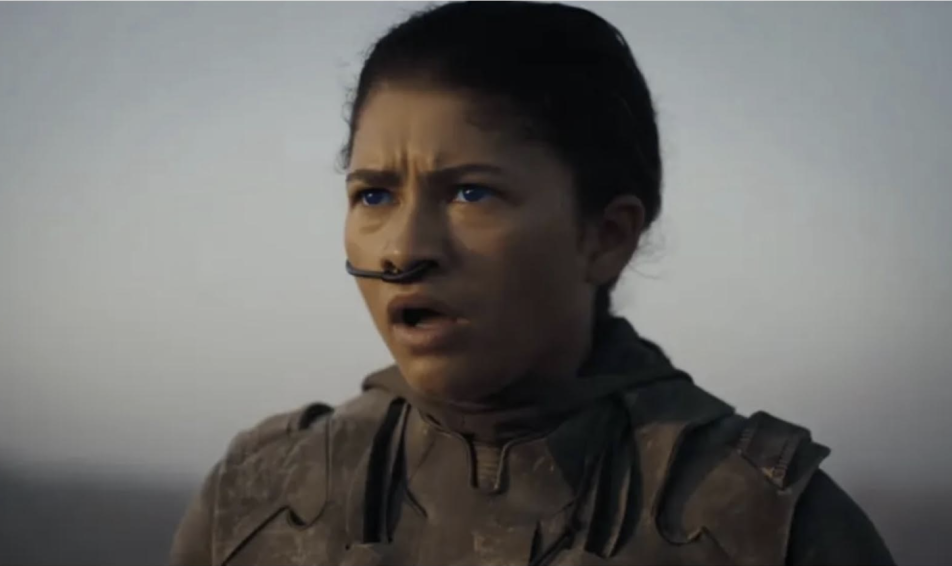
…with his teenager hair — longer, curly — than his older 20something hair (shorter, no curls). He shouldn’t have cut it. If he hadn’t, Faist would be the unquestioned star of Challengers. Because Zendaya‘s acting manner is too dry and flat (as always), and because Josh O’Connor is too grinny and joshy and “yuh-huh…yeah, bro.”
Luca Guadagnino’s tennis film is being called “a romantic sports comedy.” It follows a Grand Slam tennis champion Faist) who signs up to compete in a challenger event against the former lover (O’Connor) of his wife and coach (Zendaya). Or am I misunderstanding?
Challengers (MGM) opens on 9.15.23, just after debuting at the Venice Film Festival.
For days and days the French Connection censorship story has confounded everyone. The “whodunit” factor, I mean, although it’s been obvious for several days that the nine-second deletion was done at the behest of director William Friedkin (formerly known as Hurricane Billy).
Has the 87-year-old Friedkin gone silly in his old age? Bending over in obeisance to the wokesters? I personally think —- all due respect —- that this formerly ballsy, gold-standard helmer should be roasted on a spit for censoring his own film. It sets a terrible precedent.
On Friday, 6.9, HE commenter “The Multiplex” reported that “in Disney’s DCP asset list the currently-streaming version of The French Connection is listed as ‘2021 William Friedkin v2.'” This info, I noted, “is seemingly fortified by a statement from The Criterion Channel, passed along by “The Connection” in another 6.9.23 HE story titled “HE to Friedkin re Censorship Fracas.” CC’s statement said that “according to our licensor [Disney], this is a ‘Director’s Edit‘ of the film.”
After reciting the same evidence that I reported several days ago — “2021 William Friedkin V2.” plus Criterion calling the censored version a “Director’s Edit” — Kenny merely says that “this ostensibly puts the ball in Friedkin’s court.” Ostensibly?
Kenny adds that (a) he’s “reached out to Friedkin through CAA and received no response” and that (b) “a film asset manager I’ve asked about this matter has reached out to Friedkin personally and received a response from Friedkin’s personal assistant saying basically nothing.” And the name of that tune is The Guess Who’s “No Sugar Tonight (In My Coffee).”
“Wells likes to cultivate a barrel-chested, combative, curmudgeonly air in his writings. (Commenting on the blanket of orange wildfire smoke that recently enveloped Manhattan, he shrugged it off, stating, “You should try breathing Hanoi air on a shitty day. Tough guys only.”) He’s long had differences with Criterion’s physical product practices, over issues like aspect-ratios and color timing. He almost invariably couches his complaints in ad hominem terms, and this French Connection business allowed him to really go to town in that respect.
“In one of several subsequent posts commemorating the Twitter rage over what many were still calling Criterion’s censorship of Friedkin’s film, Wells instructed the company’s president to ‘blow it out your ass,’ never specifying the “it” to which he referred. As with the inference that Criterion is some kind of ‘woke’ company, Wells believes that the label represents what he calls a ‘dweeb’ sensibility, and is populated by people who would more than likely snub him at receptions and on movie queues. And honestly, on the latter count, he’s probably not wrong, although not necessarily for the reasons he thinks.”
It’s been estimated that the Titan, the small, deep-sea, Titanic-spotting submersible that went missing early Sunday morning, can sustain the lives of five on-board travelers for 96 hours, or four 24-hour days.
The 23,000-pound Titan began descending around 4 am on Sunday, or roughly 53 hours ago. (It’s now 9 am eastern.) Start to finish Titanic dives last ten hours, including a 2 and 1/2 hour descent to the wreckage some 13,000 feet below.
If the five aren’t rescued by early Thursday morning, an agonizing finale awaits. The clock is ticking — at most rescuers have the remainder of today (Tuesday, 6.20) and all-day Wednesday.
This paragraph, from a N.Y. Timesreport, conveys the bottom line:
A new expression entered my vocabulary yesterday — “hate-eating.” That’s when you’ve ordered something you really don’t like but you eat it anyway because it would be too much toil and trouble to send it back. That was me yesterday, sitting inside the Spicy Moon cafe and eating the worst-tasting vegetable dumplings I’ve ever had in my life. I wrote yesterday that they tasted like “hot mashed-up Brussels sprouts and filled with a kind of seaweed green gloop.”
HE commenter Zoey Rose: “Seriously Jeff, look for the things you enjoy [and] not the things you hate. Time on this planet is winding down so why not find pleasures in life instead of being the epitome of the cliched old fart complaining about kids,” blah blah.
HE to Zoey Rose: “Speak for yourself regarding the ‘winding down’ of time. Nothing’s winding down on this end, I can tell you. And what do you know of the future, by the way? About as much as anyone else does, which isn’t much except for generalities.”
If there’s one serving of advice I have consistently rejected and in fact despised all my life, it’s “invest in love rather than disdain,” “glass half full rather than half-empty,” “always look on the bright side,” etc.
Do you think Mark Twain or George Orwell or Paul Morrissey ever bought into that happy-faced crap?
I’ve always looked at things as they are or seem to be, and free of vibes of forced smiley-face happiness or rose-colored glasses or any of that jazz. Life is not Disneyland.
Yesterday’s world of the streets of the Lower East Side — warmer than warm, in some ways bland, shade-less, somewhat sticky and certainly dreary — was what it fucking was. It was certainly no cultural blessing to be there, I can tell you. The architecture mostly lacked intrigue and character, certainly compared to the nabes of Paris, Rome, Prague, Bern, Barcelona, Cefalu, San Francisco, etc.
Manhattan has always been a must-to-avoid on summer days. Stay the hell out of town until after Labor Day. They’ve all said that for decades. Nothing cranky about it — just the way it is.
Posted on 2.3.22: “Sometime in 2009 or ’10 I was seated next to Morrissey at a Peggy Siegal luncheon in some plush Manhattan eatery. I recognized him right away, but even if I hadn’t I would’ve felt instantly at home with the sardonic attitude and the seen-it-all, slightly pained facial expressions. I love guys like this. They’ve lived long enough and have met enough people of consequence to know that much of what constitutes modern life (even in a first-class town like New York City) is distasteful or disappointing or phony. And yet they soldier on with their squinty smiles and witty asides.”
All along I’ve felt that Penny should have shown more caution in trying to restrain Neely. I don’t think he intended to kill this allegedly threatening, mentally unstable guy. I think the situation just got away from Penny, and before he knew it (five minutes — three minutes captured on video) Neely was dead.
It’s very easy to make Monday morning armchair judgments, and it’s a different thing altogether when you’re in a tough situation in the heat of the moment. Neely was, by all accounts, sounding and acting like a dangerous asshole, and if I had been in that subway car a voice is telling me I wouldn’t have had any objection to Penny holding him down.
There are people, of course, who will accuse me of coming from a racist place — me and and others holding a similar opinion. I don’t agree, of course. If you start shit by scaring people and acting like a dangerous asshole, you’re obviously asking for trouble. What happened wasn’t entirely Neely’s fault but it was mostly his.
That said, Penny should have shown more caution as Neely didn’t deserve to die. Then again it’s very easy to say whatever from the comfort of a home or an office.
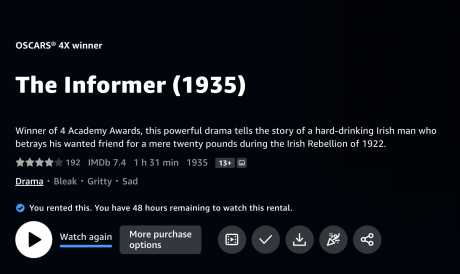
Here are 12 bullet points about the recently discovered removal of a brief, first-act passage in William Friedkin‘s The French Connection (’71), or more precisely in the CriterionChannel’sstreaming of same.
1. The absence of this sequence can be confirmed by anyone who streams the Criterion Channel’s version of the Oscar-winning feature. The messed-with sequence begins at the 9:42 mark, during the film’s first act. Gene Hackman‘s Popeye Doyle enters the brightly-lighted main lobby of the police station. He drops off paperwork, puts on his overcoat, walks over to the main door and flexes his hand. Roy Scheider‘s Cloudy follows but at exactly 10:05 a passage that used to be part of the film is no longer there.
2. It’s a bit between Doyle and Cloudy, who’s nursing a wounded arm after being stabbed by a drug dealer. Doyle: “You dumb guinea.” Cloudy: “How the hell did I know he had a knife?” Doyle: “Never trust a [ethnic slur].” Cloudy: “He coulda been white.” Doyle: “Never trust anyone.”
3a. The nine-second sequence (:52 to :59 in the below video) was obviously censored over Doyle’s racially offensive dialogue, specifically the N-word.
3b. It is presumed that the sequence was removed by Disney, which bought the film’s original owner, 20th Century Fox, on 3.20.19, and not The Criterion Channel.
4. The absence of said passage was also reportedly evident when The French Connection was screened at the American Cinematheque’s Aero theatre on Friday, 5.12.23. HE commenter identified as “The Connection”: “I don’t know if anyone else complained. I should have said something to the manager as I was leaving, but I sent them an email the next day asking who changed it (themselves? the studio? the filmmaker?) and [that] in the future they [should] at least advertise that they’re showing an altered version. Since Criterion is now showing the same version, I’m assuming it was the studio, and I wonder if the Aero was even aware of the change.”
5. HE commenter “Gus Petch” (posted Sunday night): “I have multiple recordings of the movie on my DVR. The versions recorded off TCM 4 and 2 months ago are both the censored versions, but the versions recorded off FXM (Fox Movies) 8 months ago are uncensored. Also FWIW, the TCM versions did not have the title screen in front that you often see that the film has been modified for presentation on TV.”
6. HE commenter “Ken Koc” (posted Sunday night): “That [nine-second sequence] is also gone from my purchased copy of The French Connection on iTunes.”
7. It is nonetheless astonishing that the Criterion Channel is running this version of Friedkin’s Oscar-winning film (Best Picture, Hackman for Best Actor, Friedkin for Best Director, Best Film Editing, Best Adapted Screenplay) without an explanation of some sort. This deletion seriously harms the Criterion brand, which has always been about honoring and representing the original artistic intentions of filmmakers. They need to address this issue ASAP.
8. If in fact Disney is responsible for deleting the nine seconds of footage, they owe an explanation to the film’s fans as well as the industry at large why this was done, and whether or not they consulted Friedkin before doing so, and if they intend to delete other portions of other films that feature the N-word.
9. Over the last couple of days I’ve sent emails to various directors and producers, asking them to please forward yesterday’s HE story about the French Connection censorship to Friedkin. I’m presuming that Friedkin would hit the ceiling when he learns of this, and will post some kind of protest statement or perhaps even a video.
I never know how to react to showbiz hagiography docs, which always seem to explore and celebrate the life of a famous person in the same way. They all say “this person didn’t lead an easy life and endured his/her share of challenges, sorrows and setbacks, but he/she was nonetheless fascinating and lovable and certainly admirable, hence this tribute doc about what an vivid and nourishing life he/she led…nourishing for all of us, really.”
I’m not saying that Being Mary Tyler Moore (Max, 5.26), a two-hour doc about the beloved star of The Mary Tyler Moore Show in the early to mid ’70s and costar of The Dick Van Dyke Show in the early to mid ’60s, is dishonest or banal or sugar-coated — it’s a somewhat open-hearted, reasonably honest piece of polished portraiture as far as it goes. But it sure plays and feels like dozens of other such docs that I’ve seen over the years.
The intention is to make the longtime fan feel good about Moore’s life, and to reassure them that the person she seemed to be (or that she had been reported to be) all those years was more or less genuine, and confirm that the typical fan’s emotional investment in Moore was sensible and sound.
It succeeds in this effort, and I was more or less fine with the final import. I didn’t believe some of it. I knew it was downplaying the dark and thorny and emphasizing the sunny side-up, but that’s what docs like this do. But I believed a fair amount of it, and that was enough.
From my 1.25.17 obit: Poor Mary Tyler Moore has passed at age 80. Nine people out of ten will fondly recall her 16-year run (with a three-year gm my 1.25ap) in two hugely popular TV sitcoms, first as Laura Petrie on The Dick Van Dyke Show (’61 through ’66) and then Mary Richards in The Mary Tyler Moore Show (’70 through ’77). She was especially perfect in the latter series, doing that sunny, wholesome and vulnerable thing to full perfection and winning three Lead Actress Emmy awards in the bargain.
But to me Moore will always be Beth Jarrett, the emotionally frigid mom of Timothy Hutton and wife of Donald Sutherland in Robert Redford‘s Ordinary People (’80) — one of the greatest screen villains in history and surely Moore’s finest role. If she had never done anything before or since, her portrayal of Beth the bitch (which resulted in a Best Actress nomination) would entitle her to a place of eternal honor in the annals of American cinema.
Feature-wise, Ordinary People was pretty much Moore’s career peak. She costarred in the not-so-hot Six Weeks (’82) and then Just Between Friends (’86). But then she rebounded as another high-strung bitchy type in David O. Russell‘s Flirting With Disaster (’96). Moore also costarred in Elvis Presley‘s last scripted film, Change of Habit, in which she played a work-clothes-wearing nun who allowed herself to develop romantic stirrings for The King.
Kenneth was born on 8.12.98, and was therefore, believe it or not, 29 when this photo was taken.
Kenneth reportedly gave Astor a new Packard as a wedding gift. They soon moved to a home on Lookout Mountain in Laurel Canyon. Less than two years later he was dead.
Initially a writer, editor and supervisor at Fox Films Corporation, Kenneth began directing films for Fox in ’29 — a year or so after his marriage. On 1.2.30, the 31-year-old was traumatically killed while directing aerial scenes for Such Men Are Dangerous. He and nine others were instantly destroyed following a mid-air plane crash over the Pacific Ocean. The planes that smashed into each other were identical Stinson SM-1F Detroiters. Sun glare was listed as probable cause.
My final Cannes ’23 screening will be Alice Rohrwacher‘s La Chimera, which screens at the Grand Lumiere at 3:30 pm.
Pic costars Josh O’Connor and Isabella Rossellini. Filming began in Tuscany roughly 15 months ago. Dictionary definitions of “chimera” seem elusive: (a) “A fire-breathing female monster with a lion’s head, a goat’s body, and a serpent’s tail,” and (b) “a thing which is hoped for but is illusory or impossible to achieve.”
Packing and cleaning up this evening, and then catching a train back to Paris at 11:24 am.