Gambling and Hollywood

Gambling is an addiction — a high-dive fever trip that people with wired, aggressive natures enjoy because (and I’m not trying to be facile or judgmental about this) it offers a brief respite from the dutiful, methodical, nose-to-the-grindstone rigors that are necessary in order to lead a life defined by at least some degree of honor, dignity, consistency, responsibility and consideration for others. Gambling is, I’ve always believed, about tempting disaster and flirting with self-destruction. It can take you down as surely as alcohol or cocaine or debt or anger. But there’s still something about it that I like.

The willingness or at least the readiness to gamble is, of course, a necessary element with any creative person who dreams of making it big, and certainly with any producer or screenwriter or director. It’s been said over and over that the lack of hot gambler nerve is what ails the film business more than anything else these days. You can’t hedge or calculate your way into a hit movie. The biggest Hollywood cliche of all is that movies are a crap shoot, but over the last 25 years or so the purse strings have become increasingly constricted by more and more nervous-nelly corporate types, which has often been a key factor in bad big-studio movies and the much-bemoaned corporate addiction (unfortunately necessary within the realm that big studios are obliged to operate) to franchises.

The vast majority of creative people in this town are not problematic casino gamblers, although a lot of them are in regular poker games with industry friends. I know a few actors and at least two director-writers who enjoy playing the tables in Las Vegas and Atlantic City, but I wonder if anyone has ever written a piece about the overlap between gamblers of whatever delineation and the type of films they tend to dream up or pitch or try to make?

Gambling addicts are people looking to lose, but is there something in the character of people who, under the right circumstances and with the right idea or inspiration, have the brass to throw the dice on a script or a concept that has a tendency to spill over into Vegas-y gambling (or horses or dogs) to some extent? All the legendary producers have been tenacious with thick skins, but don’t you also need a little of that “crazy guy still playing craps downstairs at 4 ayem” spirit?

I’ve never been into gambling of any kind. I’ve played in less than ten serious poker games in my entire life. I hate losing money. But there’s something about that side of my nature that has also led, I suspect, to not having had the brass or the drive to push harder at other ventures like scriptwriting (which I tried and failed at, possibly because I didn’t have the talent but also because I may have lacked the moxie to keep at it and theoretically improve as I went along). I’m very happy with what I do, but deep down I’ve always admired the gamblers, or at least the thing they have that leads them to an occasional belief, as James Caan‘s character puts it in James Toback‘s The Gambler, that “two plus two equals five.”
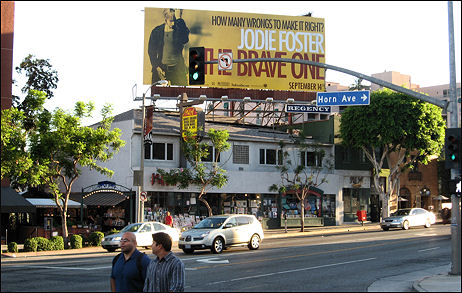
“Brave One” on Sunset


Sunset Blvd. and Horn Ave. — Monday, 8.20.07, 6:45 pm, taken at Coffee Bean, waiting for 3:10 to Yuma screening (my second) at the seriously under-ventilated Sunset Screening Room

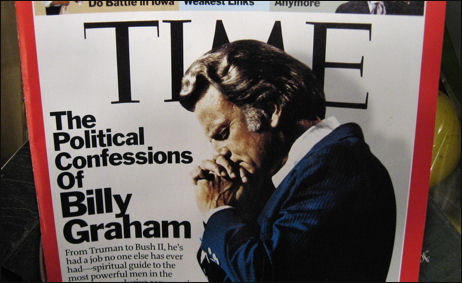
Devil horns

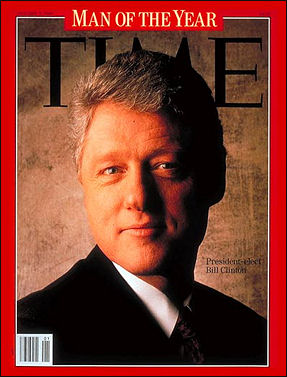
This is last week’s news, but are you going to tell me that Time‘s layout editor didn’t say to himself (or herself), “Hey, devil horns! Nobody can prove malice on our part — we can just say they’re paranoid — and it’ll sort of fun to piss off the religious-right nut fringe.”

Postnote: HE reader “SaveFarris” pointed out a while ago that Time did this before to Bill Clinton, with a link to prove it.

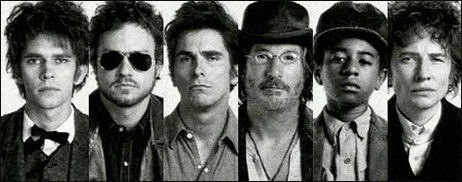
Anderson & Weinstein on “I’m Not There

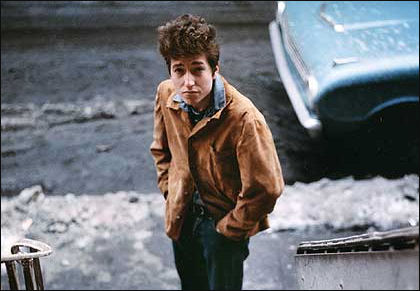
There are a few straight-from-the-shoulder statements, one or two feints and some very careful posturings in John Anderson‘s 8.21 N.Y. Times piece about Todd HaynesI’m Not There. But it’s all in the service of a good cause, which is to modify the thinking of those who are going, “Wow, I’m Not There is opening at the Film Forum? Isn’t that almost the same as opening it at the Nuart?

Some highlights: (a) Harvey Weinstein‘s decision to open this mystery-of-Bob Dylan film in only two Manhattan theatres — Film Forum and some other venue — and two in Los Angeles on 11.21 has made the release plan “something of a curiosity,” Anderson notes, since it’s getting “the kind of debut that might be afforded a Mexican documentary.”

(b) “With a movie like this you have to build it,” Harvey tells John. “I don’t think you can go out on 500 screens. The reason for Film Forum is you go where the best word of mouth is on the movie. I like the movie; I think it’s adventurous.” (Positive energy! Safety lines and hiking boots!) The audience is going to have to work– work in a good way.” (We can work it out? No, that’s the Beatles.)

(c) “I have a tendency to start small and go big. If we threw this movie out wide, I don’t know what it would do. I think we have to start somewhere. I’m going to play every major city in the United States with this movie. I’ll play 100 cities, at least.”

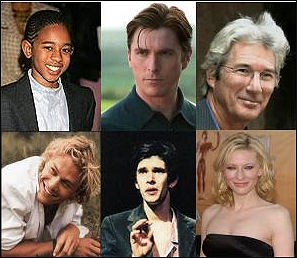
(d) Harvey adds, “I may be jumping the gun, but if Cate Blanchett [one of the six “Dylan’s] doesn’t get nominated, I’ll shoot myself.”

(e) The film, says Anderson, “sometimes looks like A Hard Day’s Night, elsewhere like McCabe and Mrs. Miller” and has been “shot in styles that correspond to each Dylan epoch, imbuing Dylan’s life with mythic American qualities.” Hey, sounds cool.

(f) I’m Not There, Anderson interprets, is “not purely about making money but about an obligation to have important movies distributed. “That’s the story of my life,” says Harvey. “That’s exactly what I believe in. I’m Not There and some of the tougher stuff — it’s not going to be The Nanny Diaries, you know.” (Did I interpret that right?) “But I’ve been very fortunate that what I’ve believed in has worked, and even when it doesn’t work, we make money in other areas to cover that. It is my responsibility and, more importantly, it’s my passion.”

This is the old Harvey talking, and that’s finally a heartening thing. (Patrick Goldstein will be pleased.) After all is said and spun, it’s reason enough to be there for I’m Not There.

The L.A. bookings will be at the Landmark and the Arclight.

Edelstein on Gleiberman

“In my twenties, I hung out at a Boston dive bar with another young film critic (let’s call him, oh, Onan Gliberperson) drinking pint after pint of Bass Ale and playing Donkey Kong well into the night.” — from David Edelstein‘s review of of The King of Kong: A Fistful of Quarters in the current New York magazine.

Magoo Hoffman

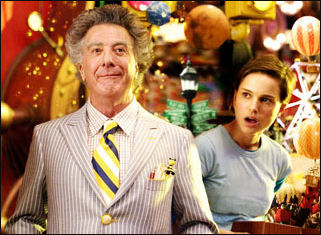
Of all the films described in Entertainment Weekly‘s Fall Preview issue, only one made me go “uh-oh” — Zac Helm‘s Mr. Magorium’s Wonder Emporium (20th Century Fox, 11.16). It’s that look on Dustin Hoffman‘s face, mainly. On top of a guarded feeling I’ve had about Helm since seeing Stranger Than Fiction, which he wrote, last year. Obviously not aimed at guys like myself, but is anyone up for another Charlie and the Chocolate Factory-type deal? Natalie Portman mitigates somewhat.

Many Dallaires, many devils

It’s a little unusual that Roger Spottiswoode‘s Shake Hands With the Devil, a drama about Lt. General Romeo Dallaire‘s horrific saga as a commander of UNAMIR, the U.N. peacekeeping force, during the 1994 Rwandan massacre, is using the same title as Peter Raymont‘s exact- same-subject documentary, which played at Sundance ’05 and made its way around festivals and select theatrical bookings later that year.

It’ll also be the second time that Dallaire’s Rwandan experience has been portrayed in a feature — Nick Nolte‘s character in Tony George‘s Hotel Rwanda was based on him. Both the doc and the Spottiswoode film are based on Dallaire’s “Shake Hands With the Devil: The Failure of Humanity in Rwanda,” a book published in 2003.

Spottiswoode’s feature costars Roy Dupuiis, Deborah Kara Unger and Jean-Hugues Anglade

$33 million, not $31.4 million

I missed this Nikki Finke update earlier today: Superbad finished the weekend with $33 million, not $31.2 million or $31.4 million (per Josh Friedman and Len Klady, respectively), for the weekend. An “exceptional hold,” down only about 2% from Saturday, etc.

Superbad is now a strong candidate to earn $100 million. It’s a safe bet to earn a little north of $10 million between today and Thursday, and with all the so-so movies debuting next weekend it could do another $22 to $23 million (perhaps a bit higher), which would give it a cume as high as $67 or $68 million by next Sunday night.

Fire, dark, cold

“And in the dream I knew that he was goin’ on ahead and that he was fixin’ to make a fire somewhere out there in all that dark and all that cold, and I knew that whenever I got there he’d be there. And then I woke up.” An older man’s description of a dream about his deceased father, spoken at the end of a very good film (one I’m not going to name) that has stayed with me for weeks and weeks, and which sinks in deeper every time I think of it.

Lane on Antonioni

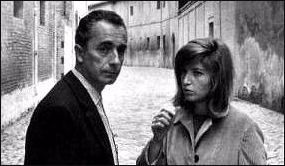
“If Alfred Hitchcock‘s tombstone bore the word ‘suspense,’ what would we engrave on Michelangelo Antonioni‘s? ‘Alienation,’ probably, yet that is a word forever applied to the films, not spoken within them. You may disagree with his vision of the sexes fighting to make connections that endure, as opposed to mere spasms of desire (‘avventura’ means not just an adventure but a fling), but there is no denying the sharp, concrete form in which that vision was set.

“And so the paradoxes accrue: sex solves nothing for Antonioni, yet somehow his films, blending tactility with froideur, remain a tease and a turn-on, and, for someone insistent on human solitude, he was awfully skilled at handling group situations — look at the beach party in The Girlfriends, or the search party climbing rocks in L’Avventura. He was an urbanist, yet few can match his eye for landscape or his nose for weather.” — from Anthony Lane‘s essay, “Lone Sailors,” in the 8.27 New Yorker.

Weekend projections

Of the forthcoming 8.24 openers, Philip G. Atwell‘s War (Lionsgate), the Jet Li-Jason Statham martial-arts thriller, and Robert Pulcini and Shari Springer Berman‘s The Nanny Diaries (Weinstein Co.) are tracking the best. War has better awareness and definite interest, and will probably be the #1 newbie. And the 9.7 duke-out between 3:10 to Yuma and Shoot ‘Em Up is still neck and neck, with the latter enjoying a very slight edge.