
Bryan Singer‘s Valkyrie, a thriller about the real-life attempted assassination of Adolf Hitler, apparently won’t be filming in Germany due to a German defense ministry ruling denying permission because of star-producer Tom Cruise‘s allegiance to Scientology. The Germans feel that Scientology is a con and not a legitimate religion (whatever that means), but it seems excessive to say “nein” to a major American film company trying to shoot in their country just because of Tom Nutjob. I mean, it’s not like Singer is trying to shoot Battlefield Earth there.
Cruise is going to play Col. Claus von Stauffenberg, the man who led the anti-Hitler plotters. Think about that — Joel Goodsen in Risky Business playing a senior level German military guy during World War II.
For me to truly believe Cruise in that role, Singer is going to have to start Cruise off the way Stanley Kramer started things off for Maximillian Schell in Judgment in Nuremberg — by having him speak German for a couple of scenes, and then work out some visual signal that tells the audience, “Okay, no more German — we’re switching to the English-language. We just didn’t want you to think we’re one of those lame Germany-based American films in which Germans speak nothing but German-accented English.”
wired
New Yorker critic David Denby has called Lajos Koltai‘s Evening (Focus Features, 6.29) “one of the rare movies that are too sensitive for their own good.” My sentiments exactly, I’m afraid, except for Denby’s use of the word “rare.” Movies that overdose on moist-eyed sensitivity are almost a genre unto themselves.
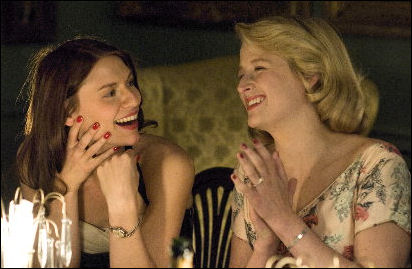
I’m not speaking of chick flicks precisely, but…well, yeah, I mostly am. Episodic chick flicks about suffering that isn’t alleviated until the characters have gotten old or died in some sudden or painful way, or variations of same written by gay guys, or super-sensitive-couples-in-trouble movies, or ones about sensitive families coping with the tragedy gene (i.e., The Virigin Suicides).
Movies that are too much in love with the notion of its characters (i.e., which are often middle-aged women or gay guys, and occasionally teenaged boys) as gentle reeds in a raging river. Movies that not only wear their exquisitely sensitive natures on their sleeves, but use them as soporifics or sedatives. So much so that 20 or 30 minutes in your inner child is crying out for the stern hand of Michael Bay or Eli Roth or Brett Ratner.
There’s a very slender line between sadistic sensitivity and sensitivity that seems genuinely caring and welcome and appropriately applied. The former is about pushing sensitivity while the latter seems to more into letting it happen at the right times and according to the rules of human nature.
Rodrigo Garcia‘s Nine Lives and Herbert Ross‘s Boys on the Side do it right; Michael Pressman‘s To Gillian on Her 37th Birthday and Michael Mayer‘s A Home At The End of The World (novel and screenplay by Michael Cunnigham) do it wrong.
The Hours, which was adapted to the screen by David Hare but based on a novel by Evening‘s screenwriter Michael Cunningham (again!), tried to smother its audience in the goo of massive grief. The mantra of that film was “we’re really hurting — feel our pain,” and the reason some people wet themselves over this film is that it refused to let up. I wasn’t relieved when Nicole Kidman‘s Virginia Woolf finally drowned herself — I was overjoyed.
The United States of Leland, the Ryan Gosling drama about a juvenile who’d killed a young boy, was certainly guilty of laying it on too thick.
Alan Parker‘s Shoot The Moon (’82) was, in my judgment, about a world of adult relationships that was almost grotesquely prickly-sensitive.
I once read a Bo Goldman screenplay called Monkeys, based on a novel by original Evening author Susan Minot, and the sensitive vibes that came out of that script felt like longshoremen poking their fingers in my neck.
Other offenders off the top of my head: Rob Reiner‘s The Story of Us, Rose Troche‘s The Safety of Objects, Jocelyn Moorhouse‘s A Thousand Acres (referred to by press junketeers as “A Thousand Minutes”) and Shainee Gabel‘s A Love Story for Bobby Long (a.k.a., “Bobby Way-Too-Long”).
This is only the tip of the iceberg. There are probably dozens more. Submissions, please.
Sizemore to the slammer
Poor, addicted, self-destructive Tom Sizemore — a walking car wreck in a town filed with drug-meltdown cases — has been doing his level-best for years to erase his career and poison himself in the bargain. The simplest and cleanest procedure would be to kill himself, but it appears that Sizemore is into half measures. TMZ reported this morning he was sentenced to 16 months in the slammer (Donovan Correctional Facilty, near San Diego) for violating his probation in a 2004 methamphetamine conviction.
TMZ = Walter Winchell of the ’40s
Two zippy quotes from Allison Hope Weiner‘s 6.25 N.Y. Times piece about Harvey Levin’s TMZ. One is Levin himself saying that despite initial reservations about launching a celebrity website, “I started seeing that if you don’t have time periods and publishing cycles, you can publish on demand and beat everybody.” The other is a non-identified publicist equating Levin’s power with that of columnist Walter Winchell in his 1940s heyday. “If you have something you know [TMZ] will like, you tip them to it,” he says. “It’s kind of the old way you dealt with the old-time gossip columnists…you have to occasionally feed them an item…you have to be in the game with them…if you’re a publicist and the only time you call up is to complain about an item, they’ll laugh at you.”
Members Only pitch
The single worst TV ad for a line of pseudo-hip ’80s jackets by a celebrity pitchman ever made or aired. In fact, it ranks as one of the worst ads ever, for anything, in any medium. (I’m posting this because of Phil Leotardo‘s goombah nephew…figure it out.) Thanks to Mutiny Co.’s Jamie Stuart for passing this along.
Theatres you like but don’t patronize
This is hard to explain, but here goes: as much as I love the fact that slightly grubby sub-run theatres like Lyndon Golin‘s Regency Fairfax and the Silent Movie theatre a block or two south are doing pretty well, I never really feel like actually driving over and plunking down five or six bucks for a cheap seat at either establishment.
That sounds shitty and unhelpful, but most of us are fairly passionate about seeing movies only at deluxe, blue-chip locations or at home on DVD, and no in-betweens. Call them high-thread-count venues….I don’t care…but I just don’t want to schlub it when I’m out seeing a film. Same deal with the New Beverly Cinema…wait, they’ve put in new seating and have cleaned up the sticky floors?
And yet I love the fact that others in the Fairfax disrict (i.e., the nearby retirement-age community, under-30s with not much money, etc.) love the Fairfax and the Silent Movie theatre. The Fairfax district would be immeasurably harmed if either one of these theatres were to shutter. I mean that. Is this coming out right?
Why Gandolfini was shot
“I couldn’t let it just hang. Eight years of my life, and a fucking artsy cut to black? It was eating me up inside. I just had to tie up the loose ends. I’m positive this is exactly how [creator and executive producer] David Chase wanted fans to interpret the ending.” — Sopranos fan Louis Bowen explaining to an Onion staffer why he felt compelled to murder James Gandolfini last Tuesday at an Italian Greenwich Village restauant called Occhiuto’s.

Corliss on Ebert
“Whatever else they may be, movies are stories people tell us; and a review is a conversation the critic has with both the filmmaker and the audience about the power and plausibility of the tale. No one has done as much as Roger Ebert to connect the creators of movies with their consumers. He has immense power, and he’s used it for good, as an apostle of cinema. Reading his work, or listening to him parse the shots of some notable film, the movie lover is also engaged with an alert mind constantly discovering things — discovering them to share them.” –from a Time tribute piece by Richard Corliss.
Granger in Santa Monica
Shortly before Strangers on a Train was released, Farley Granger (i.e., Guy Haines) ran into Robert Walker (i.e., Bruno Antony) at a party in Hollywood. “He said, ‘Farley, we have to get together…I miss you…We should not let the friendship slip away,'” Granger tells L.A. Times staffer Susan Granger. “I took his number and he took mine, and the next thing I knew he died.”
On Wednesday, 6.27, Granger will be signing copies of his co-written autobiography, “Include Me Out: My Life From Goldwyn to Broadway” at the Santa Monica branch of Every Picture Tells a Story (at 1311 Montana) , and will then do a q & a after a screening of Strangers on a Train at the Aero.
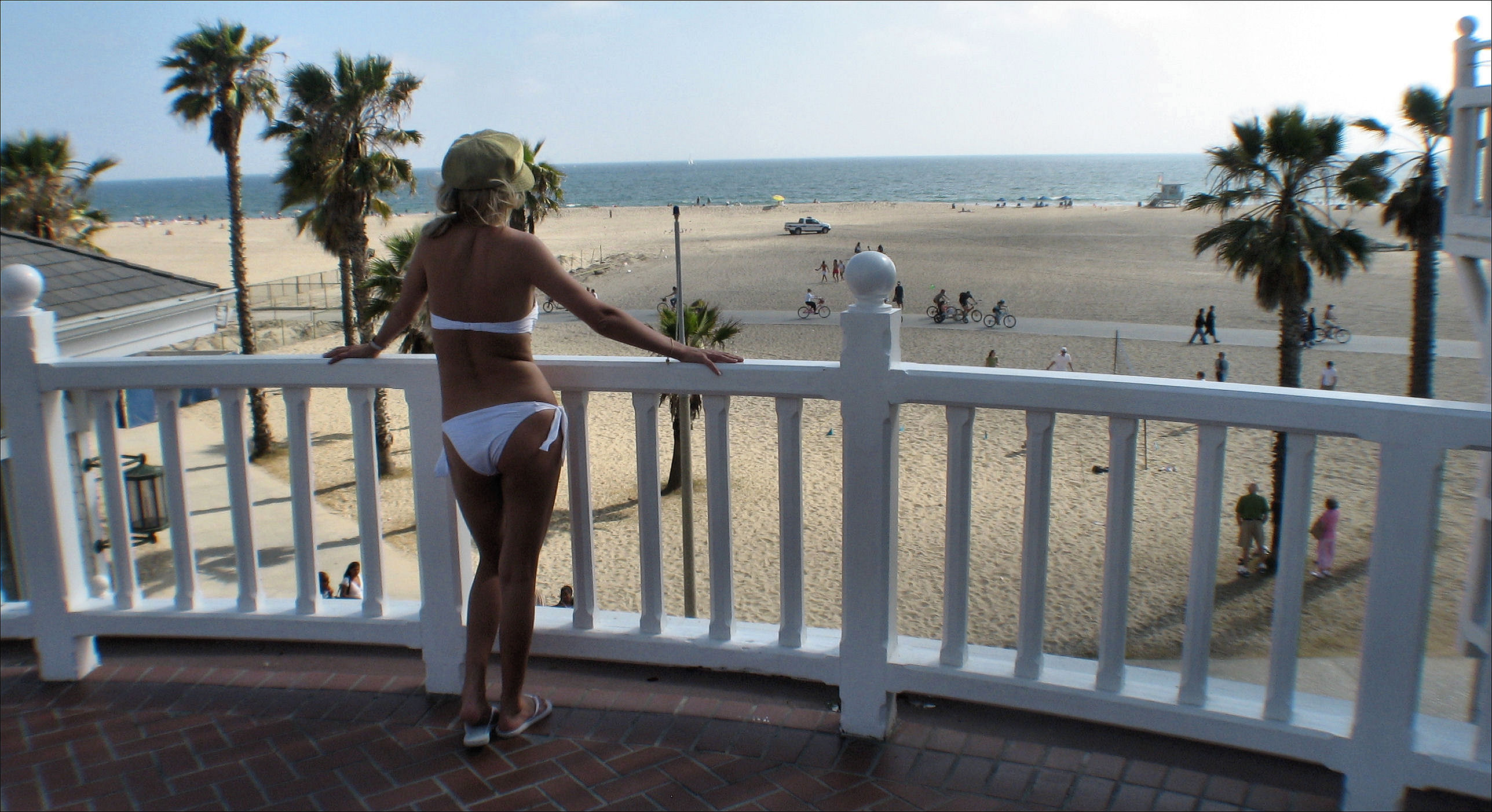
Beach ass
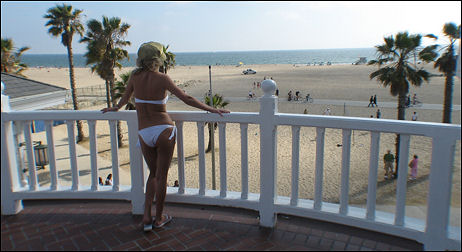
From the third-floor deck of Shutters in Santa Monica — Sunday, 6.24.07, 4:50 pm – where I went to chat with director-writer Jim Toback, who’s working in Culver City on a documentary about Mike Tyson.
Goldstein on Herzog
At 64, Werner Herzog is our filmmaking god of dark adventure, a willful but adventuresome artist whose characters — both in his features and documentaries — test the boundaries of human madness and quixotic folly.” — from Patrick Goldstein‘s 6.24.07 L.A. Times profile, titled “Werner Herzog’s Night Vision.”
Andy Jones memorial
Arnold Jones, brother of the late Anderson Jones, informs that a memorial is being planned for Saturday, 6.30.07 at 1 pm at a small church all the way the fuck down in Long Beach (location yet to be disclosed). Flowers and condolences can be sent to Andy’s parents, Anna and Arnold L. Jones, at 1471 E. Fairifield Ct. Ontario, CA 91761.