Hollywood Elsewhere has arrived in Cannes to the sound of blaring trumpets. It’s bright and sunny, but there’s also a strange hazy quality in the air. That’s how life looks when you’re totally jet-lagged. Pulled into town on a big white bus about five hours ago. I adore my sleeping quarters (i.e, two single beds in a small room that is slightly bigger than a two-man cell at the L.A. County jail), but that’s what you get when you shell out the big bucks.
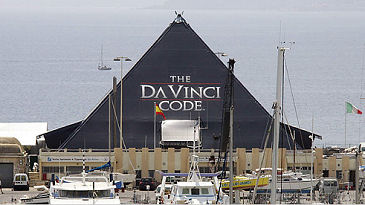
I picked up my press pass an hour or so ago, and now I’m sitting in front of a wireless flat-screen at the press room at the Palais. Several others are here also. The balcony is shaded this year with six “Ali Baba and the 40 Thieves” white tents, and there are lounge-like seats (blue fabric over padded seating, wood panelling) and tables under them…classy. And there’s Wi-Fi everywhere…great. I have to pick up my tickets for the DaVinci Code soiree tomnorrow night and then decide what to do before the DaVinci Code screening at 8:30 pm. What I need to do between now and then is crash for a couple of hours. I got about two hours of sleep on the plane last night, if that.
Travelling day today….I leave JFK for Paris at 5:30 pm, arriving in Paris around 6 ayem, and then taking an Easy Jet to Nice a couple of hours later. No more postings between now and sometime around 7 ayem Tuesday morning, New York time. At the earliest, I mean…

Another tribute piece to the great Charlie Kaufman, a screenwriter (Adaptation, Being John Malkovich) propelled by a kind of perverse impudence and irreverence. This profile is better than most and has been written by L.A. Times contributor David L. Ulin .

“If the [Cannes Film Festival] does not take itself seriously enough to use what power it still has to move the quality agenda forward, why would anyone else? (That is, outside of journalists who love getting a free trip to the South of France each year.) The truth is [that] Cannes has become far worse than Sundance in terms of selling out. Yet the unfamiliarity seems to be a condom from the contempt that has infected so many journalists and critics in recent years. And the studios are happy to be welcomed to abuse the credibility of the festival and to use it mercilessly as a platform to market their big, but not necessarily fine, movies to the more-important-than-home-in-many-cases European and world market.” — a not-unfair criticism from David Poland, a perennial non-attender who gets it on one level and misses it profoundly at the same time. The Cannes Film Festival exists and is trying to thrive in the world that we have made. That world, lamentably, includes gala screenings of Brett Ratner‘s X-Men 3: The Last Stand, but Cannes isn’t a hideaway haven like Telluride or the Bermuda Film Festival, and Poland finds that objectionable. I agree with him — there should be more aesthetic purity in the world — but he never goes to Cannes and I think you have to do that to get what it is and what it signifies. To roll with the film festival aesthetic of 2006 you need to be, on some level, a film-buff equivalent of a moral relativist . You can’t just sit on your squishy couch in Los Angeles and go, “Nyah-nyah.” You have to get on the plane, do the 18-hour days, sip the cappucino, file the stories and reviews and generally tough the whole thing out. Then and only then

I haven’t seen Werner Herzog’s Rescue Dawn, but trust me (and you won’t need to take my word for it once you see it), this trailer is a very vague and misleading representation of what the film almost certainly is. The cutting, the bullshit slogans, the Apocalyose Now-styled percussion — it’s the same old shit, and s.o.s. is what you never get from a Werner Herzog film. This trailer is a marketing jerkoff’s idea of what he-she thinks (or what his-her agency boss thinks) will appeal to the schmucks out there looking to enjoy a standard-issue Vietnam-era prisoner-of-war escape drama. (Which isn’t to say Rescue Dawn will utterly ignore or wave off the expecations of this crowd.) Memo to marketing jerkoff: Werner Herzog’s films are never less than transcendent or stunning or cinematically challenging in the best way imaginable. Your efforts at trying to sell this film are predictable and understandable, but compared to Herzog’s vision and artistry your mentality is that of a fly sitting on the neck of a lion.

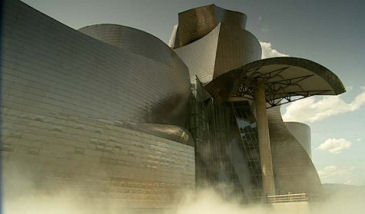
In tribute to the opening of Sydney Pollack‘s Sketches of Frank Gehry (Sony Classics, 5.19), which is easily one of the most spiritually uplifting films you’ll see this year (and I mean this), I did a phoner with Pollack a couple of weeks ago to recap and go over things.

The sound file is sufficient, but here’s the piece I did eight months ago after first seeing Sketches at the Toronto Film Festival. I called it “a stirring, hugely likable portrait of the most daring and innovative architect of our time,” and said that “as corny as this sounds, Sketches left me with a more vivid feeling of celebration and with more reasons to feel enthused and excited about life than anything I’ve seen so far at this festival. It’s a film that lets you into the head of a genius in a very relaxed and plain-spoken way, and it lets you share in the sense of being a person of Gehry’s magnitude — a guy who has created a kingdom out of a supreme confidence in his dreams, but at the same time someone honest enough to admit he doesn’t precisely know what he’s doing much of the time. This is partly due to Gehry having been very open and unguarded with Pollack as the doc was being shot, and partly due to Pollack having sculpted this film in a way that feels more personal and congenial and relaxed than your typical portrait-of-a-noteworthy-person movie. And yet Pollack doesn’t relent in passing along all the information we need to know about Gehry. It’s all done with total thoroughness and clarity of purpose.”

One presumes that N.Y. Times reporter Sharon Waxman is always multitasking and going a little bit crazy from this, hence her interest in writing this piece about a marketing study of how and why people multi-task, and who gains and loses in terms of serious focus and attention. And my eyes….glazed…over. Reading it was like taking Percocet; I felt increasingly shrouded in mist and fog and a keen sense of space-time discontinuum. I’m still fogbound as I write this…help!

Hollywood’s bathroom-break age-divide issue, as it affects the summer blockbuster season. Christopher Noxon‘s N.Y. Times piece eventually segues into discussing the always elusive, revenue-bestowing films known as kid-adult hybrids .

“Unlike its counterpart at the Academy Awards, the red carpet at the Cannes Film Festival (set to begin Wednesday, 5.17) is the place where suspense comes to die. The only filmmakers who reliably attend the Cannes award ceremonies are winners of the festival’s various prizes, so all a savvy observer really needs is a passing knowledge of the films, and an unobstructed view of the limos, to figure out who’ll be going home with the coveted Palme d’Or.” — John Anderson in Sunday’s (5.14) N.Y. Times.

Please, yes…a Judas-was-a-good-guy-who-was-in-on-the-big-plan movie. That would be a movie. I’ll pay to see it twice, especially if Joaquin Phoenix plays Judas. And the story/background that the Guardian‘s John Patterson has sketched out is fascinating. One thing, though: there’s already been a Judas-was-a-good-guy-who-was-in-on-the-big-plan movie. It was called The Last Temptation of Christ, an exquisite 1988 film directed by this guy…wait a sec…here it is… Martin Scorsese .

I opened this New York Post story by Stephen B. Hunt about “a sold-out Eurpean tour” thinking it would be about the junket-whore DaVinci Code train from London to Cannes that leaves on Monday or something and arrives in Cannes just before the press and gala screenings start on Tuesday night, 5.16. But nope…just another DaVinci hubbub story.

This Variety variation by Elizabeth Guider about how the film is expected to fare a European country-by-country basis is more interesting.