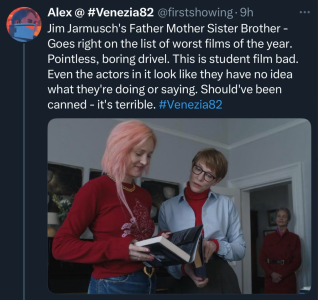
I could call Jim Jarmusch‘s Father Mother Sister Brother inert and threadbare and let it it go at that. I’m thinking of Casey Affleck‘s three-word confession to Michelle Williams in Manchester By The Sea — “There’s nothin’ there.” And that’s it, man.
Jarmusch has always been into less-is-more dialogue and fill-in-the-blanks minimalism, but this doesn’t even meet that standard.
Father Mother Sister Brother isn’t “about” Rolex watches (Chinese knockoffs), water, tea, “Bob’s your uncle”, stillnesses, absent parents in more than one sense, and most certainly the absence of dialogue. But these are what the film leaves you with.
Two of the three short films that comprise this 110-minute feature — the “father” opener with Adam Driver, Mayim Bialik and Tom Waits, and the “mother” follow-up with Charlotte Rampling, Cate Blanchett and Vicky Krieps — aren’t just about parents and kids who no longer matter much to each other, and are unable or unwilling to summon the will to indulge in polite, banal, family-style chit-chat…family members who really don’t care any more, and are just going through the motions.
Okay, to a certain degree Driver cares about Waits, his economically-strapped dad, as he slips him some cash from time to time. But Driver and Bialik can’t spend more than 45 minutes with Waits; ditto Blanchett and Krieps’ quality time with Rampling (their mom), which boils down to a short tea-and-cakes session in Rampling’s living room. As short as possible, I mean. Their little-sit-downs are over before they begin.
These chapters are basically about the expression of brittle, hostile indifference by way of silences. And these pregnant silences do nothing more than drain the viewer’s soul. It is baked into our DNA, of course, to fill empty, awkward, little-or-nothing-to-say encounters with vacuous small talk — we’ve all been there, and so has Harold Pinter, you bet. But these trios can’t be bothered with the blah-blah, and so the silences scream. And it’s fairly close to unbearable. Because it’s fundamentally inhuman.
Thank God for the brother and sister finale, costarring the attractive, Millennial-aged Indya Moore and Luke Sabbat. It’s basically about these two reminiscing about their dead, fondly recalled, mixed-race parents (mom was white, dad was Afro) while sitting in their emptied-out apartment in a large French city. (Possibly but not necessarily Paris.) This chapter offers a little warmth, at least. Moore and Sabbat actually talk to each other. What they say is mostly about about lazy regrets and resignation, but at least it’s something.