With the 9.26 New York Film Festival showing of Luca Guadagnino ‘s After The Hunt fast approaching, keep in mind what recently happened to this fascinating, bravely ambiguous and certifiably un-woke drama about an alleged sexual assault incident on the Yale campus.
A sizable horde of Venice Film Festival critics clobbered this forthcoming Amazon-MGM release (10.10) for two…make that three reasons, and none of them honorable:
(1) Hunt adopts a posture of skepticism and/or uncertainty regarding a sexual assault charge leveled by Ayo Edibiri’s Maggie, a privileged, lesbian, allegedly mediocre student, against Andrew Garfield‘s Hank, a professor looking at tenure who suspects Maggie has plagiarized a term paper. This in itself is enough to warrant critical dismissal as the woke manual says filmmakers aren’t allowed to portray a progressive woman of color (and especially a non-hetero one) as possibly shady or seemingly hair-triggered in a standard mode of Zoomer alarmism.
(2) The film suggests what may have happened but refuses to clearly state who the proverbial “wrong one” might be. To some a film with an ambiguous attitude about a possible campus rape situation…this is also reason for dismissal as woke-leaning critics are nothing if not intolerant of a failure to morally condemn a suspected white-male sexual transgressor. Especially when the alleged victim is a woman of color.
(3) Guadagnino’s decision to use a classic Woody Allen font for Hunt’s opening credits is another woke no-no, as it signals not only a certain respect for and allegiance with the Woodman but a corresponding skepticism about Dylan Farrow‘s decades-old accusation of sexual molestation (i.e., having allegedly been fingered) against Allen. This is tantamount to Guadagnino waving a red flag at the bulls. I loved the Allen symbolism, but many wokeys go into flared-nostril mode when pro-Allen types reveal their colors.
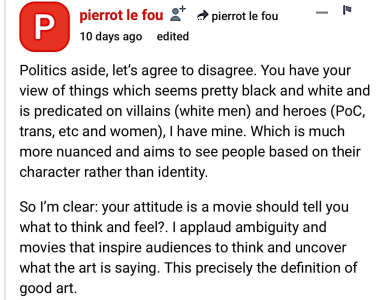
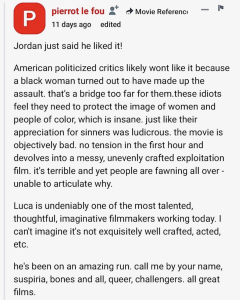
Please re-read my 8.29 Venice review, and consider sone of the comments posted about World of Reel‘s Jordan Ruimy’s 8.29 piece about the negative reactions. Note: “Pierrot le fou” is mistaken about Ayo’s character being characterized as “having made up the assault”…the film implies that she may be faking it, but that’s all.
HE’s 8.29 rave review of After The Hunt:
I immediately fell in love with the opening frames of Luca Guadagnino‘s After The Hunt, or more precisely the amplified sound of a slowly ticking clock — an aural statement that says “ominous stuff is brewing, you bet.”
Though I was fully familiar with the basic story bones, having read an early draft of Nora Garrett‘s original screenplay, a #MeToo rape accusation drama mostly set on the Yale campus, I was pulled in all over again. Largely because After The Hunt is not a simple point-and-shoot capturing of Garrett’s script, but a Guadagnino re-think…a stirring, a modification, an enhancement. Assured, unforced and deliberate, Luca’s version fascinates by not pushing too hard…by advancing the campus mystery in a gradual, step-by-step way.
I was actually kind of startled — pleasantly — by his decision to keep things on the subdued side. No sharply raised voices or glaring expressions or slamming doors or anyone throwing things around.
Except, that is, for a tantrum thrown by Andrew Garfield’s Hank Gibson, a professor who’s up for tenure — a reaction to his having been accused of sexually assaulting Ayo Edibiri‘s Maggie Price, an allegedly mediocre philosophy student, the daughter of super-wealthy parents, and a lesbian.
Maggie is a key story figure, not just because of this alleged assault but also because of her protege relationship with Julia Roberts‘ Alma Imhoff, a whipsmart, well-liked, seriously admired Yale professor who’s also in line for tenure. (It’s an either-or choice between Alma and Hank.) But as things develop and social pressure increases, Alma and Maggie’s relationship becomes less and less trusting, and then tips over into hostility.
I was mostly taken by a tone of ambiguity that manifests in the third act. A haunting ambiguity mixed with stabs of suspicion. And, not incidentally, by a somewhat instructive score by Trent Reznor and Atticus Ross.
Did a drunken Hank in fact assault Maggie after a boozy, low-key party at the home of Alma and Fredrik, her bearded, laser-focused psychiatrist husband (Michael Stuhlbarg)? Who’s lying or fudging the truth?
I for one didn’t want to believe Maggie’s accusation, as she is an all-too-typical, hyper-sensitive, woked-up Zoomer…a product of #MeToo theology who seemingly lives to take offense or at least shudder at white-male privilege, and seems almost eager to unsheath the deer rifle and plug Garfield. Hank doesn’t respect Maggie, by the way, because he strongly suspects that she’s plagiarized a social-analysis essay she’s been working on for quite some time.
Through an array of voices, Guadagnino’s rewrite doesn’t shrink from sharing disdainful, eye-rolling views of the recent #MeToo terror climate and the general “all white guys are bad” belief system, and so I, gripped by my own persuasions, was hoping Maggie would get some kind of comeuppance.
Alas, things are not that simple.
The only thing that threw me was the appearance of Maggie’s girlfriend, Alex, who is played by Lio Mehiel, a gay female who uses “they” pronouns and, to my surprise, has absolutely no breasts at all, and I mean not even the tell-tale surgical scars that some lesbians have after boob-removing surgery.
Last February I wrote that Garrett’s screenplay “feels like a splicing of Todd Field‘s TAR, David Mamet‘s Oleanna and Ruben Ostlund‘s The Square.”
This is pretty much how the film feels, although Ostlund’s satirical jabbing was far more pronounced. Hunt leaves you to grapple with your own persuasions and suspicions. It is my take (feel free to disagree) that the film offers no final, clear-cut resolution that delivers an unmistakable unmasking of the more or less guilty party (or parties). It doesn’t fully exonerate anyone while keeping at least a couple of doors ajar.
This, I feel, is what makes After The Hunt such a fascinating adult drama. It basically says “what a hard-to-figure shit show these poor academics are caught up in.” Hell, all of us. I also loved that Guadagnino’s voice — his actual, literal voice — chimes in at the very end, although I won’t say how.
I also wrote that Garrett’s screenplay planted “expectations of Roberts’ performance possibly stirring convos about a Best Actress trophy”, as she’s “playing one of those well-sculpted, sturm und drang roles that older actresses have always pined for.” This still seems likely but what do I know? Alma is definitely a hider with a major buried secret that doesn’t surface until things have reached a breaking point. She’s certainly no fighter for any kind of ultimate truth, and she’s suffered a social beating that will reverberate big-time.