

Penn Jillette rambles for over seven minutes in order to deliver a cynical suspicion — i.e., that the Obama-Wright relationship might have ended due to a deliberate scheme. Please. Obama’s dad left when he was two, and Wright filled that vacuum when Obama came of age in his mid 20s, and family is family.
Americans always vote over character issues and they don’t get the hold that fathers have over their sons? You don’t need a master’s degree to suss this stuff out, but a lot of baboons out there are still hung up on why Obama stayed with Wright for as long as he did.
How many guys out there have cut ties with their dads because their political beliefs aren’t in synch with his, or because his views on this or that are extreme or perverse or impossibly retrograde? Not one. If your father’s philosophy is asinine or astonishing, you might argue a bit once in a while but you always let it go after four or five minutes of pointless debate because his jerkweed beliefs are set in stone. You suck it in and change the subject and say “please pass the mashed potatoes.” Anyone who says they don’t play it this way is a liar.
There’s also this view from Chicago Tribune reporters Christi Parsons and Manya A. Brachear:
“In Chicago, the choice to attend [Rev. Wright’s] Trinity for so long is a little less of a puzzle, given Obama and Wright’s shared history on the city’s South Side and the spiritual and cultural haven the church and pastor offered the aspiring politician.
“Membership at Trinity is often taken as a progressive credential, a sign that a person is attuned to issues of social justice and equality and supportive of issues important to its gay and lesbian members.
“‘Rev. Wright is more sophisticated intellectually than many pastors,’ said Kwame Raoul, the state senator who took Obama’s place in the Illinois legislature and who is a member at Trinity. ‘He’s well-read, he takes the theology seriously. He doesn’t just make quick references to the Bible but offers a very deep analysis and an application to current events.’
“In an interview in early 2007, Obama said Wright had affected his politics by nurturing his connection to the historically black church and how he understands the obligations of his faith.
“‘He’s been somebody who has helped me feel comfortable with some of my doubts when it comes to faith and how to work those through,’ Obama said at the time. ‘His scholarship is very rigorous, and his sense of social justice is very keen.'”
Unbridled
Most of the hardcores will have seen Iron Man by late this evening. I agreed two or three days ago that it’s a pretty decent ride and that Downey’s performance is as good as it gets with this kind of thing, but I’d like someone to explain to me why it’s so damn great. I know it’s not. Anyone who comes out of this thing doing cartwheels has a need to express him/herself along these lines.
Media Slimeballs
Some TV commentators’ insistence on staying with the Rev. Wright clamor despite Barack Obama having totally put that issue to bed earlier this week has been making me more and more angry. I’ve been thinking about tapping out something that makes more or less the same points as this 5.2 piece by Huffington Post contributor R.J. Eskow, but I may as well just link to it. Says it just right.
“Suppose a small group of people controlled the press, and they wanted to ensure a Republican victory in November,” Eskow begins. “If this group were to write a memo to the media, what would it say? (1) Extend the Democratic primary race as long as possible; (2) Remind the public that the seemingly ‘post-racial’ Obama is a black man, [and] make him seem as scary-black as possible; (3) Strengthen Hillary Clinton‘s image with white working-class voters by making her appear populist, folksy, and one of them. Conversely, characterize Obama as an elitist who is out of touch with ‘real people’; (4) Break down Obama’s post-partisan appeal to independents and Republicans by linking him to the divisive left/right politics of the 1960s. Bingo — mission accomplished!”
Of course, you need to be an under-educated dumb-ass prole to be swayed by this horseshit to begin with. But this country has plenty of those.
This 4.29 Bob Cesca Huffington Post piece says almost the same thing.
Stallone Loves Rambow
“When I first heard about Son of Rambow, I assumed it was going to be a very broad and stylized joke-a-minute comedy at Rambo’s expense,” Sylvester Stallone has told L.A. Times guy Mark Olsen. But the aging action star “took a look at the playfully rambunctious tale of two boys in 1980s small-town England,” Olsen says, “and liked what he saw.” Stallone explains that “the fact that it was so heartwarming is the result of brilliant filmmaking by its creators.” Wait…are the last three words in that sentence necessary?

Tracking
Speed Racer opens seven days from now, and new tracking has it at 84, 26 and 3….obviously a weak number, although there’s no telling with family audiences. What Happens in Vegas is running at 80, 32 and 7 (with first-choice numbers among women being closer to 11 or 12). Chronicles of Narnia: Prince Caspian, which opens on May 16, is running at 96, 40 and 12 — pretty good. Indiana Jones and the Kingdom of the Crystal Skull (Paramount, 5.22) is through the roof, of course — right now at 89, 56 and 22.
Vegas
Presumably people are aware that What Happens in Vegas, the Cameron Diaz-Ashton Kutcher film (20th Century Fox, 5.8) that seems a little too chick-flicky for my tastes, is previewing nationwide tomorrow night. Not at 7 or 7:30 pm but at 9:30 or 10 pm, apparently. In some theatres, at least.
Be That Thing
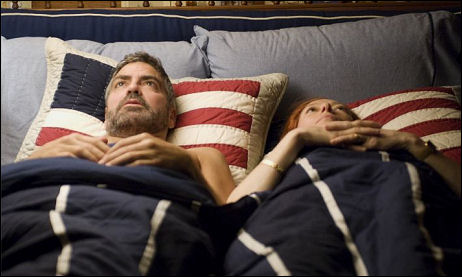
Consider George Clooney‘s ceiling stare in this newly revealed still (lifted from Rope of Silicon) from the Coen Brothers’ Burn After Reading (Focus Features, 9.12). You can see in a second that he’s “playing” stupid. Only dumb buys look like George Romero zombies during post-coital meditation. You can pretty much gather what his performance will be from this one shot. I believe it’s very hard to play a dumb-ass as if you really are one, instead of just appearing to be pretending.
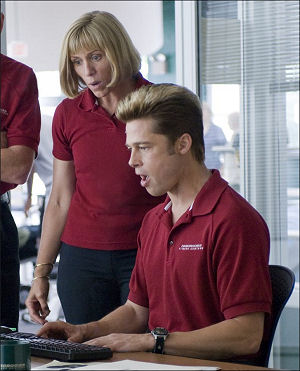
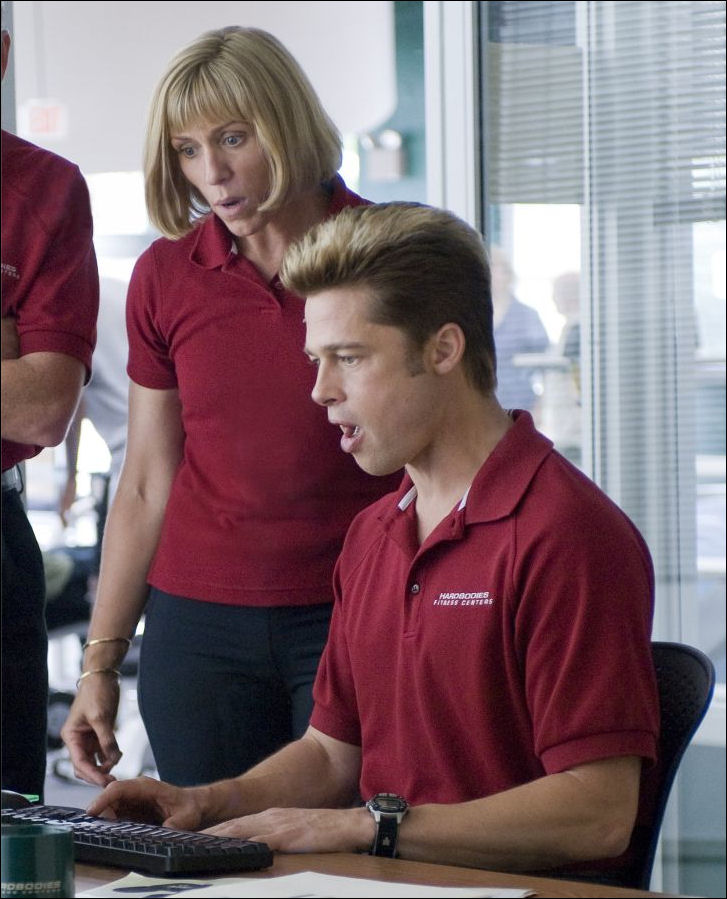
This is apparently the moment of discovery when Frances McDormand and Brad Pitt, playing health-club employees, realize they’ve gotten hold of a copy of some very hot memoirs from an ex-CIA guy (John Malkovbich). Big deal, right? Well, it seems that way because there hasn’t been a decent still selection from this film in months…ever.
The Hollowest
“Perhaps no vilifier of Hillary Clinton traipses across the footlights with a bigger satchel of calumnies than Andrew Sullivan, who diagnosed Mrs. Clinton as ‘the hollowest form of political life,’ a ‘sociopath.’ His solo act had and has a symptomatic significance. Published under the aegis of The Atlantic‘s stable of notable byliners, Sullivan’s Daily Dish blog is must-reading among the media elite, those sheep.
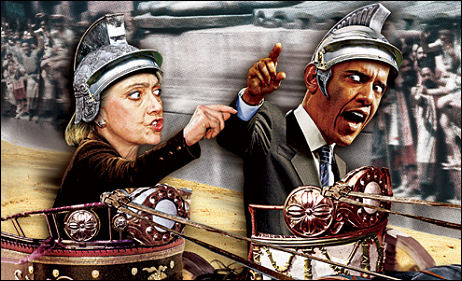
Wolcott’s anti-Sulllivan sympathies aside, the creator of this illustration, a guy named “Darrow,” is clearly anti-Hillary as he’s placed her in the position of Stephen Boyd‘s evil Messala and Barack Obama in the position of Charlton Heston‘s Judah Ben-Hur during the chariot race scene in William Wyler’s film.
“His words extend wider ripples in the ocean of emotion that passes for opinion journalism than did those of his fellow cobblers. In a column for The Times of London entitled ‘The Clintons, a Horror Film That Never Ends,’ Sullivan compared Hillary to Glenn Close‘s bunny boiler in Fatal Attraction — ‘Whoosh! She’s back at your throat’ — and the Clintons as a couple to the fast-running zombies in 28 Days Later. ‘The Clintons live off psychodrama,’ he contended in a classic pot-kettle-black moment.'” — from James Wolcott’s current (June 2008) online Vanity Fair column, titled “When Democrats Go Post-al.”
Adjustment
Indiana Jones and the Kingdom of the Crystal Skull (Paramount, 5.22) will actually show at the Cannes Film Festival on Sunday, 5.18, at 1 pm — not 8:30 am, as I wrote earlier. (The big film of the day is always shown at that hour.) And the press conference that will follow at 3 pm or thereabouts will be the only time, I’m being told, that director Steven Spielberg will give quotes about the film to general hoi-polloi press. (He’ s gotten on the phone with elite journos, of course, as he always does — Vanity Fair, etc.)
Uh-Oh…
David Gordon Green‘s Pineapple Express (Sony, 8.8) has been showing here and there, and a friend is telling me that aside from James Franco‘s career-changing performance as a stupid pot dealer, it’s a little coarse. It’s loud, “lots of mayhem,” youth-market-pandering, an “Abbott & Costello chase film,” full of explosions and “very, very violent,” he says. One comment was especially disturbing: “I’m not sure this is your kind of film.” What?, I said. I love smart stoner humor, I said. The Big Lebowski, Wonder Boys …that kind of thing. Guys with baked brains. It’s not on that level, he said. It’s louder, noisier…lots of explosions. Oh, I said. Well, there’s always Franco.
That aside, the friend said, the young audience he saw it with “ate it up…laughed at everything, even the women.” So it’s not for stoner sophisticates…fine. Basically an animal movie. Another Harold and Kumar thing except on a slightly higher level, a young girl said last night. “But it’s not Superbad,” my guy says. It’s not? “I don’t know what it is but David Gordon Green was never directed comedy before and….well, the violence is a much bigger factor than I expected.”
What about “episodic stoner segues,” I said? Side episodes in which they get all tangled up and confused over stuff that a normal person without pot issues would be able to handle but the stoners can’t because they’re too fried? “It’s not on that level,” he said. “It’s not as steeped in dry stoner humor as Lebowski is. It’s a little more pandering than that.”
Visions of Light
Another brilliant, perfectly-cut video piece from Jamie Stuart, and a good quote to go with it: “I’ve never been a big fan of ‘movie lighting’ (where exactly does rim light come from anyway?), although some filmmakers do it in a way that works for me.
“Movie lighting — and, by extension, photography lighting — came about, in part, because film stocks in the past weren’t fast enough to shoot in low light levels. At the dawn of the medium, electric lights weren’t even bright enough, so the filmmakers created roofless sets that the sun could illuminate.
“Eventually, cameramen started to stylize their lighting and created a whole slew of affectations; it was exceedingly rare to see light fall in movies as it actually does in real life. Eventually, film stocks improved and filmmakers took their cameras out into the world from studios. Things changed.”
Here‘s the location of the original article.
Tweed-Jacket Kingsley
Vanity Fair Daily‘s Julian Sancton recently spoke to distinguished wackazoid actor Ben Kinglsey, who’s portraying yet another psychiatrist in Martin Scorsese‘s Shutter Island and, he says, playing it fairly straight and tweed-jackety. (The working title, he says, is Ash Cliff….terrible! Means nothing!)
Kingsley discusses his craft and his background as a classically trained Shakespearean interpreter. He’s a superb actor — one of the best — but don’t be fooled by such talk. Just as the Superman TV series in the 1950s taught us that George Reeves wore tights and could fly faster than a speeding bullet, Sexy Beast and his other nutter roles (You Kill Me, The Wackness, Lucky Number Sleven, Mrs. Harris, etc.) taught us that Kingsley is a raving loon under the skin. All that Gandhi and Turtle Diary and Betrayal stuff was a put-on. He was having us off!