What’d I say?

What’d I say?
The following point was brought up by Bill Maher and a few columnists last week, but the ignorance or tunnel vision that was in effect during last week’s Martin Luther King tributes wasn’t, by my sights, widely acknowledged. It can’t hurt to point it out again.
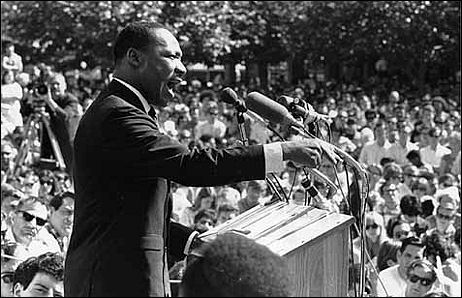
Overlooked in all the pious and rotely kowtowing speeches heard on the 40th anniversary of King’s murder (the ones by Hillary Clinton and John McCain struck me this way especially) is the fact that during the last two or three years of his life (’65 to ’68), King said a lot of the same things — damning indictments of U.S. warfare, calling the waging of war in Vietnam evil, predicting God’s vengeance, etc. — that Rev. Jeremiah Wright said in the pulpit on that revolving tape loop.
But none of the speechifiers wanted to go there last Wednesday. Because Clinton, McCain and others hadn’t the slightest interest in remembering some of what the deified King actually believed and said, particularly during the last year of his life. They just want to salute the up-with-people platitudes — the safe stuff — from the early to mid ’60s.
As Gary Yonge said a week ago on commondreams.org., “Wright is no King. His delivery is too shrill, his demeanour too hectoring, his message insufficiently unifying. Nonetheless, Wright and King come from the same tradition of militant religious leadership that has been a hallmark of black political life for well over a century. Under slavery and then segregation, the church was one of the few places that African-Americans could gather and organize autonomously — giving primacy, for better and for worse, to the pulpit and the preacher in black politics.
“It is unlikely King would have fared any better on YouTube or the blogosphere than Wright did,” Yonge goes on. “King, like Wright, was excoriated for opposing the ‘senseless and unjust war’ in Vietnam. ‘The reaction was like a torrent of hate and venom,’ recalled one of his aides, Andrew Young. ‘As a Nobel prizewinner we expected people not to agree with it, but to take it seriously. We didn’t get that. We got an emotional outburst attacking his right to have an opinion.”
“A few months before he died, King told parishioners at his church in Montgomery, Alabama: ‘We are criminals in that war…we’ve committed more war crimes almost than any nation in the world. But God has a way of even putting nations in their place.’ And how would God deal with an unrepentant America? ‘And if you don’t stop your reckless course, I’ll rise up and break the backbone of your power.'”
In an April 4, 1967 appearance at the New York City Riverside Church — exactly one year before his death — King delivered ‘Beyond Vietnam: A Time to Break Silence,’ says his Wikipedia bio. “In the speech he spoke strongly against the U.S.’s role in the war, insisting that the U.S. was in Vietnam ‘to occupy it as an American colony’ and calling the U.S. government ‘the greatest purveyor of violence in the world today.’ But he also argued that the country needed larger and broader moral changes:
“King was long hated by many white southern segregationists, but this speech turned the more mainstream media against him. Time called the speech ‘demagogic slander that sounded like a script for Radio Hanoi,’ and the Washington Post declared that King had ‘diminished his usefulness to his cause, his country, his people.'”
Barack Obama chose to breathe the air of Ft. Wayne, Indiana rather than that of Memphis, Tennessee, on the 4.4 anniversary. By staying away from the congregation of media in Memphis and the usual blah-blah that the media always seems to engender, I think he did the right thing.
“I can still see Widmark turning the pages of the script, and his voice was so frightening. He was not repeating his most famous role [i.e., Tommy Udo in Kiss of Death], but you knew that evil son of a bitch was somehow still lurking, still inside him, ready and willing to kill you but, more than that, anxious to put you in agony.” — William Goldman recalling a moment in ’75 or thereabouts when Richard Widmark read for the part of Szell in front of Goldman and John Schlesinger, at a time when it wasn’t 100% certain that Laurence Olivier would be able to play the part.
Tough super-delegate math for Hillary Clinton, another even-steven Pennsylvania poll (the third in this vein), and Barack Obama leading Clinton 56 to 33 in North Carolina. But it would be disingenuous of me not to applaud Clinton for (according to Drudge) reportedly calling on Bush to boycott the Beijing Olympics opening ceremony.
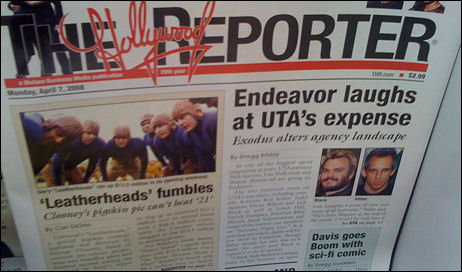
The Reel Geezers (Lorenzo Semple, Marcia Nasatir) on Leatherheads — a very frank, very intelligent pan by a pair of old pros who speak with believable authority about the studio-era classic comedies that George Clooney‘s film tries to emulate. This was “added” on 4.6 — these guys don’t post in advance of a film’s release?
Sample comments: (a) “These guys are running around like crazy trying to make a funny movie, and it’s embarassing…like being in a restaurant and no waiters or busboys”; (b) “It is singularly unfunny and doesn’t make a great deal fo sense”; (c) “It’s very hard to root for Clooney as the underdog”; and (d) “As soon as I heard about, I felt it would take a gun to make me see it. Comedy football movies! I can’t think of a genre less likely to be good.”
Semple refers to David Anspaugh‘s Hoosiers as “that basketball movie that came out about ten years ago.” It opened on 11.14.86.
It’s also interesting to consider the almost uniformly rough, dismissive comments about Clooney on Nikki Finke‘s blog, who wrote yesterday morning about the box-office failure of Leatherheads and in so doing used the word “fumble.” I warned against that!
Does the firing of top Clinton campaign strategist Mark Penn over his mucking around with the Columbian government over the possible passage of a bilateral trade treaty with the United States (which threatened to muddy by association Hillary Clinton‘s anti-NAFTA posturings) going to be read as a credibility compromiser by Joe Lunchbox voters in Pennsylvania, or is the story too complex to affect their understanding of things? I had to read this story twice to absorb all the angles. Working men like to keep things straight and plain and sound-bitey.
The Newark Star Ledger‘s Stephen Whitty has run a good story about Charlton Heston. “I’m waiting though — and wondering — if we’re going to hear from Michael Moore on this,” he writes. “I’ve enjoyed his books, and films, but I thought Bowling for Columbine was dicey, particularly when he went to interview Heston — and when I called Moore on it at the time, he insinuated that Heston was somehow lying or exaggerating the Alzheimer’s he announced he’s been diagnosed with.”
Young @ Heart (Fox Searchlight, 4.9) opens three days from now. I’ve seen it twice since catching it at last summer’s L.A. Film Festival (for a total of three sits), and I could see it another couple of times, no sweat. It so far the year’s most emotionally affecting film, hands down. Easily. And it manages this without resorting to anything treacly or mawkish or calculated.
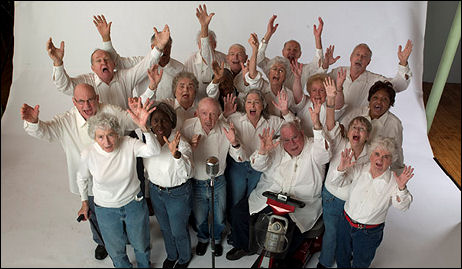
You might have heard Young @ Heart is some kind of family film or an old person’s musical, or something for people with aging parents. What it is is a movie about a bunch of old coots determined to sing and perform and affirm their vitality until it’s gone or taken away from them. It’s about living your ass off while you still have a life to live. Like most of us are doing right now…right? (Except for certain arrogant teens, druggies and whatnot.)
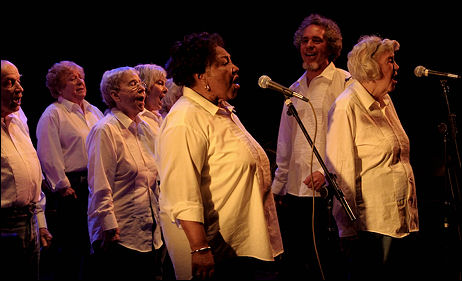
The characters are the Young@Heart Chorus from Northhampton, Massachusetts — all retired and then some, from 73 to 90-something years old, singing classic ’70s and ’80s rock tunes for paying audiences, touring here and there (including Europe) and having a spirited and moving time of it.
There’s something about the way these old guys sing songs by Bob Dylan, the Clash, David Bowie, James Brown, Jimi Hendrix, etc. that gives the lyrics added humanity and poignance. The height of this effect comes when the group does a performance in front of state prison inmates a day after a group member has passed. The group sings Dylan’s “Forever Young” much more movingly, trust me, than Dylan himself has ever managed.
After my last viewing I spoke to a journalist friend who found it “a little sad” because it’s about characters who don’t have a lot of time left. “Neither do we,” I replied. “Do you have some contractual guarantee in your filing cabinet at home that says you’ll definitely be alive next week?”
The fact that it aired on British TV in ’06 has apparently disqualified it from contending for the ’08 Best Feature Doc Oscar, but who cares? There’s nothing that radical about this film, really, except for the fact that it works. It kicks in. It will probably make you question whether you’re living your life to the fullest or not, or at least re-sell you on the idea keeping your heart and spirit open.
Here‘s what I wrote about it last summer. I was actually told not to review it at the time by publicist Mickey Cottrell. So I ran this little thing which amounted to an introduction to an excerpt of a review by Variety‘s John Anderson. Then other stuff happened and I forgot about Cottrell’s deadline and here we are, nine months later.
I managed to call it “the reigning heart movie of the LA. Film Festival (and in both senses of the term, delivering both warmth and sadness) and will be a guaranteed winner when it goes out commercially.” Some people are calling it “funny,” which it is at times. Chuckly-funny. Grandparent-funny. But it’s a lie to say it’s about a bunch of laughing octogenarians having the time of their lives.
The most infectious parts are the two music videos (which were directed by the film’s producer, Sally George). It’s “funny,” yes, to watch the group perform the Ramones’ “I Wanna Be Sedated” and the Talking Heads’ “Road to Nowhere'” but you can’t help but reflect on the echoes. As fate would have it, two members die a week or so before the big show at the finale.
The Young @ Heart director is a 53 year-old guy named Bob Cilian, who, like all visionaries, can be demanding. One of the oldsters calls him a “taskmaster.” But he does make it hard on the gang by choosing pretty difficult tunes. Rehearsing the Pointer Sisters’ “Yes We Can Can” (which requires the singing of 60 or 70 ‘cans’) drives everyone nuts. There are also problems when an 80-something gent has difficulty with Brown’s “I Feel Good.” Why doesn’t Cilian have them do Neil Young‘s “Only Love Can Break Your Heart” or “Old Man”? Or…I don’t know, Roy Hamilton‘s “Don’t Let Go”?
If I had George Bush‘s job, I would join Nicholas Sarkozy in threatening not to attend Beijing Olympics’ opening ceremony unless China agrees to (a) talk with the Dalai Lama, (b) free political prisoners and (c) put an end to an alleged brainwashing campaign for Tibetans “in an effort to end nearly a month of unrest.” Bush is far too mushy and committed to status quo cash flow to take such a stand, but I genuinely respect Sarkozy for standing up. I didn’t think he had it in him.
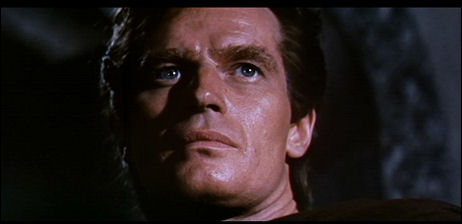
“Charlton Heston is an axiom. He constitutes a tragedy in himself, his presence in any film being enough to instill beauty. The pent-up violence expressed by the somber phosphorescence of his eyes, his eagle’s profile, the imperious arch of his eyebrows, the hard, bitter curve of his lips, the stupendous strength of his torso — this is what he has been given, and what not even the worst of directors can debase.
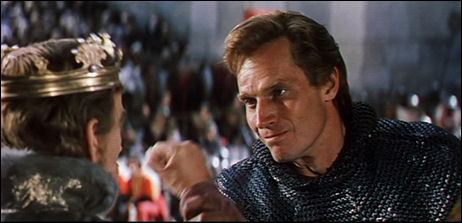
“It is in this sense that one can say that Charlton Heston, by his very existence and regardless of the film he is in, provides a more accurate definition of the cinema than films like Hiroshima mon amour or Citizen Kane, films whose aesthetic either ignores or repudiates Charlton Heston. Through him, mise en scene can confront the most intense of conflicts and settle them with the contempt of a god imprisoned, quivering with muted rage.” — French film critic Michel Mourlet, from a 1960 Cahiers du Cinema essay, quoted today by both Time‘s Richard Corliss and Dave Kehr on his own film blog (i.e., not his Times DVD column).
The main point in a 4.6 piece about the just-deceased Jules Dassin by Time‘s Richard Corliss is that aside from his reputation as the father of the sophisticated heist film, he was a gifted but not exceptionally talented in-and-outer who lived through a 40-year dry spell after his last big hit, Topkapi, in 1964.
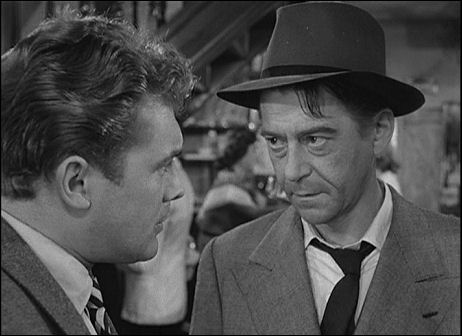
That’s not an unfair verdict, but some of what Corliss says veers on the mean-spirited. He under-values, at the very least, the delicious aroma of first-rate heist films, and how grateful millions are for the survival of the genre, and that Dassin did something really special by simultaneously creating and upgrading in one fell swoop.
Corliss reminds that an official remake of Rififi is due out next year, with Al Pacino as the Tony le Stephanois character. Is that so? With Harold Becker directing and a screenplay by Bo Goldman? I thought that had gone by the wayside. I thought Al Pacino had been hypnotized and kidnapped by Jon Avnet.