

“This is one of the few years where it is easy to imagine the DGA nominations being off of Oscar’s Top 5 by at least two directors,” David Poland wrote in his most recent “20 Weeks to Oscar” column. I’ve read this sentence five times and the sucker won’t ring true. Let’s try it this way: “This is one of the few years in which it’s easy to imagine the DGA’s Best Director nominees being, in at least two instances, different than the directors of the five most likely Best Picture nominees.”
Cut to the chase and Poland is more or less saying that while Jason Reitman‘s Juno and Joe Wright‘s Atonement‘s are likely Best Picture nominees, Reitman and Wright haven’t quite shown the chops and passion one associates with a sturdy and unassailable Best Director Oscar nominee.
Rewriting Poland again, he says the following: “Due respect, but if you have (a) Paul Thomas Anderson‘s work in There Will Be Blood, (b) Julian Schnabel‘s work in The Diving Bell & The Butterfly, (c) a living legend like Sidney Lumet delivering, at age 83, a vibrant, rough film in Before The Devil Knows You’re Dead, (d) Todd Haynes bending time and personality in I’m Not There, and (e) Ridley Scott delivering the highest caliber of commercial cinema in American Gangster, is the DGA really going to go for a Joe Wright or a Jason Reitman?
“Moreoever, will they embrace a first-timer like Tony Gilroy? Can anyone miss the stride that Sean Penn, who has always been a very serious director, however you feel about the output, has made with Into The Wild?”
The thing about Penn and Into The Wild is this: having made a personal best (which he unquestionably has) doesn’t necessarily mean that Into The Wild, spirited and reaching as it may be, is finally a classic, world-class, power-punch achievement. The bottom line is that I don’t believe Penn gave me the whole-hog truth about Chris McCandless. The movie gave me his view of the guy and that’s fine…but it didn’t feel like enough.
McCandless could have lived and thrived and had a life that was about more than just saying “no” to his parents’ values, but he pissed it away because he was too arrogant to own a decent map of the area where his rusty bus was located — a map he could have used to save himself when he wanted to get back to civilization. And I don’t have any respect for a guy who refuses to write or call his parents for as long as McCandless did. He was brave and strong in some respects, but in others he was an asshole. And that’s fine. Everyone’s tangled up in this way or that. But at the end of the day this portrait of McCandless left me feeling a little distant.
Bill and Hillary’s conjugal psychodrama
“Just when I thought I was out, the Clintons pull me back into their conjugal psychodrama,” writes N.Y. Times columnist Maureen Dowd in a truly fascinating column. The thrust of her 12.23 entry is that Bill Clinton, for the strangest and most tangled-up of reasons, may be subconsciously sabotaging Hillary Clinton‘s presidential campaign.
The seed of this suspicion is a friend of the Clintons having told Dowd that “for the first time since the Marc Rich pardon, Bill is seriously diminishing his personal standing with the people closest to him.”
“Is Bill torn between resentment of being second fiddle and gratification that Hillary can be first banana only with his help?,” Dowd wonders. “Their relationship has always been a co-dependence between his charm and her discipline. But what if, as some of her advisers suggest, she turned out to be a tougher leader, quicker to grasp foreign policy, less skittish about using military power and more inspirational abroad? What if she were to use his mistakes as a reverse blueprint, like W. did with his dad?
“When Bill gets slit-eyed, red-faced and finger-wagging in defense of her, is he really defending himself, ego in full bloom, against aspersions that Obama and Edwards cast on Clintonian politics?
“Maybe the Boy Who Can’t Help Himself is simply engaging in his usual patterns of humiliating Hillary and lighting an exploding cigar when things are going well. ‘They’re not Scott and Zelda Fitzgerald, who had jealousy as the lifeblood of their marriage,’ said one writer who has studied the pair. ‘The lifeblood of their marriage is crisis, coming to each other’s rescue.'”
Exploding cigars! Reverse blueprints! Sturm und drang! Terrific stuff.
Writing too much about Oscars
“There is also a growing tension between critics — who take film seriously as art and are increasingly scornful of the vituperative blog culture — and Oscar pundits, who with their wacky statistical analysis come off more like breathless racetrack tipsters than film admirers. The root of all this evil, of course, is that everyone writes entirely too much about the Oscars (my newspaper included). With all those special issues and Oscar blogs to fill, the occasional astute observations are drowned out by the 24/7 blather.” — from a 12.18 Patrick Goldstein “Big Picture” column that I should have acknowledged earlier.
Todd/Ahab skunk hair
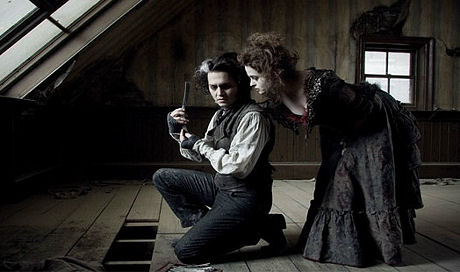
Sweeney Todd is not only consumed by vengeance but goes mad with it, finally destroying himself and taking others down with him. In a way the visual signature of his derangement is his white shock of skunk hair. It’s interesting to note that the last movie character who had the same skunk ‘do was also obsessed by vengeance, so lost in rage that he’s prepared to sacrifice his life, the lives of his crew members and even his ship to find and destroy his nemesis.
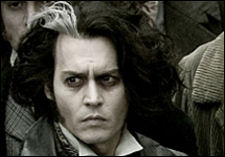
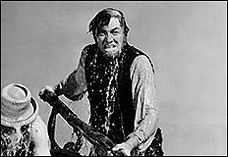
Johnny Depp in Sweeney Todd; Gregory Peck as Captian Ahab in John Huston’s Moby Dick
On top of which both men raged and obsessed sometime in the early to mid 19th Century. Has anyone ever tried to make a musical out of Herman Melville‘s Moby Dick?
There’s one more parallel. Both Sweeney Todd and John Huston‘s Moby Dick (1956) both have monochromatic color palettes. In Moby Dick, in fact, Huston and cinematographer Oswald Morris made the first color film with a subdued drained hue, an effect that was achieved in the printing process by blending the color negative with a “grey” (black and white) negative. The idea was to emulate the Currier and Ives etchings of the period.
I only wish I could find a decent color closeup of Peck and his Ahab skunk hair.
Sweeney Sparrow
I clicked, I saw, I chortled…a little lame but not too bad…”you, sir!”
Three “Blood” articles in Calendar
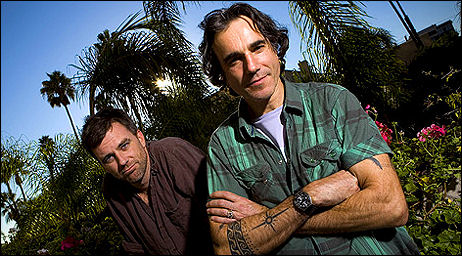
Two articles about There Will Be Blood appear in today’s L.A. Times/Calendar section — a Daniel Day Lewis/Paul Thomas Anderson profile by Michael Ordona and one by Paul LIeberman about the casting of young Dillon Freasier as Lewis’s “purported” son. A third piece by Reed Johnson examines how “the planetary and human costs of overconsumption [are] a major cultural theme” examined in Blood as well as Sean Penn‘s Into the Wild.
Dargis’s Top Ten
“Paul Thomas Anderson‘s There Will Be Blood, which I will write about in detail when it opens on Wednesday, and David Fincher‘s Zodiac, which I wrote about when it was released in March, together constitute my 1 through 10,” writes N.Y. Times critic Manohla Dargis in a 12.23 article.
“These aren’t necessarily the year’s best (impossible to determine given the glut of films), just the two that matter most to me, that dug in the deepest and rearranged my own givens. They made me feel like the woman in the start of Orson Welles√ɬ¢√¢‚Äö¬¨√¢‚Äû¬¢s film Touch of Evil who says, ‘I√ɬ¢√¢‚Äö¬¨√¢‚Äû¬¢ve got this ticking noise in my head,’ just before she√ɬ¢√¢‚Äö¬¨√¢‚Äû¬¢s blown to smithereens by a time bomb.
“I√ɬ¢√¢‚Äö¬¨√¢‚Äû¬¢m still intact (more or less), but these films shook up my world in the best possible way.”
“Todd” drops big-time on Saturday
Sweeney Todd suffered a disastrous 23% drop in terms of its projected weekend earnings from Friday to Saturday. This appeared to be a result of the Redville cognoscenti finally figuring out it’s not a London-based Jack Sparrow adventure of some kind but a (choke…gag) Stephen Sondheim musical. (Fantasy Mogul’s Steve Mason has reported an 11% Friday to Saturday downturn. The 23% drop is based on Friday’s projection of a $12 million weekend vs. Paramount’s own reported weekend tally of $9.3 million.)
Realizing they’d been boondoggled (after ignoring the internet chatter for months), a significant percentage of the slow-on-the-pickup crowd apparently went into shock after seeing Tim Burton‘s dark fantasia on Friday. They obviously passed along some negative comments to their friends (perhaps not only about the music but about the arterial garden-hose spurtings) and led a modest revolt against the Paramount/DreamWorks ad campaign.
Sweeney Todd had been projected to take in $12 million after Friday’s earnings were calculated, but the weekend projection is now down to $9,399,000. I’m told that DreamWorks marketers wanted to sell Todd for the grand guignol musical that it is and open it more slowly — starting with 200 theatres — but Paramount marketers insisted on a fake-out campaign with a bigger 1200-theatre opening.
The main Sweeney Todd trailer wasn’t a total fake-out, of course. The one I saw in theatres two or three times showed Johnny Depp singing the line, “I will have vennn-geance!” What did the dumb-asses think that meant? That the film would be a straight adventure drama about a bunch of pirate ships attacking London?
Other films went down as well. National Treasure was projecting $54 milion, is now projecting $48 million…a drop of 12% from Friday to Saturday. I Am Legend was projected to do $36,900,000, is now looking at $34,800,000. Alvin and the Chipmunks was projected to make $30 million for the weekend, now looking at $28 million. So everyone dropped 10% or thereabouts, but Sweeney Todd‘s 23% drop (calculated by the projected vs. actual weekend figure) was much more than the norm.
It also snowed yesterday in much of the Midwest, which much have hurt ticket sales also.
Sadness of sudden loss
A final remembrance of The Lives of Others star Ulrich Muhe, whose death last July was, for me, the saddest and most unexpected of the year. Coming in the wake of having given one of the most moving performances of the 21st Century and experiencing the greatest international success of his career and then bam…over.
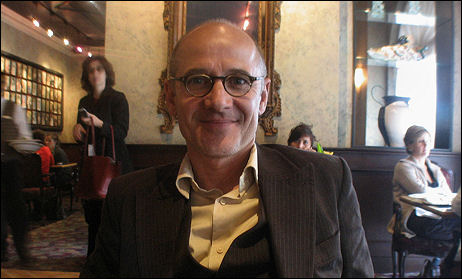
I felt a huge kinship with Muhe himself, partly due to interviewing him at the Toronto Film Festival (also chatting at a couple of festival parties) in September ’06, partly because I knew that his own disturbing history with the Stasi (they watched him very closely in the ’80s) was tied up in the role, and partly because I’ve got a German ancestry from my mom’s side of the family.
Obama nudges ahead of Hilary
For the first time, Barack Obama has nudged ahead of Hillary Clinton in a New Hampshire primary voter survey. Behind her by 14 points in early November, now at 30% to her 28% according to a just-published Boston Globe survey. McCain is surging also in the Granite State. 15 points behind Mitt Romney in early November, he’s now trailing by only 3 points — 25 to Romney’s 28.
Stuart on Stonement’s Joe Wright
This Jamie Stuart video portrait of Atonement director Joe Wright is, as usual, “different”, personal, whimsical…a promotional piece that doesn’t promote or smooch celebrity butt as much as burrow in with some kind of view askew. One big problem: it was released two days ago, but it begins with a title that refers to a screening of Atonement that happened over three months ago at the Toronto Film Festival. My first reaction was “what…it took Stuart three months to slap it together?”
“Zodiac” near the top
Check out this Top Ten of ’07 list at Movie City News. Growing and evolving, might rearrange in a few days. No Country for Old Men at the top, of course. But look at #2. So it’s not just the British critics and four or five other guys (myself included). The total absence of Zodiac as a Best Picture winner with all of the various award-giving groups so far amounts to some kind of disconnect.