Audiences vs. “sand” movies

An 11.17 Hollywood Reporter piece by Gail Schiller went up yesterday about the blanket refusal of most American moviegoers to patronize any film vaguely related to 9/11 or the Middle East conflict. Even a first-rate whodunit procedural like In The Valley of Elah, highlighted by superb performances and set entirely in Tennessee and New Mexico….even that got the bum’s rush.
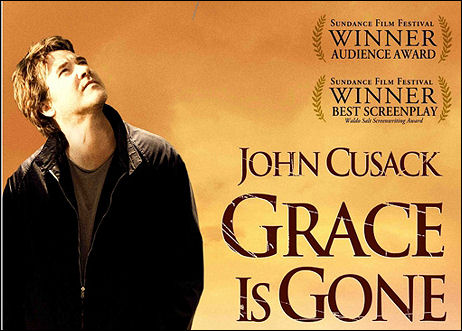

Will audiences regard Grace is Gone (Weinstein Co., 12.5) as a sand movie in sheep’s clothing?

The “leave us aloners” (no sand, no dark-eyed characters of any Middle Eastern heritage…we just want to be entertained) are, of course, the same group who wouldn’t see United 93 (i.e., the “too sooners”) last year.

“One of the biggest challenges beyond the topicality of these different [Middle East] movies is their sheer number,” New Line marketing chief Chris Carlisle told Schiller. “It becomes a muddle for the consumer.”

That’s a polite way of putting it. Allow me to put it more bluntly. To a one-track mind looking to avoid even a hint of darkness or complexity, a folded newspaper is a muddle. 90% of the American moviegoing public goes to movies in order to find a cinematic quaalude — a film that will give them a kind of fluttery high and make them go “aaah.” If a movie seems to be offering anything other than some form of positive primal experience (i.e., something that offers big laughs or thrills or which affirms basic yearnings or values), it’s got problems.

Rendition is very different,” Carlisle explains. “Despite its Middle East backdrop, it doesn’t take place in Iraq. We played up our cast and the thriller aspects of the story line. This film is an engaging, entertaining and emotional story, and that’s where we focused our campaign.” Forget it, Chris. The “leave us aloners” are like deer in the forest picking up the scent of humans in hunting jackets. They can smell a terrorist flick a mile away, and they don’t want to know from distinctions.

We are smack dab in the Age of the Mass-Market Ostrich.

Brian De Palma‘s Redacted (Magnolia, 11.16) is facing a double whammy — it’s a sand movie with some of the most amateurishly awful performances in the history of commercial cinema.

Will the “leave us aloners” blow off the Weinstein Co.’s Grace is Gone also? Do deer tend to hightail it when they hear the crack of twigs 500 yards off? This is a touching Middle American family drama about dealing with grief, plain and simple. It uses spare brushstrokes to tell a spare story. The great John Cusack plays a Bush-supporting dad who finds it next to impossible to tell his two daughters that their soldier mother has been killed in Iraq. The Weinsteiners moved the release date from 10.5 to 12.7, hoping this might make a difference.

“Any time you deal with the current war situation anywhere in the Middle East, you risk U.S. audiences just glazing over,” Picturehouse president Bob Berney told Schiller. “They look at movies as an escape and they want to be entertained.”
Roberts in “Wilson” trailer

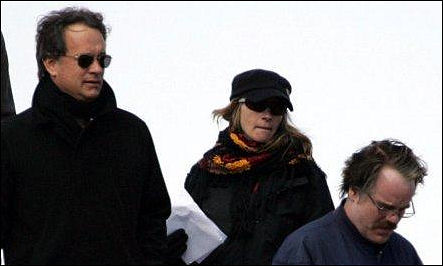
Charlie Wilson’s War blowback item #1: the more I look at this trailer, the more irksome those clips of Julia Roberts are starting to become. Trailers have the potential of souring viewers on the movies they’re supposed to be selling because they always hammer home the most cloying selling points, but in every clip Roberts is either doing the sly sexy smile with the raised eyebrows or she’s winking. Sorry, but I have a low tolerance for this stuff in movie trailers to begin with.

Plus her accent sounds Southern but not exactly Texan (i.e., she’s playing a real-life conservative Houston socialite named Joanne Herring), and that big blonde hairdo is starting to bother also. I don’t mean to be a pain-in-the-butt nitpicker with nothing better to do than complain, but I’m starting to feel these iffy vibes because of Roberts and (let’s be honest) the trailer itself. More and more I’m hearing and seeing a series of quips and punch lines, but not much of a river or current underneath.

Memo to Universal marketing: get the team to cut a non-cute, non-winking trailer sometime soon that makes Charlie Wilson’s War look like a moderately serious political drama. The more I think about it, the idea that it’s some like of light, sardonic geopolitical romp isn’t going down well. I’m not saying “dreary” is the ticket — just get away from the smirks and the chuckles, and maybe throw in one or two extra clips with Phillip Seymour Hoffman.


Hanks, Roberts and Hoffman on location.

And please, please shitcan the “All Along the Watchtower” and “American Pie” song clips altogether.

“Hearts of Darkness” on DVD

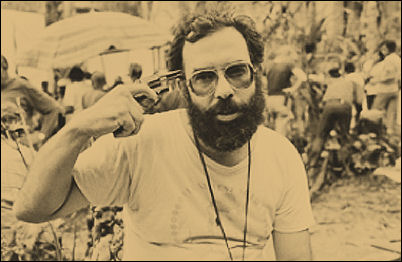
Yesterday Benjamin Crossley-Marra announced on the Filmmaker website that a DVD of George Hickenlooper and Fax Bahr‘s Hearts of Darkness, a fascinating behind-the-scenes look at the tortured making of Francis Coppola‘s Apocalypse Now, will finally be released on 11.20.

It bothers me that Crossley-Marra doesn’t mention the disc’s distributor in his story, and that I can’t find any mention of the Hearts DVD on Amazon.com, and that I haven’t heard about this directly from Hickenlooper. I’ll feel a lot more trusting about this announcement when some of these details peek through, or when they don’t.

The Hearts of Darkness DVD will reportedly include a narration track by Francis Coppola and his wife Eleanor. The disc will also feature Eleanor’s Coda: Thirty Years Later, a follow-up documentary on the whole magilla.

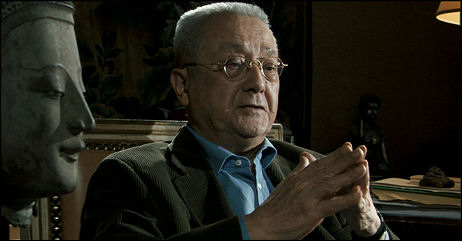
Barbet Schroeder, “Terror’s Advocate”

I spoke last week to Barbet Schroeder, the esteemed director of Terror’s Advocate, a doc that I wound up respecting more than liking. This led to conflicted feelings and a kind of blogger’s block when it came to posting something about it last week, when the film had its debut.

Terrorist’s Advocate is a portrait of Jacques Verges, a brilliant and vaguely charming French-Vietnamese attorney who’s defended (or been in some kind of collusion with) almost every big-time terrorist, anti-colonialist, revolutionary cowboy and anti-imperialist operative of the last 50 years.

It’s essentially a story of a bright, opinionated, anti-colonialist lawyer who began his professional life with great passion during the Algerian uprising, defending and then winning freedom for a beautiful anti-French terrorist named Djamila Bouhired and later marrying and having two children with her. But he gradually came to love being wanted by as many terrorists and freedom-fighters around the world, however dubious their credentials, as possible.

He came to love the attention — the heat of the action — and this hunger for engagement in and of itself (as well as the spotlight) gradually consumed him.

This, at least, is the impression I got from Schroeder’s film. Not that Verges stopped believing in revolutionary ideals or fighting U.S. imperialism or general oppression, but that he came to care a little more about being Jacques Verges than anything else. It goes that way for a lot of us, I suppose. We start out believing, fighting, trying to be heard or at least see our passion have some impact or result. But we end up owning and occupying a certain turf — a way of living, thinking, being — that becomes, in the end, the ultimate focus.

By the late ’60s Verges had become the terrorist go-to guy for legal defense and consultation. He is still at the top of this pyramid today. (Terror’s Advocate is obviously a kind of advertisement for Verges’ skills as an attorney.) The Baader-Meinhof gang, Carlos the Jackal, Saddam Hussein, allies of Khmer Rouge psychopath Pol Pot, Waddi Haddad, Slobodan Milosevic, former Nazi torturer Klaus Barbie…they all called him, dealt with him, trusted him.

Terrorist’s Advocate is an emotionally dry film — you could call it arid — but it’s not without fascination. For more than two hours Schroeder relates Verges’ history from the mid 1950s to the present, speaking only to Verges and the people who’ve actually dealt with him. There are no outside observers, no judges. Perhaps, for the sake of simple-minded souls like myself, there should have been. After the first hour or so I began to long for something more than Schroeder’s immaculate dispassion.

The movie reminded me that anyone with enough guile and brain cells can be charming. Villains do not scowl or glare or laugh fiendishly like they do in the movies. They smile and chat on the phone and order take-out food on weekends and enjoy taking long walks along country roads as much as anyone else.

I was going to run my mp3 of my chat with Barbet last week, but something held me back. I guess I just didn’t feel enough enthusiasm for the film to get myself up on the diving board so I could do my approach and then bounce off and attempt some kind of jacknife dive into the pool. I knew the fire and the feeling weren’t there.

But I’ve known and admired Barbet Schroeder for 20 years. I worked with him closely for a brief period at Cannon Films, when he was making Barfly and I was writing press kits. He came to a party I threw once, when I was married and living in a home in the Hollywood hills. He’s a fascinating guy, a superb filmmaker, always kind and fair-minded, one of my heroes. So I did my best with Barbet on the phone (he called from from the set of Inju, a thriller he’s currently shooting in Japan) and showed as much interest and enthusiasm as I could.

Terror’s Advocate is a film of great intelligence, but it does gradually lull you into a sort of stupor after a while. Is it possible to feel engaged and nodding off at the same time? Naturally I didn’t have the impertinence to say this to Barbet.

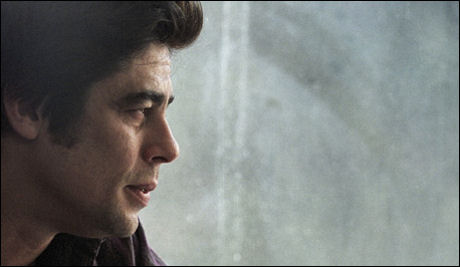
Praise for Del Toro in “Fire”

Things We Lost in the Fire has bombed out with slightly less than half the critics — only 65% have thumbs-upped it on Rotten Tomatoes, 58% on Metacritic — but nearly everyone (except for Stephen Holden and maybe one other) has gone into full cartwheel mode over Benicio del Toro‘s performance and, to any fair-minded reader or watcher of the film, made a Best Actor Oscar nom seem mandatory.

The Austin Chronicle‘s Josh Rosenblatt says it best: “If you’re bored some Saturday night, try this game: Close your eyes, spin around three times, and point a finger at Del Toro’s resume. Dollars to doughnuts, you’re going to land on one of the better acting performances of the last 20 years. Basquiat. Fear and Loathing in Las Vegas. Traffic. 21 Grams. Big Top Pee-wee. He can do it all.

“Yet somehow, with Things We Lost in the Fire, he’s managed to top even himself; this most recent performance is right up there with the best screen turns, not just of his generation but of all time: Brando in On the Waterfront. Hopkins in Nixon. Washington in Training Day. Rarefied air.

“In Danish director Susanne Bier‘s excellent new film, Del Toro plays Jerry Sunborne, a fortysomething junkie living in squalor in downtown Seattle who’s forced to re-examine his life after the violent death of his best and only friend, Steven Burke (the perpetually somnolent David Duchovny). Burke’s wife, Audrey (Halle Berry), never trusted Jerry even when her husband was alive, but she decides to call on him after realizing that raising two kids alone in her emotional state may be an impossible task.

Things We Lost in the Fire is Bier’s first English-language film and her follow-up to the Oscar-nominated After the Wedding, and like that film, it’s an impeccably constructed and perfectly paced drama of domestic and internal volatility.

“In the end, this movie belongs to Del Toro. He imbues Jerry with such life, such ambiguity, such unsentimental complexity and depth that you can’t help but feel you’re watching the most intricately mapped depiction of addiction and strained humanity the film world has ever given us.”

Likewise, The Stranger‘s Andrew Wright states that “you’re mainly going to be watching Del Toro, who somehow slinkys and random-tangents his way into a fully realized being who’s never more soulful than when he’s dealing with the monkey on his back. The film has yet to be made that fully does justice to Del Toro’s alien transmissions, but Bier comes awfully close.”

The trouble with “American Gangster”

In this audio interview with The Envelope‘s Tom O’Neil, N.Y. Daily News film critic and amiable chatterbox Jack Matthews reiterates a basic perception about Best Picture Oscar contenders. Uhm…well, Jack doesn’t really explain it as completely as he could so I’ll re-phrase it.

The movies that tend to win (or come close to winning) always seem to do one of two things. They say something fundamentally true about life on this planet that most of us recognize (like American Beauty‘s theme that few of us take the time to appreciate life’s small, quiet wonders). Or they make us choke up in recognition of some buried or under-acknowledged emotional truth residing deep in our chest cavities. Or both. Exceptions happen, of course — The Departed, The French Connection, etc. But mainly the soft, squishy stuff gets the gold.

In this sense, as much as I hate to admit it, American Gangster is vulnerable because it doesn’t do either of these two things. I think (hope) it’ll be nominated anyway because it’s a mesmerizing valentine to ’70s cinema and an awfully good textural-procedural in the vein of The French Connection, Serpico and Prince of the City with a sprinkle or two from the Across 110th Street salt-shaker. It’s a wonderfully savory NewYork cops-and-bad-guys story that underlines shared values between the hunter and the hunted.

The fact that it lacks ambition by not trying to do much else makes it, of course, unpretentious as well, and much to my liking. But if the Academy hard-cases keep up with the complaints that “it didn’t make me cry” and the beef that “it’s not really about anything,” then there might be trouble down the road.

Remaking “The Birds”…for sure

The notion of Naomi Watts playing the Tippi Hedren role in a Michael Bay-produced remake of Alfred Hitchcock‘s The Birds (which production sources prefer to call “a reimagining of Daphne du Maurier‘s short story”…bullshit) is at least a couple of years old. The basics were bandied about a year ago by myself, Hollywood Wiretap’s Nancy Vialette and TMZ’s Claude Brodesser-Akner.


(l. to r.) Martin Campbell, Michael Bay, bird victim, Naomi Watts

But Martin Campbell is now signed to direct and Watts is still the star, so Variety is running an official announcement story.

As I said a few weeks ago, people have forgotten (or don’t want to acknowledge) what a stiff, stilted and unnatural film Hitchcock’s Birds really is. The first 30 to 40 minutes are pretty close to horrible. The child actors are detestable. It only takes off with the bird attack on the house, Jessica Tandy‘s discovery of the guy with the pecked-out eyes, the attack on the school, the legendary cafe scene (“It’s the end of the world!”) and then the attic attack on Hedren. It really could stand a remake, or (okay, whatever) a “reimagining.”

Here‘s what Hedren told MTV.com a few days ago about the Bay-Campbell project.

David Chase on that ending

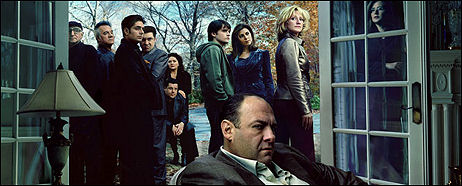
In The Sopranos: The Complete Book (in bookstores on 10.30), interviewer Brett Martin asks producer David Chase about that final cut-to-black scene in the diner and if there’s a puzzle to be solved.

“There are no esoteric clues in there,” Chase answers. “No Da Vinci Code. Everything that pertains to that episode was in that episode. And it was in the episode before that and the one before that and seasons before this one and so on.

The seed of the finale, says Chase, was “just that Tony and his family would be in a diner having dinner and a guy would come in. Pretty much what you saw.” The way it plays out, he feels, delivers “a definite sense of what Tony and Carmela’s future looks like. Whether it happened that night or some other night doesn’t really matter.

“There had been indications of what the end is like,” he explains. “Remember when Jerry Torciano was killed? Silvio was not aware that the gun had been fired until after Jerry was on his way down to the floor. That’s the way things happen: It’s already going on by the time you even notice it.”

This gets Martin’s attention. He says to Chase, “Are you saying…?” And Chase waves it right off. “I’m not saying anything. And I’m not trying to be coy. It’s just that I think that to explain it would diminish it.”

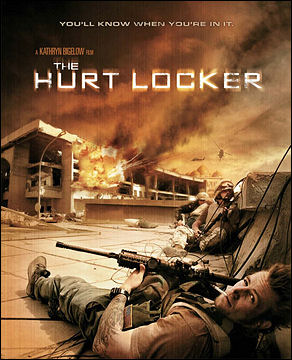
“Hurt Locker” poster

This one-sheet for Kathryn Bigelow‘s The Hurt Locker (due sometime in ’08) feels to me like one of the greatest war-film posters I’ve ever seen. For the brutal squalor of it, the hellish atmosphere, and because of the guy on the ground looking back and to his left and straight at us.

He seems to be saying, “You just gonna sit there or what?” That expression — the decision to make his face almost the entire point of the poster, the fact that he’s got that thousand-yard stare — is some kind of genius. Hats off to the art director who threw it together.

Except I can’t identify the actor. I’ve looked at head-shots of the whole Hurt Locker castJeremy Renner, Anthony Mackie, Brian Geraghty, Ralph Fiennes, Guy Pearce –and I’m coming up blank.

Joey Bishop = Jimmy Kimmel

Now that the biological host-vessel has expired, the spirit of Joey Bishop will attempt to enter (or perhaps already has entered) Jimmy Kimmel. Every culture and era needs a Joey Bishop type. Somebody smart, sardonic, flip, deadpan. This doesn’t describe Kimmel to a T — he’s his own man, a guy who lives and dies by the wearing of elephant collars plus he smiles more than Bishop ever did — but he’s the closest thing we have today to a Bishopian figure.

Ten Worst Movies Directed by Actors

New York magazine’s Vulture column has a listing of the 10 Worst Movies Directed by Actors — The Ten Worst Movies Directed by Actors. Mel Gibson‘s Braveheart, Eddie Murphy‘s Harlem Nights, Crispin Glover‘s What Is It?, William Shatner‘s Star Trek V: The Final Frontier, Andy Garcia‘s The Lost City, Ben Stiller‘s The Cable Guy, Nicolas Cage‘s Sonny, John Turturro‘s Romance & Cigarettes, Kevin Spacey‘s Beyond the Sea and Danny De Vito‘s Duplex.

The Cable Guy doesn’t belong on this list. The ending aside, it has its moments — I particularly enjoyed Jim Carrey shoving that hot-air blower into Owen Wilson‘s mouth. In its place I would insert Peter Fonda‘s Idaho Transfer.

And the ten best movies directed by actors? The Night of the Hunter, Ordinary People, Reds, Heaven Can Wait, Bulworth and…?

Best Picture race…again

David Poland‘s 20 Weeks to Oscar column says “anything can happen,” meaning that it’s a totally wide-open Best Picture race. I don’t know anything either — who does at this point? — but c’mon….c’mon! It’s not a salad toss. It’s a definable universe and we all pretty much know what’s going on so why pretend otherwise?

Barring a cataclysmic rupture in the scheme of things, it’s going to be American Gangster (the spectacular ’70s grit, the tangy, rock-hard performances, the huge grosses), Atonement (the obligatory square-stately romantic drama entry with Vanessa Redgrave‘s killer ending), Before The Devil Knows You’re Dead (the go-Sidney! vote — people rooting for a guy still firing away in his mid ’80s — will be all but unstoppable), There Will Be Blood (the presumption that it’s Anderson’s finest coupled with an epic, Giant-like, Citizen Kane-ish brush) and one other.

Elements of doubt are creeping into the Charlie Wilson’s War bandwagon, and No Country for Old Men — the finest, deepest, saddest and most cinematically awesome Coen Bros. movie of all time — may run into resistance from the squares because of the final ten minutes. The fifth contender ought to be (but of course won’t be ) Once, Things We Lost in the Fire, Zodiac or The Assassination of Jesse James by the Coward Robert Ford. I will totally keel over and pass out if The Diving Bell and the Butterfly nabs the fifth Best Picture nomination.