
Denby on “Superbad”

“I recently wrote that I could happily do without any more movies devoted to the breaking of the male bond,” David Denby writes in his 8.20 New Yorker review of Superbad. “Yet here’s an uproarious and touching picture on that theme [that] combines desperately filthy talk with the most tender, even delicate, emotion. [It] succeeds as a teen’s wild fantasy of a night in which everything goes wrong, revised by an adult’s melancholy sense that nothing was ever meant to go right.
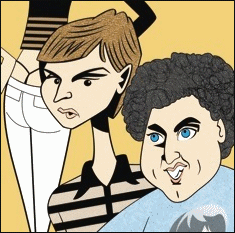
Superbad is a suburban mock-epic. Seth (Jonah Hill) and Evan (Michael Cera), with the help of their friend Fogell (Christopher Mintz-Plasse), agree to buy the booze for a party that the coolest girls in their class are throwing. The boys are convinced that if they deliver the goods the girls will get so drunk that they’ll make out with guys by mistake. ‘We could be that mistake!’ Seth shouts, hopefully. Getting themselves to the party, however, turns out to be a journey somewhat more difficult than that endured by the Greeks coming home from Troy.
“In spirit, Superbad isn’t so different from Fast Times at Ridgemont High (1982) and other rude teen comedies made years ago. But the tone of Superbad, like that of other recent teen movies, is so profane and anatomical that it would shock Sean Penn‘s loutish Spicoli.
“The boys in Superbad are all internet-porn addicts. Their talk is not just dirty but bizarrely detailed — spangled with fantasy, odd practices, and curious devices. They know more about sex than boys did a couple of decades ago, but they’re frightened by what they know — the expectation of performance is so much more explicit. For them, the only mystery is flesh itself, and the presence of a willing girl sends them into anguished fits of dithering.”
Face punching, lens punching

If you’d asked me last night which big-name director is best known for simulating a face-punch by having an actor pretend to punch the camera lens, I would have said Alfred Hitchcock. He does this twice (and with a good amount of pizazz and precision) in North by Northwest when a bad-ass South Dakota cop slugs Cary Grant at the end of Act Two, and then about 15 minutes later when James Mason decks Martin Landau.
Then I read Dave Kehr‘s N.Y. Times video column this morning and remembered that Samuel Fuller trail-blazed this effect in I Shot Jesse James (1949), his debut film, when “a barroom brawler takes a poke right at the camera’s lens, the defining moment in a style that Jean-Luc Godard would later characterize as ‘cinema-fist.'” I’d read this, you see, but I’ve never seen this Fuller film.
I Shot Jesse James is now part of a new Criterion DVD package called “The First Films of Samuel Fuller.”

Atonement, vs. Dedication vs. Rendition

It’s taking me two or three seconds to mentally separate Justin Theroux‘s Dedication (Weinstein Co., opening 8.24, expands 9.14), Gavin Hood‘s Rendition (New Line, 10.12) and Joe Wright‘s Atonement (Focus Features, 12.7) whenever any one of these films comes up in casual conversation. Any journalist who denies experiencing at least a slight twitch when discussing these three is flat-out lying.

Limato is free to go

An arbitrator has sided with talent agent Ed Limato‘s desire to leave ICM after 32 years and take his hot-shot clients — Denzel Washington is the biggest, along with Mel Gibson (temporary toast), Richard Gere (on the way down), Steve Martin (a lot less than what he was), Billy Crystal (diminishing returns) and Liam Neeson (Abraham Lincoln!) — with him to the next gig. ICM didn’t want that to happen and they tussled, but now it’s over and Limato, in the words of ICM General Counsel Richard B. Levy, “is now able to accept new employment opportunities.” The Denzel loss alone is obviously bad news for ICM, and is sure to further observations that this once-major super agency isn’t what it used to be. Nikki Finke will jump into this sometime soon.

Awful Wiliams theme

It may be a mistake for the official Indiana Jones site to be using John Williams‘ almost gruesomely familiar trumpet-solo theme to herald the arrival of Indy 4 movie. For every middle-aged Jones fan who sprays shorts when he hears this anthem, there’s probably at least two or three younger viewers who are saying, “Is this some memory-lane theme-park movie or are they making a film that has at least something to do with right now?” (Apart from Shia Le Bouf being in it.)

Beatty railing against age-ism

“A lot of people out there just kind of dismiss me as an irresponsible kid. All of Hollywood is old, old, old, for that matter. There are as many good young actors and directors in America as there are in Europe, but Hollywood shuts them out. Hollywood is afraid of young blood. It’s a ghost town. I’m 28 years old. I’ll give you five seconds to name me another Hollywood leading man under the age of 35.” — Warren Beatty speaking to Roger Ebert 40 years ago in London during a Bonnie and Clyde interview.

New tracking

Tracking on The Invasion (8.17.07) is now at 67 aided awareness, 27 definite interest and 4 first choice….look for $10 million this weekend, perhaps a bit more. Superbad is finally starting to get traction — 54, 39 and a first choice rating of 9 among films opening this week. I can feel it climbing, climbing….it could crack $20 million this weekend, maybe more. The Last Legion is at 25, 19 and 2.

“Gone Baby Gone” wide release

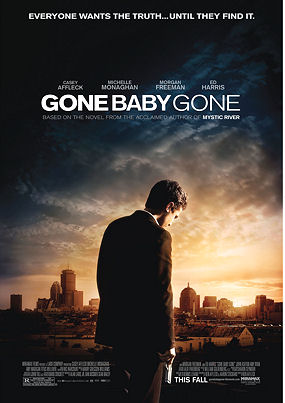
The 10.19 platform debut of Ben Affleck‘s Gone Baby Gone (which publicists still aren’t letting anyone outside of editors and feature writers see) is out the window. The Boston-based kidnap investigation drama (it doesn’t appear to be a “thriller” precisely, and I’m not sure if the word “procedural” applies) will now open nationwide on 10.19…one fell swoop.

“In The Shadow of the Moon”

One of the absolute finest docs of the year (right up there with Charles Ferguson‘s No End in Sight and Tony Kaye‘s Lake of Fire) is David Sington‘s In The Shadow of the Moon (ThinkFilm, 9.7). Finest as in touching, inspiring, thought-provoking…a genuine contact high.

This is going to sound funny coming from an L.A. leftie, but Sington’s film made me feel almost patriotic — at least patriotic in a nostalgic sense. It reminds you that despite the pestilence of the Vietnam War and race riots and all the other horrors going on in the ’60s and early ’70s this country — by virtue of the space program — used to stand for something at least partly good. What does the U.S. government stand for today besides rube ignorance, neocon arrogance, the inspiring of Middle Eastern hate and contributing mightily to the destruction of the planet so that affluent-alcoholic Americans can drive their fat SUVs?
And yet one of the most moving things in the film is a recollection from one of the Apollo astronauts that when Neil Armstrong and Buzz Aldrin landed on the moon on 7.20.69, the sentiment wasn’t that “the U.S. did it” but that “we” did it — i.e., people of the earth.
And yet the emphasis in Shadow is not on the technical or political side but how the astronauts felt about what they went through, and what they were thinking deep down. Their recollections are even intimate at times. At least one of the guys (his name escapes) talks about having had a mystical experience during a moon voyage. No surprise in this. Anything that takes you outside the day-to-day groove can theoretically lead to a spiritual breakthrough, and in this sense the Apollo space program provided at least one or two of these former military pilots the same kind of God-head revelations that LSD voyagers were experiencing down on the ground during the same era.
There’s a special screening of In the Shadow of the Moon in Beverly Hills on Wednesday evening — special because it’ll be followed by an after-party with Ron Howard (who has endorsed the film by agreeing to a “Ron Howard presents” in the credit block) and astronauts Buzz Aldrin and Dave Scott in attendance.