

The day after that perplexing Sopranos finale, I compared it in one respect to the ending of Alfred Hitchcock‘s The Birds. Now MCN’s Larry Gross has compared it to unexpected killing of Janet Leigh in Hitchcock’s Psycho:
“There’s a famous choice in movie narrative that nominally offers resolution but in fact destroys the possibility of conclusiveness even more monstrously than this Soprano’s finale. That is the murder of Janet Leigh in Psycho, [which] did not emanate as an inspiration, from the psychological necessities of the character of Marion Crane in that movie, nor was it in any meaningful way a ‘resolution’ of her story.
“It was in fact the most aggressive insult to ‘meaning’ in the history of cinema. Marion Crane‘s death is precisely as black and arbitrary as the black screen that ended The Sopranos as a series.”
Gross also weighs in on did-Tony-get-hit?: ” Chase is not tantalizing us with specific narrative issues. There’s no one in the story left to kill Tony and the danger of a cop bust has already been covered in the scene with his lawyer. Tony’s anxious fearful looks to the door are not narratively specific. They are signatures of his soul’s perpetual divided state, as Michael Corleone‘s blank impassive stare was the signature of his damnation.”
Dowd on Chase
N.Y. Times columnist Maureen Dowd is calling Sopranos creator David Chase “an apocalyptic tease” and claiming that last Sunday night he “gave us a gimmicky and unsatisfying film-school-style blackout for an end to his mob saga, a stunt one notch above ‘it was all a dream.’ It was the TV equivalent of one of those design-your-own-mug places.
“Even though I loved the first few years of The Sopranos, Chase always struck me as passive-aggressive,” she opines. “The more fans obsessed on his show, the longer his hiatuses would grow and the slower his narrative velocity moved. His ending was equally perverse, throwing the ball contemptuously back at his fans after manipulating them and teasing them for an hour with red herrings — and a ginger cat.
“Surely, after eight years with this family, we deserved some revelation better than ‘life goes on…or not.'”
Obama would beat Republicans
“New York Sen. Hillary Rodham Clinton maintains a solid lead at 33%, followed by Illinois Sen. Barack Obama at 22%. [And] yet despite Clinton’s lead, Obama is the strongest Democrat in hypothetical match-ups with Republicans in the general election, running even or well ahead of the GOP’s top contenders. Obama would defeat Giuliani, 46% to 41%, the poll found. Clinton, in a showing that could spark concerns among some Democrats, does not fare as well. Against Giuliani, the poll found she would lose by 10 percentage points.” — from Michael Finnegan‘s L.A. Times story about a recent Times/Bloomberg poll.
“Sopranos” numbers
“The 11.9 million viewers who watched last Sunday’s The Sopranos finale brought HBO to the edge of an historic feat: a show on a pay cable network available in about 30 million homes was more popular last week than all but one show on the far larger world of broadcast television. Nielsen Media Research reports that only the premiere of NBC’s America’s Got Talent, with 13 million viewers, did better. ABC, CBS and Fox are all available in 111 million homes for no extra charge, and nothing they aired last week did better than The Sopranos.” — from an AP report on Breitbart.com.
“Invasion” trailer
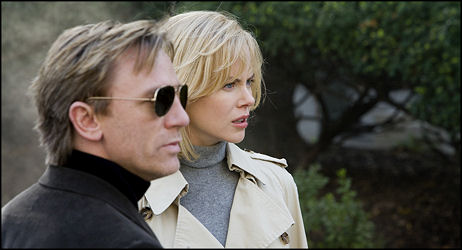
Here we go with a trailer for The Invasion (Warner Bros,. 8.17), the latest revisiting of the old saw about emotionally barren ghouls taking over our bodies and souls after we fall asleep. Nicole Kidman is the central protagonist (i.e., analagous to Kevin McCarthy‘s role in Invasion of the Body Snatchers). Strange that pic seems to be using the Columbia Space Shuttle disintegration as a plot point, but whatever. Reports claim that the version shot by director Oliver Hirschbiegel (Downfall) didn’t sufficiently excite producer Joel Silver and/or the Warner Bros. suits, and he was pushed aside as a result.
“Straight Time” dialogue
Some fairly, rich, down-to-it dialogue from Straight Time, between Dustin Hoffman and Theresa Russell. Whenever I’ve thought of this film over the last 20-plus years, I’ve thought of this scene.
Sepinwall talks to Chase
Sometime recently (i.e., apparently after Sunday night’s Sopranos finale, which indicates yesterday), the Newark Star Ledger‘s Alan Sepinwall spoke to Sopranos creator David Chase in France, “where he’s fled to avoid ‘all the Monday morning quarterbacking’ about the show’s finale.”
Following this interview, Sepinwall writes, “Chase intends to go into radio silence, letting the work — especially the controversial final scene — speak for itself.
Except it doesn’t speak for itself. Not in any commonly decipherable sort of way. If it did there wouldn’t be so many thousands of people arguing what happened in that last scene. So let’s call a spade a spade: Chase is a gifted filmmaker who talks like a straight-shooter when in fact he’s an artful dodger and a bit of a film-flammer. (No offense, Chase, if you’re reading this.)
There is, however, one possible major “tell” in Sepinwall’s piece. Chase says one problem in doing a movie version is that “over the last season Chase [as] killed so many key characters.” Chase, says Sepinwall, “has toyed with the idea of ‘going back to a day in 2006 that you didn’t see, but then (Tony’s children) would be older than they were then and you would know that Tony doesn’t get killed. It’s got problems.”
Is Chase saying what I think he’s saying — that Tony “doesn’t get killed” and therefore wasn’t killed two nights ago?
“‘I have no interest in explaining, defending, reinterpreting, or adding to what is there,’ Chase says of the final scene.
“‘No one was trying to be audacious, honest to God,’ Chase adds. ‘We did what we thought we had to do. No one was trying to blow people’s minds, or thinking, ‘Wow, this’ll piss them off.’ People get the impression that you’re trying to fuck with them and it’s not true. You’re trying to entertain them.’
In Sunday night’s final scene, Tony Soprano waited at a Bloomfield ice cream parlor for his family to arrive, one by one. What was a seemingly benign family outing was shot and cut as the preamble to a tragedy, with Tony suspiciously eyeing one patron after another, the camera dwelling a little too long on Meadow’s parallel parking and a man in a Members Only jacket’s walk to the men’s room.
Just as the tension had been ratched up to unbearable levels, the series cut to black in mid-scene (and mid-song) with no resolution.
“‘Anybody who wants to watch it, it’s all there,’ says Chase, 61, who based the series in general (and Tony’s relationship with mother Livia specifically) on his North Caldwell childhood.
“Some fans have already assumed that the ambiguous ending was Chase setting up the oft-rumored Sopranos movie, but that doesn’t seem to be in the cards.
“‘I don’t think about (a movie) much,’ he says. ‘I never say never. An idea could pop into my head where I would go, ‘Wow, that would make a great movie,’ but I doubt it.
“I’m not being coy,” he adds. “If something appeared that really made a good Sopranos movie and you could invest in it and everybody else wanted to do it, I would do it. But I think we’ve kind of said it and done it.”
Tony was hit
“I’ve never sat through an entire episode of The Sopranos, but in watching the final four minutes of last night’s episode or so on YouTube [editor’s note: clip was just removed by HBO for copyright violation], Tony was hit. Period. Based on pure filmic language, that’s how it reads.
“If you have a character at the bar who keeps looking over, then he walks to the bathroom and the camera dollies to reveal the bathroom is just off to Tony’s side, providing the geography and the logistics. And there’s your answer. This show always had a very formal aesthetic, and this dolly was motivated.
“The abrupt cut to black was it. That’s how it happens in the mob, as per Goodfellas — no yelling, no nothing, it just happens.” — Video artist Jamie Stuart to Hollywood Elsewhere, received 6:15 pm, 6.11.07.
“Pharoah” DVD
I’ve always gotten a goofy kick out of Howard Hawks‘ Land of the Pharoahs (1955), which has an upcoming 6.26 DVD release. One reason is that a presumably half-drunk William Faulkner helped write the script. I don’t know of any eyewitness accounts of Faulkner’s behavior during this period, but if you were Faulkner wouldn’t you booze it up if you were stuck writing an ancient Egyptian costume flick?
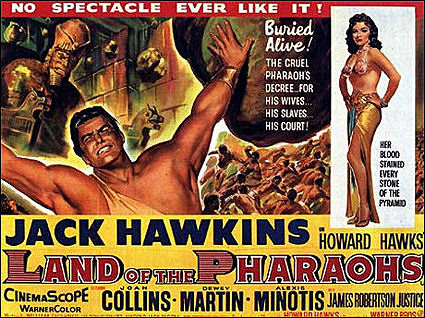
Here are four more reasons: (1) those slinky bikini-harem costumes worn by costar Joan Collins (only 21 at the time of filming, and allegedly referred to in mid ’50s industry circles as “the British Open”), and the way Jack Hawkins, as the Pharoah Khufu, tears off her covering veil in an early scene, (2) Dimitri Tiomkin‘s grandiose, slam-bang musical score, (3) Hawkins’ tough-guy performance as an arrogant man of action, and (4) the finale that has a crying, screaming Collins (“I don’t want to die!”) realizing she’s been tricked into being buried alive inside Khufu’s pyramid.
Tony and family got hit?
HE reader Roy Batty has convinced me that Tony Soprano got hit last night, and possibly his whole family along with him. Seriously. None of us except Batty and (I presume) a few others were sharp enough to decipher the meaning — a very obvious one, in Batty’s view — of what we saw. Here’s his explanation:
“Just how closely did people who call themselves fans pay attention last night? The writing is not only on the wall — it’s on the floor, the ceiling and fluttering from a banner over the entrance: Tony and probably the family got hit.
“I didn’t think so just after it had ended, believing like many that David Chase had simply set up some sort of bullshit ambiguous ending to engender debate. I argued that had something happened, we would not have seen Meadow enter the diner. And that she was meant, as the person least connected to Tony’s blood money, to survive because of her distance from the family.
“But I was just going on surface information and not really considering all the things that make it impossible to ignore. While most are in the form of metaphors and callbacks to past characters, the single biggest signpost that is a virtual headstone is the flashback to Bobby and Tony in the boat talking about what it’s like to be killed.
“Bobby says you don’t see it coming and it’s just over. The show then ends with a ‘smash cut’ to black. It doesn’t get any clearer than that.
“I think too many people are pissed that Chase didn’t end it the way they had written in their minds or hate the idea that Tony, et. al. are gone. I don’t know if it was brilliant, but not seen through glasses of denial it’s pretty clear.”
“The Hustler” again
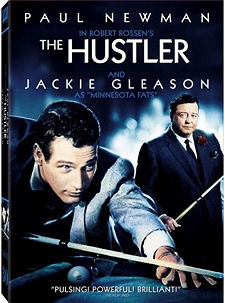
How much better can you make a 1961 black-and-white CinemaScope film look? I’ve always loved Robert Rossen‘s The Hustler (particularly that revolutionary opening-credit sequence), and I would probably buy a Blu-Ray DVD of it. (That is, if I had a Blu-Ray player and a first-rate high-def monitor.) But what could I possibly expect to get from this brand-new double-disc DVD get that would amount to a genuine visual upgrade?
Moore vs. Bush’s OFAC
It’s been claimed that Michael Moore‘s criticism of the Bush administration’s health-care politicies may have prompted a federal investigation into his trip to Cuba for the upcoming health-care documentary, Sicko. In a letter to the U.S. Treasury Department’s Office of Foreign Assets Control, attorney David Boies noted that Moore has been a constant Bush critic for years, and “for this reason, I am concerned that Moore has been selected for discriminatory treatment by your office.” This is…what, a hypothesis? As in “this may have been the case”?