Are We Done Yet?

Are We Done Yet? (Columbia, 4.4) is a cretinous family comedy about an idiot father (Ice Cube) going through hell as he tries to fix up a huge ramshackle mansion that he’s bought in some far-off Oregon country town while his wife (Nia Long) goes “now, now” and his two totally contemptible asshole kids smirk and giggle as he howls and screams and falls through roofs and gets electrocuted. It’s an African-American Money Pit with fewer brain cells.
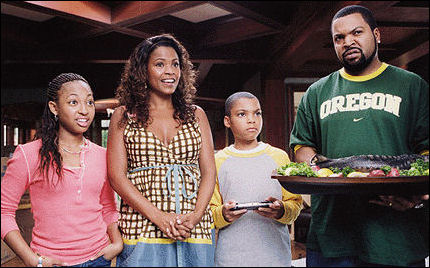

Aleisha Allen, Nia Long, Philip Bolden, Ice Cube in Are We Done Yet?

I knew going in that Are We Done Yet? would be a downmarket horror, but I went to see it last night (i.e., at a promotional screening in Culver City) because the makers are claiming that it’s based upon Mr. Blandings Builds His Dream House, the sophisticated 1948 Cary Grant-Myrna Loy comedy written by Norman Pan- ama and Melvin Frank, and I wanted to note the similarities. (Would there be a sardonic Melvyn Douglas character who flirts with Long, etc.?)

It turns out there are maybe five or six elements that link this godawful metaphor about the devolution of the human brainpan with the Grant-Loy movie, but they’re so marginal that the Ice Cube flick could just as easily be “based” on Ben-Hur or A Nightmare on Elm Street or Jersey Girl.

To call Are We Done Yet? not funny is like saying that a 12 year-old kid afflicted with Down’s Syndrome probably won’t be hired as a CEO of some Fortune 500 company when he turns 21.

As directed by Steve Carr and written by Hank Nelken, it’s basically about the joy of watching a proverbial dad type put through all kinds of agony and humiliation because he can be something of an arrogant fool. I recognize that the term “family comedy” these days means “comedy aimed at obese 10 year-olds with huge monthly cell-phone bills who are having trouble graduating from the fourth grade,” but there is nothing — zilch — in this movie that rings any kind of truth bell. It is haphazard idiot bullshit from start to finish.
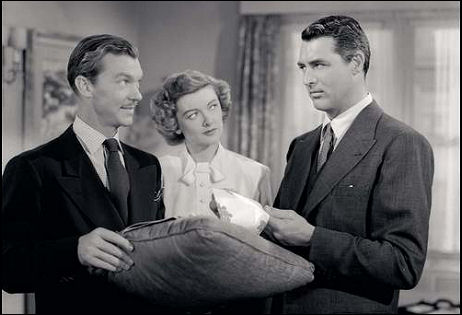

Cary Grant (r.), Myrna Loy (center) in Mr. Blandings Builds His Dream House

I’m sorry to be the pain-in-the-ass sorehead, but nothing in a comedy is funny unless you recognize some aspect of a personal experience (or that of a family member or close friend) in the gags or the writing. The story has to faintly resem- ble life as it is actually experienced outside the walls of a megaplex in order for anyone of any intelligence to laugh at the twists and turns and pratfalls. Otherwise, it’s just crap being thrown at the wall.

And Are We Done Yet? isn’t even a good Tom & Jerry cartoon. The adventures of Wiley Coyote and the Road Runner are like a Tom Stoppard play compared to this.

Hostility towards damn-fool dads isn’t the whole thematic ballgame. Are We Done Yet? is also about local yokels flim-flamming the city slicker and picking his pockets. It’s also about the fear and loathing of nature. All of the CG-enhanced animals in this film are hostile and predatory and bare their fangs. The underlying message is basically that you don’t want to get close to nature. Just stay safe and chillin’ in your bedroom with your universal remote and your i-Pod and your unlaced homie shoes and you be fine.

The work and money particulars are mind-bending. Ice Cube’s character has some money because he sold his share in some kind of Portland bar/restaurant. As the film begins he’s not only supporting Long and her kids with this nest egg but also funding a start-up sports magazine (not an online thing but an actual paper-and-ink thing). The start-up alone is a hugely expensive proposition. Magazine often take two or three years to show a profit. But we don’t want to deal with any of this because we’re just making a stupid movie and nobody gives a damn.
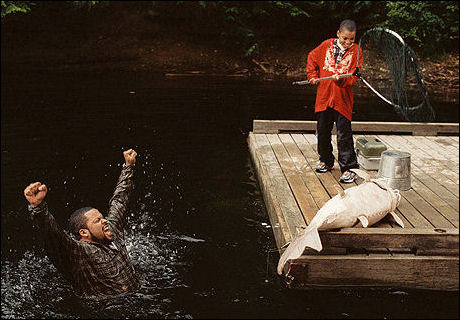
Nonetheless, Ice is also able to afford the fixer-upper that causes all the pain — a massive 19th Century lakeside mansion with all kinds of acreage and a second cottage on the grounds. It’s probably located less than an hour from their former home in Portland because Ice Cube would have to commute there frequently in order to afford to publish his new sports magazine and manage his staff, but even in the far-out boonies the house would have to cost, bare minimum, $750 grand (and probably a lot more). So the guy has to be holding at least a million liquid, and yet he balks at paying a local shyster electrician $8 grand for a re-wiring of the house.

You sit there staring at the screen and you feel dead inside, and then you feel poisoned and you realize you’ve been reborn except you’re losing your mind. Ice Cube got paid a lot of money for doing this thing but you’re just sitting there.

25 or more years ago Andrew Sarris wrote that “the bottom has fallen out of badness in movies.” Now the roof is gone also and the walls have collapsed, and makers of mainstream family comedies have thrown in the towel and said “if it makes money, we don’t care!…the family-audience laser-brains out there loved Are We There Yet? so what do you want us to do…not make more money?” And so the movies they’re making radiate a terrible odiousness…a kind of soul-rupturing stupidity…not just unfunny but suffocating in ways you wouldn’t think possible.

If I were the corpse of either Norman Panama or Melvin Frank, I would crack open my coffin, claw my way up through the dirt like Uma Thurman did in Kill Bill, and then walk zombie-style through Beverly Hills in the wee hours of the night until I found the homes of Joe Roth, whose Revolution Pictures produced this thing, and Are We Done Yet? producer Todd Garner. What I would do next is best imagined instead of described.

Rodriguez-McGowan dalliance

Two major columns — Anne Thompson‘s in Variety and “Page Six” in the New York Post — have stuck their necks out and actually acknowledged the Robert Rodriguez-Rose McGowan dalliance during the shooting of Planet Terror (i.e., the zombie feature constituting the first half of Grindhouse), in defiance of the myopic attitude exhibited by Entertainment Weekly‘s Chris Nashawaty and the L.A. TimesPaul Cullum in their coverage of the Weinstein Co. release.

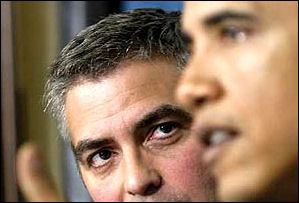
Clooney on Obama

“Everyone says the country isn’t ready for a black president. I think that’s ridiculous. Is he going to lose Illinois? Is he going to lose New York or California because he’s black? No. And maybe he makes some inroads into other places, and maybe, for once, he could get young people to show up and vote.” — George Clooney talking about the ’08 presidential election prospects of Sen. Barack Obama, as conveyed in an over-and-done-with (i.e., four days old) L.A. Times piece by Tina Daunt.

Clooney is right-on except for the part about Obama getting young people to “show up and vote.” More young people than usual showed up at the polls in November ’04 (they accounted for 17% of the electorate), but a much bigger percentage didn’t vote at all. Younger voters are usually more liberal and supportive of challengers and against the status quo, and therefore would have mainly voted for John Kerry.

They could have therefore denied Bush his re-election, but they didn’t. Too many of the 18-to-29 age group sat on their ass and became, as I put it the day after election, the “generation of shame.” As one MSNBC commentator remarked, “in a presidential election younger voters will always leave you at the altar.”

Google’s TiSP

I’ve been hearing about a low-cost, toilet-using broadband system being in the works since ’02 or ’03, and now it’s finally here. And installing Google’s TiSP is a “mostly sanitary” process. I meant to run this yesterday (obviously a more appropriate day than today) and I have no excuse.

Pollack’s “Recount”

The most exciting sounding film I’ve read about today, hands down, is Sydney Pollack‘s Recount, an HBO feature about the 2000 presidential election and how the George Bush forces managed to finagle things in their favor at the end of the day. With shooting beginning this spring or summer, it’ll be a character-driven film about all the squabbling, spinning, vote-disqualifying and Supreme Court deliberating that eventually handed Bush the presidency despite Al Gore winning the popular vote.


(l.) Sydney Pollack; (r.) Danny Strong

Recount will probably be seen at the beginning of the ’08 primary season, or certainly by March or April.

No stars are attached. The script (“a hot commodity when it first made the rounds”) is by Danny Strong, who is best known as an actor (Pleasantville, Seabiscuit). It will be produced by HBO Films in association with Spring Creek/Mirage Prods, with Paula Weinstein, Len Amato and Pollack exec producing. HBO Films has decided against releasing Recount via its theatrical arm Picturehouse because, execs told Variety‘s Steven Zeitchik, airing it on the pay net will guarantee millions of viewers.

HBO Films honcho Colin Callender said that Recount would focus on many of the smaller players in the drama. “It boils the story down to individuals, men and women and husbands and wives, caught up in events slightly beyond their control,” he told Variety. That doesn’t interest me. I want to see a drama about the top campaign chiefs spinning and strategizing and pulling strings in order to beat the other team.

Smith is the Shit

In the wake of Mel Gibson and Tom Cruise‘s descent into wackjob eccentricity and with Tom Hanks “no longer viable for most leading-man scripts,” Newsweek is saying that Will Smith is become the biggest Big Hollywood Kahuna of them all, followed by Johnny Depp and Ben Stiller.

The ability to sell tickets to the shmoes is certainly exciting beyond measure. When I think of all that money, and all that power that Smith has in the palm of his hand, I just go limp in the knees.

Of course, Smith is a softballer from the word “go” and hasn’t accelerated anyone’s pulse since he made Six Degrees of Separation.

And Depp is such a patented eccentric that he makes eccentricity seem mun- dane. Plus he has all that bad movie karma right now. I don’t want to sound judg- mental, but it will take Depp many years to atone for Charlie and the Chocolate Factory and the Pirates of the Caribbean movies. I’m sorry but he has to suffer for those films, and if sourpusses like me have anything to say about it, he’ll pay through the nose when Sweeney Todd comes out in December.

And Stiller…I used to love Stiller. I own that Ben Stiller Show DVD package and still watch it from time to time. As recently as Starsky and Hutch he was crackling like a sparkler. Maybe he’ll come back. Let’s leave it at that.

Binder-Hickenlooper hitbacks

Variety‘s Monica Corcoran considers the always-entertaining phenomenon of movie directors getting into scraps with anonymous online detractors. Specifically, helmers Mike Binder and George Hickenlooper jumping into Hollywood Elsewhere reader-response discussions (including some scattered dissings) of their respective films, Reign Over Me and Factory Girl.

“So it seems directors do, in fact, read their reviews,” says Corcoran. “And given the chance to bite back, some would like an opportunity to personally defend their cinematic theses face to face. Just don’t expect Internet posters to play along. After all, stripping web revelers of their masks would certainly leaden the dialogue and make cyberspace just another safe, boring Hollywood party.”

Dennis Lim meets “Zoo”

Yes, absolutely, no argument whatsoever — Robinson Devore‘s Zoo (ThinkFilm, 4.25) is, visually, a very lyrical piece of work. Sean Kirby‘s cinematography, especially when taking in the beautiful scenery in and around Enumclaw, Washington (i.e., the final home of a man who died from a perforated colon after having anal sex with a horse, which is what the film is more or less about), is undeniably captivating.

And here’s N.Y. Times writer Dennis Lim and his editors paying a respectful tribute to the fact that the film’s lyricism “is startlingly at odds with the sensational content.” And in a tidy, well-written way that makes the film’s subject matter seem almost as natural as picking peaches or playing stickball.

I’m sorry but there’s something profoundly troubling about talented filmmakers and a highly respected publication like the N.Y. TImes giving their earnest and thought- ful attention to a ridiculously perverse (the term I’m most comfortable with is “diseased”) sexual practice. This is precisely what red-state theologians deplore about liberal blue-state values — there are almost no absolute rights or wrongs, and therefore almost no sexual practice outside of the molesting of minors is considered out of bounds. Every form of wick-dipping under the sun is afforded a certain dignity.

I asked Devore at a Sundance q & a if any “zoo” types had ever looked into having sex with elephants in African game preserves (i.e., on the presumption that the larger the sexual organ, the greater the sexual pleasure for the receiving male). Devore smirked and shook his head and said, “There’s always one person who asks a question like that.”

Of course, it’s entirely within the realm of logic to ask such a question, and the fact that Devore (or perhaps Dennis Lim) would regard such a question as antagonistic and beyond-the-pale is precisely what’s wrong with the blase p.c.-attitude types who can look at perversity of a certain kind and call it a fitting subject for an unusual art film, but then turn around and draw lines and act dismissive when it comes to another, equally absurd form of perversity. Does the notion that human- animal couplings may be an affront to nature and basic decency even enter their minds?

Perhaps as they’re thinking this over, “zoo” types and their friends might want to look at the eyes of the horse in the above photo and ask themselves if they’re seeing calm or comfort, or perhaps a degree of alarm.

Oh, and by the way: Lim (or his editor) gets it wrong by saying Zoo was known during the Sundance Film Festival as “the horse-sex movie” — the coinage was a little blunter than that.

McCarthy on “Grindhouse”

Robert Rodriguez‘s Grindhouse installment, a zombie movie called Planet Terror, “wins points on the basis of sheer accuracy for more exactly replicating the hollow, soul-sucking badness of many low-grade gore films,” writes Variety‘s Todd McCarthy. “By contrast, Quentin Tarantino‘s Death Proof, a road-rage opus, so far exceeds almost anything made [in exploitation films of the late ’60s and ’70s] in terms of dialogue and performance that it seems like a different beast — one half plotless gabfest, the other half insane car chase.

“The dialogue in Death Proof‘s first section, an Iceman Cometh-like segment with Kurt Russell dispensing smoothie chit-chat to some hot ladies in an Austin bar, is “great, ” says McCarthy, “with a touch of the poet at times. Tarantino here lays a claim to being the Joseph L. Mankiewicz of trash talk, so easily does he create reams of dialogue in distinct voices and so well does he direct it.”

Morgenstern to Bart

“I’m not an industry insider like you, but I’ll bet dollars to popcorn, Peter, that you…hear what I do from some of our most gifted filmmakers — expressions of deep concern, if not downright despair, about Hollywood’s growing hostility to creative enterprises that don’t fit the entertainment conglomerates’ increasingly rigid templates, and about the precarious plight of the independent film movement. If this is health, then spare us all from too much more of it.” — Wall Street Journal critic Joe Morgenstern to Variety editor Peter Bart about Bart’s 3.15 column — over two weeks ago! — that claimed critics are out of touch with the tastes of the mongrel hordes.

Zell owns L.A. Times

The Tribune Company and the L.A. Times have been purchased by Sam Zell, a “flamboyant” Chicago real estate tycoon with zero newspaper-managing experience who “fancies Ducati motorcycles, leather jackets [and] playing paintball,” according to an L.A. Times article by Thomas S. Mulligan and James Rainey.

Zell is a self-made billionaire, and — judging from what I’m reading here — a bit of a rube. In a 12.04 interview with the N.Y. Times, “Zell suggested that he did not have a high opinion of journalists,” according to a 4,2 piece by Katherine Q. Seelye and Andrew Ross Sorkin. “I started out as a kid thinking that reporters are out there to do good, to expose the world to the truth,” Zell is quoted as saying. “Over the years I’ve gotten a lot smarter. I’ve gotten a lot thicker skin.”

Manhattan-based entertainment journalist Lewis Beale says, “I’ve been a staff writer for three dailies — two individually owned, and one run by a chain. And I’ll take the chain ownership any day of the week. Not subject to individual whims, prejudices and bizarre peccadillos. Chains sure aren’t perfect, but they’ve definitely got the billionaire bozo-owner beat.”

“I feel really sorry for the folks at the L.A. Times and Newsday,” he adds. “They are in for some hard times.”