Howell, Richards, Borat effect

“Pour some extra vinegar on that popcorn — the Borat effect has begun,” observes the Toronto Star‘s Peter Howell. His basic thesis is that all comedic phenomenons and iconoclasts create spawns, and that Borat‘s success is unleashing a wave of imitators,wannabes and samplers. Hence the Michael Richards onstage “nigger” outburst at L.A.’s Laugh Factory. (Which led to Richards’ explanation the other night on “Late Night with David Letterman.”)
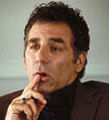
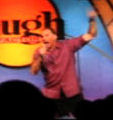
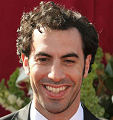
(l. to. r.) Michael Richards; still of Richards’ Laugh Factory appearance; Sacha Baron Cohen

“It may seem unfair or a stretch to link Richards’ appalling tirade to Cohen’s infinitely more clever satire,” Howell writes. “But the link is there and I’m not the first to make it. Paul Brownfield, a writer for the Los Angeles Times, coined the phrase “the Borat effect” this week to describe what happened in the Laugh Factory. (Brownfield also came up with an interesting phrase/tagline in his piece: “Cultural Learnings of Kramer to Make Benefit Wounds of America.”)
“The big difference between Cohen and Richards is that the former plays a ridiculous and naive journalist character, who says terrible things out of ignorance. Richards, unable to create a similar figure of levity, simply hurled insults like a schoolyard bully.
“Success breeds imitators, mostly inferior ones who want to push the envelope even further,” Howell writes. “Nowhere is this truer than in comedy, which forever follows the brave and the reckless. Just as true innovators like Lenny Bruce, Andy Kaufman, Steve Martin and the Saturday Night Live troupe all spawned countless bad knock-offs, so will Cohen’s Borat schtick lead to a host of fish-out- of-water screenplays in which a buffoon with a funny accent and obnoxious ideas foists himself on unsuspecting victims.”
Doesn’t Mel Gibson‘s Malibu tirate also fit into this on some level? Obviously it was anything but funny (although I confess to having laughed when I first heard the term “sugar tits“), but didn’t it seem to pry open the Pandora’s Box subconscious of a lot of closet racists out there? Didn’t it nudge the “ironic” hurling of ugly racist epithets a wee bit closer to the mainstream realm?
Bling Bling

‘You know, we don’t do things like you do in Hollywood, bling bling. Here, it’s bling pow.'” — pissed-off South African guy with a gun talking tough to Leonardo DiCaprio while conveying a reported threat to Djimon Honsou during filming of Blood Diamond, according to a story told by Honsou at a recent press conference and written up by L.A. Daily News critic and “Reel Deal” blogger Bob Strauss.

Keillor on Altman

In an 11.23 L.A. Times piece about Robert Altman, Prairie Home Companion creator Garrison Keillor says when they first met he “tried to interest him in making a movie about a man coming back to Minnesota to bury his father, a winter movie. ‘There haven’t been many movies made in winter,’ I said. And Altman replied, “You would quickly find out why.’ He declined. ‘In the end,’ he said, ‘the death of an old man is not a tragedy.'” (Joe Leydon sent me the call-out.)

Radcliffe’s hormones

Watched the trailer again for Harry Potter and the Order of the Phoenix (Warner Bros., 7.13), and you’re left with one main impression, which is that it’s a hormonal coming-out party. Daniel Radcliffe has developed a weight-lifter’s bull neck and has basically turned into Sammy Stud (the Katie Leung kissing scene, his plans to do Equus in the spring) along with a fiercer, angrier look in his face when asked to register deep emotion. Boys of 11 and 12 are into imaginary realms and barely notice the scent of girls — not so when they reach 16 and 17, and no amount of formulaic CG diversion can hide this simple fact.

Loder on “The Fountain”

Darren Aronofsky‘s The Fountain “is visually intoxicating — the images have a luminous psychedelic beauty — and the film’s themes emerge elegantly out of the story’s intricately-looped tri-level structure. It’s a new kind of science-fiction movie, and, unusually for that boys’ club genre, probably a great date movie too. Mainly, though, as they used to say back in the Roger Corman days, it’s a trip.” — MTV.com’s Kurt Loder refraining the stoner mantra.

No One To Lose To

In her 11.25 piece called “No One To Lose To,” N.Y. Times columnist Maureen Dowd quotes former Times reporter Neil Sheehan, author of “A Bright Shining Lie,” to wit:
“In Vietnam, there were just two sides to the civil war. You had a government in Hanoi with a structure of command and an army and a guerrilla movement that would obey what they were told to do. So you had law and order in Saigon immediately after the war ended. In Iraq, there’s no one like that for us to lose to and then do business with.”
In response to which Dowd writes, “The questions are no longer whether there’s a civil war [in Iraq] or whether we can achieve a military victory. The only question is, who can we turn the country over to? At the moment, that would be no one.”

Saturday numbers

Happy Feet bounced back yesterday from a very temporary Thanksgiving Day (i.e., Thursday) defeat at the hands of Daniel Craig‘s 007. The Birds tallied $15,692,015 on Friday compared to Casino Royale‘s $12,928,000…families out in force. Deck the Halls did $4,952,000, Borat $4,351,000, Santa Clause 3 $4,230,000, Stranger Than Fiction $2,461,000, Flushed Away $2,293,000 and Bobby $1750. In limited N.Y. and L.A. runs, The History Boys did about $36,000 in 7 theatres or $5140 a print — okay but not much. (Figure a projected $132,000 for 5 days.) Fiction‘s cume is about $32,008,000 after three weeks. It will do about $8 million for the 5-day Thanksgiving weekend, and next weekend it’ll be down to $3 million — it’ll be a push to $40 million altogether. Not bad for a film that doesn’t work, but in relation to cost (and Will Ferrell‘s fee) it’s probably a short-faller.

The Diseased

One of my all-time favorite improvs in a Robert Altman film — fast, loose, totally spur-of-the-moment — is one spoken by Elliot Gould in The Long Goodbye.

Phillip Marlowe (Gould) is speaking to a couple of local officials in a small Mexican town about the death of old friend Terry Lennox (Jim Bouton ), whom Marlowe has always known deep down to be a frosty taker-user- manipulator. Speaking in typical heavily-accented, south-of-the-border English, one of the officials says, “You were acquainted with the deceased?” And Marlowe/Gould says, “The diseased?…yeah, right.” Deft stuff like this never turned up in any other director’s films.

Nine things about Altman

Nine reasons why Robert Altman mattered, as assembled by Toronto Star critic Geoff Pevere: he was brilliant at ensemble pieces, he was phenomenally “in the zone” from ’70 to ’75, his pioneering use of multi-track, overlapping sound, he always packed lots of visual information into scenes and was sometimes into long takes (like that famous opening shot in The Player), he was a superb genre-deconstuctor, he was great at inspiring and capturing improvisation, he had a running stock company of actors who turned up time and again, he was always pissed off about something and put these beefs into his films, and he never stopped working.