Stone’s “Jawbreaker”

Two observations about Oliver Stone‘s Jawbreaker, his Paramount project about this country’s response to the 9/11 attacks with the invasion of Afghanistan and hunt for 9/11 maestro Osama Bin Laden. One, the source material and choice of screenwriter indicates the film will be more critical of the Clinton team’s anti-terrorist efforts than that of the post-9/11 Bushies, which is surprising given Stone’s lefty leanings. And two, Jawbreaker sounds a lot like the “fascinating procedural” about a hunt for terrorists that Stone spoke of five years ago during a public discussion at Alice Tully Hall .

As Variety‘s Michael Fleming reported, the Jawbreaker screenwriter is Cyrus Nowrasteh, whose teleplay for the ABC miniseries The Path to 9/11 was said to contain unfair allegations that tarred the Clinton adminstration’s handling of the Mideast terrorist threat in the mid to late ’90s.
Plus the script is based “in part” on a memoir of the same name by Gary Bernsten, a senior CIA operative during the invasion who coordinated various efforts to put an end to the Taliban in Afghanistan. Fleming writes that Bernsten’s book is about how he felt “stymied by bureaucrats in President Bill Clinton‘s administration who prevented operatives from engaging a growingly malicious Al Qaeda and Bin Laden presence.
“While Bernsten describes how he and his cohorts were stunningly told to stand down when they had Bin Laden cornered in Tora Bora, he writes approvingly of President George W. Bush‘s handling of the invasion.”
Fleming quotes Stone as saying that “Gary might be a defender of the administration, but he certainly had very clear criticisms of bureaucratic snafus in Afghanistan.'”
Jawbreaker was foreshadowed by something Stone said during a panel discussion on Saturday, 10.6.01, at Alice Tully Hall called “Making Movies That Matter: The Role of Film in the National Debate.”
What politically-challenging movie would Stone like to make, he was asked, if he had his way?
“I’d like to do a movie on terrorism,” Stone said to the audience listening to the discussion. “It would be like The Battle of Algiers in which you’d just go in and show how it works. And it would be a hunt — people looking for them [the terrorists] while they’re about to do this. And perhaps it’s an old formula, but if it were done realistically without the search for the hero, which is often required, if could be a fascinating procedural.
“If it’s well done and real and accurate, you would see the Arab side, you’d see the American side…people will respond and they will go.”
Gilliam to MTV Movies

“Warner Bros. had their chance the first time around, and they blew it. It’s a factory job, that’s what it is, and I know the way it’s done. I’ve had too many friends work on those movies. I know the way it works, and that’s not the way I work. Alfonso Cuaron‘s [The Prisoner of Azkaban] is really good, but the first two I thought were just shite. They missed the whole point of it; they missed the magic of it. Alfonso did something much closer to what I would’ve done.” — Tideland director Terry Gilliam, a guy everyone loves for what he dreams about and stands for, speaking to MTV MoviesLarry Carroll about the Harry Potter films.

Stuart’s final piece

Jamie Stuart‘s fifth and final New York Film Festival video report delivers a slight diss to Pan’s Labyrinth director-writer Guillermo del Toro by implying he’s long-winded (and thus boring, which Guillermo never is), and gives a pass to Sofia Coppola and Marie-Antoinette by saying that the Austrian queen’s idle distractions in Versailles serve as a metaphor for the human condition in general and denial in particular. Stuart is a talented filmmaker, but to end his NYFF with a Coppola-Kirsten Dunst bendover…shattering. Unless he meant it as a put-on.

Bening’s shot at the gold?

Annette Bening, thrice nominated for acting Oscars, is “almost certain to get another shot at the gold for her performance as a narcissistic, mentally ill mother in Running with Scissors (Columbia, 10.27), according to Newsweek‘s Sean Smith. “Her character, Deirdre, gives up teenage Augusten (Joseph Cross) for adoption to her quack psychiatrist (Brian Cox), while she dreams of becoming the next Anne Sexton. At turns hilarious, vicious, gorgeous, hideous, imperious and pathetic — often in a single scene — Deirdre is the kind of flashy role that allows an actress to chew serious scenery, but Bening doesn’t do it for a second.”

Iris Yamashita’s story

A bland recap by L.A. Times writer Michael Koehn about how Iris Yamashita landed the job of writing the screenplay for Clint Eastwood‘s Letters From Iwo Jima (Warner Bros., 2.9) and how she researched it, refined it and whatnot. It reads like a thorough job of reporting, but the piece doesn’t even acknowledge that Yamashita’s script was originally called Red Sun, Black Sand.

Eastwood on envelope pushing

“Sometimes [directors] don’t change with the times,. They don’t reach out to material that they can change or grow with. I think if I had come back from Italy in the ’60s and [only] knocked off a few westerns, I would have been out of business long ago. I think pushing the envelope, constantly changing, constantly searching for new material and new things to overcome, both as an actor and as a director — that’s the secret. Not being limited. And so you could say, a man shouldn’t know his limitations.” — Clint Eastwood talking to N.Y. Daily News profiler John Clark.

“The Prestige” dinged

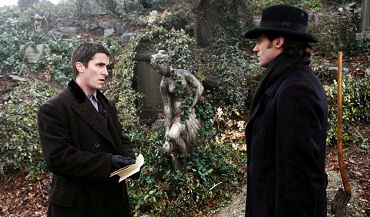
Whoops….Chris Nolan‘s The Prestige (Touchstone, 10.20) is a “smarter”, more ambitiously constructed turn-of-the-century magician movie than Neil Burger‘s The Illusionist…but it’s so complex and so into cinematic sleight-of-hand with too-obscure hints that it’s something of a struggle to make heads or tails out of what you’ve just seen when it’s all over. And that ain’t good.

Groups of journos were standing around after the all-media screening at the Westwood Avco last Wednesday night trying to sort out what they understood vs. what they didn’t get at all. When moderately with-it types are admitting confusion to each other after a film, that film, trust me, is dead meat with the public. The Prestige may wind up satisfying the extra-smarties and the Nolan freaks, but that’s a fairly small assembly.
All of the best movies are easily understood by the dummies, but they also excite the smarty-pants types with their thematic profoundity or ace-level brush strokes or whatever. An expensive movie that appeals only to the smarties has essentially written its own death sentence.
The Illusionist may not be as much of a intriguing brain-tease as The Prestige — perhaps not as handsomely produced or multi-layered — but at least you can understand it without spending 15 or 20 minutes sorting out the plot details with friends, which is what you’ll probably be doing after you see the Nolan film. On top of which the two magician characters, played by Hugh Jackman and Christian Bale , are strident obsessives and not very likable. Maybe it’ll turn into a cult hit down the road, but that’s a DVD matter. Bottom line is that another keenly anticipated film has bitten the dust.
“Nolan’s approach might be too cool,” Hollywood Reporter critic Kirk Honeycutt has written. “Audiences might enjoy this cinematic sleight of hand, but the key characters are such single-minded, calculating individuals that the real magic would be to find any heart in this tale. So the question is whether audiences find any emotional hook amid all this cleverness. So tangled are the tricks and plot lines that the story’s characters are little more than sketches. Remove their obsessions, and the two magicians have little personality.”
Variety‘s Dennis Harvey has written that the film’s “capper moment” — the payoff known in magician parlance as “the prestige” — is “precisely where Nolan’s plush period mystery goes from middling to messy. Tale of dueling magicians takes itself awfully seriously, yet might have ideally suited a 1938 programmer pitting Karloff against Lugosi. Combined high polish, so-so character involvement, and a confusing denouement won’t help this handsome production once word-of-mouth trumps alluring advance come-ons.
“While complicated intrigue might have fascinated in Christopher Priest‘s novel, it tends to overwhelm Jonathan and Christopher Nolan’s adaptation. Pic insists on a depth of human emotion that isn’t developed — protags emerge as one-dimen- sional, despite the efforts of two of our best leading actors — amid increasingly elaborate, uninvolving plot mechanizations.
“Pic’s resolution suddenly admits to fantastical and hitherto-unsuspected elements. It’s a flame-out likely to send most viewers home perplexed. Clearly, Nolan is aiming for something else. But the delight in sheer gamesman- ship that marked his breakout Memento doesn’t survive this project’s gimmickry and aspirations toward Les Miserables-style epic passion.”

Infamous is over

An okay-whatever N.Y. Times piece by Ginia Bellafante on Douglas McGrath‘s Infamous, which opened and closed this weekend. Warner Independent sealed the fate of Infamous last year when it made the decision not to open it last fall against Bennett Miller‘s Capote, which would have been a kind-of event — no one would have been able to see just one. That would have been the only chance it had.

As it happened, people had no interest in seeing a second Truman Capote-writes-In Cold Blood film a year later, especially when the word began to get around that it had problems.
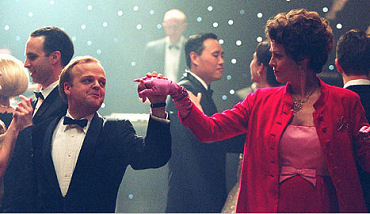
My opinion after seeing Infamous before the Toronto Film Festival was that it wasn’t nearly as rich and resonant as Miller and Dan Futterman‘s Capote pic. David Thomson‘s early-bird review, in which he called it close to miraculous and superior to Capote, was absolutely bizarre — and I think Thomson is brilliant. It’s obvious that Toby Jones looks more like the real Truman Capote than Philip Seymour Hoffman, but Philly is a much better actor. There are some major wrongos in the Infamous depiction of the Clutter murders. I don’t believe Capote dressed himself as a road-company cowboy in order to ingratiate himself with the Holcomb locals, as he does in McGrath’s film. I didn’t buy Daniel Craig (and the black dye he used on his hair and eyebrows) as Perry Smith for a second, and I don’t believe any of the physical stuff between Smith and Capote in McGrath’s film (including the kiss) actually happened.
If I were a Warner Independent distribution exec, I would gone out and taken a long walk after reading those Saturday morning numbers.

Bring Back The Dead

Sometime in ’92, I wrote a piece for Empire magazine called “Reanimator,” about how emerging digital technologies will one day be able to bring back actors from the grave and put them in new movies in a highly believable fashion. One computer graphics guy I spoke to for the piece said this could be a reality within 15 or 20 years. And I remember how Army Archerd wrote something in his Variety column not long after that seemed to comment on the piece, and how he faintly pooh-poohed the possibilities.

Well, here we are 14 years later and a Santa Monica-based company called Image Metrics, according to a fairly thrilling article by N.Y. Times reporter Sharon Waxman, has just about gotten there.
The cyber duplications of human faces that Image Metrics has lately been composing “seem to possess something more subtle, more ineffable, something that seems to go beneath the skin,” writes Waxman. “And it’s more than a little bit creepy. And if you look at the video on the Times website that accompanies Waxman’s piece (which includes footage of Waxman herself being turned into Shrek), you’ll probably agree.

Image Metrics chairman Andy Wood says he likes to call the process “soul transference,” the key process being that “we can have one human being drive another human character…we can directly mimic the performance of a human being on a model.”

“You look and you wonder: Is it the eyes? Is it the wrinkles around the eyes? Or is it the tiny movements around the mouth?” Waxman asks. “Something. Whatever it is, it could usher in radical change in the making of entertainment. A tool to reinvigorate the movies. Or the path to a Franken-movie monster.”
At the very least, this technology will probably one day lead to a situation in which producers and studios will have a certain advantage over difficult or problematic actors, although I’m sure attorneys for actors worldwide are going to be scrambling henceforth to make sure their clients’ organic value will not be challenged or diminished in any way.

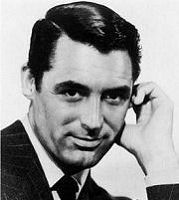
Refinements and improvements will inevitably kick in over the coming years, but Image Metrics is pretty much able right now to reconstitute any dead actor and recast him/her in a new movie opposite live actors. There are many other applications for Image Metrics technology besides bringing back the dead, but this has always held a special fascination for yours truly. Imagine a 33 year-old Cary Grant (i.e., the one who starred in The Awful Truth) starring opposite Rachel McAdams in a new comedy. Or James Dean back from the dead in a new drama directed by Chris Nolan.

“We could put Marilyn Monroe alongside Jack Nicholson, or Jack Black, or Jack White,” Wood reiterates. “If we want John Wayne to act alongside Angelina Jolie, we can do that.”