

Nothing looks sensational this weekend. Yesterday’s numbers on Apocalypto (Touchstone, 12.8) were at 82, 24 and 12…although it still has a 14 % definitely-not-interested. It might eke out $10 million or so. Blood Diamond (Warner Bros.) is at 76, 28 and 14. It’s played moderately well with some but the reviews are not there . A strong show of support by women probably means that Nancy Meyers‘ The Holiday (Columbia) will at least be competitive and may do better than indicated by Thursday’s figures (i.e., 74, 29, 8). Unaccompanied Minors was at 59, 19 and 1…no business to speak of.
The first tracking figures on Dreamgirls (12.15), which almost certainly indicates the effects of mostly urban advertising, is now at 43 % general awareness and a 29 % definite interest…but it also has a definitely-not-interested rating of 13%, which is high. This is most likely your white cracker rurals telling phone surveyors they don’t want to see a black musical with a gay sensibility, blah, blah. The numbers will go up next week either way.
The biggest numbers of the month are going to be earned by The Pursuit of Happyness (Columbia, 12.15).
Bagger on NYFCC
“On Monday, millions will be waiting breathlessly for the results from the New York Film Critic Circle Awards,” writes N.Y. Times Oscar guy David Carr (a.k.a. “the Bagger”). “Okay, that’s patently not true, but dozens, at least, will be breathing heavily as they wait to find out what gives. The Bagger has done nothing by way of investigation, save talking to a friend who talked to some other friends who know some people. So, with a sampling error that approaches 100 percent, he can say with certain uncertainty that The Departed might sneak in.
“This year, some love the tidy achievement of The Queen, while others are stuck on Pan’s Labyrinth. Alfonso Cuaron has his posse as well, so maybe Children of Men will get its first visibility of the season. Don’t look for Letters from Iwo Jima to remain on a New York roll. The smartypants who sit in this circle have a bit of a Clint issue, and refused to get their arms around either Mystic River or Million Dollar Baby.”
Don’t forget Bill Nighy
Having delighted over Bill Nighy‘s performance in David Hare‘s The Vertical Hour two nights ago at the Music Box, it suddenly hit me this morning that I haven’t attempted to bring any Oscar- season favor whatsoever upon a fascinating Nighy performance that easily qualifies as Best Supporting Actor-level. No, not his older-husband-of-Cate Blanchett role in Notes From a Scandal (in which he’s perfectly fine) — I mean his gloppy squid-faced Davy Jones in Pirates of the Caribbean: Dean Man’s Chest.

In this otherwise-despised film Nighy not only filled the shoes of the greatest movie villain to come along in years, but gave the year’s most under-valued performance because nobody regarded Jones as anything more than a CG crea- tion. Half it was that, yes…but the other half came straight from Nighy. I wrote last summer that under the makeup, Nighy “delivers his lines with perfectly honed humor and wit. He should be nominated for a Best Supporting Actor Oscar, really.” 50 or 100 years from now audiences will be getting and savoring what Nighy did here. I think it merits a fresh salute right now.
By the way, please read John Lahr‘s review of The Vertical Hour and especially Nighy’s performance in this 12.4 New Yorker piece.
Negative ratings
A tiny bit more than one out of three moviegoers — 34% — would avoid any movie Tom Cruise is starring in, according to a just-published Gallup poll. I knew the guy had high negatives but not that high. The actor with the next highest negative rating — 18% — is Angelina Jolie. What could that be about? People don’t like her because she’s too pretty, too rich, adopts orphans, makes noises “like an animal being killed” during lovemaking…. what? The third highest neg rating — 15% — was earned by Mel Gibson.
Manohla on Leo
In Blood Diamond (Warner Bros., opening today), Leonardo DiCaprio “plays Danny Archer, a Rhodesian-born diamond smuggler who, having been orphaned during his native country’s violent struggles in the 1970s, has spent most of his 30-some years crisscrossing the continent as a soldier of fortune and a merchant of misery. Tousled and tanned, with a long, slicing gait and a killer smile, Danny looks as if he were born for trouble of the sweetest kind.

“But Mr. DiCaprio, perhaps because he knows that much of the audience has already crawled into his pocket, plays the smuggler as the scum he is. Even as the film coaxes Danny toward redemption, the actor fights to hold his ground and the truth of a character who has inspired the most fully sustained performance of his adult life.” — from Manohla Dargis‘ N.Y. Times review.
O’Hehir on “Apocalypto”
“The public narrative surrounding Apocalypto is almost all about [Mel] Gibson, and hardly at all about the movie,” writes Salon‘s Andrew O’Hehir. “Can the demented Captain Ahab accomplishment of this film outweigh, in the hearts and minds of movie-biz insiders, Gibson’s drunken anti-Semitic tirade or his general reputation as a religious fanatic and all-around nutjob?
“Well, having seen Apocalypto I have two things to tell you: Mel Gibson has serious issues with violence and masculinity, and if there’s really ‘Oscar buzz’ around this picture, then everyone in Hollywood really is an idiot.” (This is a reference to Sharon Waxman‘s piece in the 12.4 N.Y. Times that credited Apocalypto with same.)
“There are about 10 truly amazing minutes in Apocalypto, when the film’s hero, a captured villager named Jaguar Paw (played by the Native American actor Rudy Youngblood), is brought into a Maya city as a prisoner and taken to the central pyramid, where captives are being sacrificed by the score to appease Kukulcan, supreme god of the Maya pantheon (equivalent to the Toltec-Aztec god Quetzalcoatl). And that’s about it.”
Manhattan pics #5
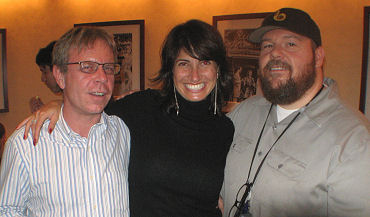
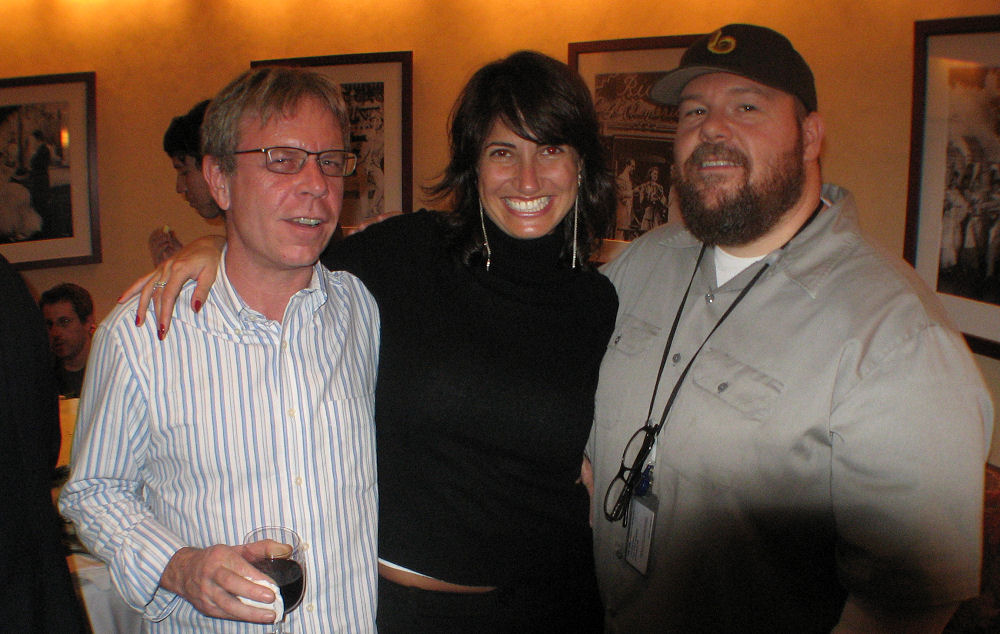
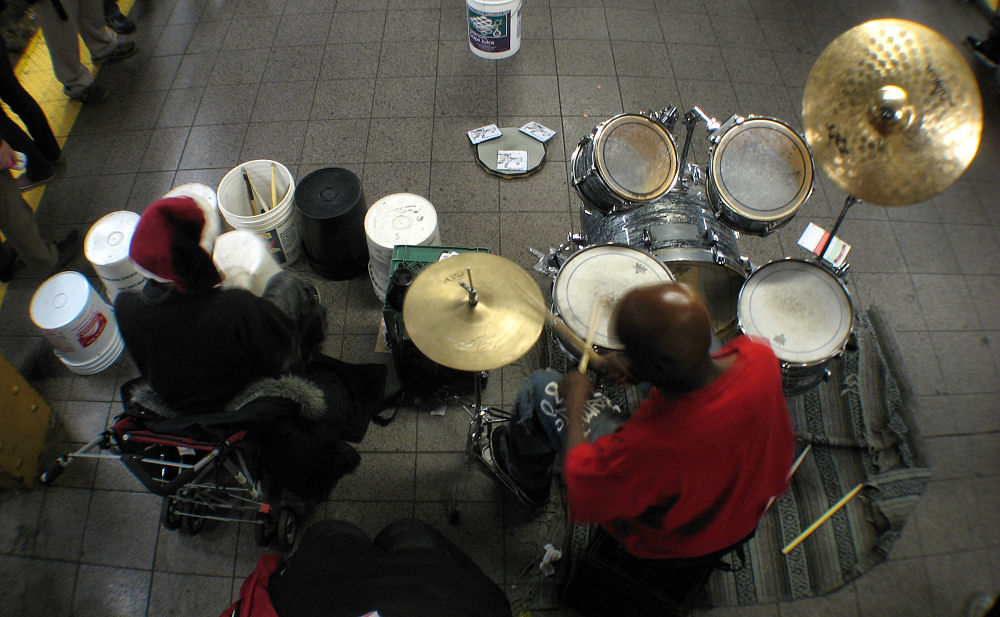
Warner Bros. publicists Don Buckley, Orna Zadeh and Darren Olscvary at pre-screening wine-and-cheese gathering for McG’s We Are Marshall — Thursday, 12.7.06, 7:20 pm; audience at the Music Box on 45th Street on Wednesday, 12.6, just before the evening performance of “The Vertical Hour” — Bill Nighy alone is worth the steep ticket price; audience shuffling out of theatre two or three minutes after curtain calls; Times Square #1 and #2; Cafe Un Deux Trois on West 44th — Wednesday, 12.6.6, 11:25 pm; ditto, ditto and ditto again; drummers on L train platform at Union Square station; French ciggies









“Letters” review
No disrespect to Clint Eastwood‘s Flags of Our Fathers, but Letters From Iwo Jima — a sad elegiac portrait of the Japanese defenders of Iwo Jima during that horrific battle in early 1945 — is a much better film. It’s sadder, cleaner and more primal, for one thing, and the absence of all the cutting back-and-forth between the battle and the bond tour in Eastwood’s earlier Iwo Jima visitation feels like a kind of blessing.
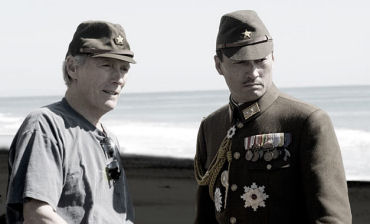
The sense of increased focus in this Japanese-language film is immediately apparent, yielding as it does a more earnest humanistic aura along with a story that feels far more tragic. The Japanese troops know from the get-go that they haven’t a hope of victory against the American invaders, and so Letters quickly falls into relief as a compressed, bare-bones meditation about an eternal question that tugs at us all — how to live bravely and honorably in the face of certain death.
As Todd McCarthy has noted in his just-up Variety review, “considered from the Japanese angle Iwo Jima resembles the Alamo — a futile if heroic last stand against an enemy force too overwhelming to withstand, although withstand it they did, for much longer than their opponents imagined possible.”
Letters delivers at least three performances that are unquestionably more affecting than the respectable but muted ones in Flags — Ken Wanatabe‘s as General Tadamichi Kuribayashi, a portrayal of a combat-averse foot soldier named Saio by the unknown Kazunari Ninomiya, and Tsuyoshi Ihjara‘s as Baron Nishi, a kindly cultivated officer with a fondness for horses.
For the first time an American-made film is not only showing us what it was like for Japanese troops to fight U.S. forces — it’s a fascinating thing to consider guys from “our” side as faceless grunts and deliverers of doom — but provides insight into basic Japanese values of that time, not just in a military sense but in terms of their homeland, families and indeed their eternal spirits.
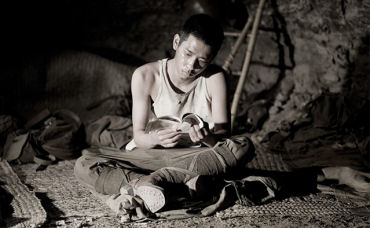
Letters starts out a bit slowly and carefully, and it feels a bit choppy and abbreviated in the early stages of the battle. But once it gets going — particularly during the second half, with the strongest portions coming during the final third — it delivers the goods and then some. Eastwood has reason to feel very proud. And lucky, in a sense. Something deep down told him he should attempt a Japan- ese-side-of-the-battle film while shooting Flags, and it was a good instinct.
In early October I heard from from a big-name critic who’d recently seen Flags that a person he spoke to from Eastwood’s camp had told him that as good as Flags was, Letters was the superior film. I’ve been hoping all along that this would turn out to be true. I had the heebie jeebies just before last Sunday’s Letters screening began, but less than five minutes in I knew the Eastwood-camp guy was right.
Watanabe should absolutely be added to the tally of Best Actor contenders — his Kuribayashi is cut from the same heroic, humanistic cloth that has begotten all great military leaders. The on-screen ones, I mean.
Four NBR Beefs
I realize that yesterday’s National Board of Review awards were damaged goods from the get-go, given the org’s idiosyncratic oddball rep and all. But the Letters From Iwo Jima Best Picture win was nonetheless a good thing, if for no other reason that the startle factor. That aside, I had four significant beefs with the hand-outs.
(a) The Best Supporting Actor trophy going to Blood Diamond‘s Djimon Hounsou felt like an especially deranged call. Honsou’s acting in that film is emotionally excessive — he has two emotional-outburst moments are flat-out idiotic. The worst is a scene in which he and Leo are hiding in the dark from a platoon of bad-ass hip-hop rebels — very dangerous, hair-trigger cats armed with automatic weapons — when the crouching Honsou suddenly sees his kidnapped, long-lost son among them. Naturally, this being an Ed Zwick film, he immediately jumps up and shouts out, “Son!” He should have died right there and then. All stupid people (i.e., those without the sense to hold themselves in check when their lives are in danger) deserve a bullet in the head.
(b) The Best Supporting Actress award going to For Your Consideration‘s Catherine O’Hara means that NBR voters thought she was more deserving than Cate Blanchett (Notes on a Scandal, Babel); Jennifer Hudson (Dreamgirls); Ivana Baquero (Pan’s Labyrinth); Adriana Barraza (Babel); Carmen Maura (Volver), Abigail Breslin (Little Miss Sunshine) or Babel‘s Rinko Kinkuchi. That’s just absurd.
(c) The NBR’s Best Original Screenplay went to Stranger Than Fiction‘s Zach Helm because they wanted to honor Helm’s inability (refusal?) to define the metaphysical system in that film? At no time do you clearly understand whether Will Ferrell’s tax man is some kind of organic but basically “fictional” guy living inside novelist Emma Thompson’s head, or, if he’s as “real” as you or me or Dustin Hoffman‘s character, how it is that Thompson’s decision to kill him off in her book is going to affect him. Helm’s screenplay is infuriating.
(d) The NBR omitting Florian von Henckel Donnersmarck‘s The Lives of Others from its top five foreign-film list is just nutso…a joke. The ones they went with are Volver, (the favorite), Curse Of The Golden Flower, Days Of Glory, Pan’s Labyrinth and Water.
Lumenick makes some calls
“It’s tough getting a fix on the Best Picture race,” writes N.Y. Post film critic Lou Lumenick. “Everyone agrees that the much-hyped musical Dreamgirls (Dreamamount, 12.15) has the pole position. It’s a huge crowd-pleaser, but already the chattering classes are starting to pick at it with the sort of griping that eventually left recent Oscar front-runners Brokeback Mountain and The Aviator gasping at the finish line.
“On the other hand, the Academy loves even flawed musicals like Chicago — unless they’re complete botches like The Phantom of the Opera, Rent and The Producers.”
Rent was a complete botch? News to me. I don’t know why exactly, but from time to time I’ve had radically different reactions to this and that musical, and this was definitely a prime example. Last year at this time I wrote the following: “Call me emotionally impressionable, call me unsophisticated, call me a sap…but I saw Rent last night in Santa Monica, and in its vibrant, open-hearted, selling-the- hell-out-of-each-and-every-song-and-dance-number way, it’s a knockout and an ass-whooper and damn near glorious at times.
“I didn’t just like it…I felt dazzled, amped, alpha-vibed. I got into each and every song, every character and conflict…I settled back and went with it. People were applauding after almost every song, and the film really does give you a ‘whoa… this is special’ feeling.”
“Factory Girl” followups
Okay, so the Weinstein Co. is still screening Factory Girl this week after all — today (Thursday, 12.7.06, 2:00 pm at Dolby 88 Screening Room) and Friday (1:00 pm at same location)…even though it doesn’t matter as far as next Monday’s New York Film Critics Circle voting is concerned because the film isn’t opening in NYC on 12.29.
A Manhattan journalist is saying my chronology in yesterday’s item was off: “What happened is that when the Factory Girl screening notice went out it stated that the film was only opening in Los Angeles, [and then] several NYFCC members pointed out that it was thus ineligble for our awards. That’s when they pulled the plug on the NYC screenings.”
So Weinstein Co. staffers didn’t realize their decision to not book Factory Girl into Manhattan theatres on 12.29 (they’re apparently looking to open it here in early February instead) disqualified it from NYFCC consideration? They were clueless about this until certain NYC critic-journos pointed this out?
Diana Ross& “Dreamgirls”
Others may be interested in how “the great diva” Diana Ross is reacting — or plans to react — to Dreamgirls and/or questions about same from the media in the next few weeks, but I personally don’t give a damn, no offense. What does Diana Ross do all day exactly? Question withdrawn — I don’t want to know.