

I haven’t even looked at this, but it’s an apparently legit link to a Borat press conference that happened today in Santa Monica.
Buzzometer
The Envelope “Buzzometer” is up and running…sort of. Only five or six of the ten contributors — USA Today‘s Claudia Puig, Comingsoon.net‘s Edward Douglas, Newsday‘s Gene Seymour, myself, the Chicago Tribune‘s Michael Phillips, Hollywood Wiretap‘s Pete Hammond (one of the slackers), Rolling Stone‘s Peter Travers, Ebert & Roeper‘s Richard Roeper, and The Envelope ‘s Steve Pond and Tom O’Neil — are there, but I guess everyone will be along by the end of the month.
Smith in “Happyness”
With the exception of his performances in Enemy of the State and Ali, I’ve been fairly averse to Will Smith for years. He’s a calculating performer who always leans on his shtick and charm. Too smooth, too ready with a line and a smile. Some critics feel Smith has to pay for past sins (The Wild Wild West and chomping on that cigar and saying “now that’s what I call a close encounter!” in Independence Day ) and that he needs to just be still — just settle into himself and stop looking for love.
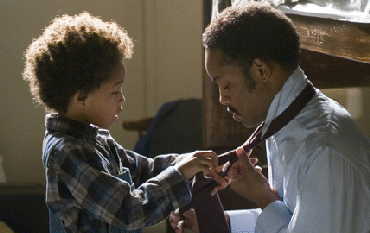
So when I began hearing about his being a presumed Best Actor nominee in Gabriele Muccino‘s The Pursuit of Happyness (Columbia, 12.15), I wasn’t buyin’ it. Then a week or two ago I watched the trailer and damn if he doesn’t win you right over, especially playing a father and a real-life figure with the older-guy makeup and the sideburns and all.
Now comes word from a guy who’s seen the film that Smith is restrained and focused all through it (the guy actually used the word “stoical”), and that the story — how businessman Chris Gardner went from homelessness and sleeping in bathrooms with his young son to great strength and wealth — holds back on the emotion until the final ten minutes. And at this point, the guy says, he succumbed. He choked up.
Smith is “a guaranteed lock for Best Actor,” the guy says. “It’s between him and Peter O’Toole.”
Between this guy and another guy, the two-man consensus is that Forrest Whitaker (The Last King of Scotland) peaked too early, Derek Luke (Catch a Fire) is good but may not deliver enough voltage to warrant a nomination, and that people are now snickering at Leonardo DiCaprio‘s South African accent in Blood Diamond so that one’s up in the air too. Fuck that, I said. It’s enough that DiCaprio kills in The Departed.
“Flags” consensus
If the general critical barometer means anything, Flags of Our Fathers — despite the flaws, despite grousing from a few “name” critics, despite a director I know telling me that people who’ve seen it have been going “naah” — is going to wind up as a Best Picture Oscar nominee. The Academy doesn’t exactly look to film critics for guidance, but the Clint legend and Clint kowtowing are very powerful forces in this town, and critical huzzahs backing this up are always part of the dynamic.
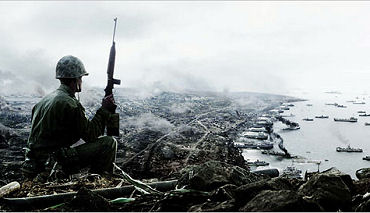
The Rotten Tomatoes and Metacritic averages for Flags of Our Fathers are about the same — 75% and 78% positive, respectively. One out of every four critics going “sorry, but not this time” doesn’t exactly constitute a mixed response, but it’s not anyone’s idea of a thundering critical consensus either. It basically means Flags of Our Fathers is no Million Dollar Baby.
One indicator is that within some the allegedly positive reviews, you’ll find some half-hearted statements. “The flaws in Flags of Our Fathers are at least partly attributable to Eastwood’s attempts to do too much,” wrote red-tomato raver Stephanie Zacharek of Salon. John Venabale of Supercalafragalistic.com, another supposed raver,says “it’s good, great in spurts, but overall leaves one longing for a story better suited for film.” L.A. Daily News critic Bob Strauss says that “making a movie like [Flags] is totally honorable, even pretty heroic. I just wish that it had moved me more.” Joshua Tyler of Cinemablend says Eastwood’s film “raises interesting questions about heroism and the uses of propaganda, but it left me hungering for more about the battle.”


Fact is, most of the unqualified raves are from the top-dog elite — Dargis, Turan, McCarthy, Puig, Roeper, Rea, Matthews — and I have a feeling that some of these critics are doing a subtle little dance. I’m not saying they’re shading or modifying their true opinions, but I know that Clint has a fraternity of film critic fans who are part of the faith and “on the boat” — and if you know anything about human nature you know we all like being on the boat rather than off it. I also know that almost every over-40 critic worships the Eastwood career metaphor (i.e., the older you get the better you get), and that admiration for an artist’s general body of work always slips into this or that particular review.
Hell House
Hell House
Anyone who tells you Ryan Murphy‘s Running with Scissors is funny — as in a film that makes you laugh, which is an activity regarded in most cultures as something positive and good for the soul — has a very, very twisted idea of what “funny” is. On the other hand, certain aspects of blue-state culture are turning more and more perverse as things move along and — who knows? — maybe the people who will laugh at or with this film will outnumber people like myself.
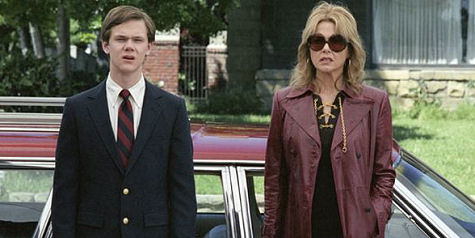
But I respect Running With Scissors, which is based on Augusten Burroughs‘ popular 2002 autobiography, for its unmitigated, unapologetic torture-chamber vibe. A film as difficult to sit through as this one is nothing if not bold. And there are some — New York Observer critic Andrew Sarris and Village Voice critic Rob Nelson — who think it’s quite funny so there’s no accounting for anything or anyone.
Urban culture has afforded a certain designation of respect for films like this. Scissors is basically an extreme permutation of grand guignol gay camp, and as such belongs in a tradition of archly mannered, darkly funny shockers like Whatever Happened to Baby Jane? and Mommie Dearest and that line of country. Diseased behavior, ultra-corroded personalities, hair-pulling, etc.
< ?php include ('/home/hollyw9/public_html/wired'); ?>
Other reviewers have mentioned the drawings of Edward Gorey and Charles Adams as stylistic influences. I think Scissors is actually more of a cross between early John Waters and The Hills Have Eyes, only with an effete surburban milieu and self-destructive nutso behavior substituting for a trailer-trash backdrop and killings and mutilations.
You have to at least give Murphy some kind of cojones award for adapting a book as gnarly as Burroughs’ and being relatively forthright in translating it. Burroughs’ writing style is clean and well-ordered, but his life story is all about suffocation, madness, imprisonment, torture, abuse…c’mon.
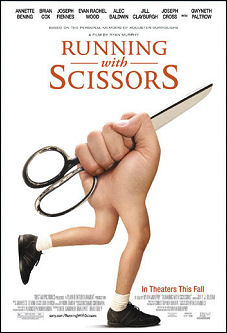
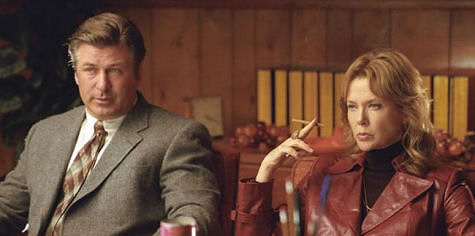
And so viewers are put on a ride with young Augusten (Joseph Cross) suffering under an obsessively egoistic mom (Annette Bening) and alcoholic dad (Alec Baldwin) and then getting through their divorce, and eventually being sent to live with her oddball therapist, Dr. Finch (Brian Cox) and his emotionally curdled family — wife Agnes (Jill Clayburgh), daughters Natalie (Evan Rachel Wood) and Hope (Gwynneth Paltrow) — and an unshaven 30ish wackjob (Joseph Fiennes) with whom he has his first same-sex affair.
Murphy doesn’t shrink from the psychological boils and emotional leprosy that seep out of every character, every page. (I’ve read portions of the book since seeing the film.) He lets you have it with both barrels. And I respect the ballsiness of doing that and then turning around and saying, “Okay, now pay ten bucks to see this.” He walks the walk and does the thing. And if I were a fan of this kind of dark and diseased film, I could imagine being satisfied with it.
The only time I looked at the ceiling and counted to ten was during a toilet-bowl contemplation scene. Dr. Finch is convinced that the shape and/or flotation qual- ities of…I’m not going to describe this any further. Go to the movie and absorb it directly. I won’t be a go-between.
Will Bening be Oscar nominated for Best Actress? She certainly gives the part (and the audience) hell. Like Murphy, she doesn’t shrink from the material. But to what end? Oscar-nominated perfs tend to give pleasure on some level — recog- nizing some aspect of a friend or a parent or a mate in a performance, deriving some insight into why people act they way they do…something. Bening’s performance is totally blazing and balls-out, but it’s not the sort of thing that usually inspires affection or allegiance.
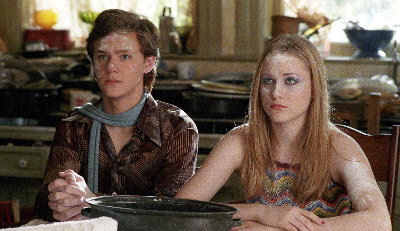
The actors are all pretty vivid and, in a sense, uniform. Clayburgh is just as memorable as Bening, but my God, the poor woman. I liked Cross the most because he’s the only sane and half-reasonable one. Oh, and I liked Baldwin’s character after he gets sober. Does this constitute a spoiler?
You could call Scissors a cautionary tale of sorts. You could say Murphy and Burroughs are saying if any aspects of our own lives resemble the madhouse depictions in the film, then we might want to take stock and make some changes, etc. But you could say that about The Sorrow and the Pity…about anything.
Running with Scissors is not funny, not entertaining, not touching…but I can honestly call it staggering. And never boring.
If you’re twisted enough, you might have a ball with it…great. But if you are a relatively healthy, untwisted sort, watching this movie is an exercise in claus- trophobic agony. But in a ballsy, non-trashy way. It’s like someone coming along and stabbing you in one of your nostrils with an electric toothbrush and then hitting the “on” button. Remember rolfing? Therapists sticking their fingers up their patients’ nose and patients feeling better for it? That’s kind of the idea here.
“Venus” trailer
The Venus trailer…not sure when it went up and who cares in the great scheme, but I hadn’t clicked on it before tonight.
“Dreamgirls” trailer
The new Dreamgirls trailer is good stuff, but it doesn’t deliver the same pizazz I’ve gotten out of those 20-minute reels shown at those special press presentations — one several weeks ago at the Pacific Design Center, and an earlier one at the Cannes Film Festival last May. The unspoken fear is that the original Dreamgirls stage musical in the early ’80s had a weak story (a friend who saw it way back when says this was the main complaint from the New York theatre critics), and that if Bill Condon‘s feature runs into any kind of flak, it’ll be from this.
Fox “Borat”
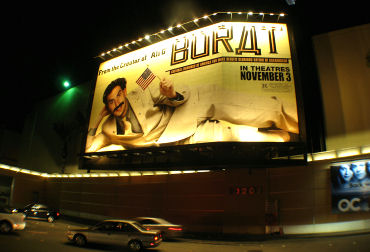
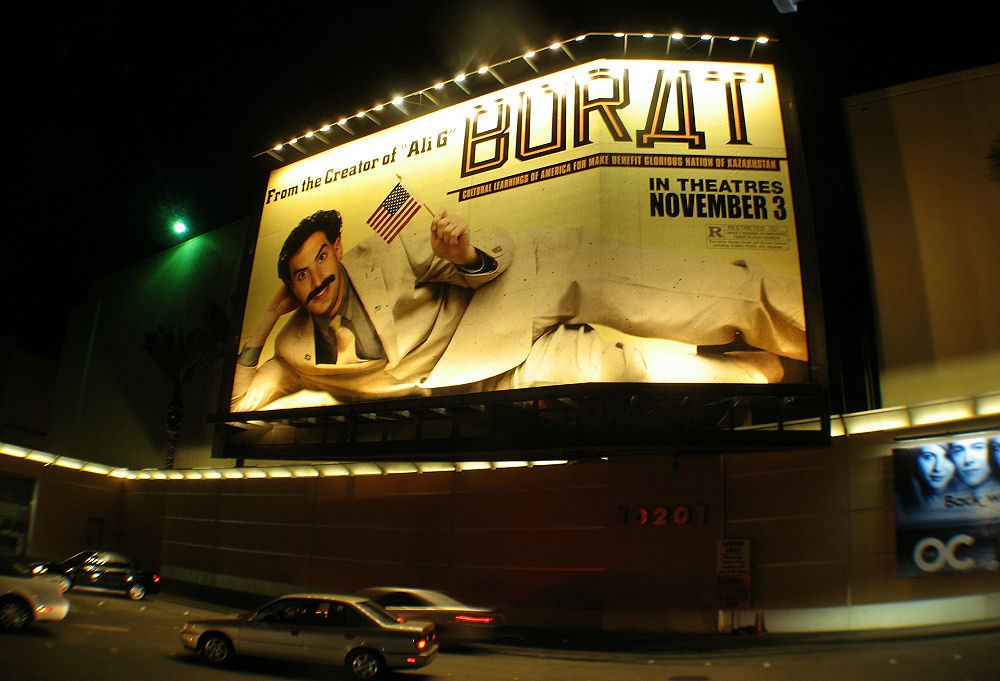
The main entrance to 20th Century Fox studios on Thursday, 10.19.06, at 9:50 pm , just after a showing of The History Boys
My Cannes “Antoinette” review
In honor of today’s limited opening of Sofia Coppola‘s Marie- Antoinette, a link to my 5.24.06 Cannes Film Festival review.
Clint and Paddy
City Beat’s Andy Klein has suggested that Clint Eastwood‘s Flags of Our Fathers is “The Americanization of Emily without jokes.” That sounds like a smart-ass thing to say but it’s not. Okay, it is somewhat, but not really. I happen to love and respect the latter film, written by Paddy Chayefsky and directed by Arthur Hiller, and I feel the analogy is valid, although obviously only in the broad strokes.
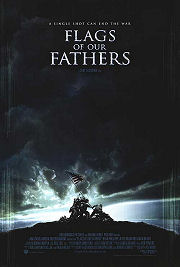
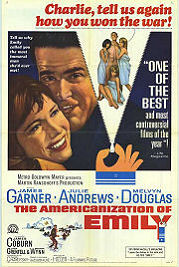
Both films are essentially about the fraudulence that goes into selling war to the public, and how the lies and the bullshit role-playing weigh upon the souls of U.S. military men who are ordered by higher-ups to play the role of p.r. spokes- persons.
And both are about the power of a single combat photo to advance and strengthen the agenda of the U.S. military, and about how this photo, when published in just every newspaper and magazine in America, amounts to a visual distillation of the fakery involved, and how the men in these photos — a London-based Naval Lieu- tenant played by James Garner in Emily, and two Marines and a sailor played by Adam Beach, Jesse Bradford and Ryan Phillippe in Flags — are repulsed by the charade, even though all but one decide in the end to swallow this feeling and move on.
The hard fact is that The Americanization of Emily is more succinct that Flags of Our Fathers in making these points. It is also spunkier and more persuasive. I respect Flags — Eastwood has made a war film that says something solemn and truthful about the men who are forced or persuaded to fight our nation’s enemies — but I like Emily more.
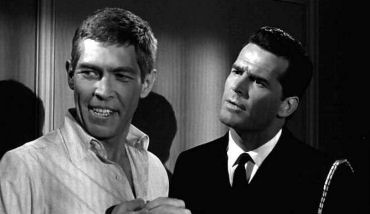
Very different films, separated in almost every stylistic way imaginable…but pushing very similar talking points
Come to think of it, I might have felt more supportive of Flags if one of the three guys had been a cynical wiseacre like Garner’s Charley Madison and if he’d mouthed off all through the film’s war-bond tour with irreverent Chayefsky zingers about the guilt he was feeling and the absurdity of selling war as a noble activity, etc. At least it would add a little seasoning from time to time.
State of O’Toole
A London journalist friend tells me it was a bit of a touch-and-go thing about whether Oscar hopeful Peter O’Toole, 74, would attend tonight’s London Film Festival “Mayor of London” gala screening of Roger Michell‘s Venus, but word came down late yesterday that he’d be dropping by after all, although probably not for long.
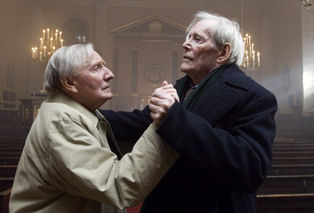
It’s not touch and go, however, about whether O’Toole will attend the AFI Film Festival’s special screening on 11.7 or the 11.10 Los Angeles Venus junket — he’s flat-out not coming. These two no-shows on top of O’Toole being too sick to attend the Toronto Film Festival’s festivities for Venus last month (i.e., his doctor said no), and you can’t help but wonder and ask questions.
The answer, apparently, is that O’Toole’s doing okay — he works a lot (Stardust, One Night with The King, Romeo and Me, Lassie, Venus and a TV Casanova in just the last year and a half, and another film — La Fenice — in the wings) and apparently he just hates flying back and forth to Los Angeles and is going to concentrate his Oscar-promoting chores to a period between December-January.
The flying aversion has something to do with the fact that O’Toole fell and busted his hip on 12.26.05 during the shooting of Venus, which led to surgery and a three-week filming delay, and because it’s painful for a guy with that kind of recent history to sit on a nine-hour flight.
Being 74 years old doesn’t automatically mean a withered lifestyle and cutting back. I know about guys in their late 70s and 80s who play tennis and go out to dinner and ride bicycles and everything else. The great Norman Lloyd, whom I met last year when he was 90, was driving a Jaguar around town and playing doubles tennis at the time. On the other hand it’s no secret that heavy imbibing in the prime of one’s life will often lead to a withered condition or an early check-out when you’re older. It’s called paying the piper.