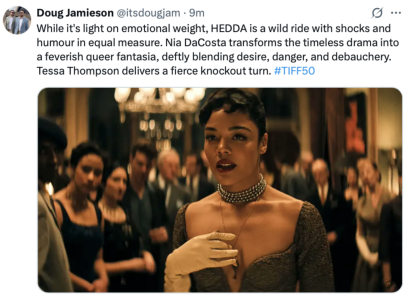
Nia DaCosta‘s reimagining of Henrik Ibsen‘s “Hedda Gabler” is set in the present, and among mostly white “swells” (a term that absolutely no one uses these days), and is sorta kinda lezzy as far as Tessa Thompson‘s titular character is concerned.
In 1891 Ibsen’s Gabler was newly married and bored, trapped in a flush marriage and a house that she didn’t want. In DaCosta’s film Nina Hoss‘s supporting character, Eileen Lovborg, is Hedda’s object of desire.
Woked-up Hedda was shot in early ’24, an eon ago in cultural terms, but the progressive feminist ethos (i.e., almost all men are dull, oppressive shits and women need to be free to muff-dive) has since turned and the wealthy sapphic thing….well, okay but right now girl-on-girl action isn’t as exciting and crackling-with-possibility, social-signpost-wise, as it seemed to be when droolin’ Joe Biden was president. Wokeys are in retreat, searching for tall grass…everyone hates them now. Life never stands still…a constantly moving train.
DaCosta did her career no favors with 2023’s The Marvels, but we all need to re-invent ourselves from time to time.
Hedda premiered last night in Toronto. It will have a token theatrical release on 10.22, and will begin streaming on Amazon Prime Video a week later (10.29)
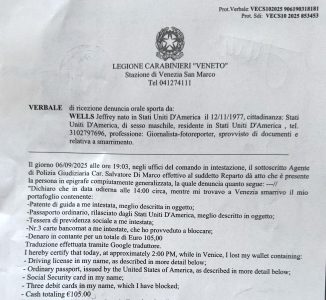
I wanted to get to Copenhagen early (as in tonight) so I’d have a day and a half to get a fresh new passport as well as a brand-new bank card before my returning flight to JFK.
Tonight’s 8:05 pm SAS flight from Milano Malpensa to Copenhagen had several unbooked seats, I was told, but the desk agents said they couldn’t break the rules so I’m crashing this evening in the Malpensa-adjacent commune of Ferno.
A nice, friendly little rooming house. The landlady, a good soul, drove out and picked me up at Malpensa…an extra 20 euros.
In the old days they would let you fly standby on a try-your-luck, catch-as-catch-can basis, if you wanted to leave earlier for whatever reason…no longer. I would have those catch-as-catch-can days again.
A medieval church bell began ringing this morning at 7:30 am….wonderful.
Malpensa airport is a long way from Milan — 49 kilometers or 30 miles. The so-called “Malpensa Express” lops and chugs along like a freight train…no hurry. And the ride takes an hour! Malpensa is a little bit closer to the southern tip of George Clooney‘s Lake Como than it is to Milan.
Just because I failed to post a review of Iain Forsyth and Jane Pollard‘s Broken English doesn’t mean I wasn’t won over and in fact melted down. I caught a late-night screening at the Venice Film Festival, and have been thinking about it — warmly — ever since. It’s not a typical shake-and-bake summary of a pop star…a quirky individualist who seemed to live by the light of camera flashbulbs and was, for a certain period, a radiant, raspy-voiced pop poet and vocal stylist. I can’t wait to see it again.
This is generally true of feral reactionary racists, MAGA loyalists, sensible Average Joes and deranged woke fanatics alike, but thank God for that 3% who’ve been touched by God or vague inspiration or something greater than themselves…call them the clear light contingent.
HE commenter Howard Beale is certainly not among the CLCs. He is sadly a DWF, and I’m this effing close to booting his sick ass. A confirmed hater…spewer of venom.
In the fall of ’88 I had an experience similar to Alec Guinness‘s, as described below by Peter Ustinov. It happened in either Cork or Limerick, and it involved an Irish policeman and a parking infraction.
I was standing near our rental car when a friendly uniformed cop approached and asked if the car was mine. Yes, I said. “Well, I’m only askin’ because it’s parked in a red zone”, the cop said in a gentle Irish brogue, “and you might wanna think about movin’ it before too long, as you’ll probably get a parking ticket if you don’t.” I thanked him and promptly parked the rental elsewhere…no sweat. It was easily the most pleasant encounter with a parking cop in my entire life.
And Alexander Payne‘s jury has blown off The Testament of Ann Lee‘s Amanda Seyfried…no Best Actress Volpi Cup! All the hipster handicappers had her taking it…the “Seyfried, Seyfried, Seyfried” drumbeat could be heard up and down the Lido.
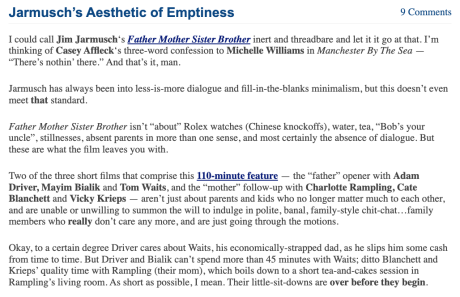
Jim Jarmusch‘s Father Mother Sister Brother is easily his weakest, least nourishing film ever, which is why Cannes Film Festival topper Thierry Fremaux declined to debut it four months ago.
All I can figure is that Payne’s jury decided to give Jarmusch the top Venice award as a “you go, bruh” neck-massage thing…”don’t let Fremaux ratttle you, Jim…take solace in our love and respect.”
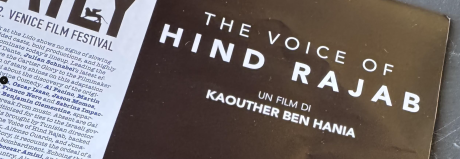
I thought The Voice of Hind Rajab, a devastating, anti-Israel docudrama that generated emotional tsunamis whenever it screened, would take the Golden Lion for sure, but assuaging Jarmusch’s ego was a more important thing.
Benny Safdie‘s helming of The Smashing Machine won the Best Director prize fair and square…he did a good job, went for the deep-down stuff.
If an actor doesn’t trust a director, the camera won’t catch much of a performance. The actor has to trust that if he/she jumps off a certain kind of performative cliff, the director will absolutely be there to catch him/her. Both on the set and in post-production.
This kind of faithful bonding surely existed between Elia Kazan and Marlon Brando, Humphrey Bogart and John Huston…any famous pairing along this line.
This said, what does this photo tell you about the relationship between Hamnet director Chloe Zhao and star Jessie Buckley?
A traditional relationship between a director and a lead actor tends to be the opposite of what’s being conveyed here…no? The actor tends to be the emotionally uncertain snuggler and the director is the confident care-giver offering a protective embrace…right?
Don’t recite your resume or your hobbies, don’t tell us what you own or how your golf game has improved or how much you love your pets or anything peripheral…none of that…just tell us who you are.
Okay, here goes: I’m a guy who lives to write and writes to live. I believe that while certain bedrock behaviors are more or less constant, sobriety as a way of life matters a great deal, and if you’re sober, moods and perceptions are always tipping this way or that. There is no “real” essential identity. There is only our genetic history plus the constantly adjusting, moving-train way of things…influences, appetites, defense mechanisms, second thoughts.
I was angry as a kid because I’d suffered through a traumatic birth, and angry as a teenager because my functioning alcoholic dad managed to persuade me that I had to avoid turning out like him…that anything would be preferable to that. And yet I miss him as we speak.
Nicholson to HE: That’s very nice, Jeff, but as usual you’re dodging. Who are you? Just say it.
HE to Nicholson: I don’t have a pat answer, and neither do you. Nobody does. I’m an imaginative egocentric refugee from a middle-class New Jersey suburb. I live for those transcendent moments that descend from time to time. (We all do, I think.) I’ve been lucky in some respects, and I’ve been blessed with a strong constitution. Otherwise I’m a reasonably stable, steady-as-she-goes workaholic.
I vastly prefer the poetry of cinema + great writing + music to the occasionally maudlin reality of day-to-day life. My eyes go all watery when certain memories surface, and especially when certain songs and passages from certain film scores are re-savored.
Most of us understand about God’s absolute and infinite indifference about whether we are happy or not, and that there is only “be here now” and the hum of it all, etc. And yet deep down I seem to spend a lot of time trying to re-savor or re-appreciate my deepest and most lasting memories from the 20th Century, and all the while hitting re-fresh.
I understand the rule about not mentioning cats and dogs, but they’re mostly wonderful (98% of the time) to hang with.
Rainer Maria Rilke: “To simply be here is immense.”
David Kittredge’s Boorman and The Devil, which I saw this morning at 9 am, is one of the wisest, deepest, most poetic-minded, most eloquent and most satisfyingly assembled “inside baseball meets human vulnerabilty” documentaries that I’ve ever seen.
With the festival nearly over, I wasn’t expecting any kind of triple or home run. But it’s a truly masterful film.
It actually ranks among the four or five best films I’ve seen in Venice thus far…seriously.
Kittredge doesn’t just cover the whole, calamitous, chapter-by-chapter story of the making of John Boorman‘s The Exorcist II: The Heretic. He also assesses Boorman’s entire career while examining his personal passions and tendencies.
The most intriguing aspect is an atmospheric recreation of the fascinating Hollywood milieu of 1976 and ’77, which was when the film was made…the closing chapter of the whole sprawling saga of New Hollywood, which began in ’67 (The Graduate, Bonnie and Clyde) and ended with the super-successful, game-changing release of Star Wars in May ’77.
Produced over the last seven years, Boorman and the Devil is a very thorough telling of a grueling creative effort. Kittredge has interviewed pretty much every living person who worked on the film, starting with Boorman, the project’s bruised but resilient godfather.
Costars Linda Blair (who turned 66 last January) and Louise Fletcher (died three years ago) are given a healthy amount of screen time; ditto uncredited screenwriter Rospo Pallenberg and Steadicam inventor Garrett Brown.
A stimulating variety of peripheral participants and observers are also heard from — directors Joe Dante and Jeff Kanew, critics Bilge Ebiri and Stephanie Zacharek plus author and former Variety reporter Joe McBride.
There’s footage of a funny story about a sneak preview screening, passed along by Exorcist helmer William Friedkin….hilarious.
The Boorman interview apparently happened in ’18, as he tells Kittredge’s camera that he’s 85. Born in 1933, Boorman is now 92.
The two best docs about “difficult shoots that produced a good or classic film”, of course, are George Hickenlooper, Fax Bahr and Eleanor Coopola‘s Hearts of Darkness (’91) and Les Blank‘s Burden of Dreams (’82).
Kittredge’s doc belongs in the pantheon of an opposite category — i.e., docs about the making of movies that went horribly wrong.
Throughout the viewing I was saying to myself “how ironic that a movie this rich, insightful, compassionate and enticingly human-scaled is a study of one of the most notorious artistic and commercial failures in Hollywood history.”
The professional-grade sketchings of key episodes during the film’s making are truly exceptional. I’ve reached out to Kittredge for an answer to this and other questions.
“Much of the film is about the home-bound JLaw going increasingly crazy because the work-obsessed RPatz won’t fuck her.
“Pic is altogether too grim, too downish in a one-note sense, no plot pivots of any kind….just a downward swirl into Jennifer Lawrence‘s increasing derangement….down, down, down.
“What’s it really about? Just as Alfred Hitchcock‘s The Birds wasn’t so much a restrained horror film about malicious winged demons as an indictment of social complacency, Die, My Love isn’t so much about JLaw’s descent into self-destructive madness as a portrayal of the dull horror of doing almost nothing with your life while caring for a child…an indictment of middle-class, stay-at-home-and-burp-the-baby-while-baking-cookies momism.”