

I’m searching around for news about who will write the script for The Winter of Frankie Machine, an aging-mafia-hitman flick to be directed by Martin Scorsese and star Robert De Niro, to be produced by De Niro and Jane Rosenthal. Whether this film actually happens or not, the source material is a book by Don Winslow. (Haven’t read it, but of course the name “Frankie Machine” was Frank Sinatra ‘s in Preminger’s The Man with the Golden Arm.) If anyone knows anything…
For the third time in recent months, a respected old-media film critic has been downgraded or shown the door at a major daily: the word broke two or three hours ago that Jamie Bernard ‘s contract will not be renewed at the N.Y. Daily News , and I’m very sorry. A tough break, but print regulars are probably going to be dealing with turbulent upheaval for months and years to come. It’s shake-up time, sorry to say. I took a train to Connecticut around 3:30 this afternoon and ran around a bit, and when I finally got online I read the news about Bernard.
I’ll know a bit more tomorrow morning, but I’m projecting right now that Poseidon‘s opening weekend take may be possibly as low as $15 million but will probably not be higher than $20 million, even with winds favoring. I mean, it looks that way now. Undeservedly, I would add, but them’s the breaks.
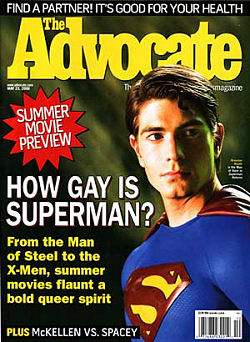
This is not a parody cover of The Advocate. It’s “real world”, and it’s on the on the Advocate site right now. (I’m not sure about the newsstands.) The piece, written by arts and entertainment editor Alonso Duralde “looks at superheroes and their appeal to gays and lesbians,” the blurb says. I’ve never detected anything intrinsically or suggestively gay about the D.C. Comics’ Superman character, and you know Superman Returns director Bryan Singer wouldn’t begin to think about pulling a Joel Schumacher move…not with all the pressure on him and the film.
Douglas Carter Beane‘s The Little Dog Laughed , a Second Stage production that opened last January, is about the problems of a sexually conflicted movie star. It was rumored to be based upon — suggested by — impressions of Tom Cruise and his relationship with former publicist Pat Kingsley. (The third character is a gay hustler whom the actor is involved with.) Anyway, I’m told the play will be moving to Broadway in the fall, and when it does the storm over Cruise — peaking now, but certain to die out in a week or two — will rev up again. Here’s what N.Y. Times critic Ben Brantley said in his 1.10.06 review: “What has garnered the most advance attention for Little Dog has been the promise that it would be about a closeted gay actor who knows his homosexuality is incompatible with being a matinee idol. Sure enough, the character of Mitchell (Neal Huff) is suggestively familiar enough that certain contemporary male stars (names withheld in view of possible litigation) should probably stay away from this show if they want to avoid sleepless nights.” The Kingsley character, Diane (Julie White) “muses wonderingly on her client’s naive idea of taking his mother as a date to an awards ceremony ‘so that no one will know he’s gay.’ Certainly the play’s basic plot hinges on the professional problems of such secrecy, after Mitchell begins an affair with a young prostitute named Alex (Johnny Galecki) while visiting New York. Diane has secured the film rights to a play in which the lead male character is gay. And as she observes, ‘If a perceived straight actor portrays a gay role in a feature film, it’s noble, it’s a stretch. It’s the pretty lady putting on a fake nose and winning an Oscar.'”
I’ve been running around Manhattan with my head down but the first breather moment that comes along I’m grabbing that double-disc DVD of Munich — i.e., Steven Spielberg‘s Quills — and popping it into my Netflix portable player. The problem is that I tried watching it for a second time last December and it didn’t play.
An AICN correspondent named “Mutant Camel” claims to have seen Brett Ratner‘s X-Men 3: The Last Stand (20th Century Fox, 5.26), and I don’t know. He doesn’t have that quasi-measured circumspect tone that tells me a writer is coming from at least a somewhat perceptive or trying-to-be- thuggishly-thoughtful place. He sounds too effusive and geeky, like a plant trying to sound like he isn’t one.
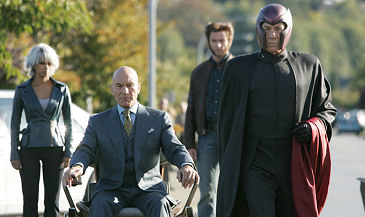
That said, he likes it…and yet one of the things that seems to warm his heart is the intense violence. Terrific. “If the last one was subtitled X:Men: United, the subtitle of this one should be X-Men Kick the Holy Crap Out of Each Other for 2 Hours.”
http://www.aintitcool.com/display.cgi?id=23285
“Box-office prognosticators don’t necessarily think that the summer season will tank after M:I:3, but Hollywood seems certain to suffer through another bad weekend if Warner Bros.’ Poseidon is as weak as advance tracking suggests. Even a senior Warner executive concedes, ‘We’re all pretty much aware that ‘disaster film’ will take on a whole new meaning on Friday .'” — from Kim Masters‘ 5.10 Slate piece about the renewed box-office concerns, called (but not limited to the particular subject of) “The Fall of Tom Cruise: Hollywood frets over the weak opening of Mission: Impossible III.
“As any geek can tell you, HDTV comes in several degrees of resolution: 720p, 1080i and 1080p. Weirdly, Toshiba’s HD-DVD player can’t send out 1080p, which is the holy grail. (To be sure, this standard is still rare among TV sets, but it’s the wave of the future.) You should know, too, that you’re guaranteed the sensational high-resolution HD-DVD picture only if your TV set has an HDMI connector (a slim, recently developed, all-digital jack that carries both sound and picture). If you use S-video or component cables instead, you may see only 25 percent of the resolution you’re supposed to get — a maddening antipiracy feature that the studios can invoke at their option. The A1 does deliver the spectacular picture and sound promised by Toshiba. Should you buy one, then? Not unless you’re an early-adopter masochist with money to burn.” — from N.Y. Times columnist Eric Pogue’s 5.11 column, “Why the World Doesn’t Need Hi-Def DVD’s”
“Christians have not been this worked up about a movie since Martin Scorsese‘s Jesus stepped down off the crucifix in The Last Temptation of Christ in 1988.” — Laurie Goodstein‘s N.Y. Times piece about the various ways hot-headed Catholics are planning to protest Ron Howard‘s The DaVinci Code (Columbia, 5.19).
Why is the Cannes Film Festival press-screening The DaVinci Code, a movie that lasts about 150 minutes, at 8:30 pm on Tuesday the 16th rather than, say, the slightly more workable hour of 7 pm? Especially considering that a good portion of the viewers will be jet-lagged Americans? Because Sony publicists have arranged for Ron Howard‘s film to be shown to Cannes press at more or less the same time that New York and Los Angeles journos will be seeing it. The Gotham screening, I gather, will happen around 2:30 or 3 pm (a film critic for a major weekly told me that the Cannes screening will actually begin “a half-hour earlier” than the Manhattan screening). By this logic the Los Angeles showing would obviously be happening around noon, although a press pal says that the only LA press screening for DaVinci he knows about is set for Wednesday, 5.17, at 7pm at Hollywood’s Arclight .
There’s a launch party happening at the Columbus Hotel in Monte Carlo on Tuesday, 5.16 — the night before the Cannes Film Festival begins — to announce the International Emerging Talent Film Festival , which hopes to begin each year a few days before Cannes. American Cinematheque’s Margot Gerber is handling U.S. publicity. Participating supporters include producers Tricia Van Klaveren (Lying, Edmond), Bruce Cohen (Big Fish ), and George Litto (The Crew). I’d go but that The DaVinci Code press screening at 8:30, man…it’s a toughie.