Joan and Toni

Match Guilt

I’m feel I should be beating the drum more loudly for Woody Allen’s Match Point (DreamWorks, 12.25) because it’s not just his best in a long time, but one of the best of the year. And I need to stop being wimpy about this.
It really is Allen’s darkest and most precisely calibrated film since Crime and Misdemeanors…clean, cruel and ironic as hell.


Scarlett Johansson, Jonathan Rhys-Meyers in Woody Allen’s Match Point

Any film worth its salt has to have thematic clarity. Match Point‘s theme is clear as a friggin’ bell, and with echoes of George Stevens’ A Place in the Sun and Fyodor Dostoevsky’s “Crime and Punishment,” and it boils down to this:
Be smart and vigilant in life, and maybe you’ll get what you want, or what you think you need. But if you want things to really turn out, be lucky.
< ?php include ('/home/hollyw9/public_html/wired'); ?>
People hate this notion because it means our lives are little silver balls whirling around a roulette wheel. Maybe we’ll plop into a red or black slot at the right time, or into an odd or even number at the wrong time…and maybe something amazing or comical or devastating will come of it. Life is cold, man.
If there wasn’t such a herd mentality in this town, if people weren’t so political and equivocal, Match Point could actually be in the mix for Best Picture.
It’s a slightly better film than Good Night, and Good Luck. It’s not as much of a sad and broken-hearted thing as Brokeback Mountain, but it has as much confidence and self-awareness as Walk the Line. It’s five or ten times better than Memoirs of a Giesha, and the Munich comparisons will soon be clear.
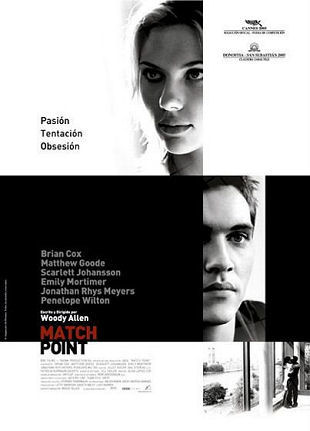

The Italian one-sheet…right?

Let’s be really honest. I’m not ballsy enough to stand up for the Woody all alone, partly because deep down I’m only 90% supportive of Match Point (I have some problems with this and that aspect, but nothing humungous), but I feel bolder with Oscar prognosticators Pete Hammond, Sasha Stone and Eugene Hernandez listing it among their top five.
So I guess I’m like Bobby Kennedy after Eugene McCarthy got 42% of the vote in the 1968 New Hampshire primary against Lyndon Johnson. I’m going, “Uhh, okay …there’s something happening here and I’m joining the insurrectionists.”
Screw the herd mentality and the hell with political and equivocal. The more I think about Match Point, the better it seems. Woody is easily a Best Original Screen- play contender, and…well, at least that.
I said last May at the Cannes Film Festival that Match Point isn’t quite as good as Woody’s Crimes and Misdemeanors, but it deals the same kind of cards and has its footing in more or less the same philosophical realm.
And I’ve said this three or four times, but the finale kills.
Set in present-day England (mostly London, Match Point is about a tennis instruc- tor namd Chris Wilton (Jonathan Rhys- Meyers) who relationships his way into an upper-crust English family by way of one of his male students, a cheerful smoothie named Tom Hewett (Matthew Goode).

Chris is soon romancing and then marrying Tom’s sister Chloe (Emily Mortimer), but almost-as-quickly getting involved with Tom’s fiance, a struggling American actress named Nola Rice (Scarlett Johansson).
The story essentially turns on the matter of Nola becoming pregnant and insisting that Chris leave his wife for her, and how Chris deals with the pressure of this.
Rhys-Meyers handles his part skillfully and with exactly the right balance between terrible, gut-wrenching guilt and the suggestion of a sociopathic undercurrent. But it’s Johansson, far and away, who gives the finest performance. She seems in possession of a fierce, almost Brando-esque naturalism here. She grabs Allen’s dialogue by the shirt collar and slaps it around.
Match Point feels a bit creaky from time to time. The talk feels a little pat here and there, and certain aspects of the plot feel a wee bit forced. But that’s Woody these days, and in this instance, that’s pretty damn good.

Sense of Gravity

Do today’s African-American actors radiate a graver, weightier aura…a stronger sense of manly conviction than white actors these days? Do they seem more rooted, less whimsical…more dependably earnest?
Or has it always been this way and white-guy columnists like myself are only just waking up to this? Or is the whole idea bogus and agenda-driven?
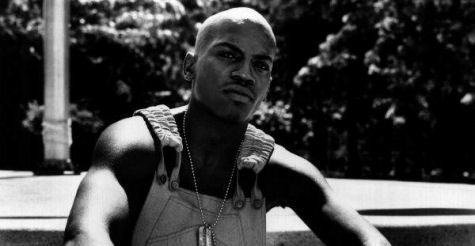

Would Mekhi Phifer have been better as Ennis del Mar or Jack Twist?

I got started on this theory when a New York-area guy named Richard Szathmary suggested this morning that if two black actors — Mekhi Phifer and Sharif Atkins, say — had played the kissin’ cowboys in Ang Lee’s Brokeback Mountain (Focus Features, 12.9) that reactions among younger-male heteros might be less squeamish.
I’m referring to under-25s in both Flyover Country and in the big cities guffawing derisively at the film’s teaser-trailer. (I really hate bringing up this asinine reaction, but I’ve been told about it time and again.)
The feeling is that Atkins and Phifer falling for each other would somehow seem solemn and steady and take-it-to-the-bank.
That’s how it seems to Szathmary, at least…a guy who hasn’t seen seen Brokeback Mountain but has his suspicions based on the trailer…a notion that there’s something vaguely flakey and untrustworthy about Jake Gyllenhaal and Heath Ledger. Something in their eyes, manner…something deep down.
I’ve seen Brokeback and I completely disagree. Ledger and Gyllenhaal totally inhabit their characters and then some, revving their emotional engines to a high pitch.
It wouldn’t have quite worked, in any case, to have a couple of black actors playing sheepherders-for-hire in a film that begins in the early ’60s, given the relatively few people of color known to have worked the open range forty or forty-five years agi, not to mention the conservative-racist mentality of big-time ranchers back then.
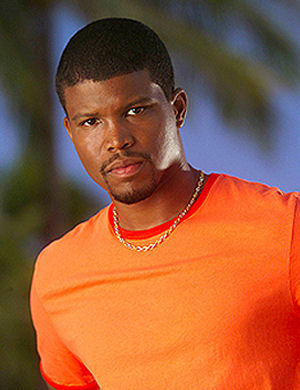

Sharif Atkins

And I can’t help wondering if Ang Lee and James Schamus would have been able to find a pair of marquee-worthy black actors if they’d said “Fine, let’s cast it this way.” The machismo factor among African-American actors is thought to be pretty high. Remember Will Smith’s reaction to briefly kissing a guy in Six Degrees of Separation?
But maybe Szathmary is onto something anyway.
The more I think about these guys and whatever that thing is they seem to possess, the more solid this idea seems.
I’m thinking of a list that includes (but certainly isn’t limited to) Terrence Howard, Don Cheadle, Denzel Washington, Mos Def, Jamie Foxx, Samuel L. Jackson, Phifer, Taye Diggs, Ludacris, Delroy Lindo, Bill Duke, Ving Rhames, Atkins, Ice Cube, Lawrence Fishburne, Sean Patrick Thomas, Henry Simmons, Keith Hamilton Cobb.
I could even include even Sean Combs, whom I believed as a death-row inmate in Monster’s Ball, despite his not being much of an actor.
“The American cinema is dominated by commanding black males,” wrote Szathmary. “Men whom one can picture as real men. Guys who don’t whine and have real voices and calmly and capably make their moves and get things done.”
As the risk of sounding like a cultural bubble-dweller or zombie of some kind, there’s something to this view. A feeling that there’s something more dependable and rock-solid about black guys…except when it comes to Martin Lawrence, the dandified Will Smith and that guy who played the sick-fuck Little Ze in City of God.
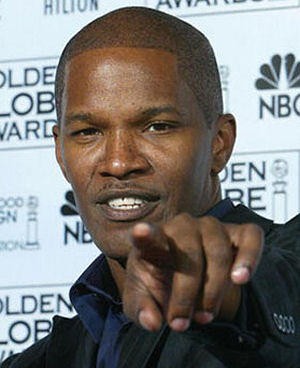

Jamie Foxx

At the same time the notion that guys with darker skin have it all over guys of European heritage sounds simplistic and dumb-assed.
On the other hand there was a voice inside me that said “cool” when that fast-flurry rumor popped up last year about Colin Salmon being one of the finalists being tapped to play 007.
I could riff some more about about this and call up ten or fifteen producers, agents and casting directors and chew it over with them, but let’s just throw this one out and get some reader reactions.

Joan and Toni

L.A. City Beat film critic Andy Klein came on “Elsewhere Live” last night (i.e., Thursday) to talk about the leading Best Actress contenders, and all the verbal sifting-through led me to realize something I hadn’t quite come to on my own:
The two finest waker-upper female performances of the year are both underdogs. One isn’t being spoken of very much, and the other isn’t even on the map.
I’m speaking of Joan Allen’s alcoholic, emotionally off-balance mother of four girls in Mike Binder’s The Upside of Anger and Toni Collette’s stressed, hurting, buoy- ant Philadelphia attorney in Curtis Hanson’s In Her Shoes.
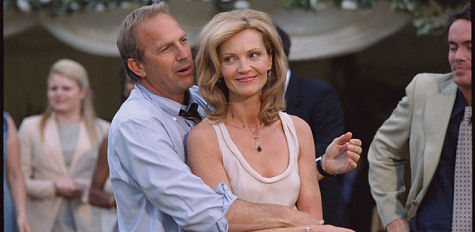

Kevin Costner, Joan Allen in The Upside of Anger

Allen is sitting on a few Oscar prognosticator “maybe” lists, but not so you’d notice. It’s high time to refresh the browser. There’s an emotional hair-trigger element that Allen gets hold of in Anger that feels almost giddy at times. She’s bracing and sexy, willful and vulnerable and quirky. (And let’s not forget how sublime she was in Sally Potter’s Yes.)
No one anywhere is talking about Collette at all. Obviously people disagree with my feelings about her. Maybe In Her Shoes getting only a 75% positive rating on Rotten Tomatoes had its effect, and maybe the underwhelming box office was a factor, or Fox not going to bat for Collette with trade ads…whatever.
I know what exceptional in-the-pocket acting is — I know what it feels like, sounds like — and I know plenty of others who feel this way, and those who’ve dismissed Collette’s performance out-of-hand are just being slackers.
Allen and Collette’s performances are funny, sad, joyful, exuberant. They raise the emotional thermometer and have all kinds of ins and outs, and the plain simple truth is that none of the other supposed contenders (i.e., the ones on everyone’s lists) are in their realm.
I believe this because…
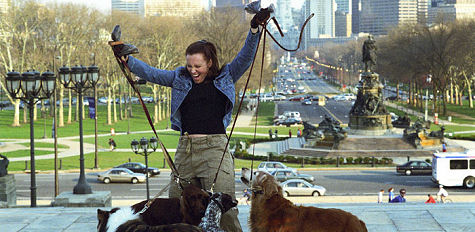

Toni Collette in In Her Shoes

Reason #1: Reese Witherspoon, the presumed front-runner for her fine inhabiting of June Carter in Walk the Line, gives an assured movie-star performance…yes. Her acting is robust and and authentically down-home. She does more with less and is quite radiant and likable, and she sings like an angel. And she’s almost a supporting character (I said “almost”). And she doesn’t have one of those hair- pulling, “look ma, I’m acting” scenes to work with either.
But at the same time Witherspoon isn’t exactly pushing her boundaries or rewriting the book on acting. She’s great but c’mon…
Reason #2: Judi Dench, another presumed front-runner for her playing a spirited upper-class snob in Mrs. Henderson Presents, can do this sort of thing in her sleep. Academy people always kowtow to world-class British actresses when they get hold of a good part, and that’s happening here. Like I said a few weeks ago, Dench “has a pitch-perfect way of delivering zap lines with just the right tone of upper-class indifference, and yet the joke is always on her.” But it’s a performance that’s straight out of her kit bag.
Reason #3: Sarah Jessica Parker is the one who goes through the big character journey in The Family Stone, starting out all rigid and butt-plugged and then evol- ving into somone calmer and more centered. But she’s not in Witherspoon’s class, much less Allen’s or Collette’s (in part because of how her character is written).
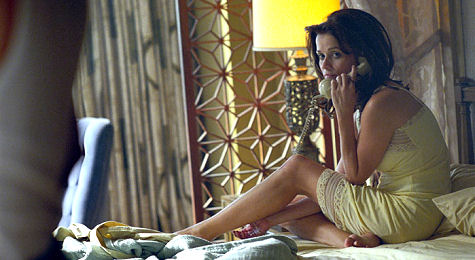

Reese Witehspoon in Walk the Line

Reason #4: Charlize Theron gives an impassioned, balls-out, tough-as-nails performance in North Country, but the movie, a fairly solid drama on its own terms, didn’t cause much of a stir when it came out, and people feel a little Charlize-d out from the Monster hoopla of…what was it, two years ago?
Reason #5: This is a non-reason, but I haven’t seen Felicity Huffman playing a man undergoing a gender-switch procedure in Transamerica, so she’s off the table for now.
Reason #6: Keira Knightley doesn’t have that element of a-churning-river-running- through-her…not at all…not in Pride & Prejudice, and not in any performance she’s given in any film so far. It’s vaguely silly that people have even put her on their lists. Just forget it.
Reason #7: Ziyi Zhang is a barely emotive presence in Memoirs of a Geisha. She’s all makeup and porcelain and dropping her gaze to the ground. She’s young and vigorous and great on her feet with a sword, but quiet acting isn’t her game. She may get swept along in the current of all the below-the-line nominations that Geisha is expected to receive, but she doesn’t deliver on her own and that’s a fact.


Charlize Theron in North Country

Reason #8: Claire Danes doesn’t have nearly enough to work with in Shopgirl, and her character’s a bit opaque and the movie’s underwhelming, so forget it.
Reason #9: Gwyneth Paltrow’s daughter-of-Anthony-Hopkins character in Proof is too gloomy and self-involved. That was my reaction, at least — I felt she was too wrapped up in her woe-is-me blanket, and I found that off-putting after a while. The film has its moments and Paltrow’s performance has merit, but it’s a stretch to talk about Oscar contention.
Reason #10: The White Countess is said to have more than a few problems so however good Natasha Richardson may be, a nomination doesn’t seem to be in the cards.
Reason #11: It’s a little early to say anything, but the word around the campfire is that the same equation may apply to notions of Q’orianka Kilcher being singled out for her work in The New World.
I said no other female performance this year was quite in Allen and Collette’s realm. That isn’t entirely accurate if you allow Robin Wright Penn’s brief but startling turn in Rodrigo Garcia’s Nine Lives into the mix.
Wright Penn may not be on-screen long enough to qualify for contention in the Best Supporting Actress category (in people’s heads, I mean) but she’s absolutely mesmerizing in this film. I wrote about it in October (scroll to the bottom of the page).
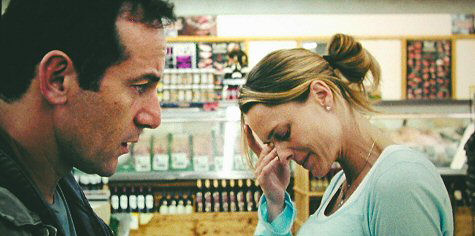

Jason Isaacs, Robin Wright Penn in Nine Lives

Forget It

Forget that whole Sundance Film Festival ’06 thing I posted in this section a few days ago, and in the main column last Saturday. Almost all of it was wrong and that’s that.
I’ve been reliably persuaded that a good portion of the titles I mentioned won’t be at the festival, and that some weren’t even submitted (!).
Five or six days ago a friend from the festival circuit sent me a document put together by Film Finders called “Tipped for Sundance,” and it had those 22 films listed.
I went for the information because (a) the Film Finders people are known to be fairly well connected on a business affairs level, (b) the document was passed along only a few days before the official announcements (the trades will be running the stories this week), (c) the document “looked” superficially reliable — it had production info history, sales contact info and phone numbers for each film — and (d) the combined reptutations of Film Finders and the guy who sent me the document convinced me the information was probably jake.
And for the most part, it wasn’t.

Fist in the Air

“I finally got a chance to catch Rent yesterday and wanted to let you that your review in your 11.9 column absolutely nailed it. Columbus did a helluva job transferring this thing to the screen and I agree it worked better in many ways than the play.
“Film allows the viewer to peer deep into its characters souls in a way that the stage (for all its vitality) cannot, and Columbus’s choices were excellent. He let the music speak for itself and didn√ɬ¢√¢‚Äö¬¨√¢‚Äû¬¢t let his ego or pretensions get in the way of telling the story.
“I can’t help but think that a more auteur-type (Martin Scorsese and Spike Lee were both attached at one time) would be more inclined to put a personal spin on the material, and thus dilute the essence of Larson’s music. The ego-less direction from Columbis lets the source material to shine through.
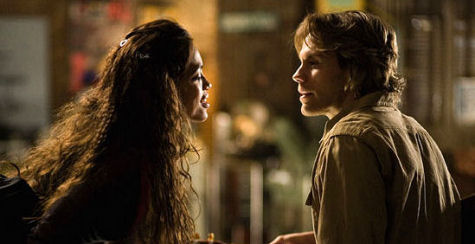

Rosario Dawson, Adam Pascal in Rent

“Like many others, I find myself caught in a daily grind of trying to move forth and survive in life’s scramble. Rent reminded me of how important prioritization is. When Rosario Dawson sings to Adam Pascal about how ‘life is yours to miss’ …damn, it hit hard.
Rent reminded me of why I love art and the way it can help affirm why we’re all here.
“I think many critics are down on this thing due to an anti-Columbus bias (which I previously shared), or they just didn’t enjoy the style, music, etc. They’re missing the boat. This film is much better than Chicago and has an emotional immediacy that is heartfelt and pure.
“So three cheers for Rent and your standing-by-what-you-saw review. It’s another reason why I will remain a loyal reader of your column.” — Kyle Fredette

Brokebackers

“In the Twin Cities where I live, the Brokeback Mountain trailer has been getting lots of snickers at cineplexes and Landmark chain theaters alike. I’m no homo- phobe, and I’m a big Ang Lee fan who will be seeing Brokeback the weekend it opens here. But the collective reaction in some of these theaters has been really something.
“People openly laugh at Heath Ledger’s line ‘Why can’t I quit you?’ A very liberal friend of mine has even taken to doing his own impression of Ledger saying that line, to the howls of all of our other friends.
“While Ledger is very talented and deserves more respect than he gets, I think the idea of the star of A Knight’s Tale uttering that line is hitting people as utterly ridiculous. The line is going to be the thing that most people think of when they think of this movie. Watch over the coming months as it becomes a catchphrase.

“I’m looking forward to this movie and I’m sure it will be deserving of/in contention for numerous awards. But I expect it’s going to get quite a beating from the mass culture, in the way The Crying Game did. I hope I can find a showing in a theater on opening weekend that isn’t ruined by laughter.” — Brian Roche
“I am a 20-something woman, and James Shamus is right, as he usually is about these things, that women like me are the target audience for Brokeback Mountain, and I will be there as soon as it opens here in DC.
“But whenever I bring up BBM to any heterosexual male under 30 I just get the ‘independent films are all about gay cowboys eating pudding’ thing from South Park. These men are well-educated and enjoy independent film. And I don’t think there is so much of a cringe factor as one might think for these young-ish men watching two dudes in love. I just do not think that is the problem.
“As much as I love South Park (and personally think that their characterization of independent film is quite funny), I have to blame Matt and Trey for the chortle and giggle factor that I have run into. However, I also think that if these men got their asses into the seats and watched the film I think most of them would enjoy it. But please, take me with a huge grain of salt as I really liked Ang Lee’s The Hulk.” — Haley Aurora
“Okay, message received: Jeffrey Wells is full-steam behind Brokeback Mountain as the film of the year. Groovy. And your worries about a bubba backlash against it, spurred by homophobia, are entirely realistic and well-founded.
“But with respect, is it possible you’re overlooking the other side of the coin here?
“What I mean is, if one is going to be upfront about the fact that there will be people who will skip this movie, dump on this movie, refuse to like or admit liking this movie because of what side they take in the moral debate over gay rights…is it not only fair but simply intellectually honest to also concede that there will be people who will reflexively praise and exalt it, without having seen it because they take the opposite side and want to see a gay-themed movie succeed?
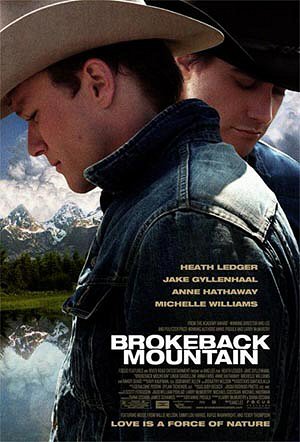
“I’m not accusing you of outright bias. You’ve seen the film, it’s obviously gotten to you in a profound way, and you’re convinced of it’s innate quality. But if it’s going to be fair-game (and I believe it ought to be) to read between the lines of negative reviews and question whether an element of homophobia is clouding the reviewer’s decision, would you not agree that it’s equally fair-game to do the same for the positive reviews?
“Not every critic is going to agree that this is a great or even good film. But how many of them will be, you’ll pardon the expression, bending over backwards to be positive about it for fear of appearing in cahoots with the religious right wackjobs who will probably be trashing it?
“I’m from Massachusetts and am regularly in the social company of various gay, bisexual or otherwise pals. I’ve supported just about every gay rights cause that’s come down the pike. I’m a full-bore enemy of religious fundamentalism in all it’s forms. I want to see a serious gay-themed movie make a mainstream impact to help society grow up a bit over the whole issue…
“And thus far, I think this movie looks like a chore. I’m sorry, but thats the impression I have right now. It’s possible my impressions are wrong, but for trailer-one this has looked to me like a drippy, soap-opera-ish, Titanic/Gone With The Wind/Cold Mountain chick-flick melodrama, and I’m regarding the prospect of seeing it with the same basic feeling you’ve expressed over sitting through the future Harry Potter sequels.
“But when I tell people this at least half of them look back at me in shock, as though I just implied that AIDS was a plague from God or that the Holocaust hadn’t occured. And I’m not seeing this discussed anywhere in the critical press, so far. Instead, the prevailing theme is Brokeback Mountain will be great, and anyone who doesn’t think so is a Christian right homophobe. And frankly, that’s just plain uncool.” — MST Mario
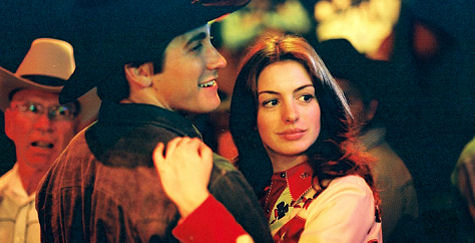
Wells to MST Mario: You contemptible closet-Christian bigot homophobe skeptical Ang Lee-dissing prick!
“Seriously, MST, I hear you and you’ve made some good points, but trust me on these two points: Brokeback Mountain in no way resembles Titanic or Gone With the Wind or anything along those lines. It’s austere, under-stated, and doesn’t try to massage you into feeling anything. Secondly and more importantly, it’s not a gay or gay-themed film. It really isn’t, despite what you may be presuming.
“I program a series of fine-film cinema locations here in Melbourne Australia, and last weekend I held the first public screening of Broekback Mountain in Australia as part of a promotional weekend launching a loyalty card. I attended the screening with my partner after having watched the film at an exhibitor’s screening the week prior.
“I enjoyed the film greatly at the exhib’s screening, perhaps only finding it a little longer than it could have been, but that’s probably my exhibitor’s hat talking. It actually wasn’t until I was driving home that evening that the weight of the film dawned on me and I was left profoundly moved by it. All night I wanted to talk about the film but forbid myself, not wanting to set expectations too high for my partner.
“I agree that the film is certainly worthy of a Best Pic nomination as well as a win, but from where I am standing the U.S. is a very conservative place at the moment and I wonder about the film’s box-office performance there and whether it will get the support it will need from the expanse between the east and west coasts.
“Perhaps the old adage that any publicity is good publicity” stands in this case. Who knows? Maybe if Oprah likes it, it’s in with a chance with the women of middle America.
“What I want to ltell you was that when I was at the screening, I found myself surprised by the reaction it received from the audience. Admittedly the cinema is in a very upscale location in the suburbs of Melbourne and the audience was partially made up of film buffs who jumped on the opportunity to see the film 2 months out from local release.
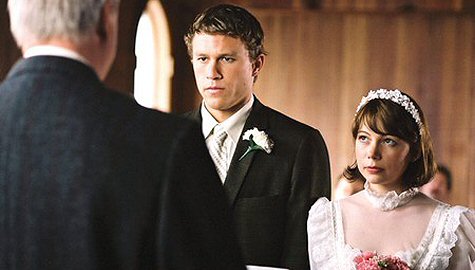
“But there was not a peep from anyone during the film’s more intimate scenes, 80% of the audience sat in their seats during the closing credits and when the film ended I overhead nothing other than quiet comments along the lines of ‘amazing,’ ‘brilliant,’ ‘incredible’ and other assorted superlatives. There were also plenty of tears and gasps during the film’s more shocking moments.
“It’s this reception that has me thinking that regardless of the U.S. reception, the film should find considerable success internationally.” — Kristian Connelly, Film Programmer, Cinema Europa, Traditional & Gold Class Village Cinemas, Australia
“I can understand why you’re on the Brokeback horse, but you better be paying real attention to those snickers in those heartland theaters.
“America is homphobic. To its core. And this is a film — no matter what you feel — about two guys in love. About two guys who have (rather explicit) sex with each other. And no matter how sensitive or how well-made, Brokeback mountain ain’t gonna fly in flyover country.
“And please dump your prejudices and realize that Pride and Prejudice is the kind of lush, middle-brow based-on-a-classic picture that Hollywood just loves to gift with Oscar noms.” — Lewis Beale
Walk the Line (20th Century

Walk the Line (20th Century Fox) has really caught on. A $28 million haul is being projected for the five-day Thanksgiving holiday, plus a three day projected total is $20 million, a very good hold and very slight drop from the opening weekend total of $22 million. The word-of-mouth is obviously a factor, meaning that the only thing Fox screwed up on was not sneaking it a week before opening. If they’d done that they might’ve had an opening frame of $30 million or so.

I’ve said before that 20th

I’ve said before that 20th Century Fox probably made a bad call in delaying the opening of The Family Stone from mid-November to 12.16. Maybe they’ll luck out with Diane Keaton or Sarah Jessica Parker getting Golden Globe-nominated for a Best Female Performance in Comedy or Musical…or maybe the Los Angeles or New York critics will give Diane a nod. All I know for sure is (a) The Family Stone is the best home-for-the-holidays family dramedy I’ve seen in a long time, on the level of You Can’t Take It With You and/or The Man Who Came to Dinner, (b) neither the trailer nor the upraised-wedding-finger poster conveys what it really is (especially the poster, which is all about anger and irreverence…emotions that are not exactly front-and-center in the ffilm), (c) I’m sensing the same sand-leaking-out-of-the- hourglass feeling I had before In Her Shoes opened, and (d) the latest tracking I’ve heard about says “definite interest” in The Family Stone is at 15%, which is not good for a film opening three weeks from now (it should be at 30% right about now). The word last September was that Fox had three home-run movies that couldn’t miss because they were so well made and emotionally satisfying, and here we are two months later and only Walk the Line has made good on its promise. In Her Shoes stumbled and it looks like The Family Stone may follow suit, and who else is there to blame except Bob Harper and the Fox marketing team?

Hold up on Kevin Smith’s

Hold up on Kevin Smith’s Clerks 2 going to the 2006 Sundance Film Festival, which I reported a few days ago as part of a long Word item about 22 films “tipped” for the festival. Clerks 2 (the “Passion of the Clerks” title is out) just wrapped last Friday, and the soonest they’d be ready to hit a festival would be the Cannes Film Festival in May. Smith, however, will be attending Sundance with a documentary he and Scott Mosier produced for Malcolm Ingram called Small Town/Gay Bar, which is in the documentary competition.

As much as I enjoyed

As much as I enjoyed Syriana and as much as I understand and (mostly) agree with director-writer Stephen Gaghan’s decision to keep the audience guessing about exactly what’s going on because the various characters (played by George Clooney, Matt Damon, Christopher Plummer, et. al.) don’t really get the whole picture either….even though I get and support all that, I couldn’t help but chuckle at David Edelstein’s Slate review.

L.A. Weekly columnist Nikki Finke

L.A. Weekly columnist Nikki Finke has startled the film world with a gut-punch quote from producer and longtime Steven Spielberg loyalist Kathy Kennedy that Munich (Universal, 12.25), which Spielberg directed and Kennedy produced, “could be his best.” The quote comes from a friend of Kennedy’s, who adds that Kennedy “wasn’t talking that way about War of the Worlds.” First, War of the Worlds was a pretty good film (except for the last ten minutes with the dipshit happy ending) so anyone who uses that film as an example of a big Spielberg miscalculation or letdown is a suspicious source to start with. Second, anything that Kennedy says about Munich (regardless of any perspective provided by Finke’s source) is obviously not to be trusted. Third, as I noted a couple of weeks ago, the Munich trailer strongly indicates that above and beyond the procedural aspects (Mossad agents out to kill the Palestinians who perpetrated the 1972 Munich Olympic Games masscare), it’s mainly going to be a guilt-trip movie with Eric Bana’s Mossad operative lamenting about his team having killed some innocents and the possibility of his daughter loving him less if she ever finds out, etc. The insect-antennae reading around town is that Munich will probably be pretty good, but that’s all. If it turns out to be much better or even masterful, fine…but I doubt it.

The comic tone of Lasse

The comic tone of Lasse Halstrom’s Casanova (Disney, 12.25) isn’t exactly “farcical,” which, for some of us, means humor that’s cloddishly broad and frequently unfunny. Casanova‘s alchemy is more subtle; it’s selling laughs through the filter of a certain subdued old-world lunacy. It almost feels as if Hallstrom and his cast were on mescaline when they shot it. Does Casanova feel as whimsically stoned as Richard Lester’s The Three Musketeers? Maybe not, but it’s a very close relation. I saw it earlier this week and concluded right afterwards it’s the most satisfying Lasse Hallstrom film since….I was going to say My Life as a Dog but let’s hedge a bit and say What’s Eating Gilbert Grape?. Ledger plays the legendary Venice cocksman with just the right portions of sincerity and insincerity…a very delicate brew. Costars Sienna Miller, Lena Olin and Jeremy Irons more than hold their own, but Oliver Platt gives the biggest standout performance as the pot-bellied Papprizzio. (A friend who just saw it in Sydney told me this morning he felt “more emotionally invested in Platt’s buffoon than Ledger’s Casanova.”) While I’m on the subject, the MPAA’s ratings board has again passed down an idiotic decision in giving this mildy frothy comedy an R rating because of a simulated oral-sex scene. My kids told me three or four years ago that oral sex is a total so-whatter among eighth graders (at the school they were attending in Tiburon, at least) so you’d have to think that kids who are 12 and 13 and 14 thesed days would barely raise an eyebrow at simulated off-screen oral sex in a film. Sorry, parents, but we’re no longer living in a Wonder Years world. A PG-13 would have been more than sufficient.

That rumor about Terrence Malick’s

That rumor about Terrence Malick’s The New World (New Line, 12.25) having been shot in 70mm is only a little bit true. They used 70mm film only twice during the shoot, for FX shots. 70mm used to be a gold-standard way of shooting a prestige film (the clarity of image on older 70mm films like Lawrence of Arabia is ummistakable), but no longer because 35mm has become so light-sensitive and technologically tuned-up.

Stephen Gaghan’s Syriana (Warner Bros.)

Stephen Gaghan’s Syriana (Warner Bros.) opens today with a 75% positive Rotten Tomatoes rating. I haven’t yet written my piece about it, but despite what you may be hearing about the narrative being a little oblique for some viewers, this a riveting and deliciously cynical geopolitical drama for the ages. The best people have been speaking about it in reverent tones over the last two or three weeks, and its reputation is only going to grow as the years advance…and for good reason. I did a pretty good phone interview with Gaghan last Saturday, which you can hear by clicking on the “archives” file right under the site’s Elsewhere Live ad. And read this review by senior critic Kenneth Turan. I totally agree with everything he says here, and he says it very well.

The town is shutting down

The town is shutting down for Thanksgiving already. Five days of friends-and-family kickback time (and a chance to catch up with all the movies and DVDs I’ve been putting off seeing) is about to begin. A friend sent me a “have a Happy Thanksgiving” note this morning and I replied, “I’ve been a Turkey-McNuggets-on-Thanks- giving guy for years, and the notion of holiday respite is a joke given the relentless demands of this column…but thanks for thinking of me, [name], and I hope you have a heathwarming time on Thursday as well.” The same sentiments are hereby passed along to the readership.

I love Chris Columbus’s Rent,

I love Chris Columbus’s Rent, but it has a 47% Rotten Tomatoes rating so all right, okay…I’m clearly in the minority. But at least William Arnold of the Seattle Post-Intelligencer likes it and the Hollywood Reporter‘s Kirk Honeycutt is seriously supportive. And the New York Times‘s A.O. Scott is also, to his admitted surprise, a fan. “The lyrics to one of its frenetic, show-stopping songs celebrate the idea of ‘being an ‘us’ — for once — instead of a ‘them’,” Scott Begins, “and the world around Rent may be similarly divisible, into those viewers whose hearts beat faster as soon as the lights go down [on a production of Rent], and those whose heads begin to ache before the first note has even sounded. Approaching the film adaptation, which reunites most of the original Broadway cast to belt out Jonathan Larson’s lung-stretching songs about love, art, real estate and AIDS, I was inclined toward the latter category. Two hours later, I was pleased (and somewhat surprised) to find myself an ‘us’, for once, instead of a ‘them’. Some aesthetic objections still stand…but every time the film seemed ready to tip into awfulness, the sneer on my lips was trumped by the lump in my throat. [Columbus] as taken a source that is fiercely and jealously loved by its core fans and refrained from messing it up. It is not just that he shows dexterity and imagination in transferring the spectacle onto the actual streets of the East Village in Manhattan. The real key to his success is his utter lack of condescension. Rent is nothing if not earnest…it believes in itself utterly [and] is occasionally silly, often melodramatic and never subtle. Openhearted to a fault, it stakes its integrity on the faith that even in millennial New York, some things — friendship, compassion, grief, pleasure, beauty — are more important than money or real estate. But to chide Rent for its childish politics or its simplistic and instantly obsolete vision of the New York demimonde is to think like a ‘them’.”

Man From Decency

Man From Decency

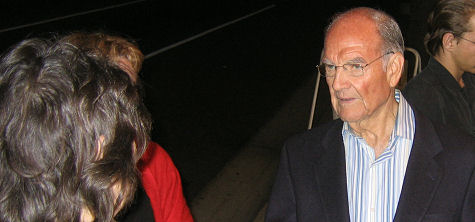
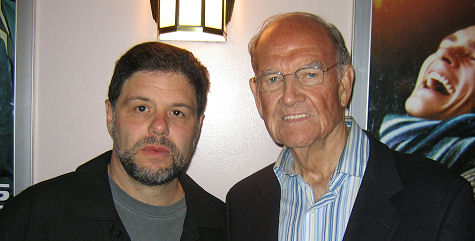
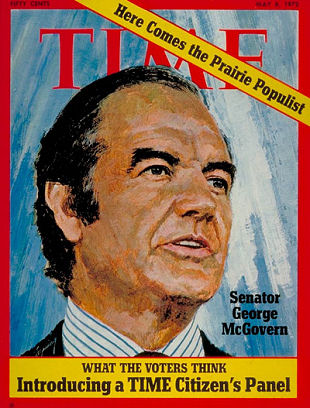
Every now and then you need to take a break from all the Hollywood crap, and I got a really nice one last Saturday from an encounter with former U.S. Senator George McGovern. In so doing I felt an emotion that I haven’t had much contact with lately. I felt a kind of familial love.
The occasion was an early-Saturday-evening showing at Laemmle’s Music Hall of Stephen Vittoria’s One Bright Shining Moment: The Forgotten Summer of George McGovern, which I’ve been trying to catch since last July or so, when I happened to see a poster for it in the lobby of Manhattan’s Quad Cinema.


Stephen Vittoria, director of One Brief Shining Moment, and George McGovern in lobby of Laemmle’s Music Hall — Saturday, 11.19, 8:23 pm.

I’ve always admired McGovern, the longtime South Dakota liberal who’s mainly known for his catastrophic run as the Democratic President candidate in 1972 against President Richard Nixon. Hurt by a campaign that was chaotically mana- ged but also unlucky, McGovern got less than 40% of the vote and took only two states, Massachucetts and the District of Columbia.
I’ve long respected McGovern for having thetorically guided the last plain-spoken, genuinely liberal Democratic Presidential campaign. But my affection has mainly been about a long-held feeling that profound currents of decency and compassion run within him.
< ?php include ('/home/hollyw9/public_html/wired'); ?>
It sure felt that way as he spoke to a middle-aged crowd that had just seen Vittoria’s film around 7:30 pm, and later as he posed for photos and signed autographs and whatnot in front of the theatre on Wilshire Blvd.
He’s 83 now and seems to be in excellent health — tanned, trim — and he told the crowd he wants to live to be at least 100. He needs that much time, he said, to accomplish all his goals, which include doing what he can to eliminate hunger in third-world countries.
He’s been the World Food Program’s first global ambassador on hunger since ’01, and before that served as U.S. ambassador to the U.N. Food and Agriculture Agencies, based in Rome, Italy, from ’98 to ’01.
He said that his favorite line in Vittoria’s doc is when Gloria Steinem says that looking back on the ’72 campaign, the McGovern loyalists have a lot more to be proud of than do the supporters of Nixon’s campaign, who have all that Water- gate-related skullduggery to contend with.

Salon‘s Andrew O’Heir recently wrote than “when the long lens of history finally focuses on McGovern’s contentious era, he’ll appear in the main text, named as a prophet, while Nixon will be a twisted king consigned to the footnotes.”
But when asked last Saturday evening what he thinks about the present White House occupant, McGovern said he’d rather have Nixon there.
Nixon, he pointed out, was fairly practical and forward-thinking on domestic issues and the economy. He created the Environmental Protection Agency, advocated gun control, imposed wage and price controls, etc. And he wasn’t indebted to the neocons and their absolutist agendas.
The talking heads in One Bright Shining Moment include McGovern, Steinem, Gore Vidal, Warren Beatty, Howard Zinn, Dick Gregory, Gary Hart, Frank Mankiewicz, Jim Bouton, Rev. Malcolm Boyd and Ron Kovic.
Vittoria’s film is, for my money, a little too admiring, strident and one-sided. I wish he’d talked to some conservatives and maybe even a former enemy or two. It would have given the film some added intrigue without compromising McGovern’s image.
Some liberals still flinch at the memory of the ’72 campaign, but when a man has lasted as long as McGovern has and consistently stood for caring and compassion in public afairs, what’s not to admire? We’re speaking of one of the most steadily principled men to succeed in big-time politics in the 20th Century.


McGovern and admirers on sidewalk in front of Laemmle’s Music Hall on Wilshire near Doheny — Saturday, 11.19, 8:25 pm.

The Village Voice‘s Michael Atkinson has complained that Vittoria’s doc is filled with “exactly the sort of starry-eyed, bullet-spraying hyperbole that drains credibility from any brand of political discourse,” adding that it “may be useful as home-front history, if only it didn’t rant, yowl, and wet its pants so much.”
Still, it’s a good thing to have a film out there that doesn’t just train your attention on who George McGovern really is and was, and what his campaign was all about, but which pays the proper respect.
One Bright Shining Moment: The Forgotten Summer of George McGovern has been moving from city to city since its New York debut on 9.16. It doesn’t appear to have played a lot of the big liberal cities — San Francisco, Portland, Seattle, Chicago, etc.
The distributor, First Run features, is obviously operating on a shoe-string, but you’d think they’d at least manage to get it booked in the above-named cities and get it seem by as many devoted lefties as possible before the DVD debut in April ’06.

USC Interlude


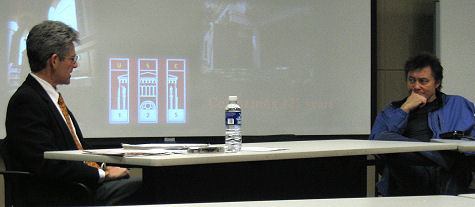
Ain’t It Cool’s Drew McWeeny and yours truly paid a visit Monday night to Charles Fleming’s “Entertainment, Business and Media in Today’s Society” class at the USC School of Journalism. We talked about internet journalism, industry politics, survival skills, the shortcomings of Tom Rothman and what the students think about the hot new movies. Defamer’s Mark Lisanti, profiled in the current issue of Los Angeles magazine, was supposed to show but bowed out at the last minute….something about his girlfriend having told him they already had “plans” (does that sound like a crock or what?). Thanks to Fleming (pictured at left with the suit and tie) for having us down.

White Eyeballs

As everyone presumably knows, I spend a lot of my spare time thinking up new ways to rip Peter Jackson. I’m kidding, but seriously…this is not one of those articles.
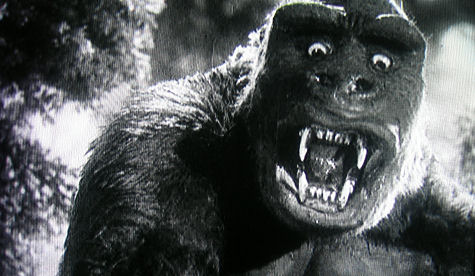
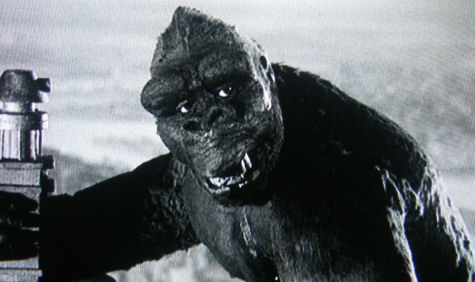
This is about a significant difference between Jackson’s King Kong — the big digital simian we’ll soon be seeing on the big screen — and Merian C. Cooper and Willis O’Brien’s classic stop-motion, herky-jerky version.

When this hit me the other day I was so excited I almost had to pull over and stop the car. The odd thing is that Jackson and a couple of his model-and-visual-effects guys talk about this very issue on the making-of-King Kong doc on the just-relea- sed Warner Home Video DVD of Cooper’s 1933 film.
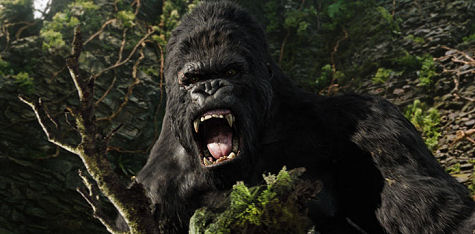
I’m not saying Jackson has made the right or the wrong call in the fashioning of his own Kong, but stills from King Kong (Universal, 12.14) make it clear that his version is modelled pretty closely on the shape and musculature of real gorillas.
There may be some creative interpretation but compare Jackson’s ape with the shot [see below] of a Dianne Fossey gorilla…okay? Same deal. Grayish brown coat, big long Popeye arms, stubby hind legs, brown eyes.

Cooper’s Kong didn’t look like any gorilla, chimp or orangutan that had ever walked the earth. He was something between a prehistoric hybrid and an imaginary mon- ster of the id…a raging nightmare beast designed to scare the bejeesus out of 1933 moviegoers.
O’Brien, the legendary stop-motion phtography pioneer, used three slightly different-looking Kong models during filming, but for me the master stroke was deciding to give his Kong a set of gleaming white teeth and a pair of very bright white eyes.
In some of the darker shots of Kong in the 1933 film those teeth and those eyes just pop right out, and the effect is still primal as hell. Those white eyes and black pupils look so fierce and almost demonic…contrasting as they do with that black bear fur that Kong was covered in…that they almost give you the willies, even now.

Judging solely by the stills, there’s no such aura with Jackson’s National Geogra- phic Kong. The realism element is awesome but the guy doesn’t look all that spooky. I mean, not even a little bit. Ferocious and all, but he makes me think of Michael Apted and Sigourney Weaver.
There’s anothing wrong with this approach. It is what it is, and Jackson is going for his own thing. The stills and the trailer clearly suggest that his Kong is going to be one of the richest visual banquets in monster-movie history, if not movie history itself.
But in going for anthropological realism Jackson has thrown out that creepy, better-than-reality, only-in-the-movies element that gives the 1933 film a little- boy’s-nightmare quality.

Step On It

Rob Marshall’s Memoirs of a Geisha (Columbia, 12.9) is this year’s model of the big bland Best Picture contender that everyone who isn’t a sucker for this kind of thing — expensive, beautifully produced, Oscar-hungry, terminally boring — needs to throw tomatoes at.
Seriously…let’s start the ball rolling now. IM your friends and coworkers and tell them you’ve heard it’s a tedious costume-movie drag, but also that it’s caught a certain headwind and there’s a slight chance it could metastasize into this year’s Chicago.


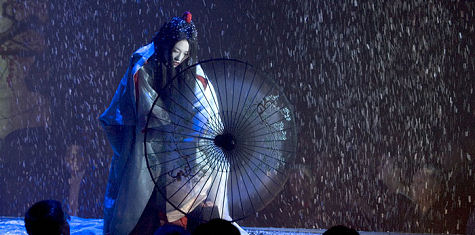
Ziyi Zhang during her big geisha-in-a-snowfall performance number that has zip to do with her character but a lot to do with Rob Marshall’s creative sensibility

The best thing about it is Gong Li’s performance as a jealous-bitch geisha in a Bette Davis mode. Otherwise the film is all costumes and pretty photography and a rags-to-riches story that creeps along at a petty pace.
It’s porcelain, nothing, stupefying…and every Godforsaken line of Chinese-accent English-language dialogue is like screeching chalk.
The first Academy-member Geisha screening happens tonight (11.21) so no pulse- readings until tomorrow, but there’s a poll of nine connected journos that just went up today on Movie City News called “Gurus of Gold,” and Geisha is being project- ed as one the top five Best Picture contenders.
Two of the respondents — Variety guy and Maxim critic Pete Hammond and USA Today‘s Scott Bowles — are actually projecting it as the most likely Best Picture winner…at this juncture.
The stars of Memoirs of A Geisha are Ziyi Zhang, Michelle Yeoh and Gong Li… three famed Chinese actresses played Japanese geishas and speaking English …and the feeling of Hollywood fakery and retrograde attitudes is fairly relentless.
The same Anglos-first mentality that led to the casting of Marlon Brando as Sakini in The Teahouse of the August Moon (’56) and Ricardo Montalban as Nakamura in Sayonara (’57) has prevailed once again.

And at no point does Memoirs of a Geisha feel like anything more than a colorful but perfunctory corporate tour of an exotic culture, tailor-made for Disney World Americans who won’t pay to see movies with subtitles.
I can tolerate the three Chinese actresses playing Japanese (although Ziyi doesn’t look Japanese for a second, and there’s a clear genetic difference in the faces of the two peoples), but the language and accent barriers are impossible.
Marshall should have shot a Japanese-language version concurrently, which Columbia could have concurrently released into select big-city theatres. Difficult but not impossible, and then people like me would have had an easier time of it.
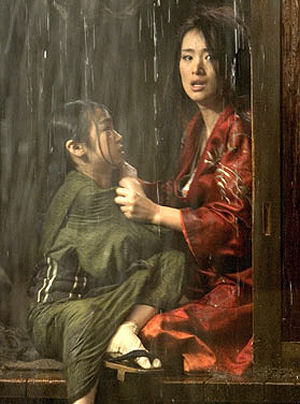
There’s a scene early on in which a pair of young sisters are about to be forcibly separated. A very traumatic thing, but if this were to happen in real life the sisters would be in such shock they’d probably whimper a little bit and spend most of their last few seconds just staring at each other. Not in Rob Marshall’s world. When Geisha‘s sisters are torn apart the more spirited of the two goes, “Noooooo!!”
That’s a bullshit Hollywood reaction. People in bad Hollywood movies always go “noooo!!” when something bad happens. In a way, the whole movie is like this one scene. I didn’t believe a word of it.
And I wonder if the women for whom it’s been made will either. And I doubt if any real critical support will manifest. A publicist friend tells me all the journos he’s spoken are saying “pretty to look at, but cold.”
Robin Swicord and Doug Wright’s script is based on Arthur Golden’s 1997 novel, which is a huge international best-seller. I think it’s safe to say that the movie will dampen interest in anyone who hasn’t yet read it wanting to do so. My God, who would want to take this journey twice?


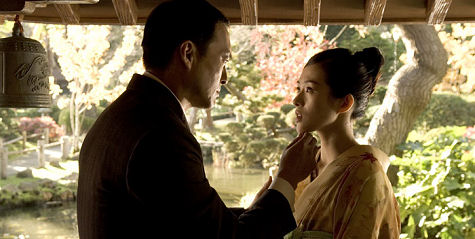
Ziyi Zhang, Ken Watanebe

Set in Japan in the 1930s and ’40s, Geisha is essentially a Cinderella story, and there’s not a hint of story tension or rooting interest in any part of it.
A little Japanese girl (Suzuka Ohgo) who will eventually be called Sayuri is sold to a geisha house (called an “okiya”), kicked around and treated like a slave. She’s quite pretty as an adolescent and is considered a special standout because of a pair of very weird-looking blue eyes (which throw you completely out of the film because they look like dopey contact lenses, pure and simple).
And then she grows up to be Ziyi Zhang, who doesn’t resemble Ohgo in the slightest.
This much-celebrated 26 year-old actress gives her first nothing performance here. She brought a fierce glaring passion and a taut physicality to her roles in Crouch- ing Tiger, Hidden Dragon and Hero and found a sense of emotional truth in Wong Kar Wai’s 2046, but here she’s a piece of wood.
Gong Li wields a much sharper blade as Sayuri’s wicked geisha nemesis Hatsu- momo. She’s stuck in the same mediocre Rob Marshall movie, but there’s fire in her veins and the heat burns through, and right away she has you thinking impure thoughts.
Sayuri, in any event, is trained to be a geisha and soon gets into an ongoing generational cat-fight with the older Hatsumomo. Her ally is Yeoh’s Mameha, a 40ish geisha playing a stock older-mentor character, dispensing sage advice with the usual kindly-patient smile.


Suzuka Ohgo (l.), Gong Li

Eventually Sayuri meets Prince Charming in the form of a businessman called “The Chairman” (Ken Watanabe) and falls for him. The usual hurdles and compli- cations have to be overcome before Watanebe finally recognizes what a treasure she is and tells her he loves her.
I think I was a little happier than Sayuri was when this happened.
The most irritating performance is given by Kaori Memoi, who plays the crusty and conniving Mother, the head of Sayuri’s geisha house. Her English is so bad and so grating I literally twitched in my seat at one point.
The movie stays with the explanation in Golden’s novel about what being a geisha is all about, which is that geishas are in no way prostitutes and are more about being a very refined form of arm candy…a poised and disciplined ideal of Japanese femininity.
And yet somehow, despite all the talk about no sexual favors, Sayuri and Mameha end up doing some nocturnal skinny-dipping with a bunch of Japanese business- men and an American colonel (Ted Levine) in the third act.
A Japanese businessman admirer of Sayuri has asked her to cuddle up to the American Colonel so he get get a business deal out of him, and when Levine’s character makes a move a few minutes later Sayuri is shocked and offended.
This is ridiculous, and another reason I didn’t believe what the film was selling. Geishas are not hookers, okay, but all my life I’ve been told that carnal knowledge is sometimes part of the equation. You just have to be the right guy with the right attitude, the good manners of a gentleman and a lot of money.

No one will argue with Geisha getting the usual below-the-line nominations that are always handed to a film of this type. Dion Beebe’s cinematography, John Myhre’s production design, Colleen Atwood’s costumes and John Williams’ score are all topnotch. What the hell, throw in nominations for the editor and the sound editing guys.
Geisha was mostly shot in the Los Angeles area (an outdoor Japanese village was built north of the city), including the Sony soundstages in Culver City. That means a lot of local people were paid top dollar, which tends to produce in the minds of Academy people an urge to reciprocate in the form of handing out Oscar nomina- tions in the less-important categories.
But classy window-dressings aren’t enough to justify nominating a film for Best Pic- ture. The above-the-line nutrition in Memoirs of a Geisha simply isn’t there, and no amount of cheerleading by its supporters is going to change that fact.