Toronto’s Eleven

Toronto’s Eleven

I’ve only been coming here since ’98, but it seemed to me like the best Toronto Film Festival ever. Too many good films, too many I didn’t get to see, the energy always there…every day felt like a full deck.
I saw (or re-saw) eleven films here that I know will matter in terms of awards or box-office or causing some kind of a stir over the next thirteen and a half weeks, and that felt fairly bountiful.
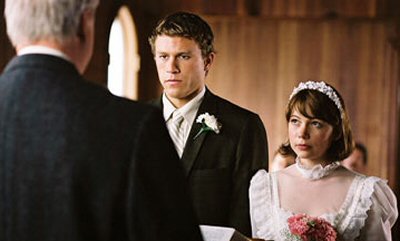

Brokeback Mountain costars Heath Ledger, Michelle Williams

I’m just sorry that the festival fathers didn’t re-show some of the favorites this past weekend (like they used to) so I could’ve seen some of the films that I couldn’t get to for whatever reason. Now I won’t get to see Bettie Page until next year…not good.
The goodies, in order of admiration…
< ?php include ('/home/hollyw9/public_html/wired'); ?>
1. Brokeback Mountain: I didn’t expect to be as moved as I was. Not a “gay cowboy” movie, but a film about the costs of love denied and lost. My idea of a profoundly sad film, and obviously a love story of a strikingly original cast… certainly in terms of multiplex movies. Oscar potential: A probable Best Picture candidate (if it doesn’t tank financially). Ditto Ang Lee for Best Director. Heath Ledger, who gives the best performance of his career here, will almost certainly snag a Best Actor nom. Commercial prospects: No telling, although I’d like to say quality sells itself and let it go at that. I know this movie is a kind of break- through, and therefore a marketing challenge as far as the cultural foot-draggers are concerned.
2. No Direction Home: Bob Dylan: An electrifying music-history saga, a powerful American epic and Martin Scorsese’s finest film since My Voyage in Italy. Oscar prospects: It’s not going out theatrically so Oscar doesn’t figure. Commercial potential: The numbers for the doc’s PBS airing on 9.26 and 9.27 should be huge; ditto the sales and rental for the DVD (in stores on Tuesday, 9.20).
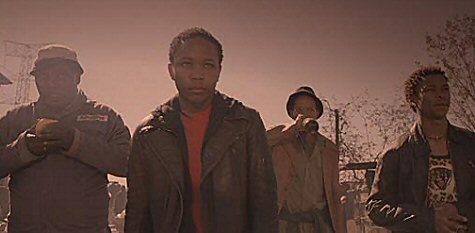

The Tsotsi gang

3. Capote: Searing, fascinating drama about a writer who pours his heart out and uses every ploy in the book to produce a groundbreaking novel, but loses his soul in the process. So deft and mature it’s almost like Louis Malle directed it. Oscar prospects: Phillip Seymour Hoffman’s performance as Truman Capote is an absolute lock for a Best Actor nomination, and I really think the film is good enough to be in the running for a Best Picture nomination. Clifton Collins, Jr. deserves a nom for Best Supporting Actor, Bennett Miller for Best Director, and Dan Futterman for Best Adapted Screenplay. Commercial potential: Everyone who’s ever heard the name “Truman Capote” is going to want to see Hoffman. One of those films that every semi-educated soul over the age of 25 or 26 is going to have to see…right?
4. Tsotsi: Emotionally pungent drama about the spiritual awakening of a socio- pathic teenage killer after he finds an infant boy in the back seat of a car he’s stolen. Winner of Toronto Film Festival’s audience award. Oscar prospects: A shoo-in for Best Foreign Language Film (it’s spoken in “Tsotsi-taal,” a mixture of several tongues), but obviously only if it gets picked up right away and pushed into theatres before 12.31. Commercial potential: A toughie…will depend very much on word-of-mouth, reviews, how good the marketing campaign is, etc.
5. A History of Violence: David Cronenberg’s strongest and most commercial film since The Fly. Oscar prospects: Limited, although William Hurt could push through with a Best Supporting Actor nomination. Commerical potential: On the modest side.
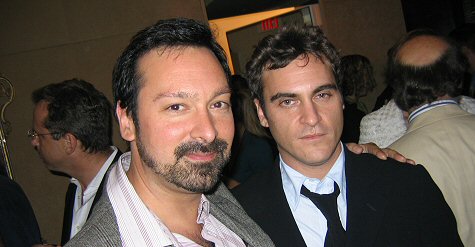

Walk the Line director James Mangold (l.), star Joaquin Pheonix

6. In Her Shoes: Best upscale chick flick since Terms of Endearment. Oscar prospects: Forget what Manohla Dargis or Stephanie Zacharek may or may not say about it — the fact that it emotionally connects means Shoes could go all the way and land noms for Best Picture, Best Director (Curtis Hanson), Best Screen- play, Best Actress (Toni Collette), etc. An assured Best Supporting Actress nom for Shirley MacLaine. Commercial potential: Very big, although Fox is going to have to work hard at first to sell it to the women who don’t read reviews, or who move their lips when they do.
7. Walk the Line: Admirably pared-down, ultra-believable Johnny Cash biopic…rooted and steady on its feet. Oscar prospects: Guaranteed Best Actor and Best Actress noms for Joaquin Pheonix and Reese Witherspoon; possible Best Picture and Best Director (James Mangold). Commercial potential: I don’t think it’s going to do what Ray did, but reasonably spirited business seems likely.
8. Thank You for Smoking: Sharp, clever, quippy…lacking in emotional gravitas. Oscar prospects: Not that kind of thing. Commercial potential: Good to pretty good.
9. Mrs. Henderson Presents: Not a massive home run but a very brisk serving of rudely effete British humor in a perky period vein. A lively near-perfect film for the over-30 (or do I really mean over-40?) crowd. Oscar prospects: A better-than- decent chance of Dame Judy Dench landing a Best Actress nomination…if the Weinstein Co. campaigns hard and smart for it. Commercial potential: Rather good.
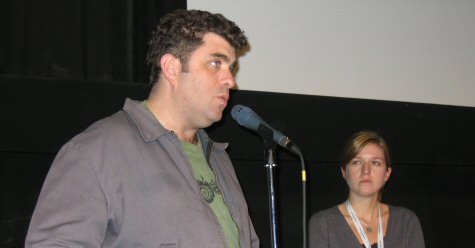

Why We Fight director Eugene Jarecki during q & a at Cumberland plex during Toronto Film Festival

10. Sketches of Frank Gehry: Sydney Pollack’s doc is a highly intelligent look at an exceptional man, and a profound contact high. Oscar prospects: There’s no theatrical distribution deal, and even if it lands one it may be too late (or so I understand) due to Academy rule about August deadline. Commercial potential: The only viewing opportunity for sure right now is a PBS “American Masters” airing in the fall of ’06.
11. Why We Fight: Eugene Jarecki’s doc about the carrot-and-stick relationship between American interventionism over the decades and the military-industrial complex is utterly fascinating, well-sculpted, and stirring. Oscar prospects: Good potential to figure among the Best Feature Doc nominees. Commercial potential : Good.
As for the rest…
The Modest but Very Welcome Return of Steven Soderbergh: Bubble
Good, Fairly Good, Decent: Mary (dir: Abel Ferrara), Cache (dir: Michael Haneke), Tristram Shandy (dir: Michael Winterbottom…although I’m leaning on the word of trusted sources, as I was shut out of the press screening last Monday), Everything is Illuminated (dir: Liev Schreiber), Imagine Me and You (dir: Ol Parker), L’enfer (dir: Davis Tanovic), Vers le Sud (dir: Laurent Cantet).
Shortfalls: North Country, Stoned, John & Jane, Romance & Cigarettes, Lie With Me.
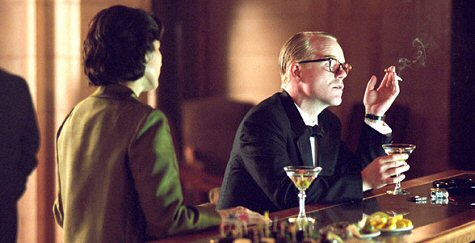

Capote costars Catherine Keener, Phillip Seymour Hoffman

Near-wipeout: Elizabethtown…but an obit would be premature at this stage, as a re-edit is in the works.
Wipeouts: Tideland, Revolver, Wassup Rockers, The Cabin Movie, Mrs. Harris.
If only the music grabbd me…: The Devil and Daniel Johnston.
Gloob gloob: Shopgirl, The President’s Last Bang, The White Masai, Mistress of Spices, Sorry Haters.
Martyr-Ball: The War Within, Paradise Now
Missed ‘Em: Leonard Cohen: I’m Your Man, Iberia, Tristram Shandy, The Matador, Edison, Jesus is Magic, The World’s Fastest Indian, The Proposition, The Notorious Bettie Page, Wah-Wah, Tim Burton’s The Corpse Bride (didn’t care that much about seeing this one), Oliver Twist, Bee Season.

Bad Guy and a Baby

Gavin Hood’s Tsotsi has become the big stand-out at the end of the Toronto Film Festival.
It was first shown on Wednesday night, right opposite the In Her Shoes viewing at Roy Thomson Hall, and by this time many of the top-tier journalists had left town, so there haven’t been a lot of insiders hopping up and down about it. And yet today — Saturday, 9.17 — it won the Toronto Film Festival People’s Choice award.
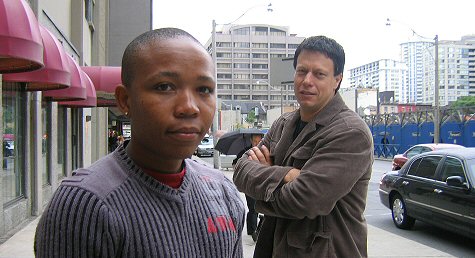

Tsotsi star Presley Chweneyagae (l.) and the film’s director-writer Gavin Hood outside Toronto’s Sutton Place hotel — Friday, 9.16, 8:55 am.

I also know Tsotsi has aroused the persistent passions of at least one would-be distributor. And that it touched enough people at the recently-wrapped Edinburgh Film Festival to win the Audience Award, along with the Michael Powell award for Best New British Feature.
Even the notoriously hard-nosed critic Len Klady told me early this afternoon, “I hear it’s very good.”
As I waited to see it Thursday afternoon I thought I might be in for another hyper- cut City of God crime-in-the-slums movie, but it was something quite different.
Set in a rancid Johannesburg shantytown, Tsotsi (pronounced “Sawt-see”) is about an ice-cold teenage thug (Presley Chweneyagae) who discovers a small spring of compassion in himself when he starts to care for an infant boy who happens to be in the back seat of a car he’s stolen.
What is this film doing exactly? It’s reminding audiences in a believably non-sappy way there are sparks of kindness in even the worst of us. It’s a rather Christian- minded movie, in a sense.
It may sound sentimental and manipulative, but it’s not. But neither is it sadistic or repellent in some flashy, gun-fetish way. It’s real and unblinking, but it also lets you feel what’s happening. But not too much…just enough.
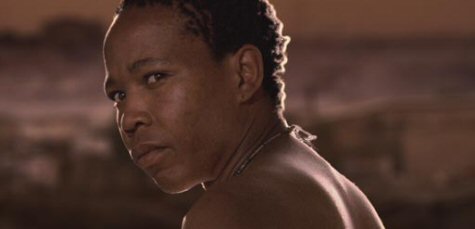

Tsotsi star Presley Chweneyagae

Emotions suppressed but leaking out anyway…the emotion you’d rather not feel but which won’t leave you the fuck alone…the emotions that you stopped letting in when you were eight or nine but have always been there…conveying these in a film is always a stronger, more poignant thing than having some emotionally healthy actor or actress cry their eyes out or hug everyone to death…please.
I said this in a Wired item posted on Friday morning, and here it is again: unlike Luc and Jean-Pierre Dardenne’s Palme d’Or-winning L’enfant, which it vaguely resembles, Tsotsi has a potential to snag some decent coin as well as Oscar nominations (Best Foreign-Language Film, Best Actor, etc.), critics awards, Golden Globe awards, etc.
How do I know Tsotsi will sell tickets? Because my good and kindly Toronto friend Leora Conway, who know what she knows but isn’t tremendously knowledgeable or sophisticated about movies, went apeshit after seeing Tsotsi at the Wednesday night premiere…she was beaming when she told me about it afterwards, and said it made her cry at the end.
Bad guys and wailing babies…it’s bound to be the very next phase. Tsotsi, L’enfant and Michael Davis’s Shoot ‘Em Up, the comically violent Don Murphy-New Line movie with Clive Owen as a gun-toting Man of Few Words protecting a baby who’s only a day or two old. Any others?
Wait a minute…I see a TV series in this. A wise-cracking yuppie assassin (think John Cusack) whose girlfriend dies just after giving birth..this hard-assed guy has to juggle diapers and nanny-care while taking care of business. And he’s got a nosey female neighbor who’s secretly hot for him.
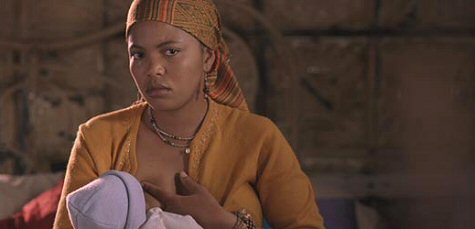

Tsotsi costar Terry Pheto as Miriam, a single mom who establishes a bond with Chweneyagae’s street thug.

I had breakfast early this morning with Hood, Tsotsi‘s director and writer (the film is based on a novel by South African playwright Athol Fugard), and Presley Chweneyagae, who plays the title role, at the Sutton Place hotel, and we batted it around some.
Hood said he’s always been “terrified” of sentimentality and “being mushy” in movies, and says that his mantra during shooting was that “there’s always got to be more going on within a character than what he lets out.”
Hood said he wanted to use formal compositions and a slower editing style than the one popularized by City of God “because I didn’t want to seem like I was saying ‘me too’…I didn’t want to come in second.”
Hood says he feels more of an affinity with the shooting style of director Walter Salles (The Motorcycle Diaries) and particularly Sales’ Central Station than he does with City of God director Fernando Meirelles.
The language that Chweneyagae and his costars speak is known as “Tsotsi-taal” (the first word meaning “thug” and the second meaning “language”). It’s a mixture of several tongues including English, Afrikaans, Zulu, Xhosa, Sothu and Tswana.
To qualify for Academy consideration, Tsotsi is opening in South Africa today for one week.
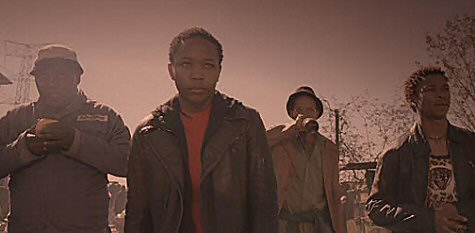

Tsotsi gang (l. to r.): Aap (Kenneth Nkosi), Tsotsi (Presley Chweneyagae), a failed teacher (Mothusi Magano) and Butcher (Zenzo Ngqobe)

Hood showed the finished film to Fugard, 87, at his San Diego home just before the Toronto Film Festival began. Fugard was delighted and wrote that Tsotsi “is everything in my wildest dreams that I hoped it would be…it is far and away the best film that has been made of something I have written [and] it will rank as one of the best films ever to come out of South Africa.
This is one of those “it” films. I could feel the rooted energy from the get-go…from Hood’s hard-edged direction, the elegant photography and Chweneyagae’s mesmerizing performance as an ice-cold psychopath who now and then devolves into a terrified three-year-old. It all coagulates into something steady and whole.
If I know anything about this business, somebody is going to pick this film up fairly soon. But they’ll need to move quickly once they do, so hubba-hubba and chop- chop.

Reasons to Believe

A thought hit me when I was writing my column from Toronto on the evening of 9.11.01, but I didn’t have the brass to write it down.
It was my suspicion that no one in the news media in the coming weeks or months would ever be permitted to explore (or even discuss on a talk show like, say, Chris Matthews’ “Hardball”) what might have motivated the 9.11 attackers to do what they did.
It seemed fairly obvious that the news media were already locked into characterizing the Al Qeada plotters as nothing more or less than harbingers of pure evil, and that allowing for the possibility that United States foreign policy might have had something to do with their anger would simply never be acknowledged.
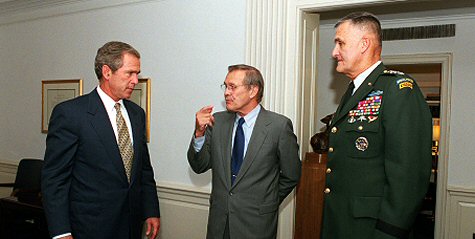

Not from Eugene Jarecki’s Why We Fight, although it could have been used if Jarecki had so chosen.

Eugene Jarecki’s Why We Fight, which I finally saw Thursday afternoon at Toronto’s Cumberland cineplex, isn’t the first doc to explore why so many people around the world hate our guts, but it’s one of the most precise and persuasive.
This is a cleanly composed, very perceptive explanation of how the American military-industrial complex basically runs everything and everyone, from the U.S. President to the U.S. Congress to the slant of our foreign policy.
Sony Pictures Classics will be releasing Jarecki’s doc in January 2006. It’s already been qualified, I’ve been told, to compete for the best feature-length documentary Oscar.
The news-clip centerpiece, as you might imagine, is former president Dwight D. Eisenhower’s farewell address warning about the influence of the burgeoning military-industrial complex. Jarecki then goes on to show exactly how prophetic Ike was.
This will seem like boilerpate stuff to some, but Jarecki and his sources explain how and why the U.S. decided at the end of World War II to become a permanent roving super-power with the technological ability (if not necessarily the political will) to strike any adversary in any country at any time.
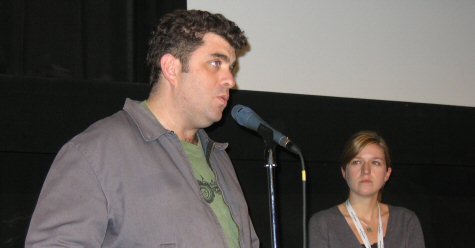

Why We Fight director Eugene Jarecki during q & a following Thursday afternoon’s screening at the Cumberland plex — 9.15, 5:50 pm.

The film’s title is borrowed from a jingoistic Frank Capra doc made during World War II that explained the necessity of defeating Japan and Nazi Germany.
The movie says that for roughly the last 60 years, the U.S. has been led by a basic need for constant military adventurism for the sake of domestic corporate profits, which are then spread around to political supporters in government.
Fight shows how there are four branches of Eisenhower’s complex today — the military, the weapons-making industry, the U.S. Congress and conservative think tanks — and how they all feed into each other.
Gore Vidal is one of Fight‘s talking heads, supplying his view at one point that “we live in the United States of Amnesia.”
But Jarecki is smart enough to stay away from staunch liberals for the most part, speaking mostly to establishment or conservative types such as Sen. John McCain, high-level CIA veteran Chalmers Johnson, William Kristol, Richard Perle, former Lt. Gen. Karen Kwiatkowski and former president Eisenhower’s granddaughter Susan and son John.
Jarecki also talks to the wonderfully candid and articulate Charles Lewis of the Center for Public Integrity, who was more or less the star of Orwell Rolls in His Grave.
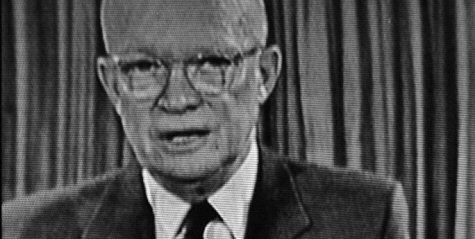

Former U.S. President Dwight D. Eisenhower delivering his farewell speech on 1.17.61.

Why We Fight is also effective when it talks to average-Joe types. The standout in this realm is an ex-cop named Wilton Sekzer, whose son was killed on 9.11 and who came to embrace a very cynical attitude about the foreign policy aims of the Bush administration, not to mention its general lack of candor about same.
Jarecki also interviews a fresh Army recruit named William Solomon, and to a couple of military pilots who dropped the first bombs in the 2003 invasion of Iraq.
On top of everything else, Jarecki is an excellent cinematographer and editor. The movie is persuasive in part because it’s been shot and cut with eye-pleasing expertise.
Eugene is the brother of Capturing the Freidmans director Andrew Jarecki, as well as the half-brother of Nic Jarecki, who made the excellent James Toback doc The Outsider. Having hung with all three, I can say with some authority they’re a clan worthy of Eugene O’Neill.

Lonesome Town

The energy is down all over the Toronto Film Festival. You can feel it on the street, at the Varsity, in the hotels…it’s over except for locals and stragglers like myself and a few clean-up screenings to get to, like tomorrow’s (9.16) showing of Martin Scorsese’s No Direction Home: Bob Dylan.
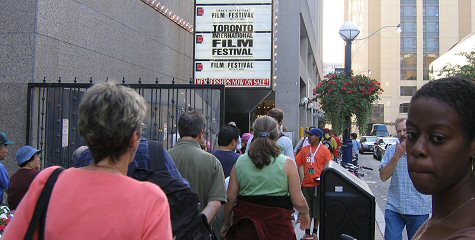
Girl Power

It was early Wednesday afternoon, and I was standing in the hallway of the 26th floor of Toronto’s Four Season’s hotel, waiting for my ten-minute quickie with In Her Shoes director Curtis Hanson.
And then a door opened about three feet away and Shoes costar Shirley Maclaine, who owns each and every scene she appears in, peeked out and said hello.
A Fox publicist sitting to MacLaine’s left smiled and nonchalantly said “hey.” I forget how Maclaine replied, but I think she was mainly looking to take a breather.


In Her Shoes star Toni Collette, snapped at Wednesday night’s post-gala party, has shed the weight she gained for the film and is now quite obviously not a brunette, as she is in the film. Director Curtis Hanson, Shirley MacLaine, Cameron Diaz and a bunch of journos (Peter Rainer among them), publicists and agents were also huddling in the VIP area.

The Fox publicist smiled and said, “Shirley, this is Jeffrey Wells, a journalist, and he really likes the film.”
“A man who likes the film…good,” said MacLaine.
The publicist turned slightly in my direction and said, “Tell Shirley what you told me.”
I looked at MacLaine and said, “I think it’s the best chick flick to come along since Terms of Endearment.”
And I know how phony that sounds. People are always tossing around suck-uppy comments at press junkets, but I really haven’t responded this strongly to a film that’s mainly about older and younger women in the same family grappling with heavy emotional life issues since that 1983 James L. Brooks film.
Really…I haven’t. And if I have I can’t think what other film I might be forgetting about.
“That’s good but it’s not a chick flick,” Maclaine said right away. “It’s really about family. Nice meeting you…bye.” And then she closed the door.
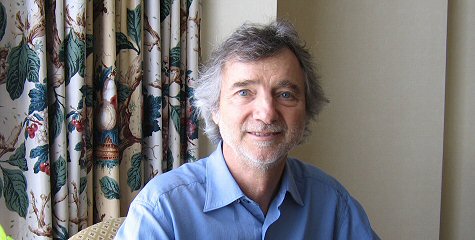

In Her Shoes director Curtis Hanson during my ten-minute interview with him at Toronto’s Four Seasons hotel — Wednesday, 9.14, 1:12 pm.

“She’s a bit of a character,” the publicist said. I was thinking to myself, didn’t MacLaine just make a point about a man liking this thing?
Trust me — In Her Shoes is a chick flick. It just happens to be a very good one, and when a particular type of movie is really exceptional that usually means it’s digging deeper and operating with more skill and finesse than other chick flicks that have gone before. And that means it has become more of a plain old good movie than just a chick flick…even though it started out that way.
It was finally time for my ten-minute Curtis Hanson interview. I’ll get into this sometime over the next two or three days, but Curtis was his usual robust and articulate self and I wished we could’ve had…oh, maybe two or three minutes more? Should I shoot the moon and wish for an extra five?
When I was told I would only have ten minutes with Hanson, I coughed and shifted my weight and leaned forward and said, “Ten minutes?” I felt insulted. Why not eight minutes? Why not two? The haiku interview!
I wrote a blurb-sized review of In Her Shoes yesterday for the Wired box. I’ll try and write more this weekend…maybe.

Line Walker

Walk The Line holds up and then some. I liked and respected it after seeing it the first time (i.e., last July), but didn’t quite love it. I saw it again Tuesday morning and while I’m still not 100% wowed by the love story element, I have an even greater respect for how lean and down-to-it and well-assembled this film is.
I’ll say it again for the sake of emphasis: this movie, very neatly, is analogous to a Johnny Cash song — solid and straight, no b.s. or flaky embroidery. And it’s very conceivable it could punch through as a Best Picture nominee because of these attributes alone.
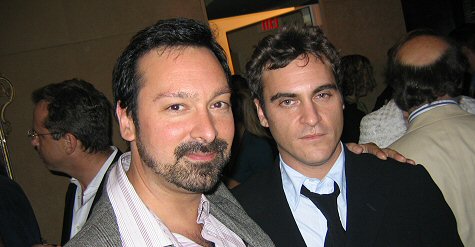

Walk the Line director and co-writer James Mangold (l.) with star Joaquin Phoenix at 20th Century Fox’s post-screening party for Walk the Line — Tuesday, 9.13, 10:10 pm.

Oh, and that item I ran about director James Mangold having allegedly trimmed a bit out of the opening scenes of Walk the Line so it would lessen resemblances to Ray? Bogus. Mangold is telling journalists that the film has been locked for the last four months, and the version I saw this morning in Toronto was precisely the same one I saw in Manhattan, so sorry for briefly muddying the waters.
After seeing four movies today — Walk the Line, the very authentic and unsettling Paradise Now, John & Jane (see review below) and Larry Clark’s lazy, totally masturbatory Wassup Rockers — I strolled over to the Walk the Line party at the Chanel store on the north side of Bloor between Bay and Avenue Road.
The small VIP room was upstairs and very poorly ventilated. No sooner did the Fox publicists wave me into this inner sanctum when Joaquin Phoenix and a friend of his both lit up cigarettes, and you could really smell it.
Daily Mail columnist Baz Bamigboye and I spoke with Phoenix for a few minutes. He’s a nice guy, cool dude. I loved hearing that he hasn’t seen Walk the Line yet, either in a screening room or with an audience, and he has no plans to see it in the foreseeable future. He laughed when he said this, and his laugh has a very slight tone of perversity.
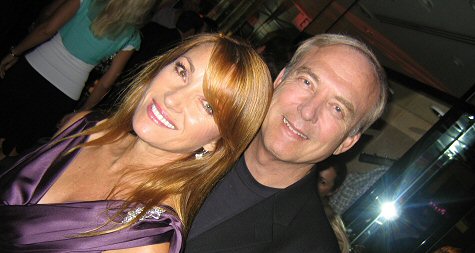

Jane Seymor and husband James Keach, producer and ground-floor instigator of Walk the Line at same after-party — Tuesday, 9.13, 9:55 pm.

I complimented Phoenix on his ultra-realistic fight scene with Mark Wahlberg in The Yards, which is one of the all-time greats. I was surprised to hear that he and Wahlberg didn’t have a stunt guy advising them, but worked out the rollin’ and tumblin’ on their own. They wore knee pads and just told each other, “Okay, I’m gonna hit you and you’re gonna fall down the stairs and then…”, etc.
Mangold, dressed in a tweed jacket and just as warm as I was, was friendly and gracious. I asked him about the film’s best scene, which he wrote, in which Sun records owner Sam Phillips tells Cash and his band during an audition that he doesn’t believe Cash’s signing of a gospel tune, and that he needs to sing some- thing tough and real, etc. Mangold agreed it’s one of the film’s best, and he toasted actor Dallas Roberts, who plays Phillips, for making the scene play as well as it does.
I also spoke to producer James Keach, who knew Cash for several years and tried, with Cash’s approval, to launch his own Cash biopic for a long while before he tied in to the Fox/Mangold/Phoenix project.
Keach and I talked about Cash’s first wife, Vivian, and how the way she’s written and the actress who plays her, Ginnifer Goodwin, makes her seem like the world’s biggest complainer and worst marital partner…a total drag.
What did they get married for? I asked Mangold. Was it sex or…? Mangold said Cash once told him he got married to Vivian because he considered her a dead ringer for Pier Angeli, who was (allegedly) the great love of James Dean’s life.
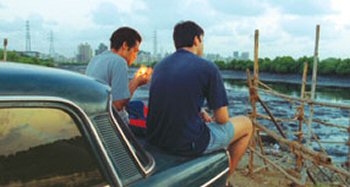

John Turturro’s Romance & Cigarettes

John Turturro’s Romance & Cigarettes is somewhere between being admirably brave, extremely amusing and horribly embarassing for everyone concerned, including those in the audience. But then you’re always risking pain when you make a musical, and you can’t say that Turturro doesn’t have creative cojones. A story about infidelity, stifled dreams and floundering family values among working-class types in Queens and Brooklyn, Cigarettes is at least something “different.” And it’s extremely comforting that the actors don’t wail and croon on their own…they do it karaoke-style (i.e., on top of established recordings on the soundtrack). They also indulge in some half-assed dancing here and there. Romance & Cigarettes is mostly kind of awful but at other times it verges on the euphoric. There are grace notes aplenty whenever the great Chris Walken is on-screen, although his song-and-dance number isn’t as knock-down cool as his Fat Boy Slim MTV thing. (I have to say that the older he and I get, the creepier the mutual resemblance.) As clumsy, indie-styled, vaguely painful musicals go, this is way, way better than Dan Mirvish’s Open House…but I guess that’s not saying much. James Gandolfini sings entirely on his own for about two or three bars, and I found this truly spellbinding while it lasted. Susan Sarandon delivers a fairly spirited sing-along with Janis Joplin’s “Piece of My Heart,” and Kate Winslet punches it out pretty well here and there. But if comedy is hard, musicals are an absolute bitch…especially when you’re dealing with people who may love music but don’t have the talent to deliver tunes and dance numbers in a truly first-rate way…even with original soundtracks providing accompaniment. This is a partly sincere but largely satirical movie, and it’s obviously been influenced by the karaoke phenomenon (which is based on the sickening notion that we’re all singing stars waiting to happen, or at least unappreciated for our intensly soulful croonings) as well as efforts like Pennies From Heaven. But this is nothing if not a blue-collar musical, and what this movies mainly proves is that working people should stick to what they know.

I have a screening to

I have a screening to catch in less than two hours and doing my usual early-morning nutso thing, and Robert Wise has just died at the age of 91. I’m sorry it finally happened, but Wise had a rich life and a distinguished career as a director for about 20 years, from the late ’40s to late ’60s. It was 37 years ago when Wise seemed to surrender the ghost with the arrival of Star!, that godawful Julie Andrews musical debacle that permanently clouded Wise’s reputation as a director who occasionally mattered. Star! made him into a joke. The irony is that two years earlier Wise enjoyed his last creative hurrah with The Sand Pebbles. This 1966 big-studio period drama was widely seen as an allegory about Vietnam and the overall folly of heavily-armed countries look to mold less-strong countries into their own image…a theme that has some resonance today in Iraq. The Sand Pebbles contains Steve McQueen’s best performance ever (not to mention Richard Crenna’s), and it still shatters me each and every time I see it. The first Wise film that really mattered was The Set-up (1949), the real-time boxing noir with Robert Ryan (whose frame was too skinny for a fighter’s). The ones that counted in between this and The Sand Pebbles were The Day The Earth Stood Still, The Desert Rats, Somebody Up There Likes Me, Run Silent, Run Deep, I Want to Live!, Odds Against Tomorrow, West Side Story and The Haunting. This last effort, released in 1961, was a classy horror film that showed nothing except a shot of an expanding wooden door and used only subtle suggestions (sounds, mostly) to convey the presence of ghosts, but it was still extremely creepy. It’s depressing to think about how Wise became known as the stodgy industry guy responsible for The Sound of Music and Star! and Star Trek: The Motion Picture…I prefer to shut these films out. Wise managed one last half-decent film — 1971’s The Andromeda Strain.

We’re supposed to be in

We’re supposed to be in a wind-down phase at the Toronto Film Festival, but there are still several…well, a few intriguing films left to see. At the top of the anyone’s list has to be Martin Scorsese’s 201 minute No Direction Home: Bob Dylan, even though it’ll shortly play on PBS, Gavin Hood’s Tsotsi (which a friend saw last night and raved about), Annette Bening and Ben Kingsley in Mrs. Harris, Hermine Huntgeburth’s The White Masai, and my three cleanup viewings — The War Within, The Notorious Bettie Page and Harsh Times.

David Ayer’s Harsh Times, a

David Ayer’s Harsh Times, a violent Los Angeles-based drama starring Christian Bale and Freddy Rodriguez, has been acquired for distribution by Bauer Martinez Distribution, the new theatrical distribution arm of Bauer Martinez Studios. (Apologies for the earlier error naming Lions Gate as the distributor.) It will have one final Toronto Film festival screening on Saturday evening, which I plan to attend. Movie City News is calling it “Crash for one” while another observer has described it as “a lot like Training Day, but with more of a gritty approach, and with actors who seem actually believable…which makes sense since it’s based on the real-life experiences of the director/writer and people he knows.” Okay…I’m there.

I can see why Fox

I can see why Fox Searchlight and Paramount Classics were fighting over the U.S. distribution rights to Jason Reitman’s Thank You For Smoking. (Fox Searchlight won.) The script is very witty and sharp. The dialogue, if nothing else (and there’s plenty else, starting with Aaron Eckhardt’s performance as Washington, D.C.’s all-time smoothest pro-tobacco lobbyist)…if nothing else describing the rationale “I have a mortgage to pay” as a “yuppie Nuremberg defense” will give it a kind of instant fame in chat rooms and cocktail parrties. Okay, somebody is now going to tell me that some comic coined the “yuppie Nuremberg defense” term ten or fifteen years in his/her stage act…right?

I saw Curtis Hanson’s In

I saw Curtis Hanson’s In Her Shoes (20th Century Fox, 10.7) this morning and it got me. It’s “commercial,” yes, but not in the pat sense of that term — this is the best classy chick flick since Terms of Endearment, and they both have award-level Shirley MacLaine performances. Once you get past the first half-hour, which has a rote, almost sitcommy flavor and is all about showing us what an infantile self-destructive screw-up Cameron Diaz’s character is (and why her older sister, played by Toni Collete, is perfectly justified in wanting her out of her life), In Her Shoes starts to touch bottom when Diaz visits her long-lost grandmother (MacLaine) at a Florida old-folks home, and then it takes off and starts getting better and sadder and wiser and more touching. This is not an Armond White movie, but it’s exceptional nonetheless. It’s going to get every woman in the country and a lot of guys, it may wind up as as a Best Picture nominee, and this is MacLaine’s year, I think, to win another one. Collette and Diaz will probably also be nominated in their respective categories (which may be different), and Hanson also as Best Director. This sounds gushy, I realize, but trust me — Shoes works the way a big-studio, high-pedigree, lay-the-groundwork-and-then-make- them-feel-it emotional drama should. Hanson knew exactly what he was doing.

Niki Caro’s North Country is

Niki Caro’s North Country is an honestly acted, decently assembled 1989 period drama about a landmark class-action sexual harassment case, but it feels way familiar and is nowhere near surprising or “whoa” enough to make you tell your friends to stop what they’re doing and go see it…although it is a sturdy, close-to-first-rate effort. It’s a little slow at times. For a movie that’s about a real-life courtroom case, it feels a bit curious that the idea of single-mom-and-coal-miner Charlize Theron suing the mining company she’s been woriking for doesn’t come up until the movie has been running for a good hour and 20 minutes. And then the courtroom stuff happens during the last 15 or 20 minutes. It’s fine and moving here and there, but we’ve all seen this kind of thing before and I can’t imagine anyone getting that cranked about it. Sexual harassment is a detestable thing, but it’s been a hot-button issue in our culture for…what?…25 or 30 years now? Yes, Theron could wind up as a Best Actress Oscar contender for her performance, but the film’s been-there, done-that quality will not work in her favor. Frances McDormand gets to play a victim of Lou Gehrig’s Disease….whoo-hoo! Lou Gehrig’s Disease! Emotional-impact-opportunity! Her character is dying but she still has the moxie to say “fuck you” to a corporate lawyer through a voice-box speaker and musters the courage to stand up for her friend, etc. But with all my complaining out of the way, it would be inaccurate and unfair not to say that the final courtroom scene does work…it put a modest lump in my throat. North Country may do fairly well with ticket-buyers, but it’s not a major-event film like Caro’s Whale Rider and that’s the truth.

Suddenly, starting yesterday (i.e., Monday)

Suddenly, starting yesterday (i.e., Monday) morning, all those vaguely bothersome humanoids with industry passes started cramming into the press and industry screenings, and within hours journos were heard bitching to one another about getting shut out of showings of essential-to-see films. I couldn’t get into Mary Harron’s The Notorious Bettie Page and then I was shut out of Michael Winterbottom’s Tristram Shandy. And yet this morning I got into the 10 a.m. Walk the Line press screening without any difficulty. Peter Howell told me that local Fox publicists had a well-attended press screening a couple of weeks ago, so maybe that was why. Variety‘s Joe Leydon says the Bettie Page jam-up happened simply because everyone wanted to see Gretchen Mol looking stylishly naked in that really dirty 1950s way.

It’s not that I haven’t

It’s not that I haven’t been seeing films the last couple of days, or thought through my various reactions. I’ve seen Niki Caro’s North Country, Michael Haneke’s Cache (finally, after missing it in Cannes last May), Liev Schrieber’s Everything is Illluminated, Andrucha Waddington’s The House of Sand, Laurent Cantet’s Heading South, et. al. There have been two or three others, but none have so moved me to my core that it has felt mandatory that I file an immediate review. That’s been my policy for the last couple of days…fuck it. But I guess I’d better put something down about something sometime today, even if I’m not turned on about it.

Apparently enough people who saw

Apparently enough people who saw James Mangold’s Walk the Line a couple of months ago told Fox publicists that portions of it were too much like Taylor Hackford’s Ray (early stuff showing a very young Johnny Cash growing up impoverished with his family in the rural south, and particularly the death of his brother). So a few trims were allegedly made in this section, etc. But the version I saw this morning (i.e., the 10 am screening on Tuesday, 9.13) doesn’t seem any different than the one I saw in Manhattan in mid-July, so I don’t know what’s up here. More later…

Curried Hell

Girl Power

It was early Wednesday afternoon, and I was standing in the hallway of the 26th floor of Toronto’s Four Season’s hotel, waiting for my ten-minute quickie with In Her Shoes director Curtis Hanson.
And then a door opened about three feet away and Shoes costar Shirley Maclaine, who owns each and every scene she appears in, peeked out and said hello.
A Fox publicist sitting to MacLaine’s left smiled and nonchalantly said “hey.” I forget how Maclaine replied, but I think she was mainly looking to take a breather.


In Her Shoes star Toni Collette, snapped at Wednesday night’s post-gala party, has shed the weight she gained for the film and is now quite obviously not a brunette, as she is in the film. Director Curtis Hanson, Shirley MacLaine, Cameron Diaz and a bunch of journos (Peter Rainer among them), publicists and agents were also huddling in the VIP area.

The Fox publicist smiled and said, “Shirley, this is Jeffrey Wells, a journalist, and he really likes the film.”
“A man who likes the film….good,” said MacLaine.
The publicist turned slightly in my direction and said, “Tell Shirley what you told me.”
I looked at MacLaine and said, “I think it’s the best chick flick to come along since Terms of Endearment.”
< ?php include ('/home/hollyw9/public_html/wired'); ?>
And I know how phony that sounds. People are always tossing around suck-uppy comments at press junkets, but I really haven’t responded this strongly to a film that’s mainly about older and younger women in the same family grappling with heavy emotional life issues since that 1983 James L. Brooks film.
Really…I haven’t. And if I have I can’t think what other film I might be forgetting about.
“That’s good but it’s not a chick flick,” Maclaine said right away. “It’s really about family. Nice meeting you…bye.” And then she closed the door.
“She’s a bit of a character,” the publicist said. I was thinking to myself, didn’t MacLaine just make a point about a man liking this thing?


In Her Shoes director Curtis Hanson during my ten-minute interview with him at Toronto’s Four Seasons hotel — Wednesday, 9.14, 1:12 pm.

Trust me — In Her Shoes is a chick flick. It just happens to be a very good one, and when a particular type of movie is really exceptional that usually means it’s digging deeper and operating with more skill and finesse than other chick flicks that have gone before. And that means it has become more of a plain old good movie than just a chick flick…even though it started out that way.
It was finally time for my ten-minute Curtis Hanson interview. I’ll get into this sometime over the next two or three days, but Curtis was his usual robust and articulate self and I wished we could’ve had…oh, maybe two or three minutes more? Should I shoot the moon and wish for an extra five?
When I was told I would only have ten minutes with Hanson, I coughed and shifted my weight and leaned forward and said, “Ten minutes?” It felt insulting at first glance. Why not eight minutes? Why not two? The haiku interview!
I wrote a blurb-sized review of In Her Shoes yesterday for the Wired box. I’ll try and write more this weekend…maybe.

Line Walker

Walk The Line holds up and then some. I liked and respected it after seeing it the first time (i.e., last July), but didn’t quite love it. I saw it again Tuesday morning and while I’m still not 100% wowed by the love story element, I have an even greater respect for how lean and down-to-it and well-assembled this film is.
I’ll say it again for the sake of emphasis: this movie, very neatly, is analogous to a Johnny Cash song — solid and straight, no b.s. or flaky embroidery. And it’s very conceivable it could punch through as a Best Picture nominee because of these attributes alone.


Walk the Line director and co-writer James Mangold (l.) with star Joaquin Phoenix at 20th Century Fox’s post-screening party for Walk the Line — Tuesday, 9.13, 10:10 pm.

Oh, and that item I ran about director James Mangold having allegedly trimmed a bit out of the opening scenes of Walk the Line so it would lessen resemblances to Ray? Bogus. Mangold is telling journalists that the film has been locked for the last four months, and the version I saw this morning in Toronto was precisely the same one I saw in Manhattan, so sorry for briefly muddying the waters.
After seeing four movies today — Walk the Line, the very authentic and unsettling Paradise Now, John & Jane (see review below) and Larry Clark’s lazy, totally masturbatory Wassup Rockers — I strolled over to the Walk the Line party at the Chanel store on the north side of Bloor between Bay and Avenue Road.
The small VIP room was upstairs and very poorly ventilated. No sooner did the Fox publicists wave me into this inner sanctum when Joaquin Phoenix and a friend of his both lit up cigarettes, and you could really smell it.
Daily Mail columnist Baz Bamigboye and I spoke with Phoenix for a few minutes. He’s a nice guy, cool dude. I loved hearing that he hasn’t seen Walk the Line yet, either in a screening room or with an audience, and he has no plans to see it in the foreseeable future. He laughed when he said this, and his laugh has a very slight tone of perversity.


Jane Seymor and husband James Keach, producer and ground-floor instigator of Walk the Line at same after-party — Tuesday, 9.13, 9:55 pm.

I complimented Phoenix on his ultra-realistic fight scene with Mark Wahlberg in The Yards, which is one of the all-time greats. I was surprised to hear that he and Wahlberg didn’t have a stunt guy advising them, but worked out the rollin’ and tumblin’ on their own. They wore knee pads and just told each other, “Okay, I’m gonna hit you and you’re gonna fall down the stairs and then…”, etc.
Mangold, dressed in a tweed jacket and just as warm as I was, was friendly and gracious. I asked him about the film’s best scene, which he wrote, in which Sun records owner Sam Phillips tells Cash and his band during an audition that he doesn’t believe Cash’s signing of a gospel tune, and that he needs to sing some- thing tough and real, etc. Mangold agreed it’s one of the film’s best, and he toasted actor Dallas Roberts, who plays Phillips, for making the scene play as well as it does.
I also spoke to producer James Keach, who knew Cash for several years and tried, with Cash’s approval, to launch his own Cash biopic for a long while before he tied in to the Fox/Mangold/Phoenix project.
Keach and I talked about Cash’s first wife, Vivian, and how the way she’s written and the actress who plays her, Ginnifer Goodwin, makes her seem like the world’s biggest complainer and worst marital partner…a total drag.
What did they get married for? I asked Mangold. Was it sex or…? Mangold said Cash once told him he got married to Vivian because he considered her a dead ringer for Pier Angeli, who was (allegedly) the great love of James Dean’s life.

Curried Hell

For three days I’ve been looking for a new film that would provoke a really strong reaction (the last was Sydney Pollack’s Sketches of Frank Gehry, which I saw on Saturday) and it finally happened this afternoon when I saw Ashim Ahluwalia’s John & Jane.
It’s basically about those Bombay or New Delhi guys we talk to all the time for tech support and who sometimes cold-call to try and sell us worthless crap…those repulsively polite Indian humanoids who’ve brought so much irritation and frustration and pure sputtering rage into our lives…ah, yes.


Image from Ashim Ahluwalia’s John & Jane

I don’t hate John and Jane, but I can’t say I enjoyed watching it.
I may have felt a tiny bit oppressed by the elitist buzz that decreed early on (as ascertained in a Peter Howell piece than ran a week ago last Saturday) this was a must-see. But I could see right off it’s a worthy, decently made thing as well as humanistic statement of sorts — half-compassionate, half-ironical.
Ashluwalia is clearly trying to lend a sad human face and some kind of darkly ironic perspective to the economic scourge that is Indian outsourcing.
But I loathe and despise those Indian phone-center workers, mainly because 90% of them are morons when it comes to any kind of serious technical challenges regarding PDA’s or computer hardware or e-mail issues.
They tie you up with their ninny-nanny questions and they waste your time and sometimes come close to destroying entire work days, and if I could clap my hands and eliminate all instances of Americans like me ever again speaking with Indian tech support guys between now and the end of time, I would clap my hands.
You sit and watch John & Jane and you say, “Okay, here they are in the flesh…those relentlessly considerate and persistent boobs I’ve been speaking with from time to time over the last few years…and it turns out they might be more miserable than myself.

“They feel economically fucked over by the companies they work for,
and some want better lives and some have the discipline and focus to perhaps raise themselves to the next level…but they all seem to lead spiritually depleted (or at least wanting) lives, and a couple of them seem so brainwashed by the lure of the American materialistic dream that it’s making me slightly ill.
“And…what am I supposed to take from this? I still despise these guys. I still hate that I’ve wasted so many hours of my life talking to them. So what exactly am I getting from this movie other than a reminder that we’re all fucked one way or the other?”
Just before seeing John & Jane I caught a noon screening of Hany Abu-Assad’s Paradise Now, the Warner Independent release (Nov. 11) about a couple of Middle Eastern childhood friends recruited to become suicide bombers against a target in Tel Aviv.
After seeing both I realized I’d like to see a hybrid that blends the two. It would be about two American lonely guys who so hate Indian phone centers that they’ve gone a little bit wacko. They assemble a Fight Club-like team of 12 or 15 guys to fly over to India to become suicide bombers — martyrs for the cause of wiping out as many Indian phone-bank centers as they can.
What sustains them, of course, is a belief that Americans back home will privately think of them as heroes. I don’t know that I’d feel quite that way myself if this were to actually happen, but I must say my reactions would probably be mixed.

Fresh Grabs


Brokeback Mountain director Ang Lee at beginning of interview at Toronto’s Park Hyatt — Monday, 9.12, 11:35 am.

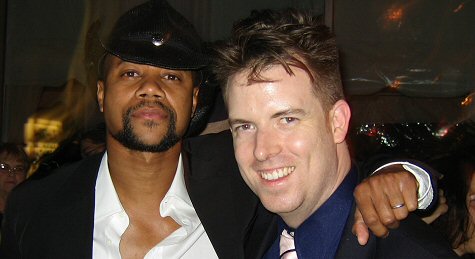
Pick Up The Mic director Alex Hinton (r.) and Cuba Gooding at a party for Hinton’s film, known in festival circles as an explosive documentary on the world of queer hip-hop, on the penthouse floor of the Manulife building — Sunday, 9.11, 11:50 pm. Producer Steve Nemeth (a good guy) was there, and Jeff “the Dude” Dowd and Mickey Cottrell invited me, and the view…

…of the Toronto nightscape was awesome — Sunday, 9.11, 11:35 pm.

Charlotte Rampling, easily the most alluring and delectable woman I have gazed upon so far at the Toronto Film Festival (and that covers a lot of hotties). In town to promote Laurent Cantet’s Heading South (Vers le Sud), in which she costars, Rampling was sitting at a party thrown on Monday, 9.12, by Catherine Verret and the French Film Office. The location was Prego, at 150 Bloor Street.

Jeff Stanzler, the very sharp and engaging director-writer of Sorry Haters, at IFC pizza party at Prego thrown from 5 to 7 pm on Monday, 9.12. Haters‘s next festival showing is on Friday evening, 9.16, at the Cumberland.

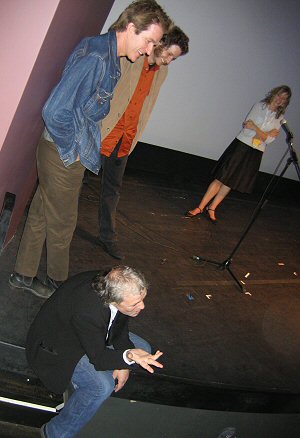
A post-screening discussion of Abel Ferrara’s Mary at Isabel Bader theatre on Sunday evening. Ferrara sat on the edge of the stage and let go with his usual raspy-voiced moody-genius colorful-downtown-guy number as he answered questions. Costar Matthew Modine stood directly behind Ferrara. Standing next to Modine was the film’s editor, Langdon Page.

The War Within director and co-writer Jeff Castelo, about a young Pakistani guy whose plan to blow himself up as part of an attack on New York City is re-examined at the 11th hour. Castelo grew up in Mountainside, New Jersey, which is walking distance from my hometown of Westfield, N.J. Pic was taken at HDNet/Magnolia Films breakfast at Toronto’s Windsor Arms hotel — Monday, 9.12, 8:40 am. (Notice the partially shadowed features of Bubble director Steven Soderbergh, sitting behind Castelo and to his left.)

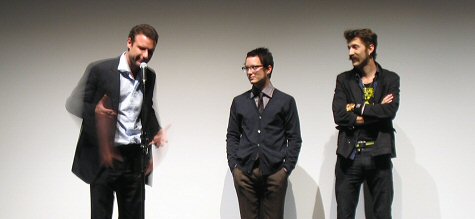
During the q & a that followed Monday evening’s public screening of Liev Schrieber’s Everything is Illuminated, a broadly played road movie about a young Jewish American lad (Elijah Wood) visiting the Ukraine to commune with his family’s roots and history. That’s director-writer Schreiber standing at left in front of the mike, with Wood and costar Eugene Lutz to the right.

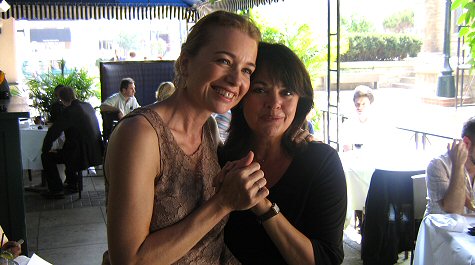
Karen Young (l.) and Louise Portal, costars with Charlotte Rampling in Laurent Cantet’s Heading South, at Monday’s French Film Office party at Prego — 9.12, 12:45 pm

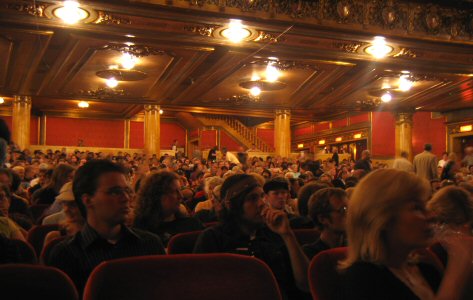
I realize I just ran a shot of the Elgin theatre prior to a screening last weekend, but here’s another one…taken just before Monday afternoon’s showing of Michael Haneke’s Cache (a.k. a., Hidden) — 9.12, 2:55 pm

Master Builder

Sydney Pollack’s Sketches of Frank Gehry, which I caught yesterday at a public screening at the historic Elgin theatre, is a stirring, hugely likable portrait of the most daring and innovative architect of our time.
As corny as this sounds, Sketches left me with a more vivid feeling of celebration and with more reasons to feel enthused and excited about life than anything I’ve seen so far at this festival.


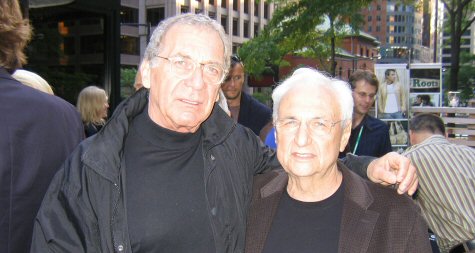
Director Sydney Pollack, architect Frank Gehry at Saturday afternoon’s cocktail party for Sketches of Frank Gehry in downtown Toronto — 9.10, 6:25 pm.

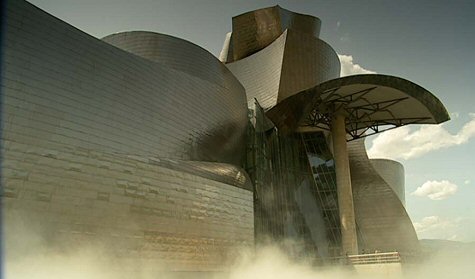
I knew a few things about Gehry before seeing this film, but not a whole lot. Now I feel like I know a few things. The man is the Pablo Picasso of architects. He’s a risk-taker who lives big and tosses the creative dice all the time and really goes for it. And I now know about his significant creations (the most famous being Disney Hall in downtown Los Angeles and a seaside museum in Bilbao, Spain), how he creates, who he mostly is, where he’s been.
Sketches is more than just a meet-and-understand-Frank-Gehry movie — it’s a contact high.
It’s a film that lets you into the head of a genius in a very relaxed and plain-spoken way, and it lets you share in the sense of being a person of Gehry’s magnitude — a guy who has created a kingdom out of a supreme confidence in his dreams, but at the same time someone honest enough to admit he doesn’t precisely know what he’s doing much of the time.
This is partly due to Gehry having been very open and unguarded with Pollack as the doc was being shot, and partly due to Pollack having sculpted this film in a way that feels more personal and congenial and relaxed than your typical portrait- of-a-noteworthy-person movie.
And yet Pollack doesn’t relent in passing along all the information we need to know about Gehry. It’s all done with total thoroughness and clarity of purpose.


Gehry’s Guggenheim museum in Bilbao, Spain.

I met and spoke with Gehry and Pollack at a nice cocktail party on Wellington Street late yesterday afternoon, courtesy of publicist Amanda Lundberg. What a pleasure to hang with these guys. I left the party feeling wise and steady and optimistic about everything.
Sketches of Frank Gehry will air on the PBS “American Masters” series in late ’06, but Pollack first wants it to play theatrically. This should happen. I can see this film being an essential “see” with people of a certain stripe, and yet a ten year-old kid could watch it and understand almost everything.
I can only repeat that the film is much more than just a sturdy documentary — it’s a profound turn-on. I’ve looked at Gehry’s buildings and designs — those weirdly bent and sloping pieces of steel and sheet metal and glass and what-have-you — but I never really “saw” them until yesterday.
There’s a wonderful edit right at the beginning of the film, which I won’t spoil by describing in too much detail. Suffice that it takes Gehry’s doodly drawings and brings them into full-metal aliveness in a single stroke.
There’s another delicious moment when Julian Schnabel is asked about Gehry’s press critics, and he refers to them as “flies on the neck of a lion…they’re the sort of people who complain that Robert Duvall’s character in Apocalypse Now is over the top.”


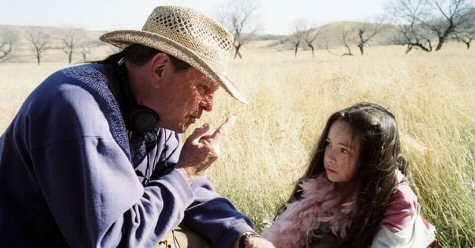
Terry Gilliam, Jodelle Ferland during shooting of Tideland

Just before the Gehry party I saw Terry Gilliam’s Tideland, which everyone I’d spoken to had warned me away from. (One guy told me it’s the worst film of the festival so far; another called it “unreleasable.”) This is why I wanted to see it, frankly. I like seeing films that everyone has trashed because I always seem to find something about them that I like or admire.
But not this time. Tideland feels Gilliam-esque (visually alluring and semi-pastoral at times with a Fisher King-like fetish for dust and grunge and curio clutter) but it was very tough going, for the most part. I’m talking about zero tension, funereal pacing, no engagement in the characters to the point of engendering hostility, a maddening sense of directorial indulgence, etc.
“It is [Gilliam’s] willingness to push his material to the extreme edge that makes him a true original,” says Toronto Film Festival director Piers Handling in the program notes. This signature has also resulted in two critically dumped-on movies in a row (this and The Brothers Grimm.)
Tideland is basically about the fantasy life of a little girl named Jeliza-Rose (Jodelle Ferland), a sire of junkie parents (Jeff Bridges, Jennifer Tilly) who both dead of overdoses, leaving the kid to imagine voices, play with tiny doll heads she wears on the tips of her fingers and explore her imaginings to her heart’s content.
She eventually becomes friends with a moron named Dickens (Brendan Fletcher) and his witch-like sister Dell (Janet McTeer), and now we have three wackos living in their dreams and acting weird for weird’s sake, or for Gilliam’s sake…whatever.


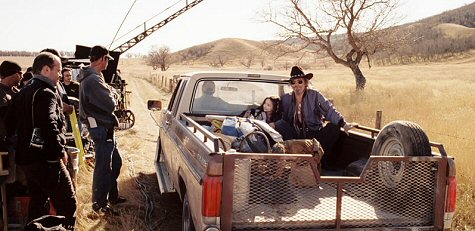
During shooting of Tideland.

I really can’t do this, I told myself. I can’t sit through another Terry Gilliam stylistic free-for-all masturbation movie. Others had the same notion. Two guys in front left somewhere around the 45 minute mark. Then another one left, and then another. I’ve seen this domino effect before. People say to themselves, “If all these guys are leaving, this gives me an excuse to leave too.”
I turned to Chicago Tribune critic Mark Caro, who was sitting to my immediate left, but he was toughing it out. I said to myself, “If Caro goes, I go….and I won’t feel as guilty about walking out on a Terry Gilliam movie.” Another guy left. A woman left. Caro was looking around and chuckling at the exodus, but he wouldn’t budge. So I decided to be a man and just do it on my own.
I next went to a warm, family-friendly dinner party thrown by Sony Classics. It was attended by the Capote crew (director Bennett Miller, actors Phillip Seymour Hoffman, Clifton Collins, Jr., and Catherine Keener, screenwriter Dan Futterman), Breakfast on Pluto director Neil Jordan and star Cillian Murphy, Why We Fight director Eugene Jarecki, and The Devil and Daniel Johnston director Jeff Feuerzig, along with the usual pack of journo-critic freeloaders.
Feuerzig was nice about my having thrown water on his film a couple of days ago. He asked me to see the entire film some day, and I promised I would.
What I actually said in my piece was that I don’t care for Johnson’s music, and without that affinity I couldn’t muster any interest in his emotional and psychological troubles. (Whereas I could when it came to Brian Wilson’s story in I Just Wasn’t Made For These Times because I love Wilson’s music.)


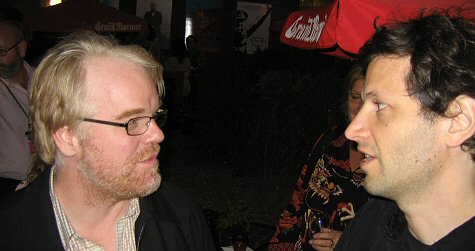
Capote star Phillip Seymour Hoffman (l) and the film’s director Bennett Miller at Sony Classics party at Margaret’s Brasserie — Saturday, 9.10, 7:35 pm.

It felt briefly odd to hear Hoffman speak in his own voice, which is sort of deepish and a tiny bit guttural, rather than his mincing Truman Capote voice, which everyone loves. The crowd at the public screening at the Elgin was obviously eating it up. There was strong laughter here and there. The “Bergdorf’s” line got a big response.
After the Sony thing ended I went to the Brokeback Mountain party and said howdy to Heath Ledger, Terry Gilliam (I didn’t bring up Tideland), producer James Schamus, film journalist Paul Cullum, New York Times reporter Sharon Waxman, the Focus Features publicity team and I forget who else.

Smash-up

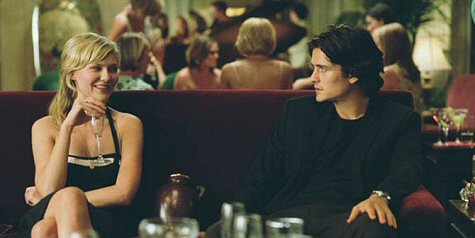
It’s a two-bit irony, but there’s no denying it: the professional failure that Orlando Bloom’s character goes through in the opening of Elizabethtown, which is massive and absolute, is not unlike the sense of almost total failure that seems to be enveloping the film and its director-writer Cameron Crowe right now, at the Toronto Film Festival.
Crowe is going to be trimming Elizabethtown down by several minutes, perhaps as much as 15 or 20, but there are so many things in this undisciplined movie that have seemed to so many people at this festival to be terribly wrong, that it seems damn near unfixable.
It could work for some people in the ticket-buying world, but this movie is for all practical purposes finished with the critics and journos who’ve been nothing but supportive of Crowe’s films in the past.


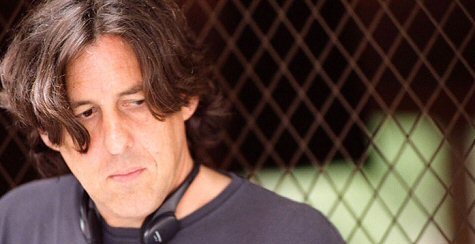
Elizabethtown director-writer Cameron Crowe.

A day and a half has passed since I saw Elizabethtown at Friday evening’s press screening, and I’m still shattered by the half-failure of it. So bummed and turned around, in fact, that I couldn’t summon the courage to attend the Elizabethtown press conference that happened about an hour ago. (It’s now about 12:20 pm.) I thought it would hurt too much to listen to what I was sure would be a display of forced gaiety.
Yeah, half-failure. This is a movie that stabs itself in the chest over and over during the first hour or so, but then it finds itself somewhere near the halfway point and becomes…well, not a movie exactly but a meditation about what it is in life that is joyful and soul-restoring, and which generally keeps us going.
Elizabethtown starts out on a note of futility and plans of bloody suicide, with Orlando Bloom ready to pack it in after a winged running shoe he’s designed has resulted in a loss of nearly a billion dollars.
Then he’s saved, in a way, by news of the death of his father. He forgets about “the plan” and flies to Kentucky to take care of the funeral arrangements. And on the way he meets a plane stewardess (Kirsten Dunst) who’s so oppressively perky and Jean Arthur-ish that…I’m getting ahead of myself and not completing my thought.
Which is this: if you forget about Elizabethtown not working as a real movie — minus most of the disciplines, character shadings and payoffs we’ve seen in Crowe’s previous films — if you forget all that stuff and just go with the meditative flow, it starts to work after the first hour or so.


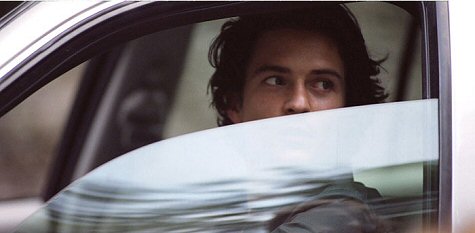
Orlando Bloom

You can’t really believe in it — the movie is way too un-tethered — but you can sorta roll with it and feel the vibe. I did, at least.
I was not having a miserable time at the end, and some (but not all) of the middle is pretty good. The problem, for me, is in the first hour, and I don’t know where to start, or even if I want to.
It’s not just that the crash-and-burn opening (Bloom saying “I’m okay” over and over, his girlfriend leaving him because he’s failed, every last person in the office eyeballing him) is too Jerry Maguire-ish. It feels completely artificial every step of the way, and keeps hitting you with stuff you can’t help but disbelieve or gag on.
I can’t catalogue everything that falls apart in this section, but for openers Crowe doesn’t tell us why the running shoe has died, or why the company didn’t do any product testing, or why Alec Baldwin, the big boss, would sink $900 million-plus into launching a single line…I didn’t believe a second of it.
When something awful has happened to you, people who know you don’t usually look directly at you. Certainly not in a group situation. They usually avoid eye contact because they don’t want to deal with your pain, because they’re afraid it might be catching.
The suicide stabbing device that Bloom nearly uses on himself seems ridiculous. With all the suicide options out there, who in the world would think of stabbing themselves to death with a big knife tied to a workout contraption?


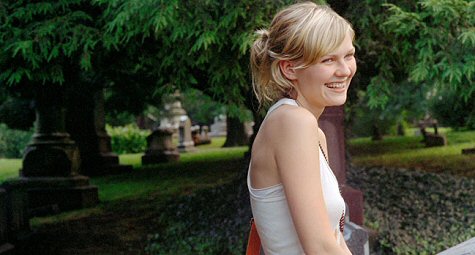
Kirsten Dunst

There has never been a flight from Seattle to Kentucky in the history of aviation with only one passenger on the plane.
There’s an argument with an Elizabethtown local about what color suit his deceased father should wear — they want brown, Bloom insists on blue. And then there’s a shot of the body in the coffin and Bloom’s father is wearing a suit of…dark gray!
When Orlando Bloom’s character finds out that his father has died and he flies off to the bluegrass state, there’s no real reason for his mom (Susan Sarandon) and sister to not come with him.
Sarandon, we are told, starts taking dance lessons right when she learns of her ex-husband’s death, and a mere four days later she’s found a teacher, had a lesson or two and learned enough to cautiously perform a tap-dance routine in front of the Kentucky family…pretty fast work!
I was in shock. I was in denial. I couldn’t accept that this movie was misfiring as badly as it was. But then, finally, the fog lifted. It’s not that Elizabethtown started being good but that it stopped making me groan, and the movie’s basic theme — what makes us stay in love with life? — started to find its feet.


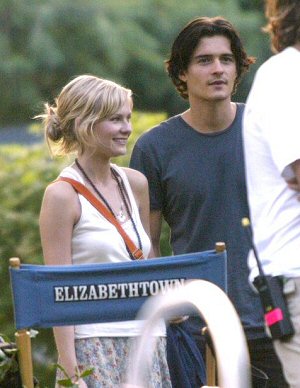
Dunst, Bloom on Elizabethtown set

Someone has written that “those magical moments that survive in memory from the weakest of Crowe’s works are simply nowhere to be found.” No — the last third is actually pretty good, or at least there’s a way to roll and groove with it. That is, if you follow my instructions.
It starts sometime after the all-night cell phone conversation scene (Bloom and Dunst never recharge their phones, and why should they?), and then it starts to grow and build. I actually liked the final road-trip sequence, which a lot of people have told me they couldn’t stand.
Bloom isn’t great in the role, but he’s not bad. The relentlessly positive perkiness coming out of Dunst starts to wear you down after a while. Bruce McGill, Alec Baldwin and Susan Sarandon are…okay. But nobody kills.
About 70 minutes into the film, a certain high-profile movie guy whom everyone knows got up and left the theatre. (He came back later, he says.) As he left to go out through the right-side tunnel, he very briefly turned and looked at the audience as if to say, “I’m a little bit surprised there are so many you continuing to sit there and watch this thing.”
About ten minutes later two major critics sitting a row in front of me got up and left. I’ve walked out on plenty of films but almost never one directed by a name-brand guy like Crowe. Wait a minute…I just walked out on a Terry Gilliam film yesterday. And I admit to being so miserable watching Martin Scorsese’s Kundun that I shut my eyes and fell asleep. But I was still shocked when I saw those two guys get up and bolt.

I wish there was some way for me to believe this movie isn’t dead, dead…deader than dead. But I really think it is.
The next chapter in the Elizabethtown saga will be upon us when an F.X. Feeney-like savior comes along and says, “No, no…you guys missed it! This movie is brilliant. It’s just that Crowe decided to take a big leap over the usual narrative devices and you guys were too constipated or conservative-minded to get what he was doing!”
I am not that guy, but I say again: forget about Elizabethtown doing what you’d like it to do (i.e., delivering the goods the way Billy Wilder used to) and just wait for the here-are-the-things- that-make-life-worth-living portions, which mostly unfold in the second half.