

New York Times reporter Laura M. Holson is not Chicken Little. She is, of course, on to something…a turn of the cultural screw that has seemed evident to me for some time…in her 5.27 article about younger folks being less and less interested in going to theatres to see movies. The headline says it all (“With Popcorn, DVD’s and TiVo, Moviegoers Are Staying Home”) and while the drooping box-office over the last few months is about more than just this phenomenon, the leisure-time paradigm does seem to be shifting. A lot of people just watch the tube, rent DVDs from Netflix, instant message their friends, futz around with video games and go to theatres only to see monster attractions like Star Wars. It’s terrible in a way (the death of communal movie-watching would constitute one of the coldest social winds to ever blow through this country), but it’s not fantasy…and Movie City News‘ David Poland should know better than to dismiss this as another dubious report from “the paper of Wreckord.” Of course, movie quality has always been a key factor in attracting or repelling audiences. It is hugely ironic, to say the least, that Holson’s story quotes Amy Pascal, the Sony Entertainment motion picture group chairman who greenlit the two McG Charlie’s Angels films — certainly among the most wretched, big-grossing, shit attractions of all time — as saying with an apparently straight face, “We can give ourselves every excuse for people not showing up — change in population, the demographic, sequels, this and that — but people just want good movies.”
Richard Linklater is making Fast
Richard Linklater is making Fast Food Nation into a fictional story? Come again? What’s next….French Women Don’t Get Fat as a thriller starring Jet Li? If the hoi polloi who can’t be bothered to read and who continue to patronize the sludge peddlers want to remain ignorant, why make a movie just to reach them? I don’t get the concept of inventing characters in order to lightly touch upon the ideas so thoroughly explored in the book. Then again, it’ll probably still be better than anything from George Lucas.
Kubrick Taschen
Instead of spending 10 bucks to see Adam Sandler clobber prison guards this weekend, think about dipping into your slush fund and coughing up a portion for The Stanley Kubrick Archives (Taschen). Take it home and bolt your doors and let it seep in, page by lustrous page.
I’m so in love with this thing that I packed it in my suitcase earlier this month and hauled it all the way from Los Angeles to New York, and then up to my parent’s home in Connecticut. I almost took it with me to the Cannes Film Festival. It’s my best friend, my rock `n’ roll, my lump-in-the-throat. I haven’t felt this way about a mere possession in a long, long time.
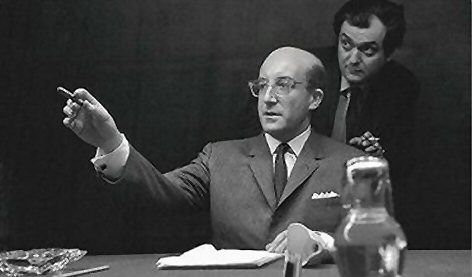
Stanley Kubrick (r.) directing Peter Sellers in his President Merkin Muffley guise on the set of Dr. Strangelove, or How I learned to Stop Worrying and Love the Bomb.
I’m not buying the claim on Amazon.com that this 544-page beast weighs 14.6 pounds. It felt like at least triple that when I was lugging it around Kennedy Airport.
The cost weighs pretty heavily too. 200 dollars, according to the Taschen website. But if you’ve ever thought about laying down serious coin for a first-rate coffee-table book, this might be the deal-maker. Besides, you can get it on Amazon for only about $125. I’ve blown $125 on things that I wasn’t all that thrilled about the morning after. I know I’m going to feel good about having this book twenty years from now.
< ?php include ('/home/hollyw9/public_html/wired'); ?>
Of course, you have to be a fool for Kubrick’s films in the first place. You have to get the Kubrick thing altogether, which means not just worshipping Paths of Glory or Dr. Strangelove or admiring most of Barry Lyndon, but also coming to terms with Eyes Wide Shut, which wasn’t easy at first but I got there.
I did this by facing up to the fact that resistance was futile. I’ve watched that red-felt pool table scene when Sydney Pollack explains the facts to Tom Cruise over and over, and I don’t even know why exactly…it’s like voodoo.
I presume this same susceptibility has enveloped most of the readers of this column.
The Archives text — articles, essays, interview excerpts, all kinds of data — has been edited and assembled by Alison Castle. It’s all smart, elegant and informative stuff, but this is par for a book of this size and scope from Taschen, the Rolls Royce of prestige publishers.
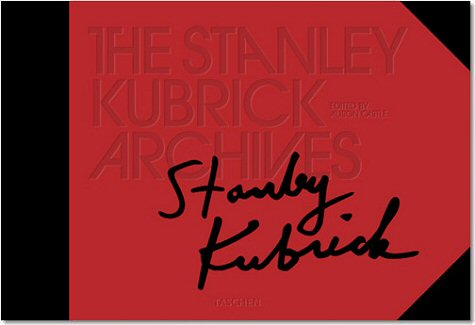
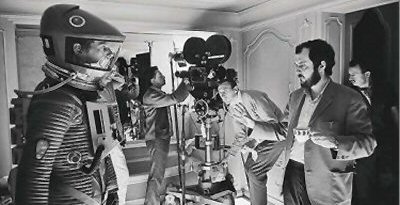
It’s the purely visual stuff that does it to you, in a strategy that mirrors that of Kubrick’s films. There are something like 1600 images in this thing — 800 immaculate frame blowups from all the films, and another 800 behind-the-scenes stills and various “items” (drawings, script notes, letters), most of which have never seen before. Plus essays by Kubrick scholars Michel Ciment, Gene D. Phillips and Rodney Hill
There are two keepsakes in The Stanley Kubrick Archives that are nearly worth the price alone: a twelve-frame film strip from a 70mm print of 2001: A Space Odyssey, taken from a print in Kubrick’s private vault, and a CD containing a 70-minute audio interview with Kubrick by Jeremy Bernstein in 1966…when Kubrick was at the summit of his powers.
All through my first reading I was feeling envious of Castle, who was given complete access by Kubrick’s widow, Christiane, and his longtime producer and brother-in-law, Jan Harlan. What an amazing job she had for two or three years.
All those details, all that minutae…and she and the Taschen editors only got one little thing wrong. I’m referring to a photo taken on the Spartacus set that identifies costar Rudy Bond (who played a loud-mouthed gladiator, although for some reason this role isn’t listed on his IMDB page) as the film’s producer, Edward Lewis. There’s a very slight chance I’m wrong about this (Lewis may have been a dead ringer for Bond), but I doubt it.
This is a spa book…something to sink into and be replenished by. And yet it’s not quite the ultimate down-to-the-bone Kubrick book of all time. It’s more the ultimate Kubrick massage…a thinking person’s pleasure cruise…a first-class voyage into a very sumptuous and particular world.
It’s been called the most comprehensive book on Kubrick thus far. It is that, but in a selectively affectionate way.
Is it the most penetrating exploration of who Stanley Kubrick really was, and what his life and work finally amounted to, warts, missed opportunities and all? That’s not the intention here.
Does it explore the conflicts Kubrick had with Marlon Brando in the development of One-Eyed Jacks, which resulted in Brando firing him? I would have loved to have read something specific about this, but no.
Does it get into the specific clashes Kubrick had with Kirk Douglas over the making of Spartacus? Here and there, but not to any great detail.
The best books about artists should not only celebrate but dish some rude stuff here and there.
It’s been reported before that Douglas was offended by Kubrick’s pre-production suggestion that he, Kubrick, be given screen credit for Dalton Trumbo’s script, since Trumbo, it was assumed at the time, couldn’t be given this due to his blacklisted screenwriter status. (Douglas eventually gave Trumbo this credit, which helped to end the blacklist era.)
Was this the only reason that Douglas referred to Kubrick during a 1982 interview I had with him as “Stanley the prick”? Douglas was famously egotistical and a scrapper, but I always wanted to know more about his and Kubrick’s relationship.
I guess what I’m saying is that Archives would have been a tad more interesting if Castle and Kubrick’s family hadn’t been so fully committed to the late director’s perspective and had brought in a few naysayers or nitpickers for added flavor.
Does it take a hard look at Kubrick’s fastidious, increasingly isolated way of living and working, removing himself more and more from life’s rough and tumble as he got older…more exacting, more of an aesthetic unto himself? Again, not the shot.
Does it ponder the regrets and might-have-been’s and shortfalls? Somewhat, but family-sanctioned tributes are never about tough love.
It would have steered in this direction if I had been the editor. Not to take Kubrick down (I’m as much a fan as Castle or anyone else on the team) but to explore the ironies more fully. I’m saying I would have zeroed in on the paradoxical lesson of Stanley Kubrick’s life and career, which is that absolute creative control can have its downside.
The truth is that the more he became “Stanley Kubrick,” the more he ate his own creative tail. Kubrick became powerful off the success of Dr. Strangelove and 2001: A Space Odyssey in the 1960s. This led to the carte blanche support he enjoyed from Warner Bros. starting with the making of A Clockwork Orange, which in turn allowed him to follow his intrigues to his heart’s content. But this became both his salvation and his trap.
This is an old tune with me, but as watchable as his movies are and always will be, the more remote and mercurial Kubrick became the more rigidly mannered his films were. This is why I’ve always been more of a fan of his work period from The Killing to A Clockwork Orange than the last 24 years of his career, during which he produced only four films — Barry Lyndon , The Shining, Full Metal Jacket and Eyes Wide Shut.
I realize that the emotional bloodlessness of Barry Lyndon is partly what makes it a masterwork, but you can’t tell me Kubrick’s personality wasn’t at least a partial ingredient in this.
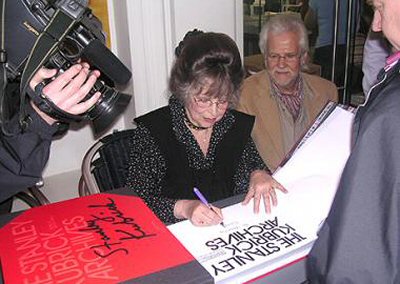
Christiane Kubrick signing copies of The Stanley Kubrick Archives a few days ago in London. Her brother Jan Harlan, who produced Kubrick’s later films, sits to her left.
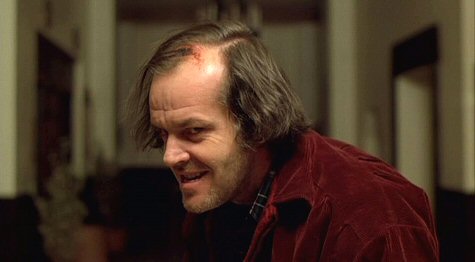
The opening 20 or 25 minutes of The Shining are among the spookiest ever captured in any film (that interview scene between Jack Nicholson and Barry Nelson is sheer perfection) but the very last shot, the one that goes closer and closer into that black-and-white photo of Nicholson’s Jack Torrance celebrating at an Overlook Hotel black-tie ball in the 1920s, is metaphysical claptrap. It’s a terrible ending.
(I was one of the few who saw a version of The Shining with an excised scene between Nelson and Shelley Duvall that comes right before this shot — Kubrick cut it before the film went into general release. I don’t have the book with me as I’m writing this, but I don’t think it makes any mention of this last-minute edit.)
(And while we’re on the subject, it would have been really special if the book had included frame blowups from the reported five minutes or so from 2001‘s “Dawn of Man” segment that Kubrick trimmed out just after a critics preview. But it doesn’t.)
The labored dialogue in the Vietnam portions of Full Metal Jacket (like “I say we leave the gook for the mother-lovin’ rats” or “Am I a heartbreaker? Am I a…whoo-hoo!..life-taker?”) makes Jacket feel like some kind of stage production rather than something actually going down in that war-torn region in the late ’60s. I read somewhere that some of the actors (Adam Baldwin, for one) bitched behind Kubrick’s back about this, or maybe to his face…I don’t precisely recall.
And yet that final battle sequence (going after that female Vietcong sniper in Hue) is breathtaking.
Don’t get me started on Eyes Wide Shut, but Kubrick’s belief that he would get an R rating (which he was contractually obliged to deliver) for that mansion-orgy sequence footage indicated a man who had stopped taking the pulse of things outside his country estate.
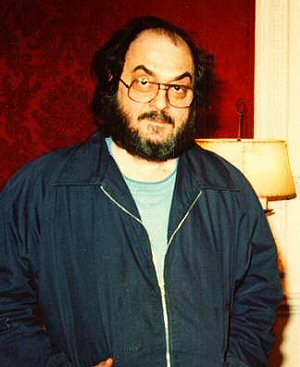
Kubrick at his home in January 1984, in a snap taken by a friend.
And yet for a guy hooked on visual fastidiousness and an increasingly misanthropic view of human affairs, Kubrick nonetheless made films that were tantalizing and seductive….each one a feast.
There’s a Kubrick quote in this book that I’m paraphrasing here, which is that the final measure of lasting motion picture art — all art — lies in the emotional.
It comes down to simple visual pleasures…the thought-out, strongly fortified kind that has led me to watch the Barry Lyndon DVD 15 or 20 times, even thought I don’t care very much for the funereal tone of the film’s second half. I sit through it because I love the Lord Bullington duel sequence and the final epilogue card that states, “Rich or poor, happy or sad, they are all equal now.”
I wouldn’t want to suggest that The Stanley Kubrick Archives is too softball. It is what it is, and that’s a hell of a thing.
The second half takes you in to Kubrick’s deliberative mind more thoroughly (i.e., more personally) than anything I’ve read. From the perspective of first-hand creative immersion, of recreating a world as the artist himself tried to know it and lick it as best he could, it’s one of the finest books on a film director ever published.
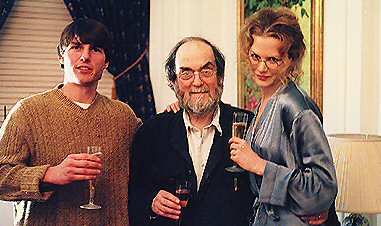
Tom Cruise, Stanley Kubrick, Nicole Kidman on the set of Eyes Wide Shut. It never occured to me before reading this book that Kubrick was on the short side, or shorter than Cruise anyway.
Slightly Gentler Neil
I was so traumatized by the weakness of the dollar during my stay in London last Saturday through Tuesday that I was having anxiety attacks the whole time. I did a lot of speed-walking and visiting different internet cafes and questioning my dumb impulsiveness in flying there in the first place. I didn’t eat anything except fruit and coffee and fast food….awful.
And yet in the face of this I decided last Monday night to see Neil Labute’s Some Girls, which opened a day or two later. I’d missed Labute’s last two, Fat Pig and This Is How It Goes (which both played in New York), as well as The Mercy Seat and The Distance From Here, which I didn’t even know about until I read the program. I felt I needed to catch up.
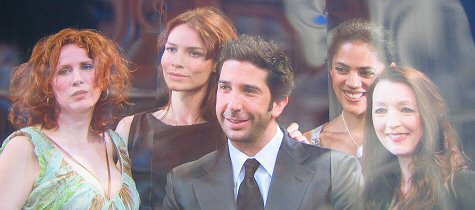
Some Girls costars Catherine Tate, Saffron Burrows, David Schwimmer, Sarah Tate, Lesley Manville.
And I wanted to see how former Friends star David Schwimmer, who began on the Chicago stage, would handle himself in the lead role. Verdict: he’s relaxed and assured and does quite well.
He’s playing a nominally sensitive short-story writer who’s run away from relationships all his semi-adult life, and is now feeling a bit guilty about this as he prepares to get married. So he pays a visit to four ex-girlfriends in four different cities to talk things over and see if any of them are still pissed about anything…anything at all.
He’s really looking to be forgiven or at least hear that he’s not so bad. This doesn’t happen. He gets a good stiff shot of reality from each ex.
Labute’s plays and films are usually about what pigs or weaklings men are in their relationships with women, and in this light the dealings in Some Girls aren’t as searing or corrosive as usual. It’s not lacking in emotional bruisings, but it’s not quite mild-mannered either.
And Schwimmer’s character makes an effort to at least talk a sensitive game when he catches up with the women. But who and what he really is — a serial escape artist — comes through soon enough, and at the end you feel for his young fiance (whom we never meet) because you know what she’s in for.
The one-act play is funny here and there, briskly paced (at roughly 100 minutes) and sometimes very biting. A moderately enegaging piece. But it doesn’t build or develop all that excitingly and it basically leaves you with a “yeah, not bad” reaction. Is it a movie? No, but maybe an HBO or a Showtime thing.
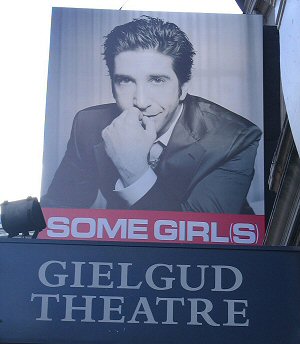
Schwimmer’s first visitation is in Seatlle with Sam (Catherine Tate), whom he dropped just before the senior prom in high school. Married to a local guy who works in a food store and raising kids, she’s still riled about what Schwimmer did (especially his having taken another girl to the prom) and having her emotions stirred.
Then there’s Tyler (Sara Powell) from Chicago, a randy easygoing type who needs a little time to remember what a bastard Schwimmer was to her…and then the anger catches fire.
In Boston he pays a call on Lindsay (Lesley Manville), a married woman he had an affair with behind her busband’s back, and who is also quite angry and looking for revenge.
Finally there’s Bobbi (Saffron Burrows) from Los Angeles, who is hurt but still cares for him…although she’s too smart and proud to open up a second time, even when he tells her she’s the love of his life.
The actresses are all sharp and on top of their roles, and each scene deftly reveals a surprise or two about their past relationship with Schwimmer. LaBute is a gifted writer and psychologically shrewd, but Girls is basically laying out Schwimmer’s history without adding anything urgent or present-tense to it.
Randomly
I was so upset by London I decided to get back to States as quickly as possible. That meant flying Easy Jet from London to Amsterdam for the connection back home, and since I had a few hours to kill I decided to train into town and look around.
I don’t get high so the whole cannabis side of things didn’t hold any appeal, but it’s mildly startling to be in the Abraxas Cafe and see the wide variety of hallucinogenic brownies being sold. Amsterdam is cool but English is spoken so widely and there are so many Brits and Americans running around that the exotic appeal feels diminished for me.
It’s obviously more than just a party town for stoners, but that’s what it felt like during my three-hour visit. Stoners and flower markets (what exactly do you do with a tulip?) and prostitutes and Burger Kings.

Southern sector of Hyde Park near Lancaster Gate — Sunday, 5.22, 5:50 pm.

McDonald’s delicacy available primarily to Londoners.
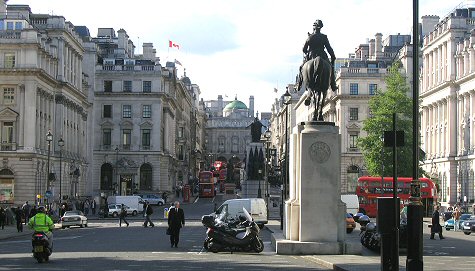
Four or five blocks due south of London’s Piccadilly Square — Monday, 5.23, 4:45 pm.

Near London’s Sussex Gardens — Sunday, 5.24, 2:35 pm
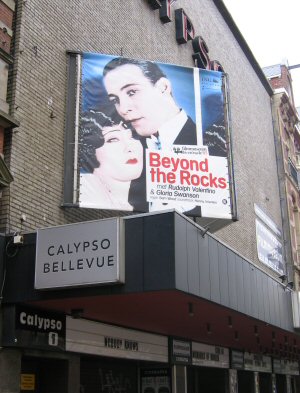
Valentino and Swanson at Amsterdam’s Calypso Bellevue — Tuesday, 5.24, 3:10 pm

Amsterdam — Tuesday, 5.24, 5:05 pm.
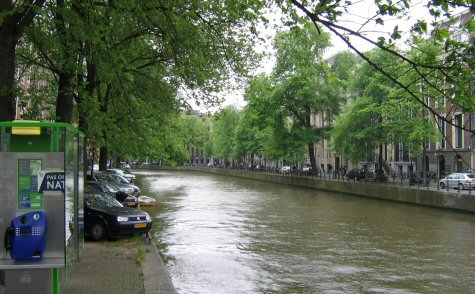
Amsterdam — Tuesday, 5.24, 3:50 pm.

Amsterdam — Tuesday, 5.24, 4:10 pm.

Tuesday, 5.24, 10:10 am.
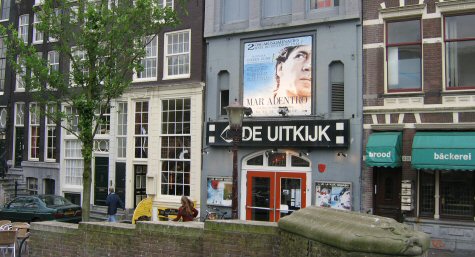
Canal-adjacent theatre in Amsterdam — Tuesday, 5.24, 3:05 pm.
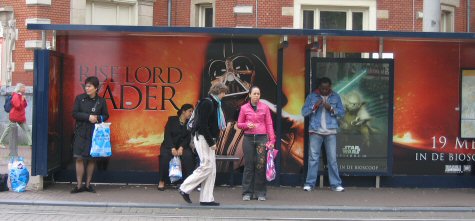
Amsterdam commuters — Tuesday, 5.24, 3:20 pm.

Near London’s Sussex Gardens — Sunday, 5.22, 2:15 pm

Residential street near London’s Sloane Square — Sunday, 5.22, 4:20 pm.
I had begun to entertain
I had begun to entertain the soothing notion that with wi-fi being so commonly available that all the technical mucky-muck that used to be part of getting a new cyber hookup in a new location (like, for example, my modest new swap pad in Williamsburg, Brooklyn, where I’ll be parking it this summer) was a thing of the past. Nice dream. The last day and a half has reminded me that tech hassles are as constant as the moon, not to mention huge gulpers of time…especially when you’re on the receiving end of technical “support” provided by those Indian guys. You know who I mean…those extremely polite, undeniably fastidious, collosally dim professionals who do their part to make life a living hell for so many of us, courtesy of those cost-saving dedicated phone feeds from the land of Gandhi. One of these guys in particular is the main reason why the column is so late today (i.e., Wednesday, 5.25). I don’t need to tell anyone this and nobody likes a whiner, but these guys are a menace. Please send in your own horror stories about tech support from Bombay…I’ll run some on Friday.
In a 5.21 Cannes Journal
In a 5.21 Cannes Journal entry, New York Times critic A.O. Scott wrote that he was “disheartened” by Anne Thompson’s also-recent Hollywood Reporter column which reported/asserted that U.S. moviegoers don’t know and almost certainly won’t care about this year’s big Cannes attractions, much less who their creators are. Her column quoted indie distributors like Warner Independent’s Mark Gill and ThinkFilm’s Mark Urman expressing this realistic (although certainly pessimistic-sounding) view. Scott complained that Thompson’s piece “seemed almost intended to perpetuate the situation it pretends to describe. If you assume that American audiences aren’t interested in certain kinds of movies, and therefore don’t release or write about those kinds of movies, then your assumption will of course appear to be proven right.” The same principle applies to all the whoopin’ and yellin’ over the $300 million-plus earned worldwide thus far by Star Wars: Episode 3 — Revenge of the Sith. If Hollywood-covering editors and journalists were to openly practice advocacy journalism (which of course they don’t — they practice it covertly), they would refuse to report any and all box-office figures for those especially pernicious, grossly disappointing, spiritually polluting movies that come along every so often, like Sith. This is fantasy, of course — you can’t not report about massive box-office earnings anymore than you can omit reporting on huge Asian tsunamis. But one or two local news channels in Los Angeles have talked about refusing to run video coverage of freeway chases and New York Daily News columnist Lloyd Grove has refused to run any more items about Paris Hilton, so there’s some precedent. As God is my witness, showbiz salutations about how the Sith grosses are good and healthy things and that the public has finally and wondrously awakened from its months-long slumber with the release of Sith, blah, blah…these exclamations are feeding the underlying malignancy. To me, these box-office reports seem to almost perpetuate the situation they’re pretending to dispassionately describe. If you assume that American audiences are hugely delighted and/or feel profoundly fulfilled about having seen Revenge of the Sith, and therefore you write about the statistical box-office figures that confirm this assumption, then your assumption will of course appear to be proven right. I have said this over and over in years past, but millions upon millions of easily seducable slackers lining up to see a blockbuster can, depending on the dynamic, mean (and should mean) absolutely nothing in the greater scheme of things. (Which of course if where we should all be living in our heads…in Greater Scheme Land.) What does it mean when a dust storm blows across Kansas and everyone covers their faces and stays inside their home(s)? Is this something to jump up and down about, examine from this and that angle, compare statistically to previous dust storms, and talk about the various ramifications with dust-storm experts like Paul Dergarabedian? People can go to see Sith by the mega-millions and a tip of the hat to those who have shrewdly profited from this, but in a better, smarter and more spiritually focused world, editors and journalists would try to report this dispiriting phenomenon with a bit more perspective…and without quite so much of a “yea, team!” cheerleader tone.
It’s 2 pm on Sunday
It’s 2 pm on Sunday afternoon in London, and it looks like it’s going to rain. Unusual! If any London readers are in the mood for a pint or two sometime this evening, write me this afternoon and we’ll figure something out. I’ll be checking mail off and on all day.
Flash! You’re reading it here
Flash! You’re reading it here dead last! The surprise Palme d’Or winner did turn out to be Jean-Pierre and Luc Dardenne’s L’enfant (The Child) after all…which I was told might happen just as I was unplugging at the American Pavillion on my final day in Cannes (i.e., Saturday). Hearty congrats to (a) Jim Jarmusch’s Broken Flowers for copping the Grand Prize, (b) Tommy Lee Jones for taking the Best Actor award and Guillermo Arriaga winning the Best Screenplay trophy for The Three Burials of Melquiades Estrada, (c) Hidden‘s Michael Haneke for winning the Best Director award, and (d) Free Zone‘s Hanna Laslo for being named Best Actress. Good calls all around.
I couldn’t file when I
I couldn’t file when I got to London last night due to my lodging situation being up-ended when I arrived at the hotel, and then having to scramble around town betwen 11pm and midnight for a place I could afford. The hotel I found (near Sussex Gardens) didn’t have Wi-Fi, of course. (Which is partly what makes places like this affordable.) And the nearby internet cafes start to shut down around midnight, so the hell with it. I walked around in the surprisingly chilly and windy night air and had a really delicious, super-greasy shawarma. I don’t take days off anymore — I take hours off. But it felt like peace.
Returned…
…to these shores late Tuesday night, and currently putting finishing touches to Wednesday’s column this morning, i.e., Thursday. Apologies to those who’ve come to expect a stricter adherence to the schedule.
Dead Beach
It’s straight-up noon on Saturday (5.21), and the aura of finality is everywhere. This is one totally flatlined film festival.
For 94% of the visiting journalists, I mean. Make that 96%. The locals are gearing up for the awards ceremony tonight, which I’ve never attended and probably never will attend.
I’m gone early this evening, which is unfortunate because there’s an opportunity to see the movies I missed (most notably the presumed Palme d’Or winner, Michael Haneke’s Cache) at the catch-up screenings on Sunday.

American Pavilion beach, looking westward — 5.21.05, 10:40 am.
But I’ve had it and I don’t care. I mean, I do care but the spirit rebels and suddenly you need to get the hell out of here.
In the unlikely event that Cache (a.k.a., Hidden) doesn’t win tonight, the surprise winner could be Jean-Pierre and Luc Dardenne’s L’enfant, about some low-life druggies taking care of a baby. I didn’t see this one either. I know, I know.
My favorites were David Cronenberg’s A History of Violence, Tommy Lee Jones’ The Three Burials of Melquiades Estrada, Gus Van Sant’s Last Days (because it’s stayed with me…what you feel and think during the watching of a film is only the half of it), Jim Jarmusch’s Broken Flowers (despite slight reservations) and Woody Allen’s Match Point (because of the great ending).
And I liked Brent Hamer’s Factotum, the Charles Bukowski film with Matt Dillon in the lead role.
< ?php include ('/home/hollyw9/public_html/wired'); ?>
And I loved watching East of Eden last night at the Salle Bunuel. It feels a bit too tidy and 1955-ish at times, but James Dean was a prince and a genius, Jo Van Fleet gives one of the scrappiest female performances ever put on the screen, and Julie Harris’s acting in this Elia Kazan film still breaks my heart.
I never got around to writing anything about Amos Gitai’s Free Zone, which I found half-absorbing (it certainly isn’t the bad film that the Hollywood Reporter guy said it was). I loved the driving-through-Israel-and-Jordan footage, and Natalie Portman gives a performance that’s as grounded and filled out as she was in Closer.
No more filing until Monday or maybe even Tuesday. There’s plenty of stuff to get into that’s been piling up over the last eleven or twelve days.
The Why Of It
I saw Wim Wenders’ Don’t Come Knocking on Thursday morning, and I’m sorry to say I was profoundly unmoved.
I’m sorry because I’ll always admire Wenders for his exceptional films (The American Friend is still my all-time favorite, followed by Wings of Desire) and for the auteurist streak that used to be his handle, but this, lamentably, has ebbed and flowed according to the quality of the project in recent years.
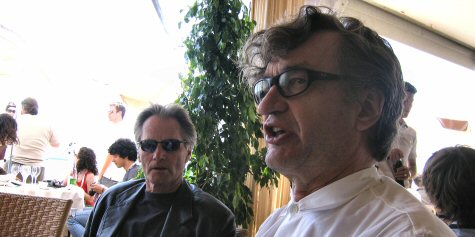
Don’t Come Knocking screenwriter-star Sam Shepard (left), director Wim Wenders at Sony Classics press luncheon at Carlton beach cafe — 5.20.05, 2:10 pm.
Wenders and screenwriter-star Sam Shepard last collaborated together on Paris, Texas (’84). That was a fairly strong, deservedly admired film, and I suppose they thought they could make lightning strike twice, or at least create a few meaningful sparks.
“We decided to fuck with it again,” Wenders said earlier today (5.20) during a press luncheon.
Like Jim Jarmusch’s Broken Flowers, Don’t Come Knocking is about a middle-aged guy on a downturn cycle facing up to all the crap in his life by reconnecting with a woman he used to love (or at least have sex with) in his youth, and also looking to find and perhaps get acquainted with a fully-grown son he never knew he had.
Trust me, Jarmusch’s film is a far, far better thing.
Shepard’s Howard Spence is an alcoholic, self-destructive actor who’s on his way down fast. The film begins with Howard hightailing if off the set of his latest film, a western being directed by a journeyman type in his late ’70s, played by George Kennedy.
This put me off right away. Guys who look like George Kennedy direct television shows…maybe. If they used to be feature directors and their rep carries some weight. But mostly they don’t direct anything because the industry discriminates against white-haired guys of this age, so right away I was saying to myself, “Bullshit.”
I also don’t find alcoholics the least bit interesting, especially ones who walk away from paying gigs for no discernible reason other than the fact that the screenwriter has decided the character is a fool who’s going through a midlife crisis.
Howard stays with his mother (Eva Marie Saint) for a while, who sees right through his bullshit boozy behavior but feels no need to call him on it. She provides the inciting incident, 45 minutes into the story, when she tells Howard that he has a son by Doreen (Jessica Lange), his ex-wife (or ex-girlfriend…not that it matters either way).
Howard makes his way up to Butte, Montana, and meets up with Lange, and she points out his son Earl (Gabriel Mann), a local country music performer.
Earl is black-haired and hugely pissed off and averse to emotional exposure of any kind, which means, of course, he doesn’t want to know Howard. He’s one of those guys given to throwing clothes and furniture out of his second-story apartment when emotions come to a boil.

Don’t Come Knocking costar Sarah Polley.
Howard’s mother has a scrapbook full of newspaper clippings about him, and his fame allows him to score with women he’s just met, but Earl, a 30 year-old, doesn’t know who he is. “What is he, an actor?” he says at one point.
The Cannes-based Hollywood Reporter critic wrote that Wenders and Shepard have yielded “a dry, spare, odd and oddly satisfying drama about a modern-day lonesome cowboy, lost in a desert of his own making, who seeks out salvation by seeking out those he left behind.”
Oddly satisfying? The movie is deeply aggravating. I was sitting there trying to decide when to leave. I wanted to see enough so I couldn’t be accused of missing most of it. I knew I was stuck there for a good 90 minutes or so, but I damn sure wasn’t going to sit through all 122 minutes’ worth.
To me, Knocking is not a Wim Wenders film. It doesn’t have his mood or visual signature or stylistic consistency.
It has an unfocused, shuffling-along attitude that feels way, way off. The script is sloppy and raggedy-assed, although there’s a good scene in which Lange tells off Shepard for being an irresponsible screwup.
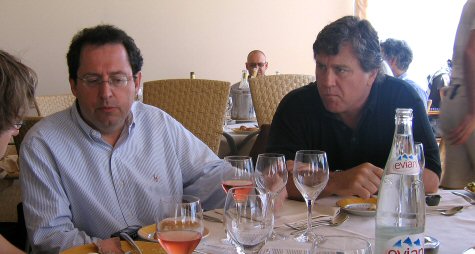
Sony Classics honchos Michael Barker (l.) and Tom Bernard — 5.20.05, 1:20 pm.
I asked Wenders to respond to a comment about his film written by New York Times critic Manhola Dargis and published today, to wit: “This deeply sincere film takes place in an American West that bears little relation to the real world, perhaps because that isn’t the America with which [Wim] Wenders first fell in love.
“Like other artists and intellectuals from abroad, Mr. Wenders seems to have fallen for an America that mostly exists on Hollywood back lots and in rock ‘n’ roll lyrics, which probably explains why the romance has lasted so long.”
To this Wenders responded, “I have travelled around this country and gotten to know it better than any film critic I’ve ever met. I don’t think [Dargis] has ever been to Butte, Montana.”
I can’t write any more about this, but I had a swell time at the press luncheon and enjoyed speaking to Wenders and Shepard and costars Sarah Polley, Gabriel Mann and Fairuza Balk (who said I had “an interesting face,” which made me feel funny for some reason.)
I’m just sorry I had such a rough time with the film, and I’m hoping Wenders and Shepard do better next time.
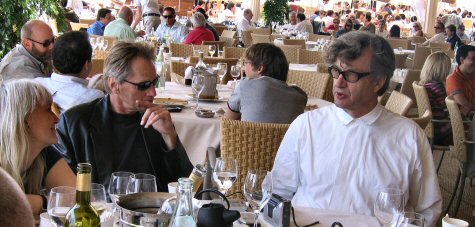
Shepard, Wenders — 5.20.05, 2:05 pm.
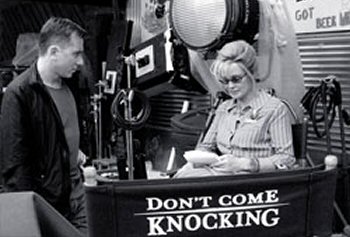
Don’t Come Knocking costars Tim Roth, Jessica Lange on set.

Exquisitely designed cappuccino cup, sipped from and remarked upon by Wim Wenders and yours truly during Knocking luncheon — 5.20.05, 2:20 pm.
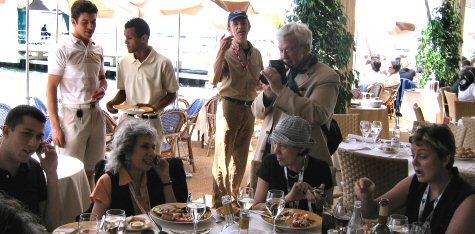
Roger Ebert (third from right, standing) snapping photos before start of Knocking luncheon. Variety critic Todd McCarthy (gesturing, wearing cap) stands to Ebert’s immediate right.
Respecting a Dead Guy
I’ve agreed not to wade into Tommy Lee Jones’ The Three Burials of Melquiades Estrada until 10:30 pm Thursday (Cannes time) and it’s only around 7 pm now, so I’ll have to write this a certain way.
I think it’s fair to say what other journos are saying, which is that they’re very admiring, and that some (like the Toronto Sun‘s Bruce Kirkland) are surprised at how smartly composed and compassionate and thematically rich it is.
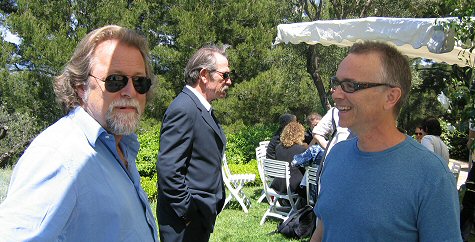
The Three Burials of Melquiades Estrada producer Michael Fitzgerald (left, avec beard), director-producer-star Tommy Lee Jones (center) and Toronto Sun critic-reporter Bruce Kirkland at Thursday’s press gathering at a wonderfully picturesque and soul-soothing villa in the hills above Cannes — 5.19.05, 12:35 pm.
Surprised because you never know what to expect from a first-time-out director **, especially when he’s a famous actor. It could have been indulgent or precious or half-baked.
But then Jones is a very intense, exceptionally bright, very passionate hombre, so his having scored with top-level journos shouldn’t be that surprising. Especially with Jones basing the film on an obviously thoughtful, time-shuffling script by Guillermo Arriaga, who wrote Amores Perros and 21 Grams.
I think it’s also fair to report that I attended an American Pavilion interview late Wednesday afternoon between Jones and Roger Ebert. Ebert made it clear he’d had a positive reaction to the film. He also asked if anyone in the audience had seen it, and when I raised my hand he asked me what I thought and I offered a thumbs-up gesture.
I don’t know if Melquiades Estrada is going to stand up against the supposed Palme D’Or favorites thus far, which are Michael Haneke’s Cache (which I missed last Saturday, and hasn’t, as far as I know, been shown since), David Cronenberg’s A History of Violence and Jim Jarmusch’s Broken Flowers.
It may (I say “may”) be received as more in the realm of being very good or worthy rather than masterful (there’s a prominent critic for a monthly who, according to a Texas-based critic, feels it falls apart during the second half), but I wouldn’t be surprised if the buzz is better than that.
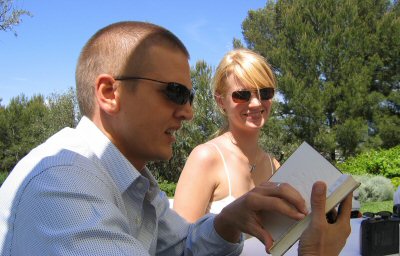
The Three Burials of Melquiades Estrada costars Barry Pepper and January Jones at press table, as Pepper reads from a diary-journal he wrote during production. In it he described Tommy Lee Jones as “a Southern badass with a ruthless work ethic and a heart the size of the Copper Canyon.”
The Three Burials of Melquiades Estrada is a modern-day tale set in western Texas and northern Chihuahua, Mexico. It deals with a ranch foreman (Jones), a border patrolman (Barry Pepper) and an illegal immigrant named Melquiades Estrada who works for Jones. The second half is a horseback-journey film about redemption and seeing through prejudices and imbedded attitudes.
It’s a film with a great deal of compassion and soul and a generally humanistic view of things. If you want your literary influences, check out Flannery O’Connor’s work and William Faulkner’s “As I Lay Dying.”
In the press kit, Arriaga says he wanted “to make a study in social contrast between the land that’s south of the Rio Grande river and the land that’s north of it. About what iron ies, injustices, glory, beauty and redemption you can find in this area that has its own character…something that cannot be imposed, something that has grown and evolved… something that cannot be controlled.”
Just before 11 am today myself and a few other journos (Kirkland, Stephen Schaefer, Desson Thomson, Harlan Jacobson, Shari Roman, etc.) were driven in a minivan from the Gray d’Albion hotel near the Croisette into the hills above Cannes, and eventually (the driver got lost) to a beautiful hilltop villa.
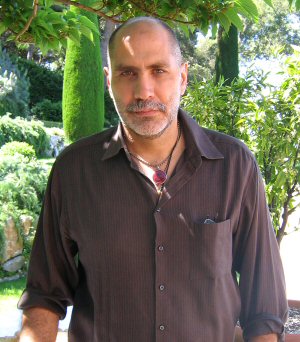
Guillermo Arriaga, hunting buddy of Tommy Lee Jones and screenwriter of The Three Burials of Melquiades Estrada (as well as 21 Grams and Amores Perros.
The purpose was to allow for a brief schmooze with Jones, Arriaga, Pepper, young co-star January Jones and producer Michael Fitzgerald (whose other ventures include Colour Me Kubrick and Sean Penn’s The Pledge).
Pepper said that Jones “has a very deep passion for strong visual composition and the poetry of words.” He read some passages from his on-set journal, and on one page he described Jones as “a Southern badass with a ruthless work ethic and a heart the size of the Copper Canyon.”
He mentioned two things that Jones told him before shooting a couple of scenes — “Keep it stupid simple” and “don’t do somethin’, just stand there.”
I mentioned to Jones, Arriaga and Fitzgerald that since seeing their film on Wednesday I’ve had trouble remembering the exact title. I like the earnest writerly sound of it — it doesn’t sound like your standard test-marketed title — but there is something about the name “Melquiades Estrada” that won’t stick in my brain, and I’m not trying to sound like a xenophobe when I say that.
Somebody asked Jones and Fitzgerald about the U.S. distribution prospects, and Jones said that “the wheels of commerce are turning as we speak.”
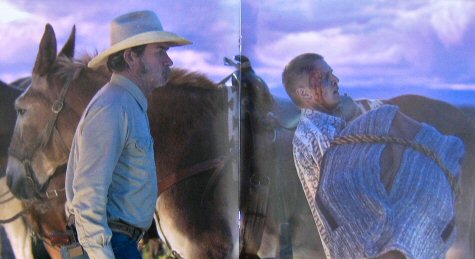
Tommy Lee Jones, Barry Pepper in scene from The Three Burials of Melquiades Estrada, taken straight from an image in press book (i.e. laid flat on the rug at the American Pavilion, and then cropped and refined).
Jones was asked to articulate the film’s themes, but he’s not what you’d call a press-junket gabber. Aside from calling it “a journey toward redemption,” he said, “You’re invited to read into it anything you deem appropriate…all you want, all you want.”
Pepper said that Jones read aloud from the book of Ecclesiastes during shooting. Jones was later asked why. “Because I like the book,” he replied.
His philosophy of directing actors, he said, is the same attitude he brings to handling a horse, which is “never ask a horse to do what it can’t do.”
Jones was asked what doesn’t work on the setas far as directing is concerned. “Tantrums are not constructive,” he said. “Egotism is not, I think, a good thing.”
He said he’s long wanted to direct a film of Cormac McCarthy’s “Blood Meridian,” and was asked a few years ago by then-Sony chief John Calley to write an adaptation of it in script form. He delivered it a year later but “they said it was too violent,” he said.

View of Cannes and the Med from EuropaCorp-rented villa, the site of Thursday’s press junket for The Three Burials of Melquiades Estrada.
The session ended after an hour or so, and everyone was driven back to town.
A journalist I spoke to near the front of the Gray d’Albion said I should have snapped a photo of January Jones when she was eating a banana at our press table. He was struck by this act of consumption for obvious reasons.
A wafer-thin and very beautiful brunette woman who does interviews for French TV sat next to me in the van on the way back. She was dressed in a sheer white dress and smelled like jasmine mixed with musk.
I glanced at a printed itinerary she was holding in her hand, and I saw that she had three hair and makeup appointments set for today — one at breakfast, a second just after lunch and a third before going out this evening.
Numbers
There is no more time at all…none…but the caption says it all. I’ll try and amplify tomorrow morning:
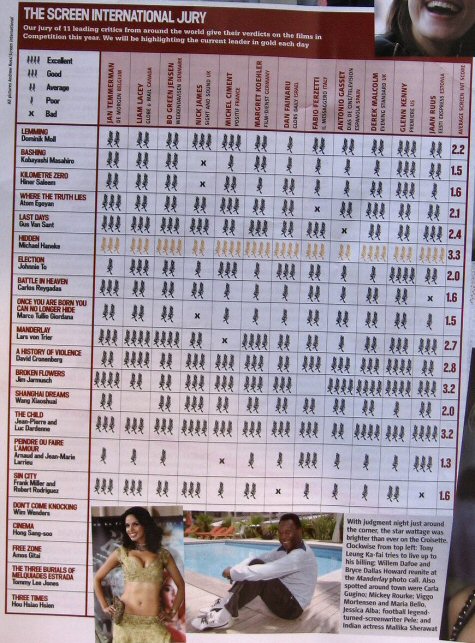
Screen International‘s poll of mostly European critics (and no Americans) still had Michael Haneke’s Cache (a.k.a. Hidden) at the top of the list of Palme d’Or contenders as of Wednesday, 5.18, in a graphic published in Thursday’s (5.19) issue. Notice that the Jim Jarmusch’s Broken Flowers is running a very close second. Tommy Lee Jones’ film was shown for the first time late Wednesday morning, and therefore didn’t figure. To what degree do these conclusions reflect the sympathies of the Palme d’Or jurors? I couldn’t say, but they do indicate what a lot of people I’ve spoken to myself are saying. Notice also that Pendre ou Faire L’Amour, which I walked out on, has the lowest ratings of all.
Beached!
I was taking a break yesterday (Thursday, 5.19) on the beach in front of the American Pavilion when I spotted two guys cruising along about 100 years out in the bay in some kind of watercar — an engine-driven car with tires and windshield wipers and everything else that floats and can be driven across the water.

Didn’t I see one of these in a James Bond film back in the early ’90s? Or in some Herbie or Love Bug remake from Disney?
Anyway, the two guys and their watercar started heading for the beach. Paddle, paddle…blub, blub, blub….so far, so good.
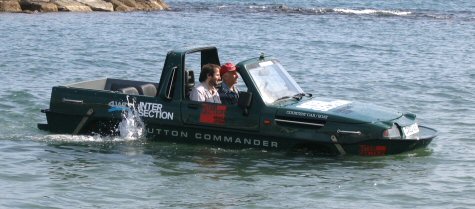
Then the tires hit the sand and they started spinning out. The slope of the beach is very gradual and slight, but the car couldn’t get any traction. They kept trying, accelerating, spitting water into the air ….failure.
The various onlookers on the beach began to laugh and joke with each other and point at the beached jalopy. Dumb invention! Back to the drawing board! How very quickly and suddenly the love and support of the public evaporates.

Fact
When I made my first trip to the Cannes Film Festival in ’92, topless women on the beach were a common sight. I used to love to stop for a minute or two and pretend to look at the water and sky and everything else except these women, and there were always several to gaze upon.

But nowadays it’s rare to see a bevy of women lying around topless. I noticed exactly two earlier today, and it’s very sunny and warm out. I think this signifies something. French culture is turning more covered and conservative, apparently…but why? This demands further thought. If anyone has any theories, please send them along.
Do you literally have to
Do you literally have to live in the U.S. to knock its values or criticize its culture or politics? David Cronenberg, a Canadian whose recently-screened A History of Violence addresses America’s shoot-em-up, fistifcuff tendencies, is quoted thusly by L.A. Times critic Kenneth Turan: “Does a fish know about water? Living in a tributary, not the ocean, [Marshall] McLuhan had a different perspective. The insights he had into America would not be possible to anyone living in America. Stepping away has a lot to do with it.”
A lot of press people
A lot of press people in Cannes have been doing their usual ranting against Lars von Trier for making another film critical of the U.S. (i.e., Manderlay) without having ever visited American shores. Certainly one needs to absorb a country’s culture first-hand to get a thorough understanding of what it’s about…but it also seems absurd to insist that a visitation has to happen before one can render a strong opinion about a country’s history with a film like…well, Manderlay. As von Trier told the Hollywood Reporter‘s Anne Thompson, “America dominates world culture” and “is a big part of our lives in my country. 60% of the main words in all the experiences of my life are American…I am an American, but I can’t go there to vote [and] I can’t change anything. That’s why I make films about America.”
“The general opinion of Revenge
“The general opinion of Revenge of the Sith seems to be that it marks a distinct improvement on the last two episodes, The Phantom Menace and Attack of the Clones. True, but only in the same way that dying from natural causes is preferable to crucifixion.” This from Anthony Lane’s pan in the current issue of The New Yorker. Hail to this fellow…his review is hilarious.